Introduction
The prevalence of type 2 diabetes and coronary heart disease is very high among South Asians all over the world, including the Netherlands.Reference McKeigue, Miller and Marmot1, Reference Middelkoop, Kesarlal-Sadhoeram, Ramsaransing and Struben2 Although the causes of this high prevalence have not yet been fully explained, they are known to be associated with an increased prevalence of traditional risk factors, that include insulin resistance as well as genetic and lifestyle factors. The high prevalence of insulin resistance is in turn associated with the characteristic body composition of South Asians: comparative studies have shown that for a given body mass index (BMI) South Asians have a higher percentage of body fat compared with white Caucasians and African-Americans, but have lower muscle mass. This latter phenotype is known to be associated with an increased incidence of insulin resistance, hypertension, hypercholesterolemia and coronary artery disease.Reference Gujral, Pradeepa, Weber, Venkat Narayan and Mohan3
Previous studies have shown that the characteristic body composition of South Asians may (at least partly) originate during fetal development: compared with white European neonates, South Asian neonates born in rural and urban areas in India (Pune, Mysore, Davangare) have low birth weight, small abdominal viscera and low muscle mass (i.e. they are thin). Furthermore, they have a tendency to accumulate subscapular fat. Subscapular fat is a depot of central fat, high levels of which are associated with an increased risk of insulin resistance. This phenotype is referred to as the ‘thin–fat’ phenotype.Reference Yajnik, Lubree and Rege4–Reference Kulkarni, Muthri and Kulkarni7 In addition, cord plasma levels of insulin in South Asian neonates are higher than those in white British neonates, also after adjusting for birth weight.Reference Yajnik, Lubree and Rege4 So the thin–fat insulin-resistant phenotype of South Asians is already present at birth or even before birth.
It is well known that genetic factors influence body size and composition. Lifestyle factors are also important. This is illustrated by studies in rural and urban areas of India describing the importance of maternal nutritional status before and during pregnancy on determining fetal body composition.Reference Rao, Yajnik and Kanade8, Reference Kanade, Rao, Kelkar and Gupte9 South Asians who have left India have undergone changes in living circumstances and lifestyle. In most cases, living conditions and socio-economic status have improved. We hypothesize that since such improvements have a positive effect on maternal nutritional status, neonatal anthropometry will be more favorable in this group. However, in a previous study we also found the thin–fat phenotype to be present in migrant South Asian neonates living in Surinam (South-America).Reference Van Steijn, Karamali and Kanhai10 Studies in the UK report similar findings: UK-born infants of South Asian descent had greater adiposity than white infants of British descent. This conclusion was based on measurements of birth weight and skinfolds.Reference Bansal, Ayoola and Gemmel11, Reference West, Lawlor and Fairley12
The objective of the present study was to assess whether the thin–fat insulin-resistant phenotype is also present in migrant South Asian neonates, born in a large city (the Hague) in an industrialized, prosperous country (the Netherlands). South Asians in the Netherlands are an unusual group of South Asians because they have experienced two migrations. To begin with, between 1873 and 1916 about 34,000 South Asians migrated from India (Uttar Pradesh and Bihar) to Surinam, a colony of the Netherlands, to work on the plantations. The individuals recruited to work on the plantations were predominantly strong and healthy men and women and only the strongest and healthiest men and women survived the long journey from India to Surinam. A ‘healthy migrant’ selection is therefore very likely in this special group of South Asian migrants. The second migration took place after the independence of Surinam in 1975 and the political turmoil in 1981, following which many South Asians migrated to the Netherlands.Reference Choenni and Adhin13 In this study, we wanted to assess whether the thin–fat phenotype is preserved in this unusual group of ‘healthy’ South Asians in the Netherlands.
Methods
Participants
Between January 2007 and March 2011, pregnant women of South Asian descent (study population) and white Dutch (controls) descent were included at 10 midwives’ practices and two of the three large hospitals in the Hague. We included women who were pregnant with a singleton baby and who had either four South Asian grandparents or four white Dutch grandparents. We excluded women who had either diabetes (gestational or otherwise) or hypertension (pregnancy induced or otherwise) or both, because the anthropometry of neonates from these women tends to differ from that of neonates from healthy mothers. Neonates born before a gestational age of 37 weeks were also excluded from the study, because they are not yet fully grown and their anthropometry therefore also differs from that of neonates born at term. Ethical permission was granted by the Medical Ethical Committee of the region and informed consent was obtained from both parents of the neonate.
Clinical characteristics of women and neonates
The following data were obtained from the mothers’ medical records: height, weight before pregnancy, obstetric history and morbidity in the current pregnancy. Data on birth weight and gestational age was collected for the neonates.
Gestational age was derived from an early ultrasound scan before 14 weeks of gestation, or from the last menstrual period if an early scan was not available.
Anthropometry of neonates
Anthropometry of neonates was performed within 72 h of birth by the main researcher (N.K.) or by one well-trained fieldworker. The main researcher was trained in an academic hospital to perform the measurements. Anthropometric measurements were performed in duplicate using standardized methods and the same set of instruments. The mean of the two measurements was used in the analysis. Crown-heel length was measured using a measuring rod attached to a baby scale (Seca 232, Seca Gmbh, Hamburg, Germany). Head circumference, mid-upper arm circumference and abdominal circumference were measured to the nearest 0.1 cm using a Seca 200 measuring tape (Seca Gmbh, Hamburg, Germany). Abdominal circumference was measured at the umbilical level in expiration. Triceps and subscapular skinfolds were measured on the left side of the body using a Harpenden skinfold calliper (Baty International, Burgess Hill, West Sussex, UK), which was read after 2 s.
Cord blood
Immediately after birth, 20 ml of cord blood was taken from the neonate’s umbilical vein and centrifuged within 1 h. Cord blood was collected in all three hospitals in the Hague (although one hospital did not include pregnant women, it was possible to take cord blood at deliveries under supervision of a midwife). In one hospital (MCH Westeinde, The Hague, the Netherlands) levels of glucose, insulin and triglyceride were measured immediately. In the two other hospitals, plasma was frozen and at the end of the study the stored samples were transported frozen on dry ice to the MCH Westeinde, where the levels of the same parameters were determined.
Glucose and triglyceride levels were measured on a Modular P800 Chemistry Analyzer (Roche Diagnostics, Basel, Switzerland) and insulin levels on a Immulite 2000 Immunoassay Analyzer (Siemens Healthcare Diagnostics, Munchen, Germany) using standard enzymatic kits.
Statistical analysis
Data were analyzed using SPSS statistical package version 17.0 (SPSS Inc., Chicago, IL, USA). Data are shown as mean plus standard deviation (s.d.) for normally distributed variables. Neonatal skinfolds and levels of insulin and triglyceride were logtransformed to satisfy assumptions of normality and are presented as median and interquartile range (IQR). Independent t-tests were used to test differences between white Dutch and South Asian mothers and babies. Linear regression was used to adjust for confounders.
Outliers and extremes for the cord blood analyses were defined by producing a box plot in SPSS (outliers: 1.5–3 IQR; extremes: >3 IQR from box) and were excluded from analysis unless an extremely high or low glucose level corresponded with a high or low insulin level and vice versa (glucose one case, insulin eight cases).
Regarding anthropometry, sex- and gestation-specific s.d. scores were calculated to compare both groups, using the values for mean and s.d. obtained from the white Dutch subjects as a reference: South Asian s.d. score=(South Asian observation−white Dutch mean)/white Dutch s.d.
Results
Inclusion
A total of 143 South Asian and 147 white Dutch pregnant women were included during the study period. Eight South Asian and four Dutch women withdrew from the study and one South Asian and one white Dutch woman moved to another city before delivery. Another four South Asian women had an abortion or miscarriage. After delivery, 25 South Asian and 19 white Dutch women were excluded, because the baby was born before a gestational age of 37 weeks and/or the women had (pregnancy-induced) hypertension or (gestational) diabetes. In all, 105 South Asian and 123 white Dutch women were eligible for analysis (Fig. 1). The majority of the South Asian women had been born either in Surinam or in the Netherlands and had one or both parents from Surinam. Two women came directly from the Indian subcontinent: one from India and one from Bangladesh.
Flow chart of inclusion of South Asian and white Dutch pregnant women.

Anthropometry mothers and babies
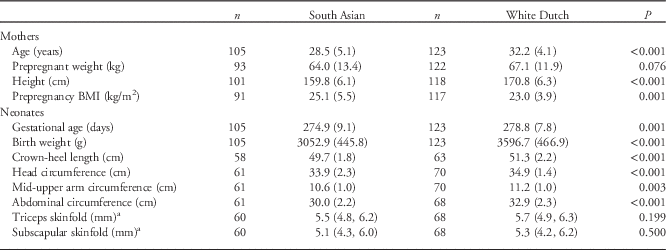
The characteristics of mothers and babies are shown in Table 1. South Asian mothers were younger and had a lower prepregnancy weight. Prepregnancy BMI was higher in South Asian women due to their significantly lower height.
Characteristics of mothers and babies [mean (s.d.)]

BMI, body mass index.
a Follows log normal distribution, median and interquartile range of original variable are presented.
Gestational age at delivery was on average 4 days lower in South Asian neonates. South Asian neonates had a mean birth weight of 3052.9 v. 3596.7 g for white Dutch neonates (P<0.01). This difference in birth weight persisted after adjusting for gestational age, sex of the baby and other possible confounders, including parity, maternal age, prepregnancy BMI and level of education (P<0.01).
South Asian neonates were also significantly smaller in all other measurements, except for the skinfolds. The skinfolds were slightly smaller in South Asian neonates, but this difference was not statistically significant. After adjusting for gestational age and sex, the differences between South Asian and white Dutch neonates remained. The largest difference was found in abdominal circumference, which was smaller by 1.39 standard deviations (95% CI −1.76 to −1.01), followed by birth weight (s.d. score −1.08, 95% CI −1.27 to −1.89), head circumference (s.d. score −0.97, 95% CI −1.32 to −0.62) and length (s.d. score −0.69, 95% CI −0.91 to −0.46). Mid-upper arm circumference was smaller by 0.49 standard deviations (95% CI −0.79 to −0.19). There was no statistical significant difference in triceps and subscapular skinfolds between South Asian and white Dutch neonates. Subscapular skinfold had the smallest s.d. score (triceps s.d. score −0.34, 95% CI −0.88 to +0.20 and subscapular s.d. score −0.03, 95% CI −0.31 to +0.25; Fig. 2).
Sex- and gestation-specific s.d. scores for South Asian mothers and neonates compared with white Dutch mothers and neonates.
Cord plasma measurements
Cord plasma levels of glucose, triglycerides and insulin were higher in South Asian neonates. However, these differences were not statistically significant (Table 2).
Cord plasma concentrations of glucose, insulin and triglycerides (mmol/l) in South Asian and white Dutch neonates in the Hague, the Netherlands

a Follows log normal distribution, median and interquartile range of original variable are presented.
b No adjustment.
c Adjusted for birth weight, sex and gestational age.
d Additionally adjusted for glucose in cord blood.
After adjustment for the differences in birth weight, gestational age and sex between the two groups, the difference in cord plasma levels of insulin between the two groups became significant (P=0.001). The difference in cord plasma levels of triglycerides and glucose remained non-significant.
Insulin was related to cord plasma glucose levels: the higher the cord plasma glucose level, the higher the cord plasma insulin level (β=0.186, P=0.004). This relation remained after adjustment for birth weight, gestational age and sex of the neonate (β=0.218, P=0.001).
Therefore, we also adjusted for glucose when analyzing the difference in cord plasma insulin levels. The difference in insulin levels between South Asian and white Dutch neonates remained significant (P=0.002).
Discussion
In this study, we found that the thin–fat insulin-resistant phenotype is also present in South Asians born in the Netherlands with ancestors from India. Our results demonstrate that when compared with white Dutch neonates, South Asian neonates in the Hague (the Netherlands) have lower birth weight and smaller abdominal and mid-upper arm circumferences, but similar skinfold thickness. Subscapular skinfold was most similar, suggesting a tendency to central adiposity in South Asian neonates. Mid-upper arm circumference, which reflects muscle bulk, was reduced, as was abdominal circumference, which reflects visceral size.
Our anthropometry results are consistent with the results of several studies from India.Reference Yajnik, Lubree and Rege4–Reference Kulkarni, Muthri and Kulkarni7 However, they apparently contradict the result of one study in which South Asian neonates appeared to be similar to Western neonates.Reference Muthayya, Dwarkanath and Thomas14 It should also be noted that studies using other techniques to determine body composition – including magnetic resonance imaging, air-displacement plethysmography and cord leptin – describe a greater degree of adiposity among South Asian infants.Reference West, Lawlor and Fairley12, Reference Stanfield, Wells, Fewtrell, Frost and Leon15, Reference Modi, Thomas and Uthaya16 The fat sparing may have survival advantages for the small South Asian baby. However, this tendency to spare fat may continue into adult life and lead to obesity and insulin resistance.Reference Yajnik, Fall and Coyaji5
Our finding of higher cord plasma insulin levels in South Asian neonates is in line with those of Yajnik et al.,Reference Yajnik, Lubree and Rege4 who also found the levels of cord plasma insulin in South Asian neonates to be higher than those in white British neonates. Central adiposity, which is present in South Asian neonates, is known to increase the risk of insulin resistance.Reference Hardy, Czech and Corvera17
We found a persistent thin–fat phenotype in a South Asian population who live in a prosperous environment, who have a lifestyle different to that in India and who possibly have a healthy migrant effect in their ancestors. Even in this ‘healthy’ selection, the thin–fat phenotype persists. This suggests either a genetic cause, or some lifestyle or nutritional cause that has persisted over several generations and that exposes the fetus to an unfavorable intrauterine environment. Moreover, gene–nutrient interactions could also play a role. Nevertheless, the birth weight of the South Asian neonates in our study was higher than those currently living in India: in Uttar Pradesh and Bihar, from where the Surinamese South Asians originate, the prevalence of low birth weight (<2500 g) varies from 23% to 26%,Reference Bharati, Pal and Bandyopadhyay18 whereas only 15% of the Surinamese South Asians living in the Hague have a low birth weight.Reference De Wilde, Van Buuren and Middelkoop19 Overall anthropometry, however, has not changed: the neonates are still thin–fat. Efforts to reduce ethnic differences in birth weight should therefore consider the possibility that an increase in birth weight can have adverse effects, that is, a possible increase in adiposity.Reference Muthayya, Dwarkanath and Thomas14
An important difference between South Asian mothers in the Hague and those living in India is prepregnancy BMI: this is, as expected, higher in South Asian mothers in the Hague than in South Asian mothers in India. Moreover, our study showed that the Dutch South Asian mothers have a significantly higher BMI than that of white Dutch mothers. The prevalence of prepregnancy overweight and obesity in this group is also significantly higher than the prevalence in white Dutch mothers (44% v. 23%). If the BMI cut-off point of 23 is used – which is recommended as a public health action point by the WHO for South Asians – the prevalence of prepregnancy overweight and obesity rises to 64% among Dutch South Asian mothers. Previous studies have shown that newborns of overweight and obese women have higher total body fat and that higher maternal BMI and/or obesity during pregnancy are associated with a greater risk of overweight and obesity in their children.Reference Whitaker and Dietz20, Reference Modi, Murgasova and Ruager-Martin21
Our study has some potential limitations. First, the number of neonates studied is small. Despite these low numbers we found significant differences. Second, we were not able to collect cord blood from all the neonates studied. However, there were no significant differences in maternal and neonatal measurements between neonates for whom cord blood was available and those for whom no cord blood was available. The small sample size for cord blood may, however, have led to insufficient power to detect differences in glucose and triglyceride levels. Yajnik et al. Reference Yajnik, Lubree and Rege4 found cord plasma levels of glucose and triglycerides to be significantly higher in South Asian neonates than in white British neonates. Moreover, in a previous study of white Dutch and Surinamese South Asian neonates we found the levels of triglycerides in Surinamese South Asian neonates to be significantly higher than those in Dutch neonates.Reference Boon, Karamali and de Groot22
Despite these limitations, our study also has a number of strength and advantages. One strength of our study is that the comparator population lives in the same city as the study population.
As mentioned above, two other groups have also studied migrant South Asian infants in an industrialized country.Reference Bansal, Ayoola and Gemmel11, Reference West, Lawlor and Fairley12 One advantage of our study is that anthropometry was measured within 3 days of birth, unlike the London Mother and Baby Study.Reference Bansal, Ayoola and Gemmel11 An advantage over the Born-in-Bradford study is that we report a higher number of measurements on neonatal anthropometry and cord blood.Reference West, Lawlor and Fairley12
In this study, we have shown that the thin–fat insulin-resistant phenotype is also present in South Asian neonates in the Netherlands. Tracing the underlying mechanisms for the development of this phenotype may help us to understand the susceptibility of South Asians to obesity, diabetes and cardiovascular disease. For this reason, more research is needed into both genetic and environmental factors. A comparison of South Asian neonates born in different living conditions and environments may be helpful in elucidating the relative influence of genetic and environmental factors.
Acknowledgments
The authors are grateful to all the women and neonates who took part in the study and to the midwives and obstetricians for their help in recruiting and acquiring cord blood. The authors thank Sally Hill for language editing.
Financial Support
This study was funded by the Dutch Diabetes Foundation (grant number: 2006.00.003).
Conflicts of Interest
None.
Ethical Standards
The authors assert that all procedures contributing to this work comply with the ethical standards of the relevant national guidelines on human experimentation and with the Helsinki Declaration of 1975, as revised in 2008, and has been approved by the Medical Ethical Committee of the region (ZuidWest Holland).