

Two fundamental chronological assumptions underlie understandings of the origins of the motet in the thirteenth century.Footnote 1 The first is that the motet emerged out of an already established genre: motets were initially created by the addition of syllabic texts to the pre-existing music of melismatic clausulae.Footnote 2 The second is that the earliest motets had liturgically appropriate texts in Latin, while motets with texts in the vernacular represent a later development.Footnote 3 This basic evolution from clausula to Latin motet to French motet enacts a gradual process of ‘secularization’,Footnote 4 with motets originating in close proximity to the Church and the liturgy, and only subsequently (albeit quickly) penetrating the secular, vernacular realm.
Jeremy Yudkin's account of the origins of the motet is typical: he described the beginnings of the motet in the troping of the upper voices of clausulae with Latin texts, and continued ‘soon, however, the added texts began to be written in the vernacular, in French, and to take on a decidedly secular slant’.Footnote 5 Likewise, Richard Crocker, though he proposed that a repertory of French motets was very quickly established, suggested that ‘the earliest texting of Notre-Dame discant seems to have been with Latin texts’.Footnote 6 More recently, Thomas Payne observed that ‘French motets … are almost certainly a later phenomenon than Latin ones due to the more immediate connection of the Latin language to the liturgical domain that created organa, clausulae, and motets’.Footnote 7
Mark Everist has been rather more circumspect in the automatic application of such general chronologies.Footnote 8 He emphasised the ‘spectacular explosion of experimental musical procedures’ that characterised the development of the motet, embracing the ‘appropriate’ disagreement and uncertainty surrounding the chronological priority of motets in one language over another.Footnote 9 Yet even Everist's discussion of the early history of the motet strongly reinforces the traditional chronology, beginning with clausulae and Latin motets before turning to French ones,Footnote 10 and demonstrating the possible derivation of French motets from pre-existing Latin pieces.Footnote 11 This accepted chronological progression, then, still holds sway, and it remains enshrined as the basic narrative of key catalogues and reference works that continue to be employed by scholars of the thirteenth century.Footnote 12
The earliest surviving source to contain a collection of motets is the Florence manuscript F.Footnote 13 Copied by a single text scribe and a single music notator,Footnote 14 in Paris in the 1240s,Footnote 15 it preserves ‘the largest repertory of polyphony to survive from the middle ages’.Footnote 16 It offers a comprehensive compendium of organa, clausulae and conducti, with two substantial fascicles devoted to the new genre of the motet.Footnote 17 The motets in F, like the rest of the contents of the manuscript, are exclusively Latin-texted pieces. Many of their texts closely trope underlying tenor chants and would be appropriate for performance in the liturgy.Footnote 18 The motets, particularly in the first motet fascicle, are also arranged according to the liturgical calendar of their tenor chants.Footnote 19 Furthermore, the majority have related clausulae extant elsewhere in F, which are thought to have been performed within organa in the Mass and Office.Footnote 20
F stands in contrast to later manuscripts, such as W2 (dated in the mid-thirteenth century)Footnote 21 or Mo (the earliest layers of which are dated in the 1270s).Footnote 22 Such later sources include motets in the vernacular, they do not contain collections of related clausulae and their motets are arranged alphabetically rather than liturgically. That Latin motets in W2 might be later contrafacta reworkings of earlier French versions has long been acknowledged.Footnote 23 However, the Latin motets in F are, in accordance with the chronologically early date of this manuscript, typically held to represent the earliest layer(s) of composition in the new genre.Footnote 24 This hypothesis exists in a mutually supportive relationship with the traditional chronological model for the development of the motet. F, as the earliest surviving motet source, provides crucial evidence in favour of the priority of ‘sacred’ Latin motets with related clausulae. And likewise, the accepted evolutionary narrative reinforces the proposition that F must record the earliest motets.
Several scholars have, however, questioned the chronological priority of motets in F as tenable in all cases. Gordon Anderson initially strongly rejected the possibility that F could contain contrafacta: he referred to the ‘very early collection of motets in the second fascicule of F’, asserting that ‘they belong to the group of earliest motets based on source-clausulae, and it would appear that they are earlier than any possible or actual French redactions’.Footnote 25 Yet only three years later, in 1973, Anderson acknowledged in a footnote that ‘the question of contrafacta [motet] settings in F has as yet scarcely been raised in scholarly literature, and it is generally assumed that F represents the first layer’.Footnote 26 Betraying unease with this assumption, he proceded to refer to two Latin motets in F that could possibly have derived from French pieces.Footnote 27
Wulf Arlt, in an unpublished paper presented at ‘Das Ereignis Notre Dame’ in Wolfenbüttel in 1985, confirmed one of Anderson's suspected motets as a contrafactum.Footnote 28 Through detailed analysis of text–music relationships, Arlt convincingly proposed the triplum of the double motet Ypocrite pseudopontifices/Velut stelle firmamenti/ET GAUDEBIT (F, fols. 411v–413r) as a Latin reworking of the vernacular text, El mois d'avril.Footnote 29 Despite the consequences of this finding, Arlt's analysis remains unpublished and thus unacknowledged in subsequent motet scholarship. Baltzer, writing about the same group of ET GAUDEBIT motets in 1997, automatically favoured the priority of the Latin texts in F over their French equivalents, stating simply that it was ‘far less likely’ that a vernacular double motet might be older than the Latin version preserved in F.Footnote 30 Subsequent discussions of this motet family by Thomas Payne and Fred Büttner in 2011 have continued to accept the precedence of the Latin texts in F.Footnote 31
Wolf Frobenius voiced a further challenge to the priority of Latin motets in F in 1987.Footnote 32 Principally concerned by the presence of melodies associated with secular, vernacular refrains within supposedly liturgical clausulae, he identified sixty-two clausulae in F as transcriptions of French and Latin motets. In thirteen cases he proposed certain clausulae in F, with related Latin motets in the same manuscript, to be transcriptions of French motets.Footnote 33 This relegated the thirteen Latin motets in F to the status of contrafacta of French originals. However, Frobenius's cursory analyses often employed problematic criteria by which to establish clausulae as transcribed motets.Footnote 34 Moreover, his wholesale reversal of the traditional clausula-to-motet chronology was not accepted in later scholarship,Footnote 35 thus discouraging close engagement with his conclusions.Footnote 36 As Franz Körndle observed: ‘Frobenius's provocative theory found little positive resonance in subsequent literature on the medieval motet. Either his postulated precedence of the motet over the clausula was simply ignored or it was dismissed as erroneous.’Footnote 37
This situation has recently been rectified, when, in certain instances, Frobenius has been shown to be correct.Footnote 38 In 2002, Fred Büttner convincingly argued that one of the clausulae in F discussed by Frobenius did indeed represent a transcribed French motet.Footnote 39 This clausula, [Domi]ne 5 (F, fol. 151r–3), is unique to F. It is irregularly notated and contains a melody associated with the vernacular refrain ‘Cele m'a s'amor dounée, qui mon cuer et mon cors a’ (vdB 314) at its conclusion.Footnote 40 Büttner demonstrated the structural importance of the refrain melody in the musical construction of the piece, confirming its French motet origin. In consequence, he regarded the related Latin motet, Prothomartir plenus fonte/[DOMI]NE (F, fol. 410r–v), also unique to F, as a contrafactum.Footnote 41
French influences on the Latin motets and clausulae in F have, therefore, been long acknowledged. Indeed, the possible vernacular and popular origins of the motet as a genre were emphasised by Christopher Page, who drew attention to the derivation of the Latin word ‘motetus’ from the diminutive French ‘motet’ (little word).Footnote 42 This article is by no means the first to undermine still pervasive narratives of ‘clausula before motet’ and ‘Latin motets before French’. Rather, it builds on the work of Arlt, Frobenius and Büttner, offering the first detailed revision of both chronological assumptions to be presented in a single study and in English, and exploring the consequences of these revisions for current understandings of the Florence manuscript.
I shall focus on three particular examples of Latin motets in F, demonstrating their dependence – and, in two cases, that of their related clausulae – on vernacular models. While all of the case studies have previously been suspected or suggested as contrafacta, I seek to establish this conclusively, through a close analysis of the Latin motets in F and their wider networks of related clausulae and motets across a variety of manuscripts. I shall scrutinise aspects of musical and poetic design, text setting, notational and scribal practices and manuscript organisation, engaging with wider questions concerning the copying process and the nature of F as a source, the relationship between cum littera and sine littera notation, understandings of consonance and dissonance and interactions between vernacular refrains and clausulae. The case studies are contextualised in a concluding reflection on how widespread such exceptions to the traditional chronological model might be. This question cannot yet be answered with certainty. But it is hoped that the analyses offered here might serve as methodological models, demonstrating ways in which relationships between clausulae, Latin and French motets can be tested and their relative chronologies established.Footnote 43
Error popularis and fole acostumance
The two-voice motet Error popularis/DO[MINUS] appears near the end of the second motet fascicle of F (fol. 413r–v). This Latin motet is unique to F, and it has no extant related clausula. Its music is more commonly associated with the French text Fole acostumance, with which it is recorded in three chronologically later sources: W2 (fols. 218r–218ar), MüA (complex A, no. 4) and Mo (fols. 85r–86v, motetus only).
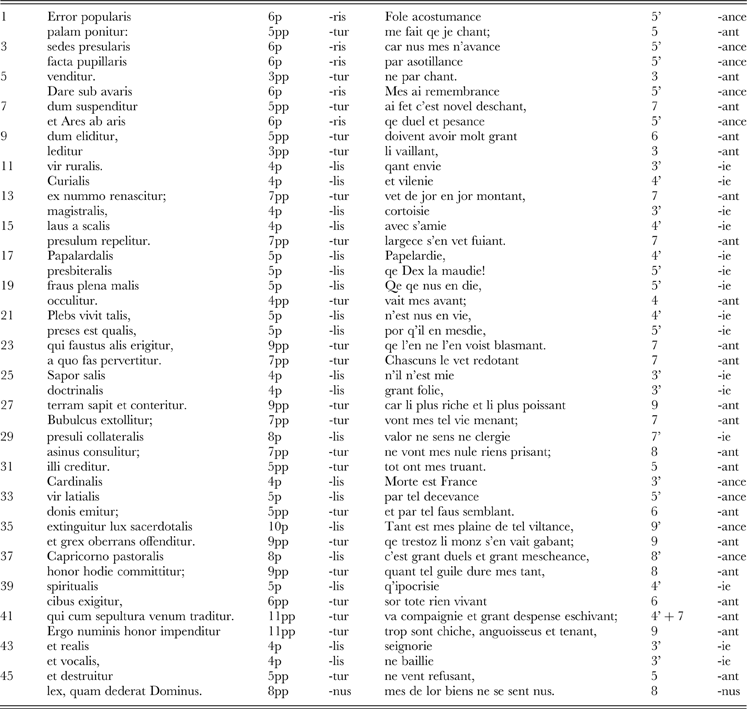
Error popularis and Fole acostumance share the same musical setting, and they have common poetic features, such as stress patterns and rhyme schemes (see Table 1).Footnote 44 A paroxytonic line ending in the Latin text invariably matches a paroxytonic or ‘feminine’ close in the French. The two rhyme schemes are closely connected: -tur endings in the Latin text are always matched by -ant endings in the French. Likewise, -ris endings in the Latin text correspond to -ance endings in the French. When the feminine -ance ending is replaced by an -ie rhyme at line 11 of Fole acostumance, a parallel situation occurs in Error popularis: the -ris rhyme is superseded by -lis. There is a slight divergence at line 32, when the French text returns to the opening -ance rhyme while the Latin continues to employ -lis endings. However, both texts share the concluding rhyme -nus, echoing the final syllable of the tenor word ‘Dominus’ (also the last complete word of Error popularis).
Texts of Error popularis and Fole acostumance

Error popularis and Fole acostumance are additionally linked semantically. The French text is in the first person, a song mourning the lack of courtesy and generosity and the growth of suspicion and evil, and the Latin is satirical and anti-ecclesiastical in tone. Both texts lament the prevalence of hypocrisy, corruption and greed in the present time.Footnote 45 And on one occasion, line 17 of the poem, the same word in both languages, meaning false devotion and hypocrisy – ‘papalardalis’ and ‘papelardie’ – appears at exactly the same point in the two motet versions.Footnote 46 The contrafactum motet (whichever it is) must, therefore, have been created with reference to the earlier textual incarnation.
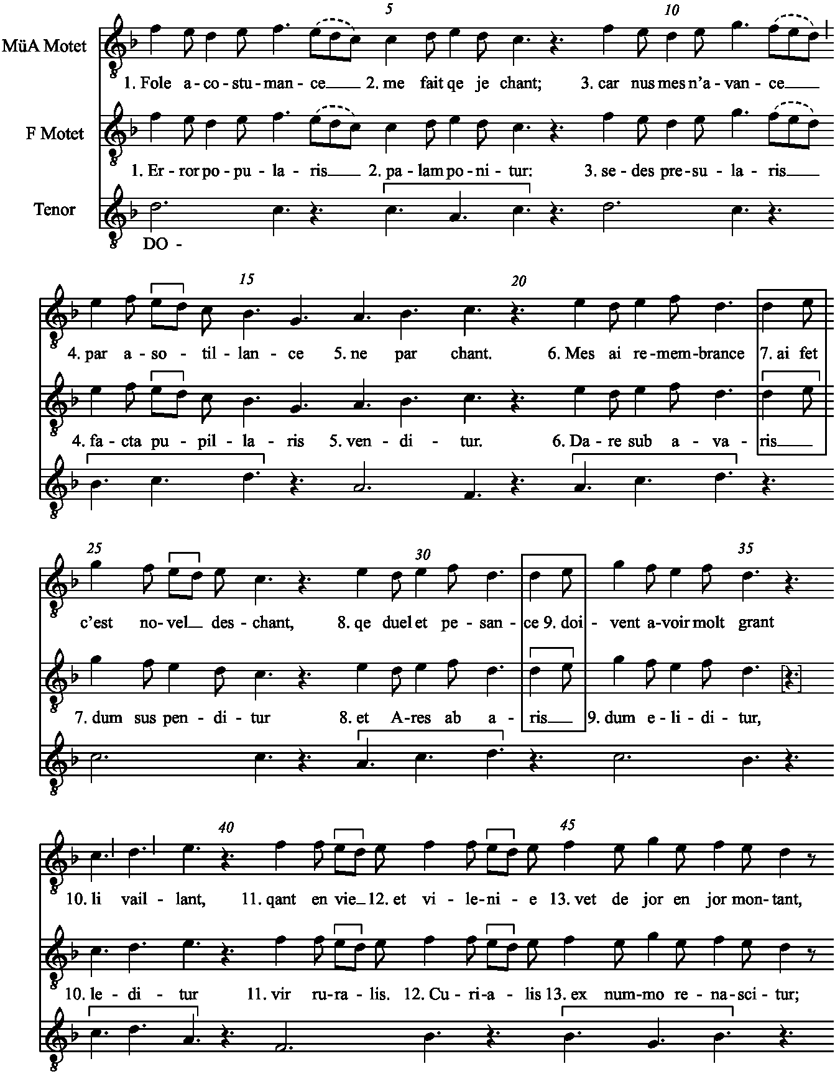
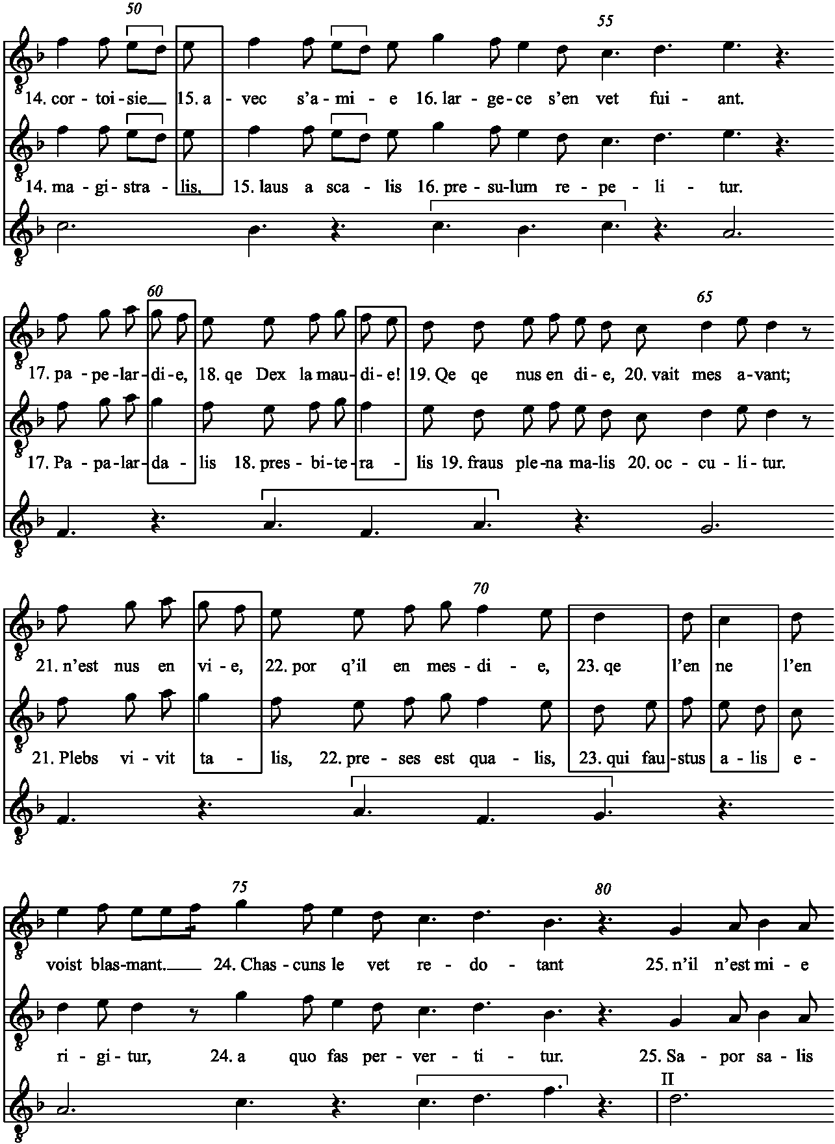
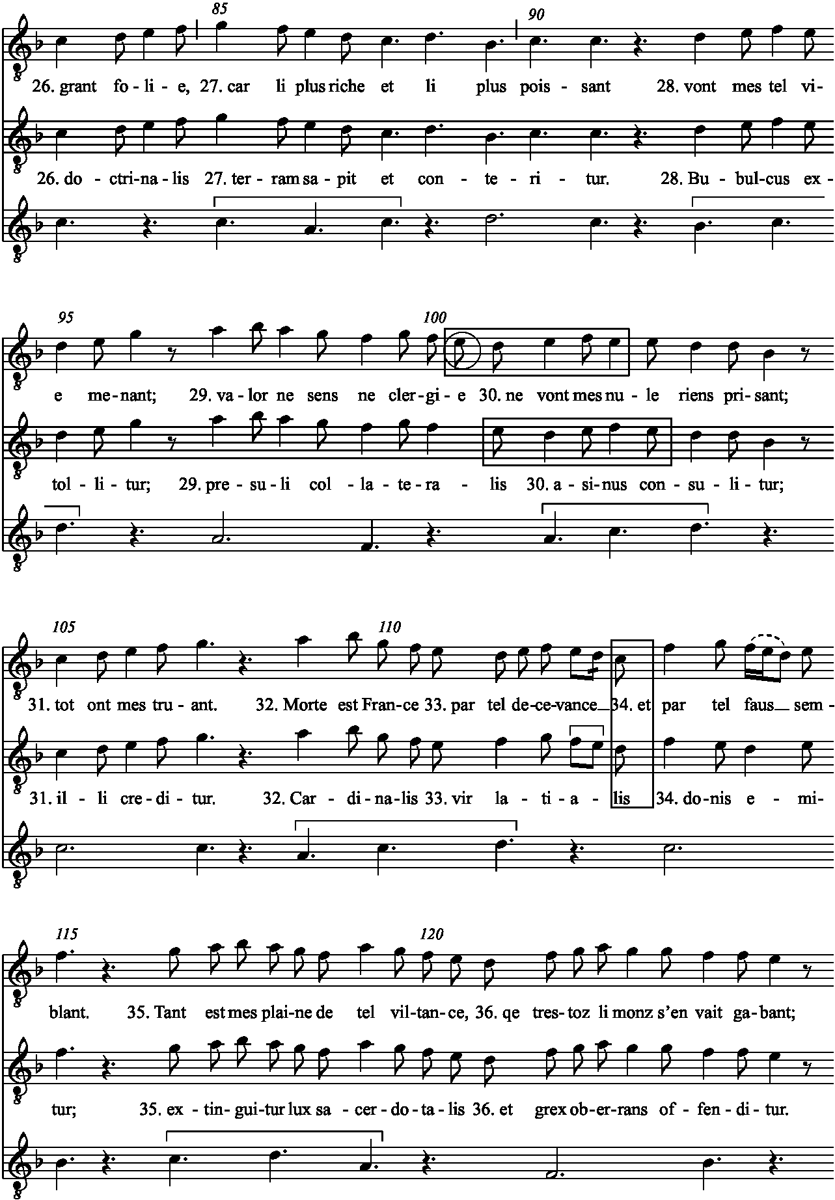
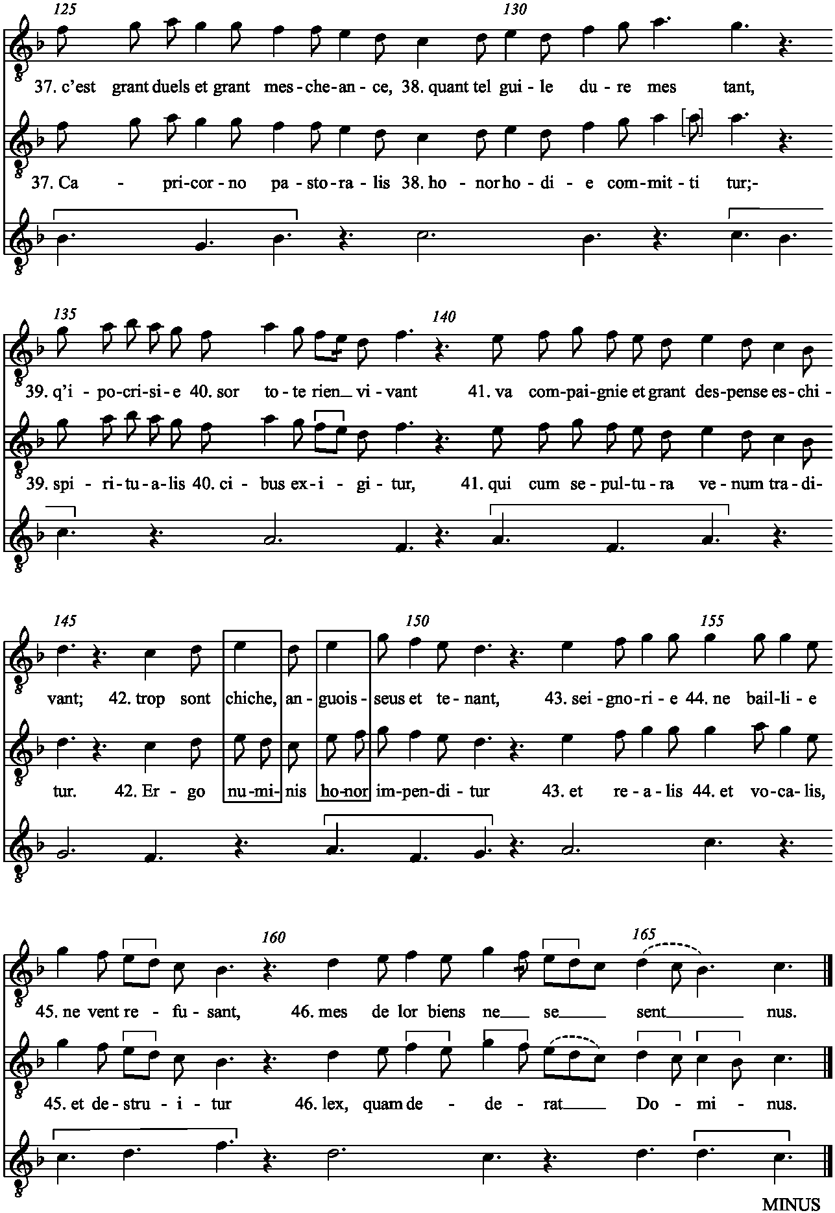
This hypothesis is supported by the close musical relationship between the two motets. Example 1 presents the version of Fole acostumance in MüA above Error popularis, and the tenor DO[MINUS] as extant in MüA.Footnote 47 The phrase structure of the two motetus parts is not always identical, but there are no significant structural divergences. Boxes in Example 1 mark particular examples of moments of difference. Occasionally, the French text begins a new poetic line on an anacrusis when the Latin text does not (see, for example, the last notes of perfections 50 and 112 respectively). There are a number of moments when the Latin and French texts differ as to the number of syllables in a line, resulting in slight musical variants. Periodically, notes at the end of phrases are set to two syllables in the French text but only one in the Latin (see perfections 24 and 32 respectively). There may also be an ‘extra’ breve (a quaver in transcription) in the music accompanying the French text to fit in an ‘extra’ syllable, as in perfections 60 and 62, for example, or perfection 68. Such ‘extra notes’ are less often demanded by the Latin text (only in perfections 71–2 and 148–9). These ‘extra notes’ in the middle of phrases are not normally transmitted in a motet version that does not require them: notes supporting an ‘extra’ syllable in the French text are absent in the Latin motet version and vice versa.
Fole acostumance, MüA, complex A, no. 4; and Error popularis/DO[MINUS], F, fol. 413r–v
Previous scholarship has assumed that Error popularis represents the earliest version of this motet, and that Fole acostumance is a later reworking. Luther Dittmer, Hans Tischler, Peter Burkholder and Claude Palisca have all unquestioningly accepted the priority of the Latin motet in F.Footnote 48 Only Wulf Arlt has suspected that Error popularis might possibly be the contrafactum.Footnote 49 This possibility will now be explored, as a dependence on a vernacular model would convincingly account for many of the peculiarities of Error popularis.
Significantly, Error popularis has much in common with the motet triplum Ypocrite pseudopontifices, proposed by Arlt as a contrafactum of El mois d'avril. The two motets share several features anomalous in the context of F, and they appear side by side in this manuscript, Ypocrite pseudopontifices/Velut stelle directly preceding Error popularis. The texts have a common anti-ecclesiastical theme,Footnote 50 and both motets exist in a form that is unique to F.Footnote 51 Neither Error popularis nor Ypocrite pseudopontifices has extant related clausula material, placing them among a minority of motets in F.Footnote 52 The musical settings of these two texts employ the sixth rhythmic mode, a feature similarly unusual in the context of F. While the triplum Ypocrite pseudopontifices is unrelentingly in mode 6, the motetus of Error popularis alternates simple mode 1 rhythms with passages of sixth-mode declamation. This rapid rhythmic movement is not only atypical of the Latin motets in F,Footnote 53 but it is also uncharacteristic of clausulae.Footnote 54 Furthermore, the irregular alterations between mode 1 and mode 6 in Error popularis strongly suggest that its music was newly created in conjunction with an associated motet text: it seems unlikely that the motet was derived from a pre-existing clausula, now lost.
The use of the sixth rhythmic mode is common in French motets, and it is characteristic of the ‘fussy fractured style’ that Baltzer has identified as typically ‘French’, a contrast to the ‘clean and classic’ first-mode idiom of many Latin motets.Footnote 55 The speedy text declamation of sixth-mode motets is arguably better suited to the unaccentual presentation of a text in the vernacular. In a number of mode 6 passages in Error popularis the accentuation of the Latin text is not particularly satisfactory: ‘extinguitur lux sacerdotalis’ in perfections 117–20, ‘oberrans’ in perfections 121–2 or ‘cibus’ in perfections 136–7.Footnote 56 Rhetorically, the French text also seems better reflected by its musical setting.Footnote 57 The pair of identical musical gestures in perfections 49–50 and 51–2, for example, is matched poetically by two similar vices, ‘envy’ and ‘villainy’, in Fole acostumance. In the Latin version, however, this musical pairing is disrupted by the fact that ‘vir ruralis’ is part of the previous sense unit, while ‘Curialis’ marks the beginning of the next. Similarly, the rhetorical impact of the first introduction of mode 6 rhythm (at perfection 59) complements the French text, matching the direct exclamation ‘Papelardie, qe Dex la maudie!’ (‘Religious hypocrisy, may God curse it!’). This change in musical gesture corresponds to the beginning of a new sense unit in the Latin motet text, but the dramatic musical effect is not so rhetorically convincing. Furthermore, the word ‘papelardie’ is of French origin, and is considerably more common than its Latin equivalent ‘papalardalis’.Footnote 58
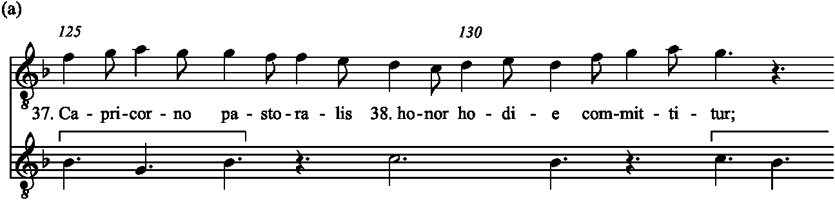
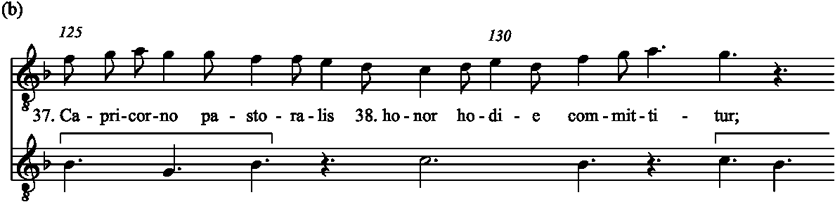
A particular copying error in Error popularis might also confirm this motet as the contrafactum. As recorded in F, the phrase at perfections 125–34 could have two possible rhythmic interpretations, shown in Example 2.Footnote 59 The first, employing a simple mode 1 rhythm throughout, respects the accentuation of the Latin text, but results in significant dissonances against the tenor. The second fits better with the tenor but plays havoc with the text accentuation.
Error popularis, F, fol. 413v, perfs. 125–34: (a) interpretation 1; (b) interpretation 2
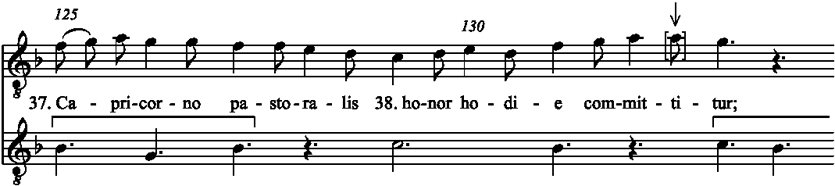
Neither of these interpretations is satisfactory, and the solution is surely that the first two notes of the phrase should actually be set to a single syllable.Footnote 60 This avoids problems of consonance with the tenor and of textual accentuation. To compensate for the fact that the second note of the phrase now belongs to the first syllable, the addition of an extra note is required. This ‘extra note’ should presumably be an a′ at the end of perfection 132, supporting the syllable ‘-ti’ of ‘comittitur’ (marked by an arrow in Example 3).Footnote 61
Proposed reworking of Error popularis, F, fol. 413v, perfs. 125–34
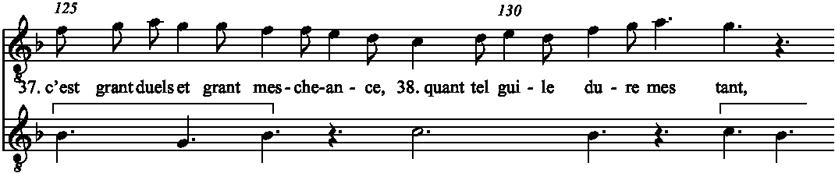
The second note of the phrase, g′, is unnecessary in Error popularis, lacking a corresponding syllable and, moreover, occasioning a copying error. Its presence might be explained through comparison with the equivalent phrase in Fole acostumance. Example 4 shows the relevant passage, in which this g′ is required to set the word ‘grant’. This note – superfluous in the Latin motet version, and responsible for the misconstrual of an entire phrase – is, by contrast, essential in the French motet. It would be wholly uncharacteristic for Error popularis to have a melisma of two notes on the first syllable of ‘capricorno’. There are no other occasions in the motet when a pair of notes set to a single syllable is found at the beginning of a phrase: all other pairs of breves set to a single syllable occur in the middle of a phrase and the melodic movement is always falling rather than rising (see Example 1). Furthermore, the setting of a pair of notes to a single syllable seems generally to have been avoided, and Error popularis contains fewer melodic decorations than any of the copies of Fole acostumance. The Latin motet in F has, throughout, a slightly plainer version of the motetus than the French motet in MüA, and it is considerably plainer than the more heavily decorated versions of Fole acostumance in W2 and Mo. It is likely that the unnecessary g′ in perfection 125 entered the Latin motet via some connection with the French version: its extraneous and disruptive presence is otherwise difficult to explain. By contrast, it is not possible to trace the influence of any ‘extra notes’ necessitated by additional syllables in Error popularis in extant versions of Fole acostumance.
Fole acostumance, MüA, Complex A, no. 4, perfs. 125–34
Retexting an existing motet: the copying process of error popularis/do[minus]
Such an inaccuracy in Error popularis is suggestive of a music scribe working from an exemplar that did not contain both the music and the Latin text of this motet.Footnote 62 Of course, the mistake could have been made in the copying of the exemplar itself, in which case the same conditions would apply for its preparation. Errors, particularly in motetus and triplum parts, were usually scrupulously corrected in the motet fascicles of F. Passages were frequently erased and correctly altered in the same hand, indicating that the scribe probably effected corrections as he was copying. Had his exemplar for Error popularis contained both music and text, then one might reasonably expect him to have noticed and rectified his mistake. Given the nature of the error and the very presence of an extraneous quaver in an exemplar for the Latin motet, it is possible that the scribe was working from a French version of the motet. The scribe of F, or of the exemplar from which F was copied, must have been dealing with a written record of this French motet rather than simply remembering a French version known to him. Had he been hearing, singing or remembering Fole acostumance then he would have been aware of its rhythm, surely realising that these lines of Latin text would be wrongly accentuated. The process of adapting the notated music of Fole acostumance for a copy of Error popularis would not have been difficult, involving only the simple removal of a note in places and, less frequently, the addition of one or two pitches.Footnote 63 This would explain why the task was otherwise completed so successfully: simply by comparing the number of notes in a line with the number of syllables in the Latin text, it would be fairly obvious where a note needed to be excised or inserted.
This single significant error in the setting of the Latin text corresponds with the sole phrase in the motet when the French and Latin texts have the same number of syllables but cannot be sung to the same rhythm. The only erroneous phrase in F is, therefore, a unique case. To set the Latin text properly, a note would need to have been removed at the beginning of the phrase as well as added at the end. In consequence, the number of notes in the French motet does indeed equate to the number of syllables in the corresponding Latin text. A scribe simply checking that the number of notes and syllables of his text were equal would find that they were, without realising that any alteration was required.
That the F scribe was working from a notated version of Fole acostumance is further supported by the relationship between Error popularis and Fole acostumance in perfections 100–2. In perfection 100, the French text has an ‘extra syllable’ absent in the Latin text: the -e of ‘clergie’, set to the pitch e′ (circled in Example 1). The most obvious way of dealing with this ‘extra note’ in the Latin motet would be simply to omit it. Yet in Error popularis the ‘extra’ e′ is instead retained, used to set the syllable -lis of ‘collateralis’. Error popularis reproduces the exact sequence of pitches found in perfections 100–2 of Fole acostumance, but in a new rhythmic arrangement (as marked by boxes in Example 1). It seems that the note eventually omitted in the Latin motet was not the ‘extra’ e′ in perfection 100, but rather the final pitch (also e′) of perfection 102. This again is suggestive of a scribe making alterations without imagining the rhythmic profile of a melody and working from a written copy of a cum littera French motet, where the sequence of pitches was clear, but their rhythmic values were not immediately obvious. It appears that the scribe of Error popularis was aware of the presence of an ‘extra note’ lacking a corresponding syllable in perfections 100–2, and he knew that one pitch must be omitted. The solution he arrived at was actually perfectly satisfactory, but it was achieved in spite of the fact that he did not correctly identify and remove the specific pitch that was the ‘extra’ one.
These potential copying errors are revealing, not only because they might confirm Error popularis as a Latin reworking of an earlier French motet, but also because of the insight they offer into the creation of this contrafactum. The musical adjustments required to facilitate the singing of Error popularis to the music of Fole acoustumance were seemingly executed by the scribe of F, in consultation with a notated copy of the music of Fole acostumance. It seems unlikely, given his mistake, that the scribe himself was also the author of the Latin contrafactum text, but he nonetheless played a creative role in shaping this motet as it appears in F. That the F scribe possessed written copies of French motets and worked directly from them is a possibility explored further in the following case studies. This suggests an interaction and overlap between aspects of oral and written culture that is characteristic of early motets. Though motets were probably sung, remembered, borrowed and reworked in predominantly oral contexts, their creation and transmission was simultaneously strongly connected with writing.
Veni, salva nos, he, quant je remir and amo[ris] 2
The dissemination of the two-voice Latin motet Veni, salva nos/AMO[RIS] (F, fol. 411r) has a number of features in common with that of Error popularis. The various incarnations of this musical material on AMO[RIS] are as follows (in an order that does not imply a chronology):
Two-voice clausula on AMO[RIS], Amo[ris] 2: F, fol. 163v–1
Two-voice Latin motet Veni, salva nos: F, fol. 411r
French double motet Por vos, amie/He, quant je remir: Mo, fols. 124v–125v; Cl, fol. 388v
French double motet (different triplum melody) Dame de valour/He Dieus, quant je remir: Mo, fol. 318r–v; Ba, fol. 22r; Tu, fols. 6v–7r
Text incipit ‘He, quant je remir’: Bes, fol. 38r
Motetus O quam sollempnis (With the legend ‘Motetum de Sancto Spiritu super illud Et quant iou remir son cors le gai, cujus tenuram tenet Amor’): Lille, fol. 32r–v
Franco (Ars cantus mensurabilis musicae, Ch. 11, Ex. 68) quotes the beginning of the motetus and tenor with the text incipit ‘Virgo Dei plena gratia’.Footnote 64
Veni, salva nos is unique to F, recorded near the end of the ninth fascicle, closely preceding, but for a single intervening motet, Ypocrite pesudopontifices/Velut stelle firmamenti/ET GAUDEBIT and Error popularis/DO[MINUS]. Its related French text He, quant je remir is more widely transmitted across six different sources, serving as the motetus text for two French double motet versions,Footnote 65 and as the model for the contrafactum O quam solempnis legatio.Footnote 66
Unlike Error popularis or Ypocrite pseudopontifices, Veni, salva nos does not betray telltale signs of French influence. First, it has a related two-part clausula extant (uniquely) in F. Secondly, the Latin motet is not stylistically unusual, predominantly employing the first rhythmic mode. And thirdly, its text would be highly suitable for liturgical use. Rebecca Baltzer proposed that Veni, salva nos could have been sung on the Tuesday, Wednesday or Saturday after Pentecost.Footnote 67 Likewise, Susan Kidwell believed it to have a liturgical application, intended for the days following Pentecost Sunday.Footnote 68 Kidwell explained that Veni, salva nos addresses the Holy Spirit directly, petitioning the spirit to ‘pour out grace’ and ‘cleanse sin’, precisely because the feast of Pentecost is in the past and the Spirit's descent has already taken place.Footnote 69 This motet text is clearly connected to the Alleluia verse from which its tenor is taken: ‘Alleluia. Veni sancte spiritus, reple tuorum corda fidelium, et tui amoris in eis ignem accende.’Footnote 70Veni, salva nos incorporates a number of words and phrases which are obvious references to this chant: ‘veni’, ‘ignem tui amoris’, and ‘in cordibus’ (shown in bold).Footnote 71 The more widely transmitted French text He, quant je remir, by contrast, offers a worldly interpretation of the tenor AMO[RIS]:
This surely explains why the priority of Veni, salva nos, representing the earliest text to be added to a pre-existent Amo[ris] 2 clausula, has often been taken for granted.Footnote 72 However, several scholars have also previously challenged these assumed chronologies, for both the Latin motet and the clausula in F. Veni, salva nos was one of the two possible contrafacta in F suggested by Anderson in 1973.Footnote 73 Though Anderson continued to accept the priority of its related clausula, William Waite had in fact already questioned this in 1954.Footnote 74 Waite listed Amo[ris] 2 among an exceptional group of twenty-one clausulae in F that he considered (for notational reasons, explored in detail in due course) to represent ‘transcribed motets’. He did not specify whether these clausulae were derived from Latin or French motets, but Wolf Frobenius, writing about the Amo[ris] motet family in 1987, proposed a vernacular origin.Footnote 75 He simply stated that the rhythmicisation of the clausula tenor reflected the demands of refrain citations, thus proving the French motet as the original incarnation and the clausula and Latin motet to be later descendants. In 2011, Büttner concurred with Frobenius's chronology, noting the similarity of the opening of the Amo[ris] 2 clausula to a clausula on IOHANNE in the Saint-Victor manuscript (no. 21, fol. 290v), which he also believed to represent a transcribed French motet.Footnote 76 I shall demonstrate that Waite, Frobenius and Büttner are indeed correct, offering a close analysis of the texts Veni, salva nos and He, quant je remir, scrutinising their interactions with each other and with their musical settings and examining musical and notational relationships between clausula and motet versions.
The liturgically appropriate text Veni, salva nos is structurally related to its ‘secular’ French counterpart, He, quant je remir. The initial rhyme schemes of both poems correspond: -ta and -ie endings in the Latin text matching -ai and -ant endings respectively in the French. The two texts diverge as they progress. In Veni, salva nos a new rhyme, -us, is introduced in line 7, preparing the rhyme of the concluding word ‘cordibus’ (alluding to the tenor chant), while in He, quant je remir, line 7 marks a return to the -ai rhyme of the opening. However, the texts are further linked by the coincidence of allusions to the tenor chant in the Latin motet and the appearance of the refrain in the French. The opening words of both texts – ‘Veni’ and ‘He’ – immediately reference the tenor and the refrain respectively.Footnote 77 In addition, the most obvious moment of quotation from the tenor chant in the Latin text – ‘ignem tui amoris’ – occurs at exactly the same point as the final presentation of the French refrain, ‘He Diex, he Diex, encore l'amerai’. These two texts correspond, then, not only in their syllable count and aspects of their rhyme schemes, but also in their use of textual devices particular to their linguistic traditions. Such interaction probably indicates that, whichever of the texts represents the later contrafactum, it was created with reference to the existing text.
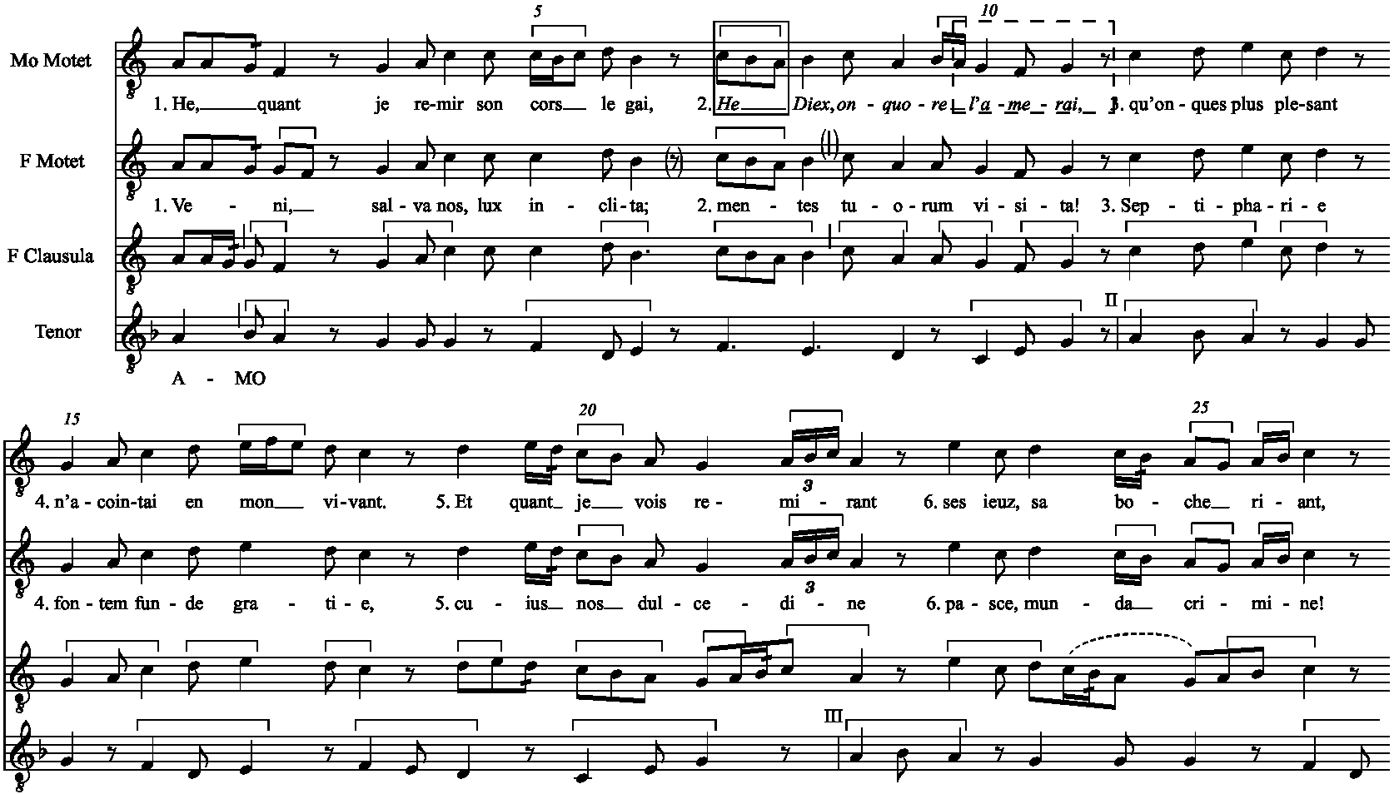
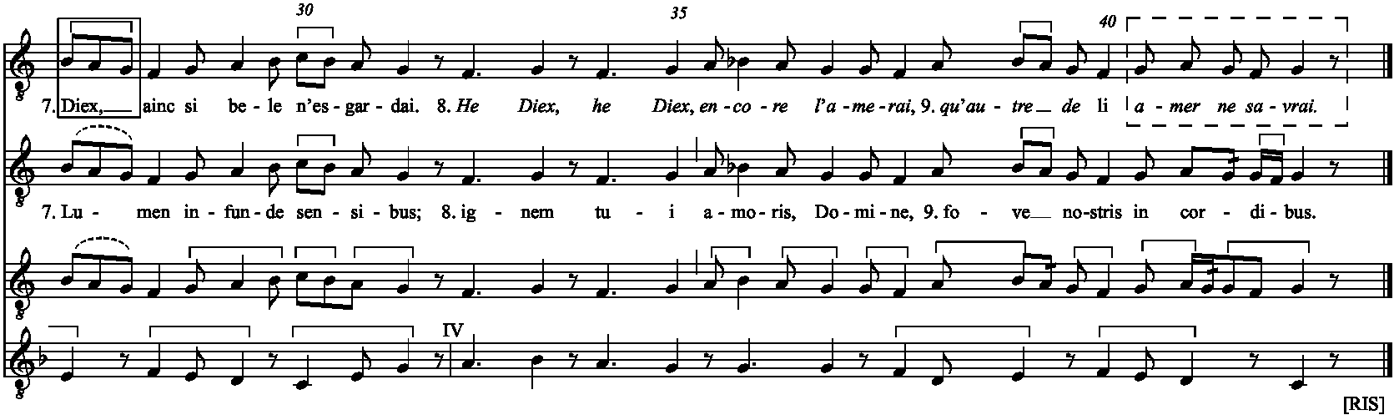
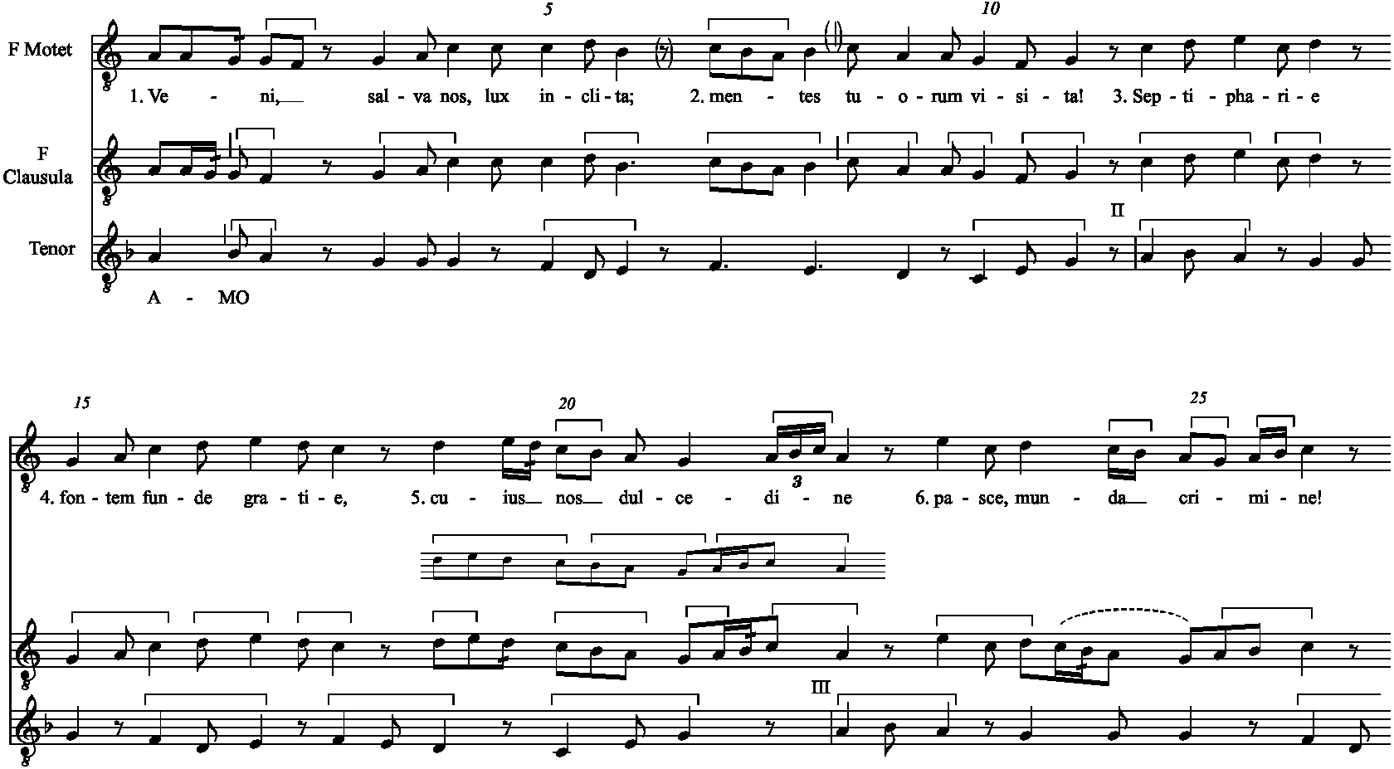
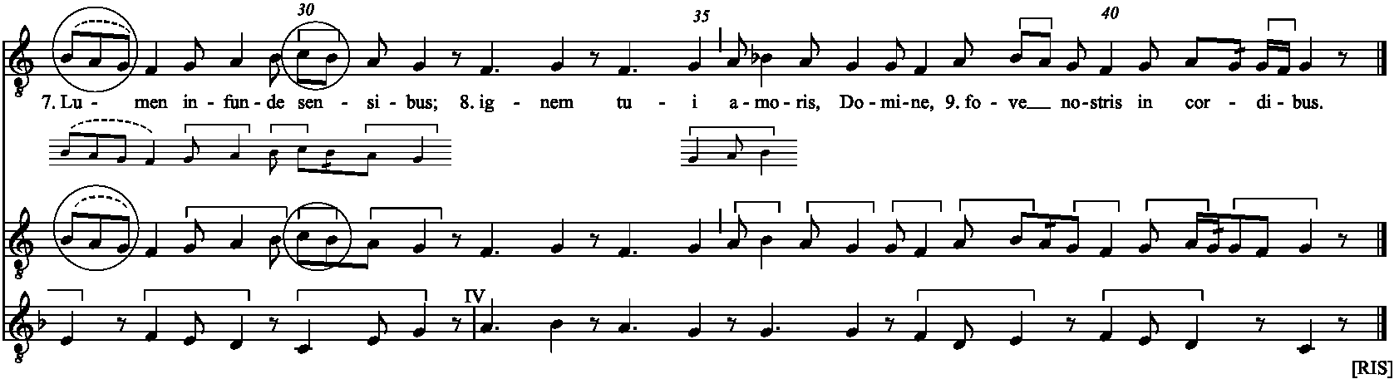
There is strong structural evidence to suggest the conception of the French text He, quant je remir in conjunction with its accompanying musical setting, which was later refashioned in the Latin motet and clausula versions preserved in F. Example 5 presents the clausula Amo[ris] 2, above which are placed the motetus voices of both Veni, salva nos and He, quant je remir. The French poem is carefully crafted, exhibiting characteristics associated with the motet enté:Footnote 78
Amo[ris] 2, F, fol. 163v–1, Motetus of Veni, salva nos amoris, F, fol. 411r, and Motetus of Por vos amie/He, quant je remir/AMORIS, Mo, fols. 124v–125v
The text employs typical enté vocabulary, the words ‘He’ and ‘Diex’,Footnote 79 and the presentation of a refrain frames the text. The first line of the refrain is stated in the opening couplet, but its completion, with the addition of the second line, occurs only at the conclusion. The very opening of the motet immediately references the refrain with the word ‘He’, and the second word, ‘quant’, sets up the -ant rhyme, which is exchanged with the refrain rhyme, -ai, throughout. Textually, the poem is clearly in three sections, each section concluding with the rhyme of the refrain. The opening couplet with its -ai rhyme closes with the first line of the refrain; the middle five lines are characterised by the -ant rhyme, but return to the -ai rhyme at their conclusion and the final two lines present the refrain in full. The text is further framed by initial and concluding nine-syllable lines. Indeed, were it not for the repetition of ‘He Diex’ at the beginning of the third section (in line 8), adding an extra two syllables to the eight-syllable line to create a ten-syllable one, the line-lengths of the final couplet would mirror those of the opening couplet.
This poetic structure is reflected in the underlying tenor structure of the motet. There are four presentations of the tenor melody,Footnote 80 grouped in such a way as to produce three distinct sections. The conclusions of the first tenor statement (at perfection 11) and of the third statement (at perfection 31) are both signalled by simultaneous breaks in the tenor and motetus parts, and by cadences on a unison G. But the end of the second presentation of the tenor at perfection 21 is not so marked: the second tenor statement moves smoothly into the third without a break, and the join is concealed by the fact that it occurs in the middle of a motetus phrase. The three resulting major points of articulation in the four-part tenor construction correspond exactly with the sectional breaks in the tripartite poetic structure of the French text. It is also noteworthy that the poetic balance of the opening and closing couplets is complemented musically: both couplets are set to a musical phrase of eleven perfections in duration.Footnote 81
This close interaction need not necessarily suggest that He, quant je remir and its music were conceived together. It would be remarkable, though not impossible, that the music of a pre-existing clausula should be so well suited to the setting of a conventional poetic form. However, the musical details of Amo[ris] 2 are, in a number of ways, unexpected in the context of the clausulae preserved in F. First, the tenor melody does not employ a strictly fixed rhythmic pattern, as is usual. While the short chant melisma is faithfully repeated, the rhythm in which its pitches are presented is subject to rather inexplicable variation. In perfections 7–9, for example, the rhythmic pattern is broken when two tenor notes are unexpectedly lengthened and there is similar disruption in perfections 31–7. The change in underlying rhythm in perfections 31–5 is particularly prominent because the upper voice moves in rhythmic unison with the tenor at this point, and the resulting unprecedented breaks in musical texture in perfections 31 and 33 are not characteristic of clausulae.
In fact, Arlt has identified the musical feature of ‘coinciding caesurae in cantus and tenor’ as typical of French motets that are not related to a clausula model.Footnote 82 And indeed all of the atypical features of this Amo[ris] clausula can be explained in the context of the French motet. Both of the disruptions to the tenor rhythm (in perfections 7–9 and perfections 31–7) underlie important structural moments in He, quant je remir: they correspond to the presentation of the words ‘He Diex’, the opening of the refrain. The curious breaks in texture in perfections 31 and 33 also appear to be linked to the refrain. The pauses reinforce and punctuate the dramatic cries of ‘He Diex, he Diex’, and the rhetorical impact of these textual repetitions is enhanced by accompanying pitch repetitions (f–g, f–g) in the motetus. It is striking that the only other ‘coinciding caesura’ in this motet (save the very end of piece) also occurs at a significant moment in the context of the French text: the break in texture in perfection 2 offsets the opening cry of ‘He, quant’, highlighting the word ‘He’, which is part of the refrain, and drawing attention to the -ant ending of ‘quant’, to be employed as a rhyme in the middle section of the motet.
Two further melodic details might also betray the influence of the French text on this musical material. The descending three-quaver melisma which occurs in perfections 7 and 27 (marked by boxes in Example 5) appears only twice in this motet. On both occasions this melodic figure is associated with the appearance of the ‘He Diex’ refrain text, set to the word ‘He’ in perfection 7 and ‘Diex’ in perfection 27. It is also noteworthy that the initial presentation of the refrain, which marks the close of the first section in perfections 9–11, concludes with the pitches a–g–f–g (marked by a dashed box in Example 5). This exact sequence of pitches is reiterated at the close of the French motet in perfections 40–2 (also marked in Example 5).
Significantly, every mark of musical punctuation in the clausula Amo[ris] 2 also corresponds with the text He, quant je remir. In both clausulae and motets vertical lines are used not only to show rests, but also to mark breaks and punctuations of text and/or music (these vertical lines are reproduced in Example 5).Footnote 83 In clausulae and organa such lines often indicate syllable changes in the tenor text, as seems to be the case in perfection 1 of Amo[ris] 2.Footnote 84 In the duplum of the Amo[ris] clausula there are two occasions, in perfections 8 and 35, on which vertical lines cannot mean rests, nor do they correspond to syllable changes in the tenor. In both cases the musical breaks coincide with the exclamation ‘He Diex’ in the French motet text. While the break in perfection 35 of the clausula could be explained in purely musical terms as punctuating the strong cadence on a unison G, the articulation in perfection 8 would be more difficult to justify simply in the context of the untexted clausula.Footnote 85
These marks of musical punctuation found in Amo[ris] 2 are also evident in the motetus of Veni, salva nos in F, even though such punctuations do not complement the Latin text. In perfection 35, for example, the break after ‘tui’ is inexplicable in the context of Veni, salva nos, while the line of punctuation in perfection 8 of the motetus meaninglessly interrupts the presentation of the poetic line ‘mentes tuorum visita’. This line in perfection 8 of the motet was subsequently erased (and thus is placed in round brackets in Example 5).Footnote 86 However, the mere fact that it was present at all in this Latin motet might be revealing.
In general, the close structural music–text relationship evident in He, quant je remir/AMO[RIS] contrasts with the less convincing music–text dynamic of Veni, salva nos/AMO[RIS]. The poetic sections of the Latin text do not correspond so neatly with musical divisions: the musical parallel between the endings of the first and third tenor statements that is reflected in the French text is, conversely, obscured in the Latin. Instead of echoing the rhyme at perfection 11 (line 2), a new rhyme -us is introduced at the close of the third tenor statement at perfection 31 (line 7). Textually, the structural break in the music at the end of the third tenor statement is further concealed by the fact that it is straddled by a sense unit: the line ‘Lumen infunde sensibus’ belongs syntactically to the final two lines of text. In fact, the second major poetic articulation in the Latin text pre-empts the second musical articulation at the end of the third tenor cursus in perfection 31. It occurs instead after ‘pasce, munda crimine!’ in perfection 26, at a weaker musical cadence. More significant still, the remarkable musical punctuations in perfections 31–5 do not complement a rhetorical effect in this motet text. The breaks in the texture distort the Latin text, fracturing the line ‘ignem tui amoris’; although one semantic unit, it is broken after each word. It is, therefore, unlikely that the music of Amo[ris] 2 was influenced by, or designed for, the Latin motet version in the same manuscript.Footnote 87
The musical structure of Amo[ris] 2 is difficult to comprehend without reference to features of the French text He, quant je remir and its repeated refrain. The appearances of this refrain seem to dictate the movement of both tenor and duplum voices, whose coinciding caesurae and – in the case of the tenor – changes in rhythmic pattern would otherwise be inexplicable and uncharacteristic. It appears that the musical fabric of Amo[ris] 2 was conceived in conjunction with the French text He, quant je remir. In addition, the related Latin motet also demonstrates the effects of this French text, to the extent that the presentation of its own text is compromised. There seems, therefore, little reason to doubt that Veni, salva nos is a contrafactum of He, quant je remir, and that the clausula Amo[ris] 2 is essentially a transcription of a newly composed French motet.
Clausulae as transcribed motets?
As noted above, the priority of Amo[ris] 2 was challenged as early as 1954 by William Waite, who included it among twenty-one clausulae identified as ‘transcribed motets’ (unspecified as to French or Latin) purely on notational grounds.Footnote 88 Waite believed that the generally irregular ligation in clausulae, the careless texting of the tenor voice and a lack of syllable strokes in the tenor resulted from the translation of unligated cum littera motets into sine littera clausula notation. Waite's proposal was initially accepted by both Hans Tischler and Norman Smith.Footnote 89 Rudolf Flotzinger, writing in 1969, dismissed the possibility that these clausulae derived from related motets, and he was sceptical of Waite's observations concerning the texting and punctuation of tenor chants, referring to other instances of such errors and omissions, and thereby demonstrating that they were relatively common.Footnote 90 But Flotzinger acknowledged that the melodically ornate dupla of Waite's clausulae were difficult to express in modal notation, identifying seven further clausulae similar to those listed by Waite.Footnote 91 He suggested that these clausulae were indeed conceived as clausulae, but in mensural notation that was then translated back, with difficulty, into the modal system.Footnote 92 Waite's proposal was, however, rejected outright by Gordon Anderson in 1970,Footnote 93 and has – save a sympathetic reappraisal from FrobeniusFootnote 94 – subsequently been rather overlooked.Footnote 95
In the case of Amo[ris] 2, not all of Waite's criteria are relevant. The tenor texting in this clausula is correct: the change to the syllable ‘-mo’ of ‘Amoris’ in perfection 1 occurs at the appropriate point in the chant melody and is marked by a syllable stroke in both tenor and duplum. Nor is the tenor text incomplete, for the syllable ‘-ris’ of ‘amoris’ occurs only at a later point in the chant melody, not included in the clausula. At three moments in the clausula duplum, however, ligature patterns are, as Baltzer has also noted, irregular.Footnote 96 It is significant that more conventional ligature patterns could have been employed at these moments, but they were not. Example 6 shows the motetus of Veni, salva nos above the Amo[ris] 2 clausula in F. For the three passages that are irregularly ligated, an alternative, more conventional way of recording this rhythm in sine littera notation is presented directly above the clausula duplum.
Amo[ris] 2, F, fol. 163v–1 (with alternative ligations shown above the duplum), Motetus of Veni, salva nos/AMO[RIS], F, fol. 411r
The three notational irregularities in Amo[ris] 2 could be explained if this clausula represents a translation from cum littera motet notation. The expected ligature pattern in perfections 35–6, for example, was interrupted by the intervening mark of punctuation which, as noted above, offsets the presentation of the exclamation ‘He Diex’ in the French motet text. Similarly, the irregular ligation of the clausula in perfections 27–31 might have been encouraged by the ligation in the related motet version. Two features of this clausula notation are irregular: the use of a descending three-note ligature in perfection 27 and of a two-note c′–b ligature in perfection 30 (both circled in Example 6). This could result from the preservation of motet ligation. These ternaria and binaria in the motet simply demonstrate that three or two notes are to be sung to the same syllable, but they do not make notational sense in the context of the clausula, and they prevent the application of a more conventional ligature pattern.
In perfection 19 of the clausula duplum the descending plica figure, also notated as a plica in the related motet versions, proved problematic. This plicated note (presumably a d′) ought to have been incorporated within a four-note ligature in order to show the desired rhythm conventionally. However, the use of a plica naturally made it impossible to show this pitch in the middle of a ligature. It is of no notational consequence in the cum littera motet whether this figure is expressed as a plica or a two-note ligature. But the ligature patterns of the clausula are affected by the choice to include this pitch d′ as a plica, rather than as a notated d′. The presence of a plica challenges the conventional notation of this phrase sine littera, and this initial irregularity in ligation in perfection 19 seems to have encouraged further error in the continuation of the phrase.
The proposition that Amo[ris] 2 represents a transcription of a cum littera motet would account, at least partially, for its notational irregularities. Such a hypothesis would also explain certain rhythmic variants existing between clausula and motet versions of this music. The openings of the clausula and the Latin motet in F, for example, are identically ligated, but this ligation is subject to different interpretations according to the conventions of cum and sine littera notations, producing a difference in rhythm. Similarly, the clausula and motet imply different rhythms in the final two perfections of the piece, but once again they are alike notationally, both containing a downwards plica and both grouping together the antepenultimate and penultimate pitches, g and f. Further rhythmic disagreements in perfections 21–6 might also be explained through their notations. The different rhythm of the clausula in this passage could represent the closest approximation possible in sine littera notation to the rhythms clearly implied in the motet versions.
Baltzer, commenting on these rhythmic disparities between clausula and motet in perfections 21–6, came to the opposite conclusion: that the clausula rhythm had been adjusted in the Latin motet to accommodate the ‘disposition of syllables’ in the added text.Footnote 97 The question of rhythmic variants between clausulae and motets, and the possible harmonic consequences of such rhythmic variants, will be explored further in the example that follows. But given the purely musical arguments in favour of the ultimate priority of a French motet version in this case, Baltzer's explanation is unconvincing. Furthermore, it is puzzling that the clausula and motet in F should disagree rhythmically when they are so closely related in terms of pitch. There are no melodic variants between the clausula and Latin motet in F: in Veni, salva nos not a single pitch of the Amo[ris] 2 clausula is removed, nor are any new notes introduced. That pitch should remain entirely constant while rhythm is subject to variation further supports the proposition that the clausula is indeed a translation from a cum littera motet model, and that the rhythmic variants were therefore unintentional. Cum littera, as a notational system, necessarily privileges pitch over rhythm; details of pitch, and the sequence of pitches, are unambiguous. Rhythmic information is not prescribed, but must be gleaned from text accentuation and context.
Given the close correspondence in pitch between Amo[ris] 2 and Veni, salva nos it is plausible that these two incarnations of the same musical material were copied from a common exemplar. The derivation from a common exemplar is also supported by their shared marks of musical punctuation. As already noted, these shared marks of musical punctuation seem unnecessary and inappropriate in the context of both the clausula and the Latin motet. This might, in turn, suggest that (as in the case of Error popularis) the shared exemplar from which the two pieces in F were derived was, in fact, a version of the French motet, He, quant je remir. That not only a liturgically appropriate Latin motet, but also a clausula, presented in the main collection of F and ordered strictly according to the liturgical calendar, might be descendants of a ‘secular’ French motet preserved in a manuscript as late as the Montpellier codex challenges existing preconceptions of F, as well as of the relationship between clausulae and motets.
Refrain melodies in clausulae
I have argued that the musical structure of the motet He, quant je remir and of its related clausula Amo[ris] 2 was strongly influenced by presentations of a French refrain. The refrain ‘He Diex, encore l'amerai, qu'autre de li amer ne savrai’ (vdB 815), with its accompanying melody, is found exclusively in the family of motets and the clausula related to He, quant je remir. ‘He Diex, encore l'amerai’ clearly functions as a refrain in the structural context of this motet. Yet its status as a refrain, in the sense of ‘an agent of intertextuality’,Footnote 98 a musico-textual phrase that is borrowed and cited in different contexts, remains in doubt.Footnote 99
Initial scholarly understandings of refrains emphasised two principal characteristics: their importance as citations or quotations, and their origins in the rondet and rondeaux repertories.Footnote 100 These understandings have now been revised.Footnote 101 Both Mark Everist and Jennifer Saltzstein have demonstrated that the vast majority of music–text units catalogued as refrains by Nico van den Boogaard and Friedrich Gennrich are in fact unique;Footnote 102 thus they are lacking the aspect of citation considered to be so central to the identity of refrains.Footnote 103 Saltzstein has continued to undermine the idea that refrains must always originate in monophonic chansons,Footnote 104 recently drawing attention to the corpus of ‘intertextual’ (i.e. non-unique) refrains that ‘circulate in the motet repertory alone, with no surviving connection with monophonic song’.Footnote 105 It is now, therefore, generally accepted that many refrains could have been newly created in motets, and need not represent citations ultimately derived from the chanson repertory.
This revised view of the origins of refrains happily accounts for the presence in several ‘liturgical’ clausulae of melodies associated with refrain texts in rondeau and motets.Footnote 106 The appearance of refrain melodies, supposedly from vernacular song, in the context of clausulae had previously perplexed scholars: it concerned Yvonne Rokseth,Footnote 107 and lay at the heart of Frobenius's reversal of the traditional clausula-to-motet chronology.Footnote 108 Everist, Suzannah Clark, and Saltzstein, by contrast, are now prepared to accept that these melodies originated in clausulae and became refrains only in the process of texting the pre-existent clausula to make a motet.Footnote 109 Indeed, Clark and Everist are of the opinion that ‘one of the most widely disseminated refrains’ of the thirteenth century (‘C'est la fin, la fin, que que nus die j'amerai’, vdB 338, to be discussed in detail in the following example) ‘seems to have originated in a clausula’.Footnote 110 Everist emphasised its potentially ‘complex’ origins, proposing that this refrain ‘may be the result of texting a clausula with a Latin text and only subsequently creating a French contrafactum. The music of the refrain would then have undergone two textings before reaching the form in which it circulated as a refrain.’Footnote 111 Through this reversal of the traditional refrain chronology – the refrain now proceeding from motet to chanson – another traditional chronological narrative is permitted to remain unchallenged: the progression from clausula to motet.
A nuanced understanding of the origins of refrains, permitting reversal of the conventional narrative in certain cases, could usefully be developed also with regard to clausulae and motets. Examples such as the Amo[ris] 2 clausula and the [Domi]ne 5 clausula discussed by Büttner (with its intertextual refrain, vdB 314, cited in three different French motets and a rondeau-motet) challenge the currently accepted clausula–refrain relationship, which typically preserves the priority of clausulae. While refrain melodies may indeed have originated in clausulae in some cases, this hypothesis arose, at least partly, out of a desire not to ‘give greater weight to the pre-existence of the refrains than to the clausulae’.Footnote 112 Now that the necessary pre-existence of both refrains and clausulae has been undermined, there is scope for an investigation of individual cases that remains deliberately open to two possibilities: that a refrain was born in the process of texting an existing clausula, or that a clausula contains a refrain melody as a result of association with a French motet.
Stirps iesse/virga cultus, quant revient/l'autrier jouer and flos filius e[ius] 3
The three-voice clausula Flos filius e[ius] 3 is unique to F and has a related Latin double motet in the same manuscript, Stirps Iesse/Virga cultus/FLOS FILIUS E[IUS], also unique to F. This clausula and Latin motet in F are part of a large family of pieces that shares the same musical material, variously associated with a number of different Latin and French texts. The extant incarnations of Flos filius e[ius] 3 are as follows (the order does not imply a chronology):
Three-voice clausula on FLOS FILIUS E[IUS], Flos filius e[ius] 3: F, fol. 11r–v
Latin double Latin motet Stirps Iesse/Virga cultus: F, fols. 409v–410r
Two-voice Latin motet Candida virginitas: W2, fols. 145v–146r (marginal incipit ‘Autrier jour’); LoC, fol. 1r–v
French double motet Quant revient/L'autrier jouer: W2, fols. 206v–207r; R, fol. 206v; N, fols. 185v–186r
French triple motet Plus belle que flor/Quant revient/L'autrier jouer: Mo, fols. 26v–27v; Cl, fols. 377v–378r
French two-voice motet L'autrier juer, with text only of Virgo viget melius copied above: Ca, fol. 131v
Latin double motet Claustrum pudicie/Virgo viget melius: Hu, fol. 116r; Ba, fol. 60v
Motetus only, Virgo viget melius: Bol, fol. 8r
Franco (Ars cantus mensurabilis musicae, ch. 5, ex. 6) quotes the beginning of the motetus with the text incipit ‘Virgo viget melius’Footnote 113
Franco also (Ars cantus mensurabilis musicae, ch. 11, ex. 73) quotes the beginning of the motetus and tenor with the text incipit ‘Virgo viget melius’.Footnote 114
The French texts Quant revient and L'autrier jouer are transmitted together in five difference sources, and are most commonly associated with the music of Flos filius e[ius] 3. Furthermore, as Anderson has emphasised, the two-voice motet Candida virginitas/FLOS FILIUS EIUS, extant in W2 and LoC, is evidently a contrafactum modelled on the text L'autrier jouer, rather than on Virga cultus or Virgo viget melius.Footnote 115
Flos filius e[ius] 3 and its related motets have received considerable scholarly attention. Yet, aside from the brief analysis of this clausula by Wolf Frobenius,Footnote 116 the assumed conventional progressions from clausula to motet and from Latin text to French contrafactum have not otherwise been questioned.Footnote 117 Everist discusses Stirps Iesse/Virga cultus/FLOS FILIUS E[IUS] and Quant revient/L'autrier jouer/FLOS FILIUS EIUS in detail in French Motets in the Thirteenth Century,Footnote 118 and this motet family is also the main focus of Alejandro Enrique Planchart's 2003 article, ‘The Flower's Children’.Footnote 119 Neither scholar seems to have doubted the priority of the clausula, Flos filius e[ius] 3. While Everist is cautious about the relative chronology of its related motets, Planchart is strongly in favour of Stirps Iesse/Virga cultus/FLOS FILIUS E[IUS] as the earliest texting of the clausula, his preference based on the unreliable hypothesis that this Latin motet most closely tropes the tenor chant.Footnote 120 Planchart takes no account of the presence of a widely transmitted refrain melody, ‘C'est la fin, la fin, que que nus die j'amerai’ (vdB 338) in this clausula and its motets. By contrast, both Everist and Clark, as already noted, cite ‘C'est la fin, la fin’ as an important example of a clausula-derived refrain, which, as Everist suggests, may initially have been associated with a Latin text.
Notational and musical features of Flos filius e[ius] 3 invite a challenge to the conventional chronological model underlying Planchart's analysis and Everist's proposal concerning the origins of refrain 338. Stirps Iesse/Virga cultus/FLOS FILIUS E[IUS] is placed near the end of the second motet fascicle of F, in close proximity to other possible Latin contrafacta of French motets. This Flos filius e[ius] motet family exhibits characteristics also shared with the family of Amo[ris] motets discussed above. Not only does F preserve a unique clausula and a unique Latin motet version, but it is once again texts in the vernacular that are most frequently found in association with the musical material.
Musically, Flos filius e[ius] 3 is strongly characterised by the ‘small-note ornaments or embellishments’ typical of newly composed French motets, but relatively unusual in the context of clausulae, and difficult to express in sine littera notation.Footnote 121 The clausula tenor lacks syllable marks and the corresponding text is not presented at the appropriate moments in the tenor chant: the words ‘Flos filius e’ are simply placed at the beginning of the clausula. The final syllable ‘-ius’ of ‘eius’ was never copied, nor is there a syllable stroke to indicate where it should have been placed. An initial attempt to show the relationship of the three voices to one another using lines to mark the corresponding ordines seems swiftly to have been abandoned. Ordo lines in the triplum and duplum quickly cease to appear (though two are present in both upper voices in the opening phrase of the clausula), probably because the duplum and the triplum voices are poorly aligned throughout.
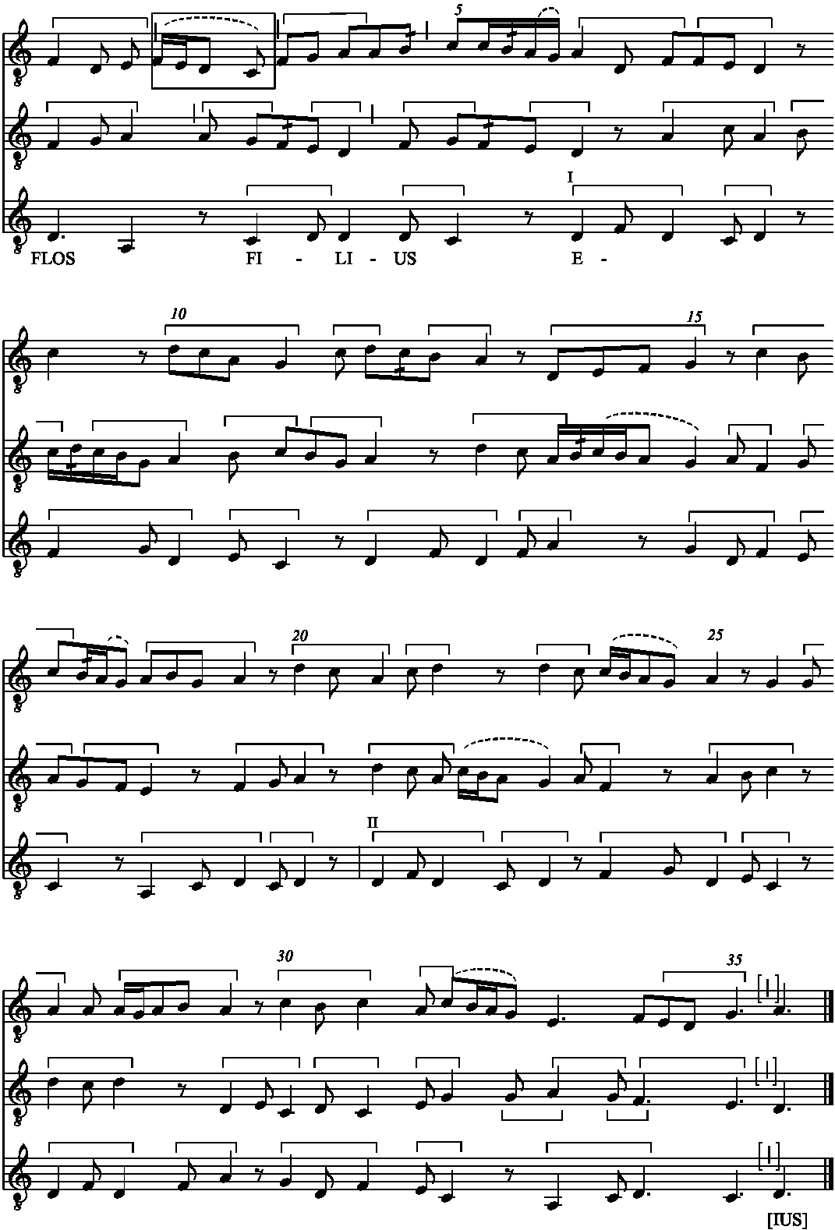
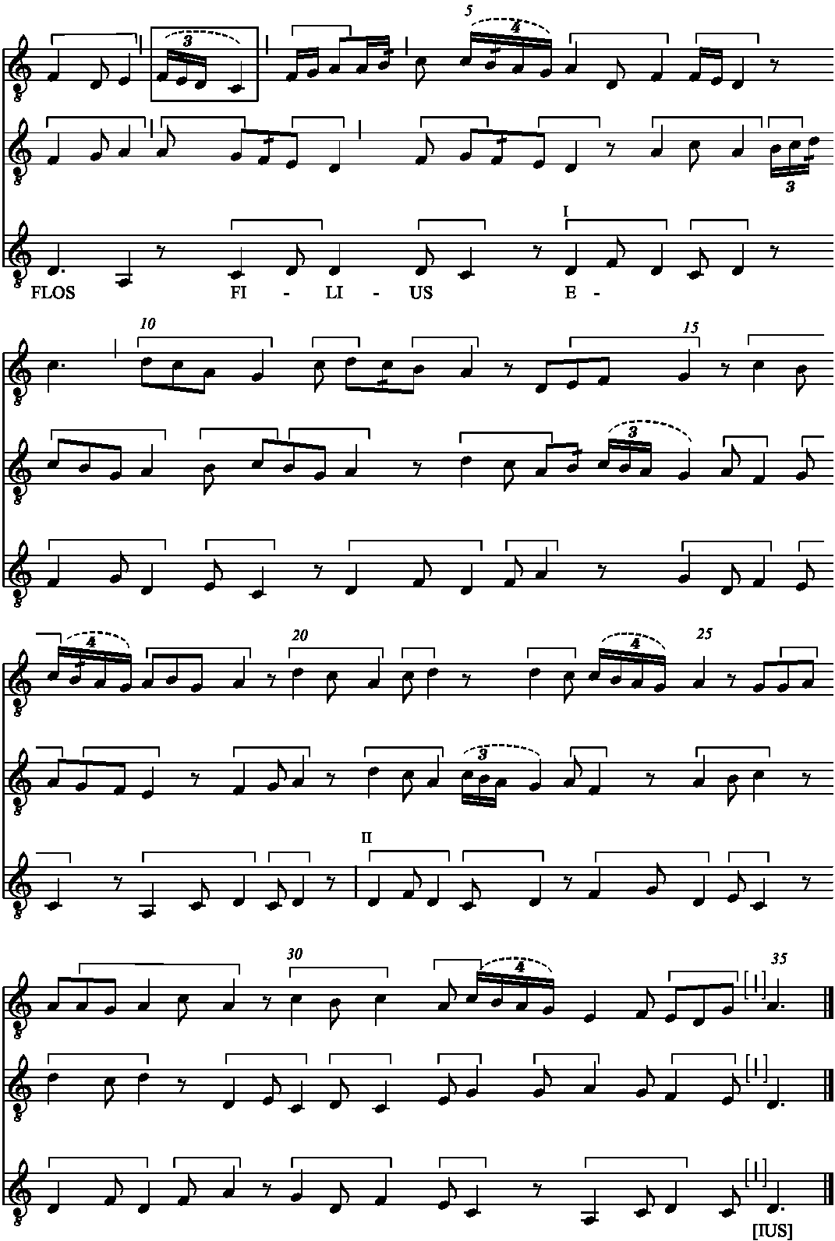
Notationally, the clausula is occasionally problematic. The ligation of perfections 32–4 of the duplum, for example, appears to be erroneous (see Example 7, where the conventional alternative is shown directly underneath the duplum).Footnote 122 Hans Tischler has commented on the notational ambiguity of this clausula,Footnote 123 and Edward Roesner concurs, stating that Flos filius e[ius] 3 contains ‘extensive fractio modi, expressed in notation that is sometimes equivocal and capable of sustaining several different interpretations of the rhythmic detail’.Footnote 124 Roesner's statement is confirmed by comparing the differing readings of this sine littera notation offered by Planchart (see Example 7)Footnote 125 and by Roesner himself (see Example 8).Footnote 126 This clausula displays, therefore, the hallmarks of a transcribed French motet: its notation is equivocal, the tenor is not properly texted and lacking in syllable marks, and the musical fabric is more characteristic of a newly composed French motet than a clausula.Footnote 127
Transcription of Flos filius e[ius] 3 (F, fol. 11r–v), after Planchart
Transcription of Flos filius e[ius] 3 (F, fol. 11r–v), after Roesner
Significantly, Flos filius e[ius] 3 and Stirps Iesse/Virga cultus/FLOS FILIUS E[IUS] bear a strong resemblance to the clausula–motet pair Amo[ris] 2 and Veni, salva nos/AMO[RIS], not only in their patterns of manuscript dissemination and concordance. Just like Amo[ris] 2 and Veni, salva nos, the copies of Flos filius e[ius] 3 and Stirps Iesse/Virga cultus in F are very closely related. Flos filius e[ius] 3 and Stirps Iesse/Virga cultus agree almost entirely as to pitch,Footnote 128 and seem to have been copied either in conjunction or from the same exemplar. Planchart also noted this close correspondence between the clausula and motet in F. Assuming a clausula-to-motet progression, he argued that ‘the clausula exemplar for the motet version was precisely the clausula as copied in F’.Footnote 129
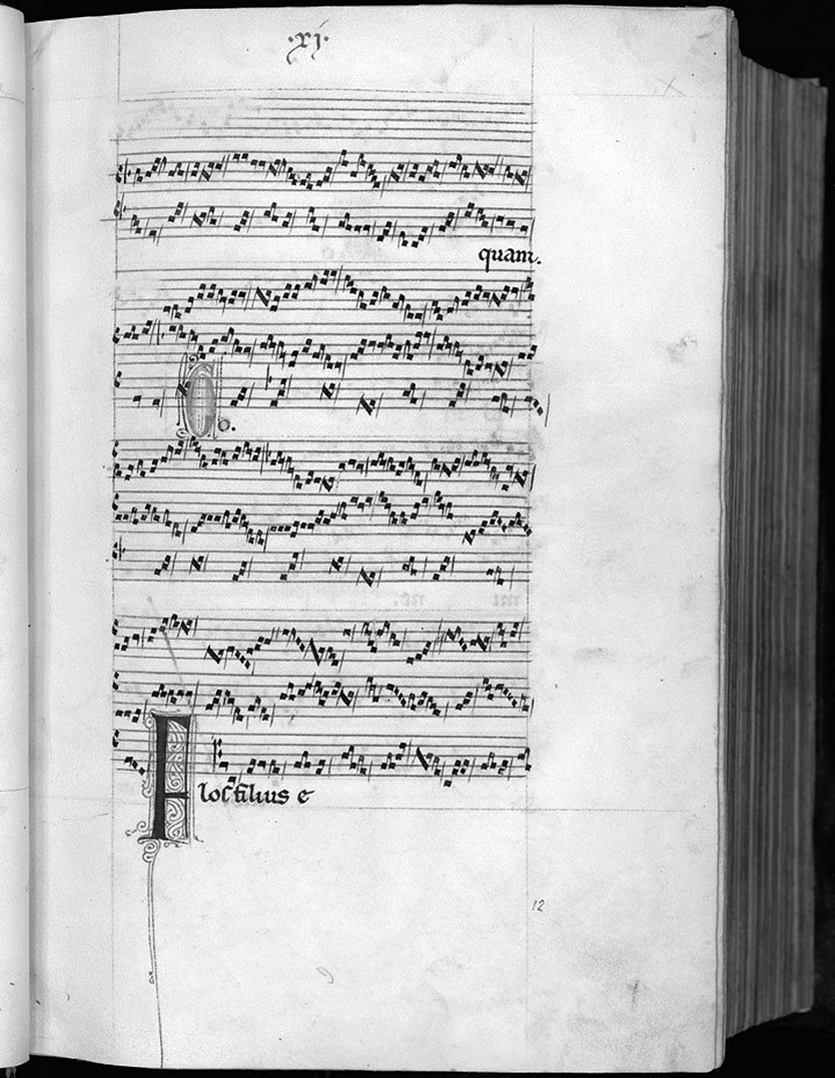
Yet, as in the relationship between Amo[ris] 2 and Veni, salva nos, a number of rhythmic variants exist between Flos filius e[ius] 3 and Stirps Iesse/Virga cultus. Variations in rhythm between the F clausula and motet on FLOS FILIUS E[IUS] are more numerous and significant than those found in the clausula and motet on AMO[RIS]. Despite notational ambiguities in the Flos filius e[ius] clausula, there are occasions when, in whatever ways one interprets the precise rhythmical details, a conventional reading of the clausula ligation clearly places a certain note at the beginning of a rhythmic perfection when this is not the case in the related motet. At the opening of the triplum, for example, the clausula ligation indicates that the third perfection has to begin with the pitch c. This note is placed at the end of a ligature, therefore it must fall at the beginning of a perfection, as it does in both Planchart and Roesner's transcriptions of perfections 2–3 (marked in Examples 7 and 8 respectively; see also the facsimile of F, fol. 11r in Figure 1 below).
Facsimile of F, fol. 11r: end of Tanquam 12; [Vir]go 2; beginning of Flos filius e[ius] 3
The Latin motet in F, however, clearly incorporates this c as part of a melisma on the syllable -gre of ‘progreditur’, with the result that it cannot possibly be placed at the beginning of a perfection (marked in Example 9). This forces a different reading of this phrase from the related clausula. The difference in F between the Latin motet and the clausula, explicit in both their respective notations, results in what Planchart describes as a change in ‘vertical sonority’.Footnote 130 Differences of vertical sonority between clausula and motet versions occur, not only at the opening of the triplum, but also at the beginning of a perfection on five further occasions. Example 9 indicates variant clausula sonorities, as interpreted by both Planchart and Roesner, above the relevant staves of the Latin motet.Footnote 131
Stirps Iesse/Virga cultus/FLOS FILIUS E[IUS], F, fols. 409v–410r (with clausula variants producing changes in vertical sonority shown above the relevant staves)
Such disagreements in ‘vertical sonority’ are difficult to explain if one accepts Planchart's proposition that the motet in F was copied from the related clausula in the same manuscript. One would have to conclude that the rhythmic and harmonic character of the clausula was actively altered in its related Latin motet, directly contradicting certain unambiguous rhythmic information provided by the clausula. While Norman Smith has demonstrated that slight rhythmic changes could be made to clausulae in the process of creating motets, none of Smith's examples is so drastic as this one.Footnote 132 It is hard to justify the proposition that rhythmic adjustments were made to the Flos filius e[ius] 3 clausula simply in order to accommodate motet texts: the variant rhythms in the motet do not have a dramatic impact on the text setting, and the extant Latin (or French) motet texts could have been fitted to the rhythms implied in the clausula without any need for the addition or removal of notes. The changes to the vertical sonority of the clausula, then, would seem an unusual and a high price to pay for a relatively small textual gain. In addition, it is perplexing that the creator of the motet in F should have been so faithful to the pitches of the clausula, while conversely treating its rhythmic details with freedom, effecting changes that altered the harmonic character of the borrowed musical material.Footnote 133
Significantly, all other French and Latin motet versions of this music correspond with the vertical sonorities of the Latin motet in F rather than those of the clausula. If these motets were the offspring of the Flos filius e[ius] 3 clausula it would be curious that this large family of motets should rely on, and consistently reproduce, misreadings of its clausula model. This would also assume a clausula–motet relationship entirely dependent on written notation, for an aural memory of the Flos filius e[ius] 3 clausula, were it pre-existent, would surely have prevented its widespread corruption in related motets.
The opposite hypothesis seems more convincing: as in the case of Amo[ris] 2, the Flos filius e[ius] 3 clausula represents a transcription of a cum littera motet. This would explain irregular notational features of the clausula, also accounting for the consistency of pitch between the clausula and motet version in F in combination with discrepancies in rhythm. It is almost impossible to show all of the rhythms clearly implied in the motets in sine littera clausula notation. The beginning of the triplum Stirps Iesse discussed above, for example, would have been very difficult to transcribe in ligatures without abandoning the passing note d on the syllable -gre. To notate this opening phrase sine littera either the d must be omitted or the rhythm of the motet slightly altered. If the creator of this clausula were working from a series of unligated pitches in a motet, and his priority was faithfully to reproduce these pitches, then the notational solution for a sine littera representation of the opening triplum phrase would be precisely that as found at the opening of the clausula triplum (see the facsimile below in Figure 1). That the scribe of the clausula in F encountered difficulties in the copying process is evidenced by the misalignment of parts and the erroneous ligation at the end of the duplum. Such difficulties could easily arise if he was working with, and translating into sine littera, a cum littera motet, shown in parts rather than in score, whose musical fabric was conceived in relation to a different notational system.
It is most likely, therefore, that the music of the Flos filius e[ius] 3 clausula originated as a motet. The question remains as to whether this motet was conceived in conjunction with the Latin texts Stirps Iesse/Virga cultus or the French texts Quant revient/L'autrier jouer.Footnote 134 These Latin and French texts appear to be related, with identical syllable counts and shared aspects of rhyme scheme (the alternation of rhyme in lines 5–7 of the triplum, for example, or the use of internal rhyme in line 9 of the motetus):Footnote 135
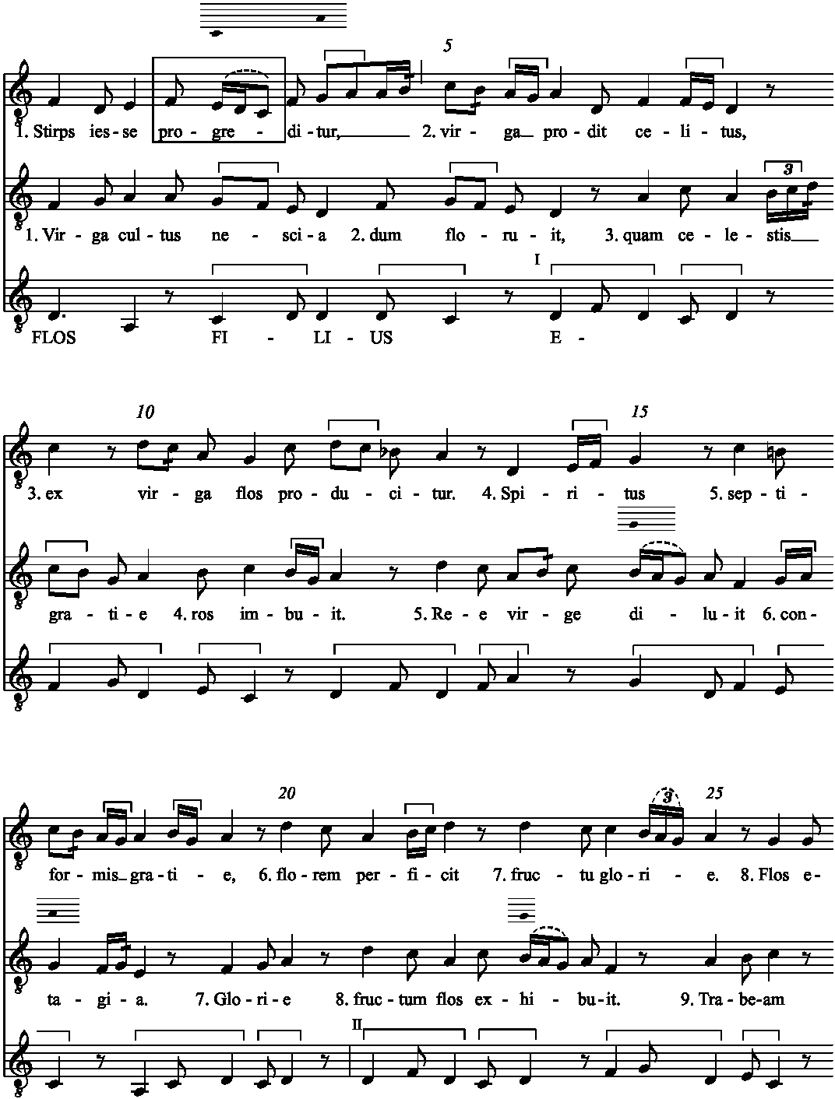
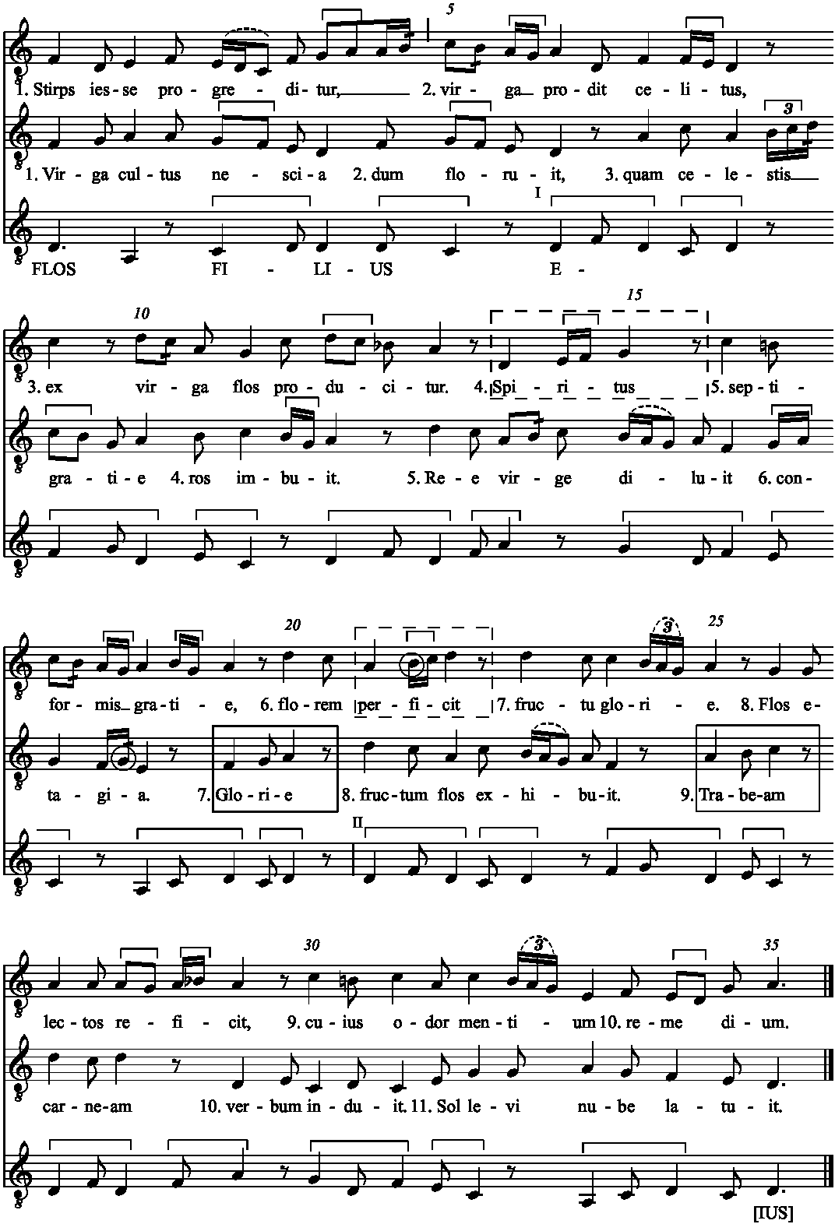
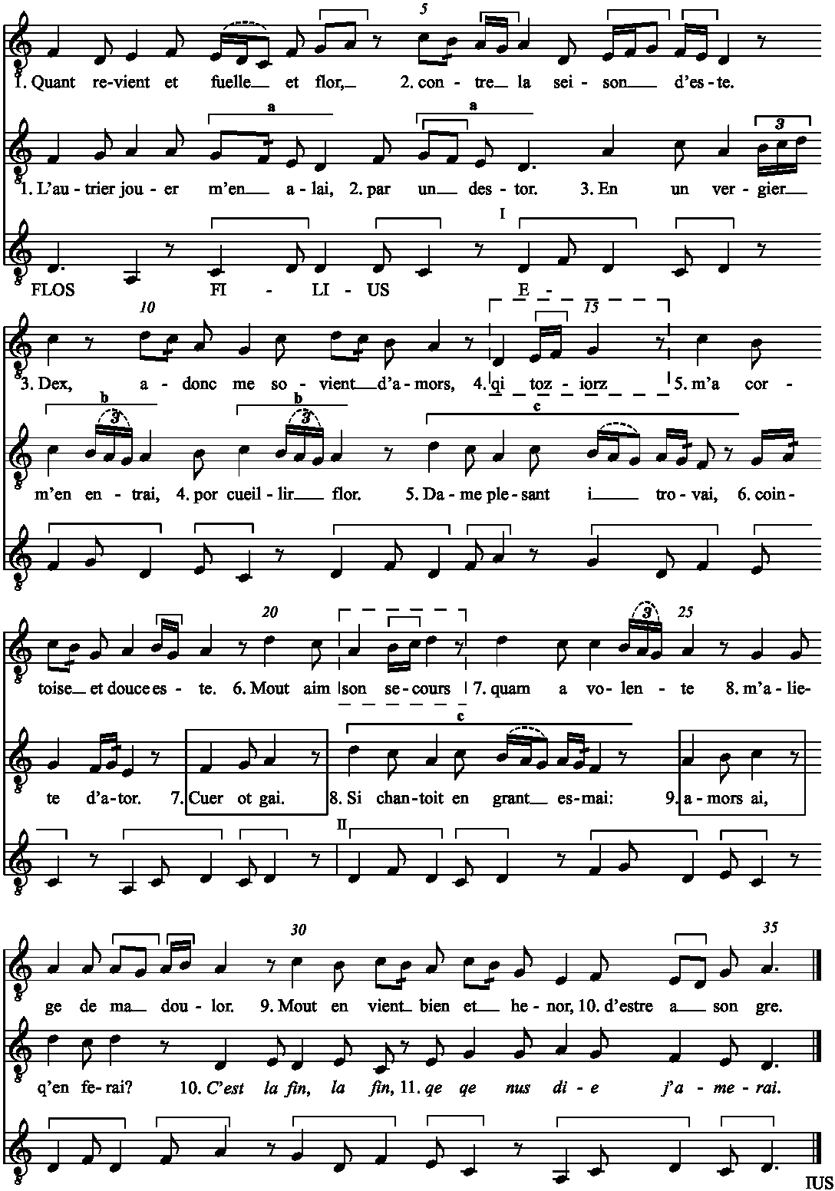
The music of Stirps Iesse/Virga cultus/FLOS FILIUS E[IUS] and Quant revient/L'autrier jouer/FLOS FILIUS/E[IUS] is shown in Examples 10 and 11 respectively.
Stirps Iesse/Virga cultus/FLOS FILIUS E[IUS], F, fols. 409v–410r
Quant revient/Lautrier jouer/FLOS FILIUS E[IUS], W2, fols. 206v–207r
The musical presentation of Quant revient and L'autrier jouer is arguably more convincing than that of Stirps Iesse and Virga cultus. The French texts are better suited to the quite sectionalised musical delivery in both voices, while semantic units of the Latin texts sometimes span breaks in the melody (as in lines 4–7, perfections 14–25, of the triplum, for example). Musical and textual correspondence is closer in the French motet. The rhymes of two phrases in perfections 19–20 and 25–6 of the French motetus, ‘cuer ot gai’ and ‘amors ai’, reflect textually their musical correspondence, while the Latin motetus has ‘glorie’ and ‘trabeam’ (marked by boxes in Examples 10 and 11). Similarly, the half-rhyme of two triplum phrases at perfections 14–15 and 21–2 in the French motet, ‘qi toziorz’ and ‘son secours’, underlines the musical parallel between these two phrases better than the words ‘spiritus’ and ‘perficit’ in the Latin motet triplum (marked by dashed boxes in Examples 10 and 11).
In addition, the music of perfections 25–8 complements the French text ‘amors ai, q'en ferai?’ very well, with the rising musical phrase mimicking the question ‘what shall I do’? The introduction of the refrain ‘C'est la fin, la fin’ is then set apart musically from this question by the drop of an octave. This shift in register at perfection 29 highlights the presence of the refrain, perhaps also drawing attention to its status as a quotation, and marking the slight change in poetic register. In the Latin motetus, the words ‘trabeam carneam verbum induit’ are set to the music of perfections 25–31. This represents a single sense unit; however, the semantic unit is interrupted musically after ‘carneam’ by the break of an octave between perfections 28 and 29. Though ‘trabeam carneam’ mirrors the internal rhyme of ‘amors ai, q'en ferai?’, the rhetorical impact of the French text at this moment is arguably greater.
The music of the motetus in particular, then, suggests that it was conceived in conjunction with its accompanying French text. This is further confirmed by the song-like construction of the motetus melody, comprised of pairs of repeated melodic figures (indicated by letters in Example 11). While the repetition of melodic patterns is common in clausulae, such repetition is usually of a rather different type, involving the exhaustive exploitation, rhythmic manipulation and transposition of melodic motifs in different harmonic contexts.Footnote 136 In L'autrier jouer the melodic repetitions are cleverly integrated with the underlying tenor melody, but they are never rhythmically altered and only once (between perfections 19–20 and 25–6) is a repeated motif transposed. Such a motetus voice, in which melodic repetitions preserve details of rhythm and pitch-level and are, in consequence, clearly audible, is more typical of a vernacular song than of a Latin motet or clausula.
It is feasible not only that the music of Flos filius e[ius] 3 originated in conjunction with the texts Quant revient and L'autrier jouer,Footnote 137 but also that the exemplar from which the clausula and Latin motet in F were copied was a version of this French motet. This is supported by the context in which Flos filius e[ius] 3 appears in F. The clausula is found in a ‘little appendix’ of three-voice pieces (six clausulae and three organa) beginning on folio 10v, seemingly tagged onto the end of the first fascicle of F after four-voice organum and conductus settings.Footnote 138 An organising principle for these three-voice works is not immediately apparent, and their sequence is not liturgical. Yet various links between the initial three clausulae may be discerned. The first three clausulae in this group, their motet concordances in F and W2, and any refrain citations are as follows (see Figure 1 for a facsimile of fol. 11r):
The multiple connections between these initial clausulae in the appendix seem too marked to be purely coincidental. All three of these clausulae are unica in F, and all are related to motets associated with French texts in W2. Furthermore, the dupla of [Vir]go 2 and Flos filius e[ius] 3 contain melodies associated with French refrains in their concluding phrases.Footnote 141 The notational irregularities of Tanquam 12 and Flos filius e[ius] 3 were also noted by both Hans Tischler and Edward Roesner,Footnote 142 and more recently Ann Katrin Zimmermann has observed that ‘these clausulae at the end of the first fascicle of F vary significantly from untexted three-voice passages of discant’: she stated that the nature of their three-part texture (‘Dreistimmigkeit’) seemed to ‘emerge out of the context of motets’.Footnote 143
Tanquam 12 and Flos filius e[ius] 3 are strong candidates for ‘transcribed motets’,Footnote 144 independently of any suspicion that they might be part of a ‘little appendix’ of works of this type; and the fundamental priority of the clausula [Vir]go 2 over its related motet versions has also been challenged.Footnote 145 While the rest of this group of pieces at the end of fascicle 1 lack related motets, the choice and order of the first three clausulae is potentially significant. Their appearance alongside one another in F could be explained if they were copied in conjunction with a French motet source. The first line of text of the (uncopied) triplum of the French motet on TANQUAM is Quant nest la flor,Footnote 146 the motet on [Vir]go 2 is Por conforter mon corage, and the motet triplum on Flos filius e[ius] 3 is Quant revient et fuelle et flor. As these three texts begin with ‘Q’ and ‘P’ they would probably have been neighbouring pieces in an alphabetically ordered collection of French motets.Footnote 147 The disturbance to the alphabetical ordering of these pieces in F (where the clausula corresponding to Quant nest la flor appears before that for Por conforter mon corage) could have resulted from a desire to begin the appendix appropriately with a clausula on TANQUAM, the Christmas tenor that also opens the first motet fascicle of F.
I have called attention to a number of features of this Flos filius eius motet family that are difficult to account for under conventional chronological models. These features can be most convincingly and simply explained by concluding that Quant revient/L'autrier jouer/FLOS FILIUS EIUS was transcribed as a clausula and furnished with the Latin contrafactum Stirps Iesse/Virga cultus/FLOS FILIUS E[IUS] in F. If this is accepted, then understandings of the refrain ‘C'est la fin, la fin’ must be revised. The French motet from which I believe Flos filius e[ius] 3 descended (and may even have been copied) would have contained both the music and text of this refrain. ‘C'est la fin, la fin’ could have been formulated in the process of creating Quant revient/L'autrier jouer/FLOS FILIUS EIUS, whose music was, it seems, newly composed in conjunction with its text. Given the wide transmission of this refrain, however, it is perhaps more likely that the musical and textual phrase already had the status of a refrain, representing a genuine citation at the end of the motetus. In either case, ‘C'est la fin, la fin’ can no longer be considered an important example of a widely disseminated refrain believed to derive from a clausula.
Motets transcribed as clausulae: notational models?
Mark Everist has explained the presence of refrain melodies in clausulae with a proposition that momentarily reverses the generally accepted clausula–motet chronology. He underlined the possibility that certain clausulae may have been ‘conceived not to enrich the musical fabric of organa but as notational models for motets’, concluding that a ‘compositional scenario in which a “normal” borrowing of a refrain takes place in a newly composed motet and in which a clausula is created to act as a notational prop is entirely believable’.Footnote 148 This idea had already been suggested by Lefferts and Sanders, who thought it ‘likely that some of the later “source” clausulas never had an independent prior existence, but represent new compositions in the motet genre that are being stored in a rhythmically intelligible manner’.Footnote 149
However, many of the clausulae in F that contain refrain melodies and are strong candidates as transcribed motets would actually be quite unhelpful notational models for their related motets.Footnote 150 Tischler has described precisely such clausulae as ‘ligated so poorly that they cannot be transcribed without the help of motets’.Footnote 151 In Amo[ris] 2 and Flos filius e[ius] 3 the sine littera clausula notation is both irregular and ambiguous. In both cases, it is the cum littera motet versions which are, arguably, more rhythmically precise and prescriptive. The motet versions, despite the absence of ligatures, have clear rhythmic implications: there is no doubt as to how many notes must be sung to each syllable and, as Baltzer has observed, ‘the average rate of text declamation serves as a fairly reliable guide’.Footnote 152
‘Small-note ornaments or embellishments’Footnote 153 characteristic of newly composed French motets are, by contrast, difficult to notate in clausulae, and their rhythmic interpretation can go more seriously awry. It is possible to mistake the length of a small-note ornamental figure when reading from sine littera notation, or for its misinterpretation to cause the misconstrual of a whole phrase. This could almost never happen in a motet, where textual rhythm and sense should mitigate against any drastic misreading. Motets transcribed as clausulae, therefore, do not ‘represent new compositions in the motet genre that are being stored in a rhythmically intelligible manner’,Footnote 154 for it is precisely the intelligibility of their rhythmic information that is in doubt.Footnote 155 Indeed, it might be useful to turn the hypothesis on its head, proposing that motets (though I do not claim that this was their intended function) could serve as notational models to help with the rhythmic interpretation of such clausulae.Footnote 156
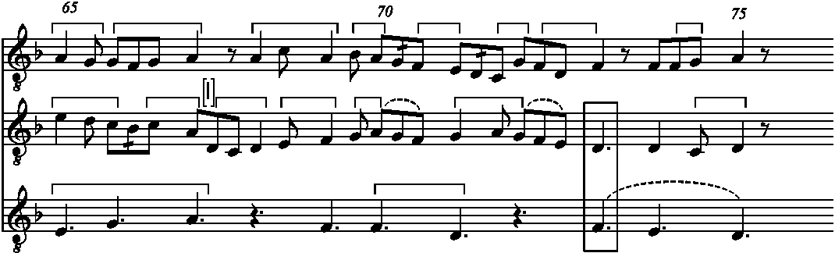
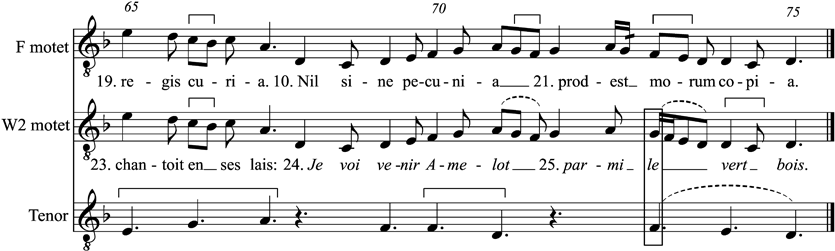
Scholars have typically looked to the rhythmic information offered by clausulae in preference to that of their related motets. The penultimate phrase of the clausula [Vir]go 2 (unique to F, fol. 11r, possibly a transcribed motet) provides a good example of an occasion when sine littera notation can sustain two possible readings and where the evidence of related motets could usefully be employed. This clausula, and the motets sharing its musical material, are in the first rhythmic mode. Although there is fairly frequent fractio modi, there is only one instance where significantly different interpretations of the clausula and motet notation could occur, in perfections 65–75. A facsimile of F, fol. 11r is provided as Figure 1 above, and the relevant passage of the clausula duplum begins above the final tenor ordo at the end of the third system. Roesner's transcription of this passage is shown as Example 12.Footnote 157
Transcription of [Vir]go 2 (F, fol. 11r), perfs. 65–75, after Roesner
Significantly, Roesner's transcription of the clausula duplum at this point could not support the corresponding texts of either Por conforter mon corage or Crescens incredulitas. Both motets strongly imply a substantially different rhythm (as shown in Example 13). Evidently Roesner, regarding the clausula as the rhythmic authority, disregarded the testimony of related motets in his transcription of this passage. The clausula notation can sustain both readings. In perfection 67 of [Vir]go 2 (just above the beginning of the final tenor ordo of the third system in Figure 1) there is an ordo line in the triplum voice, but this line is omitted in the duplum, though there is a clear gap between the two notes that it would have separated. The implied missing line in the duplum could be interpreted as either a rest or simply a mark of articulation. If the line indicates a rest, it seems likely that the duplum a which precedes it would be a long (equivalent to a crotchet in modern notation), followed by a break corresponding to the length of a breve (a quaver). However, if the line indicates merely a punctuation, as Roesner interprets it (see Example 12, perfection 67), the a could be of shorter duration – only a breve in length. Similarly, the rhythm of the two repeated ds in perfections 73–4 of the duplum is not certain, since repeated pitches cannot be ligated. These two ambiguities allow the clausula notation to support both the motet version and Roesner's interpretation of this passage. Roesner reads the first of the repeated ds in perfections 73–4 as a perfect long (a dotted crotchet) in order to compensate for the fact that he construed the a in the duplum at perfection 67 as a breve. The related motets strongly imply that it is the a in perfection 67 that is a perfect long, and that the first d (in perfection 73) must, correspondingly, be only a breve in duration.
Motetus of Crescens incredulitas (F, fol. 402v) and Por conforter mon corage (W2, fol. 241r), perfs. 65–75
Roesner's transcription of this short passage avoids a dissonance at the beginning of perfection 73. It prevents g and f sounding simultaneously in the duplum and tenor, a clash that is evident in the motet version in W2 (compare the two moments marked by boxes in Examples 12 and 13). Yet Roesner's interpretation is rather out of character with the rest of the clausula: it provides the only example of a moment where the triplum and duplum phrases overlap, and it also substantially obscures the melody of the refrain ‘Je voi venir Amelot, parmi le vert bois’ (vdB 1154). It is remarkable that an interpretation of sine littera notation aiming to produce a ‘consonant’ reading can differ substantially from the rhythm more clearly implied in corresponding motet versions. In a case such as this, where modal notation is genuinely equivocal, I cannot see why a preoccupation with consonance should necessarily be favoured over the evidence of the related motets.
Consonance and dissonance
Consonance has previously been employed as a quality by which to confirm the priority of clausulae over their related motets. When examining the clausulae suggested by Waite to be transcribed motets, Baltzer ultimately rejected Waite's hypothesis, emphasising that her rhythmic interpretations of his notationally irregular clausulae gave ‘better’, that is, less dissonant, readings than their corresponding motets.Footnote 158 This is true in the case of both clausulae proposed here as transcribed motets.Footnote 159Amo[ris] 2 and Flos filius e[ius] 3 imply more consonant readings of their musical material than any related motets in almost all of the instances of changes of ‘vertical sonority’ between clausulae and motets discussed above.Footnote 160
Yet to establish chronological priority in terms of consonance is problematic for several reasons. First, the question as to what is acceptable or even typical in terms of dissonance in the early thirteenth century remains open. The often harsh dissonance of the four-voice pieces Latex silice/[IMMO]LATUS and Serena virginum/MANERE (as preserved in F, fols. 230v–231v and 235r–237v respectively), for example, has occasioned much comment: it has been suggested these works simply could not have been intended for performance as motets in four parts (as preserved in F).Footnote 161 But both Wulf Arlt and Darwin Scott have demonstrated that dissonance can be justified by concerns of melodic patterning.Footnote 162 Scott has further argued that the occurrence of striking dissonances in the four-voice versions of these pieces can be explained, and shown to be legitimate in the context of the writings of contemporary theorists.Footnote 163 The degree of dissonance acceptable in thirteenth-century compositions, then, may be greater than has previously been recognised.
Secondly, the interpretation of sine littera notation, particularly when ligature patterns are unconventional, can fundamentally privilege consonance. Consonance guided Roesner's transcription of the [Vir]go 2 clausula, and Baltzer freely admitted that her method of deciphering the rhythm of ambiguous clausula notation relied precisely on attention to the intervallic relationship between duplum and tenor.Footnote 164 There is a danger of circularity here: the relative ambiguity of sine littera notation – believed implicitly to represent the ‘original’ version of the musical material – gave Baltzer fairly free rein to produce ‘good’ consonant transcriptions. Thus ambiguities in sine littera notation might allow scholars to produce more consonant readings of clausulae than were, in fact, intended. That consonance should be employed as a measure for the ‘authority’ of a musical version, or confirmation of its status as an ‘original’, is, therefore, problematic.
Indeed, it is arguably dissonance that might be a more accurate indicator of chronological priority than consonance. Manuel Pedro Ferreira, tracing the history of particular harmonic intervals from the eleventh to the fourteenth centuries, has demonstrated that the perception of seconds as dissonant intervals, and thirds, sixths and fourths as secondary consonances increases, in both theory and practice, throughout this three-hundred year period.Footnote 165 Ferreira suggests that a growing preoccupation with the theoretical codification of consonant and dissonant intervals in this period was matched by a generally heightened emphasis on perfect consonances in its music.
The relative consonance of Amo[ris] 2 and Flos filius e[ius] 3 in comparison to their related motets should not, then, confirm the priority of these clausulae. Even though this increase in consonant harmonic intervals is sometimes clearly and conventionally implied by the clausula notation, it is problematic to insist on the conventional interpretation of a ligature pattern in one instance, when in other instances in the same clausula a conventional interpretation is deemed impossible or unacceptable. That is, the decision to read ligatures conventionally at certain moments may be encouraged by the fact that a conventional reading will produce a strongly consonant transcription. Yet even if differences in vertical sonority between these clausulae and motets are accepted as intentional, they could be explained by the proposition that the notator converting motets into clausulae deliberately made the clausulae more consonant as he did so. Perhaps the scribe himself was using consonance as a guide, or was aware that the sine littera notation would be equivocal, and aimed to fix its interpretation by employing strong consonances to help a reader. Or the more consonant clausulae could possibly represent modernisations of their parent motets, offering musical versions eliminating lately unfashionable dissonances. Whether or not differences in vertical sonority between clausulae and motets are considered to be deliberate, it is problematic to assert the priority of clausulae, or to refute the priority of motets, on harmonic grounds.
Why transcribe motets as clausulae?
With nearly five hundred ‘regular’ clausulae to choose from, why should a copyist transcribe some dozen motets into a notation he does not understand; and how did these few works become interspersed in random fashion in such an ordered section of a MS [F] which is itself most meticulously ordered? Were these clausulae gathered together in a little appendix, much more credence could be given to the hypothesis; if such clausulae were transcriptions they would of necessity spring from a tradition so strikingly different from that of the others in the codex that there would be some clear division of the two series made manifest in the MS itself.Footnote 166
In ‘Clausulae or Transcribed Motets in the Florence Manuscript?’ (1970), Anderson chiefly attempted to deny the notational irregularities of the clausulae identified by Waite as transcribed motets. He also challenged Waite's proposition on a number of grounds, rightly questioning the need for such transcribed motets in F, given the very extensive collection of ‘regular’ clausulae in this manuscript, which did not appear to require supplement or enrichment with transcribed motets. He was concerned by the seemingly ‘random fashion’ in which these transcribed clausulae were interspersed in the manuscript,Footnote 167 and he queried the presence of short melismas at the end of a number of these contentious clausulae (usually in order to produce a complete presentation of the borrowed tenor chant), absent in their related motets. Anderson asked how ‘a redactor who did not understand the notation’ could have ‘appended an entirely new melisma not known in the original’.Footnote 168 Furthermore, he emphasised the difference between F and the Saint-Victor manuscript, the only known source thought to contain a collection of transcribed motets and long considered to be exceptional.Footnote 169 He stated that ‘the singular nature of the StV collection certainly grants the possibility of motet-transcription, and thus transcription is not an impossibility in F, although one may not use by analogy the StV MS to substantiate any possible evidence of this method of compilation in F’.Footnote 170
A number of Anderson's concerns are ill-founded. Baltzer has already challenged Anderson's notational analyses, demonstrating that the clausulae identified by Waite could have been notated in a more regular manner than they are in F.Footnote 171 Despite these notational irregularities in F, Anderson's claim that the copyist ‘did not understand’ sine littera notation is misleading. Errors in notation may reflect the inherent difficulty of translating musical material conceived in a different notational system rather than the fundamental inadequacy of the scribe. In consequence, there seems little difficulty in accepting that the clausula scribe could have appended new material not present in the original motets. In any case, the added closing melismas are often highly conventional concluding gestures, common to a number of clausulae.Footnote 172 Furthermore, the ligation of a complex motet sine littera would have surely required just as much, if not more, skill than the addition or creation of a short melismatic addendum.Footnote 173 Similarly, Anderson's concerns about the ordering of F might be partially assuaged by the possible cluster of transcribed motets at the end of fascicle 1.Footnote 174 But the fundamental question as to why motets would ever have been transcribed in such a way in F, particularly since the clausulae-as-notational-models theory can now be rejected, remains unanswered.
The need definitively to answer this question might be less pressing if F as a source were differently understood. One need not regard clausulae derived from motets as part of a ‘strikingly different’ tradition. The idea of a clausula derived from a motet is more palatable if F is imagined in a general context of musical reuse, where motets and clausulae interacted and influenced one another, and where the scribe copying a clausula might be aware of Latin and French texts associated with the music in question. This renders the possible appearance of a ‘transcribed’ French motet in a clausula fascicle less surprising, and the admission that one particular clausula might represent a transcribed motet need not challenge the priority of clausulae over related motets in other instances.
It appears that those copying F aspired to provide a very comprehensive collection of music: almost all the known Latin monotextual motets are preserved in this manuscript, and likewise, the collection of clausulae is far greater than in any other source. This led Anderson to refute Waite's claims that the clausulae in F required any further supplement in the form of transcribed motets. Yet the vast size of the clausula collection would support the inclusion of ‘transcribed motets’ if one of the aims of those copying and collating F was to record, as comprehensively as possible, the great extent and richness of their musical repertory in many possible forms. In this case, it would be entirely reasonable that the scribe transcribed the music of a French motet on a certain tenor, in order to increase the number of clausulae on this chant yet further. In such circumstances, clausulae lacking related motets, clausulae subsequently texted to become motets, and motets transcribed as clausulae could appear alongside one another in the same, liturgically ordered, fascicle.
French motets might also have been transcribed as clausulae as a means of including their musical material in F without any accompanying text in the vernacular. Roesner has underlined the possibility that F may once have contained a number of gatherings, or even a fascicle, now lost, devoted to French motets.Footnote 175 This could be supported by my suggestions that French motets were available to those copying F. However, Roesner's proposition seems improbable in other respects.Footnote 176 F, as it is now extant, contains exclusively works in Latin, and employs liturgical ordering principles uncommon in sources in the vernacular. It is noteworthy that the duplication of musical material across the motet fascicles of F seems actively to have been avoided. It is unlikely that the Latin motets Ypocrite pseudopontifices/Velut stelle firmamenti/ET GAUDEBIT, Veni, salva nos/AMO[RIS] or Stirps Iesse/Virga cultus/FLOS FILIUS E[IUS] would also have been copied in F in their French versions. These Latin motets – extant only in F and with an apparently narrow circulation – are related to particularly widely disseminated French motets, perhaps indicating that the contrafacta in F were specially created, precisely in order that well-known French motets could appear in the context of a purely Latin motet collection.Footnote 177 I think it more probable that works with French texts were deliberately excluded from F – despite the fact that they were available to those preparing the manuscript – than that the manuscript contained vernacular motet fascicles now lost.
Yet it is striking that there was apparently no effort made in F to conceal or obscure links with vernacular musical traditions. A number of the Latin contrafacta are very clearly related to their French counterparts; Error popularis, for example, resembles Fole acostumance closely in theme, vocabulary, poetic structure and semantic content. Similarly, the music of such a Latin contrafactum would probably have carried associations of its more widely disseminated French text. Any desire to exclude French motets from F must, then, have operated on quite a superficial level: though in Latin, the vernacular heritage – both musical and poetic – of the contrafacta in F would presumably have often been obvious. This would also apply to refrain melodies present in both Latin motets and clausulae in F. Despite the lack of associated French texts, the refrains could still have been recognised as part of the musical currency of the vernacular world. Those compiling F had, seemingly, no objection to French music or French influences, only to the actual appearance of French texts within their purely Latin collection. The transcription of French motets as clausulae in F would, therefore, have been an effective way of recording their music without associated vernacular texts, and without the need to create a Latin contrafactum.
How might these explanations for the presence of transcribed motets among clausulae in F relate to the justifications offered for the collection of clausulae in StV? Büttner, in his 2011 monograph Das Klauselrepertoire der Handschrift Saint-Victor, demonstrated conclusively that all forty of the Saint-Victor clausulae represent transcriptions of French motets, whose accompanying texts are cued by marginal incipits. While F is dated in the 1240s, both Körndle and Büttner place StV between 1270 and 1300,Footnote 178 arguing that the transcription of motets as clausulae here is part of a deliberate act of conservatism in this source. Körndle suggested a particular desire in StV to employ modal, rather than mensural, notation; a notational ‘correction’ related to concerns, as expressed in Pope John XXII's later Bull Docta sanctorum patrum (1324), about the use of semibreves and minims. Büttner likewise situated StV in a reactionary context, responding to particular philosophical debates from the 1270s onwards. He viewed the clausulae as an attempt to transform worldly secular French motets into a supposedly older and purer musical state. Büttner observed that StV consciously imitates earlier liturgically appropriate sources containing clausulae, yet simultaneously draws attention to its reformation of undesirable secular motets through the inclusion of their vernacular incipits. These explanations, while convincing in the context of StV, do not seem so appropriate in the case of F, a source that presumably pre-dates such reformative tendencies, and where modally notated, ‘genuine’ clausulae and transcribed motets can be interspersed and, on the surface, indistinguishable. Indeed, the evidence of F indicates that the transcription of motets as clausulae was already established relatively early in the thirteenth century and that the conversion of French motets into clausulae in StV may be part of a much more widespread and older practice than has been fully acknowledged. This practice is one for which further explanation and contextualisation is therefore required.
Conclusions
I have proposed three Latin motets in F as contrafacta of earlier French motets, and demonstrated that two clausulae in this manuscript might also represent textless transcriptions of French motets. These Latin motets and clausulae are exceptional in the context of F: I do not claim that all, or even most, of the clausulae in this manuscript are transcribed motets, nor that a majority of the Latin motets in F are derived from earlier French pieces. Nonetheless, the potential number of transcribed motets and contrafacta in F is, arguably, significant. Initial investigations suggest that there are at least twenty-nine transcribed French motets amongst the clausulae of F,Footnote 179 and that eleven of the Latin motets in F might be contrafacta of French models.Footnote 180 The possibility that newly composed Latin motets in F could also have been transcribed and preserved as clausulae merits further investigation,Footnote 181 as does the hypothesis that certain motets in F are contrafacta of existing Latin texts.Footnote 182 As knowledge of the characteristics that might identify a transcribed motet or a contrafactum increases, certain pieces could also be posited as contrafacta or transcriptions of motets now lost.Footnote 183 All of the clausulae investigated here are ‘true’ clausulae: they are presented in separate fascicles devoted to this musical type rather than appearing in the context of organa. The significance of this generic distinction remains to be seen, and the possibility that passages of discant embedded within organa might also represent transcriptions of motets is ripe for exploration.Footnote 184
If as many as twenty-nine clausulae in F might be transcriptions of French motets, the relationship between French motets and clausulae requires re-evaluation. Only sixty-one motets with text(s) in French have related clausulae extant in the so-called ‘Notre Dame’ sources (W1, F and W2).Footnote 185 Were nearly half of such clausulae proven to be sine littera transcriptions of French motets, this would challenge the idea that vernacular motets were often created through the addition of texts to pre-existing clausulae. And it would undermine the presumption that a tradition of motets in French must, like the Latin tradition, have originated in the texting of clausulae.Footnote 186 Given that certain French motets were reworked as clausulae and/or contrafacta by the time F was copied in the 1240s, this encourages an earlier dating for such newly composed motets,Footnote 187 and perhaps also for the repertory of motets in the vernacular more generally.
The proposition that the texts Ypocrite pseudopontifices and Stirps Iesse/Virga cultus are contrafacta suggests, in addition, a vernacular origin for two out of the three Latin double motets extant in F. Significantly, one of only two Latin double motets recorded in W2, Salve salus hominum/O radians stella/NOSTRUM (W2, fols. 186r–v), has also been proposed as a contrafactum of a French double motet.Footnote 188 It seems, then, that just one of the four Latin double motets preserved in sources copied before 1270, Mors que stimulo/Mors morsu/MORS (F, fols. 400v–401v and W2, fols. 164r–165v), was actually conceived as a Latin double motet, probably derived from a pre-existing clausula. This could question the current tendency to identify an early ‘tradition’ of Latin double motets.Footnote 189 It might, instead, indicate that polytextual motets were an essentially vernacular concept, accounting for the ‘paucity of Latin double motets [extant] before the fourth fascicle of Montpellier’, described by Everist as ‘most curious’.Footnote 190
Vernacular influences uncovered in F, even if only in a minority of exceptional cases, challenge the widespread presumption that this chronologically ‘early’ motet manuscript necessarily preserves motets in their earliest form. If Veni, salva nos, for example, derives from a motet extant only in sources that post-date F by about three decades, then the relationship between manuscript chronology and musical chronology is much more complex than is generally acknowledged. Similarly, two of the Latin contrafacta discussed above demonstrate that liturgical function or sacred content does not necessarily confirm chronological priority, nor should it be assumed that motets become progressively more ‘secular’ as their family trees grow. As Büttner has emphasised, the tendency to enforce strict divisions between ‘liturgical’, ‘sacred’ and ‘secular’ music is artificial,Footnote 191 obscuring the potential for multidirectional interchange between sacred and secular spheres in the thirteenth century. Fluid exchanges between these spheres might include, and convincingly account for, the presence of melodies associated with secular, vernacular refrains in supposedly liturgical clausulae.
The importance of written materials in the creation of contrafacta and clausulae in F, as demonstrated above, also reflects an important aspect of thirteenth-century musical culture. It appears that some clausulae could have served as notational supplements for the subsequent motet versions of their musical material, recording specific rhythmic details impossible to prescribe in cum littera notation. Yet it seems that motets also very quickly developed in a way that expanded the notational possibilities of clausulae, particularly with regard to small-note melodic decorations. In F, those creating motets avail of the opportunity to notate syllabic pieces, the rhythm of which can be established with certainty because of the existence of a related, sine littera clausula. However, F also contains motets exploiting the kind of melodic ornamentation simply too difficult to notate in a clausula, but made possible in a motet precisely because of the presence of a syllabic text whose rate of declamation is an important clue to the correct rhythmic interpretation. Ways in which music is recorded in writing and features of musical style are, therefore, closely interwoven, existing in a mutually dependent relationship. This is entirely typical of the burgeoning literacy and textuality of the culture in which these pieces are rooted: the musical fabric of thirteenth-century motets and clausulae exhibits the influence of written models and notational possibilities.