During childhood, heart valve diseases are generally diagnosed as congenital or sequelae of rheumatic carditis. Although the pathophysiology of heart valve disease has not been clearly understood, it is considered that the interaction of several risk factors such as genetic, autoimmune, inflammatory, infectious, and oxidative stress may have a role.Reference Lincoln and Yutzey 1 – Reference Gölbasi, Uçar and Keles 4 Acute rheumatic fever, an autoimmune disease, occurs as a complication of an untreated beta-haemolytic streptococcal pharyngitis. Carditis may cause serious morbidity and also mortality, whereas acute rheumatic arthritis and chorea recover without sequelae. Endocarditis may frequently lead to chronic rheumatic heart disease, characterised by progressive and permanent valvular lesions.
In genetically prone individuals, cross-reacting antibodies and cytokines are consequently synthesised from immune response of antigens induced by streptococcal pharyngitis.Reference Chopra and Gulwani 5 Acute rheumatic carditis reveals infiltration of the myocardium and endocardium with neutrophils, lymphocytes, monocytes, and macrophages, and also other features of granulomatous myocarditis can be seen. These phagocytic cells could have a role in the pathogenesis of the disease by producing various inflammatory cytokines and generating reactive oxygen species.Reference Kumar, Ganguly, Sethi, Anand, Verma and Wahi 6 , Reference Oran, Atabek, Karaaslan, Reisli, Gultekin and Erkul 7
Ischaemia-modified albumin is a new marker for tissue ischaemia.Reference Bar-Or, Curtis, Rao, Bampos and Lau 8 The diagnostic albumin cobalt binding test is used to be based for ischaemia-modified albumin on the observation that the affinity of serum albumin for cobalt is reduced after N-terminus modifications. Hypoxia, acidosis, superoxide-radical injury, energy-dependent membrane disruption, and exposure to free iron and copper could result in ischaemia-modified albumin formation. It has been proposed that reactive oxygen species generated during ischaemia results in ischaemia-modified albumin formation. Ischaemia-modified albumin is accepted as a marker of oxidative stress.Reference Roy, Quiles, Gaze, Collinson, Kaski and Baxter 9 , Reference Sbarouni, Georgiadou and Voudris 10 Recently, elevated ischaemia-modified albumin levels have been reported in various clinical conditions such as ischaemia, inflammation, and oxidative stress.Reference Sbarouni, Georgiadou and Voudris 10 Furthermore, increased oxidative stress has been shown in acute rheumatic fever and heart valve disease.Reference Oran, Atabek, Karaaslan, Reisli, Gultekin and Erkul 7 , Reference Uner, Sal and Doğan 11 – Reference Ahmed, Gladden and Litovsky 15 Nevertheless, to our knowledge, there are no data regarding the levels of ischaemia-modified albumin in patients with acute rheumatic fever and heart valve disease. Therefore, the purpose of the present study was to investigate the role of ischaemia-modified albumin in the diagnosis of acute rheumatic fever and also to evaluate the ischaemia-modified albumin levels in children with heart valve disease.
Materials and methods
A total of 108 participants were enrolled in the study, including consecutive children (aged between 5 and 18 years) with newly diagnosed acute rheumatic fever (22 female, 18 male), congenital heart valve disease (17 female, 18 male), chronic rheumatic heart disease (17 female, 16 male), and 20 healthy (11 female, 9 male) age-matched control subjects. The study procedure was approved by the local Ethics Committee, and informed consent was obtained from all participants.
Patient groups
The medical history of patients were obtained and physical examination findings and laboratory analysis, including blood tests, electrocardiogram, and echocardiography were evaluated. The diagnosis of acute rheumatic fever was established on the basis of the modified Jones Criteria. If supported by evidence of a preceding streptococcal infection, the presence of two major manifestations, or one major and two minor manifestations was considered as a proof of acute rheumatic fever. 16 Patients in the acute rheumatic fever group were subdivided according to major diagnostic criteria as carditis, isolated arthritis, and chorea. Sydenham's chorea was diagnosed by excluding other causes of paediatric chorea, and this group was composed of all the patients with chorea and carditis. Peripheral blood smear, viral serology, anti-nuclear antibody, anti-double-stranded DNA, and rheumatoid factor levels were assessed for the differential diagnosis of the patients with arthritis.
Patients with chronic rheumatic heart disease consisted of the children previously diagnosed with acute rheumatic fever, who fulfilled the modified Jones Criteria and were followed-up in our clinic because of mitral and/or aortic regurgitation that were sequelae of acute rheumatic carditis. Benzathine penicillin G was given to all non-penicillin-allergic patients for secondary prophylaxis. Cardiac abnormalities of the patients with congenital heart valve disease consisted of mitral valve prolapse or bicuspid aortic valve with valve regurgitation, without a history of previous acute rheumatic fever. The control group was selected from age- and sex-matched healthy children who had no congenital cardiac defect except patent foramen ovale.
Exclusion criteria
Patients with any chronic disease, associated infections and/or inflammation, history of ischaemic events, malnutrition, abnormal serum electrolytes, abnormal renal function tests, smoking, use of antioxidant medications and/or those taking multivitamin preparation, and pulmonary hypertension were excluded from the study.
Echocardiographic examination
Echocardiographic studies were performed with two-dimensional guided M-mode echocardiography according to the methods established by the American Society of Echocardiography with 2.5 MHz transducer frequencies using a Hewlett-Packard Sonos 5500 ultrasonic imager (Andover, Massachusstes, United States of America). Cross-sectional and Doppler examinations were used to evaluate the severity of valvular regurgitation.Reference Sahn, DeMaria, Kisslo and Weyman 17 Pathologic valvular insufficiency was decided according to World Health Organization criteria. 18 The diagnosis of mitral valve prolapse and bicuspid aortic valve was established according to American Heart Association criteria.Reference Cheitlin, Armstrong and Aurigemma 19 In order to establish the diagnosis of bicuspid aortic valve, the valve must be visualised in systole in the short-axis view. The raphe can make the aortic valve mistakenly appear trileaflet during diastole. In addition, the aortic orifice has a characteristic “fish-mouthed” appearance during diastole in patients with bicuspid aortic valve. In the long-axis view, eccentric closure line and doming of the leaflets are characteristics of bicuspid aortic valve. Mitral valve prolapse was defined as thick and redundant mitral valve leaflets bulging into the mitral annulus and superior displacement (>2 mm) of the mitral valve leaflets to the plane of the mitral valve in 2D-echocardiography in the parasternal long-axis view, together with holosystolic or purely mid-late systolic mitral regurgitationReference Cheitlin, Armstrong and Aurigemma 19 .
Blood sample collection and biochemical assay
White blood cell, erythrocyte sedimentation rate, C-reactive protein, antistreptolysin O titres, and ischaemia-modified albumin were examined in all groups. All parameters were analysed at the time of diagnosis in the acute rheumatic fever group. Antistreptolysin O titres, white blood cell, C-reactive protein, and erythrocyte sedimentation rate values were determined by routine methods. Antistreptolysin O titres and C-reactive protein were considered to be elevated if they were higher or equal than 200 IU/ml and higher than 8 mg/l, respectively.
To study the serum ischaemia-modified albumin levels from each subject, blood samples were collected from the antecubital vein. The serum was separated from the cells by centrifugation at 4000 rpm for 10 minutes and then transferred into aliquots for storage at −80°C until analysis.
Ischaemia-modified albumin assay
Ischaemia-modified albumin levels were measured manually based on the principle that the binding capacity of albumin to cobalt ions is altered in some conditions such as increased reactive oxygen species and measurement of the unbound cobalt with a rapid colorimetric method described by Bar-Or et al.Reference Bar-Or, Curtis, Rao, Bampos and Lau 8 Patient serum (200 μl) was placed into glass tubes and 50 μl of 0.1% cobalt chloride (CoCl2.6H2O; Sigma, Sigma-Aldrich Corporation, St. Louis, Missouri, United States of America) in H2O was added. After gentle shaking, the solution was left to stand for 10 minutes to ensure sufficient cobalt–albumin binding. Then 50 μl of dithiothreitol (1.5 mg/ml H2O; Sigma) was added as a colorising agent, and the reaction was quenched 2 minutes later by adding 1.0 ml of 0.9% NaCl. Blank tubes for each sample were prepared similarly without dithiothreitol addition. Blank and test absorbances were measured at 470 nm using a spectrophotometer (Shimadzu UV-1601, Shimadzu Scientific Instruments Inc., Columbia, Maryland, United States of America). Ischaemia-modified albumin values were expressed as absorbance units.
Statistical analysis
The statistical package for social sciences (version 16.00, Chicago, Illinois, United States of America) program was used for assessment of the results. The distribution of data analysed using the Shapiro–Wilks test according to which suitable parametric and nonparametric tests were selected. The parametric data were presented as means ±standard deviation and nonparametric data were presented as median (minimum–maximum). Pearson chi-square test was used to compare categorical variables. In the comparison of the groups, the univariate variance analysis was used in variables with normal distribution (One-way ANOVA test), whereas the Post Hoc test (Tukey-HSDhonestly significant difference test) was used as a secondary test in multiple comparisons. The Kruskal–Wallis test was used for analysis of variables that were not normally distributed, and the Mann–Whitney U test was used in cases showing a statistical difference between the two groups. The correlation between ischaemia-modified albumin and acute phase reactant levels of the patients has been performed by Spearman correlation test. In the statistical evaluations, a p value of <0.05 was regarded as significant.
Results
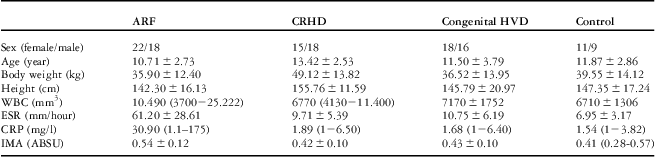
Age, sex, and anthropometric values were similar between control and other groups. However, the age and anthropometric values of the chronic rheumatic heart disease group were significantly higher than the acute rheumatic fever and congenital heart valve disease groups (p < 0.01, Table 1). The acute rheumatic fever group consisted of 18 patients with carditis, 12 with isolated arthritis, and 10 with chorea. In the acute rheumatic carditis group, the prevalances of mitral regurgitation, aortic regurgitation, and mitral valve prolapse were 96.4%, 46.4%, and 25%, respectively. Pericarditis was determined in only one patient (3.5%). Prolongation of PR interval was determined in 10 patients (25%). In the chronic rheumatic heart disease group, the percentages of mitral regurgitation, aortic regurgitation, and mitral valve prolapse were determined as 93.9%, 39.4%, and 30.3%, respectively. In the congenital heart valve disease group, the percentages of mitral valve prolapse and bicuspid aortic valve were found to be 54.3% and 45.7%, respectively.
The comparison of demographic characteristics, acute phase reactants, and serum ischaemia-modified albumin levels in all groups.

ABSU = absorbance units; ARF = acute rheumatic fever; CRHD = chronic rheumatic heart disease; CRP = C-reactive protein; ESR = erythrocyte sedimentation rate; HVD = heart valve disease; IMA = ischaemia-modified albumin; WBC = white blood cell
ARF versus CRHD for age, body weight, and height p < 0.01
CRHD versus congenital HVD for body weight and height p < 0.01
ARF versus other groups for WBC, ESR, CRP, and ischaemia-modified albumin p < 0.001
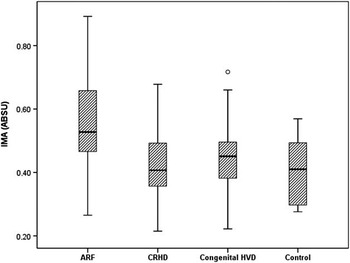
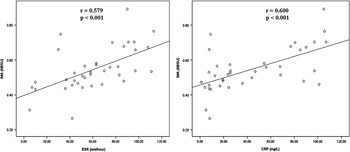
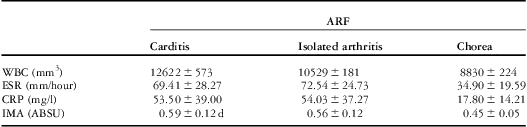
The levels of acute phase reactants and serum ischaemia-modified albumin of all groups and the acute rheumatic fever subgroups are presented in Tables 1 and 2. The mean ischaemia-modified albumin level of the acute rheumatic fever group was significantly higher than other groups (p < 0.001). No statistically significant differences were found among the mean ischaemia-modified albumin levels of the chronic rheumatic heart disease, congenital heart valve disease, and control groups (Table 1, Fig 1). In addition, no statistically significant difference was detected between the patients with mitral valve prolapse and bicuspid aortic valve in terms of serum ischaemia-modified albumin levels. In the acute rheumatic fever group, positive correlations were detected between the serum ischaemia-modified albumin levels and acute phase reactants (p < 0.01 for white blood cell, p < 0.001 for erythrocyte sedimentation rate and C-reactive protein, Fig 2). The mean ischaemia-modified albumin levels in both carditis and isolated arthritis groups of children with acute rheumatic fever were significantly higher than those in the control group (p < 0.001, p < 0.01, respectively). However, no statistically significant difference was found between the chorea group and control subjects. In addition, acute phase reactants and serum ischaemia-modified albumin levels were significantly lower in the chorea group than in the carditis group (Table 2).
Comparison of serum ischaemia-modified albumin levels between the groups.

Significant correlation of ischaemia-modified albumin levels with acute phase reactants levels.

The comparison of acute phase reactants and serum ischaemia-modified albumin levels in subgroups of the patients with acute rheumatic fever.

ABSU = absorbance units; ARF = acute rheumatic fever; CRP = C-reactive protein; ESR = erythrocyte sedimentation rate; IMA = ischaemia-modified albumin; WBC = white blood cell
Carditis versus chorea for WBC, CRP, and IMA p < 0.05, for ESR p < 0.01
Isolated arthritis versus chorea for ESR p < 0.01, for CRP p < 0.05
Discussion
Heart valve diseases have many features that are characteristic to active pathobiological processes, including chronic inflammation, lipoprotein deposition, active calcification, and activation of the renin–angiotensin system.Reference Lincoln and Yutzey 1 , Reference O'Brien 2 , Reference Helske, Kupari, Lindstedt and Kovanen 20 , Reference Mohler, Gannon, Reynolds, Zimmerman, Keane and Kaplan 21 The pathogenesis of rheumatic valvular disease has been responsible for fibrosis that occurrs at the end of the inflammatory process.Reference Davutoglu, Celik and Aksoy 3 – Reference Chopra and Gulwani 5 Furthermore, the oxidative stress increases in inflammatory disease. In addition, previous studies have shown that oxidative stress has been found to increase in acute rheumatic fever and chronic rheumatic heart disease and it is also thought to have a role in the pathogenesis of rheumatic carditis.Reference Oran, Atabek, Karaaslan, Reisli, Gultekin and Erkul 7 , Reference Uner, Sal and Doğan 11 , Reference Chiu-Braga, Hayashi, Schafranski and Messias-Reason 13
Ischaemia-modified albumin is considered to be a novel biochemical marker for ischaemic conditions.Reference Bar-Or, Winkler, Vanbenthuysen, Haris, Lau and Hetzel 22 – Reference Dundar, Cander, Gul, Karabulut and Girisgin 25 Initially, ischaemia-modified albumin was shown to be the most promising biomarker for early detection of cardiac ischaemia.Reference Bar-Or, Winkler, Vanbenthuysen, Haris, Lau and Hetzel 22 However, in recent studies, it has been shown to increase in several chronic diseases such as diabetes mellitus, chronic liver disease, end-stage renal failure, obesity, hypercholesterolaemia, and advanced cancer.Reference Kaefer, Piva and De Carvalho 26 – Reference Fidan, Mentese and Kavgaci 32 Therefore, increased ischaemia-modified albumin does not only show cardiac ischaemia. In addition, chronic hypoxia, inflammation, and increased oxidative stress are considered to change the structure of albumin, and eventually elevation of the ischaemia-modified albumin level occurs.Reference Roy, Quiles, Gaze, Collinson, Kaski and Baxter 9 , Reference Sbarouni, Georgiadou and Voudris 10 On the other hand, despite the fact that pathologic evidence of myocardial inflammation has been shown in acute rheumatic carditis, the fact that the level of cardiac troponin-I is not elevated in acute rheumatic carditis suggests that there is minimal or no myocytic necrosis in this setting.Reference Oran, Coban, Karaaslan, Atabek, Gurbilek and Erkul 33 , Reference Williams, Minich, Shaddy, Veasy and Tani 34 In the present study, the serum ischaemia-modified albumin levels of both acute rheumatic carditis and isolated arthritis groups were found to be significantly higher when compared with controls. However, there was no statistically significant difference between the chorea group and control subjects. The elevated serum ischaemia-modified albumin level was found only in the acute rheumatic fever group, and additionally positive correlation was found between acute phase reactants and serum ischaemia-modified albumin levels. We think that normal serum ischaemia-modified albumin level of the patients with chorea may be due to the long latent period for the determination of clinical findings for chorea. The elevated acute phase reactants are returned to normal levels in this period. On the basis of these findings, increased ischaemia-modified albumin level in patients with acute rheumatic fever may not only be related to cardiac ischaemia, but also inflammation. Therefore, it can be considered that ischaemia-modified albumin may be used as an acute phase reactant. A positive correlation between ischaemia-modified albumin level and high sensitive C-reactive protein concentration in patients with type-2 diabetes mellitus and hypercholesterolaemia has been reported in several studies.Reference Sinha, Vazquez, Calvino, Gaze, Collinson and Kaski 23 , Reference Duarte, Rocha and Moresco 31 Inflammation reduces the capacity of albumin to bind cobalt and results in higher ischaemia-modified albumin levels.Reference Sinha, Vazquez, Calvino, Gaze, Collinson and Kaski 23 The above data suggest that ischaemia-modified albumin may be a relatively new biomarker to indicate a valuable signal for oxidative stress in patients with acute rheumatic fever. Eventually, high serum ischaemia-modified albumin level can be considered to be associated with inflammation.
The generation of reactive oxygen species can transiently modify the N-terminal region of albumin and produce an increase in the concentration of ischaemia-modified albumin.Reference Roy, Quiles, Gaze, Collinson, Kaski and Baxter 9 Accordingly, ischaemia-modified albumin can be accepted as a marker of oxidative stress.Reference Roy, Quiles, Gaze, Collinson, Kaski and Baxter 9 , Reference Sbarouni, Georgiadou and Voudris 10 There are many biomarkers used to determine the extent of oxidative stress, including lactate, myeloperoxidase, nitric oxide, free fatty acids, glutathione, thiobarbituric acid reactive substances, advanced oxidation protein products, and total oxidant status.Reference Valko, Leibfritz, Moncol, Cronin, Mazur and Telser 35 , Reference Gaze 36 There are few studies indicating a relationship between ischaemia-modified albumin and oxidative stress markers; a positive correlation has been shown between ischaemia-modified albumin and thiobarbituric acid reactive substances in patients with acute ischaemic stroke and also between ischaemia-modified albumin and advanced oxidation protein products in patients with systemic sclerosis.Reference Senes, Kazan, Coşkun, Zengi, Inan and Yücel 24 , Reference Borderie, Allanore, Meune, Devaux, Ekindjian and Kahan 27 Advanced oxidation protein products are generated not only via a proinflammatory mechanism, but they are also end products of oxidative stress.Reference Gaze 36 Chiu-Braga et alReference Chiu-Braga, Hayashi, Schafranski and Messias-Reason 13 observed elevated levels of advanced oxidation protein products and high sensitive C-reactive protein in patients with chronic rheumatic heart disease, and they have also shown the involvement of oxidative stress and systemic inflammation in the pathogenesis of chronic rheumatic heart disease. However, no correlation was found between advanced oxidation protein products and high sensitive C-reactive protein plasma values.Reference Chiu-Braga, Hayashi, Schafranski and Messias-Reason 13 More recently, increased oxidative stress in patients with acute rheumatic fever compared with healthy controls has been reported.Reference Oran, Atabek, Karaaslan, Reisli, Gultekin and Erkul 7 , Reference Uner, Sal and Doğan 11 , Reference Kurban, Mehmetoglu, Oran and Kiyici 12 All these findings may suggest that increased ischaemia-modified albumin levels may also be attributed to the increased level of oxidative stress.
The persistence of inflammatory process in the chronic phase of rheumatic carditis was previously reported.Reference Davutoglu, Celik and Aksoy 3 , Reference Gölbasi, Uçar and Keles 4 On the other hand, increased oxidative stress was also reported in tissue and serum of the adult patients with chronic rheumatic heart disease or degenerative heart valve disease.Reference Chiu-Braga, Hayashi, Schafranski and Messias-Reason 13 – Reference Ahmed, Gladden and Litovsky 15 On the contrary, Rabus et alReference Rabus, Demirbağ and Sezen 37 have reported that no increased oxidative stress was detected in the plasma and tissue level of the patients with chronic rheumatic heart disease.
There are some limitations to the current study. The small number of patients and absence of the oxidative stress parameters might bring uncertainty with regard to the association of ischaemia-modified albumin with heart valve disease. Further studies are required to investigate whether ischaemia-modified albumin level is affected by oxidative stress in acute rheumatic fever.
In conclusion, serum ischaemia-modified albumin and acute phase reactant levels of the patients with chronic rheumatic heart disease and congenital heart valve disease have been detected to be normal, although higher serum ischaemia-modified albumin and acute phase reactant levels have been demonstrated in patients with acute rheumatic fever. Despite the limitations of this study, we suggest that increased ischaemia-modified albumin levels in patients with acute rheumatic fever can be explained as secondary to inflammation and probably increased oxidative stress. Therefore, in the future, serum ischaemia-modified albumin level may be assumed as an acute phase reactant and could also be used as a biomarker in the diagnosis of acute rheumatic fever. Further prospective studies with a larger number of patients and also with oxidative stress markers supporting this study are necessary to clarify the clinical usability of serum ischaemia-modified albumin level. In addition, we believe that oxidative stress may be considered to be prevented by some mechanisms that have not been described yet in childhood patients with congenital heart valve disease and chronic rheumatic heart disease.
Acknowledgements
None.
Financial Support
This research received no specific grant from any funding agency, commercial or not-for-profit sectors.
Conflicts of Interest
None.
Ethical Standards
The authors assert that all procedures contributing to this work comply with the ethical standards of the relevant national guidelines on human experimentation (Ethical Committee of Necmettin Erbakan University, Meram Medical Faculty) and with the Helsinki Declaration of 1975, as revised in 2008, and has been approved by the institutional committee (Ethical Committee of Necmettin Erbakan University, Meram Medical Faculty).