The relationship between drug trafficking and civil wars has been of longstanding interest to scholars. Though they continue to debate the precise nature of the relationship, scholars tend to agree that drugs complicate and lengthen internal conflicts, and most suggest that their presence tends to increase violence by insurgents and nonstate armed actors.
Little has been said about whether and how state behavior is similarly affected. This is striking, since state actors are responsible for an important share of violence against civilians in internal conflicts. There may, therefore, be reason to expect that where the drug trade is present, the behavior of state actors will be affected. This article begins to address this gap in the literature by analyzing the impact of drug production on violence committed by the Peruvian state in its conflict (1980–2000) with two insurgent groups, Sendero Luminoso, or the Shining Path, and the Movimiento Revolucionario Túpac Amaru, MRTA, which caused about 69,000 deaths.Footnote 1 Conflict unfolded both in Peru’s Upper Huallaga Valley (UHV), which was at the time the world’s most important source of coca for the drug trade, and in other regions that saw no drug production. This provides an opportunity to assess the effects of drug production on state violence in the conflict region.Footnote 2
Because the effect of drug production on state violence has been little studied, the goal of this article is theory building. It builds in section 1 on criminal violence and drug policy literatures to theorize militarization as the main channel by which drug production affects how state forces treat the civilian population during internal conflicts, and it delineates, in section 2, hypotheses about specific mechanisms linking militarization to state violence. The article also explores the relationship between corruption and violence. Section 3 describes the Peruvian conflict and its utility as an empirical setting. Section 4 describes the data and methods, and section 5 presents empirical analyses based on a dataset of human rights violations compiled by Peru’s Truth and Reconciliation Commission (CVR 2003).
Overall, the results show that state violence increased in coca-producing regions in ways consistent with the militarization channel, though that evidence is stronger for some mechanisms than others. Section 6 discusses the relationship between corruption and violence. The article concludes by suggesting avenues for further research on the effects of the drug trade on state violence.
Drugs and Internal Violence: The State of the Literature
The study of the drug trade and violence in internal conflicts has focused on insurgent behavior. Building on logics of the “criminalization” of insurgents or the “greed” framework (Collier and Hoeffler 2004), many works argue that narcotics, as a lootable resource, make civil wars more likely and transform combatants’ motives by making them less ideological. In a central contribution to this scholarship, Weinstein (Reference Weinstein2006) argues that rebel groups are more likely to engage in violence against civilians where they draw on illegal resources for funding. Resource-fueled insurgents will tend to attract opportunistic combatants rather than activists with longer-term ideological commitments, and rebel leaders will have more trouble designing institutions that prevent these opportunists from engaging in predatory behavior against civilians.
Scholars also explore other links between illegal resources and rebel behavior. Some argue that the drug economy lengthens conflicts by increasing rebel resources and thereby their capacity to challenge the state, or by increasing potential illegal profits from the pursuit of violence (Cornell Reference Cornell2005; Ross Reference Ross2002). Others suggest that drugs can lengthen internal conflicts but make them less intense by changing rebel incentives, making them prone to collaborate with other armed actors to maintain profits (Lujala Reference Lujala2009; Meehan Reference Meehan2011).
In contrast to the extensive scholarship linking the drug trade and insurgent violence, the conflict literature has overlooked analogous implications for state violence.
Yet state forces are responsible for a large share of violence in armed conflicts, and therefore the determinants of such behavior are of substantive interest. Moreover, important currents of conflict research (e.g., Kalyvas Reference Kalyvas2006) model the behavior of states and insurgents as shaped by parallel incentives and calculations. We should therefore expect that if the drug trade has a sizable impact on insurgent violence, it should also affect the behavior of state actors by changing how they perceive combatants and civilians and their incentives to repress or tolerate nonstate actors, and by adding internal and external policy commitments. Exploring the effects of the drug trade on state violence is therefore an important empirical and theoretical question.
Existing literatures analyze the impact of counterinsurgency strategies on insurgent violence (e.g., Lyall Reference Lyall2009) and the effects of state institutions and policies on criminal violence (Dell Reference Dell2015; Durán-Martínez Reference Durán-Martínez2015, Reference Durán-Martínez2018; Calderón et al. Reference Calderón, Robles, Díaz-Cayeros and Magaloni2015). Yet none of this research seeks to explain variation in violence by state actors. We enter this area by focusing on the question of how drug production shapes state violence against civilians in internal conflicts. To do so, we draw on the scholarly literatures on drugs and conflict, criminal violence, and drug policy to develop hypotheses that we then investigate in the case of Peru’s armed conflict. Our discussion builds on recent work on the concept of militarization of the state and develops a set of logics by which it links drug production to state violence. At the end of the study, we develop a second set of mechanisms linking state violence to corruption and provide a preliminary evaluation of those as well.
Drugs and State Violence: A Militarization Logic
This study focuses on state violence, defined as concrete and physical harms inflicted on civilians by state actors that violate individual rights, due process, and personal integrity. This definition includes both lethal attacks and other nonlethal harms, such as torture. It allows us to explore the effects of state policy orientations (counterinsurgency and counternarcotics) on violence, rather than defining policies themselves as a form of state violence.
We acknowledge that policies are applications of state coercive power, but we distinguish policy from violence precisely because policies can be executed in ways that reduce or increase violence. Because we explore settings in which the state confronts both nonstate armed actors (“insurgents”) and illegal drug production, we distinguish analytically between efforts to curb insurgents, or counterinsurgency, and efforts to curb drug trafficking, or counternarcotics, though we recognize that such policies are interconnected. In the last section, we also discuss how corruption distorts state incentives to genuinely confront the drug trade and how it may shape violence.
The study’s main argument focuses on the effects on state violence of an increased military role in drug-producing regions. This increased military presence may be a function of efforts to reduce financial flows to insurgents by curbing drug production or of counternarcotics policy that focuses on stemming drug production as an end in and of itself. Footnote 3 Based on this logic, the analysis uses microlevel data on violence in Peru’s armed conflict to make four comparisons of variation in state violence against civilians: differential levels of state violence against civilians in drug and non-drug conflict zones (hypothesis 1), differential levels of state violence against civilians within drug-producing conflict zones as the orientation of state counternarcotics policy varied (hypothesis 2), differential association between drug production and state violence against civilians as the military’s role in enforcing counternarcotics policy varied (hypothesis 3), and differential levels of violence against civilians by the armed forces and the police in the same locations and time period.
The first hypothesis is that drug-producing locations should see more violence because these sites draw a more intensive presence of the state’s coercive apparatus and greater militarization. In the context of an insurgency, the state is likely to focus its security efforts on drug-producing regions as a way to cut off insurgent finance. More intense counterinsurgency, and greater intervention of the state’s armed forces in that function, is likely to produce more state violence against civilians. This may be intentional (because of unwillingness to distinguish between insurgents and civilians, or because of a “draining the sea” strategy) or an unintended consequence of attempts to target insurgents. We assess this hypothesis by comparing state violence against civilians in drug and non–drug conflict zones, controlling for a range of confounders.
H1. We expect higher overall state violence against civilians in drug-producing regions than in other zones within the same conflict that lack significant drug production, as a result of increased counterinsurgency.
The second hypothesis focuses on counternarcotics policy instead of counterinsurgency. It seeks to account for trends in violence within drug-producing regions by considering the content of counternarcotics policy and its implementation. As we know from the drug policy scholarship (e.g.,Youngers and Rosin 2005), international norms, foreign pressures, and formal international commitments tend to increase the militarization of domestic responses to drug production. Yet governments retain some agency over their responses; for example, they may vary the emphasis of counternarcotics efforts on forcible crop eradication and the coercive targeting of peasant producers. In Peru, we see significant variation over time in drug policy, which we expect to be systematically associated with different rates of state violence against civilians. Eradication-focused policies may generate violence both as a function of direct confrontation between state eradication agents and security forces with peasant producers and as a function of the state response to the contention they generate among producing communities. The former especially characterizes the manual eradication policies that were common in Peru, while the latter can operate even in settings where aerial eradication is used.
Alternatives to crop eradication include alternative development programs or the targeting of higher levels in the supply chain. The latter may generate violence between drug traffickers and the state that can affect civilians, as seen in contemporary Mexico; this effect, however, may depend on the organization of state forces, on whether enforcement is conditional on the violence of the criminal groups (Lessing Reference Lessing2017), and on the structure of trafficking organizations. We do not expect high- level targeting to generate as much violence in Peru, given that it was primarily a site of drug production rather than international distribution and that Peru’s transnational trafficking actors were relatively weak, limiting their firepower.
We focus on crop eradication because many analyses (e.g., Felbab-Brown Reference Felbab-Brown2010) link changes in Peru’s crop eradication policies to changing patterns of violence. To assess hypothesis 2, we examine whether, controlling for other factors, shifts in the emphasis on crop eradication are systematically associated with differential levels of state violence in conflict zones involved in the cocaine trade.
H2. Within drug-producing zones of the same conflict, where drug policy emphasizes forcible crop eradication and the targeting of peasant producers, state violence against civilians will be higher. By contrast, less eradication-focused policy that emphasizes targeting higher levels in the supply chain should be associated with lower levels of state violence against civilians.
The third hypothesis builds on Flores-Macías and Zarkin (2019), who link constabularization—defined as the transfer of policing roles normally filled by other state agencies to military hands—to increased state violence against civilians. We explore whether the assignment of drug policy enforcement to the military, rather than the police, is associated with greater violence against civilians, while controlling for the orientation of drug policy (explored in hypothesis 2) and the presence of drug production.
H3. Greater constabularization of drug policy should be associated with greater violence against civilians.
Flores-Macías and Zarkin argue that constabularization can lead to increased abuses of civilians by state actors through the use of heavy weapons that are intrinsically more lethal, through a change of mentality that prioritizes “search and destroy” efforts over attempts to “rescue and protect” civilians, and through training geared toward eliminating threats and thus less respectful of civil liberties.
We evaluate this hypothesis in two ways. First and more directly, we take advantage of a shift that placed counternarcotics more directly in the hands of Peru’s military after 1992, and we conduct a temporal comparison to see whether state violence (both overall state violence and violence by the army) becomes more associated with coca production after 1992, when counternarcotics was militarized.Footnote 4
A limitation to this strategy is that it can be difficult to parse out whether violence is a function of militarization due to drug policy or the militarization of counterinsurgency more generally. We therefore also explore variation across state actors: following the logic of constabularization, we should expect that all else equal, the military will commit more acts of violence against civilians than the police when both are assigned to similar missions in similar contexts. Lacking information on assignment to missions or deployment to specific locations, we can only evaluate this hypothesis preliminarily by comparing police and military violence against civilians after controlling for other determinants of violence. While the historical record shows that both committed significant violence in the Peruvian conflict, we suggest that a difference here is consistent with the militarization logic of hypothesis 3.
The Peruvian Context
This study explores subnational variation in state violence during Peru’s armed conflict. This case provides several analytical advantages. First, following Weinstein (Reference Weinstein2006), we leverage the fact that Peru’s internal conflict between the state and insurgents unfolded both in coca-producing regions and far beyond them.Footnote 5 Thus we can see how drug production affected state violence in the same conflict, holding constant many potential confounders. Second, we utilize the database of human rights violations collected by the country’s Truth and Reconciliation Commission (CVR 2003), which contains more than 35,000 cases of human rights violations covering the period 1980–2000 and 10 of Peru’s 25 departments. For each incident, the dataset (built from testimony the commission collected after the end of the conflict) includes information about the nature of the human rights violation, the perpetrator, the location of the act, and characteristics of the victims. Third, the Peruvian case provides a simpler analytical setting because armed actors did not engage in significant drug production and shipment of their own, unlike cases such as Colombia (Durán-Martínez Reference Durán-Martínez2018; Tickner et al. Reference Tickner, García, Arreaza, Mejía and Gaviria2011). Peru’s drug-trafficking organizations did not engage in significant violence and were weak compared to insurgents and the state. Nor did insurgents directly engage in international drug smuggling, though they did profit from taxing the production and transport of coca.
The Conflict and the Drug Trade
Peru’s internal conflict started when Sendero Luminoso, a splinter group that broke off from the country’s myriad Marxist and Maoist political parties, began its armed struggle in 1980 at the moment of democratic transition and after 12 years of military rule.Footnote 6 Challenging a state with longstanding weakness in its hold over the highlands and a new democratic regime loath to empower the military to respond to its initial actions, Sendero quickly gained control over the Andean department of Ayacucho. Counterinsurgency began in earnest only in 1982, with the deployment of the military to the highlands.Footnote 7
Though only moderately successful and characterized by massive human rights violations against civilians, these military efforts drove Sendero to shift its zone of influence northward into Peru’s central highlands, and most dramatically into the Upper Huallaga Valley (UHV), where much of the coca crop for the global cocaine trade was cultivated. Though it had been active since the early 1980s, the MRTA began its military campaign in the coca-producing regions of San Martín Department in mid-1987 (La Serna Reference La Serna2020, 79, 85), and maintained a significant presence there until the capture of its regional leadership in April 1993 (La Serna Reference La Serna2020, 184). The MRTA and Sendero repeatedly clashed over control of territory, especially in the central Huallaga Valley; MRTA controlled the lower valley and Sendero the upper (CVR 2003, vol.1, 100). Both groups spread into Ucayali Department and other regions as the drug trade expanded.
Significant coca production in the UHV had begun in the 1970s (Paredes and Manrique 2021). The region’s remoteness and limited population hampered other economic activity, and limited state presence facilitated illegality.Footnote 8 Under these conditions, drugs quickly came to dominate the regional economy (van Dun 2009; Kernaghan Reference Kernaghan2009). Higher value-added steps in the cocaine production cycle took place outside Peru and were dominated by Colombian actors, who negotiated purchase and shipment of refined coca paste with a highly fragmented array of local producers. Coca cultivation for the drug trade remained the dominant economic activity in the UHV throughout the conflict period, spreading to other high jungle regions in the 1990s.
Coca growing and low-level processing in the UHV remained decentralized in the hands of small local groups. Processed coca paste was purchased by Colombian traffickers and exported via plane. Multiple smugglers with varying associations with Colombian drug cartels operated in the region and negotiated with state security forces. Early on, flights did not even require airstrips, since traffickers could simply land on little-used portions of the UHV’s main highway, the Carretera Marginal, or on other roads. After the onset of significant counternarcotics efforts, traffickers paid bribes to allow their flights to take off and pass out of Peruvian territory. Bribes to state forces and Sendero were common; according to the CVR (2003, vol. 5, 225), the MRTA began to collect these fees only in late 1990, when it learned from Sendero’s example that this was a viable source of funding for its insurgency.
Though scholars lack direct evidence of Sendero’s arrival in the UHV, most trace it to about 1984 (see, e.g., Gonzales Reference Gonzales and Palmer1992), consistent with the view of the insurgency being forced north from its initial base in highland Ayacucho and with the first major acts of violence reported in the CVR, occurring in late 1983 (CVR 2003, vol. 1, 93).Footnote 9 Early on, Sendero sought to mobilize coca producers to confront the state, but also imposed fees for the use of airstrips and taxes on the exchange of coca, coca paste, and more refined coca products. At the same time, Sendero pursued a monopoly of violence in the region, eliminating the private security forces of the drug traffickers that would not disarm and intervening in conflicts between traffickers.
When coca prices plummeted in 1989, Sendero sought to control export, which spurred conflict with traffickers, and tensions seem to have remained high thereafter (CVR 2003, vol. 5, 196). When the army arrived in force in the UHV in 1989, traffickers believed that they had “found an unexpected ally” (CVR 2003, 197). By contrast, the MRTA initially focused on advocating for peasant producers of all goods without treating coca distinctly; in fact, there are some reports that its early actions included attacks on those involved in the drug trade (CVR 2003, 225). It eventually built ties to narcotrafficking, though these were not as deep or as long- lasting as those Sendero built.
The UHV saw both counterinsurgency and counternarcotics efforts, and represented one of the central zones of conflict from the mid-1980s on. Military presence escalated especially sharply after the series of MRTA attacks in late 1987, which marked the public emergence of its northeastern front. This led President Alan García to declare a state of emergency in the entire department of San Martín in November of that year, and again after Sendero’s February 1989 assault on the town of Uchiza and the failure of the military to respond to police calls for assistance.
As Peru’s economic crisis deepened in 1988, Sendero asserted its presence in the central highlands above Lima and regularly sabotaged electricity grids and disrupted national transport. The group’s influence can be seen in the fact that its call to boycott the 1989 municipal elections resulted in disruption in 60 percent of Peru’s provinces (de la Calle 2017; Soifer and Vieira Reference Soifer and Vieira2019). As Sendero gained a foothold in poor areas around Lima and imposed frequent and broad armed strikes and blackouts, an escalating political deadlock characterized the initial years of Alberto Fujimori’s presidency (1990–2000).
Yet even as Sendero seemed to advance, it saw declining rural support, due largely to its violence and repression of civilians. Sendero was also weakened by a process of learning by the state in counterinsurgency. These two trends combined to underpin a fragile alliance between community self-defense forces (rondas campesinas) and the military that pushed Sendero out of the highlands and forced it into a forward retreat toward Lima. In this context, a police investigative unit captured Sendero’s leader Abimael Guzmán without a shot fired. Given Sendero’s vertical organization, his capture and subsequent call for the end to armed struggle from prison in 1993 caused Sendero’s collapse as a national actor.
By 1993, then, Sendero was essentially defeated, reduced to small fringes operating on the margins of the jungle, including the UHV. The MRTA’s decline was steeper and more lasting. Both the CVR and La Serna (Reference La Serna2020) emphasize the roles of effective military actions against the group, as well as internal tensions and the impact of the Ley de Arrepentimiento in magnifying those. Though the MRTA took center stage in Peru with its 1997 seizure of the Japanese embassy in Lima, its impact in the broader conflict had come to an end by 1993. As late as 1998, Sendero still had a sizable presence around communities like Aucayacu (Kernaghan Reference Kernaghan2009); and the UHV is one of the regions where remnants continue to appear.Footnote 10 Though factions of Sendero still hold out, after the mid-1990s the threat Sendero posed to the state declined sharply, and the conflict dropped below standard thresholds of violence for coding civil wars. Peru’s coca boom also came to a close around the same time, though a subsequent boom would emerge in the mid-2000s (Van Dun Reference Van Dun2009).
State Coercive Actors
Since this study explores the behavior of state actors, it is important to sketch the landscape of the state’s coercive institutions. When Sendero emerged in 1980, Peru had three separate and rival national police forces, which even engaged in armed clashes with one another (Gorriti Reference Gorriti and Kirk2000). Rivalry between police forces was a product of power struggles but also of competition for control over corruption, which was principally (though not exclusively) related to the drug trade. The police led the initial, short-lived counterinsurgency response to Sendero in Ayacucho in 1981.
The military’s involvement in Peru’s armed conflict began with its deployment to Ayacucho in late 1982 to replace the ineffective police. Militarization resulted in massive human rights violations but persisted for the rest of Fernando Belaúnde’s presidency (1980–85). Over the next two years, counterinsurgency was nothing short of a scorched-earth campaign, as no effort was made to distinguish between Senderistas and civilians. Scholars agree that human rights violations skyrocketed during this period (Obando Reference Obando1998; Koc-Menard Reference Koc-Menard2006, 336).
García became president in 1985 in a context of severe economic crisis and sought a new, development-centered counterinsurgency strategy that deemphasized the military as a way to reduce human rights violations and build popular support for counterinsurgency among highlands communities. But this approach quickly failed, and a 1986 massacre by state forces of several hundred Shining Path members in various jails marked a return to more repressive policies. Seeking improved counterinsurgency, and confronted by a military that refused (Jaskoski Reference Jaskoski2013) to implement counterinsurgency orders because it felt vulnerable to the increased emphasis on human rights, García’s administration undertook a major police reform, culminating in the December 1988 creation of the unified Policía Nacional del Perú. At the same time, a process of learning in the military (CVR 2003, vol. 2, 194) cohered into a new counterinsurgency strategy that emphasized the acquisition of local knowledge and support rather than indiscriminate repression. Though we should not understate the extent of continued military violence, this represented a shift away from its doctrine in the initial years of the conflict.Footnote 11
Drug Policy in Peru
The state’s response to drug production shifted over time. During most of the 1980s, counternarcotics policy pursued the total elimination of drug trafficking and coca production. Because aerial eradication faced popular opposition, as well as bureaucratic challenges from other agencies of the Peruvian state, efforts focused on manual crop eradication (Morales Reference Morales1990). Rojas (Reference Rojas2005) argues that local communities resisted manual eradication efforts, including by killing several dozen eradication workers, which led state forces to target community leaders with violence. Only a brief exception in the UHV in 1984 saw a less repressive policy chosen by the military commander in that region, though the military in general remained resistant to involvement in counternarcotics policies throughout the 1980s (Manrique Reference Manrique2015). Hypothesis 2 explores whether policy orientation had a systematic effect on state violence against civilians.
After 1989, with Sendero’s increased strength, the state deemphasized eradication efforts. Recognizing that eradication policies could provide social legitimacy to Sendero, it suspended crop fumigation and manual eradication, focusing instead on targeting the criminal networks engaged in trafficking and on interdiction higher in the supply chain.
Upon assuming the presidency in 1990, Alberto Fujimori positioned himself against militarized counternarcotics and instead advocated alternative development projects to draw peasants away from drug cultivation. He even declined counternarcotics funding from the Andean Initiative newly established by the United States (Palmer Reference Palmer1992). Yet under Fujimori, the army came to take on a more central role in counternarcotics. This was the product of a series of policy shifts and of increased military autonomy for security work, which ended military resistance to counternarcotics roles (Jaskoski Reference Jaskoski2013).Footnote 12
In September 1991, police in the UHV were placed under military command for antidrug-antiterrorism operations. Later that year, a series of official decrees incorporated the military into the drug war, and after Fujimori’s April 1992 selfcoup, the number of battalions assigned to the UHV doubled. In July 1992, Fujimori’s chief intelligence officer, Vladimiro Montesinos, ordered that all agencies involved in counternarcotics would follow orders from the armed forces operational command (Rojas Reference Rojas2005). These changes coincided with a high level of corruption in counternarcotics operations during the 1990s, which characterized both the high command and the units deployed to the UHV (Jaskoski Reference Jaskoski2013). (We discuss the impact of this corruption on violence in section 6.)
We leverage these shifts over time in the cons tab ularization and eradication emphasis of drug policy to explore the effects of its militarization on state violence in testing hypothesis 3. As this section has shown, shifts in the orientation of drug policy and in the coercive actor charged with implementation do not covary, allowing us to tentatively isolate the effects of eradication and constabularization on state violence.
Data and Analytical Approach
Our statistical analysis relies on a dataset (CVR 2003) assembled by Peru’s Truth and Reconciliation Commission. This dataset contains 35,229 cases of human rights violations between 1980 and 2000 that the commission collected, based on the testimonies of victims, their families, and their communities. This is not a representative sample of the abuses that occurred during the conflict. We discuss concerns about biases in the data and present analyses intended to address them in online appendix B1.
Consistent with our definition of state violence against civilians as including a range of acts that inflict direct physical harm, we use various types of violent incidents attributed to the state to generate our dependent variables, which aggregate violent incidents of each type by district-year and represent a count of the number of acts or the number of victims of those acts in a district-year. Though CVR violence data are coded to the centro poblado, or community level, no administrative or demographic data are available at that level of aggregation. We therefore follow existing scholarship on this conflict (de la Calle 2017; García-Ponce n.d.) and use the district as the unit of analysis.
Nearly all incidents collected by the CVR were located in 10 of Peru’s 25 departments, which are considered to be the country’s conflict zone. We therefore include all districts in these 10 departments for the 21 years (1980–2000) of the conflict, but exclude all other regions of the country. Our dataset has 963 districts and 20,323 district-years for which data on the dependent variables are available. Missing data on independent and control variables reduce the N of some regression analyses. Appendix A presents descriptive statistics for all variables, detailed discussion of our control variables, and an elaboration on our coding of coca production.
Dependent Variables
To measure state violence against civilians, we use several indicators for each district- year, including a count of the number of victims of lethal and nonlethal violent acts attributed to state forces and counts of the total number of victims of killings and disappearances by state forces in each district-year. To evaluate the militarization hypothesis, we also include counts of events of types of human rights violations more likely to be affected by militarization: massacres, kidnappings, extrajudicial killings (i.e., killings not committed in combat), torture, and rapes. We use event rather than victim counts for these forms of violence because of the presence of extreme outliers in number of victims in single events. (See analyses with victim counts in appendix D1 and per capita victimization rates in appendix D2.) We build separate variables for the number of victims attributed to the police and to the armed forces. The variable milshare captures the difference between these two, and the variable milrate captures acts by the armed forces as a share of total victims of violent acts by the state.
Independent Variables
The three main independent variables in this study are coca production and two indicators of state drug policy.
Coca production for the cocaine trade. Because we lack systematic data from satellite imagery or other sources measuring amounts of coca production for the cocaine trade during Peru’s internal conflict, we code it in a binary manner for the presence or absence of significant drug production at the district level. Districts coded 1 are only those that produced coca intended for the global illegal narcotics trade. Those coded 0 include districts without significant coca production and those where coca was produced for use in its unprocessed form (often referred to as traditional use) within Peru’s borders.
We code this variable in three different ways. The first coca variable, uhv, codes 1 all districts in the Upper Huallaga Valley for all the years in our study because of the consensus that this region was the dominant location of the cocaine trade in Peru (INCB 1982; Felbab-Brown Reference Felbab-Brown2005; Weinstein Reference Weinstein2006). The second variable, coca, adds districts outside the UHV incorporated into the drug trade after 1992, when production began to be displaced from the UHV. Since some reports mention coca production in those locations for the 1980s as well, the third variable, coca2, codes these districts as 1 before 1992, even though this production may not have been intended for cocaine processing. The coding for coca and coca2 is based on Manrique (Reference Manrique2016, chaps. 2–4) and reports of the UNODC, Devida, and the International Narcotics Control Board (ONDCP 1993). We report results using the coca measure, though appendix D3 shows that results are largely unchanged using the others. With the coca variable, 75 of the 963 districts are coded as having drug production for at least some years. See appendix A1 for more detail on the coding of this variable.
State antinarcotics policy. The second main independent variable captures two elements of state antinarcotics policy. First, we consider whether it was oriented toward manual eradication or toward targeting traffickers. Peru’s antinarcotics policy in the 1980s and 1990s combined elements of alternative development (crop substitution and promotion of development) with manual eradication, crop fumigation, and other more militaristic and repressive policies, and it is therefore hard to capture all of its elements in a simple coding scheme. Yet scholars coincide in identifying two main regimes of national drug policy: an eradication-focused one that centered on eliminating coca crops, often via manual means; and a more targeted one focused on higher levels of the drug trade (Dreyfus Reference Dreyfus1999; Felbab-Brown Reference Felbab-Brown2005; Manrique Reference Manrique2015). This distinction dovetails with the one highlighted above in developing hypothesis 2.
Based on this consensus, and on the relevance of this dimension of drug policy for our hypothesis, we code a dichotomous drug policy variable for district-years as 1 in years when drug policy was eradication-oriented and more repressive against peasant coca cultivators, and 0 in years when it was more focused on weakening the insurgents, traffickers, and higher links in the drug trade. Based on the scholarship referenced in the previous section, we code the 1980–89 period as 1, or “repressive,” with the exception of 0 for 1984. We code 1990–2000 as 0, or less repressive, for drug policy. This coding applies only to districts in the UHV, so this analysis is limited to that portion of our sample.
The second dimension of state counternarcotics policy focuses on the actor charged with its enforcement: whether drug policy was in the hands of the police or whether it was more constabularized, in military hands. Here, once again given the lack of data, we can only assess temporal variation. The key breakpoint is 1992, when Fujimori made a radical shift toward placing the military in charge of counternarcotics; we code years before this 0 because the police oversaw counternarcotics, and those after it 1, reflecting increased constabularization.
Control Variables
In addition to exploring how drugs change state behavior, this study also contributes to the state repression literature by exploring subnational variation. This affects our choice of control variables. Following the cross-national literature, we include population size, poverty, and Sendero and MRTA violence in the previous year as control variables, as well as other predictors of insurgent presence and strength, detailed in appendix A1. In appendix D-7 we also include year dummy variables to account for yearly unobserved changes that may affect all districts, and our results hold. Appendix table A1 presents basic descriptive statistics for all of our variables. There are 20,223 district-year observations, and there is at least one violent incident related to the conflict in about 14 percent of district-years (2,833 observations).
We use negative binomial regressions in most analyses to account for overdispersion in the data.Footnote 13 Because some independent and control variables are timeinvariant, we use random effects models. Similar studies of the impact of resources on conflict use difference in difference estimations. We do not adopt this technique because key assumptions for difference in difference estimations do not hold in this case; in particular, a clear shock to coca prices or production is hard to identify. Appendix B4 presents difference in difference estimations and shows that they produce results consistent with our core findings, while discussing the tenuous assumptions they entail in our empirical setting.
Results
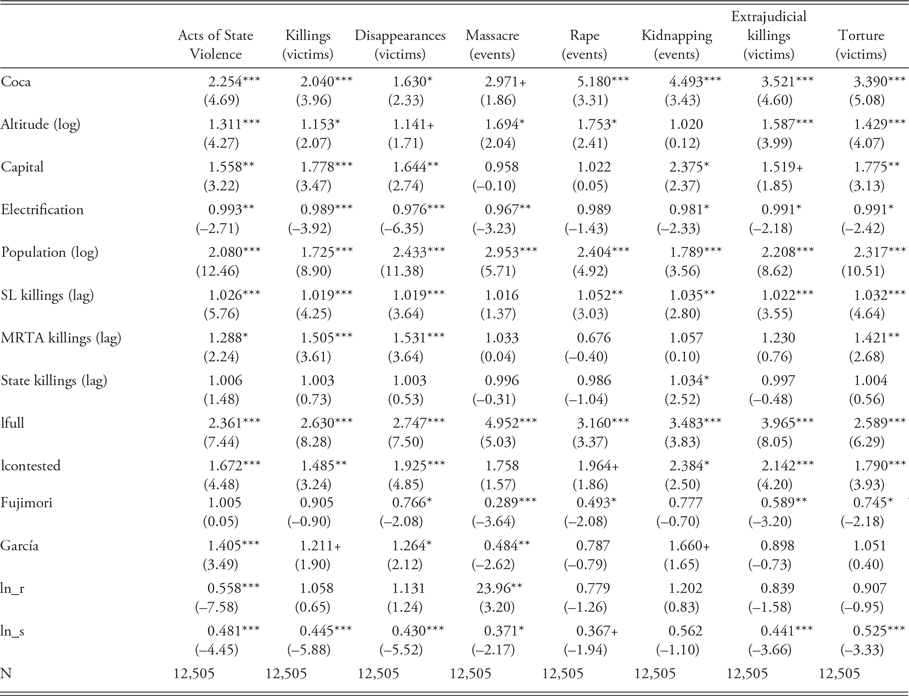
To evaluate hypothesis 1, we conducted a series of regressions with a different type of state violence as the dependent variable. In the central test, shown in the first column of table 1, the total victims of violent acts attributed to state forces is the dependent variable. Subsequent columns explore (from left to right) victims of killings and disappearances and event counts of massacres, rapes, kidnappings, extrajudicial killings, and torture.
Across all eight types of violence, the coefficient for drug production has a sizable, positive, and statistically significant effect on state violence. Comparing incidence ratios to evaluate the substantive effects of drug production reveals that in a district-year with coca production (compared to a noncoca district-year) the odds of observing a victim of state violence increase by 125 percent; the odds of a killing by 104 percent; the odds of a disappearance by 63 percent; the odds of an event of rape by 418 percent; and the odds of a torture victim by 239 percent. Thus, we find evidence consistent with hypothesis 1: drug production is associated with higher violence against civilians attributed to state forces, even after controlling for other determinants of this violence.Footnote 14 Because results are consistent across all types of violence, we use only the total number of victims of state acts as our dependent variable in subsequent analyses.Footnote 15
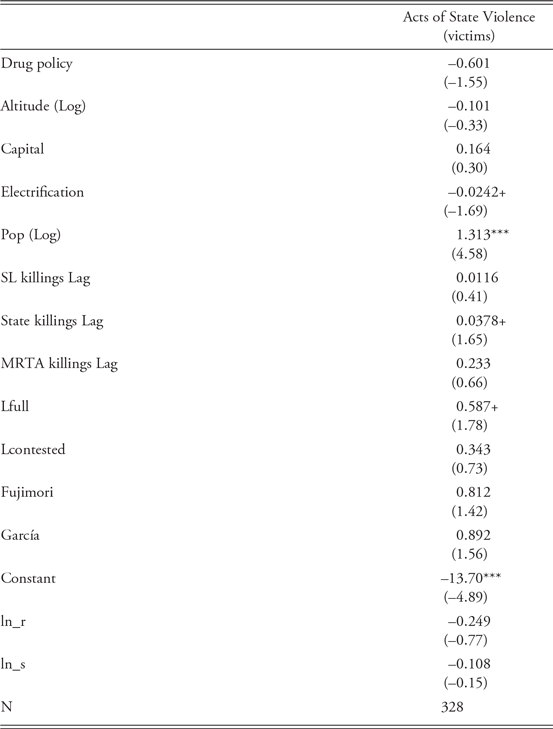
Hypothesis 2 predicts that more repressive drug policy that emphasizes crop eradication will be associated with more state violence against civilians. Here, the relevant comparison is among drug-producing district-years to examine how counternarcotics policy affects state violence. This analysis is restricted to the UHV because, as described above, we were able to code our drug policy variable only for this region. We ran a model identical to that in column A of table 1, adding the drug policy variable and restricting the sample to the UHV. As table 2 shows, we do not find support for this hypothesis. Indeed, the coefficient on our drug policy variable is negative, suggesting an association between crop eradication and less state violence, which challenges conventional wisdom in Peru about the effects of eradication-focused drug policy.
Effects of Coca Production on Violence by State Forces (H1)

+p < 0.10, *p < 0.05, **p < 0.01, ***p < 0.001
Exponentiated coefficients; t statistics in parentheses.
Effects of Drug Policy on Violence by State Forces in Drug-producing Regions (H2)

+p < 0.10, *p < 0.05, **p < 0.01, ***p <0.001
Negative binomial models with random effects.
t statistics in parentheses.
There are at least three reasons for caution about this finding, which is surprising in light of the consensus among experts on the Peruvian case. First, our dichotomous indicator of drug policy does not capture the nuances in drug policy that might affect state violence beyond the extent of emphasis on eradication. Second, it is unclear whether the implementation of policy reflected national government edicts because local commanders had policy autonomy in emergency zones, particularly early in the conflict.Footnote 16 And as Jaskoski discusses (2013), the military tended to shirk duties it saw as making it potentially vulnerable to accusations of human rights violations. Third, though unlikely in Peru due to the relative weakness and fragmentation of drug-trafficking organizations, it is also possible that counternarcotics policies directed at higher levels of the drug-trafficking chain led to more violence because those actors had more armed power than cultivators.
While further research is needed to bridge the gap between the case study– based scholarship in the policy literature and the crude coding of our preliminary examination, this finding suggests that researchers should further test the validity of the conventional wisdom among drug policy experts in Peru about the link between crop eradication-focused policies and increased state violence.
To assess hypothesis 3, about the effects of constabularization of drug policy, we conducted two analyses. First, we conducted a temporal comparison that captured the policy shift that placed counternarcotics enforcement in the hands of the military after 1992. Instead of comparing levels of state violence, as in the previous analyses, we compared the association between drug production and state violence against civilians before and after 1992.Footnote 17
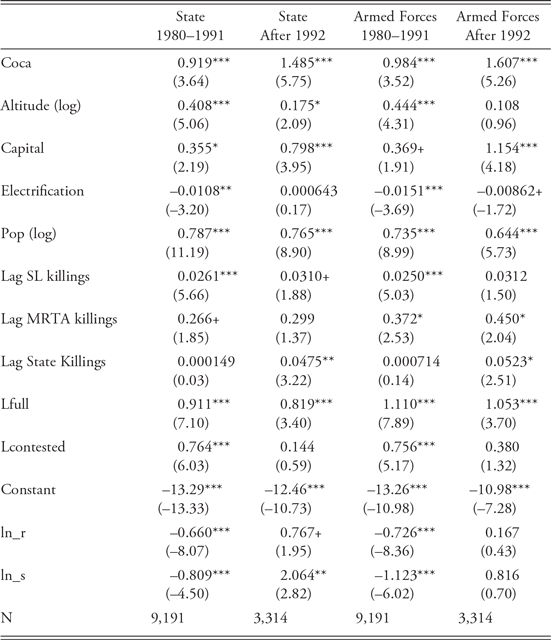
Table 3 shows the results of this temporal comparison, taking both overall state violence (in the left two columns) and violence by the armed forces (in the right two columns) as dependent variables and comparing violence before and after 1992. The much higher coefficient for the coca variable in the post-1992 sample—the size of effect increases by more than 50 percent—suggests that the constabularization of counternarcotics policing after 1992 was consistent with more violence in drug-producing regions. Though this finding is consistent with the decline of insurgent fortunes after that year and the state’s shifting emphasis toward the drug trade, this alone is insufficient to explain why this increased emphasis on counternarcotics was associated with greater violence. Our constabularization hypothesis provides an additional explanation.Footnote 18
Militarization of Drug Policy and Violence Against Civilians (by all state forces and by military only) (H3)

+p < 0.10, *p < 0.05, **p < 0.01, ***p < 0.001
Negative binomial models with random effects.
As mentioned above, we also assessed the effects of constabularization in a second manner, though here our evidence is imperfect and indirect. After controlling for other determinants of state violence and counterinsurgency activity, we looked for a greater difference between military and police violence against civilians in drug-producing regions, on the grounds that we can attribute this difference to the constabu- larization dynamic entailed in counternarcotics policy. To operationalize this, we examined the milshare and milrate variables that compare violence by the armed forces and the police in a given district-year.Footnote 19 As the left column of table 4 shows, drug production is associated with a positive, statistically significant, and substantively large effect on the difference between military violence and police violence in a given district-year. This is evidence consistent with the constabularization hypothesis. In the right column, we restricted the sample only to cases in which some violence did occur, and take as our dependent variable mitrate. We once again find a strong and significant effect at the 0.05 level, which is consistent with hypothesis 3.Footnote 20
Effects of Constabularization on State Violence (H3)

+p < 0.10, *p < 0.05, **p < 0.01, ***p < 0.001
OLS regression
Note: Military rate is defined as army violence minus police violence. Military share is defined as (army violence/total state violence) and is coded only for districts with state violence.
In all, our results suggest that in contexts of domestic conflict, state coercive actors engage in more violence in drug-producing regions, and that this is associated with the placement of counternarcotics enforcement in military hands. By contrast, we find that the emphasis on manual crop eradication in counternarcotics policy has no clear association with levels of state violence. But in addition to militarization, the presence of drug production may trigger another set of factors that shape state violence during internal conflict. These are related to the relationship between drug profits, state corruption, and violence.
Corruption and Violence
The drug trade creates opportunities for state actors to profit from the protection of illegal activity, and thus, in a conflict setting, it also distorts state officials’ incentives to legitimately reduce the drug trade. As Lessing (Reference Lessing2017) argues, state agents can use repression, enforcement, and violence to increase leverage over bribe negotiations with drug traffickers. This leads some scholars to expect greater state violence when corruption and drug enforcement commitments are coupled (Davis Reference Davis2006). Because criminal actors may respond to state violence by escalating their own use of force, upward spirals of overall violence and (for our purposes) state violence may result. Following this view, we might expect that sites of illegal drug production should see greater state violence unassociated with counterinsurgency because state actors will use violence to increase the price of protection.
Yet following the literature on criminal violence, rather than making an automatic link between corruption and state violence, we suggest that corruption can have differential impacts on violence depending on the level of organization and cohesion of armed actors and drug producers, which, in turn, shapes the types of bargains reached (Snyder and Durán-Martínez 2009; Durán-Martínez Reference Durán-Martínez2018). Where conditions allow the construction of centralized, stable, and predictable corrupt deals aimed at reducing state enforcement, corruption can lower state violence, but where actors are too fragmented to generate centralized bargains, violence will be higher as state actors use it as leverage for extracting rents from producers and traffickers.
Our hypothesis, then, is that state violence against civilians in drug-producing areas should increase with the fragmentation of state armed actors and illegal producers. Testing this hypothesis requires us to assess the degree of fragmentation of both drug producers and state forces in the Peruvian setting to generate a case-specific prediction about whether we should see greater violence in drug-producing areas. On the basis of extensive interviews, Jaskoski (Reference Jaskoski2013) argues that the army was highly centralized (16) and characterized by total corruption (27) in the UHV, especially in the 1990s, to the point that “officers competed to be assigned to the UHV specifically to receive bribes” (27).
Yet the violence-reducing effects of corrupt bargains depend on the centralization of both sets of actors. As we have seen, Peru’s drug-trafficking chain was highly fragmented and decentralized among many actors.Footnote 21 The drug-producing regions contained many armed actors (Sendero, the MRTA, and the state), which did not often collude with one another. Footnote 22 We therefore argue that centralized bargains were difficult to sustain and that corruption in Peru’s drug-producing regions, though extensive and at times centrally controlled, should be associated with high levels of violence. This expectation applies even after 1992, when the army was characterized by centralized corruption under the aegis of Vladimiro Montesinos.
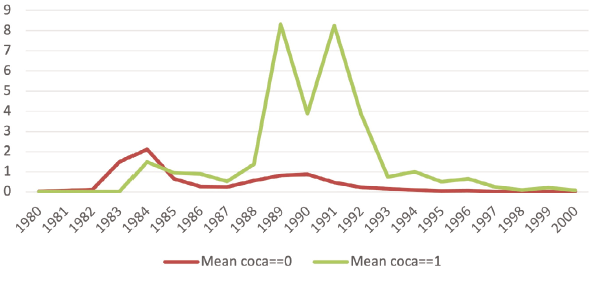
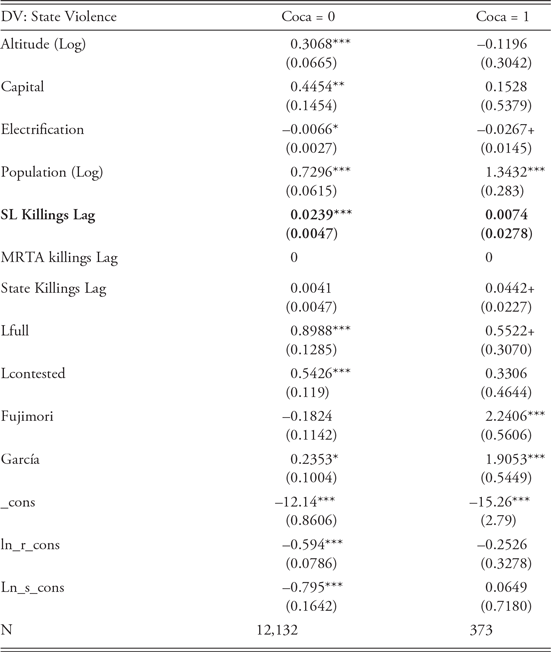
We lack a precise and direct way to quantitatively assess either the extent of corruption or the fragmentation of the actors involved. We therefore draw on two pieces of indirect evidence. First, figure 1 shows that state violence in drug-producing regions is always higher than in the nondrug regions, which is consistent with our expectation of the effects of fragmented corruption. In table 5, we split the sample between coca- and non–coca-producing districts, take state violence as our dependent variable, and compare the coefficient for the lag of Sendero violence (bolded) across the two samples. We see that the lagged value for Sendero killings has a significant, positive, and sizable impact on state violence only in noncoca regions.Footnote 23 This finding that state violence in coca regions is less responsive to Sendero violence is consistent with the presence of corruption-related violence and with corruption distorting the incentives of state officials.Footnote 24
State Violence in Drug and Nondrug Regions, 1980–2000
Note: Victims of state violence (mean) by coca production

State Violence as a Function of Lagged Sendero and MRTA Violence

+p < 0.10, *p < 0.05, **p < 0.01, ***p <0.001
Negative binomial models with random effects.
Given the variation across localities and time in how Sendero, the MRTA, and state actors treated the drug trade, the statistical findings presented conceal a great deal of local variety in the extent of corruption and the violence that resulted. Drawing on qualitative evidence from the CVR, appendix E shows the complex and diverse forms of corruption in which Peru’s armed actors engaged, highlighting the complications entailed in the systematic study of this relationship and providing more evidence for our claim that although extensive, state corruption was not organized in a way that could reduce violence, as it was, for example, in Mexico under the PRI. Some of the best-known and centralized cases of corruption, like that of Fujimori’s chief of intelligence, Montesinos, or the state protection of famous drug trafficker Vaticano, show how violence and enforcement remained a strategic tool to handle corruption.
Montesinos himself recognized that he used enforcement strategically to please US antinarcotics agendas and mitigate attention over his well-known but overlooked engagements with drug traffickers. In the case of the drug trafficker known as Vaticano, he first had alliances with Sendero but then confronted both Sendero and MRTA while providing regular payments to Montesinos for each drug flight (CVR 2003, vol. 4, p. 2005). In sum, our discussion suggests that the nature of corruption could have been another mechanism increasing violence in drug regions in Peru.
Conclusions
The aim of this study was to begin remedying a gap in the literature on the drugs- conflict nexus by statistically investigating whether and how drug production affects state behavior in civil conflicts. Drawing on the rich dataset of human rights violations assembled by Peru’s Truth and Reconciliation Commission, the analysis explored the associations between coca production and state violence against civilians. It combined insights from the criminal violence, drugs-conflict nexus, and drug policy literatures to theorize how the drug trade may affect state violence.
Overall, we found strong evidence that in Peru’s armed conflict, coca production had a significant and positive impact on overall levels of state violence. While the overall association is positive, the temporal variation in the strength of effects also suggests that this association is not automatic and is mediated by the government’s policy decisions.
Here, the results for the drug policy variable suggest that simple dichotomous characterizations of drug policy do not reflect its complexity. We found no consistent effect of eradication-focused drug policies on state violence against civilians. We did, however, find that placing drug policy implementation in the hands of the military was associated with higher levels of violence in drug-producing regions; this is consistent with the growing scholarship on the militarization of drug wars, focused largely on the Mexican case (Flores-Macías Reference Flores-Macías2018). Future research, both in Peru and in other settings characterized by insurgency and drug production, could build on this finding to refine the concept of drug policy by analytically distinguishing dimensions that are more conceptually precise than our distinction between eradication-focused and less repressive policies, and by developing ways to operationalize each in its variation across time and space. That would allow for more nuanced tests of these relationships than the ones we have provided.
This article has suggested that there is a nexus between drug production and state violence akin to the drugs-insurgency connection that has been more widely explored in the literature. Yet this nexus is not automatic and cannot simply be assumed (as often occurs in the drugs-insurgency literature). The nature of the groups engaged in drug trafficking, the content and implementation of state policy, and the organization of the state security apparatus can mediate this relationship. These factors should therefore shape state counterinsurgent violence against civilians in other drug-producing cases.
This analysis was limited by the lack of fine-grained information about variation across time and space in state counterinsurgency and counternarcotics strategies, which can help us better understand the mechanisms driving the findings and the motivations of state violent behavior. While information about the state coercive apparatus is difficult to access—and in Peru, the current prospects for deepening this analysis are limited, given the opacity of the Fujimori regime and the continuing lack of access to military archives—this preliminary investigation has shown that deepening and disaggregating our understanding of state behavior is both possible and necessary. We believe that the study of conflict will benefit from more research on subnational variation in the determinants of state coercion (as a complement to the growing scholarship on the effects of state policy on levels of violence), and we hope that scholars will continue to explore this issue to evaluate whether our findings travel beyond Peru’s internal armed conflict to other cases of insurgency in drug-producing countries.
Supporting Information
Additional supporting materials may be found with the online version of this article at the publisher’s website: Appendix.