An earthquake is a major disaster with an invariable impact on planetary health. Reference Mishra and Adhikari1 Nepal lies in a major fault line between 2 tectonic plates, and future earthquakes with potential for a much greater impact are predicted. Reference Elliott, Jolivet and Gonzalez2 Nepal was ravaged by 2 major earthquakes in 2015 within a few weeks apart. Reference Adhikari, Mishra and Raut3,Reference Adhikari, Mishra and Babu Marahatta4
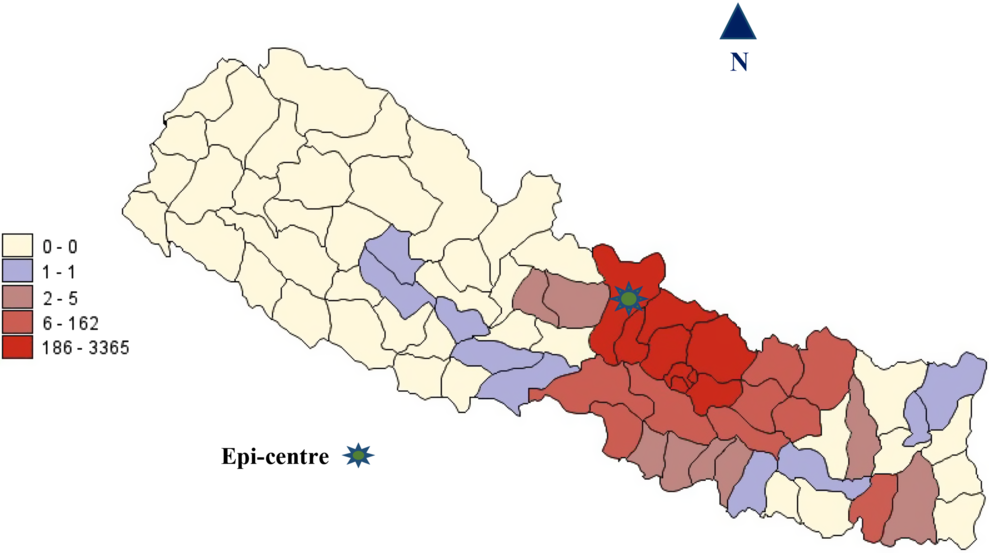
On April 25, 2015, Nepal experienced an earthquake of 7.8 magnitude on the Richter scale. Another major aftershock on May 12, 2015, of magnitude 7.3 further worsened the damages incurred in the first earthquake. Reference Adhikari, Mishra and Babu Marahatta4 Since then, several aftershocks of different magnitude continue to dread Nepal in variable proportions. A total of 387 out of 720 aftershocks were recorded above 5 magnitudes between the second major earthquake until the beginning of 2019. 5 These 2 earthquakes affected 31 out of 75 districts, claiming 9000 lives and leaving 23 000 injured with an economic loss of an estimated US $7 billion (Figure 1). Reference Adhikari, Mishra and Raut3,Reference Adhikari, Mishra and Babu Marahatta4
Nepal Geographic Map Showing Total Deaths in Gorkha Earthquakes. Legends to the Left Show Deaths by District. The Map Is Produced Using GMAP Procedure in SAS 9.4 (SAS Institute, Inc., Cary, NC).

The risk and determinants of mortality due to such major calamities are critical for future public health preparedness. Globally, post-earthquake disaster data have shown the mortality associated with the vulnerable age groups, inaccessible geographic regions, and the residential conditions. Reference Gutierrez, Taucer and De Groeve6 For instance, the 2011 Great East Japan Earthquake killed more older people (above 70 years) than the remainder of the population. Reference Koyama, Yoshimura and Kiyono7 Higher mortality due to earthquakes in Haiti was associated with older age (above 50 years), crowded living conditions, and multi-story buildings. Reference Doocy, Cherewick and Kirsch8 Higher mortality was found among people with moderate physical disabilities, mental disorders, a lower monthly wage, and people who were hospitalized before the Taiwanese earthquake occurred. Reference Chou, Huang and Lee9 In China, people with chronic diseases were often the victims of earthquakes. Reference Chan, Gao and Griffiths10 In the Armenian earthquake, people living in high earthquake-affected geographic locations and those living inside the building had the highest injuries and mortality. Reference Armenian, Melkonian, Noji and Hovanesian11 These findings resonate well with a recent study conducted in Nepal, which highlighted that the older population during the earthquakes were particularly vulnerable, and their health-related quality of life was affected by age, decreased mobility, injuries, poor access to health care, weak social support, and posttraumatic stress disorder. Reference Wagle, Amnatsatsue and Adhikari12
Time and again, the country-specific data have shown the vulnerable groups for injuries and mortality due to natural calamities. Reference Koyama, Yoshimura and Kiyono7-Reference Armenian, Melkonian, Noji and Hovanesian11 Nevertheless, these vulnerable groups and the environment that conduces injuries and mortality are often overlooked and are not fully translated in the policy and preparedness. Reference Adhikari, Mishra and Babu Marahatta4,Reference Chan, Gao and Griffiths10 This is the first study to explore the vulnerable population in terms of the morbidity and mortality using a national mortality data of the Gorkha earthquakes in 2015. The main objective of this study was to explore the distribution of mortality across the earthquake-affected districts of Nepal based on the available socio-demographic determinants.
METHODS
We analyzed data from the report published on May 25, 2015, by the Nepal Police on deaths from the Gorkha earthquake. The report published a list of 8201 casualties, considered exhaustive as of the date of publication, including information on each resident’s name, district, age, and gender. We extracted information on the surname of each casualty, the resident’s district, age, and gender and entered the information into EpiData. To assess the possible effects of ecological constructs, we linked each resident’s district with the population size of the district, province, and ecologic belt. These statistics were taken from the 2011 census report 13 and updated with the annual population growth rate of 1.35% to represent the population size of 29 796 227 in 2019.
Data cleaning, coding, and analysis were done in SAS 9.4 (SAS Institute, Inc., Cary, NC). First, we linked the surname of each casualty with the nearest possible ethnicity and further grouped ethnicity into 8 categories for analysis, following the health management information system classification of Nepal. 13 Except for ethnicity, we calculated death rates (per 100 000 population) stratified by age-group, gender, province, and ecologic belt. Because the study used secondary data from a published report and did not require a human interaction, ethical clearance was not required. The spatial analysis of total deaths was done in SAS 9.4 following a GMAP procedure. Reference Zdeb14
RESULTS
Nepal’s earthquake had a tectonic epicenter at Gorkha; however, the most deaths were distributed along the eastern districts of Gorkha (see Figure 1). In addition to the first earthquake on April 21, the subsequent aftershock shifted the epicenter to Sindhupalchok, which may have resulted in more deaths in the eastern districts.
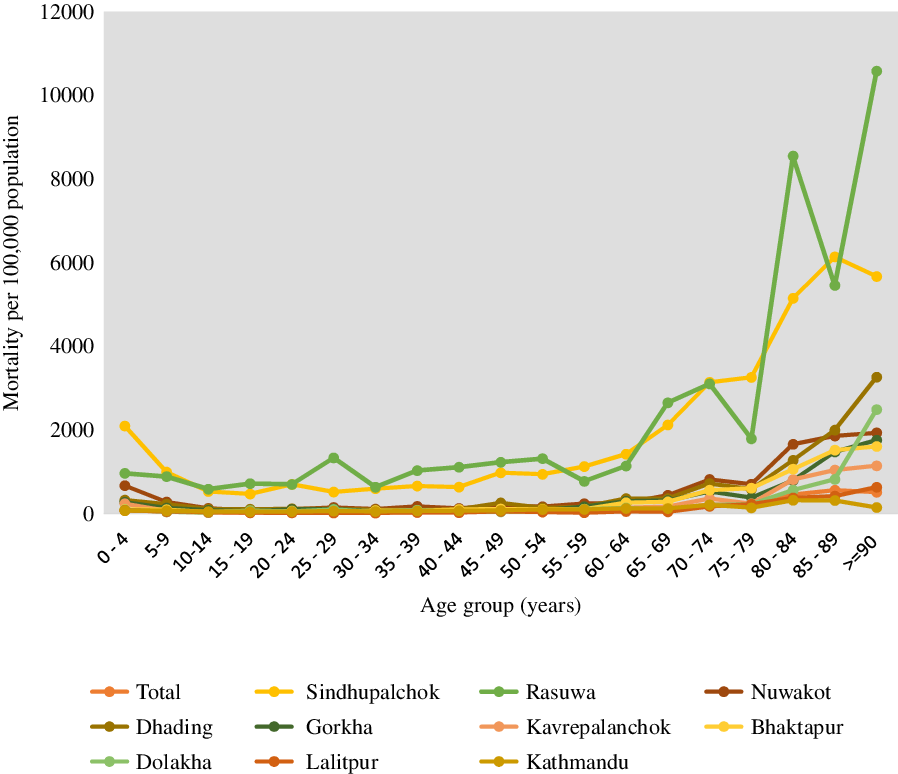
The 2 major Gorkha earthquakes claimed 8151 deaths. These deaths proportionally increased by the age groups; the elderly population was the most affected by the earthquakes (Figure 2 and Supplementary Table 1).
Age-Specific Mortality Rate by Earthquake-Affected Districts in Gorkha Earthquakes (N = 8151).

Gender-Specific Mortality Rate in Gorkha Earthquakes (N = 8151)*

* Mortality rate depicted per 100 000 population.
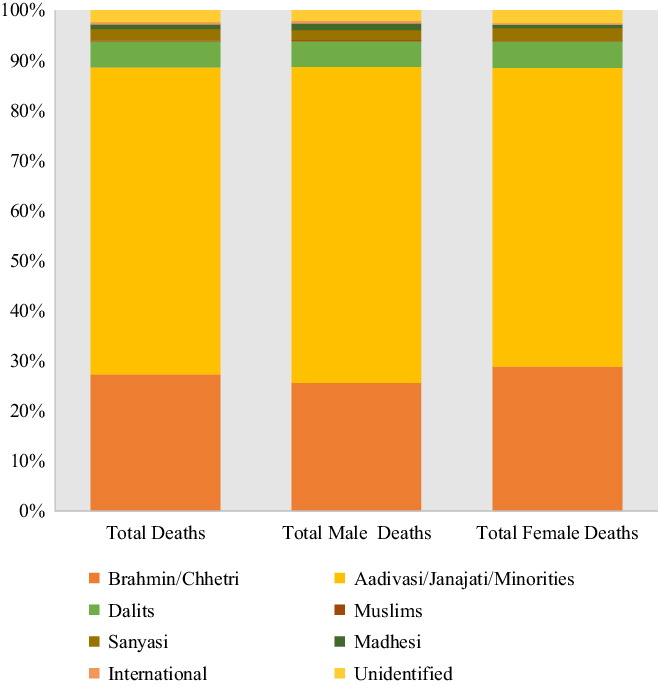
The distribution of deaths by the earthquakes was disproportionate, as the majority who lost lives due to the earthquakes were ethnic minorities (Adivasi and Janajatis) followed by Brahmin/Chhetris and Dalits alone (Figure 3).
Percentages of Total Deaths by Ethnicities in Gorkha Earthquakes (N = 8151).

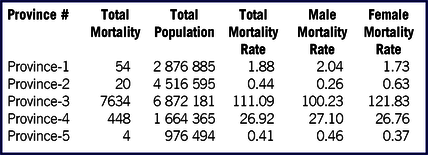
The earthquakes had a higher impact among females more than males. The mortality was higher (female: 4480/8 253 258; 54.3% versus male: 3671/7 976 846; 46%) among females compared with males (Table 1 and Supplementary Table 2). Eight more females’ deaths were reported per 100 000 population compared with their male counterparts. A higher gender-difference was seen in Province 3, where 20 more females’ deaths were reported per 100 000 population compared with their male counterparts.
Province-Specific Mortality Rate by Gender in Gorkha Earthquakes (N = 8160)*

* Mortality rate depicted per 100 000 population.
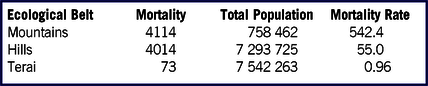
In line with the provinces (Provinces 3 and 4) where the earthquake and aftershocks had epicenters, these were mostly remote, mountainous, and hard-to-access areas within Nepal and corresponded with the most deaths (Table 2). Province 3 had the highest deaths (n = 7634) followed by Province 4, which had 448 deaths. Mountainous regions of Nepal had the highest tolls of death (mountains: mortality rate of 542.4 per 100 000; hills: 55 per 100 000; and Terai: 0.96 per 100 000 population) compared with hills and the Terai regions (Table 3).
Ecological Region-Specific Rate in Gorkha Earthquakes (N = 8201)*

* Mortality rate depicted per 100 000 population.
DISCUSSION
The impact of disasters, including the earthquakes, is predicated mainly on 2 principal factors: hazard and vulnerability. Reference Alcantara-Ayala15 While the factors embedded in the hazards of a disaster are more or less constant, such as the characteristics of the disaster in terms of geology, meteorology, and ecological characteristics, vulnerability of the population affected can be largely modifiable. Reference Chan, Gao and Griffiths10 In Nepal, the earthquakes clearly showed a high mortality amongst the extreme age groups (under 5 years and above 60 years) (see Figure 2) and resonate with the previous review, which reported that the elderly population (above 65 years) had 3 times the higher risk of injuries and 5 times the higher rates of mortality compared with the remainder of the population. Reference Bartels and VanRooyen16 A recent study from Nepal echoes our findings and shows that the older adults were vulnerable to have a poorer health-related quality of life. Reference Wagle, Amnatsatsue and Adhikari12 The older population was found to be the most affected group during the earthquakes in Japan, China, Haiti, India, and California. Reference Doocy, Cherewick and Kirsch8,Reference Chan, Gao and Griffiths10,Reference Bartels and VanRooyen16,Reference Aida, Hikichi and Matsuyama17 Although various factors play a synergistic role for the cumulative impact, Reference Ramirez and Peek-Asa18 the older adults in Nepal were further made vulnerable due to their homebound nature, low mobility (due to disability and debility as a result of old age), and comorbid conditions. Reference Chou, Huang and Lee9,Reference Wagle, Amnatsatsue and Adhikari12
In general, delayed response is observed among the elderly population who often suffer from comorbid conditions, including depression. Reference Ghimire, Baral and Pokhrel19 More than half (57% of 289 patients) of the elderly population attending general Out-Patient Department in Kathmandu were found to be suffering from depression. Reference Ghimire, Baral and Pokhrel19 Depression and old-age-associated dementia and psychomotor retardation may impact motor and cognitive impairment, thus leading to a delayed adoption of the preventive measures. Reference Aida, Hikichi and Matsuyama17 Furthermore, it can cause feelings of hopelessness and thus a reduced incentive for evacuation. Reference Aida, Hikichi and Matsuyama17 In Nepal, 1 of the other neglected yet modifiable factors could also be the housing (without retrofits) and residential conditions where older people often reside above the ground floor. A high majority among the 900 000 damaged houses did not have evacuation plans. Reference Adhikari, Mishra and Babu Marahatta4 A retrospective cohort analysis from an Armenian earthquake found living in the upper floors of buildings and being inside the building during earthquakes (not having access to safe grounds) to be conducive to injuries and mortality. Reference Armenian, Melkonian, Noji and Hovanesian11 In Nepal, as well, residing in the ground floors could have provided a quicker access to safer grounds during the earthquakes. Nonetheless, urban and semi-urban areas in Nepal suffer from crowded living conditions and lack of safe public spaces where the population could be evacuated to during the disasters. Reference Adhikari, Pokharel and Mishra20 Lack of public spaces during disasters can contribute to high rates of injuries and mortality. 21
The hardest hit areas by the earthquakes were mostly in the remote districts, such as Gorkha and Sindhupalchok; thus, there is a higher mortality in these provinces (Provinces 3 and 4), which are mostly inhabited by ethnic minorities (see Figure 3 and Tables 1 and 2). Although Gorkha earthquakes’ epicenters were located in these regions, rationalizing the high mortality to the residents of these districts simply because of the hazard factor should not offer complacency. There are serious implications for future interventions. The attribution of the earthquakes’ damages in these districts and the loss of lives could have been mitigated, because these districts are not only socioeconomically disadvantaged and hard to access, but also they are underprivileged due to a disproportionate distribution of health services. Reference Adhikari, Mishra and Babu Marahatta4 The lack of health care facilities, human resources, and intensive care facilities in these remotely located districts puts population at continuous risk. Reference Aryal, Acharya and Shrestha22 Immediate attention is required to proportion the health care in these regions, as affected households are forced to shelter in dilapidated houses/tents even after 4 years of the earthquakes. Reference Adhikari, Mishra and Babu Marahatta4,Reference Adhikari and Mishra23
Gorkha earthquakes were indiscriminate to all gender, and mortality in females was proportionately higher than that in males (Table 3). This resonates with mortality rates that are often seen during and after the war, famine, and natural calamities. Reference Neumayer and Plümper24 The females’ preponderance to higher mortality can be explained by analyzing the local social and cultural factors. Reference Ramirez and Peek-Asa18 Specifically in Asia, the unique sociocultural characteristics of females, such as vulnerability to low levels of employment, being housebound and having higher household responsibilities, can explain to some extent the higher mortality among females. Reference Chou, Huang and Lee9,Reference Adhikari and Mishra25 In Nepal, resonating with the past studies, females bear household responsibilities that are disproportionate to males. Reference Adhikari and Mishra25 The cultural entanglements of being responsible for household chores, aggravated by high male emigration, further render more vulnerability to this population. Reference Mishra and Adhikari1,Reference Adhikari and Mishra25
Response and Recovery Efforts Immediately Following the Disaster
In this section, we describe the response and recovery efforts in the immediate aftermath of the Gorkha earthquakes. These events have not been documented adequately in the literature. The report published after the first earthquake on April 30 stated clearly that 24 000 people were displaced and 3 million were in need of food relief (10% of population). 26 The same report stated that nearly 6000 were dead in the first week, the majority being from Kathmandu (n = 1039) and Sindhupalchok (n = 1376). The second earthquake on May 12 caused an additional 200 deaths and left 2500 injured. Reference Adhikari, Mishra and Babu Marahatta4 The majority (90%) of village health facilities in these districts were severely affected by these 2 major earthquakes. Despite damages to health facilities, health center/hospital visits increased to as high as 5 times compared with the pre-earthquakes situation. Reference Giri, Risnes and Uleberg27 This indicates the sheer burden on those health facilities that survived the damages, although may have failed to offer a good quality of health service. Reference Giri, Risnes and Uleberg27 Access to and quality of health services were associated with the poorer health-related quality of life among the older age earthquake survivors in Lalitpur district of Nepal. Reference Wagle, Amnatsatsue and Adhikari12 In such circumstances, published reports and anecdotes univocally reflected on the lack of attention to the health services. Obviously, the existing fragile health system (lack of adequate resources) was strained too heavily by the earthquakes and could not bear the exponential health demands during the earthquakes. Reference Adhikari, Mishra and Babu Marahatta4
Most of the relief efforts carried out by local and foreign medical teams were either Kathmandu centric or disbursed themselves in districts close to the capital. Reference Adhikari, Mishra and Babu Marahatta4 Such a disproportion of medical aid was partly due to a lack of coordination between the central and local health authorities and the non-governmental organizations that further incurred delays in the response efforts. Reference Lee28 Monsoon rains that followed the earthquakes in affected districts further complicated the already chaotic recovery efforts in the districts. Recovery efforts were further hindered by the sobering transportation cost of vehicles required to mobilize the rescue and health care services. Amid these multitude of factors, the functioning of the local disaster management committee remained further restrained. Although a disaster relief and response committee is established in every district, a lack of preparedness and experience made them largely futile. Reports state that lack of a clear delineation of roles between local, regional, and central level disaster response committees severely paralyzed the response, including aid efforts. 29 Drugs and medical aids piled at the airports waiting to be cleared and sent to the districts. 30 In 14 affected districts, 240 000 people were not reachable by road and 75 000 were at places where even helicopters could not reach; this highlights that besides lack of coordination, geographical inaccessibility was the second most challenging factor hindering aid delivery. 31
No particular focus was given on infectious disease management; however, fortunately, no major outbreaks occurred as predicted and feared. Reference Adhikari, Mishra and Raut3 was a sharp shortage of medicines and equipment, especially outside of the Kathmandu valley. Also, in the major hospitals in Kathmandu, there was no homogeneous practice of triage for emergency management. Within the first 2 weeks, 41 200 were hospitalized and 7124 surgeries were performed, including 41 amputations. Reference Goyet, Rayamajhi and Gyawali32 Among 22 000 who sustained various injuries, 5000 developed long-term disabilities. 33 The ratio of amputation to surgeries was, however, lower compared to Haiti (0.1% Nepal vs 0.5% Haiti). 34 Nevertheless, both countries have been criticized for lack of coordination in care and triage management, which could have saved more people from amputation and losing their lives at their prime.
Apart from the damages due to earthquakes often measured in injuries and mortality, the mental health impact continues to loom larger in the Nepalese population. Reference Adhikari, Mishra and Babu Marahatta4,Reference Mishra, Khanal and Khanal35 The rise in suicides after the earthquakes was alarming, which rose to over 41% within the 3 months after the earthquakes and further highlighted the overlooked impact of the earthquakes.
FUTURE RECOMMENDATIONS
The population level impacts are crucial for future mitigation of mortality due to disasters. The vulnerability of mortality in the elderly, children below age 5, and female population provides significant insights for future preparedness efforts. Specifically, earthquake preparedness measures should target interventions at individual, community, and health system levels. Reference Wagle, Amnatsatsue and Adhikari12,Reference Chan, Man and Lam36 Initial steps can be drawn from the elements of community engagement to increase the literacy on disaster and its preparedness Reference Adhikari, Mishra and Raut3,Reference Adhikari, Mishra and Babu Marahatta4,Reference Adhikari, Pell and Phommasone37,Reference Adhikari, James and Newby38 – for instance, encouraging vulnerable family members to live in the ground floors so that they can quickly evacuate to safer spaces during disasters. Similarly, creating a household plan for rescue efforts during disasters with special care to vulnerable family members is essential. At the community level, the municipal government can establish a volunteer disaster preparedness group who can coordinate and facilitate the awareness on safety measures, and conduct drills and simulation exercise. The disaster preparedness group can further help coordinate with the local health system to attend to the vulnerable groups. Nepal’s health system can significantly use the community level’s disaster preparedness groups who can coordinate and facilitate the rescue efforts. In addition to developing these bottom-up approaches, Nepal’s health system should be specifically prepared to render additional services to the vulnerable population during disasters, such as through mobilization of resources (health workers, specialists, and equipment) from unaffected districts. Reference Adhikari, Mishra and Babu Marahatta4,Reference Aryal, Acharya and Shrestha22 Additionally, drawing the lessons from this study, future preparedness should account for establishing a cadre of reserve specialities (anesthesiology, orthopedics, and pediatrics) willing to serve in disaster situations or through training mid-level health workers in temporary intensive care in the affected districts.
CONCLUSION
This study found that the populations from extreme age groups and from remote regions were highly vulnerable to injuries and mortality due to the earthquakes in Nepal and, therefore, should receive special attention in disaster preparedness and response. Further, community-based disaster preparedness/response teams should be established locally that can support and facilitate the disaster rescue and responses during the earthquakes.
Conflict of Interest Statement
The authors have no conflicts of interest to declare.
Supplementary material
To view supplementary material for this article, please visit https://doi.org/10.1017/dmp.2020.12