INTRODUCTION
In the area of first language acquisition research, relative clauses have been investigated as a representative case of complex syntactic structures. However, most studies on relative clauses focus on languages with postnominal modification such as English and other European languages, and only a small number of studies look at relative clause acquisition in languages with prenominal modification. Needless to say, it is important to look at typologically different languages in order to understand universals and particulars of language acquisition. In this study, we analyze spontaneous production data from five Japanese children, and show that their early relative clauses are dramatically different from those of children acquiring English. Specifically, we show that while English-speaking children start with presentational relatives asserting new information (Diessel & Tomasello, Reference Diessel and Tomasello2000), Japanese children start to use relative clauses as restrictive relative clauses right from the beginning, modifying the head noun with a stative predicate to identify a referent. We propose an explanation based on typological differences between the two languages.
Relative clauses in Japanese
The Japanese relative clause construction has the following characteristics: (a) it involves prenominal modification; (b) it involves a gapping strategy instead of a pronominal copy; and (c) there is no overt marker of relativization. Example (1) illustrates these points:
- (1)
a. [Ken-ga katta] rakettoKen-NOMFootnote 1 bought racket‘The racket [that Ken bought]’
b. [Raketto-o katta] hitoracket-ACC bought person‘The person [who bought a racket]’
In Japanese, all noun modifiers are placed prenominally, and as a consequence of the characteristics mentioned above, noun modification by words, phrases and clauses is often considered a continuum (Kato, Reference Kato2003; Teramura, Reference Teramura and Kunihiro1980), and sometimes it is not easy to distinguish between adjectival, phrasal and clausal modification. As illustrated in (2), these different types of modification are formally very similar. Example (2a) is adjectival modification, (2b) is phrasal modification, and (2c) and (2d) are generally considered relative clauses in Japanese.
- (2)
a. [kireena] hoterubeautiful hotel‘a [beautiful] hotel’
b. [Hawai-no dono hoteru-yori kireena] hoteruHawaii-GEN any hotel-than beautiful hotel‘a hotel [more beautiful than any hotel in Hawaii]’
c. [robii-ga kireena] hoterulobby-NOM beautiful hotel‘a hotel [whose lobby is beautiful]’
d. [resutoran-no ueetoresu-ga kireena] hoterurestaurant-GEN waitress-NOM beautiful hotel‘a hotel [where the waitresses in its restaurant are beautiful]’
English has a mixed pattern of noun modification in that short noun modifiers are mostly prenominal and long modifiers, including relative clauses, are postnominal, and the type of continuum observed in Japanese does not obtain.
Another dimension of the typological difference between English and Japanese concerns Comrie's (Reference Comrie1996, Reference Comrie, Boeder, Schroeder, Wagner and Wildgen1998, Reference Comrie and Giacalone Ramat2002; also Comrie & Horie, Reference Comrie, Horie, Abraham, Givón and Thompson1995) typology of noun-modifying constructions. Comrie, following Matsumoto (Reference Matsumoto1988, Reference Matsumoto1997), characterized noun-modifying clauses in Japanese as attributive clause constructions. He argues that attributive clauses do not involve a gap, unlike relative clauses, and have a structure where a modifying clause is merely attached to a head noun. He further argues that the acceptability of an attributive clause depends not on structural factors but on whether a native speaker of Japanese can readily establish a plausible interpretation. His argument is based on three pieces of evidence. First, in languages that allow zero anaphora, there is no need to argue that there is a gap corresponding to the relativized noun phrase. Second, Japanese seems to lack syntactic constraints (such as the subjacency condition) on the relation between the head noun and the covert co-referential noun in the subordinate clause.
Third, attributive clauses can have the same function that the fact-S construction in English has (e.g. the fact that John died). Example (3), the fact-S construction, is identical in its surface form to a more typical relative clause, as in example (1), repeated here as example (4):
(3) [Ken-ga sinda] zizitu Ken-NOM died fact ‘The fact [that Ken died]’
(4) [Ken-ga katta] raketto Ken-NOM bought racket ‘The racket [that Ken bought]’
In fact, Japanese permits a special type of noun-modifying clause called an ‘outer relationship’ clause (Teramura, Reference Teramura1970, Reference Teramura1975). This is a type of noun-modifying clause for which a gap within the modifying clause does not exist, as in the case of appositive clauses in English. Further, ‘outer relationship’ is not limited to the equivalent of English appositive clauses, but includes noun-modifying clauses involving various types of loosely related semantic characterization of the head noun, as in (5) and (6):
(5) [Doa-o tataku] otodoor-ACC knock sound ‘the sound [of knocking on the door]’
(6) [Pan-o katta] oturibread-ACC bought change ‘the change [from buying bread]’(=the change that was obtained after buying bread)
Thus, Japanese can denote diverse types of modification relations using formally identical noun-modifying clauses.
Comrie further claims that noun-modifying clauses in many Asian languages (e.g. Chinese, Khmer, Korean) also have attributive clauses, which are structurally different from relative clauses in European languages.
As this brief discussion shows, Japanese relative clauses are dramatically different from English relative clauses. In particular, Japanese relative clauses are continuous with adjectival modification while English has a discontinuity between the two. This difference is linked to whether relative clauses are prenominal or postnominal, whether the modification system is unified or mixed, whether relativization is overtly distinguished from adjectival modification, and whether modifying clauses are attributive or relative clauses. In this paper we investigate how children acquire relative clauses in Japanese, focusing on semantic and functional characteristics, and compare our results to those in Diessel & Tomasello (Reference Diessel and Tomasello2000), which reports detailed development of English relative clauses in spontaneous speech. We then attempt to explicate how typological differences affect the pattern of relative clause development.
Previous child language research on relative clauses
Previous research on relative clause acquisition mostly involves comprehension experiments, investigating the difficulty of different types of relative clauses (e.g. Hakuta, Reference Hakuta1981; Sheldon, Reference Sheldon1974). These experimental studies investigate children old enough to comprehend relative clauses to some extent, and therefore cannot provide information about how children acquire relative clauses at the early stages, as Diessel & Tomasello (Reference Diessel and Tomasello2000) point out.
There is a small number of studies on the development of relative clauses using production data, such as Dasinger & Toupin (Reference Dasinger, Toupin, Berman and Slobin1994), Jisa & Kern (Reference Jisa and Kern1998) and Slobin (Reference Slobin, Slobin and Zimmer1986). Slobin's (Reference Slobin, Slobin and Zimmer1986) cross-sectional study, for example, which analyzed conversational data from 57 children, reports that the acquisition of relative clauses is very slow in Turkish, a prenominal relative clause language, due in large part to formal complexity in forming relative clauses. He also notes that relative clauses frequently involve stative predicates.
Diessel & Tomasello's (Reference Diessel and Tomasello2000) study on English-speaking children, Brandt, Diessel & Tomasello's (Reference Brandt, Diessel and Tomasello2007) study on a German-speaking child, and Kim's (Reference Kim1987) study on Korean- and English-speaking children, are the only studies that directly investigated the process of relative clause acquisition in detail using longitudinal speech data. The dearth of longitudinal studies of natural production data probably is due to the highly labor-intensive nature of such studies. Relative clauses are very rare in caretaker–child interaction, and since they cannot be automatically searched on computer files, they have to be searched by hand. For the present study, relative clauses had to be hand-searched by reading literally thousands of transcribed pages, since in Japanese there is no grammatical marking of relative clauses.
Diessel & Tomasello (Reference Diessel and Tomasello2000; see also Diessel, Reference Diessel2004) analyzed conversational data of four children aged 1 ; 9 to 5 ; 2 from the CHILDES database. They showed that relative clauses emerge in the predicate of copula clauses such as predicate nominals and existential constructions, and that they are presentational relative clauses which ‘assert new information concerning the referent established in the presentational clause’ (Diessel & Tomasello, Reference Diessel and Tomasello2000: 137), as in (7):
(7) Here's a tiger that's gonna scare him.
What is striking about Diessel and Tomasello's results is that children rarely produce sentence types used in many experimental studies – that is, a transitive sentence with another embedded transitive sentence. (e.g. The duck licked the frog [that bit the pig].)
In contrast, Kim's (Reference Kim1987) results on Korean, a language where relative clauses are prenominal as in Japanese, are very different from Diessel and Tomasello's. Kim reported that the Korean-speaking children began to use prenominal adjectives and relative clauses simultaneously, and that the head nouns of their early relative clauses are kes, the equivalent of ‘one’ or ‘thing’, as in (8) (Kim, Reference Kim1987: 125):
(8) [Yeki kki-nun] ke eti iss-e?here insert-PRES thing where exist-INT? ‘Where is the thing [that (I) insert here]?’ (Ciman 2 ; 8)
As is clear from these studies, detailed analysis of large-scale longitudinal data is important if we are to uncover the formal and functional characteristics of the development of relative clauses in child language.
Regarding the formal aspects of relative clause acquisition, recent studies in L1 acquisition have found results consistent with Comrie's typology discussed above. Diessel & Tomasello's (Reference Diessel and Tomasello2000) study on children's conversation and Diessel & Tomasello's (Reference Diessel and Tomasello2005) elicited imitation studies with English and German children both clearly showed the effect of syntax, showing the order of subject relatives (SU: the man who came)>direct object relatives (DO: the man who she loves)>oblique relatives (OBL: the man who I talked to) in production frequency (Diessel & Tomasello, Reference Diessel and Tomasello2000) and in accuracy of elicited imitation (Diessel & Tomasello, Reference Diessel and Tomasello2005). In particular, Diessel & Tomasello (Reference Diessel and Tomasello2000) found a frequency order of relative clauses used by the children of SU (53·0%), DO (32·6%) and OBL (14·4%). Furthermore, the first ten relative clauses produced by each child were restricted to SU relatives (72·5%), and OBL relatives were very infrequent (5·0%), which suggests that SU relative clause types are acquired earlier than DO or OBL types in English. In contrast, Ozeki & Shirai (Reference Ozeki, Shirai, Matsumoto, Oshima, Robinson and Sells2007a) analyzed the same sets of longitudinal data as the present study (from five Japanese children aged 1 ; 0–3 ; 11), focusing on syntactic aspects of relative clause development, and reported that SU, DO and OBL were used from the beginning at approximately the same rate (about 30%) and that this trend did not change as the children grew older, i.e. the first ten relatives were also distributed equally among the three types. These contrasting results from European languages and Japanese might indicate that relative clauses in Japanese are qualitatively different from those in European languages. More specifically, they may suggest that relative clause formation in European languages is constrained by syntactic operations, while in Japanese, relative clause construction is governed by semantic and pragmatic principles, in line with Comrie's proposal.
We are not aware of any study regarding the semantics and pragmatics of relative clauses in child Japanese. However, Ozeki's (Reference Ozeki2004) study on adult second language learners is relevant. Ozeki reported that five untutored learners of Japanese first used relative clauses that describe states or generic attributes of the head noun. She suggested that learners develop relative clauses of the stative/generic type early, presumably because they can build on adjectival modification that they have acquired earlier, which is continuous with clausal modification, including modification by relative clauses. Also relevant is Slobin (Reference Slobin, Slobin and Zimmer1986), who found that in Turkish (a prenominal relative clause language), children's relative clauses involve predominantly stative predicates, as stated above.
In sum, although previous research investigated the formal aspects of relative clauses in child Japanese and suggested that they are very different from those observed in the development of English relative clauses, no study has directly investigated the semantics/pragmatics of relative clauses in child Japanese. In this paper we analyze relative clauses in conversational data from Japanese children with respect to their head nouns and to the stativity of their predicates to identify the semantic and functional characteristics of children's relative clauses, and we compare them with the English data from Diessel & Tomasello (Reference Diessel and Tomasello2000).
METHOD
Data
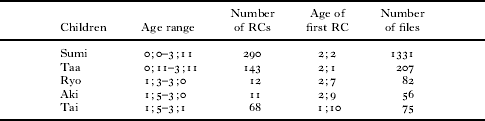
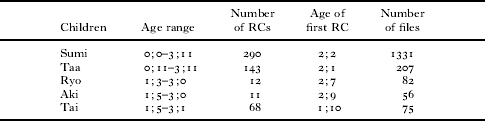
Longitudinal data of spontaneous speech from five boys from the CHILDES Database (MacWhinney, Reference MacWhinney2000; Oshima-Takane & MacWhinney, Reference Oshima-Takane and MacWhinney1998) are analyzed. Data from Aki (Miyata, Reference Miyata1995), Ryo (Miyata, Reference Miyata1992, Reference Miyata1993), Tai (Miyata, Reference Miyata2000) and Taa (Kokuritsu Kokugo Kenkyujo, 1982a, 1982b) are typical longitudinal speech data, transcribed from the recordings of caretaker–child interaction. Sumi's data come from a large-scale published corpus of diary data, which recorded almost all the utterances produced by a child from birth up to the day before his seventh birthdayFootnote 2 (Noji, Reference Noji1973–77). In this paper we analyzed the corpus up to 3 ; 11. Table 1 shows the basic information for each child.
Age of children and use of relative clauses (RCs)
For the analysis of input, every other file of Taa's data (i.e. about 50% of the total input data available) was coded for the mother's use of relative clauses. (Other corpora did not include all the utterances by caretakers and are not suitable for this purpose.)
Data analysis
All sentences containing relative clauses were extracted and coded. We included all the instances of a finite clause modifying a head noun except for the clauses of outer relationship, for which a gap within the relative clause does not exist, as discussed above. The numbers in Table 1 do not include this type. In fact, noun-modifying clauses of outer relationship were very rare in children's speech, only 6 and 5 tokens for Sumi and Taa, respectively, being observed.
In the analysis of the children's speech, the exact repetitions (both of the caretaker's and the child's own utterances) that appeared within three utterances of the original were excluded from the analysis, following Fernald & Morikawa's (Reference Fernald and Morikawa1993) criterion of exact repetition. In contrast, in the analysis of maternal speech, repetitions were included because the purpose of this analysis was to count the frequency of relative clauses that the child is exposed to in the input, assuming that each individual token the child hears, even if it is a repetition, influences the development of relative clauses.
Relative clauses were coded for: (a) stativity of the predicate in the relative clause; and (b) type of head noun (generic noun, pronoun, common noun). The following four categories were used to classify the predicates in relative clauses according to their stativity. We developed this classification scheme based on the extensive literature on the semantics of noun-modifying clauses in Japanese (e.g. Kato, Reference Kato2003; Kinsui, Reference Kinsui and Takubo1994; Takahashi, Reference Takahashi and Kenkyuukai1979; Teramura, Reference Teramura1984).
(a) Attribute and state: relative clauses that describe states or generic attributes of the head noun (e.g. [kimono kita] obake ‘ghost [that is wearing kimono]’ Taa 2 ; 2; [yakyuu suru] mono ‘The thing [with which (one) plays baseball]’ Ryo 2 ; 7).
(b) Habitual: relative clauses in which the predicate denotes habitual action (e.g. [seizikun no itteru] yootien ‘The kindergarten [that Seiji goes to]’ Sumi 3 ; 4).
(c) Progressive: relative clauses in which the predicate denotes an ongoing situation (e.g. [oneetyan ga miteiru] toko ‘the place [where the young lady is looking at (something)]’ Sumi 3 ; 7).
(d) Specific events in the past or future: relative clauses in which the predicate denotes a specific event in the past or future (e.g. [boku ga itta] kawa ‘the river [that I went to]’ Sumi 3 ; 5).
Attribute/state, habitual and progressive can be in the past or future in terms of temporal reference. They are, however, extremely rare in the data – only 9 out of the 524 relative clauses observed, and were classified as part of category (d), whose total token was 125. In other words, categories (a), (b) and (c) only had present time reference in our data.
Regarding the semantics of head nouns, they were classified into two categories: (1) common nouns and (2) generic nouns and proforms. Originally, more fine-grained analysis was attempted with additional categories such as proper nouns and pronouns, but they were not used as head nouns of relative clauses in mother–child interaction.
Following Cziko & Koda (Reference Cziko and Koda1987) and Shirai & Andersen (Reference Shirai and Andersen1995), a check of intra-rater reliability of the coding was performed four months after the original coding was completed. Five percent of the total tokens were randomly selected and once again coded by the same coder (i.e. the first author): 95·5% reliability was obtained regarding stativity, and 100% regarding head noun.
For all values in the results section, mean proportions are used, following Diessel & Tomasello (Reference Diessel and Tomasello2000). For each type of relative clause (or head noun), we computed the percentages of this type for individual children, added the proportions from all five children, and divided the resulting figure by five.
RESULTS
Semantic properties of predicates in relative clauses
It was found that 73·3% of the relative clauses produced by Japanese children have stative/attributive predicates, while about 23·8% have predicates of past and future events. The frequency of habitual and progressive was very low (1–2%), and relative clauses that describe an action ongoing in front of the child were hardly used. This trend did not change between the relative clauses produced up to age two and those produced at age three. This trend was also confirmed by comparing the first ten relative clauses and the rest, suggesting that there was no conspicuous developmental change in the use of relative clauses in this regard.
Furthermore, within the category of ‘past or future event’, virtually all of the relative clauses referred to past events (100% up to age two, 93% at age three); many of these described the ‘source’ of the object, by using verbs such as katta ‘bought’, moratta ‘received/was given’ and tukutta ‘made’, as in (9).
(9) [papa kara moratta] yatuDad from received one‘The one [I was given by Dad]’ (Ryo 2 ; 11)
This indicates that even in the relative clauses that involve dynamic predicates, they are used to describe the stative attributes of the object that do not change over time.
Since the number of relative clauses produced by Aki and Ryo is quite small compared with the other three children (see Table 1), we also calculated data excluding them. The percentage of stative predicates from the three children is 66·7%, slightly lower, and that of predicates denoting past/future events is 28%. This is because the two children whose development of relative clauses is slow predominantly produced stative predicates (83·2%), which is consistent with our claim here; that is, children's early relative clauses are generally restricted to stative predicates.
Although Diessel and Tomasello did not discuss the stativity of the predicates in relative clauses in child English, the examples they listed are predominantly relative clauses describing ongoing action of the head noun, as in (10) and (11), which are almost entirely missing from Japanese children's speech.
(10) There's somebody[‘s gonna crash on him].
(Peter 2 ; 9, without a relative pronoun)
(11) Look at dat big truck [going some place].
(Adam 3 ; 0)
Based on these observations, we can conclude that in Japanese, children's relative clauses are used mostly to describe stative attributes of the head noun right from the beginning, which is in sharp contrast to initial English relative clauses.
Head nouns of relative clauses
The head nouns of the relative clauses used by children are predominantly generic nouns (and proforms) i.e. mono ‘thing’, yatu ‘thing’, tokoro ‘place’ and -no ‘one’: 74% among the first ten relative clauses, and 73% overall, are of this type. This is similar to Kim's (Reference Kim1987) finding that the head nouns of Korean-speaking children's early relative clauses are kes, the equivalent of one or thing.Footnote 3 The data from three children (excluding Aki and Ryo) show the same trend: 67% for the first ten and 69·3% for the overall count.
Detailed analyses of the context where relative clauses were used revealed that 64% (70% if we exclude Aki and Ryo) of the first ten relative clauses by the Japanese children modify a head noun that is not present in the context of interaction, or something that the child or the caretaker cannot find, as in (12) and (13).
(12) [kore ireru] mon doko ni aru?This put.in thing where LOC exist‘Where is the thing [which you put this in]?’
(Sumi 2 ; 03)
(13) [mamagoto asobu] mono wa?Playing.house play thing TOP‘Where is the thing [with which to play house]?’
(Sumi 2 ; 03)
Again, this is in sharp contrast to Diessel and Tomasello's results, which show that early relative clauses used by English-speaking children are presentational relative clauses such as Here's a tiger that's gonna scare him.
Thus, early relative clauses in Japanese were often used to identify a referent in the context where the child asks about something that he cannot find, wants to ask for or wants to explain about. In (12), the child says kore ireru mon ‘the thing [which (you) put this in]’ to ask about the bowl which you put fish bones in. Perhaps the use of relative clauses of this type is to compensate for their lack of specific words.
Functionally, such uses correspond to the relative clause function of naming referents – a category Dasinger & Toupin (Reference Dasinger, Toupin, Berman and Slobin1994) used to analyze various functions of relative clauses in the frog story narrative (Mayer, Reference Mayer1969; Berman & Slobin, Reference Berman and Slobin1994). According to Dasinger & Toupin (Reference Dasinger, Toupin, Berman and Slobin1994: 463), in relative clauses with the function of naming referents, ‘the head noun together with the relative clause constitute a name, or category label, for a particular referent’ and the ‘head noun represents a general category, typically expressed by means of an indefinite pronoun (someone, something) or a superordinate lexical category, which is further specified by the relative clause’. It appears that this is the predominant function served by Japanese children's relative clauses.
Input
Next, we need to address the question of why such striking differences are observed between English and Japanese in the acquisition of relative clauses. An obvious candidate explanation is the input that children are exposed to. Here, we compare children's production with Taa's mother's speech.
We found that the distribution of predicate types in the mother's speech was almost identical to that in the children's speech. The percentages for the children vs. the mother were as follows: attribute/state (73% vs. 72%), habitual (2% vs. 3%), progressive (3% vs. 5%) and past/future event (21% vs. 19%). Regardless of the child's age, about 70% of the mother's relative clauses have stative/attributive predicates. This ratio is much lower in adult–adult discourse, where it is about 50% (Ozeki, Reference Ozeki2004). This skewed distribution in child-directed speech appears to be the source of the preponderance of stative predicates in children's relative clauses.Footnote 4
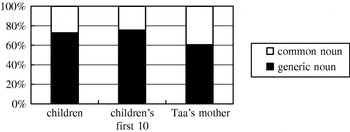
Generic nouns are about 60% of the noun types in the input to the children, which is close to the children's percentage (about 72%), as Figure 1 shows.Footnote 5 Note also that there was no difference between children's first ten relative clauses and the overall trend.
Percentages of head noun type in children's and mother's speech.

Diessel & Tomasello (Reference Diessel and Tomasello2000) also note that input to children includes a high frequency of presentational relatives, which they call the prototype of relative clauses in English-speaking children. Thus, we can conclude that although the initial prototypes of relative clauses in Japanese and English are very different, they both closely reflect properties of the input children are exposed to.
DISCUSSION
Prototype of relative clauses in Japanese
The prototypical relative clauses used by Japanese children modify generic nouns such as mono ‘thing’, tokoro ‘place’, yatu ‘one’ and -no ‘one’, describe the attribute of the head noun as a restrictive relative clause, and have the function of naming referents. Many of these relative clauses refer to something not present in the context. This is in sharp contrast to Diessel and Tomasello's results, which showed that English children start with presentational relative clauses, which have different information structure from those of restrictive relative clauses (Lambrecht, Reference Lambrecht1988).
Typological differences between English and Japanese
It appears that the major differences between the two languages in relative clause acquisition can be attributed in large part to differences in input distribution. We suggest that these differences in input distribution, in turn, largely come from typological differences in the noun-modification systems of the two languages. As noted in the ‘Introduction’, in Japanese, all noun modifiers are placed prenominally – unlike English – and thus in Japanese, noun modification by words, phrases and clauses are formally similar, and constitute a continuum. If they are formally continuous, it is not surprising if there is a continuum in terms of their function, use and acquisition. Matthews & Yip (Reference Matthews, Yip and Ramat2002), in their study of two Cantonese–English bilingual children, also note that there is a continuum between acquisition of adjectives and relative clauses, both of which are prenominal in Cantonese, a variety of the Chinese language. In other words, Japanese and possibly Chinese children may rely on adjectival modification that they have already acquired.
This scenario is consistent with the observation that acquisition of relative clauses is preceded by adjectival modification by four to eight months for the three Japanese children analyzed in Ozeki & Shirai (Reference Ozeki, Shirai, McGloin and Mori2007b), summarized in Table 2.
Emergence of prenominal adjectives and relative clauses in Japanese

Thus, Japanese children start to use relative clauses as a similar type of construction to adjectival modification with the function of providing an attribute to the head noun. Korean also shows continuity between adjectival modification and relative clause modification, as noted earlier. In this case, the continuity is so strong that adjectival modification and relative clause modification emerge around the same time, since they are morphosyntactically identical in Korean (Kim, Reference Kim1987: 82). In contrast to these languages, there is no such continuity in English between adjectival modification, which is prenominal, and relative clauses, which are postnominal, and therefore it is probably the case that children need to learn relative clauses as a new construction, as noted by Kim (Reference Kim1987: 180). Furthermore, the new construction, according to Diessel and Tomasello, is a presentational relative clause, which is at least not a prototypical restrictive relative clause (see, for instance, Lambrecht, Reference Lambrecht1988).
In sum, the discontinuity observed in English relative clause acquisition is not observed in Japanese, which reflects the continuous nature of Japanese noun modification. The presence or absence of this continuity appears to be determined by whether the modification system is mixed – Japanese with uniform prenominal modification as opposed to English with a mixed modification system.
Uniformity of modification system or attribute vs. relative clauses?
However, the results from the present study, which show that Japanese relative clauses (or perhaps we should call them ‘attributive clauses’) develop continuously from adjectival modification, can also be accounted for by Comrie's claim discussed above, i.e. that Japanese relative clauses are attributive clauses. If adjectival modification and clausal modification essentially involve the same syntactic operation (i.e. just attaching a modifier to the noun) as Comrie suggests, it is only natural that they reflect a continuous process in acquisition, whereas in the case of English, they should exhibit a discontinuous process, since relativization involves a very different syntactic operation from adjectival modification.
These two distinct typological dimensions (uniform vs. mixed modification system and attributive vs. relative clauses) essentially make the same predictions with regard to English and Japanese, and therefore we cannot be sure which one is relevant. However, they are independent dimensions, and there are languages that have both a uniform prenominal modification system and relative clauses: Turkish is one such language, according to Comrie (Reference Comrie1996, Reference Comrie, Boeder, Schroeder, Wagner and Wildgen1998, Reference Comrie and Giacalone Ramat2002). Therefore, an analysis of relative clause acquisition from Turkish would assist in clarifying the relative effect of each of these two dimensions.
As discussed earlier, Slobin (Reference Slobin, Slobin and Zimmer1986) notes that relative clauses produced by Turkish children involve many stative predicates. Therefore, it appears that although Turkish is a relative clause language, functional characteristics of early relative clauses are very similar to those in attributive clause languages such as Japanese. So, it is the uniformity of the modification system (i.e. whether the language has both pre- and postnominal noun modification) rather than whether noun-modifying clauses are relative or attributive clauses that primarily determines the semantic and functional characteristics of children's relative clauses.
At the same time, however, Slobin (Reference Slobin and Slobin1985) pointed out that relative clauses are a very late development in Turkish, which he attributes to the morphological complexity of Turkish relativization. Thus, even though there is continuity between adjectives and relative clauses in terms of semantics and function in that stative predicates predominate, the process of acquisition may not be continuous. In light of this observation, it would probably be reasonable to assume that the continuous development observed in Cantonese, Japanese and Korean is also influenced by the fact that these languages have attributive clauses, which children can just attach to the head noun just like adjectives without any special syntactic operation. We therefore suggest that continuous development in noun modification in Japanese (and Korean and Cantonese) comes from two features: noun-modifying clauses are prenominal and attributive.
Another complication with regard to the uniformity of the modification system is the order of modification. That is, some languages (e.g. Spanish) have a uniform modification system that is postnominal. If the uniformity of the modification system determines the continuity of adjectival and clausal modification, then it should not matter if the modification is prenominal or postnominal. In fact there is some indication that a unified postnominal modification system helps children acquire noun-modifying clauses. Dasinger & Toupin (Reference Dasinger, Toupin, Berman and Slobin1994: 509) suggest that Hebrew and Spanish have a unified postnominal modification system including prepositional phrases, adjectives, genitives and relative clauses, and that this may facilitate the development of relative clauses. This leads us to hypothesize that in these languages as well, we may observe continuous development of adjectival and clausal modification.
However, it is possible that postnominal relative clauses are not as continuous with adjectives as prenominal relative clauses, since they are formally instantiated very differently, in that prenominal languages do not have a relative pronoun, while many postnominal languages do (Keenan, Reference Keenan and Shopen1985).Footnote 6 Having relative pronouns necessarily involves clear formal demarcation between adjectival modification and relative clause modification, which means that postnominal relatives tend not to be formally continuous with adjectives. This may go against continuous development from adjectives to relative clauses in postnominal languages. Therefore, it may be the case that only prenominal uniform modification systems such as Japanese and Korean truly yield a continuous process, while postnominal uniform systems such as Spanish do not. This should be investigated in future research.
Thus, we propose that the semantic and functional characteristics of relative clause development in various languages can be predicted by the degree to which adjectives are structurally continuous with relative clauses, which is determined by: (1) whether relative clauses are prenominal or postnominal; (2) whether the modification system is unified (pre- or postnominal only) or mixed (both pre- and postnominal); (3) whether adjectives and relative clauses are overtly distinguished by a grammatical marker; and (4) whether modifying clauses are attributive or relative clauses (in Comrie's sense). These four factors are not totally independent, but they are not the same dimension.Footnote 7 Complex interaction of these various characteristics of noun-modification systems needs to be understood before we can predict how relative clauses in various languages develop.
In conclusion, this paper has shown that the semantic and functional characteristics of relative clause development in Japanese are very different from those in English. Most relative clauses in child Japanese modify abstract head nouns with stative/generic predicates, to refer to attributes of the noun in question. This is dramatically different from early English relative clauses, which develop as presentational relatives. The difference is attributed to the distribution of the input that children are exposed to, which in turn stems from the typological characteristics of Japanese, where adjectives and relative clauses are structurally continuous. The drastic difference observed in this study may suggest that applying theories of relative clause acquisition based on English needs to be done with caution. By investigating the acquisition patterns of noun-modifying clauses in various languages in the light of the typological differences between them, we can better understand both the universals and the particulars of language acquisition.