Introduction
The number of economic migrants – and their share in the total worldwide migration – has risen considerably in the recent decades.1 The globalisation of world economies and the increasing gap between the wealthiest and the least developed economies are two among many determinants driving international labour flows. On the one hand, there has been increasing demand for skilled workers in developed economies, many of which are experiencing labour shortages. On the other hand, higher wages and better employment conditions, better information, and lower migration costs are encouraging skilled migrants to move to developed economies for jobs. As a result, due to both push (the net balance of migration costs versus wage gap gains between developing and developed countries is particularly high for skilled workers) and pull factors (developed economies are actively recruiting skilled workers from developing countries, e.g. EU Blue Cards), migration of the best educated and most talented workforce is an increasing phenomenon of a globalising world in the 21st century. For example, Docquier and MarfoukReference Docquier and Marfouk2 find that the number of skilled migrants residing in the OECD countries has increased by 50% between 1990 and 2000. In terms of migration growth rates Docquier and MarfoukReference Docquier and Marfouk2 report that the increase in the number of skilled migrants is equal to 2.5 times that of unskilled (70% versus 28%). AvatoReference Avato3 reports that about 27% of total emigrants moving from the new member states to the old EU-15 member states were highly skilled (to North America the selection rate was even higher – 54%).
Given that the emigration of highly skilled labour is likely to decrease human capital and knowledge capital in the East European sending countries, the emigration of the most talented and skilled workforce may increase the development gap between East and West. On the one hand, it reduces the catching-up possibilities for the Eastern sending countries. On the other, it adds to the productive pool of skilled workers in the Western receiving countries. The present study examines if and how skill emigration affects the key long-run growth determinants – human capital and knowledge capital – in the East European sending countries. Studying the key general equilibrium effects induced by international labour migration, which according to previous literature and our own experience are likely to be the most important, this paper is among the first to focus on Eastern sending countries and to examine the long-run growth impact of skill emigration in an integrated innovative capital framework.
The underlying conceptual framework is based on Furman et al.’s model of innovative capital which, in the context of international labour migration, was applied by Kancs and Ciaian.Reference Kancs and Ciaian5 The empirical approach adopted in Section 2 is pragmatic and largely qualitative because, due to data limitations, robust econometric analysis is not feasible.
The impact of skill emigration on innovative capital
The starting point of our analysis is the empirical fact that even 20 years after the beginning of economic and political reform, the East European transition countries are still considerably less wealthy than the developed market economies of Western Europe. Because of sizeable differences in per capita income between East and West, labour wages are considerably lower in the East. In line with predictions of traditional migration theory,Reference Harris and Todaro6 cross-country wage differences trigger labour migration from East to West.
Relying on the innovative capital framework of Furman et al.Reference Furman, Porter and Stern4 and Kancs and Ciaian,Reference Kancs and Ciaian5 we examine in this section, both theoretically and empirically, how talent emigration may have affected (and might affect in future) economic growth in Eastern Europe. More precisely, we study how skill outflow affects the stock of innovative capital through worker education, long-run net migration of skilled workers, domestic knowledge creation through R&D activities and international knowledge spill-overs.
Migration’s impact on education
Education is the most obvious way of augmenting the stock of human capital. The level of human capital, in turn, has a strongly positive impact on productivity and growth. Analysing 111 countries over 1960–1990, Barro and Sala-i-MartinReference Barro and Sala-i-Martin7 and TopelReference Topel8 find that a one-year increase in the average education of the country’s workforce increases the output per worker by 5–15%. Conversely, low levels of education can slow growth.
According to previous studies (e.g. Ref. Reference Borjas9), skilled emigration affects the sending country’s education level in several ways. The three most important ways are changes in the skilled/unskilled wage ratio at home, a skill downgrading effect in the destination country, and a worker skill heterogeneity effect. A fourth source of migration-induced adjustments in education equilibrium is remittances, if the liquidity constraint in the East European sending countries is binding.10
The first effect is changes in the relative wages in the home (sending) country. If only skilled workers migrate or, equivalently, if more skilled workers migrate than unskilled, then the ratio of skilled/unskilled workers will decrease in the sending country. A declining supply of skilled labour compared with unskilled labour supply will exert an upward pressure on wage rates for skilled labour (see also Section 2.2). Increased skill premium will induce additional unskilled workers to obtain education. Thus, theoretically, the home wage adjustments will increase the long-run education equilibrium in the sending country.
The empirical evidence for migration impact on the sending country wages can be found in some historical migration episodes. For instance, manufacturing wages in the Philippines have tracked recruitment of overseas workers remarkably closely, despite persistent, high unemployment rates. In Pakistan, wages for both skilled and less skilled workers, particularly in the construction sector, have responded over time to the mass movements of men to the Persian Gulf.11 In earlier times, the mass deployment to South Africa of mine workers from Malawi and Mozambique induced rising labour costs.Reference Lucas12 For receiving countries, opinions are divided: whereas Borjas et al.Reference Borjas13, Reference Borjas14 find that immigration, high and low skilled, decreases native wages and employment in host countries,Reference Borjas, Freeman and Katz15, Reference Filer16 Card and othersReference Butcher and Card17, Reference Card18 point out that the effects should not be over-rated and wage effects would be moderate at most.
The second effect is skill downgrading in the receiving country, which is often referred to as ‘brain waste’. The skill downgrading of migrant work in the destination countries affects the education decision of unskilled workers in home countries. Because the majority of skilled migrants are employed in unskilled jobs abroad, a reduced skill premium creates disincentives for unskilled workers to enter education and acquire skills in the sending country. Note that not only are the potential migrants affected but, through lower international wages for migrant labour, the workers in the sending countries also are affected. Thus, theoretically, the foreign wage signal will decrease the equilibrium education in the sending country. This might explain the upward bias of Beine et al.Reference Beine, Docquier and Rapoport19 estimates, who do not account for the skill downgrading effect when analysing the impact of migration on education.
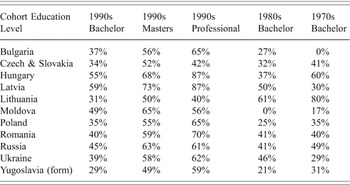
According to empirical evidence from the Western European and North American destination countries,Reference Mattoo, Neagu and Özden20, Reference Drinkwater, Eade and Garapich21 only a small proportion of highly skilled immigrants are employed in skilled jobs.Reference Poutvaara22 Usually, the majority of skilled migrants from the East work in sectors requiring few qualifications, such as agriculture, transport or construction. For example, data from the US and Swiss censuses show that because of labour segmentation in destination countries, only about one third of migrants from Balkan countries with tertiary education have obtained skilled jobs.11 This implies that the education acquired in the home country does not automatically lead to high skill wages abroad. According to Table 1, this effect seems to be particularly pronounced for workers from the CEE countries.
Probability of obtaining skilled jobs – different cohorts and education levels

Source: Ref. Reference Mattoo, Neagu and Özden20, based on US Census 2000 data.
Table 1 examines occupational outcomes of immigrants, particularly of the highly educated and those with professional qualifications. The reported figures suggest striking differences in the occupational attainment of immigrants from different countries with similar educational backgrounds, and show that from some East European countries only around one third of skilled migrants work in skilled jobs. Even after controlling for age, experience and education level, highly educated immigrants from certain countries are less likely to obtain skilled jobs. For example, a hypothetical 35-year old Polish college graduate, who arrived in 1994, has only 35% probability of obtaining a skilled job, while the probability is 59% for a Latvian immigrant of identical age, experience and education.Reference Mattoo, Neagu and Özden20
The third effect is the impact of worker ability heterogeneity on the accumulation of human capital. It is well known that not all people are equally talented. For example, they are heterogeneous in their ability to acquire education.Reference Patrinos and Sakellariou23, Reference Schiff24 The lifetime utility maximisation of workers implies that, in the presence of positive costs of education, only the most talented obtain education. This, in turn, implies that, on average, those workers who were unskilled before the emigration of the highly skilled are less talented than those who have first obtained education. Because of worker heterogeneity in terms of their abilities and positive selection of migrants, acquiring skills through education will be more costly for the remaining unskilled workers. That is, their wage increase (which is lower owing to lower marginal productivity) net of schooling costs and effort are lower compared with skilled talents, who emigrated. As a result, after emigration of the most talented workers (who first became educated), the home country will have fewer skilled workers in equilibrium than it would have if all workers were equally talented and able. Thus, theoretically, skill emigration has an additional negative impact on human capital formation through education.
BorjasReference Borjas25 provides empirical evidence that migrating workers differ from non-migrants along several dimensions. Usually, migrants are positively selected, i.e. they are younger, better educated and more talented. Docquier and MarfoukReference Docquier and Marfouk2 report that the selection rates (rates of highly skilled compared with total migrants) in 2000 among emigrants were the highest in Croatia (29.4%), Bosnia and Herzegovina (28.6%), Albania (20.0%), Serbia and Montenegro (17.4%), Slovakia (15.3%), Romania (14.1%), Estonia (13.9%), Poland (12.3%), Hungary (12.1%), Lithuania (11.8%) and Latvia (10.2%). Only in the Czech Republic it was below 10% of emigrants.Reference Docquier and Marfouk26
The fourth effect is associated with remittances, as they affect the education decisions of liquidity-constrained unskilled workers. Highly skilled workers, like other groups of migrants, tend to remit part of their income received abroad to their families in the home country. According to Cox,Reference Cox27 skilled worker remittances differ from unskilled worker remittances in at least two respects: quality and quantity. On the one hand, highly-skilled migrants remit less than unskilled because skilled migrants are more likely to settle and to reunite with their family in the receiving country. However, highly skilled migrants earn more on average than low-skilled, and empirical data show that the likelihood of remitting, and the amount remitted, increase with emigrant earnings.Reference Lowell and Findlay28 Furthermore, in contrast to unskilled worker remittances, which are mostly spent on consumer goods, the remittances of skilled migrants are more often directed towards investment in fixed assets (e.g. housing) and education.29 In addition, remittances from the skilled emigrants can also provide incentives for human capital accumulation among members of recipient households since they validate the increased rewards from education and migration. If invested in education, remittances may move up or completely remove the liquidity constraint of education. As a result, more workers, particularly those barred from education by liquidity constraints, which is often the case in poor sending countries,Reference Lowell and Findlay30 are able to acquire skills through education.31
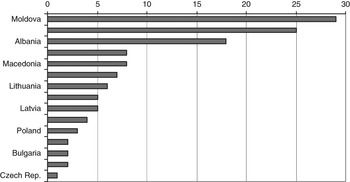
The empirical evidence of remittances in Eastern European is provided in Figure 1. According to the IMF estimates,32 income received from friends and relatives abroad as a proportion of the national income (GDP) is particularly high in Moldova (30%), Bosnia and Herzegovina (25%) and Albania (15%). These countries are among the world’s largest recipients of remittances as a portion of GDP. However, in other East European countries remittances also are significant. In addition, there is plenty of evidence that official remittance figures tend to underestimate the actual flows, as part of the transfers between migrants and their families occurs through informal networks.33
Remittances as a share of GDP in 2005 Source: IMF Balance of Payments Statistics (2007)

More generally, Ledesma and PirachaReference Ledesma and Piracha34 and Lucas11 find that remittances lead to a positive effect on economic growth, whether through increased education, consumption, savings or investment, and have important multiplier effects.
Thus, in the presence of skilled worker migration, the long-run education equilibrium will likely be different from the short-run education equilibrium. These differences are caused by adjustments in relative wages, which do not take place in the short run but might be important in the long run. The scarce empirical data available suggest that the two positive effects of talent emigration on worker education (skilled/unskilled wage effect in the sending country, and the impact of remittances on liquidity constraints) seem to be stronger in Eastern Europe than the two negative effects (skill downgrading effect in destination countries, and skill and education cost heterogeneity).
The impact of migration on cross-country distribution of skilled labour force
In this section, we examine the long-run effects of high-skill migration on the determinants of migration as, according to previous studies (e.g. Ref. Reference Borjas9), migration size affects migration decisions of potential migrants; for example, through changes in relative wages in home and host countries, and changes in migration cost.35 As usual, we assume that migration decisions are determined by a trade-off between expected increases in earnings and migration cost.
The direct and the most visible effect of high skill emigration on human capital stock in sending countries – the direct brain drain effect – is the transfer of human capital embodied in labour.Reference Bhagwati and Hamada36, Reference Lowell and Findlay37 Given that skilled migrants transfer the entire human capital embodied in their private productive skills, the stock of human capital in the sending country is declining proportionally to the number of emigrating talents. High levels of skill emigration (leading to the so-called ‘brain drain’) have adverse effects on growth and development in sending countries, as they reduce one of the key growth determinants – the stock of human capital – and unfavourably affect those who remain.Reference Lowell and Findlay28
In the medium to long run, skilled worker migration also affects wages in home and host countries and migration costs, which in turn affect the migration decision itself. In order to determine the long-run net effect of skilled worker migration on human capital stock in the sending country, it is important to take into account not only the direct effects but also these induced effects. As noted above, talent emigration leads to reduced skill supply in the sending country. If the demand for labour does not change (which is more likely to hold in the short than in the long run), a decreasing labour supply will exert an upward pressure on wages in the home country. Rising wages in the sending country will narrow the migration-driving wage gap between source and destination countries, implying a lower level of migration.Reference Borjas38 Thus, theoretically, wage flexibility in the source country has a positive impact on human capital stock.39
Indeed, the empirical evidence suggests that emigration increases wages in the sending countries.11 In most CEE countries, emigration first helped to reduce labour market pressures in times of rapid economic changes and structural adjustments, thus reducing unemployment. In recent years – after the latest EU enlargements – emigration led to labour shortages in some fast-growing CEE economies (such as the Baltic States, Romania and Bulgaria), which in turn exerted upward pressure on wages, which increased by 20–30% annually, far exceeding productivity growth. However, it has to be noted that, even here, emigration only reinforced the tight labour market situation as high economic growth was the primary source of labour shortages.
According to Borjas,Reference Borjas38 international labour migration affects wage rates not only in the sending country but also in the destination country. The immigration of workers increases the labour supply in the destination country which, in turn, exerts a downward pressure on wages. Lower wages in the destination country narrows the migration-driving wage gap between the sending and receiving countries. Smaller wage differences in turn attract fewer migrants. Fewer emigrating skilled workers imply higher human capital stock in the sending country. Thus, theoretically, wage flexibility in the destination country also has a positive impact on human capital stock in the sending country. However, the destination country’s wage effect depends on the relative size of countries. The larger the sending country relative to the receiving country, the more sizeable the wage effect and vice versa.
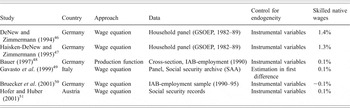
Several studies have empirically assessed the impact of migration on wages in a number of West European receiving countries. Table 2 summarises the key findings of selected empirical studies on migration’s impact on wages. Most of these studies rely either on a cross-section of regions or on branches and use variations in the migrant density in order to identify the impact of migration on wages and employment. One approach estimates a traditional wage equation, where the wage is explained by a vector of human capital characteristics, macro variables, which should control for regional demand shocks, and a measure for the density of migrants. Another branch of the literature, following the example set by the seminal contribution of Grossman,Reference Grossman40 estimates the elasticity of substitutionality of different types of labour in the production function. Both approaches rely on the theoretical assumption that changes in the proportion of factors through migration involve changes in the income of the respective factor.41
The impact of wages on migration

Source: Authors’ calculations based on the reported studies.
The last column reports the elasticity between a change in wages as a percentage and an increase in the proportion of foreign citizens of one percentage point, which is equal to an increase in employment through migration by 1%.42 The elasticities reported in Table 2 suggest that, with the exception of a few outliers from earlier studies, a 1% increase in the labour force through migration yields a change in native wages ranging between minus and plus 1%. The majority of the studies indicate that the change in the native wages is less than 1%. More recent studies of Blanchflower et al.,Reference Blanchflower, Saleheen and Shadforth43 Gilpin et al.,Reference Gilpin, Henty, Lemos, Portes and Bullen44 and Wadensjö45 have analysed the impact of relatively large inflows of CEE workers following the latest EU enlargement to the UK, Ireland and Sweden. They do not find any significant wage pressure on the destination country labour markets in growing economies, where the demand for labour is high (Ireland, UK, and Sweden).
Workers’ migration decisions are likely to be influenced not only by the wage they expect to receive in the destination country but also by migration costs.52 Given that workers trade the expected income increase off these costs, they migrate if the expected benefits arising from migration are higher than migration costs.Reference Sjaastad53 Generally, migration costs tend to be lower for the highly skilled.Reference Borjas38 In addition, migration costs are also decreasing in the stock of migrants from the sending region.Reference Massey, Arango, Hugo, Kouaouci, Pellegrino and Taylor54–Reference Carrington, Detriagiache and Vishwanath56 Declining migration costs in turn widen the net wage gap between the source and destination countries and make it more attractive for migrants. Thus, theoretically, through declining migration costs, past migration has a positive impact on the next period’s migration and, hence, a negative impact on human capital stock in the sending country.
Empirical evidence suggests that among the major EU destination countries, significant diasporas are in Germany and France for Serbia and Montenegro, and Italy and Greece for Albania. More recently, following the latest EU enlargements, Ireland, the United Kingdom and Sweden have allowed free movement of workers from CEE countries. As a result, large communities of CEE migrants have been building in these countries, creating migration networks for migrants from Poland, Lithuania, Slovakia and Latvia (Spain and Italy for Romania). Because of the reduced social, economic, and emotional costs of migration, these migration networks make it considerably easier for subsequent migrants to move abroad.
In summary, the brain drain is strictly negative for human capital stock in the sending country, at least in the short run. These findings are consistent with the previous literature.11, Reference Beine, Docquier and Rapoport19, Reference Lowell and Findlay28, Reference Katseli, Lucas and Xenogiani57 The long-term impact of migration on human capital stock is also determined by factors such as the sending country’s wage effect, the destination country’s wage effect, and changes in migration costs,58 which are not present in the short run. In a general equilibrium framework, these induced wage effects have been studied, for example, by Kancs,Reference Kancs59 who finds that adjustments in the sending and destination country’s wage rates have a negative impact on migration and, hence, a positive impact on human capital stock in the sending country. In contrast, declining migration costs magnify the direct brain drain effect which, as discussed above, is negative for human capital stock in the sending country. These long-run effects have often been neglected in the previous literature.
Migration’s impact on knowledge production
Building on the innovative capital approach of Furman et al.Reference Furman, Porter and Stern4 this section analyses the impact of high skill migration on the innovation equilibrium, which determines the amount of domestically created knowledge. For the sake of simplicity, and considering that in the CEE most R&D is funded by public funds, we focus on public investment in R&D. Under these assumptions, the amount of publicly produced knowledge depends on the size of funds allocated to R&D and the efficiency of investments. The R&D expenditure, in turn, depends on the size of the total budget (government revenue) and budget share spent on R&D.
To begin with, there is migration’s impact on the size of the government budget (government revenue). Assume that all workers in a given country contribute to government budget revenue through tax payments. After emigrating, emigrants do not contribute to the sending country’s tax revenue anymore, which leads to a direct loss in government revenue. Furthermore, given that, on average, skilled workers’ remuneration is higher than that of unskilled workers, the sending country government’s revenue decreases even more than in the case of emigration of unskilled taxpayers.60 Empirical evidence from some recent studiesReference Barbone, Bontch-Osmolovsky and Zaidi61, Reference Sriskandarajah, Cooley and Reed62 suggests that foreign workers in the EU receiving countries contribute as much in taxes as do the native-born population and do not consume higher benefits. Desai et al.Reference Desai, Kapur and McHale63 found that the net fiscal loss from high-skill emigrants from India to the US ranged from 0.24% to 0.58% of GDP per year depending on the estimation method. Further, McKinley and GriffinReference McKinley and Griffin64 estimated that the education of the 90,000 highly skilled migrants who entered the US in 1990 may have originally cost their countries in the region of US$642 million. Such fiscal losses are even more critical when the above brain waste considerations are taken into account. If the share of R&D expenditure in the government budget remains constant, lower tax revenue as a consequence of emigration of skilled workers induces reductions in the government budget, allowing for less expenditure on science, research and development, which in turn slows down the accumulation of knowledge capital.65
Further, skilled worker emigration affects the structure of government budgets, more precisely, the share of R&D expenditure. Skilled worker emigration affects the ratio of skilled/unskilled workers in the source country: the share of skilled workers in the total workforce (and population) decreases, whereas the share of unskilled workers increases.Reference Borjas66 Given that workers are also voters, the voting power of unskilled workers increases relative to that of skilled workers.Reference Downs67 Usually, the political interests of the two groups are different. For example, the demand for social redistribution policies is higher from low-paid unskilled workers, whereas the demand for government investment in research and development is higher from skilled workers. Shifts in the relative voting power between the two worker groups will change the demand for specific policies, which in turn may affect the structure of government expenditure in the sending country. In the case of skilled worker emigration, a shift in the relative voting power in favour of unskilled workers is likely to result in a higher demand for social redistribution policies and a reduced demand for future-oriented investment (e.g. R&D expenditure). A smaller government expenditure share on R&D will, in turn, slow down the accumulation of knowledge capital. This adverse impact of skilled migration on public spending in source countries was first theoretically analysed in Kancs and Ciaian (2007).Reference Kancs and Ciaian5, Reference Cook, Orenstein and Rueschemeyer68
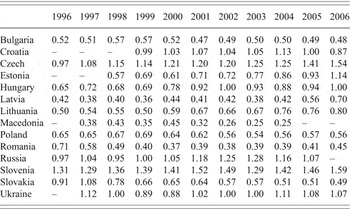
The empirical evidence of the budget shares the CEE countries spend on R&D is provided in Table 3. In general, CEE countries spend relatively low amounts on R&D compared with more developed countries such as the US (2.6% of GDP) or Japan (3.2% of GDP) and also substantially below the EU average (1.9%). Whereas low emigration countries such as the Czech Republic and Slovenia spend over 1% of their GDP on R&D, other countries, many of which experienced a significant outflow of skilled migrants, devote a considerably smaller share of their national income on investment in research and development. Even though it is difficult to estimate the effect, indirect evidence suggests that the outflow of skilled workers may indeed have held up a stronger increase in R&D investment in these countries, which is of fundamental importance for long-term growth.
Total gross domestic expenditure on R&D as percentage of GDP

Source: UNESCO Research and development database.
CEE countries undertake relatively little research and development of new technologies, not just because they lack scientists and engineers, but also because there are not sufficient highly qualified jobs.Reference Kancs and Ciaian5 The demand for scientists and researchers is, in turn, constrained by government expenditure on R&D, which we discussed above. Further, increasing returns to scale increases the incentives for skilled workers to follow others. SolimanoReference Solimano69 and LowellReference Lowell70 report a negative correlation between a country’s resources devoted to science and technology and the emigration of scientists. Thus, CEE countries may need a minimum critical mass of highly skilled worker and R&D investment in order to reach steady state growth in the innovation sector.Reference Carr, Markusen and Maskus71, 72
Thus, skilled worker emigration affects both the size and structure of government budgets. This, in turn, implies that, at least indirectly, the emigration of skilled workers affects the long-run knowledge production equilibrium. If the share of skilled workers in the migrating workforce is higher than in the domestic workforce, and political preferences are different for skilled and unskilled workers, then both fiscal effects (size and structure of government spending) decrease the domestically created knowledge capital.
Migration’s impact on knowledge spill-overs
This section analyses the impact of skilled labour migration on knowledge spill-overs between the sending and destination countries, as it co-determines the level of available knowledge. The two key determinants of international knowledge spill-overs are a country’s relative backwardness and a country’s absorptive capacity.Reference Falvey, Foster and Greenaway73 The previous three sections discussed how migration affects a country’s backwardness. This section focuses on the impact of skilled worker migration on the absorptive capacity of knowledge inflow, which is determined by human capital capability, ‘adaptive’ research capacity, and international knowledge transmission barriers.
Jointly with a sending country’s ‘adaptive’ research capacity, the absorptive capability of human capital determines the international knowledge adoption possibility frontier. New ideas and knowledge generated in other countries can only be adopted in the home country if the necessary ‘adoptive’ technologies and human capital resources are available. Therefore, the availability of highly skilled workers largely determines a country’s capability to adopt foreign technology and to use imported ideas. For example, even if new information technology developed in a frontier economy is available at no user cost in a developing country, the country can only benefit from it if the necessary human resources are available for applying the new technology. Eaton and KortumReference Eaton and Kortum74 study knowledge flows through cross-country patenting and find that a country’s level of education plays a significant role in the ability to absorb foreign ideas. These results suggest that emigration of highly skilled workers decreases a country’s ability to benefit from technological spill-overs.
The second channel through which high skill migration affects knowledge spill-overs is ‘adaptive’ research capacity, which depends on the investment in R&D activities and hence on the size of the domestic workforce (taxpayers). According to Geroski,Reference Geroski75 the size of national R&D expenditure is important not only for the generation of new ideas, but also for ‘adaptive’ research activities, because in order to be able to adopt or improve the knowledge generated in other countries, a country has to invest in ‘imitative’ or ‘adaptive’ research activities. Indeed, Geroski’s argument has strong empirical support. The firm-level econometric studies of Cohen and LevinthalReference Cohen and Levinthal76 illustrate that a firm’s own R&D activity enhances its absorptive capacity of innovations generated by other firms. The survey results of MansfieldReference Mansfield77 show that imitation costs are about 65% of the original innovation costs. At country level Guellec and van PottelsbergheReference Guellec and van Pottelsberghe de la Potterie78 tested this hypothesis by interacting foreign R&D with business R&D intensity for each country. Their results show that the impact of domestic R&D intensity on the elasticity of foreign R&D is positive and significant. Thus, theoretically, the impact of migration on the ‘adaptive’ research activities is negative, because of decreasing public funds for R&D as emigrating taxpayers reduce the government tax revenue.79
The empirical evidence of both a sending country’s ‘adaptive’ research capacity and its absorptive capability of human capital is scarce. UNCTAD80 reports that a certain level of innovative capability is needed to connect with global networks of knowledge creation, and that countries vary greatly in this respect. According to the UNCTAD Innovative Capability Index,80 which combines the Technological Activity Index and Human Capital Index, most CEE countries are either in the group of high or medium capability. Various CEE economies have high composite scores relative to their income, a result of their relatively strong performance in skill creation.
Third, skilled labour migration affects knowledge transmission barriers. The effect of natural barriers, such as distance, on knowledge spill-overs has been investigated both nationally and internationally. Many studiesReference Jaffe, Tratjenberg and Henderson81, Reference Audretsch and Feldman82 have argued that knowledge spill-overs are rather localised. Jaffe et al.Reference Jaffe, Tratjenberg and Henderson81 find that a patent is typically 30 to 80% more likely to cite other patents whose inventors reside in the same country, than patents from other countries. This suggests that cross-border mobility of knowledge is limited and that knowledge spill-overs are spatially localised. Maurseth and VerspagenReference Maurseth and Verspagen83 use citations between European regions to estimate the effect of distance on knowledge flows. Their results indicate that distance has a negative impact on knowledge flows and that this impact is substantial. They find knowledge flows to be larger within countries than between regions located in separate countries, as well as within regions sharing the same language (but not necessarily belonging to the same country). In addition, the findings of PeriReference Peri84 and other studies suggest that knowledge flows locally more easily than at a distance.
Empirical studiesReference Lowell and Findlay28, Reference Kapur85 confirm that skilled worker migration facilitates the spill-over of knowledge, technology and business contacts from migrant destination countries, by interacting as a carrier between a knowledge-producing country and a knowledge-absorbing country. LodigianiReference Lodigiani86 reports that migrant networks accelerate technology transfer to the sending country. Return migration, in particular, can transfer knowledge to the source country and, to the degree that returned migrants are more productive, they further boost a country’s productivity. In migration literature, this effect is widely known as the Diaspora effect and relates to the creation of networks between origin and destination countries (already discussed in more detail in section 2.2). In this respect, temporary migration might even be beneficial for the sending countries, for example the return of migrants can increase the average productivity in the source country, especially if these migrants return after having gained experience and skills in a more advanced country.87 Thus, in line with Meyer and Brown,Reference Meyer and Brown88 talent migration increases knowledge spill-over from migrant destination countries to their countries of origin.
In summary, two effects restrict international knowledge spill-overs: human capital capability to adopt imported technologies and national R&D expenditure for ‘adaptive’ research activities in the sending country. The third effect, this time facilitating international knowledge transmission, is that emigration of skilled workers might decrease knowledge transmission cost and enhance general knowledge exchange and circulation.
Conclusions
Adopting the innovative capital framework of Furman et al.,Reference Furman, Porter and Stern4 the present study examines the potential impact of talent emigration on the main determinants of growth and development in Eastern Europe. In line with previous studies (e.g. Refs Reference Beine, Docquier and Rapoport19,Reference Lowell and Findlay28,Reference Katseli, Lucas and Xenogiani57), we find that in the short- to medium-term, high skill migration strictly reduces national innovative capital and hence increases the gap between East and West.
Complementing the previous studies, most of which examine the impact of high skill migration on the formation of human capital (stock of skills), we also consider migration’s impact on knowledge capital (value of ideas) in the Eastern sending countries. We find that the emigration of highly skilled labour affects both the production and import of knowledge capital. Our findings suggest that, in the long run, the adverse implications of high-skill emigration on Eastern country growth prospects might be even larger through reduced knowledge capital than through reduced human capital.
The empirical identification and quantification of potential impacts is complicated by two factors: the paucity of data and the specificity of Eastern Europe. For example, the facts that the East European economies are undergoing a transition from central planning to market economies, that they are relatively small and open, and that they are receiving sizeable transfers from the West, considerably complicate the identification of migration-induced effects. Moreover, the net effect of high-skill migration depends on multiple factors and is different from country to country. In those countries where the centripetal forces of the highly skilled Diaspora are strong enough, when there is return migration, talent migration might be even beneficial in the long-run.
Hence, the impact of high-skill migration is likely to be different in the short than in the long run. Based on the limited empirical evidence discussed in this paper, we believe that the negative short-term effects are likely to be overturned by more positive long-term effects. In the long run, there is a possibility of return migration (not studied in this paper), which is also associated with increased human capital and positive knowledge transmission to the sending country, and which might contribute significantly to knowledge and technology transfer, thus boosting productivity in the sending country and increasing growth there.
Our results support the findings of Kancs and Ciaian,Reference Kancs and Ciaian5 suggesting that, if return migration policies are attractive enough, then attracting back home the return migrants might increase the stock of innovative capital in a relatively short period of time. Furthermore, policies supporting ‘brain circulation’ and temporary migration of highly skilled workers might help to mitigate the adverse effects of talent emigration. The acceleration of the globalisation process also creates new patterns of integration and skill exchanges, which brings new challenges but also opens up new opportunities. Hence, our key policy conclusion is that, while focusing on reducing the outflow of the most talented and skilled, one should not lose attention on other important general equilibrium aspects of international labour migration, such as knowledge capital, which co-determine the growth prospects of Eastern Europe in the longer run.
Acknowledgements
The authors acknowledge helpful comments from Chris Armbruster, Pavel Ciaian and Mihaela Nedelcu, participants of the European Society for Population Economics (ESPE) conference in Seville, and Research Network 1989 participants at the London School of Economics and European University Institute. The views expressed in this paper are purely those of the authors and may not in any circumstances be regarded as stating an official position of the European Commission.
d’Artis Kancs works at the European Commission, DG Joint Research Centre. He is part of the team developing a system of regional models for the assessment of the EU Cohesion Policy. He is affiliated with the London School of Economics, the Catholic University of Leuven, and the Economics and Econometrics Research Institute. Prior to joining the European Commission, he worked for the International Institute for Applied Systems Analysis. His research interests are international trade, labour migration, spatial sorting, regional economics and policy, rural factor markets and renewable energy.
Julda Kielyte works at the European Commission, DG Economic and Financial Affairs. She is part of the team analysing and forecasting macroeconomic and budgetary developments in the Member States. She is affiliated with the Economics and Econometrics Research Institute. Prior to joining the European Commission, she worked for the World Trade Organisation, European Parliament, and private sector. Her research interests are labour migration, international trade and public finances.