Emergencies, disasters, or pandemics may lead to changes in usual practices because there are changes in resources available, practice must take place in unusual settings, or the clinician finds him- or herself practicing in an unfamiliar setting with unfamiliar patient care needs. The modern expectations of a high level of technically supported care may not be achievable if there is no electric power, buildings are blown away or underwater, and a limited number of personnel are able or willing to work. For those who would work or would consider working in disaster circumstances, the fears of penalty or legal action by a licensing board or prosecutor are not entirely unfounded, given the charges leveled against physicians and nurses for failure to care and inappropriate overmedication in New Orleans area institutions following hurricanes Katrina and Rita and the associated flooding. The American Medical Association and the American Nurses Association (ANA) collaborated in a press release at the time, emphasizing the need for mechanisms other than the criminal courts to handle questions about practice during emergencies.1
Coming to an understanding of the legal issues involved and the ethical-social expectations in advance of an emergency or disaster may assist the individual physician, nurse, dentist, respiratory therapist, pharmacist, or other professional to respond willingly and appropriately. This summary of the white paper Adapting Standards of Care Under Extreme Conditions: Guidance for Professionals During Disasters, Pandemics, and Other Extreme Emergencies 2 is intended to provide guidance on this process. The authors are aware that broad policies or discussions of principles do not answer every question. There are regional differences in likelihood of emergencies, resources readily available, and expectations expressed in state laws, and there will always be the specifics of each emergent event. The regular recurrence of extreme weather conditions (e.g., the 2008 devastation of Galveston by Hurricane Ike and severe Midwestern floods) makes it critical that we prepare ourselves, despite the fact that there can be no absolute, predetermined answers to the many specific questions that arise in any emergency event.
The perspectives provided here should assist a registered nurse, advanced practice nurse, physician, dentist, or other professional, whether working in a hospital, office, public health agency, community setting, faith-based organization, shelter, or transport to more comfortably work under extreme conditions. Any member of the staff of a hospital, community-based clinic, public health agency; any emergency planner; and any health profession educator may find this guidance useful, while remembering that nothing said here substitutes for the responsibility of every professional to maintain a state of professional readiness for emergency response and the responsibility of every organization or institution to plan for and practice emergency response.
IDENTIFYING STANDARDS OF CARE
In 2007, the ANA convened a multidisciplinary expert panel (see Appendix) to identify more precisely the significant policy questions that need to be addressed and to develop strategies that can guide health professionals, institutions, and policy makers in such challenging situations. The resulting white paper was based on the deliberations of that panel, informed by feedback received from participants in a national meeting on care during disasters, a review of state and national guidelines for standards of care in other settings and professions, and comments received on the penultimate draft posted on the ANA Web site (http://www.nursingworld.org/MainMenuCategories/HealthcareandPolicyIssues/DPR/TheLawEthicsofDisasterResponse/AdaptingStandardsofCare.aspx).
The terminology being used here (and in the white paper) was chosen with care to describe the challenging process of professional response during an emergency event without inadvertently opening old and ongoing interprofessional debates such as those about scope of professional practice. While under some declared emergency situations in some states licensing laws may be suspended or altered, licensed health professionals are always bound by professional legal requirements even when applying their skills and knowledge in extreme circumstances. No matter the event, a dentist does not become a surgeon, a nurse does not become a pharmacist, a physician does not become a radiation technologist. The use of advance registration and credentialing of likely volunteers should make it easier for people to work on newly organized teams that include volunteers and reassigned staff with comfort that each person is competent and able to function effectively within the expected framework.
DEFINITIONS AND FOUNDATIONS
The practice expectations for any health professional are a combination of general standards of professional practice,3 standards of performance, professional codes of ethics,4 legal regulation, personal and institutional values, individual competencies,5, 6 and the specific workplace and situational contexts. The context will change when there is an extreme emergency,7 even before it can be officially “declared” by an institutional or governmental authority, but no emergency changes the basic standards of practice, code of ethics, competence, or values of the professional. Although the National Incident Management System8 and the associated National Response Plan are helpful, they are not specifically designed to guide nurses, physicians, or other licensed health care professionals working in these unusually challenging situations in safe, legal, ethical, efficient, and compassionate care.
Several themes span most areas of health professional practice and have emerged as being consistently and significantly influential in practice. Although not all are equally emphasized by every profession, they do provide a common template for discussion and include the following:
• Providing age-appropriate and culturally and ethnically sensitive care
• Maintaining a safe environment
• Educating patients about healthy practices and treatment modalities
• Ensuring continuity of care
• Advocating for patients
• Coordinating care across settings and among caregivers
• Managing information
• Communicating effectively
• Utilizing technology
The ethical framework that guides health services in the United States assumes that each presenting patient will receive care and attention that will not be diverted to the next patient until care for the first patient is underway or until that patient is transferred or referred. Decision making during extreme conditions assumes a shift to a utilitarian framework in which the clinical goal is the greatest good for the greatest number of individuals. In this framework, not everyone may receive the services that may be available at other times or places, and care decisions are not about “the most that can be done” or “the best that can be done under perfect conditions.” Using a utilitarian framework, an incident command structure in the individual institution and across the affected community should provide guidance on resources and constraints within which the individual clinician will be providing care.
Given the specific conditions at the time, this sufficiency approach may include expanding the role of family members or beginning students in monitoring patient status, or using outpatient care for a condition that could otherwise be treated in an inpatient setting. All of the challenges of extreme emergencies require thoughtful attention to one’s own competence and rapid assessment of the skills of the others who are available to assist. Familiar technological resources may not be present, adequate, or appropriate, or there may not be available the usual range of colleagues, experts, or support services.
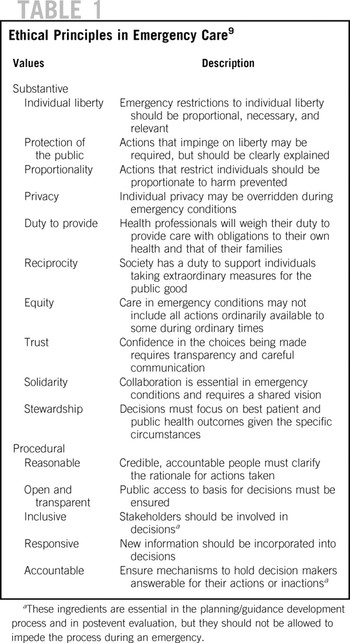
As a basis for ethical decision making during extreme conditions, the 15 ethical guidelines compiled by the University of Toronto Joint Centre for Bioethics for a discussion of Canadian pandemic influenza planning9 provide an excellent foundation and appear in Table 1. Individual professionals will not have time for this table in the midst of an emergency situation, but prior familiarity with and training in these concepts would prove helpful. It is this type of individual preparedness in which professionals need to engage in advance of emergency situations.
Ethical Principles in Emergency Care
CHALLENGES TO MEETING USUAL CARE EXPECTATIONS
The circumstances requiring adaptation of standards of care may come in the form of severe natural events, human-caused emergencies such as transportation crashes, industrial explosions, and terrorist activities, or infectious disease epidemics such as influenza, occurring singly, concurrently, or sequentially, and local, regional, or national in their impact. The situational dynamics demanding action may be as follows:
• Loss of essential services, including electricity, water, or the supply chain
• Loss of infrastructure, including facilities or electronic information
• Shortage of workers due to transportation loss, worker or worker family illness/injury, or unwillingness to report to work
• Size of affected population, requiring triage at the community level
• Sudden increase in the number of patients, in marked excess of capacity or with elevated injury severity score10 or other extreme patient conditions
• Relocation of care to an alternate facility not equipped for patient care
Essential decisions about allocation of resources should be made at a system level, by the hospital incident command structure, or the community-wide incident command structure.
The individual clinician is responsible for giving the best possible care to patients within the available resources, knowing that in the first hours of an extreme event some changes in patterns or content of care may be needed in the absence of or preceding formal declarations of emergency or legal changes. To the extent possible, public health officials, other government officials, and health care facility spokespersons should inform the public about resource allocation, patient relocation, or other decisions that may lead to adaptation in the provisions and standards of care. For example, if a decision has been made to discharge a large number of patients who would otherwise remain in the hospital to home care or a limited care shelter to accommodate those in critical need for care (eg, those with influenza or other infectious diseases during a pandemic, multiple severely injured or burned patients), then the community should be informed of the justifications and details of discharges to minimize the perception that patients are being abandoned. Furthermore, the communication should include the steps being taken to provide for patient safety, medications, access to support services for transported patients, and safety of the public.
Health professional education has included little explicit consideration of challenges such as those discussed here. Even when a clinician (eg, hospital-based nurse) is caring for several patients at overlapping times, the expectation is that all requested care will be given, even if time is short and care is rushed. The necessary priority setting may be called triage, but it does not rise to the level of what is often referred to as battlefield triage. Under these circumstances, some patients—those commonly called the walking wounded and the worried well—may be unable to access any care and some extreme conditions may warrant reserving care only for those whose recovery is likely. Professionals should be prepared to function under such circumstances; for example, making triage decisions about early discharge or transfer to a less intense level of care. Most professionals, however, will not be at a scene or be a first responder; most will be at the second level of receiving and responding to patients who have arrived at a care institution of some sort. The triage of patients who have been exposed to emergency conditions (eg, explosion, chemical dispersal, massive biological event) arriving at a hospital will most likely be undertaken by those with emergency care credentials or under the direction of specialists in triage and disasters.11 Any professional working or volunteering in situations in which this role is likely must seek out additional training in emergency triage.
It is reasonable to assume that volunteer nurses, physicians, and others will become a part of the clinician team during extreme circumstances. These individuals should never be self-directed and assigned and should work through organized programs such as the Medical Reserve Corps, the National Disaster Medical System, the American Red Cross, or a professional volunteer registry. The only exception to this is the rare event when a health professional is volunteered by virtue of happening to be next to the collapsing building, flooded school, burning train, or other disaster, and acting as a good Samaritan until other assistance arrives.
MEETING THE CHALLENGES
There are standards that should be met at all times to the level feasible under the circumstances. After triage has been performed and patients have been transferred for care, clinicians must set as a priority maximizing worker and patient safety; maintaining airways and breathing, circulation, and control of blood loss; and maintaining or establishing infection control (including continuity of medications for conditions such as tuberculosis).
Examples of familiar but less important actions that may be delayed, eliminated for some period of time, or assigned to family members, unlicensed assistants, or uncredentialed volunteers include routine care activities (eg, blood pressure checks in nonacute patients, assisted ambulation), administration of oral medications, extensive documentation of care, maintenance of complete privacy and confidentiality, and performance of elective procedures.
The emergency plan of hospitals12 and other care settings could include predetermination of routine activities that are to be delayed or omitted in the event of a disaster. Without advance guidance, experienced clinicians should identify needed changes and communicate them to those in charge as part of the incident action plan. States or local jurisdictions can establish multidisciplinary critical resource planning committees, as has been done in planning for the allocation of ventilators should pandemic influenza occur.13 When implemented, the goal of triage and assignment of limited resources should be communicated to all professional caregivers to ensure consistent allocation of resources.
Clinical Recommendations
Given the circumstances described above, individual health professionals do have responsibilities before, during, and after any extreme emergency. Every member of the health professions should prepare him- or herself and family/significant others for potential emergencies, including the potential for the professional to be away for extended periods during an emergency. This preparation includes participating in continuing education on emergency preparedness, with particular attention paid to the application of National Incident Management System and the National Response Plan within the current practice setting, and participation in emergency drills and exercises. It is also each individual’s responsibility to know the legal basis for professional care and the specific legal structure of the state(s) in which a license is held regarding the conduct of health professionals during emergencies. In addition, professionals should inform any employer or organization in which they volunteer about any limitations on their availability to volunteer and the special skills they possess applicable to emergency conditions (eg, experience with community or emergency triage).
Whether all of these steps have been completed, if an emergency occurs, it is critical that every health professional use his or her professional competence to provide the best care possible given the resources and physical conditions that exist. Assigned or announced information resources can clarify any changes in protocols or staff roles, and rapid training should be available to provide updates specific to the event. Any difficulties encountered responding as expected should be communicated through the assigned chain of command as quickly as possible.
It can be tempting to forget the emergency as soon as it is over, but it is essential that physicians, nurses, dentists, and others participate in postevent evaluation, perform a psychosocial needs assessment for self and family (and seek assistance if indicated), and actively participate in the steps needed to facilitate return to their pre-event status.
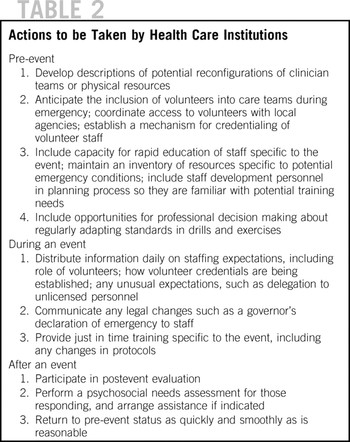
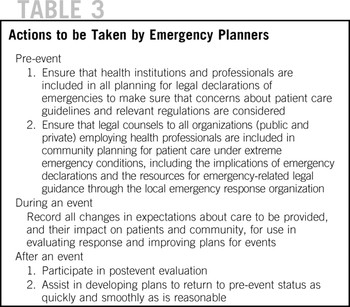
Although the work of the panel has focused primarily on the individual professional, there are a number of actions that should be taken by both health facilities or practice sites and community emergency planners before, during, and after a disaster. The suggested actions specific to questions about possible adaptation of standards of care are summarized in Tables 2 and 3. The nursing and medical professional associations have continued to elevate this issue through inclusion in professional meetings and publications and continue to meet regularly on this and related emergency preparedness and disaster response issues.
Actions to be Taken by Health Care Institutions

Actions to be Taken by Emergency Planners

Policy Recommendations
The panel developed the white paper to speak primarily to individual clinicians rather than organizations or policy makers. There are, however, some policy recommendations consistent with the paper that have been proposed, primarily to relieve the high level of anxiety on the part of physicians, nurses, and others that they will be held liable for acts that were, in fact, the best choices that could be made under extreme conditions. The American Medical Association and the ANA have argued that professional licensing boards, rather than the courts, should be the site of review, so that the fear of criminal prosecution does not forestall otherwise willing actions.13
One legislative option is the Uniform Emergency Volunteer Health Practitioners Act, which was promulgated by the National Conference of Commissioners on Uniform State Laws in 2006 and amended in 2007. The purpose of the act was to develop a uniform and coordinated approach to quickly deploy health practitioners to disaster areas. Most states have adopted aspects of the model state legislation, but no state has adopted the act in its entirety.
Another possibility is support for legislation that requires all questionable cases to be referred to an arbitration board such as a medical panel review (comprising physicians, nurses, and other health professionals) before criminal processing. After dealing with the issue of liability following Hurricane Katrina, the state of Louisiana has adopted such a provision, and precedent exists because medical review panels do exist in many states as implemented by tort reform legislation related to medical malpractice. Although the use of a review board has been helpful (eg, in reducing the number of legal complaints regarding adverse vaccine events), to date there is no arbitration board to review care decisions made during extreme conditions.
FINAL THOUGHTS
Extreme conditions may arise with or without warning due to weather, geology, utility failure, industrial explosion, transportation crash, or human action. The response of the entire health workforce may make the difference in the degree of suffering in the community and in the rate at which recovery occurs. Being ready to adapt and provide essential care under extreme conditions is a professional responsibility. It is a responsibility that can be better met if health professionals have considered the ethics and issues in advance, participated in planning and practice, and remain committed to delivering the best care possible under the circumstances. The best of pre-event training and planning will be lost if 1 of 2 gaps occurs: the caregiving institutions fail to act as planned within their own policies, or the involved professionals fail to use their best professional judgment in any care decisions made under the extreme conditions that exist.
No response to an extreme circumstance is complete until the participants reestablish the medical and public health infrastructures, both physically and in human resources, that were disrupted by the disaster. This does not necessarily require returning fully to the pre-emergency status quo (eg, in the case of major damage to a hospital), and following a major event, a return to “normal” will likely occur in stages. It may well be possible, however, to achieve a level of staffing and supplies that justifies returning to an ordinary level of care for most, if not all, patients and redirecting those not being served locally to a suitable alternate facility. This action may be performed using the original staff of the organization or activated volunteers.
Finally, all health professionals who have been a part of the emergency response in any role have an obligation to participate in the evaluation of that response, taking a thoughtful look at what was done, how it worked, and what could be done better in subsequent events with improved planning, training, equipment, or communication. This continuous quality improvement approach to emergency response means that the next unexpected initiation of emergency actions will be even better than the last.
Authors' Disclosures
The authors report no conflicts of interest.
APPENDIX
Members of the Working Group on Care Under Extreme Conditions
Co-Chairs:
Kristine M. Gebbie, DrPH, RN, Columbia University School of Nursing, and Kathleen M. White, PhD, RN, CNAA-BC, Johns Hopkins University School of Nursing
Workgroup Members:
Pat Adamski, MSN, MBA, The Joint Commission
Sherri-Lynne Almeida, DrPH, MSN, RN, Emergency Nurses Association
Kaye Bender, PhD, RN, University of Mississippi Medical Center School of Nursing
Georges C. Benjamin, MD, American Public Health Association
Sam Benson, AEMT-P, New York City Office of Emergency Management
James D. Bentley, PhD, American Hospital Association
Joseph L. Cappiello, BSN, MA, The Joint Commission
Roberta Carlin, MS, JD, American Association on Health and Disability
Colleen Conway-Welch, PhD, CNM, Vanderbilt University School of Nursing
Donna Dorsey, MS, RN, Maryland Board of Nursing
Patricia Drehobl, MPH, RN, Centers For Disease Control and Prevention
Andrea M. Garcia, JD, National Disaster Life Support Educational Consortium
Barbara Hatcher, PhD, MPh, RN, American Public Health Association
James J. James, MD, DrPH, MHA, National Disaster Life Support Educational Consortium
Patricia A. La Brosse, APRN-BC, American Psychiatric Nurses Association
Roberta Lavin, MSN, APRN-BC, Administration for Children & Families, Department of Health and Human Services
Nancy McKelvey, MS, RN, American Red Cross
Karen O’Brien, MN, RN, Association of State and Territorial Directors of Nursing
Marilyn Pattillo, PhD, RN, APRN, University of Texas School of Nursing
Rebecca M. Patton, MSN, RN, American Nurses Association
Sally J. Phillips, PhD, RN, Agency for Healthcare Research and Quality
Carol A. Romano, PhD, RN, US Public Health Service
Linda J. Stierle, MSN, RN, American Nurses Association
Beth Stover, RN, CIC, McKing Consulting Corporation
Italo Subbarao, DO, MBA, National Disaster Life Support Educational Consortium
Raymond E. Swienton, MD, Parkland Health and Hospital System
• For the American Nurses Association:
Martha Turner, PhD, RN
Mary Jean Schumann, MSN, RN, MBA
Cheryl A. Peterson, MSN, RN
Kate Markovs, MS, RN
Patricia Rowell, PhD, APRN-BC