The Burkholderia cepacia complex includes several species of gram-negative bacteria that are opportunistic pathogens in patients with cystic fibrosis (CF) and individuals with chronic granulomatous disease. Burkholderia cepacia has also been implicated in healthcare-associated outbreaks that have resulted in recalls of contaminated products and devices, including nasal sprays, eye drops, mouthwash, chlorhexidine solutions, ultrasound gel, and respiratory equipment, to name a few.Reference Dolan, Dowel, LiPuma, Valdez, Chan and James 1 – Reference Loukil, Saizou and Doiot 8 In 2012, Sutton and JimenezReference Sutton and Jimemez 9 published a review of Food and Drug Administration (FDA) recalls involving microbiologic contamination. Between 2004 and 2011, B. cepacia contamination was associated with 34% of recalls of nonsterile products.
We report an outbreak involving 24 patients at a 629-bed, tertiary-care, pediatric hospital in Houston, Texas. The investigation revealed the source of the outbreak to be contaminated liquid docusate and resulted in a national inquiry for additional undetected clusters, voluntary recall of the product by the domestic manufacturer, and an import alert on an international manufacturer of the active ingredient.
METHODS
Epidemiologic Investigation
In February 2016, we identified a cluster of 3 patients in the pediatric intensive care unit (PICU) with cultures (2 respiratory, 1 urine) positive for B. cepacia complex in the same week. B. cepacia infections outside of the CF population are highly unusual at our institution; no such infections had occurred in the previous year.
Cases were defined as any patient currently or recently hospitalized in the PICU and later cardiovascular intensive care unit (CVICU) with a culture positive for B. cepacia complex between February and July 2016. The CVICU was added to the case definition on April 3 when the first case was identified in that unit. The investigation included a detailed review of all cases with special attention to underlying conditions, unit and bed assignments, procedures during hospitalization, and products and medications utilized in the care of cases. A case-control study was started to identify risk factors for infection.
All cases were placed on contact precautions, and the patients were cohorted in the implicated units. Several times per week, infection preventionists performed audits of infection prevention practices to assess compliance with hand-hygiene recommendations and isolation precautions and provided immediate feedback to healthcare providers. Frequent multidisciplinary environment of care rounds were implemented among infection control and prevention, nursing and medical leadership in the PICU and CVICU, and environmental services. Cleaning and disinfection of equipment and the environment was emphasized at daily nursing huddles and was audited during environment of care rounds. Proper storage of supplies was monitored. Infection control and prevention and the director of respiratory care performed direct observations of respiratory care practices and processes for cleaning and disinfecting respiratory equipment. Work orders related to water leaks were reviewed. Routine clinical practice that involved the use of water or multidose products was evaluated.
After B. cepacia complex was identified in a stool specimen from a case, we expanded the investigation to include potential sources of transmission including oral care products, feedings, and medications. Direct observation of formula preparation was performed. All enteral, inhaled, and topical medications received during the 2-week period preceding the first positive culture were reviewed.
Microbiologic Investigation
Microbiologic testing of specimens from case patients was initially performed at the Texas Children’s Hospital microbiology and molecular microbiology laboratories. All B. cepacia complex isolates were evaluated for molecular relatedness with automated repetitive extragenic palindromic polymerase chain reaction (rep-PCR) on the DiversiLab (bioMérieux) system using the bacterial kit.Reference Healy, Houng and Bittner 10 Additionally, isolates were sent to the Burkholderia cepacia Research Laboratory and Repository at the University of Michigan for species identification and confirmatory genotyping per previously reported methods.Reference Mahenthiralingam, Bischof and Byrne 11 – Reference Coenye, Spilker, Martin and LiPuma 13
On April 13, 2016, the microbiology laboratory began to use Burkholderia Cepacia Selective Agar (BCSA; Remel, Lenexa, KS) for all respiratory specimens to enhance detection of any new cases. Surveillance cultures where performed on April 20 for all mechanically ventilated patients in the PICU, progressive care unit (a step-down unit of the PICU), and CVICU who did not have respiratory cultures obtained for clinical reasons in the previous 72 hours. Respiratory surveillance cultures were repeated on May 6. In addition, if a stool specimen was available on any patient that day, a stool surveillance culture was performed.
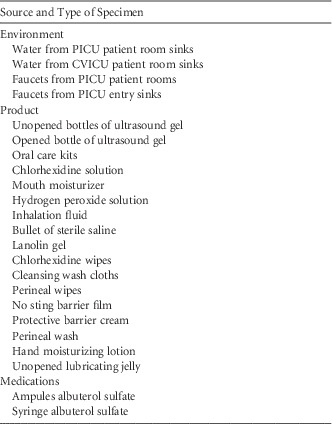
A review of the literature regarding previous outbreaks involving B. cepacia, in addition to commonalities among cases, guided initial environmental and product cultures. Samples from products related to oral, ventilation, and perineal care were sent to an environmental reference laboratory for culture. Environmental cultures were obtained of tap water from sinks in 7 PICU and 2 CVICU case-patient rooms (water was combined for a total of 4 samples of 250 mL each) in addition to cultures of 3 PICU case-patient room faucets and 3 faucets in a common area in the PICU. A comprehensive list of the products that were cultured can be found in Table 1. Additionally, after reviewing medications shared among the cases, we chose to begin pharmaceutical product cultures with 2 medications: docusate and albuterol.
Environmental Sources and Products that were negative for B. cepacia

RESULTS
Epidemiologic Investigation
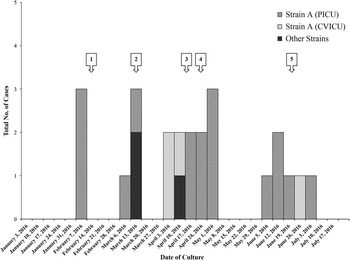
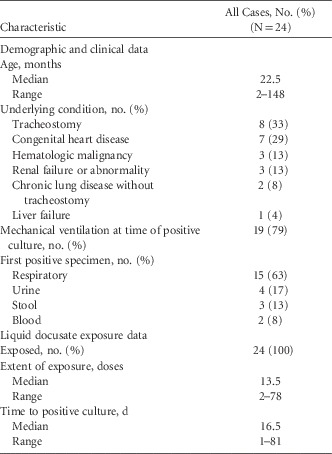
From February 8 to July 4, 2016, 24 patients had clinical specimens that grew B. cepacia complex. The epidemiologic curve (Figure 1) reveals intermittent detection of new cases as several interventions were implemented. The median age of the patients was 22.5 months (range, 2–148 months) (Table 2). All patients had underlying chronic conditions, but none had CF. Furthermore, no CF patients were in either of the units during the outbreak period. Moreover, 5 patients had a previous solid organ transplant and 1 patient had undergone bone marrow transplantation. In total, 18 patients had B. cepacia complex isolated from respiratory specimens during mechanical ventilation. Moreover, 5 patients had bacteremia; 2 of these patients had central-line–associated bloodstream infections as defined by the National Healthcare Safety Network (NHSN), and the other 3 patients had secondary bloodstream infections. In addition, 4 patients had urinary tract infections: 1 of these patients had an NHSN catheter-associated urinary tract infection (CAUTI); 2 patients did not meet the NHSN CAUTI definition; and 1 patient did not have a catheter in place. Also, 4 patients had NHSN ventilator-associated pneumonias.
Burkholderia cepacia complex infections associated with contaminated liquid docusate, according to date of diagnosis. Moreover, 21 cases were infections with strain A, which matched B. cepacia isolated from liquid docusate. Three other cases had distinct strains. Key steps in the investigation are shown in arrows: (1) increased monitoring of infection prevention practices and environment; (2) evaluation and intervention in clinical practices involving water or multi-dose products; (3) started environmental and product cultures; (4) national investigation began, expanded product cultures; and (5) notified of positive culture in docusate and removed product.

Case Characteristics

Furthermore, 3 patients had the organism identified in stool: 2 without any other source and 1 patient who later developed B. cepacia pneumonia. Stool cultures were performed for diarrhea, and growth of B. cepacia complex was identified on selective agar typically used to detect Campylobacter species because microbiology technicians characterized colonies suspicious for B. cepacia on stool cultures.
Audits identified rare breeches in compliance with hand-hygiene recommendations and isolation precautions. We did not identify any concerns with regard to respiratory care practices or equipment disinfection. In the PICU, sterile or distilled water replaced tap water for cleaning of feeding and gastric tube supplies. We identified bottles of ultrasound gel to be the one multipatient product in use and we found that, at that point, 6 of 7 (85%) of case patients had been exposed to ultrasound gel. Thus, bottles were replaced with single-use sterile ultrasound gel packets for all inpatient procedures.
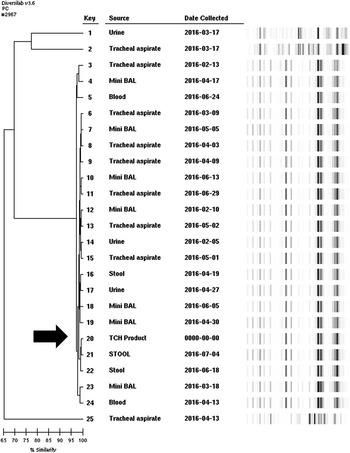
Microbiologic Investigation
As shown in Figure 2, we detected a predominant outbreak strain; the B. cepacia complex isolates from 21 of 24 patients were indistinguishable. The remaining cases had 3 unique molecular patterns in respiratory and urine specimens. Molecular typing was confirmed by the Burkholderia cepacia Research Laboratory and Repository at the University of Michigan, and the outbreak strain was further characterized as a novel species within the B. cepacia complex. Furthermore, the strain was unique in the 20-year-old repository of isolates.
The dendogram and rep-PCR results illustrate the molecular relatedness of the Burkholderia cepacia complex isolates from liquid docusate and patients. Each number corresponds to a unique patient except for number 20 (TCH product, black arrow), which corresponds to liquid docusate. The specimen source and collection dates are listed. Overall, 21 patients had the same rep-PCR pattern, a previously undescribed B. cepacia complex type, as the liquid docusate; 3 other cases showed distinct strains.

On May 3, we were notified by the Burkholderia cepacia Research Laboratory and Repository at the University of Michigan that a separate pediatric institution had submitted several isolates of B. cepacia complex that matched our predominant outbreak strain. The best explanation for a shared novel strain among 2 pediatric institutions that are geographically separated would be an intrinsically contaminated product used at both sites. The City of Houston Health Department, Texas Department of State Health Services and Centers for Disease Control and Prevention (CDC) were notified as soon as we received this information.
In total, 31 tracheal aspirates and 4 stool specimens were collected as surveillance cultures, and all were negative for B. cepacia complex on selective agar. A total of 28 cultures of water, faucets, and nonpharmaceutical products were performed at the reference environmental microbiology laboratory. All of these cultures were negative for B. cepacia complex.
On June 22, we were notified that cultures of unopened syringes of liquid docusate (lot nos. 20160404@23 and 20160404@22) from a compounding pharmacy revealed B. cepacia complex on culture day 10. To reduce the expense of culture given the numerous other products under investigation, the environmental lab had combined these 2 lots in 1 culture. Molecular typing confirmed the organism to be indistinguishable from the predominant outbreak strain.
After we determined the source of the outbreak to be contaminated liquid docusate, we determined that the median number of doses of liquid docusate prior to positive culture was 13.5 doses (range, 2–78). The median time to first positive culture from the first day of liquid docusate was 16.5 days (range, 1–81).
Termination of Outbreak
On June 22, when B. cepacia complex was identified in liquid docusate at the environmental laboratory, we took the following actions: (1) Liquid docusate was removed from the hospital formulary and the available stock was quarantined; (2) all providers of patients with active orders for liquid docusate were notified directly that the drug was no longer available; (3) an alert was implemented in the electronic medical record within hours to restrict ordering and provide alternative medication guidance; and (4) the director of pharmacy submitted a report to MedWatch, the FDA Safety Information and Adverse Event Reporting Program. On June 23, we completed an inventory of the quarantined drug including lot numbers and quantities of each item. On June 24, the CDC recommended that facilities not use liquid docusate products for patients that were critically ill, ventilated, or immunosuppressed. On June 28, the FDA collected liquid docusate from our institution in addition to other nonpharmaceutical products including ventilator circuits, inhalation fluid, and oral care kits for independent testing. On July 8, the CDC expanded the recommendation to restrict use of liquid docusate to all patient populations. On July 15, the FDA announced a voluntary nationwide recall of liquid docusate manufactured by PharmaTech and distributed by Rugby Laboratories. 15 On August 8, PharmaTech announced a voluntary recall of all of its liquid products including several drugs and dietary supplements dating from October 20, 2015 through July 15, 2016. 16 On August 11, the FDA placed Laxachem Organics Pvt. Ltd. (Ahmednagar, Maharashtra, India), a manufacturer of active pharmaceutical ingredients, including docusate sodium USP, on import alert, preventing all its pharmaceutical products from entering the United States legally. 17 The import alert occurred as a result of the manufacturer’s refusal to allow FDA investigators to inspect its facility. On October 12, the FDA confirmed that it had identified Burkholderia cepacia in >10 lots of oral liquid docusate manufactured by PharmaTech and in the water system used by the manufacturer. 18
DISCUSSION
This investigation revealed the source of the outbreak to be intrinsically contaminated liquid docusate. The CDC confirmed that our outbreak strain matched both that of the second pediatric institution and the strain isolated from the docusate. The FDA collected all sequestered liquid docusate and other products for independent testing and confirmed our findings that liquid docusate was the only contaminated product. As of August 10, 2016, the CDC had confirmed 60 cases from 8 states. 19 This number is likely a gross underestimate because many facilities may not have saved isolates for confirmatory typing. Our detailed investigation led to a national recall, likely preventing additional cases at our institution and others.
Contaminated, nonsterile products can cause significant disease in critically ill and immunocompromised patients due to unexpected pathogens. At our institution, critically ill children are often placed on bowel regimens, primarily docusate, given the need for sedation with narcotics during mechanical ventilation and/or immobility due to critical illness. This practice, in addition to the unique susceptibility of critically ill children to infection, were compounded in our cohort. As has been recognized in other Burkholderia species outbreaks associated with oral products, ventilated patients may be more easily recognized if exposed given that they are unable to protect their lower respiratory tracts coupled with the ease in sampling respiratory specimens during the course of mechanical ventilation.Reference Kutty, Moody and Smartt Gullion 4 We speculate that the use of B. cepacia selective agar for all respiratory specimens submitted for bacterial culture enhanced case detection.
Interestingly, many children were exposed to this medication, but relatively few developed clinically significant infections. Surveillance cultures did not identify other cases though 54% of patients that underwent surveillance cultures had received docusate. We speculate that both particularities about the exposure (including exposure to contaminated lots and extent of exposure) and host factors (including immunocompromising conditions and inhibited natural airway protection via endotracheal tubes, tracheostomies and frequent suctioning) accounted for certain children developing colonization or infection while others did not. The infections that were observed can be explained as follows: respiratory infections due to aspiration events, bacteremia cases due to mucous membrane translocation, and urinary tract infections from urinary colonization of a stool pathogen in patients that are incontinent either due to age, underlying condition, or critical illness.
The predominant outbreak strain was shared among 21 cases. Although 3 other cases had molecularly distinct strains, they were considered part of the outbreak given the temporal relationship to the predominant strain and rarity of isolating B. cepacia in non-CF patients in our institution. It is difficult to surmise the origin of these 3 infections, but they could be due to an environmental source given that 2 of the 3 cases occurred immediately after solid organ transplant and, thus, in patients susceptible to such infections.
We initially suspected an environmental source for the outbreak. Burkholderia cepacia complex is widely distributed in water, soil, and vegetative matter. Indeterminate species of B. cepacia complex, such as in our outbreak, compared to B. cenocepacia and B. multivorans, are less likely to cause infections in CF patients, suggesting that it was unlikely that a CF patient was the origin of the outbreak.Reference Reik, Spilker and LiPuma 14 Additionally, the susceptibility profile of the outbreak strain (susceptible to ceftazidime and trimethoprim-sulfamethoxazole) did not match the profile observed in our CF population, as those isolates tend to be multidrug resistant.Reference Torbeck, Raccasi, Guilfoyle, Friedman and Hussong 2 Lastly, the national reference laboratory did not have the case strain in its repository, suggesting that this strain was unique to our institution.
Torbeck et alReference Torbeck, Raccasi, Guilfoyle, Friedman and Hussong 2 mention that B. cepacia contaminated products can be overlooked as a source given the nature of the organism. Notification from the reference lab that it had subsequently received isolates from a separate institution that matched our predominant case strain was a pivotal point in the investigation and this information redirected our focus from a local environmental source to a contaminated product or medication.
In addition to successfully identifying the source of this outbreak, the epidemiologic investigation provided an opportunity to improve other infection prevention practices within our facility. The frequency of environment of care rounds was increased. With limited exceptions, we moved to single-use sterile ultrasound gel for procedures.
The FDA Code of Federal Regulations Title 21 Part 211 Subpart F, Production and Process Controls, states that appropriate written procedures must be established and implemented to prevent objectionable microorganisms in drug products not required to be sterile. 20 The term objectionable is not defined and must be evaluated independently; objectionable microorganisms include those that are known human pathogens, may affect product stability, may damage the integrity of the packaging, or may interfere with active ingredients. Because objectionable organisms are not listed explicitly, the burden rests on the manufacturer to recognize bacteria with the potential to cause harm.Reference Torbeck, Raccasi, Guilfoyle, Friedman and Hussong 2
Burkholderia cepacia complex thrives in wet conditions, and water is a critical component used in drug manufacturing. Furthermore, this organism is relatively resistant to preservatives; thus the potential for product contamination even in the setting of preservatives exists.Reference Torbeck, Raccasi, Guilfoyle, Friedman and Hussong 2 , Reference Kim, Ahn, LiPuma, Hussong and Cerniglia 21 Potential causes of B. cepacia complex contamination in the past have included issues with pharmaceutical water systems, inadequate cleaning of equipment, and inadequate testing procedures and environmental monitoring.Reference Torbeck, Raccasi, Guilfoyle, Friedman and Hussong 2 More than 30 outbreaks due to B. cepacia contaminated products have been published or reported in the past decade. Given the increasing numbers of vulnerable patients cared for in hospitals across the nation, standards for objectionable organisms should be reevaluated and regulations should require the absence of B. cepacia complex in any medication.
Our investigation has several limitations. In the inpatient setting, tracking of lot numbers for nonsterile medications is not mandated. Thus, while we were able to identify patients who had received docusate, we were unable to trace specific lots to each patient. Similarly, this is also a limitation of investigations of products. In the July 15 press release from the manufacturer, it was noted that when the FDA informed the manufacturer and distributor about the adverse event reports received related to their product, some of the reports identified liquid docusate products from other manufacturers. Most recently, there has been a voluntary recall of all liquid products from this manufacturer and an import alert of the manufacturer of the active ingredient.
Specific lessons learned from this investigation include the following: (1) A multidisciplinary approach to outbreak investigation is essential in identifying a source and successful interventions; (2) information sharing among institutions hastens detection of widespread outbreaks; (3) a national reference laboratory performing molecular typing is invaluable in confirmation of an outbreak due to an intrinsically contaminated product; and (4) nonsterile products, medications or others, should be used with great caution in vulnerable patient populations.
ACKNOWLEDGMENTS
We would like to acknowledge the contributions of the following individuals and departments to the outbreak investigation: Texas Children’s Hospital Administration; Shannon Holland, Director of PICU Nursing; Matthew Musick, Medical Director of the PICU; Lara Shekerdemian, Section Head of Critical Care Medicine; Lee Evey, Director of Respiratory Care; Kenneth Javier, Assistant Director of Facilities Operations and the environmental services staff; and the nursing staff of the PICU and CVICU.
Financial support: No financial support was provided relevant to this article.
Potential conflicts of interest: All authors report no conflicts of interest relevant to this article.