Implications
To formulate practical diets for piglets with a low CP content, knowledge of the standardized ileal digestible (SID) Phe : Lys and Tyr : Lys requirements is required. The results of this study indicate that a minimum of 54% of SID Phe : Lys and 40% SID Tyr : Lys are needed for maximum growth. In addition, the substitution of dietary Tyr by Phe reduces performance so that Phe+Tyr should not be used in the ideal protein profile. Phe and Tyr may be the next-limiting amino acid for growth after Ile, His, and Leu in low CP diets.
Introduction
The amino acid (AA) requirement of a pig can be defined as the minimum AA supply required to attain the maximum of a response criterion such as growth. Although there is a considerable body of literature on the requirements of Lys, Thr, Met, and Trp, knowledge of the requirements of other indispensable AA is limited. Phe and Tyr are aromatic AA and are required for growth in pigs (Mertz et al., Reference Mertz, Beeson and Jackson1952). For Phe, the estimated requirements range from 57% (British Society of Animal Science (BSAS), 2003) to 61% (National Research Council (NRC), 1998) when expressed on a standardized ileal digestible (SID) basis and relative to Lys. However, the experimental basis for these requirement estimates is relatively weak (Mertz et al., Reference Mertz, Henson and Beeson1954; Robbins and Baker, Reference Robbins and Baker1977) as these studies involved a limited number of pigs (⩽4 per treatment) and were not designed to estimate a requirement on the basis of SID AA and according to the concept of the ideal protein used in practice.
Phe can be converted to Tyr through an irreversible hydroxylation in the liver and kidneys and the enzyme catalyzing the conversion is activated by the Phe supply (Fitzpatrick, Reference Fitzpatrick2012). Tyr is a precursor of melanin, catecholamines, and thyroid hormones, and is also used for protein synthesis. Tyr is considered a conditionally indispensable AA because a Tyr deficiency occurs when dietary Tyr supply is reduced or when the dietary Phe supply is insufficient for the synthesis of Tyr (Hsu et al., Reference Hsu, Ball and Pencharz2007). Because Phe can be used for Tyr synthesis, the requirement for the latter has not been explicitly quantified and the requirement has been expressed as the sum of Phe+Tyr and the reported SID (Phe+Tyr) : Lys requirements range from 93% (NRC, 2012) to 100% (BSAS, 2003). In human nutrition, the concept of a minimum and maximum Phe requirement has been defined (Pencharz et al., Reference Pencharz, Hsu and Ball2007). The Phe requirement is maximal when the diet is free of Tyr and part of Phe supply has to be converted to Tyr to fulfill the Tyr requirement. Conversely, the Phe requirement is minimal when the Tyr requirement is covered.
The objective of this study was to estimate the SID Phe:Lys and SID Tyr : Lys requirements that maximize feed intake and growth in pigs using dose–response experiments as well as to investigate the potential of substituting dietary Tyr by Phe.
Material and methods
Experimental procedures and animal care were carried out according to French legislation at the time of the study (2012) and were approved by the local ethical committee (C2EA-07).
General
For all experiments, methods were similar and have been described in detail by Barea et al. (Reference Barea, Brossard, Le Floc’h, Primot, Melchior and van Milgen2009). Briefly, 6-week-old Pietrain×(Large White×Landrace) barrows and gilts from the experimental herd of INRA (St-Gilles, France) were used. After weaning at 4 weeks of age, pigs received a commercial diet and were accustomed to housing by two in cages (150×60 cm) equipped of low-pressure water nipples offering free access to water. At 5 weeks of age, 14 blocks of six pigs of the same sex, and of similar BW and origin (siblings or half-siblings) were constituted. Within a block, each pig was allotted to one of the treatments described below and housed individually in a 150×60 cm cage. The prestarter diet was gradually replaced by the experimental diets at 10 days post-weaning so that from 12 days post-weaning onwards pigs were only offered the experimental diets. Feed and water were offered ad libitum. The experiments lasted 21 days and pigs were weighed at the beginning and at the end of the experimental period after an overnight fast. Feed intake was measured weekly after the collection of feed refusals. The ambient temperature was maintained at 28°C the week after weaning and was decreased by 1°C/week afterwards.
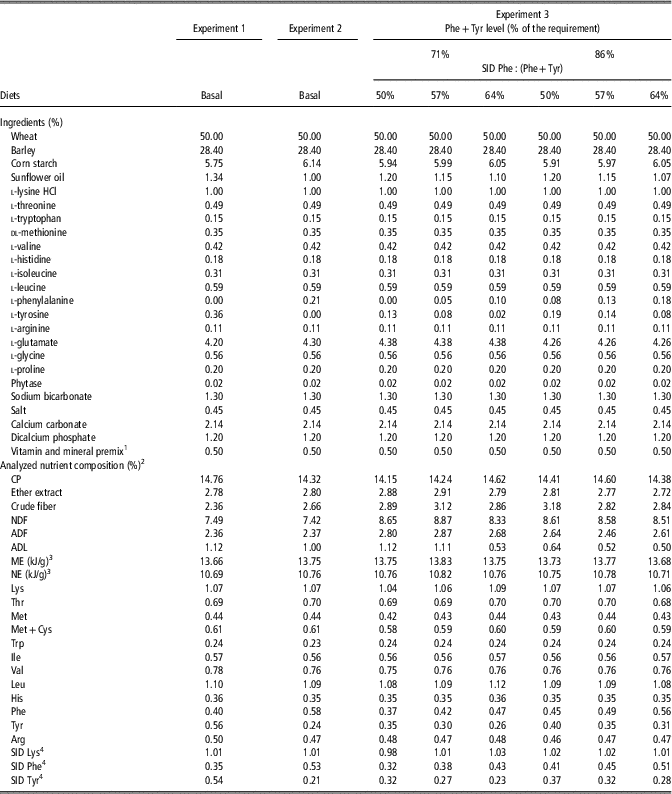
Low CP diets (14.5% CP) were formulated to be sub-limiting in Lys at 1.00% SID (Table 1) to express the AA supply relative to Lys (Boisen, Reference Boisen2003; Barea et al., Reference Barea, Brossard, Le Floc’h, Primot, Melchior and van Milgen2009). To avoid deficiencies in other AA in the low-protein diets, crystalline AA were supplied to match or slightly exceed the requirements for indispensable AA and N in 10 to 20 kg pigs (i.e. 53.6% Ile: Lys, 73.6% Val : Lys, 68.3% Thr : Lys, 45.7% Met : Lys, 62.2% (Met+Cys) : Lys, 23.2% Trp : Lys, 104.8% Leu : Lys, 33.6% His : Lys, and 44.0% Arg : Lys on a SID basis). Diets were formulated to provide 10.1 MJ net energy/kg, 4.0 g digestible P/kg, 2.9% Ca/digestible P and an electrolyte balance of 180 mEq/kg. Average daily feed intake (ADFI), average daily gain (ADG), and gain to feed ratio (G : F) were used as response criteria.
Composition of experimental diets (as-fed basis)

1 Supplied per kilogram (as-fed basis) of diet: vitamin A, 10 000 IU; vitamin D3, 2000 IU; vitamin E, 20 mg; vitamin K3, 2 mg; vitamin B1, 2 mg; vitamin B2, 5 mg; niacin, 20 mg; pantothenic acid, 10 mg; vitamin B6, 5 mg; biotin, 0.2 mg; folic acid, 1 mg; vitamin B12, 0.03 mg; choline chloride, 600 mg; vitamin C, 40 mg; Fe as iron sulfate, 100 mg; Cu as copper sulfate, 20 mg; Zn as zinc oxide, 100 mg; Mn as manganese oxide, 40 mg; I as calcium iodate, 0.6 mg; Se as sodium selenite, 0.3 mg; and Co as cobalt carbonate, 1 mg.
2 Adjusted for 87.3% dry matter.
3 Values for metabolizable energy (ME) and net energy (NE) were calculated according to Noblet et al. (Reference Noblet, Fortune, Shi and Dubois1994).
4 Standardized ileal digestible (SID) Lys, Phe, and Tyr, calculated from the analyzed amino acid composition and table values of the digestibility of feed ingredients (Sauvant et al., Reference Sauvant, Perez and Tran2004).
Experiments 1 and 2
Two dose response experiments were carried out to study the response to Phe and Tyr supply. The objective of experiment 1 was to estimate the SID Phe : Lys requirement under conditions of a sufficient Tyr supply. The basal diet provided 53% SID Tyr : Lys, which corresponds to 155% of the NRC (1998) requirement estimate. Piglets were allotted to one of six diets with graded levels of SID Phe : Lys (33%, 39%, 46%, 52%, 58%, and 65%) by the addition of l-Phe to a basal diet first-limiting in Phe. The same approach was used in experiment 2 to determine the Tyr requirement under conditions of a sufficient Phe supply and diets provided 21%, 27%, 33%, 39%, 45%, and 52% Tyr : Lys by the addition of l-Tyr to a basal diet first-limiting in Tyr. The level of Phe corresponded to the SID Phe : Lys requirement estimate obtained in experiment 1. For each experiment, two batches of feed were manufactured with the lowest and highest AA levels and were mixed thereafter to obtain the anticipated SID AA : Lys.
Experiment 3
The objective of this trial was to study the extent to which Phe can be used to fulfill the requirement for Tyr. To ensure that a response could be observed, the Phe+Tyr supply was first-limiting for growth. Six diets were formulated to study the effect of the substitution of Tyr by Phe at two limiting levels of Phe+Tyr, which corresponded to 71% and 86% of the SID (Phe+Tyr) : Lys requirement estimate obtained in experiments 1 and 2. At each of the two sub-limiting levels of SID (Phe+Tyr) : Lys, a diet was formulated to be equally deficient in Phe and Tyr. Two other diets were then formulated by increasing or decreasing the SID Phe : Lys level by 5% through an equimolar substitution of Phe by Tyr. The resulting variation in graded levels of SID Phe : (Phe+Tyr) were 50%, 57%, and 64% for both levels of Phe+Tyr. For a given SID (Phe+Tyr) supply, it was expected that the reduction in the Phe supply, and thus an increase in the Tyr supply, would induce a Phe deficiency. An increase in the Phe supply would be accompanied by a reduction in the Tyr supply, but the additional Phe could be used for Tyr synthesis.
Chemical analysis
Chemical analyses have been described in detail by Gloaguen et al. (Reference Gloaguen, Le Floc’h, Brossard, Barea, Primot, Corrent and van Milgen2011). Briefly, the gross energy content was measured with an adiabatic bomb calorimeter (ISO 9831, 1998; IKA C2000 and IKA C5000, Staufen, Germany). Crude protein content (N×6.25) was obtained after N analysis according to the Dumas procedure using a Rapid N cube (Elementar France; Villeurbanne, France) using the Association Française de Normalisation (AFNOR) method NF V18–120 (AFNOR, 1997). Total AA from protein were obtained after acid hydrolysis for 23 h at 110°C under reflux. For Met and Cys, hydrolysis was performed after oxidation with performic acid. The AA content was determined by ion exchange chromatography and ninhydrin derivatization (JLC-500/V AminoTac Amino Acid Analyzer; Jeol, Croissy-sur-Seine, France) using the AFNOR method NF EN ISO 13903 (AFNOR, 2005). Total Trp was analyzed by HPLC with a fluorescence detector (RF 10AXL; Shimadzu, Bonneuil sur Marne, France) after alkaline hydrolysis with barium hydroxide.
Data analysis
Data were analyzed through ANOVA using the PROC MIXED procedure (SAS Institute Inc., Cary, NC, USA) with diet as fixed effect in experiments 1 and 2, the Phe : (Phe+Tyr) ratio, the minimum Phe+maximum Tyr level, and their interaction as fixed effects in experiment 3 and block as a random effect. Results are reported as least square means.
In experiments 1 and 2, the response to the Phe and Tyr supply was also analyzed by regression with a curvilinear-plateau model using the PROC NLIN procedure of SAS (Robbins et al., Reference Robbins, Saxton and Southern2006). The model was parameterized to include a plateau for each block, the minimum SID AA concentration to reach the plateau (i.e. the requirement estimate) and the response at 90% of the requirement relative to the plateau value (i.e. the response for an AA supply 10% below the requirement). The latter two parameters were assumed to be common for all blocks. In experiment 3, the effect of the SID Phe : (Phe+Tyr) levels was analyzed with a curvilinear-linear model for each level of Phe+Tyr. The response to the Phe supply was considered to be curvilinear from 50% to 57% SID Phe : (Phe+Tyr), maximal at 57%, and linear from 57% to 64%, the linear phase representing the efficiency of substituting dietary Tyr by Phe. The model was parameterized to obtain the maximum response for each block, the response at 90% of 57% SID Phe : (Phe+Tyr) relative to the maximum response and the slope of the linear phase. To test whether the parameters of the model (i.e. the slopes and the average maximum response) varied according to the levels of Phe : (Phe+Tyr) or Phe+Tyr, a sum of squares reduction test was used (Ratkowsky, Reference Ratkowsky1983). This test compares a ‘full model’ with all parameters with a ‘reduced model,’ in which the slope parameters are shared by the two levels of Phe+Tyr. An F test was used to test if the diet affected the parameters (Ratkowsky, Reference Ratkowsky1983).
Results
In general, the pigs appeared healthy throughout the experiments. Four animals had diarrhea during experiment 2 without apparent relation to the diet and these pigs were successfully treated with an oral dose of colistin (CEVA Santé Animale, Libourne, France). In experiments 2 and 3, one pig was removed from the study due to a low feed intake and a poor weight gain during the adaptation period. The analyzed and calculated compositions of the experimental diets were in agreement with the anticipated values (Table 1).
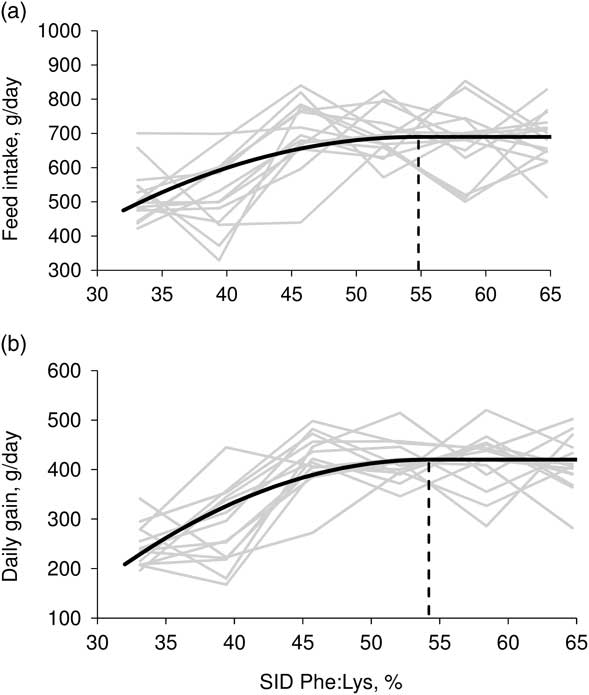
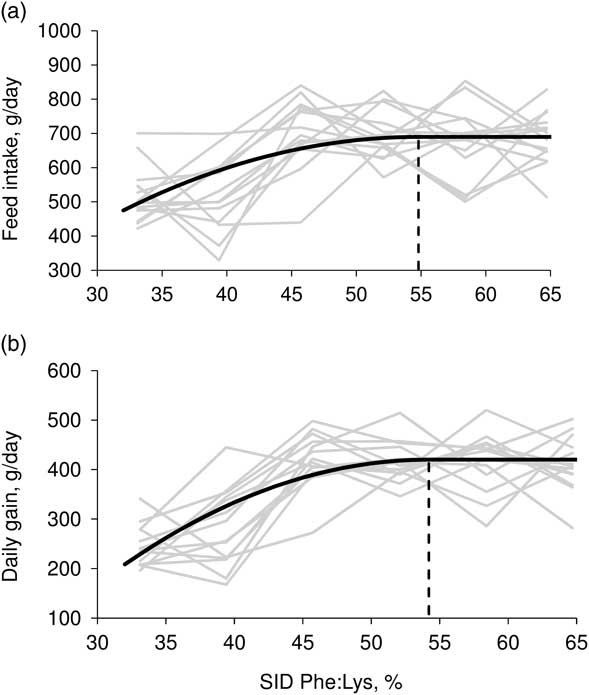
In experiment 1, ADFI, ADG, and G : F increased when the SID Phe : Lys increased from 33% to 46% to remain stable thereafter (P<0.01; Table 2). The estimated SID Phe : Lys requirements were 54.8%, 54.2%, and 52.6% for ADFI, ADG, and G : F, respectively (Table 3, Figure 1). The plateau values of the blocks ranged from 597 to 748 g/day for ADFI, from 366 to 468 g/day for ADG, and from 0.57 to 0.69 g/g for G : F. A 10% reduction in the Phe supply relative to the requirement estimate decreased ADFI, ADG, and G : F by 1.8%, 3.0%, and 1.7%, respectively.
Effect of increasing the standardized ileal digestible (SID) Phe : Lys supply on feed intake (a) and daily gain (b) in piglets (experiment 1). The response curves were adjusted for a common plateau value of 690 g/day for feed intake and 420 g/day for daily gain. The estimated SID Phe : Lys requirements were 54.8% and 54.2% for feed intake and daily gain, respectively. The gray lines indicate the responses of pigs of different blocks while the black line indicates the response estimated by the curvilinear-plateau model.
Effect of the standardized ileal digestible (SID) Phe : Lys supply on performance in piglets (experiment 1)Footnote 1

ADFI=average daily feed intake; ADG=average daily gain; G : F=gain to feed ratio, adjusted for 87.3% dry matter.
1 Data are presented as least squares means. Diet n=6, block n=14. Values with a different superscript letter are different by pairwise comparison, P<0.05. The average initial and final BW were 10.7 (s.d.±1.2) and 18.4 (s.d.±2.5) kg, respectively.
2 Anticipated SID Phe : Lys values. The SID Phe : Lys from the measured Lys and Phe contents and the estimated SID values from feed ingredients (Sauvant et al., Reference Sauvant, Perez and Tran2004) were 34%, 38%, 45%, 52%, 55%, and 64%.
3 n=84.
Estimated standardized ileal digestible (SID) minimum Phe : Lys and maximum Tyr : Lys requirement ratio for performance in piglets in experiments 1 and 2 analyzed by the curvilinear-plateau modelFootnote 1

ADFI=average daily feed intake; ADG=average daily gain are in g/day; G : F=gain to feed ratio in g/g.
Parameter estimates and asymptotic standard errors given in parentheses.
1 The model was parameterized to include the SID Phe : Lys or Tyr : Lys requirement, the response at 90% of the requirement relative to the plateau and the plateau value.
2 n=84.
3 n=83.
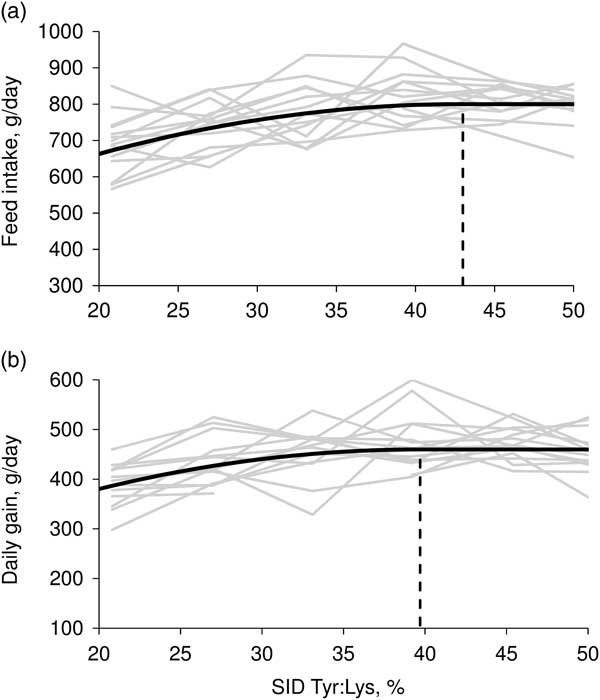
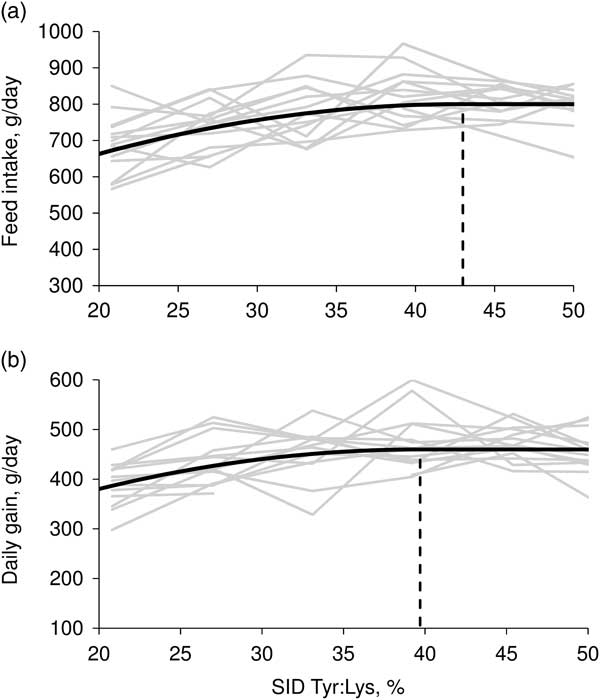
In experiment 2, the supply of SID Tyr : Lys affected ADFI and ADG (P<0.01) but not G : F (Table 4). The ADFI and ADG were maximized at 42.8% and 39.7% SID Tyr : Lys, respectively (Table 3, Figure 2). The range of plateau values of the blocks varied from 718 to 875 g/day for ADFI and from 405 to 516 g/day for ADG. Reducing the Tyr supply by 10% relative to the Tyr requirement estimate resulted in a 0.6% and 0.7% reduction in ADFI and ADG, respectively.
Effect of increasing the standardized ileal digestible (SID) Tyr : Lys supply on feed intake (a) and daily gain (b) in piglets (experiment 2). The response curves were adjusted for a common plateau value of 800 g/day for feed intake and 460 g/day for daily gain. The estimated maximum SID Tyr : Lys requirements were 42.8% and 39.7% for feed intake and daily gain, respectively. The gray lines indicate the responses of pigs of different blocks while the black line indicates the response estimated by the curvilinear-plateau model.
Effect of the standardized ileal digestible (SID) Tyr : Lys supply on performance in piglets (experiment 2)Footnote 1

ADFI=average daily feed intake; ADG=average daily gain; G : F=gain to feed ratio, adjusted for 87.3% dry matter.
1 Data are presented as least squares means. Diet n=6, block n=14. Values with a different superscript letter are different by pairwise comparison, P<0.05. The average initial and final BW were 11.1 (s.d.±1.1) and 20.4 kg (s.d.±2.0), respectively.
2 Anticipated SID Tyr : Lys values. The SID Tyr : Lys from the measured Lys and Tyr contents and the estimated SID values from feed ingredients (Sauvant et al., Reference Sauvant, Perez and Tran2004) were 21%, 27%, 30%, 36%, 41%, and 48%.
3 n=83.
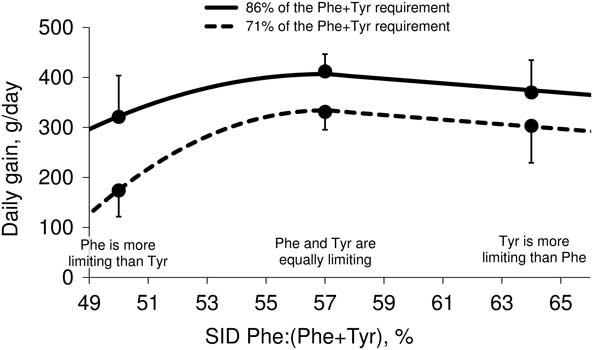
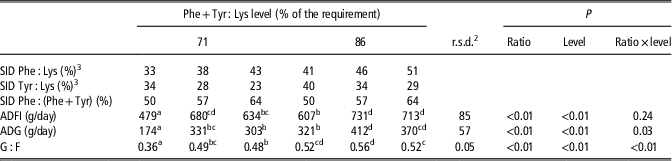
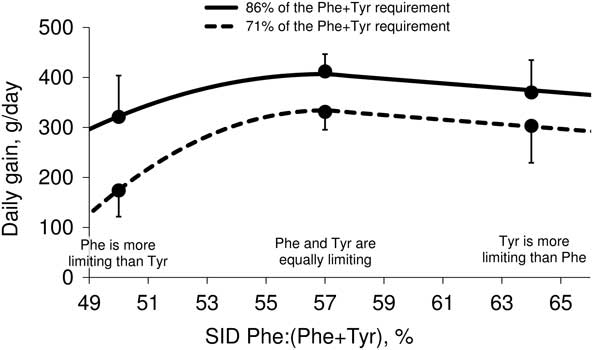
In experiment 3, as anticipated, the ADFI, ADG, and G : F were reduced when the level of SID (Phe+Tyr), decreased from 86% to 71% (P<0.01; Table 5). As indicated before, for a given level of SID (Phe+Tyr), Phe is first-limiting at the lowest level of Phe : (Phe+Tyr) and increasing this level from 50% to 57% SID resulted in an increase in ADFI, ADG, and G : F (P<0.01). At greater levels of Phe : (Phe+Tyr), Tyr is the first-limiting factor, but additional Phe can be used to synthesize Tyr. As indicated in Table 5, increasing the SID Phe : (Phe+Tyr) from 57% to 64% resulted in a slight reduction in performance. Increasing the level of SID (Phe+Tyr) from 71% to 86% of the requirement at 57% SID Phe : (Phe+Tyr) resulted in an increase in ADG from 330 to 411 g/day (Figure 3). Reducing the Phe supply by 10% below the supposed requirement resulted in a reduction in ADG of 14% at 86% of the SID (Phe+Tyr) requirement, but of 31% at 71% of the SID (Phe+Tyr) requirement (Figure 3). The level of SID (Phe+Tyr) did not affect the slope of the linear phase of substituting Tyr by Phe. Increasing the SID Phe : (Phe+Tyr) over and above 57% by 1 percentage point reduced ADG by 4.6 g/day (Figure 3).
Effect of the standardized ileal digestible (SID) Phe : (Phe+Tyr) at 71% and 86% of the SID Phe+Tyr : Lys requirement estimates (experiments 1 and 2) on average daily gain in piglets (experiment 3). At 71% and 86% of the SID Phe+Tyr : Lys requirement, respectively, the average responses at 57% SID Phe : (Phe+Tyr) were 330 g/day and 411 g/day, the responses at 90% of 57% SID Phe : (Phe+Tyr) were 69% and 86% of the maximum response, and the slope of the linear phase was −4.6 g/day.
Effect of the substitution of standardized ileal digestible (SID) Tyr by Phe on performance in piglets (experiment 3)Footnote 1

ADFI=average daily feed intake; ADG=average daily gain; G : F=gain to feed ratio; adjusted for 87.3% dry matter.
1 Data are presented as least squares means. Diet n=6, block n=14. Values with a different superscript letter are different by pairwise comparison, P<0.05. The average initial and final BW were 11.1 (s.d.±1.2) and 17.9 kg (s.d.±2.5), respectively.
2 n=83.
3 Anticipated SID Phe : Lys and Tyr : Lys values. From the measured Lys, Phe, and Tyr contents and the estimated SID values from feed ingredients (Sauvant et al., Reference Sauvant, Perez and Tran2004), the SID Phe : Lys were, from left to right, 33%, 37%, 42%, 40%, 44%, and 51% and the SID Tyr : Lys were 33%, 27%, 22%, 37%, 32%, and 28%.
Discussion
In experiment 1, to estimate the requirement of Phe, a high level of Tyr was used that exceeded the (expected) Tyr requirement. Tyr is used for protein synthesis, but is also used for the synthesis of neurotransmitters and thyroid hormones. When the requirement for Tyr is met, a Phe dose–response study can be used to estimate the Phe requirement that maximizes growth. In the present experiment, a ‘large excess’ supply of Tyr was avoided to limit competition with other large neutral AA (i.e. Phe, Trp, Leu, Ile, and Val) for transport (e.g. blood brain barrier; Andersen and Avins, Reference Andersen and Avins1976), which can lead to an AA imbalance and a reduction in feed intake (Tackman et al., Reference Tackman, Tews and Harper1990). Results of our study indicate that a supply of 54% of SID Phe : Lys allows maximizing growth in 10 to 20 kg pigs in low CP diets. The Phe and Tyr requirements for maximizing ADG have never been evaluated with a sufficient number of pigs and with an experimental design that allows expressing the requirement on an SID basis relative to Lys (Mertz et al., Reference Mertz, Henson and Beeson1954; Robbins and Baker, Reference Robbins and Baker1977). The present SID Phe : Lys requirement estimate of 54% is lower than that of the NRC (1998, 61% and 2012, 58%) and of that of the BSAS (2003, 57%). When Tyr becomes deficient in the diet, an additional dietary supply of Phe may be required to produce Tyr and to meet the Tyr requirement. In growing rats, when the diet provides 0.00%, 0.16%, 0.32%, and 0.48% Tyr, Phe requirement estimates were 0.70%, 0.52%, 0.38%, and 0.38%, respectively (Stockland et al., Reference Stockland, Lai, Meade, Sowers and Oestemer1971). Owing to this variation in Phe requirement to meet the needs for Tyr, future standards for ideal protein may integrate the concept of a minimum and maximum Phe requirements. The maximum Phe requirement was not evaluated in this study, since it requires a basal diet free of protein-bound Tyr. In the absence of Tyr, the Phe requirement of children was estimated to be only 64% of the adult requirement, while similar values were expected for children and adults (Hsu et al., Reference Hsu, Ball and Pencharz2007). This means that dietary Phe does not match the full requirement for Tyr in children who may have a dietary requirement for Tyr. Newly synthesized Tyr from dietary Phe is mainly oxidized in children (Hsu et al., Reference Hsu, Jahoor, Butte and Heird2011), which may limit the ability of dietary Phe to cover the nutritional needs for Tyr. Therefore, if a dietary requirement for Tyr can be expected in young growing pigs, the maximum Phe requirement may increase with increasing BW of young pigs.
In experiment 2, the growth response in pigs offered graded level of dietary SID Tyr : Lys indicated that Tyr is a conditionally indispensable AA and that endogenous Tyr synthesis from Phe is not sufficient to maximize growth. The reduction in growth was solely due to a decrease in feed intake while feed efficiency was not affected by the reduction in SID Tyr : Lys from 52% to 21%. The SID Tyr : Lys requirement to maximize ADG was estimated to be 40%. Performance did not increase from 40% to 52% SID Tyr : Lys indicating that above a level of 40% SID Tyr : Lys in the diet, the requirement for Phe is minimal. This confirms that, in experiment 1, the supply of 53% SID Tyr : Lys was above the maximum dietary Tyr requirement and that the minimum Phe requirement was assessed correctly. Moreover, this means that the sparing effect of Tyr on the Phe requirement may occur when dietary SID Tyr : Lys supply is above 40%. In experiment 3, the performance of pigs decreased when the SID Phe : (Phe+Tyr) decreased from 57% to 50% by substituting Phe with Tyr. This suggests that there is no sparing effect of Tyr on Phe requirement below a supply of 57% SID Phe : (Phe+Tyr). Furthermore, this reduction in growth was more important at a low SID (Phe+Tyr) level, which indicates that the growth response to the SID Phe : Lys supply was more detrimental for growth at a low Phe supply.
The Tyr requirement is met when Tyr from the diet and synthesized through the hydroxylation of Phe in liver and kidney is available for anabolic processes. In experiment 3, we hypothesized that when the SID (Tyr+Phe) level in the diet is constant, the Tyr requirement can be covered through an equimolar supply of Phe. However, when the SID Phe : (Phe+Tyr) increased from 57% to 64%, the ADG decreased slightly. This means that an equimolar substitution of Tyr by Phe is ineffective to ensure maximum growth. Moreover, the reduction in growth was independent of the SID (Phe+Tyr) level, which indicates that the expected activation of Phe hydroxylase by Phe (Fitzpatrick, Reference Fitzpatrick2012) and the subsequent increase in synthesized Tyr from Phe did not lead to higher availability of Tyr for growth. In contrast to our results, Sasse and Baker (Reference Sasse and Baker1972) determined that Phe was equal in efficacy to Tyr, on a molar basis, to provide Tyr in young chicks. In adult humans, Møller et al. (Reference Møller, Meek, Bigelow, Andrews and Nair2000) demonstrated that in the postabsorptive state, the kidney is a net contributor of Tyr to the systemic circulation while the liver removes Tyr from the circulation. It can be expected that the majority of Tyr synthesized in the liver from Phe hydroxylation is degraded as soon as it is synthesized and not available for whole body protein synthesis. Indeed, Shiman and Gray (Reference Shiman and Gray1998) showed that at normal or high plasma concentrations of Phe and Tyr, the majority of Tyr synthesized from Phe is degraded in hepatocytes in rats. Similarly, in children in the fed state, Hsu et al. (Reference Hsu, Jahoor, Butte and Heird2011) found that a reduction in dietary Tyr increased the rate of Phe hydroxylation and oxidation. Because the rates were identical, the authors suggested that the fate of newly synthesized Tyr was mainly to be oxidized. In our experimental conditions where both Phe and Tyr were limiting for growth, increasing the SID Phe : (Phe+Tyr) supply from 57% to 64% provides the animal with two options: the additional Phe can be used for Tyr synthesis, thereby limiting the Tyr deficiency, or the additional Phe can be used to limit the existing Phe deficiency. Because a Phe deficiency is more detrimental for growth than a Tyr deficiency (experiments 1 and 2), limiting the Phe deficiency could have been the preferred strategy of the animal. Increasing the SID Phe : (Phe+Tyr) supply from 57% to 64% could then have resulted in an increase in growth. The fact that this did not occur may indicate that the animal seeks a balance between the Phe and Tyr deficiencies.
The results of this study indicate that the SID Phe : Lys supply can be decreased to 54% without affecting the growth of piglets. This value is much lower than that proposed by current standards (NRC, 1998 and 2012; BSAS, 2003). In a cereal–soybean meal-based diet, the Ile, His, and Leu supply may become limiting for growth before Phe and Tyr when the CP content is reduced (van Milgen et al., Reference van Milgen, Gloaguen, Le Floc’h, Brossard, Primot and Corrent2012; Gloaguen et al., Reference Gloaguen, Le Floc’h, Primot, Corrent and van Milgen2013). Therefore, with the currently available crystalline AA (l-Lys, l-Thr, dl-Met, l-Trp, and l-Val), it is unlikely that dietary Phe becomes limiting for growth in practical low CP diets. The requirement for Tyr is typically expressed as the sum of Phe+Tyr. On the basis of the above results, the optimum dietary Tyr level corresponds to 43% of Phe+Tyr on a weight basis, which is higher than that estimated by the NRC (1998, 35%, and 2012, 38%), in agreement with the BSAS (2003, 43%) and lower than the value reported by Robbins and Baker (Reference Robbins and Baker1977, 49%). In the rat, chicken, dog, and cat, the reported values range from 43% to 50% (Stockland et al., Reference Stockland, Lai, Meade, Sowers and Oestemer1971; Sasse and Baker, Reference Sasse and Baker1972; Anderson et al., Reference Anderson, Baker, Sherry and Corbin1980; Milner et al., Reference Milner, Garton and Burns1984). This way to express the Tyr requirement supposes that Phe can be substituted to Tyr on a weight basis in the diet to cover the needs for Tyr. The results of this study demonstrated that the replacement of Tyr by Phe does not maintain the growth in pigs. Dietary Phe cannot be used on an equimolar basis (and even less so on a weight basis, the molar masses of Tyr and Phe being 181 and 165 g/mol, respectively) to provide Tyr and the sum of Phe+Tyr is not suitable to express the Tyr requirement. Therefore, the SID (Phe+Tyr) : Lys requirement may be not constant and increases when the supply of Tyr in the diet decreases below the maximum Tyr level. Knowledge on the efficiency of the substitution of dietary Tyr by Phe is therefore required before applying a Phe+Tyr requirement in feed formulation. Consequently, according to the current knowledge, it is preferable to not use a Phe+Tyr requirement in the ideal protein profile but rather a minimum Phe and a maximum Tyr requirement.
The present requirements were defined as the minimum AA concentrations in the diet that maximize growth in pigs using a curvilinear-plateau model. From an economic point of view, the dietary AA level that results in maximum profit can be different from that required to maximize growth. Knowledge of the shape of the growth curve in response to the AA supply is important to optimize the dietary AA level. A Phe deficiency has a small negative impact on performance, which is similar to that observed for His and Leu deficiencies, while the effect of a Tyr is very small. This contrasts with the response observed for Ile and Val deficiencies (Gloaguen et al., Reference Gloaguen, Le Floc’h, Primot, Corrent and van Milgen2013).
In conclusion, the SID minimum Phe : Tyr and the maximum Tyr : Lys requirement estimates for maximum growth were 54% and 40%, respectively. The replacement of dietary Tyr by Phe on a molar basis does not maintain growth in pigs. This suggests that the use of a Phe+Tyr requirement in the ideal protein profile of pigs may need to be reconsidered.
Acknowledgments
The authors wish to thank Y. Jaguelin, A. Starck, M. Eudaimon, A. Marchais, P. Touanel, F. Guerin, G. Guillemois, and J. F. Rouaud for their skillful technical assistance and helpful collaboration.