In their target article, Hibbing et al. suggest that individual differences in political ideology can be traced to differences in the way in which liberals and conservatives attend to and process negative stimuli. In detail, their hypothesis is this: Compared with liberals, conservatives are more attuned to, and devote more processing resources to, negative stimuli, and it is this difference in “negativity bias” – that is, the fact that conservatives are more strongly biased toward negative stimuli than liberals are – that accounts in large measure for the divergence in political perspective between the groups. The principal appeal of the negativity bias hypothesis (NBH) is twofold. First, NBH promises to account for more of the psychological and physiological data on ideological differences than competing accounts. Second, NBH promises to account for the data at a deeper level, by identifying a causal mechanism underlying those differences. But does it?
We have our doubts. The main source of our skepticism relates to the authors' use of a single, unidimensional measure of political ideology, anchored by liberalism on one end and conservatism on the other. A problem that arises with the use of this measure is that it glosses over the fact that, although some people self-identify as conservative on the basis of their views about both sociocultural issues (such as abortion and gay rights) and economic issues (such as taxation and social welfare programs), others self-identify as conservative on the basis of their views about issues in one of these domains but not the other. The distinction between domains here reflects the distinction made in the “ideology as motivated social cognition” literature between two factors underlying the liberal–conservative divide: (1) attitudes toward social change, indexed by right-wing authoritarianism (Altemeyer Reference Altemeyer1998) and (2) attitudes toward economic inequality, as measured by social dominance orientation (Sidanius & Pratto Reference Sidanius and Pratto1999). Attitudinally speaking, then, there seem to be two routes to conservatism, one social (rejecting change) and one economic (accepting inequality) (Jost et al. Reference Jost, Glaser, Kruglanski and Sulloway2003). What's more, these attitudinal routes appear to have different motivational origins (Duckitt et al. Reference Duckitt, Wagner, du Plessis and Birum2002). Negative attitudes toward social change are thought to stem from a concern to reduce threats to the prevailing social order, whereas positive attitudes toward inequality are thought to derive from a concern to maximize economic self-interest.
Assuming this general picture is right, individual differences in ideology exhibit an underlying complexity that unitary explanations like NBH are unlikely to capture. The reason for this is simple: Although differences in negativity bias plausibly have a direct effect on security motivation (i.e., the motivation to reduce or deflect social threats), it is less plausible that such differences have an analogous influence on power motivation (i.e., the motivation to maintain or improve one's economic status). In other words, even if heightened negativity bias does a reasonable job of explaining and predicting the tendency to adopt socially conservative attitudes, it does not do nearly so well where economic conservatism is concerned. (Indeed, as Hibbing et al. observe, insofar as extremes of economic inequality may be seen to pose a social threat, a heightened negativity bias might just as well predict a traditionally liberal response to poverty, as opposed to a traditionally conservative one.) And that explanatory and predictive shortfall, we think, is something that advocates of NBH ought to worry about.
How might the shortfall be made up? One possibility is that ideological differences based on contrasting attitudes toward economic inequality are driven by differences in empathic concern or compassion, understood as an other-oriented affective response to the plight of a person in need (Batson Reference Batson, Decety and Ickes2009). Individuals relatively high in empathic concern, on this view, would be strongly motivated to oppose inequality and endorse a more egalitarian perspective, whereas individuals lower in this trait would be less pulled in this direction. Indeed, validating the stereotypical contrast between “bleeding-heart” liberals and “tough-minded” conservatives, recent evidence from Five Factor–based studies of personality suggests that liberals are more compassionate (but less polite) than conservatives (Hirsh et al. Reference Hirsh, DeYoung, Xu and Peterson2010).
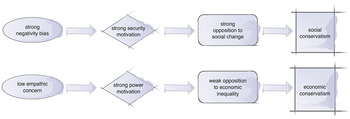
The alternative picture that emerges from these considerations looks something like our Figure 1.
Figure 1.
Two psychological routes to conservativsm.
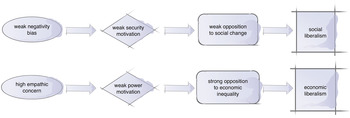
In this dual-factor model, the two strands of conservative ideology have distinct motivational and attitudinal profiles. This proposal, which effectively embeds NBH as a component, has greater explanatory and predictive power than Hibbing et al.'s single-factor model. In particular, it helps to explain why economic conservatives, being relatively low on empathic concern, respond to poverty as they typically do – namely, by downplaying the suffering of the poor and emphasizing personal responsibility for life outcomes (i.e., depicting the poor as agents, rather than victims, of misfortune). Hence, poverty may be processed by economic conservatives less as a social threat and more as a spur to the pursuit of self-interest. Similar remarks apply, mutatis mutandis, to the underlying psychology of liberalism (see Figure 2).
Figure 2.
Two psychological routes to liberalism.
The dual-factor approach is not without limitations, however. One advantage of the single-factor approach that it gives up, for example, is the prediction that social conservatism and economic conservatism (and the corresponding variants of liberalism) will be strongly correlated. That such a correlation exists seems clear (Jost et al. Reference Jost, Federico and Napier2009). What is less clear is how to explain it. One possibility, of course, is that differences in negativity bias lie at the root of both tendencies. Proponents of NBH would presumably favor this option. An intriguing alternative, and one more attractive to the dual-factor theorist, is that negativity bias and empathic concern (trait compassion) are inversely correlated. This may seem counterintuitive, given that compassion involves sensitivity to the distress of others, and distress is a paradigmatically negative stimulus. But empathic concern has less to do with emotional responsivity than with capacities for emotion regulation, particularly the capacity to downregulate one's own (self-oriented) emotional response to an aversive situation. This is reflected in studies that show a negative correlation between ratings on the empathic concern and personal distress subscales of the Interpersonal Reactivity Index (Thakkar et al. Reference Thakkar, Brugger and Park2009), as well as by evidence from functional neuroimaging (Decety & Moriguchi Reference Decety and Moriguchi2007).





In their target article, Hibbing et al. suggest that individual differences in political ideology can be traced to differences in the way in which liberals and conservatives attend to and process negative stimuli. In detail, their hypothesis is this: Compared with liberals, conservatives are more attuned to, and devote more processing resources to, negative stimuli, and it is this difference in “negativity bias” – that is, the fact that conservatives are more strongly biased toward negative stimuli than liberals are – that accounts in large measure for the divergence in political perspective between the groups. The principal appeal of the negativity bias hypothesis (NBH) is twofold. First, NBH promises to account for more of the psychological and physiological data on ideological differences than competing accounts. Second, NBH promises to account for the data at a deeper level, by identifying a causal mechanism underlying those differences. But does it?
We have our doubts. The main source of our skepticism relates to the authors' use of a single, unidimensional measure of political ideology, anchored by liberalism on one end and conservatism on the other. A problem that arises with the use of this measure is that it glosses over the fact that, although some people self-identify as conservative on the basis of their views about both sociocultural issues (such as abortion and gay rights) and economic issues (such as taxation and social welfare programs), others self-identify as conservative on the basis of their views about issues in one of these domains but not the other. The distinction between domains here reflects the distinction made in the “ideology as motivated social cognition” literature between two factors underlying the liberal–conservative divide: (1) attitudes toward social change, indexed by right-wing authoritarianism (Altemeyer Reference Altemeyer1998) and (2) attitudes toward economic inequality, as measured by social dominance orientation (Sidanius & Pratto Reference Sidanius and Pratto1999). Attitudinally speaking, then, there seem to be two routes to conservatism, one social (rejecting change) and one economic (accepting inequality) (Jost et al. Reference Jost, Glaser, Kruglanski and Sulloway2003). What's more, these attitudinal routes appear to have different motivational origins (Duckitt et al. Reference Duckitt, Wagner, du Plessis and Birum2002). Negative attitudes toward social change are thought to stem from a concern to reduce threats to the prevailing social order, whereas positive attitudes toward inequality are thought to derive from a concern to maximize economic self-interest.
Assuming this general picture is right, individual differences in ideology exhibit an underlying complexity that unitary explanations like NBH are unlikely to capture. The reason for this is simple: Although differences in negativity bias plausibly have a direct effect on security motivation (i.e., the motivation to reduce or deflect social threats), it is less plausible that such differences have an analogous influence on power motivation (i.e., the motivation to maintain or improve one's economic status). In other words, even if heightened negativity bias does a reasonable job of explaining and predicting the tendency to adopt socially conservative attitudes, it does not do nearly so well where economic conservatism is concerned. (Indeed, as Hibbing et al. observe, insofar as extremes of economic inequality may be seen to pose a social threat, a heightened negativity bias might just as well predict a traditionally liberal response to poverty, as opposed to a traditionally conservative one.) And that explanatory and predictive shortfall, we think, is something that advocates of NBH ought to worry about.
How might the shortfall be made up? One possibility is that ideological differences based on contrasting attitudes toward economic inequality are driven by differences in empathic concern or compassion, understood as an other-oriented affective response to the plight of a person in need (Batson Reference Batson, Decety and Ickes2009). Individuals relatively high in empathic concern, on this view, would be strongly motivated to oppose inequality and endorse a more egalitarian perspective, whereas individuals lower in this trait would be less pulled in this direction. Indeed, validating the stereotypical contrast between “bleeding-heart” liberals and “tough-minded” conservatives, recent evidence from Five Factor–based studies of personality suggests that liberals are more compassionate (but less polite) than conservatives (Hirsh et al. Reference Hirsh, DeYoung, Xu and Peterson2010).
The alternative picture that emerges from these considerations looks something like our Figure 1.
Two psychological routes to conservativsm.
In this dual-factor model, the two strands of conservative ideology have distinct motivational and attitudinal profiles. This proposal, which effectively embeds NBH as a component, has greater explanatory and predictive power than Hibbing et al.'s single-factor model. In particular, it helps to explain why economic conservatives, being relatively low on empathic concern, respond to poverty as they typically do – namely, by downplaying the suffering of the poor and emphasizing personal responsibility for life outcomes (i.e., depicting the poor as agents, rather than victims, of misfortune). Hence, poverty may be processed by economic conservatives less as a social threat and more as a spur to the pursuit of self-interest. Similar remarks apply, mutatis mutandis, to the underlying psychology of liberalism (see Figure 2).
Two psychological routes to liberalism.
The dual-factor approach is not without limitations, however. One advantage of the single-factor approach that it gives up, for example, is the prediction that social conservatism and economic conservatism (and the corresponding variants of liberalism) will be strongly correlated. That such a correlation exists seems clear (Jost et al. Reference Jost, Federico and Napier2009). What is less clear is how to explain it. One possibility, of course, is that differences in negativity bias lie at the root of both tendencies. Proponents of NBH would presumably favor this option. An intriguing alternative, and one more attractive to the dual-factor theorist, is that negativity bias and empathic concern (trait compassion) are inversely correlated. This may seem counterintuitive, given that compassion involves sensitivity to the distress of others, and distress is a paradigmatically negative stimulus. But empathic concern has less to do with emotional responsivity than with capacities for emotion regulation, particularly the capacity to downregulate one's own (self-oriented) emotional response to an aversive situation. This is reflected in studies that show a negative correlation between ratings on the empathic concern and personal distress subscales of the Interpersonal Reactivity Index (Thakkar et al. Reference Thakkar, Brugger and Park2009), as well as by evidence from functional neuroimaging (Decety & Moriguchi Reference Decety and Moriguchi2007).