Introduction
Parastates act as nation-builders.Footnote 1 Whereas most parastates, entities endowed with internal sovereignty lacking international recognition, are firmly rooted in a specific mono-ethnic identity, the Pridnestrovska͡ia Moldavska͡ia Respublika (PMR), a de facto state situated between Moldova and Ukraine, sought for nearly three decades to forge a supraethnic Transnistrian identity.Footnote 2 Mentioning it, Vadim Krasnosel’skiĭ, the incumbent president of PMR noted:
I hold a Transnistrian and a Russian passport. In our republic an individual can have an unlimited number of passports […] My father is Ukrainian and my mother is Russian. But my nationality is Eastern Slav [in Russian: vostochnyĭ slav͡ianin; emphasis mine]. In my veins flows Russian, Ukrainian, and Polish blood. How can you divide me into parts? The soul does not have nationality […] and as part of the Russkiĭ Mir each citizen preserves her own ethnic identity. We have thirty-five nationalities here and each of them retains its own culture and language. We have avoided national conflicts, because the philosophy of the Russkiĭ Mir [emphasis added] allows us to coexist peacefully. There is no titular nation here. We are all equal. (Pervyĭ Pridnestrovskiĭ 2017)
The references to an Eastern Slav community, multiethnicity, and the ideology of the Russkii Mir (the Russian World) raise several intriguing questions regarding the social construction of national identity in a political community at Europe’s periphery. Is Transnistria pursuing a civic nation-building policy trying to foster a multicultural community in which its ethnocultural groups enjoy equal rights? Do the assertions of the PMR officials about the preservation of ethnolinguistic identities reflect the actual educational, demographic, and media policies of the parastate? Why and when did the PMR officials start evoking the philosophy of the Russkiĭ Mir in their discourses about national identity?
In answering these questions, this article makes two claims regarding the character of nation-building in PMR. First, the parastate, despite its lack of external recognition, attempts to engineer through education, mass media, and culture, the way in which ethnic Moldovans and Ukrainians imagine themselves as members of their respective cultural groups. In doing so, the Transnistrian authorities erect and police artificial identity boundaries between the Moldovans and Ukrainians in the PMR and their more politically conscious co-ethnics living in Moldova and Ukraine. This external process of ethnic identity construction has contributed to the significant decline of the Moldovan and Ukrainian population and the rise in the number of individuals self-identifying as ethnic Russians. Second, the political discourse about the Transnistrian identity is changing. The diverse community from which PMR draws its political legitimacy is being gradually reimagined as part of the Russkiĭ Mir, a civilizational space in Eurasia centered on a conservative, traditionalist ideology in which Russian culture and historical memory dominate (Nikonov Reference Nikonov2010, 4–15). Initially, the Transnistrian elites and Russian politicians addressing the “Transnistrian people” relied on boilerplate internationalist Communist slogans largely antithetical to ethnic nationalism. Over time, however, we observe that the Russkiĭ Mir framework steadily displaces the discursive formations of the Soviet era. This updated narrative about national identity and the noticeable cultural assimilation of the Moldovans and Ukrainians in PMR stands in sharp contrast to the purported multicultural, civic nature of the Transnistrian nation-building project.
The article is structured as follows. First, it discusses the main dimensions of the regional Transnistrian identity. Second, it traces the recent transformation of PMR’s multifaceted nation-building efforts by examining the media representations of the Moldovan ethnicity, presidential discourses on national identity, demographic changes, and the language of instruction in PMR’s schools. The article ends with a brief assessment of the potential impact of PMR’s updated nation-building strategy on the prospects of conflict resolution.
Imagining the Transnistrian Community
The Transnistrian nation-building project presents a puzzle. In her landmark study, Nina Caspersen observes that most unrecognized states claim their right to self-determination based on the ethnic principle. Others, such as Transnistria, stand out as ethnically diverse entities adopting “a more civic form of nation-building” (Caspersen Reference Caspersen2012, 36). Yet, in another section of the book, the author writes that the Transnistrian authorities view with suspicion the Moldovan population in the region (Caspersen Reference Caspersen2012, 98). The initial claim about the civicness of the Transnistrian nation-building strategy echoed by other scholars (Comai and Venturi Reference Comai and Venturi2015, 887; Osipov and Vasilevich Reference Osipov and Hanna2019, 13) stands in contradiction with the official distrust expressed toward Moldovans and the outright ban on the use of the Latin script in PMR’s school system. This entrenched suspicion led to the politicization of the Moldovan identity, a central pillar of PMR’s early nation-building efforts. In this sense, PMR does not deemphasize the Moldovan ethnicity per se, but claims to protect the authentic Moldovan identity from absorption into competing nation-building projects unfolding in Moldova. In order to prevent the identification of the Transnistrian Moldovans with their kinspeople across the Nistru River, PMR attempts through media, education, and memorialization rituals to suppress inconvenient imaginations of the group.
Such nation-building efforts build on the uniqueness of the Transnistrian Moldovans. Due to different historical circumstances, the Moldovans of Transnistria and the Moldovans on the right bank of Nistru underwent distinct socialization processes throughout a few generations. Since the 18th century, the area of current Transnistria has been incorporated as a borderland of the Tsarist Empire. Except for a brief occupation period (1941 to 1944), Transnistria has never been part of Romania. Joseph Stalin, at the behest of the local Communist revolutionaries led by Grigoriĭ Kotovskiĭ, created the Moldovan Autonomous Soviet Socialist Republic (MASSR), which functioned from 1924 to 1940 along the Nistru River as an autonomous region of the Ukrainian Soviet Socialist Republic. Serving ideological and strategic purposes, MASSR operated as an incubator for revolutionaries, which were sent to neighboring Romania to support Communist revolutionary committees, engage in seditious activities and coordinate pro-Soviet secessionist revolts such as the 1919 Bender and the 1924 Tatarbunar rebellions. After World War II, at Stalin’s initiative again, Transnistria was incorporated into the Soviet Socialist Republic of Moldova, while the three Southern districts of Bessarabia were transferred to Ukraine. Thus, compared to the Moldovans on the right bank, the cultural assimilation of the Transnistrian Moldovans advanced faster.
To explore the multifaceted nature of the Transnistrian identity-building project, I adopt Benedict Anderson’s definition of the nation as “an imagined political community—and imagined as both inherently limited and sovereign” (1991, 6). When applying this description to PMR, it should be noted that any statements about the definitive formation of a new, stable national identity along the Nistru River are premature. I concur with Rebecca Chamberlain-Creanga (Reference Chamberlain-Creanga 2006, 98), who expressed strong skepticism regarding the emergence of “a unified, supra-ethnic, lasting, loyal Transnistrian people.” Moreover, she suggests that even political loyalty to the parastate is contingent on a person’s ethnicity, occupation, and residence, all of which result in varying degrees of belonging and identification (Chamberlain-Creanga Reference Chamberlain-Creanga 2006, 395–396). Given such volatile self-identification among the population, the Transnistrian identity can be described as an incompletely imagined community, fluid and hybrid, borrowing national and civilizational elements from collective identity discourses articulated by a range of actors situated within the patron-state (i.e. Russia).
Constructivist theories of nationhood highlight that the content and boundaries of national and ethnic identities change over time (Chandra Reference Chandra2012; Nagel Reference Nagel1994). While certain theories emphasize the impact of structural forces, other perspectives suggest that discursive formations and strategic elites play a greater role in bringing about change in national self-identification (Laitin and Fearon Reference Laitin and Fearon2000, 850). In this sense, the construction of a Transnistrian supraethnic identity is still a work in progress subject to three structural constraints. First, PMR’s economic dependence on Russia means that in exchange for subsidies the PMR elites will implement a nation-building strategy, which fits Russia’s long-term strategic goals and its own emerging nats͡ional’na͡ia ide͡ia (national idea).
Second, despite their control over economic, media, and political resources, the PMR elites constantly police the boundaries of the Moldovan collective identity and work on filling it with “authenticity.” Even though there is some grassroots support for the protection of Moldovan ethnic boundaries, the logic of the Transnistrian identity discursive formations is such that expanding the limits of this ethnic category to encompass co-ethnics from Moldova would threaten the political legitimacy of PMR. Occasional attempts by Moldovans to undermine the dominant discourse trigger vigorous, sometimes violent, reactions from the parastate.
Third, the high mobility of the population crossing frequently into Moldova and Ukraine and the growing access to Internet prevents the PMR elites from imposing a unified, coherent discourse on identity in the region. Despite these constraints, the cultural boundaries between the three major ethnic groups are becoming more blurred as a result of assimilationist pressures and prolonged exposure to the Russian culture.
Old and New Markers of the Transnistrian Identity
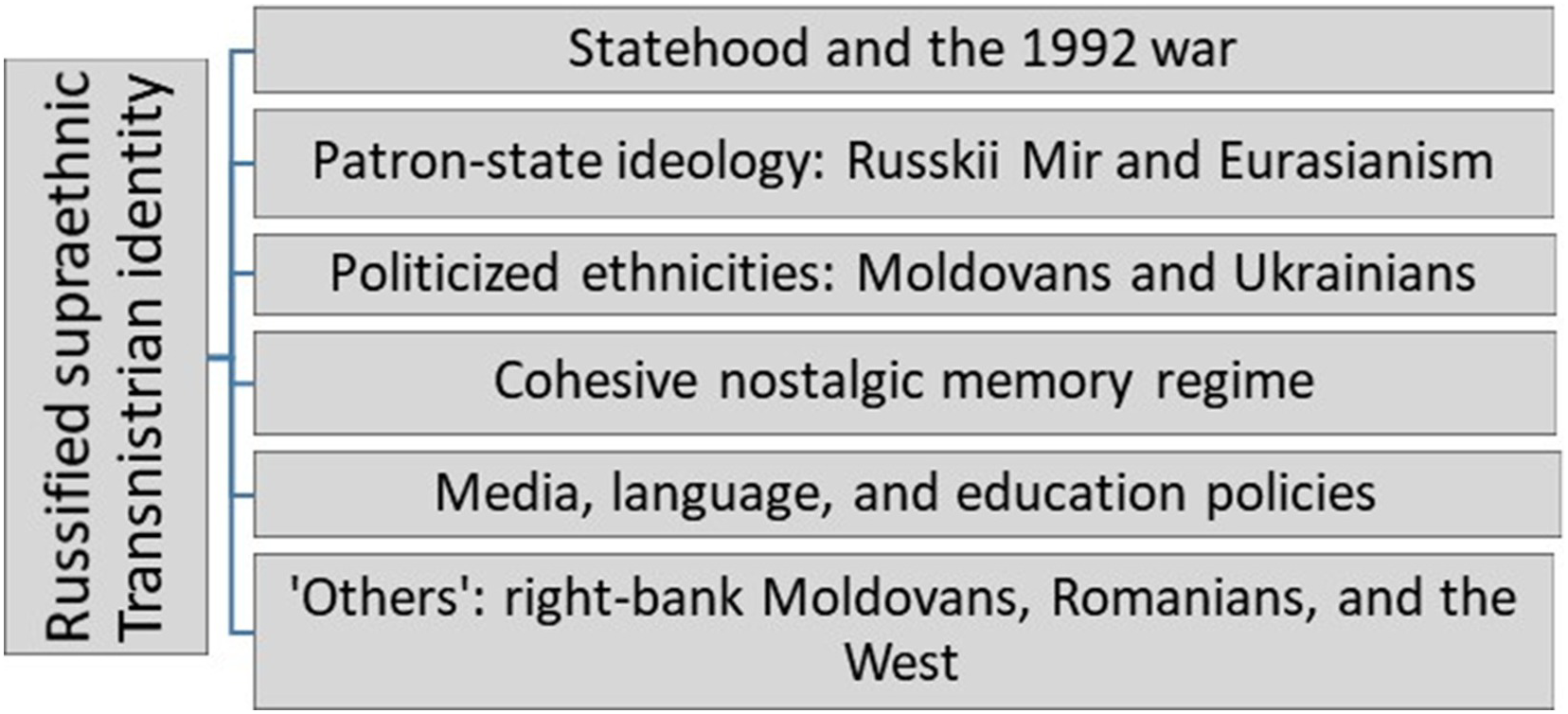
What are the markers of this semi-formed Transnistrian identity? In 1990, Nikolai Babilunga, a PMR academic, identified five elements of the Transnistrian identity: self-sufficiency (samobytnost’), statehood ( gosudarstvennost’), multiethnicity (polietnichnost’), an Eastern Slavic Orthodox orientation (vostochnyĭ slav͡ianskiĭ pravoslavnyĭ vektor), and Moldovenism (moldovenizm) (Troebst Reference Troebst2003, 451). In the History of the Dniestr Moldovan Republic, local historians invent a millennial, usable past for history of the community and situate it in the context of a greater East Slavic Orthodox civilization (Solonari Reference Solonari2003, 428–430). Over time, the markers of Transnistrian identity have changed to include new elements—the doctrine of the Russkiĭ Mir, a cohesive nostalgic memory regime, and a clearer differentiation from “Others” (see Figure 1). The markers of this semiformed multilayered identity are being currently reinforced by specific media, language, and education policies, all of which are detailed in the subsequent sections.
The core dimensions of nation-building in Transnistria.

Violent conflicts inevitably activate a process by which participants construct dehumanized images of the enemy. The more irrational and brutal the adversary is presented, the greater the mobilizational effect. The brief war of 1992 significantly shaped the initial imagining of the Transnistrian community. Collective violence erupted after the pro-independence politicians in Chișinău pushed for the reversal of the Soviet-era Russification policies. They demanded the implementation of the 1989 Language Law, which stipulated the mandatory use of the Romanian language in the public sphere, in education, and at the workplace. Fearing that they might lose their jobs and privileged status, the Russophones on the left bank resisted and received assistance from the 14th Russian Army in the region, Cossacks, and volunteers from all over Russia. The armed conflict led to the emergence along the Nistru River of resilient group solidarities, novel myths about the heroic resistance against the “savage” enemy, monuments, poems, and rituals of mourning the martyrs.
Still, the nature of the conflict itself has long been debated. Some observers underscore the involvement of Russia’s 14th Army and the signing of the El’ts͡in-Snegur ceasefire agreement as sufficient characteristics to classify the 1992 conflict as an interstate war between Moldova and Russia (Fruntașu 2002). Others emphasize the importance of the 1989 Language Law as the trigger of the dispute and categorize it as an interethnic conflict. A third group of scholars labels the conflict as a civil war noting that participants on both sides did not share the same ethnolinguistic background (Roper Reference Roper2005). This is the perspective embraced here assuming the existence of the Transnistrian Russophones—“a coalition of ethnic interests united in opposition to certain ethnic Moldovan interests” (Kaufman Reference Kaufman1996, 119). It falls in line with evidence regarding the formation of conglomerate identity groups in the near abroad (Laitin Reference Laitin1998, 263).
Both parties to the conflict strategically instrumentalized the 1992 events for domestic political purposes. To generate a rally-around-the-flag effect, the parastate elites have fabricated an image of the Moldovans across the river as the archenemy. Even though the armed conflict ended more than a quarter of century ago, suspicions toward the Moldovans of Transnistria—“the enemy from within”—endured. Likewise, the political elites in Moldova lack a unified interpretation of the roots of the conflict, but regard PMR as a puppet-state controlled by Russia, a smuggler’s paradise devoid of any independent decision-making power, undermining the fragile Moldovan statehood. Such reciprocal negative representations prove resilient and long-lasting, damaging post-conflict reconciliation.
At the same time, PMR’s significant cultural, economic, military, and political dependence on Russia leaves little doubt that much like Abkhazia, South Ossetia, the Donetsk and Luhansk People’s Republics in Ukraine, it can be regarded as another post-Soviet client state. The cultural aspect is key here. The existence of dense cultural ties between Russia and Transnistria indicates that this is more than a simple patron-client relationship. Even though the quasi-state does not border Russia proper, the references to Russkiĭ Mir point to the informal cultural dominance over the region exerted by the metropolitan center. This cultural hegemony can be understood as a form of imperialism akin to what Edward Said (Reference Said1994, 9) characterizes as “the practice, the theory, and the attitudes of a dominating metropolitan center ruling a distant territory.” In this sense, Russkiĭ Mir functions as a reinvented imperial ideology legitimizing Russia’s influence in the region. Imperial relationships need not be formal. As Michael Doyle (Reference Doyle1986, 44–45) noted “an empire is a relationship, formal or informal, in which one state controls the effective political sovereignty of another political society.” With PMR already part of Russia’s informal empire, international observers and organizations should not overstate the parastate’s aspirations to achieve full sovereignty. Instead of international recognition, PMR tries to attain formal incorporation into Russia based on claims that it belongs to a greater cultural community—Russkiĭ Mir.
The ideology of the Russkiĭ Mir emerged in the 1990s as an attempt to formulate a coherent policy toward the 25 million Russians living abroad (Laruelle 2015, 5–6). The new doctrine together with Alexandr Dugin’s variety of neo-Eurasianism operates as a conservative worldview rejecting secularism, Communism, individualism, feminism, nontraditional families, cosmopolitanism, and Western liberalism.Footnote 3 For Dugin, Transnistria figures as the outpost of Russkiĭ Mir at the edge of the Eurasian cultural space, an ideological bulwark against the expansion of Western liberalism (Novostipmr 2016). Inside Russia, Russkiĭ Mir is the equivalent of what Rogers Brubaker (Reference Brubaker1996, 67) called homeland nationalism. When politicians within Russia accentuate the need to protect compatriots (sootechestvenniki) from perceived injustices perpetrated by the titular nations in the post-Soviet republics, they adopt shrill tones. The radical adepts of the Russkiĭ Mir such as Igor Girkin, the coordinator of the secessionist armed groups in Crimea and Eastern Ukraine in 2014, view the post-Soviet state borders as illegitimate hurdles dividing an “organic” Russian nation and an imagined Eastern Slavic community.Footnote 4 Consequently, the Russkiĭ Mir ideology interferes with the nation-building processes in the near abroad and surreptitiously weakens the legitimacy of the post-Soviet states. Ultimately and more troublesome, the proponents of the Russkiĭ Mir deem unilateral military action as justified, whenever the sootechestvenniki call on Russia to protect them.
In PMR, Russkiĭ Mir can be equated to an irredentist ideology. Presented as a necessary requirement for the preservation of interethnic harmony, it spreads from the metropolitan center and, subsequently, is embedded in elite discourses at the periphery. This colonization of the souls and minds of the high-ranking PMR officials with cultural frames spreading from the metropolitan center illustrates the relative effectiveness of Russia’s distant nation-building. One of the few public opinion surveys conducted in the region revealed that 80% of Transnistrians identify with the Russkiĭ Mir (O’Loughlin, Toal and Kolosov Reference O’Loughlin, Toal and Kolosov2017, 763–768). Such high levels of support point to the fast circulation of ideologies from Moscow to the former imperial borderlands through numerous informal networks. These ideas, hampering the production of authentic local identity discourses, flow from the center to the periphery via Russia’s state-owned media, carried by politicians, state officials, NGOs, public intellectuals, and patriotic pop artists.
Despite the apparent incompatibility of Russkiĭ Mir with Soviet nostalgia, they mix in Transnistria. The Russkiĭ Mir framework, which figures primarily as a nationalist longing for Tsarist Russia and the traditional values associated with the old empire, gradually crowds out discourses about identity inspired by the Soviet past. The regular references to Russkiĭ Mir in the current political discourse about identity in Transnistria are not just some sort of window-dressing on post-Soviet nostalgia. We observe across the whole post-Soviet region an update of the political discourse about identity reconciling Russia’s hitherto three discordant pasts—imperial, Soviet, and post-communist. To that end, PMR politicians much like the “patriotic-conservative” forces in Russia pick and choose those aspects of the Soviet past, which fit well with Russia’s current resurgence narrative. For instance, conservative circles such as the Izborskiĭ Klub praise the USSR’s Cold War superpower status as an episode of Russian, not Communist, glory. In a similar manner, PMR officials praise the internationalism of the Soviet regime and its efforts to erase divisive national loyalties, while, at the same time, they ignore its anti-religious campaigns. Unsurprisingly, PMR’s current president supports the transformation of Russia into a monarchy akin to the Tsarist Empire. In all, this new updated discourse about the Transnistrian people trails the changing discourse on national identity in Russia instilling a sense of historical continuity between three hitherto irreconcilable Tsarist, Communist, and post-Soviet pasts.
Despite the Western economic sanctions, Moscow’s commitment to Russkiĭ Mir and Transnistria remains strong. At present, PMR figures as a model and reservoir of cadres for the secessionist entities in Eastern Ukraine. In 2014, numerous former PMR officials were drafted in to help run the Donetsk People’s Republic (DNR). Vladimir Ant͡iufeev, PMR’s Minister of State Security (1992-2011) participated in the annexation of Crimea and served as the vice-PM of the DNR. Alexandr Karaman, a former vice-president of Transnistria, was appointed Minister of Foreign Affairs of the DNR. Lower-level PMR bureaucrats and mercenaries traveled between PMR and the DNR during the 2015-2016 period. Both Igor Girkin (Strelkov) and Alexandr Borodai, proponents of the Russkiĭ Mir and coordinators of the DNR and LNR secession, fought in Transnistria against Moldova in 1992. It is somewhat ironic that MASSR served as a training ground for Communist revolutionaries sent as underground agitators to interwar Romania, while, currently, Transnistria exports staunch defenders of the Russkiĭ Mir and experts in parastate building to Ukraine.
It has been argued that strong ethnic loyalties in diverse societies can block supraethnic nation-building (Brubaker Reference Brubaker1996, 81). In this regard, PMR’s nation-building efforts must balance the emphasis on preserving the authentic Moldovan ethnic identity with the requirements of effective nation-building. Kolstø and Blakkisrud (Reference Blakkisrud and Kolstø2013, 193) observe as well that PMR’s cultural policy focuses on ethnic identification and on the production of an overarching Transnistrian nation. Fearing strong irredentist sentiments among Moldovans and Ukrainians, PMR officials work to “educate” them in a Russian World-conform manner. The Moldovan and Ukrainian identities are now recast in ways that render them more compatible with the parastate’s long-term survival and its potential formal incorporation into Russia.
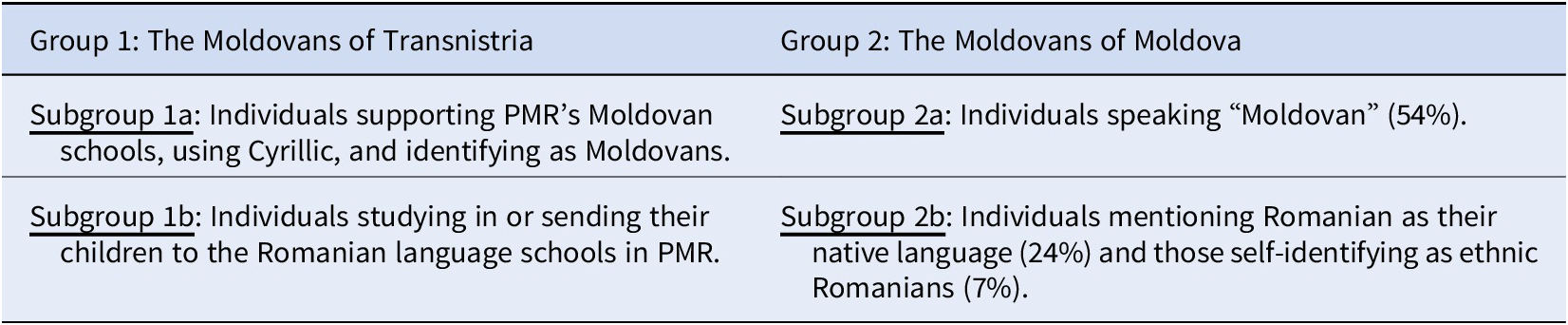
In order to explore in a neutral manner the construction of the Moldovan identity in PMR, in Table 1, I differentiate between two broad and volatile groups of Moldovans—the Moldovans of Transnistria (Group 1) and the Moldovans living on the right bank of the Nistru river (Group 2).
A fourfold typology of Moldovans using language data from the 2014 census.

Of interest here are the Moldovans of Transnistria. Since 1990, members of this group have been subjected to a set of cultural, linguistic, and educational policies designed by the parastate. The Moldovans of Transnistria can be further subdivided into those educated in the PMR-sponsored schools (Subgroup 1a) and those Moldovans, who send their children to the Romanian language schools supported by the Moldovan and Romanian governments (Subgroup 1b). The Moldovans studying in the PMR-sponsored schools use Cyrillic and study officially the Moldovan language as well as the history of the PMR and Russia. The second group of Moldovans in Transnistria, linked to the Romanian language schools, follows a curriculum which includes Romanian history, language, and literature based on textbooks often brought directly from Romania. Their school curriculum is identical to that used by their peers in Moldova.Footnote 5
Similarly, using the 2014 census results, the Moldovans of Moldova can be divided into two linguistic subgroups.Footnote 6 Subgroup 2a encompasses individuals who state that they speak a distinct Moldovan language (54%). Frequently, members of this group much like the members of Subgroup 1a in Transnistria perpetuate the Soviet-era version of Moldovan identity, express strong pro-Russian views, receive massive political support from a multiethnic coalition consisting of Russians, Ukrainians, Gagauz, and Bulgarians. Activist members of this group seek to de-Romanianize the history and language curriculum. Members of this subgroup share many characteristics with Subgroup 1a from Transnistria.
By contrast, Subgroup 2b includes those declaring that they speak Romanian, roughly 24% of the population. This group of more Romanianized Moldovans frequently consider Moldovans and Romanians as belonging to the same ethnic group bound by a common fate currently linked to Moldova’s accession to the European Union (EU). Members of this subgroup drafted Moldova’s Declaration of Independence back in 1991.Footnote 7 Within this subgroup one can also identify a minority, which opts for the reunification of Moldova and Romania following the German model as the shortest path to EU membership.
The two groups overlap only partially with the corresponding ethnic categories. Seven percent of the population of Moldova self-identifies as ethnic Romanian (up from 2% in 2004) and 75% declares Moldovan as their ethnicity (National Bureau of Statistics 2018). It follows then that roughly 15% of those self-identifying as ethnic Moldovans declare that they speak Romanian. This rudimentary and incomplete typology cannot account for multiple identities. It does not include the language preferences of individuals belonging to other ethnic groups (i.e. Russians, Ukrainians, Bulgarians, and Gagauz), of those ethnic Moldovans speaking mostly Russian, and of individuals speaking multiple languages. Despite its obvious shortcomings, it is analytically useful to distinguish between these two large groups of Moldovans. From census to census, their size varies pointing to the profound transformations in cultural self-identification in Moldova. Once in power, parties representing each of the two major subgroups have carried out divergent cultural policies advancing distinct conceptions of Moldova’s national identity.
Furthermore, the politicization of the Moldovan identity reveals the quandaries of external assignment and individual choice of ethnic categories as well as the futility of primordialist conceptions of nationhood. To protect the imaginary boundaries between the Moldovans in Transnistria (Subgroup 1a) and those in Moldova (Subgroup 2a), PMR elites embraced Moldovenism, the Soviet era theory claiming that Moldovans and Romanians form two separate ethnic groups speaking distinct languages.Footnote 8 Of course, under certain circumstances, personal choice influences ethnic assignation more than governmental policies (Chandra Reference Chandra2012, 116). Aware that Moldovan parents choosing to send their children to the Romanian schools may trigger a switch in the ethnic self-identification of the whole group, the parastate harasses these schools.
To uphold the forced division of Moldovan from Romanian, the parastate bans the use of the Latin script on its territory. Despite the constitutional equality of the three official languages and the guaranteed freedom to choose the language of communication, Article 6 of PMR’s Language Law states that attempts to replace Cyrillic will be prosecuted. Moreover, Article 30 of the same law entitled Research on the Language of the Moldovan People mentions that the parastate will provide the necessary cadres to study Moldovan ethnicity, culture, traditions, and the century-long history of the Moldovan language based on the Cyrillic script (Language Law of PMR 1992). The law imposes high costs on anyone advocating changes of the existing language policy. At the same time, the Language Law requires that schools offer instruction in a second official language. Thus, PMR’s Russian schools should offer classes in Moldovan and Ukrainian. Despite some laudable efforts to promote trilingualism, the parastate suffers from a chronic deficit of qualified teachers and lack of modern instructional materials.
To address such problems, Moldovans would have to have a greater say in the distribution of PMR’s budgetary resources. But they are underrepresented among the Transnistrian political elites. From 1990 to 2010, 23% of the Supreme Soviet members were Moldovans, whereas non-Moldovans constituted 77% (Protsyk Reference Protsyk2009, 262). Over time, the number of Moldovan members of parliament (MPs) declined further. My analysis of the ethnic background of Transnistria’s MPs revealed that in 2018 only 10% of them self-identified as Moldovans. The debates in the Supreme Soviet, the governmental meetings, and the presidential televised addresses are conducted solely in Russian. Powerless and voiceless, the Transnistrian Moldovans resemble the subaltern from the colonialism scholarship.
Constructing the Moldovan Ethnicity in the PMR Media
The invention of the printing press and the modern means of mass communication contributed to the emergence of strong national identities (Deutsch Reference Deutsch1959; Anderson Reference Anderson1991). In addition to that, the media shapes collective perceptions of certain ethnic groups. Even though the parastate relies on its official media to propagate discourses about Moldovans and the Transnistrian identity, scholars have largely ignored the PMR media landscape. To identify the ways in which they are portrayed in the media, I have examined the current state-sponsored print and broadcast media outlets.
Moldovans’ access to print media in their native language is highly rationed. There is no alternative to the official Adevărul Nistrean (The Transnistrian Truth) weekly. Under the motto “Moldovans, preserve your language!” Adevărul Nistrean remains the only Romanian/Moldovan language publication in the world edited in Cyrillic script. Serghei Sandu (Reference Sandu2016), the editor in chief and the president of PMR’s Union of Moldovans, notes that since its founding in 1994, the weekly has expanded from four to 16 pages. As of November 2017, it had a modest circulation of 1500 copies and an online edition (Pervyĭ Pridnestrovskiĭ 2017).Footnote 9 The weekly publishes commentaries and news reports on domestic and international affairs, economy, social issues, culture, and sport. Despite the official statements about the preservation of a true Moldovan identity, the bias and modest readership of Adevărul Nistrean raise knotty questions regarding the civicness of the Transnistrian identity.
By contrast, the parastate invests more resources in the public broadcast media. As of June 2018, Pervyĭ Pridnestrovskiĭ, the official TV channel of PMR, was airing four programs targeting the Moldovan audience: (1) the weekly Emisiunea Ta (Your Show) broadcast since 2012, (2) the daily news report Evenimente (Events) since 2013, (3) La Popas (At Rest) since 2017, and (4) Tradiții Care Ne Unesc (Traditions That Unite Us) since March 2016. Evenimente covers daily events. Most of its content, with rare exceptions, is initially produced for the extensive Russian-language news bulletin—Sobytii͡a and then dubbed for Evenimente. La Popas and Tradiții create original content, focusing mostly on Moldovan cultural traditions, art, historical, and educational issues. Private broadcasters provide all their content in Russian. Despite PMR’s efforts to block access to certain websites and jam radio and TV signals from Moldova, it would be an exaggeration to assert that its population lives under an informational blockade. Numerous residents gain access to alternative sources of information via satellite dishes, Internet, or by travelling to the right bank. Given the dearth of media for Moldovans, it would not be much of a stretch to assume that they function as poorly informed members of the political community.
To clarify the construction of the Moldovan ethnic identity by PMR, I analyze the content of Emisiunea Ta. Two reasons stand behind this choice. First, the show, unlike Traditions and At Rest, reports on a wide range of issues, going beyond culture. Second, all editions can be accessed online, which is not the case with the other two programs. To ensure a random selection of the audio-visual media content, I adopt a basic probability sampling design and capture, from the complete Youtube archive of Emisiunea Ta, each third show televised between 2015 and 2017. Even though the official description of Emisiunea Ta emphasizes that the program is “outside politics,” a critical analysis of its content reveals that it fabricates a distorted image of Transnistria’s Moldovans as exclusively folklore enthusiasts, largely absent as a community from Transnistria’s collective memory.
Folklorizing the Moldovan Identity
Emisiunea Ta presents Moldovans as exclusively interested in preserving their folklore. Local enthusiasts form ensembles, vow to keep the ancestral folk songs alive, and pass them on to the next generation. The aspiration to transfer cultural content across generations may prove quixotic. As urbanization continues in Transnistria, the rural youth leave the countryside and move into the heavily Russified urban areas, where they lose the necessary linguistic competence to access the oral traditions. That is why Moldovan ethnocultural practices survive in PMR’s villages, where the parastate’s reach is relatively weak. Some of the folk songs interpreted by these Moldovan ensembles can be traced to pre-Soviet times. The representation of Moldovans in the PMR media as eager to preserve their rural cultural customs should not be equated with an incipient manifestation of ethnic nationalism. Neither does this constitute a full-fledged folkloric movement like the one thriving in the 1980s in Moldova (Cash Reference Cash2007, 588–589).
Given the prevalence of Soviet nostalgia in the region, the excessive emphasis on folklore among the Moldovan population could be regarded as a symbolic rejection of the high Russian culture, a mild form of cultural resistance from below. Such assertions are substantiated by the amateur musicians themselves. For instance, the ethnographic collective Busuioc (basil) from the Moldovan village of Speia (Grigoriopol) was established in the late 2000s. According to its founder, Lyubov Zavtur, the name Busuioc was chosen, because “basil is a beautiful plant, which, used with holy water, purifies our souls and homes” (Emisiunea Ta 2015). In the Soviet-era House of Culture, the villagers rehearse and “take care of their souls” as one of them notes (Emisiunea Ta 2015). The origins of some of the folk ballads interpreted in Transnistria—“Smărăndița din zăvoi” (Smarandita in the meadow), “M-a trimis mama la vie” (Mom sent me to the vineyard)—can be located in distant regions of Romania. Nina Kozhuhari, inadvertently remarks that in contrast to the February 23 and May 9 chants “our songs give us energy and power” (Emisiunea Ta 2015). Another member of the collective expresses great pride in wearing the traditional folk clothes, bought in the late 1980s in Chișinău. In all, the mediatized performances of the folklore ensembles function as collective cultural rituals largely forgotten in PMR’s urban settings.
Such stereotypical media framing impacts the way Moldovans perceive themselves and society’s evaluation of the group. Interested primarily in policing the boundaries of the Moldovan category, the parastate loads it with content as well. Folkloric traditions feature as the conventional cultural filling of this ethnic group. In Emisiunea Ta, Moldovans perform pastoral and agricultural traditions, discuss their significance, worry about the lack of language instructors, recite poems, attend lectures and conferences about the uniqueness of their culture, meet local Moldovan writers, and hope to convey their cultural heritage to the next generation. Their occasional disloyal statements vis-à-vis the unrecognized republic are left unedited by journalists, who either miss them or knowingly ignore them as the naive utterances of Transnistria’s “hillbillies.” The distorted depiction of this ethnic group exclusively as folklore lovers illustrates tokenism at work in a multiethnic context, where three television shows figure as the Moldovans’ only public voice on television as well as their only cultural contribution through television.
A Nostalgic Unified Memory Regime
Collective memory and amnesia both impact group identities, regime legitimacy, and post-conflict reconciliation. Rituals, monuments, and annual commemorations feature as physical expressions of collective memory nurturing the feeling of belonging to a community of fate. In Transnistria, nostalgic sentiments for the Soviet and imperial past are publicized through media and urban landscaping. Catalogued as the largest museum of Communism in Eastern Europe, PMR seems frozen in the past. It preserved the Soviet memorials, street names, and rituals. Aside from creating a sense of uninterrupted historical flow, these symbols prop up a truth regime, which marginalizes excludes from the mediated memorialization process the Moldovans as a cultural community.
The Transnistrian elites appearing in Emisiunea Ta hold a cohesive view of the Soviet past. If one were to apply the concept of memory regimes proposed by Kubik and Bernhard (Reference Kubik and Bernhard2014), then PMR’s memory regime could be safely classified as unified. While in Moldova, the elites are divided over the legacy of the Soviet epoch as well as over who and what should be remembered, in PMR, officials praise in unison the glory of the Soviet times. The Communist revolutions of 1989 evidently bypassed this corner of Europe. Defended as the only true vision of history, the past evoked in PMR is juxtaposed to the “deviant” historical debates within the parent-state and aligned to the remembrance practices in the Russian Federation.
The “us vs. them” logic permeates the media discourse about history. PMR’s past is one of struggle, presented in Emisiunea Ta as an imaginary clash between “us”—the multiethnic and tolerant Transnistrians/the hard-working Soviet people/the Bolsheviks/the inheritors of the Tsarist Empire and “them”—the threatening Others/the Moldovan nationalists/the decadent West/the royal bourgeois Romania/the Romanian occupiers. Unsurprisingly, the parastate’s regular calls for mobilization against imaginary threats emanating from Moldova and Romania draw their inspiration from this conflict-ridden, idealized narrative of the past. Alternative, more reconciliatory, historical accounts are absent in the official media.
The formation of two divergent memory regimes in PMR and right-bank Moldova is the result of the protracted political conflict. Besides the insertion of major Christian celebrations based on the Julian Orthodox calendar and the memorialization of key local events, the nostalgic PMR elites preserved most of the Soviet holidays. This might not be immediately obvious if one compares the official holiday calendars across the region. The New Year, Christmas, Easter, Easter of the Dead, International Women’s Day, International Workers’ Day, Victory Day figure as public holidays in Moldova, PMR, Russia, and Ukraine. Despite this partial overlap, holiday calendars in PMR and Moldova diverge with regards to post-Soviet events. Moldova’s Independence Day (August 27) and Language Day (August 31) are ignored in Transnistria. Instead, Transnistria celebrates its own Independence Day (September 2), the Defendant of the Fatherland Day (February 23), and the October Revolution (November 7).
The growing identification with the Russkiĭ Mir is best symbolized by two recent additions to the commemoration schedule. In 2017, PMR’s president added Russia Day (June 12) and the Day of Mass Resistance against Moldova’s Aggression (March 2) to its official roster. In 2017 and 2018, a series of pompous events were organized on Russia Day. No trace of political loyalty toward Moldova seeped through the public speeches held on that occasion. On the contrary, impressive displays of loyalty to the external patron abounded. Transnistria’s public institutions hoisted the Russian flag. A large group of participants, including some dressed in Moldovan and Ukrainian folk costumes, carried an immense Russian tricolor on Lenin Boulevard, Tiraspol’s main avenue. Reporting on the 2017 Russia Day celebrations, the news anchor of Evenimente (2017) delivered an unequivocal statement regarding Transnistria’s relationship with Russia: “We are part of one great country. Russia has never abandoned us. It has always helped and backed us.”
World War II occupies the central symbolic place in the memory landscape of the parastate. The rituals of remembrance on Victory Day are synchronized with those in Russia. Since 2014, the Bessmertnyĭ Polk (the Immortal Regiment) marches take place in most of Transnistria’s urban centers. And since 2016, the Russian forces and peacekeepers stationed in the region participate in the annual Victory Day parade in downtown Tiraspol. The commemoration of Transnistria’s Independence Day is equally remarkable. In contrast to the conspicuous absence, up until 2011, of a military parade on Moldova’s Independence Day (the 2001 parade being the exception to the rule), the spectacle organized on Transnistria’s Independence Day projects its significant military strength. In terms of the number of tanks and air power, PMR’s army already surpasses Moldova’s military. It remains a matter of speculation whether the constitutionally neutral Moldovan state could resist an eventual attack launched by the more militarized Transnistria.
Other local events are commemorated too. Associations of veterans, unions of PMR defenders and their families, and historical societies honor annually those who died in 1992. On August 1, the Immortal Regiment of Transnistria brings together the veterans of the 1992 war. Emisiunea Ta (2017) included a segment dedicated to the formation of the first revolutionary Soviet in the region in March 1917. According to this report, in January 1918, the royal Romanian army crushed the revolutionary Bolshevik forces in Bender (Tighina), a railroad hub on the right bank of Nistru, currently under PMR’s jurisdiction. The city changed hands multiple times until the Romanian army gained control over it.Footnote 10 Interviewed for Emisiunea Ta (2017), Svetlana Ladygina, whose grandparents worked on the railroad, recounted their stories about how the Romanian army executed every tenth railroad worker in order to quell the Bolshevik resistance. Her grandfather crossed the river, became an underground activist, and participated in the Bender rebellion of 1919, another event rarely mentioned in Moldovan and Romanian history textbooks. Each year, Emisiunea Ta reports on PMR’s railroad workers laying flowers at the Black Wall memorial built in 1969 on the site of the executions.
Negative references to Romania and Romanians proliferate in Emisiunea Ta. Romania’s alliance with Nazi Germany during World War II and its participation in the Holocaust, in particular the deportation of the Jewish and Roma population to Transnistria, are recurring themes. Other two frames center on Romania’s involvement in the 1992 war and its support for the Romanian schools in PMR. Furthermore, politicians and individuals in Moldova identifying as Romanians (Subgroup 2b) are branded as fascists and Nazis. The endurance of such negative media reporting reflects, among other things, the deep-seated fears among the PMR elites of the potential Romanization of the Moldovan identity and the possible (re)unification of Moldova and Romania. Such anxieties are not new, they have been documented during the early days of the parastate (King Reference King2001, 534). Notwithstanding the unfavorable media framing, the PMR officials readily welcome Romanian firms investing in the region (Chamberlain-Creanga, Reference Chamberlain-Creangă2011).
While the PMR dreams of becoming part of Russia, historical figures from different eras share the same urban spaces. Alexander Suvorov, the founder of Tiraspol and defender of the Tsarist imperial border against the Ottoman Empire in 1792, appears as the key historical personality of the region. His 1979 equestrian statue in Tiraspol, depicted on the Transnistrian rouble, faces Moldova. Suvorov’s presence in the vicinity of Lenin’s statue and across the street from the Afghanistan War Memorial proves that Transnistria in an effort to reconcile the Soviet and Tsarist imperial pasts venerates both.
Population Trends: The Disappearing Ethnic Moldovans and Ukrainians?
Much like sovereign states, unrecognized states conduct censuses to collect information about the population living in their territory. In ethnically diverse societies, the state uses the official count to get accurate information about the cultural makeup of the population. But a census is never a neutral accounting exercise. It may assign individuals to certain racial, ethnic, and linguistic categories, which may be artificial. At the same time, a census may purposefully exclude inconvenient ethnic identifications. France avoids collecting ethnic and racial statistics in order to prevent the ethnicization and racialization of the society (Simon Reference Simon2008, 8–10). Consequently, census outcomes in diverse societies carry wide-ranging implications for the design of appropriate cultural policies.
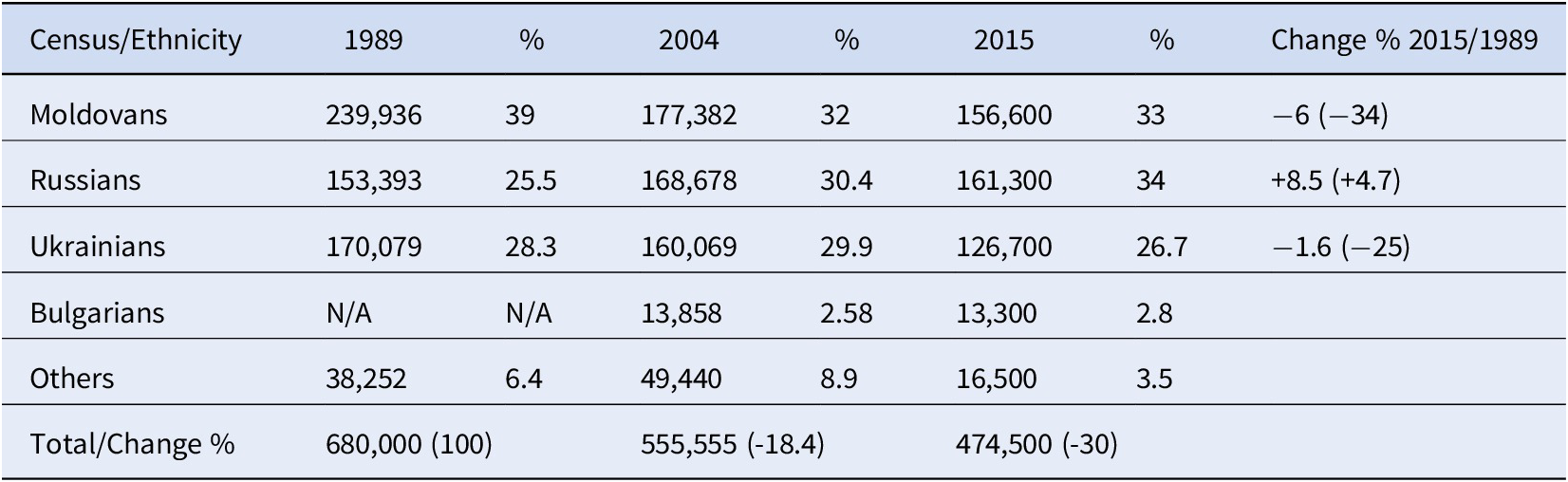
So far, the PMR has conducted general censuses in 1989, 2004, and 2015. The data in Table 2 indicate that the parastate faces a veritable demographic crisis. After 1989, its population has constantly decreased. From 1989 to 2015, the parastate’s population shrank by 30%—from 680,000 to 474,500 inhabitants. Over the last decade only, the region’s population has dropped by 18.4%. Given the dismal economic situation of the region, this trend is likely to continue.
The Major Ethnic Groups of Transnistria, 1989–2015.

Source: Compiled by author using data from the last census and the 2016 Annual Yearbook of Transnistria.
The downward demographic shift varies across ethnic groups. Undoubtedly, the major revelation of the 2015 census is that, for the first time in PMR’s history, Russians became the largest ethnic group. Over the last 30 years, the population share of those identifying as ethnic Russians went up by 8.5%. Compared to 1989, the number of individuals identifying as ethnic Moldovans in PMR declined by 34% and, respectively, by 25% in the case of Ukrainians. In 2015 compared to 2004, the Ukrainian population declined from 160,069 to 126,700 residents. If this tendency lasts, Ukrainian ethnics will experience the fastest population decline in the region.
How accurate and reliable are the 2015 census data? Two aspects are worth mentioning. First, there is the open-ended question on ethnic self-identification on the census form. The parastate did not provide a list of ethnic categories for respondents to choose from. Although we do not know what instructions the census workers received, it seems that the authorities did not constrain individuals to identify as ethnic Russians. Second, it is not clear whether politically sensitive ethnic categories such as Romanian were filtered out during the data processing stage or merged with the Moldovan ethnic category. The same goes for the hybrid Transnistrian category. In 2015, more than 1000 individuals declared Transnistrian as their ethnicity. This may signal either confusion among respondents, or evidence of the emergence of a new borderland identity. Likewise, respondents of mixed ethnic backgrounds were not provided an opportunity to choose a hybrid identity or membership in several ethnic groups. This leads us to conjecture that the census might have constrained individuals from mixed families to pick one identity over another. Given the 14% rate of nonresponses to the ethnic question (Tini͡aev Reference Tini͡aev2017), the census data should be interpreted carefully.
How can we explain the shift in self-identification observed in the PMR? Cultural assimilation may be one reason for the uneven population decline across ethnic groups. The growing use of Russian in the educational system and public sphere may have led certain individuals to perceive the Russian culture and ethnicity as superior to their own prompting a switch in ethnic self-identification. PMR’s melting pot society would then go hand in hand with urbanization. Seventy percent of the parastate’s population resides in urban areas, whereas ethnic Moldovans and Ukrainians mostly populate the countryside with limited upward mobility opportunities. The cultural adaptation takes place after Moldovans and Ukrainians move to urban areas, where they interact closely with the Russian-speaking population, enroll their children at Russian language schools, and learn new cultural repertoires.
Economic outmigration may be another cause of the uneven demographic changes across ethnic groups. It might be that Moldovans and Ukrainians, unable to identify employment opportunities, leave the parastate in greater numbers than PMR’s ethnic Russians. After the visa-free travel agreements with the European Union were signed, holders of Moldovan and Ukrainian passports gained easier access to the EU job market. Holders of Russian passports may find it more difficult to identify lucrative openings in the resource-dependent economy of the patron-state. Still, the absence of career prospects for Moldovans and Ukrainians in PMR may be itself an indicator of the inequality of opportunity faced by the three ethnocultural groups.
Cuius Regio, Eius Lingua?
Nation-building policies inevitably focus on the language of instruction as one of the factors shaping identity. Language, an essential marker of identity, provides access to one’s cultural heritage. One agrees with Ernest Gellner (Reference Gellner2008, 34), who maintains that a proper elucidation of nation-building must consider a state’s monopoly on legitimate education as more important than its monopoly on legitimate violence. Officially, PMR provides free school instruction in three languages—Moldovan, Ukrainian, and Russian. In fact, from kindergarten to high school, education is conducted mostly in Russian. Relying on a curriculum largely harmonized with the educational policies of the Russian Federation, the parastate shapes the worldview of the next generation of Transnistrians through its school system.
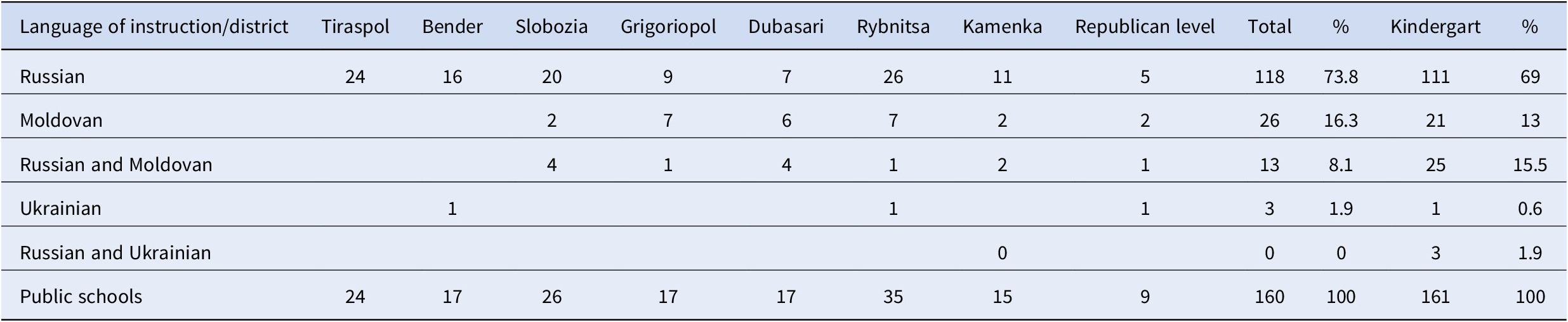
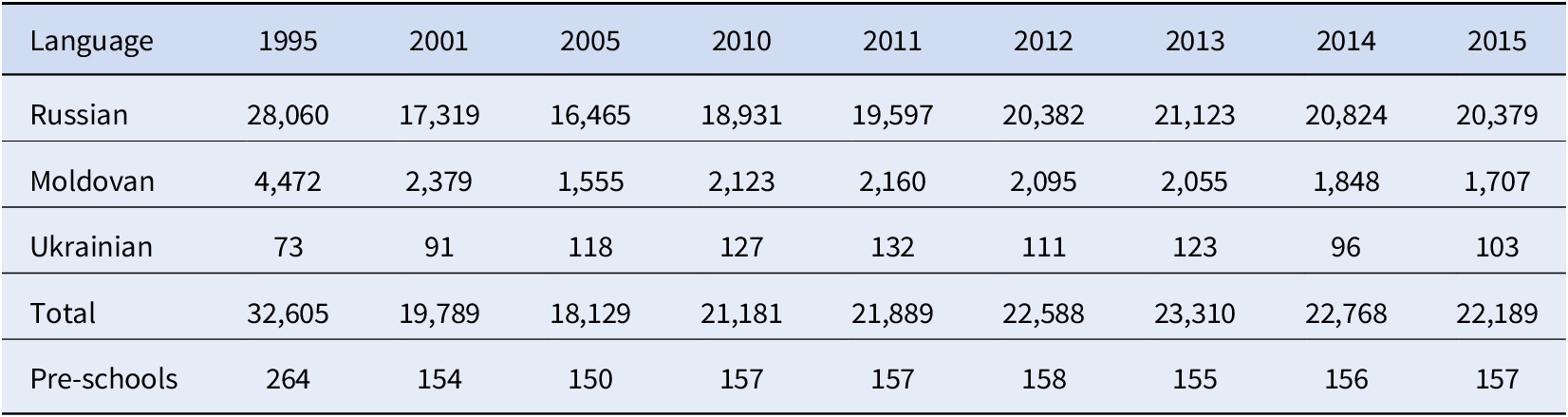
Table 3 displays recent data on the language of instruction in PMR’s school system. Of the 160 schools operating across Transnistria’s seven districts during the 2017–2018 academic year, in 118 (74%) schools teaching was done exclusively in Russian, while in 26 (16%) instruction was in Moldovan. At the pre-school level, 69% of kindergartens use Russian and only 13% Moldovan. Over the last two decades, the number of children enrolled in the Moldovan kindergartens has dropped faster than in the Russian ones (see Table 4).
The Number of Schools Per Each Language Group in PMR, 2017–2018.
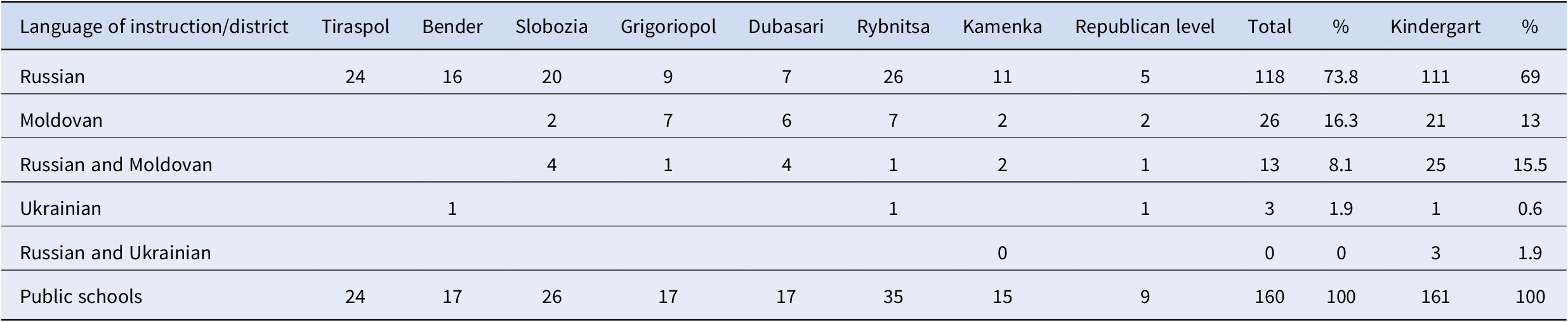
Source: Compiled by author based on data published by the PMR Ministry of Education and the Annual Statistical Yearbook.
The number of pre-school children per language group, 1995–2015.
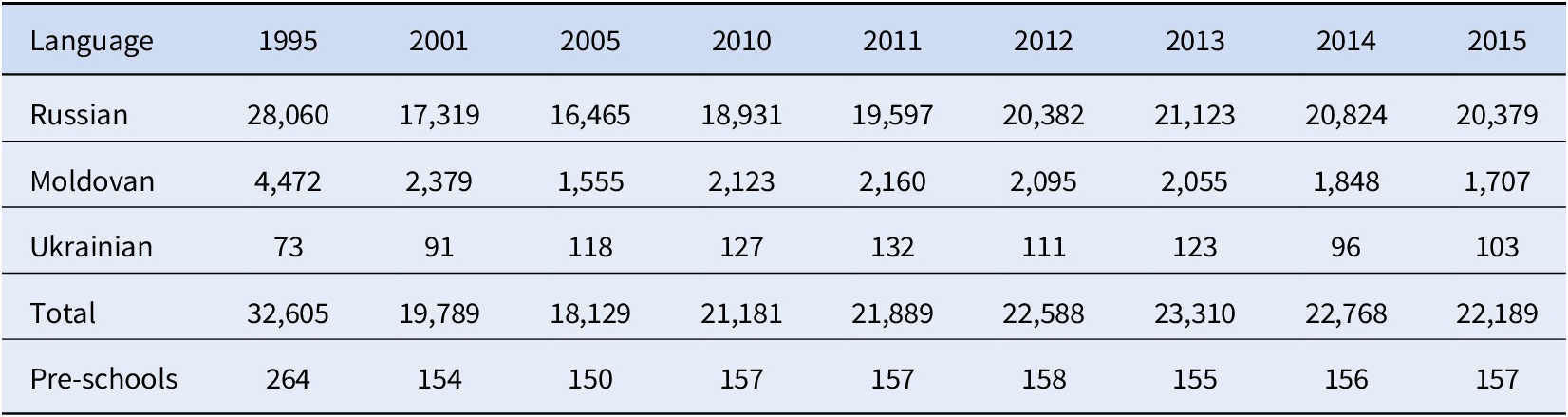
Source: Compiled by author using data from the 2006–2016 Annual Statistical Yearbooks of Transnistria.
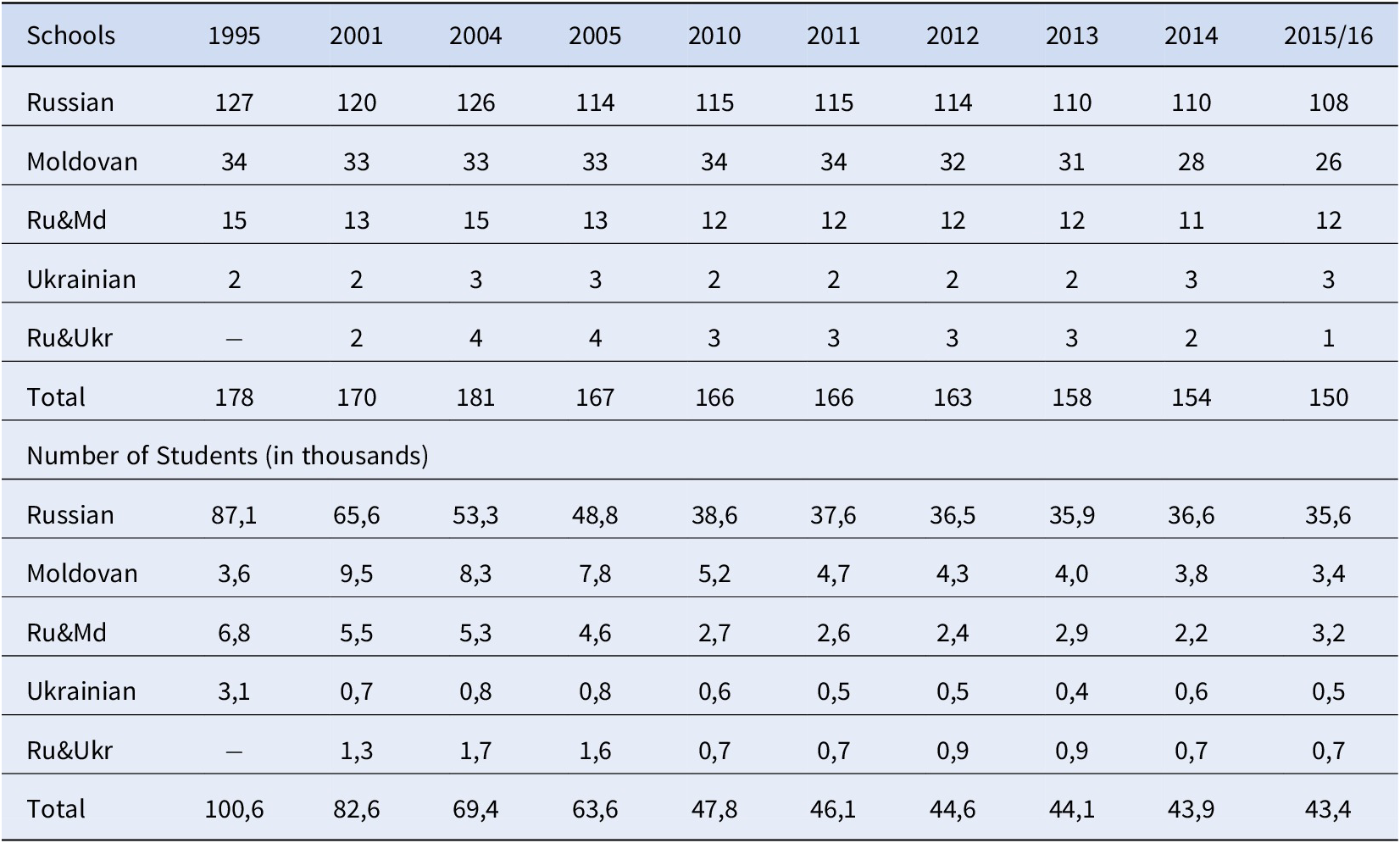
The student population shrinks too. Overall, we observe that the number of schools in PMR has declined from 178 in 1995 to 150 in 2016 ( Table 5). In 2016 compared to 1995, 60% fewer students enrolled in the Russian schools. Since 1995, eight Moldovan schools out of 34 were shut down. Equally worrisome, over the last 15 years, enrollments in the Moldovan schools dropped by 64%, while the number of pupils in the Ukrainian language schools contracted by 53%.
The Number of Schools and Students Per Language Group, 1995–2016.
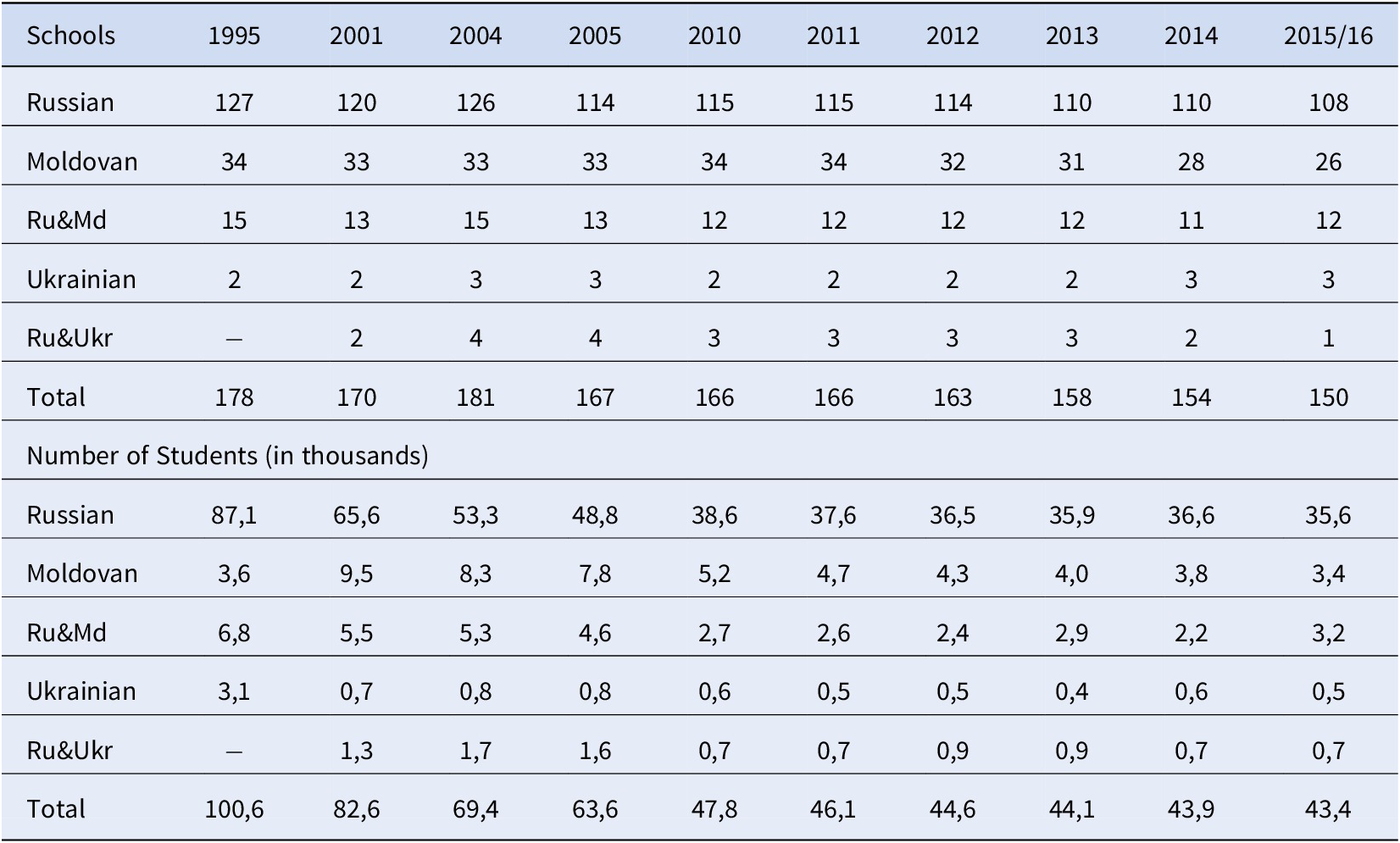
Source: Compiled by author based on data from the Statistical Yearbooks of PMR for 2015 (page 47) and 2016 (page 56).
In addition to the monolingual schools, the PMR operates mixed Russian-Moldovan schools (12) and kindergartens (25), in which both languages are being used. On paper, the situation resembles the embodiment of true multiculturalism, but, in reality, interpreting the decrease of students enrolled in mixed schools might be misleading. PMR’s high-ranking education officials admit that during the 2001–2005 period, most of the students in the mixed Russian-Moldovan and Russian-Ukrainian schools were instructed in Russian (Nikiforova Reference Nikiforova2008). Out of the 5261 students enrolled in the 15 Russian-Moldovan schools during the 2004–2005 school year, 3682 (70%) were instructed in Russian and 1579 (30%)—in Moldovan (Nikiforova Reference Nikiforova2008).
The analysis of the most recent educational data suggests that instruction in Ukrainian is nearly extinct. Thus, while the 2015 census recorded the presence of 126,900 ethnic Ukrainians (22.9%), merely 1.2% of all students were taught in Ukrainian. In 2016, only 103 preschoolers were instructed in Ukrainian. Currently, a total of 533 pupils attend classes in Ukrainian. As for the Russian-Ukrainian schools, during the 2004–2005 academic year, out of 1677 students enrolled in the four Russian-Ukrainian schools, only 112 (7%) took classes taught in Ukrainian (Nikiforova Reference Nikiforova2008). Ironically, even though PMR’s state university is named after Taras Shevchenko, Ukraine’s national poet, graduates of Ukrainian and Moldovan schools cannot pursue college education in their native language except for select pedagogical and philological specializations.
Language does not figure as the main marker of the Ukrainian ethnic identity in PMR. Individuals, who self-identify as ethnic Ukrainians, speak mostly Russian. In this regard, the assimilated Russian-speaking ethnic Ukrainians in Transnistria bear striking similarities with the Russian-speaking ethnic Ukrainians in Ukraine, who indicate Ukrainian as their ethnicity on census questionnaires. This discrepancy between ethno-cultural identification and language use has been thoroughly documented in Ukraine (Kulyk Reference Kulyk, Kotkin and Beissinger2014, 210–221). Studying similar developments in Stalin’s Soviet Union, Yekelchyk (Reference Yekelchyk2007, 174–175) noted that “linguistic assimilation did not prevent the assimilated Russian-speaking Ukrainians from associating themselves with Ukraine’s history and culture.” In retrospect, such optimism was unwarranted. In 2014, the Russian-speaking Ukrainians living in Eastern Ukraine and Crimea were not as willing as the Ukrainian-speakers in the West to defend their country against Russia.Footnote 11 While studies about the Russian-speaking Moldovans in PMR and Moldova are missing, the Ukrainian example illustrates how linguistic assimilation precedes and proceeds faster than ethnic identity change.
Despite its influence over the educational discourse, the Transnistrian parastate has failed to establish a total educational monopoly. In parallel with the official school system, eight schools known as the Romanian schools operate as private entities under Moldova’s jurisdiction.Footnote 12 These schools, in contrast to the PMR schools, use the Latin script, teach Romanian language, literature, and history, follow the curriculum and textbooks approved by the Ministry of Education in Chişinău. In the mid-1990s, these schools used standard history textbooks brought from Romania, which the PMR authorities sought to replace with history textbooks from the Soviet period (Benea Reference Benea2014). Unlike the PMR schools, the Romanian language schools use the one to ten marking system aligned with the Moldovan grading standards. Attending these schools carries significant risks. Ion Iovcev, the principal of the Lucian Blaga high school in Tiraspol, recalls how unidentified vandals spray painted—“terrorist nest” and “killers are being groomed here”—on the school walls (Benea Reference Benea2014). The only official PMR-approved Moldovan high school in Tiraspol is, in the meantime, modernized by the Russian Federation.
Rather than shutting the Romanian schools down, the parastate uses these schools as a bargaining chip in negotiations with Moldova, extracting concessions in other policy areas. To that end its monopoly of legitimate violence backs up its homogenizing cultural policies. After Moldova’s president Vladimir Voronin, pressed by street protests and the West, rejected Russia’s 2003 conflict resolution plan—the Kozak Memorandum—the parastate attempted to forcibly close the schools. Steven Roper (Reference Roper2005, 502–505) attests that “after the failure of the Kozak Memorandum, the Supreme Soviet urged the Transnistrian Ministry of Education to close seven schools that studied the Romanian language in Transnistria enrolling approximately 5,000 students.” Schools’ property was vandalized and confiscated; their rental agreements with the local authorities were arbitrarily terminated. In justifying their actions, the Transnistrian officials claimed that “the Romanian language creates an artificial Moldovan/Romanian identity” (Roper Reference Roper2005, 511). Such assertions indicate that the PMR elites understand that the language of instruction shapes ethnic identity formation. It is remarkable that in 2012, the Romanian schools successfully sued the Russian Federation at the European Court of Human Rights (ECHR) for violating the right to education of 170 children (Comai and Venturi Reference Comai and Venturi2015, 894). The positive ECHR ruling in that case confirms that the parastate, despite its complete monopoly on physical violence, cannot coerce PMR’s Moldovans to accept its educational jurisdiction and policies.
PMR’s Presidents and the Transnistrian Identity
In PMR, the president at the helm of the bureaucratic and coercive apparatus plays the main part in the politics of the de facto state. Unlike Abkhazia, where the president is required by the Constitution to be an ethnic Abkhaz (Clogg Reference Clogg2008), Transnistria’s body of law lacks provisions concerning the ethnicity of the top officeholder. None of PMR’s three presidents—Igor Smirnov (1990–2011), Evgeny Shevchuk (2011–2016), and Vadim Krasnosel’skiĭ (2016–present)—belonged to the Moldovan group. They could not communicate with the Moldovan constituents in their native language. While Smirnov’s political speeches adapted the internationalist Soviet templates, Krasnosel’skiĭ’s political discourse includes frequent references to the Russkiĭ Mir. All PMR’s presidents, in times of heightened tensions with Moldova, spoke in favor of a supraethnic Transnistrian identity, while depicting the Moldovans across the Nistru River as the archenemy of the unrecognized state. Each of them called regularly on Russia to annex formally the parastate (see Table 6). Thus, PMR’s presidents, eager to emphasize the parastate’s declarative sovereignty in relation to Moldova, are willing to easily abandon its sovereignty in relation to Russia.
The PMR Presidents and Their Political Discourse.

How did PMR’s presidents view the Moldovans of Transnistria? Igor Smirnov, the founding father and the longest-serving president, expressed the most radical statements about Moldovans. The former Communist Party member and factory director became politically active in the late 1980s blaming Moldova for triggering the 1992 conflict. Anna Volkova (Reference Volkova2001), Smirnov’s biographer and a secessionist activist in the late 1980s, observes that Smirnov was among the first to organize the industrial workers against “the rise of Romanian nationalism” in Chișinău. Obviously, Volkova’s assertions are questionable. What she calls “Romanian nationalism” was in fact the rise of the Popular Front, a movement with nationalistic overtones emphasizing the Romanianness of the Moldovan identity (Subgroup 2b) and inspiring Moldova’s independence in 1991. In his ghostwritten book Together with Russia, Smirnov (Reference Smirnov2007) notes that the birth of the parastate—a splinter of the Soviet state—resulted from the resistance movement against “the brutal nationalists [emphasis added] ready to kill or beat anyone deemed as the enemy of the Moldovan nation.” During his long tenure, Smirnov painted both Moldova and the West as the major threats to PMR’s independence.
Unexpectedly, Evgeniĭ Shevchuk, a younger and more modern president, won the 2011 elections running against Smirnov’s preferred candidate—Anatoly Kaminsky. An ethnic Ukrainian, Shevchuk has studied in Ukraine and was not burdened by the Soviet legacy. He expressed mild views about the place of the Moldovans in the Transnistrian identity project. Shevchuk (Reference Shevchuk2013), noting that most Transnistrians can communicate in all three official languages, emphasized the role of Russian as the unifying factor in the society. Shevchuk advocated for PMR’s participation in the projects of the Eurasian Economic Union and PMR’s reunification with Russia. He lost the 2016 presidential elections to Vadim Krasnosel’skiĭ, backed by the Sheriff conglomerate and by PMR’s first president. Krasnosel’skiĭ, a former Minister of Interior (2007–2012), launched a series of anti-corruption investigations against Shevchuk, putting the blame for the precarious economic situation on his predecessor’s corrupt schemes. Surprisingly, Shevchuk fled incognito to Moldova and from there to Moscow, where he remains to the present day. In approaching the problem of nation-building, Krasnosel’skiĭ, compared to both of his predecessors, exhibits more historical sophistication. The abundant references to Russkiĭ Mir and analogies to events in Russian history are deeply embedded in his political discourses. To support his claims about Transnistria’s belonging to the Russkiĭ Mir, Krasnosel’skiĭ has regularly referred to the 2006 referendum, in which 98% of the participants voted in favor of the region’s integration into Russia rather than reintegration into Moldova. Moreover, Krasnosel’skiĭ (Izvestia.ru Reference Krasnosel’skiĭ2017) considers that a Transnistrian nation has already formed:
We have preserved the Transnistrian people, consolidated it, and increased its numbers. That is why we talk about the birth of a Transnistrian nation [emphasis added]. Living in the Russkiĭ Mir, we always wanted peace with our neighbors. Russians, Ukrainians, Moldovans, Bulgarians, Jews, Poles, they are all members of the Transnistrian people. […] Igor Dodon (i.e. the current president of Moldova) talks about the federalization of the country. But that is impossible. We have the will of the people in favor of political independence and the reunification with Russia [emphasis added].
The new “normal” political discourse of PMR’s president ties the idea of interethnic peace to Russkiĭ Mir and the subsequent political integration of the parastate into Russia. His statements about an increasing population obfuscate the looming demographic crisis (see Table 2). The repeated claim that a Transnistrian nation has already been born expresses the aspiration of the local elites to construct an impermanent, regional identity, which would legitimize, in their view, the provisional functioning of the parastate until its projected annexation by the patron-state. Despite the completion of a series of confidence-building measures agreed upon in Berlin in 2016, the PMR president rejects any conflict resolution plans, even when they originate from like-minded politicians such as Moldova’s sitting president, Igor Dodon, a member of the conservative Izborskiĭ Klub and a committed supporter of Moldovenism, Neoeurasianism, and Russkiĭ Mir.
Krasnosel’skiĭ’s discourse reveals the role of coercive external ascription in reducing the menu of available ethnicities in PMR. He vehemently denies the presence of the Romanian language and ethnics in the region. Furthermore, discussions about the introduction of the Latin script in Moldovan schools under PMR’s jurisdiction are discarded as a ploy to pervert the authentic Moldovan identity. “In the PMR, we preserve the true Moldovan ethnicity, language, and culture. I am the president of all Moldovans. If we change the name of the language, Moldovans will disappear. Had it not been for PMR, Moldovans would have long been wiped out from the world map,” claims triumphantly PMR’s president (Krasnosel’skiĭ Reference Krasnosel’skiĭ2017).
Sensing that the belated and contested nation-building processes unfolding in Moldova will considerably influence PMR’s own nation-building project, the PMR elites follow as kibitzers the debates on national identity in the parent-state. Thus, Adevărul Nistrean and Krasnosel’skiĭ were quick to criticize the decision of the Moldovan Constitutional Court, which in accordance with Moldova’s Declaration of Independence, interpreted the limba de stat phrase (state language) from the Moldovan Constitution as referring to Romanian rather than Moldovan (Guțu Reference Guțu2017). PMR officials conveniently reject the reintegration into a common Moldovan state, even though, at the discursive level, they link the successful resolution of the frozen conflict to the cultural policies on the right bank of Nistru.
Conclusion
This study explored the nation-building strategy of the multiethnic unrecognized Transnistria. Much like the full-fledged states, the quasi-state relies on a robust administrative and coercive apparatus to pursue nation-building goals. Currently, its cultural, educational, and media policies reinforce the Moldovan pastoral ethnic identity aligning it with the supranational Transnistrian identity as part of the Russkiĭ Mir. Such policies increase the parastate’s political legitimacy by partially shaping the worldview of the non-Russian population living in its territory and by deepening the cultural identification with the Russian patron-state.
In contrast to scholarly accounts and statements of PMR officials highlighting the civicness of the Transnistrian cultural policies (Caspersen Reference Caspersen2012; Comai and Venturi Reference Comai and Venturi2015; Osipov and Vasilevich Reference Osipov and Hanna2019), the present analysis highlighted several mechanisms of the ongoing cultural assimilation of the Moldovans and Ukrainians, groups suspected of potential dangerous ties with the neighboring kin-states. The integration of the non-Russian ethnics in the Russkiĭ Mir at the discursive level supplements narratives of political loyalty and a nostalgic cohesive collective memory regime, all of which sustain an incompletely imagined community at Europe’s periphery. These findings align well with studies demonstrating that Moldovans are under-represented in PMR’s political institutions (Protsyk Reference Protsyk2009) and research documenting the privileged status of the Russian language and culture in the Transnistrian society (Magdalena Dembinska and Julien Danero Iglesias Reference Dembinska and Danero Iglesias2013). Indeed, it would be an error to assume that the pervasive use of the Russian language in PMR’s public sphere carries a neutral lingua franca connotation of internationalism and sophistication. The present inquiry suggests that the observed shift to the construction of a supraethnic (nadėtnicheskoe) Transnistrian identity aligned with the Russkiĭ Mir framework may figure as a roundabout route to Russification.
Unlike post-Soviet Moldova, where the representatives of the titular nation gained control over the state, the nation-building strategy in Transnistria reflects the unequal power relationships among the three major ethnocultural groups. The Moldovan population finds itself in a situation of cultural backwardness, disempowered, marginalized, and unable to articulate alternative visions of Transnistria’s future in the public sphere. Encouraged by the PMR authorities, some Moldovans cultivate and seek emotional refuge in pre-modern folkloric traditions. Others subvert the official discourse about the “authentic” Moldovan identity by sending their children to the Romanian schools in the region. The presence of these two groups of Moldovans in Transnistria points to the failure of the parastate to achieve a complete monopoly over the politicization of the Moldovan identity. Despite this setback in PMR’s nation-building strategy, Moldovans largely remain unable to mobilize along ethnocultural lines into a group of informed, engaged citizens demanding equal rights.
Instead of developing into a civic multicultural society, Transnistria may evolve into the southeastern frontline of Russian irredentism. In the long term, the cultural assimilation of Moldovans and Ukrainians should be a cause for concern given the tendency of the conservative-leaning and nostalgic politicians in the Russian Federation to view all Russian-speakers abroad, regardless of their ethnic background, as members of the Russkiĭ Mir in need of cultural, economic, political, and (sometimes) military protection. Although this study has focused mostly on Moldovans, further research should explore why the ethnic Russians in PMR view Russia, not Moldova, as their historical Heimatland. This strong cultural and political identification with Russia will undoubtedly have an adverse impact on the conflict resolution process. If the current trends in Transnistria persist, its elites will likely continue to reject any federalization plans advancing the reintegration of the region into Moldova. So far, the PMR authorities sought to extend indefinitely the presence of the Russian peacekeepers and military in the region, demanding the formal incorporation of unrecognized Transnistria into Russia.
Acknowledgments.
I would like to thank Michael Rossi, Harris Mylonas, and two anonymous reviewers for their helpful comments.
Disclosure.
Author has nothing to disclose.