Introduction
There is a sizeable literature that suggests social networks and support (variously defined and measured) can have positive effects on mental health, both directly by increasing self-esteem and indirectly by buffering individuals against the deleterious impact of exposure to stress and trauma (Brugha, Reference Brugha, Morgan and Bhugra2010). These effects may be exerted both prior to and at the onset and during the course of disorder, operating to reduce both risk of onset and of relapse. This has important implications and where support is not available naturally, its provision (at least for common mental disorders such as depression) through, for example, befriending services can lead to improvements in course and outcome (Harris et al. Reference Harris, Brown and Robinson1999a, Reference Harris, Brown and Robinsonb).
With regard to psychoses, particularly schizophrenia, research clearly shows that those with a long-standing disorder are more likely to have restricted social networks and limited access to social support outside of what is provided by mental health services (Beels, Reference Beels1981; Buchanan, Reference Buchanan2004). This may well be a consequence of disorder, as most commentators assume. However, the processes may also be more complex and it is perhaps as likely that there is a vicious cycle of exclusion in which disorder (further) limits connections and support, which in turn removes important buffers and thereby increases risk of relapse, leading to more episodes, further social disengagement, and so on – a cycle of isolation, marginalization and relapse or chronicity.
Less attention has been paid to the extent and impact of social networks and support at or before the onset of schizophrenia and other psychoses. Within a framework that sees psychotic disorders as largely genetic and biologically determined, as the (near) inevitable out folding of a neurodevelopmental process set in train early in life, this is not surprising. However, there is now strong evidence that the onset of schizophrenia and other psychoses is influenced by exposure to adverse social contexts and experiences over the life course, i.e., to acute and chronic stressors (e.g. Morgan et al. Reference Morgan, Charalambides, Hutchinson and Murray2010; van Os et al. Reference van Os, Kenis and Rutten2010). In the light of this evidence, investigating whether social isolation and lack of support precede onset or, at the very least, are evident at first presentation is important in determining whether such factors have a potential direct, mediating, or moderating effect on risk of onset.
In order to determine current knowledge on this and to lay the foundations for future research, we conducted a systematic review of studies of social networks and support in individuals with early psychosis or with psychotic experiences or schizotypal traits, with the aim of addressing the following primary questions:
(a) Is there evidence that, at first presentation (or in those with psychotic experiences or schizotypal without a need for care in the general population), social networks and supports are reduced relative to other groups?
(b) Is there variation by the type of social network or support (i.e. acquaintance, friend and family) and by demographic characteristics such as age, gender and ethnicity?
(c) Is there evidence that this isolation and lack of support precede onset?
To ensure that we were able to address these questions, we included studies of first episode or first presentation samples and studies of psychotic experiences and schizotypy in general population samples.
A note on social networks and support
Both social networks and social support are broad multi-dimensional concepts that have been measured using a wide range of instruments, from the crude (e.g. counting number of friends) to the in-depth and sophisticated (Turner & Brown, Reference Turner, Brown, Scheid and Brown2010). It is not our purpose here to review these. Rather, in discussing the literature, we simply note and comment on the definitions and methods adopted by the authors. It is, however, worth noting at the outset that researchers tend to study one or more of three aspects of networks and support that may impact on resilience (e.g. Heller et al. Reference Heller, Swindle and Dusenbury1986): (a) the perception of support, i.e., a subjective belief that one is valued in relationships and has significant others to turn to in times of crisis, (b) the provision of support, i.e., emotional and practical aid, and (c) the structure of social networks (i.e. number of contacts, frequency of interactions, etc.). In relation to this latter aspect, the assumption generally is that having more social contacts is beneficial (Beels et al. Reference Beels, Gutwirth, Berkeley and Struening1984).
Method
Inclusion criteria
We sought to include all studies published in peer reviewed journals in English up to November 2011 reporting data collected using specific measures (or clinician report) of one or more domain of social networks or of social support in a sample of individuals aged 16–64 years either with a first episode of psychosis or in a general population with measures of psychotic experiences or schizotypy.
Search strategy
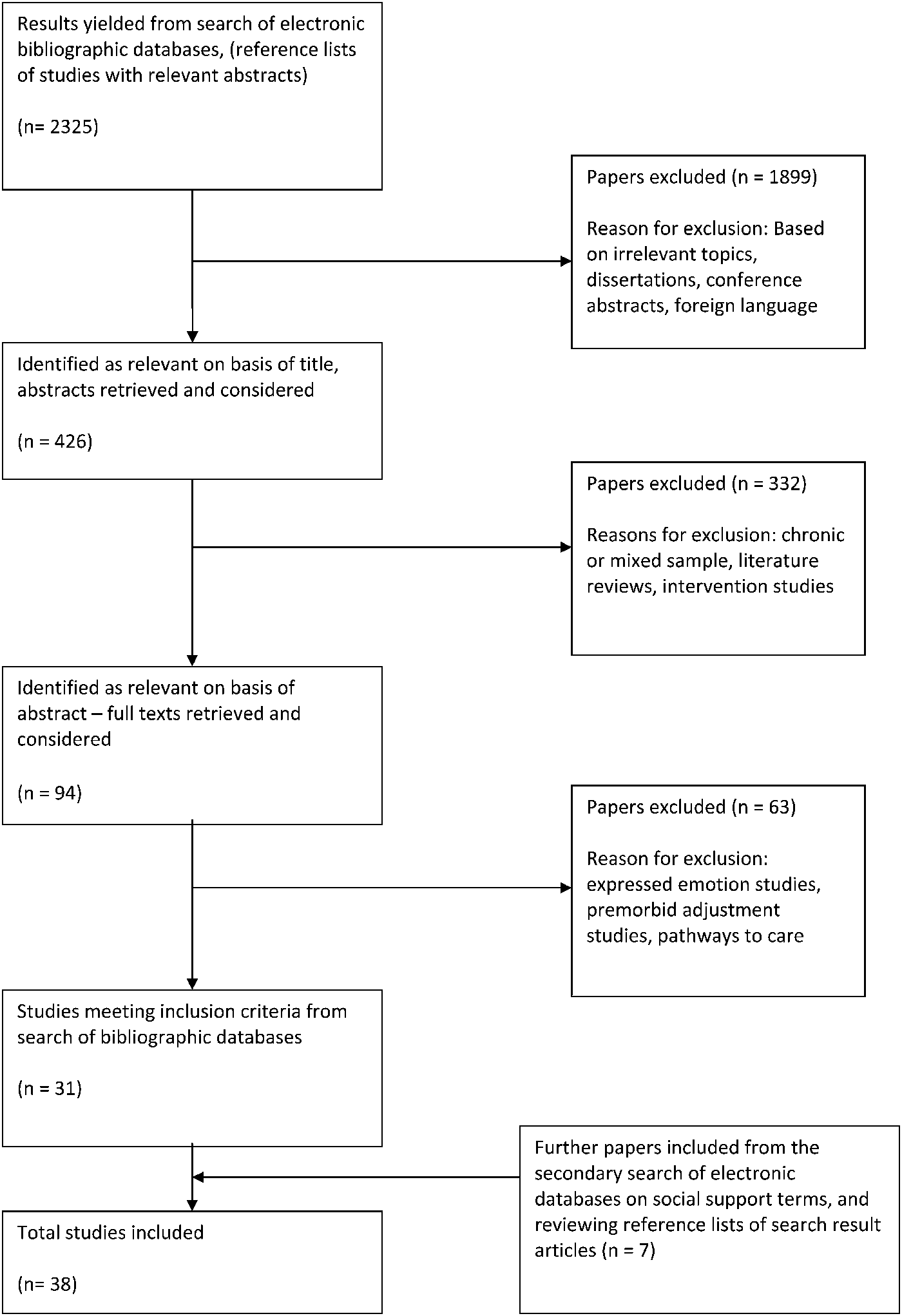
Relevant literature was identified in three stages. Firstly, a search strategy was developed and applied to the bibliographic databases PsychINFO (1806 to November 2011), Medline (1946 to November 2011) and EMBASE (1974 to November 2011). The search terms used were: schizophrenia, psychosis, first episode, social support and social network (see Fig. 1). The combined results from each database were then scrutinized first by title and then by abstract, and on this basis potential papers for review were selected and read to assess whether they met the inclusion criteria. The references of included papers were then examined for further potentially relevant articles.
Study selection.
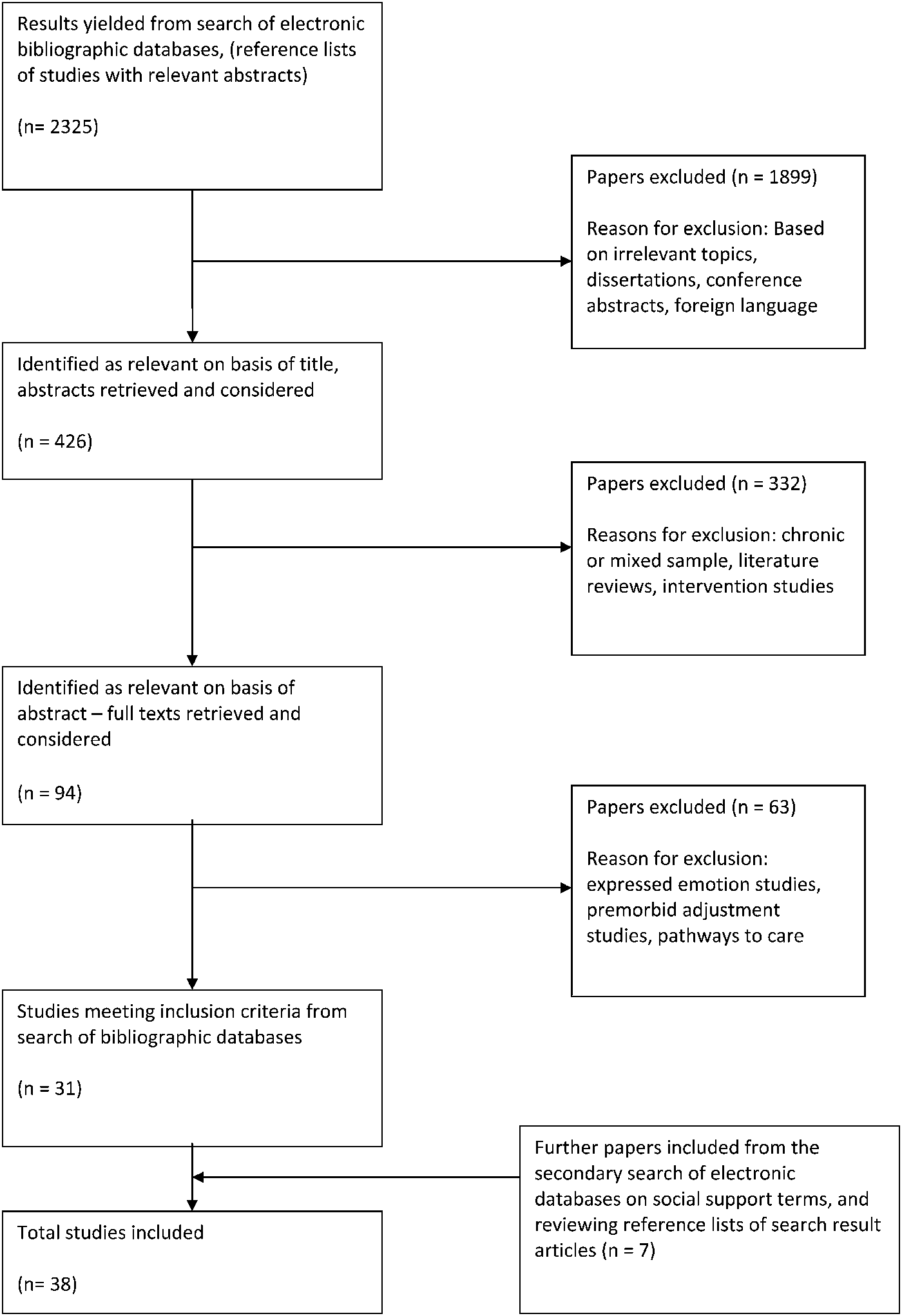
To ensure completeness, an additional search was carried out using the Tests and Measures tool in PsychINFO to search for specific measures of social support. These terms, which encompass an extensive list of social support assessments known to the authors, included: social support, interpersonal support, social relationship, close person, social interaction, social network, significant other and network analysis.
Data extraction, analysis and synthesis
A form was developed to extract relevant data from each paper. The wide variation in methodology, including samples and measures, meant a meta analysis was not feasible. We therefore adopted a non-quantitative narrative approach to synthesizing the findings (Mays et al. Reference Mays, Roberts, Popay, Fulop, Allen, Clarke and Black2001) and present findings in tabular and text form.
Results
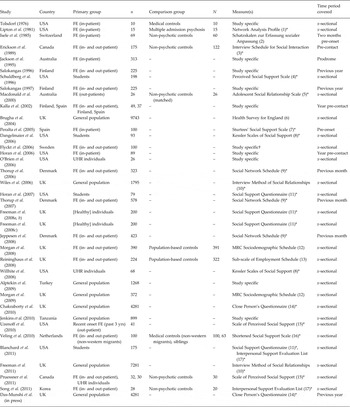
Thirty-eight papers were identified that met the inclusion criteria; 23 reported on studies that used standardized measures of networks or support; 14 on studies that used non-standardized study specific measures and 1 on a study that used clinician rated data. The overriding observation that emerges from this literature is the marked methodological heterogeneity (see Table 1). This is evident in study design, sampling and sample size, measures used, and the type of support or network variables considered, and it poses significant challenges in comparing findings and drawing conclusions. In this section, we focus on describing findings; in the discussion, we consider in more detail the methodological issues that arise and their implications.
Studies included in review

*Validated measure of social support.
†Clinician-rated support.
FE, first episode; UHR, ultra high risk.
1 (Cohen & Sokolovsky, Reference Cohen and Sokolovsky1979); 2 (Malzacher & Merz, unpublished); 3 (Henderson et al. Reference Henderson, Duncan-Jones, McAuley and Ritchie1978); 4 (Procidano & Heller, Reference Procidano and Heller1983); 5 (Macdonald et al. Reference Macdonald, Madden and Roods1996); 6 (Cox et al. Reference Cox, Blaxter, Buckle, Fenner, Golding, Gore, Hupper, Nickson, Roth, Stark, Wadsworth and Wichelow1987); 7 (Sturtees, Reference Sturtees1980); 8 (Schuschter et al. Reference Schuschter, Kessler and Aseltine1990); 9 (Dunn et al. Reference Dunn, O'Driscoll, Dayson, Wills and Leff1990); 10 (Brugha et al. Reference Brugha, Sturt, MacCarthy, Potter, Wykes and Bebbington1987); 11 (Sarason et al. Reference Sarason, Levine, Basham and Sarason1983); 12 (Mallett et al. Reference Mallett, Leff, Bhugra, Pang and Zhao2002); 13 (Warr, Reference Warr1987); 14 (Stansfeld & Marmot, Reference Stansfeld and Marmot1992); 15 (Zimet et al. Reference Zimet, Dahlem, Zimet and Farley1988); 16 (Van Eijk et al. Reference Van Eijk, van Kempen and van Sonderen1994); 17 (Cohen et al. Reference Cohen, Mermelstein, Kamarck, Hoberman, Sarason and Sarason1985).
Social support and networks in clinical samples
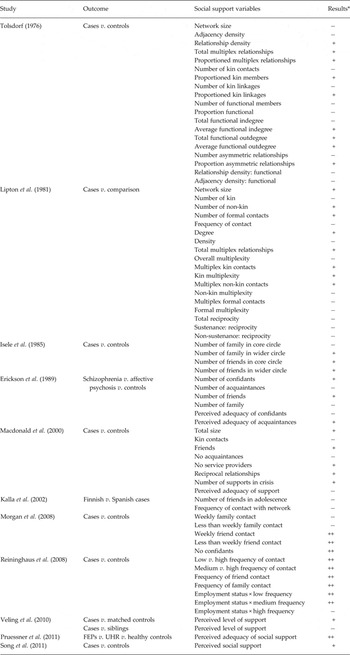
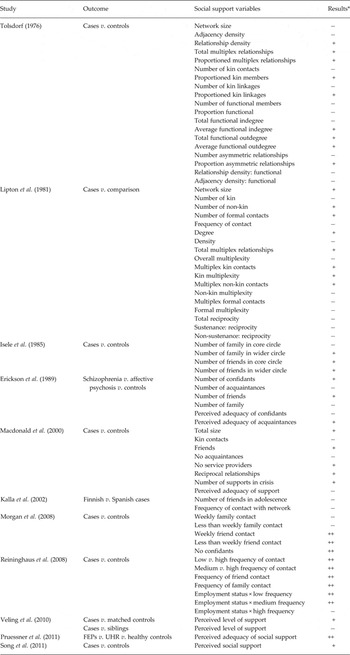
Analyses in 11 papers compared network size between samples of individuals with a first episode of psychosis and various comparison groups (see Table 2). Almost invariably, studies report smaller social networks among those with a first episode of psychosis. For example, Erickson et al. (Reference Erickson, Beiser, Iacono, Fleming and Lin1989), in a relatively large sample of 175 cases and 122 controls, found individuals with a first episode of schizophrenia (mean = 3.6) and affective psychosis (mean = 5.0) both had smaller networks than controls (mean = 6.3). Similarly, Macdonald et al. (Reference Macdonald, Hayes and Baglioni2000), in a sample of 26 individuals with a first episode of psychosis and 26 matched controls without a mental disorder, found that the first episode group on average had significantly fewer individuals in their social network (average 3.7 v. average 5.3, p = 0.024).
Associations with support in clinical samples
*Non-significant; + <0.05 unadjusted; ++ <0.05 adjusted.
There is also evidence that those with a first episode have fewer contacts, and are less satisfied with those in their social networks. For example, in a sample of 224 cases with a first episode of psychosis and 322 controls randomly selected from the general population, Reininghaus et al. (Reference Reininghaus, Morgan, Simpson, Dazzan, Morgan, Doody, Bhugra, Leff, Murray, Fearon and Craig2008) found that cases were around three times more likely than controls to have a low frequency of contact with others in their social network (i.e. were in the lowest 25th percentile for frequency of contact), after controlling for a number of potential confounders including age, gender and ethnicity. Further analyses suggested that this effect was specific to those with a non-affective psychosis.
Some studies have used more sophisticated methodologies. Two studies, for example, assessed cases and controls using a detailed network analysis interview to gather information on network size, reciprocity (proportion of support provided to and received from others), degree (average number of links between network members) and density (proportion of linkages between individuals in the network to the total size). In the first of these, Tolsdorf (Reference Tolsdorf1976) in a sample of 10 male veterans with a first episode of schizophrenia and 10 male veterans who had been hospitalized for non-mental health problems, found that those with schizophrenia had an average network size of 29.8 people compared with 37.8 in the control group.Footnote 1 The differences in network size and density were not significant at conventional levels (which is not surprising given the sample size), but the cases received significantly more support from their network than they provided (i.e. reciprocity) and had a more restricted range of relationship types (muliplexity). Similar reciprocity scores were found by Horan et al. (Reference Horan, Subotnik, Snyder and Nuechterlein2006) in a sample of 89 cases with a first episode of psychosis.
With regard to satisfaction (which overlaps with perceived support), two studies have found that those with a first episode are less satisfied with the level of support they receive, when compared with controls (Veling et al. Reference Veling, Hoek, Wiersma and Mackenbach2010; Song et al. Reference Song, Kim, Park, Lee, Kang, Lee, An and Kwon2011). Others, however, found no difference in perceived social support between cases, siblings (Veling et al. Reference Veling, Hoek, Wiersma and Mackenbach2010) and controls (Macdonald et al. Reference Macdonald, Hayes and Baglioni2000; Pruessner et al. Reference Pruessner, Iyer, Faridi, Joober and Malla2011).
Are friends more important than family?
Interestingly, when the number of contacts is grouped by type (e.g. family, friend, acquaintance, etc.), typically, no differences between cases and controls have been found in the number of family contacts (Tolsdorf, Reference Tolsdorf1976; Isele et al. Reference Isele, Merz, Malzacher and Angst1985; Erickson et al. Reference Erickson, Beiser, Iacono, Fleming and Lin1989; Macdonald et al. Reference Macdonald, Hayes and Baglioni2000). Total number of family members within networks in these studies among cases ranged from 1.8 to 18.2 (Tolsdorf, Reference Tolsdorf1976; Lipton et al. Reference Lipton, Cohen, Fischer and Katz1981; Erickson et al. Reference Erickson, Beiser, Iacono, Fleming and Lin1989; Macdonald et al. Reference Macdonald, Hayes and Baglioni2000; Horan et al. Reference Horan, Subotnik, Snyder and Nuechterlein2006), compared with a range of 1.8–16.5 among controls (Tolsdorf, Reference Tolsdorf1976; Erickson et al. Reference Erickson, Beiser, Iacono, Fleming and Lin1989; Macdonald et al. Reference Macdonald, Hayes and Baglioni2000). Some studies have suggested cases have a greater proportion of family members in their social networks relative to friends (Tolsdorf, Reference Tolsdorf1976).
It seems then that differences in network size are specifically in number of and contact with friends, with individuals with a first episode having significantly fewer friends than controls (Isele et al. Reference Isele, Merz, Malzacher and Angst1985; Erickson et al. Reference Erickson, Beiser, Iacono, Fleming and Lin1989; Macdonald et al. Reference Macdonald, Hayes and Baglioni2000). Some studies have further separated friends into confidants and acquaintances. Two studies have found that patients with a first episode have significantly fewer confidants compared with comparison groups, but no difference in number of acquaintances (Erickson et al. Reference Erickson, Beiser, Iacono, Fleming and Lin1989; Macdonald et al. Reference Macdonald, Hayes and Baglioni2000). Given that the number of confidants has been found to increase as total network size increases (Thorup et al. Reference Thorup, Petersen, Jeppesen, Ohlenschlaeger, Christensen, Krarup, Jorgensen and Nordentoft2006), it is possible that the network size differences can be attributed to differences in number of confidants.
Further strong evidence for the role of confidants was found by Morgan et al. (Reference Morgan, Kirkbride, Hutchingson, Craig, Morgan, Dazzan, Boydell, Doddy, Jones, Murray, Leff and Fearon2008). In this study, cases were around seven times more likely to have no confidants compared with a general population control group; frequency of contact with family members was not associated with case-control status. In contrast, in a sub-sample from this study and using a more nuanced measure of contact, Reininghaus et al. (Reference Reininghaus, Morgan, Simpson, Dazzan, Morgan, Doody, Bhugra, Leff, Murray, Fearon and Craig2008) found cases were more likely than controls to report ‘low’ contact with their family (OR 1.72, 95% CI 1.02–2.09). In both analyses, frequency of contact with friends was strongly associated with case status (Morgan et al. Reference Morgan, Kirkbride, Hutchingson, Craig, Morgan, Dazzan, Boydell, Doddy, Jones, Murray, Leff and Fearon2008; Reininghaus et al. Reference Reininghaus, Morgan, Simpson, Dazzan, Morgan, Doody, Bhugra, Leff, Murray, Fearon and Craig2008).
Cause or effect?
The question arises of whether limited social networks at first onset (or presentation) form part of the complex web of causes leading to psychosis or whether they are a consequence of the (developing) disorder. Some studies report findings that are relevant to this question. Lipton et al. (Reference Lipton, Cohen, Fischer and Katz1981), for example, compared 15 individuals with a diagnosis of schizophrenia at first admission with a group (n = 15) with multiple admissions. The authors found that the first admission group had a significantly larger network on average (15.5 individuals) compared with the multiple admission group (6.3 individuals), which they argue supports the hypothesis that a social network crisis occurs as a consequence of the disorder. Moreover, the multiple-admission group had significantly fewer people in their network who provided more than one type of support (multiplexity) than the first admission group, and had significantly fewer friends or someone who was important to them. However, a reduction in social networks following onset does not exclude the possibility that networks were already restricted at first onset compared with the general population.
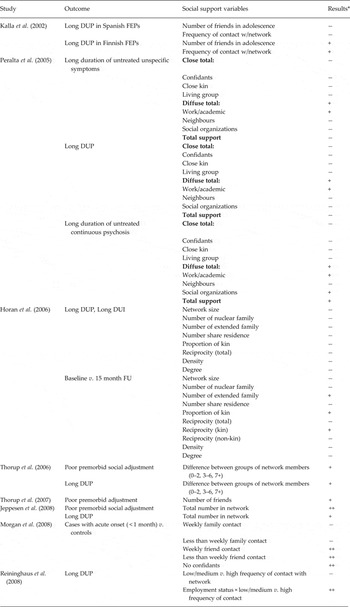
Not all studies suggest a (further) reduction of network size following onset. Thorup et al. (Reference Thorup, Petersen, Jeppesen, Ohlenschlaeger, Christensen, Krarup, Jorgensen and Nordentoft2006), in a sample of 323 first-episode cases, found that the total network size increased from 7.6 individuals at baseline to 8.2 individuals at 2-year follow-up. Similarly, Horan et al. (Reference Horan, Subotnik, Snyder and Nuechterlein2006) did not find a significant difference in total network size after 15 months (8.8 at baseline and 8.7 at follow-up), though the number of extended family within networks reduced.
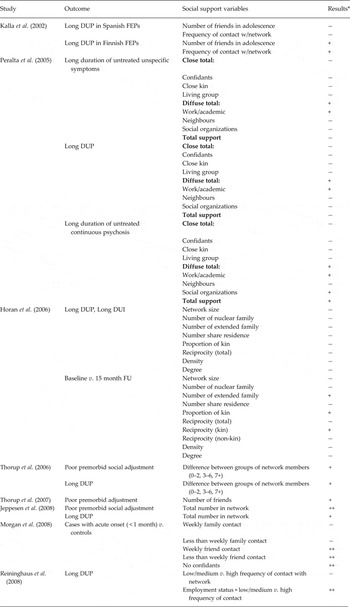
There is some evidence that social networks deteriorate prior to contact with services as a consequence of periods of untreated psychosis or illness (Thorup et al. Reference Thorup, Petersen, Jeppesen, Ohlenschlaeger, Christensen, Krarup, Jorgensen and Nordentoft2006; Jeppesen et al. Reference Jeppesen, Petersen, Thorup, Abel, Ohlenschlaeger, Christensen, Krarup, Jorgensen and Nordentoft2008) (see Table 3). In diverse samples a longer duration of untreated psychosis (DUP) has been found to be associated with a low frequency of social contacts in the year prior to first presentation (Kalla et al. Reference Kalla, Aaltonen, Wahlstrom, Lehtinen, Garcia Cabeza and Gonzalez de Chavez2002). The evidence, however, is not entirely consistent and some studies have found no association between DUP or duration of untreated illness (DUI) and various measures of social networks and support (Peralta et al. Reference Peralta, Cuesta, Martinez-Larrea, Serrano and Langarica2005; Horan et al. Reference Horan, Subotnik, Snyder and Nuechterlein2006). This inconsistency may reflect interactions with other variables. Reininghaus et al. (Reference Reininghaus, Morgan, Simpson, Dazzan, Morgan, Doody, Bhugra, Leff, Murray, Fearon and Craig2008), for example, found that DUP was not associated with frequency of social contact in all, but when looked at by employment status, a strong association was found among those who were unemployed (i.e. poor social support and unemployment together were associated with a long DUP). In line with this, Peralta et al. (Reference Peralta, Cuesta, Martinez-Larrea, Serrano and Langarica2005) found that a long DUP was associated with fewer contacts with others in diffuse social networks (mainly work or academic associates).
Premorbid adjustment, DUP and support
*non-significant; + <0.05 unadjusted; ++ <0.05 adjusted.
Finally, several authors have found that poor premorbid social function is strongly associated with smaller social networks (Thorup et al. Reference Thorup, Petersen, Jeppesen, Ohlenschlaeger, Christensen, Krarup, Jorgensen and Nordentoft2006; Jeppesen et al. Reference Jeppesen, Petersen, Thorup, Abel, Ohlenschlaeger, Christensen, Krarup, Jorgensen and Nordentoft2008) and mean number of friends (Thorup et al. Reference Thorup, Petersen, Jeppesen, Ohlenschlaeger, Christensen, Krarup, Jorgensen and Nordentoft2007).
Social support and social networks in non-clinical samples
In addition, there is a small and disparate body of research that has investigated the relationship between aspects of social networks and support and reports of psychotic experiences and schizotypal traits in non-clinical populations (see Table 4). In so far as those reporting such experiences and traits are at increased risk of developing psychosis, these studies are further relevant to the question of whether reduced networks are evident prior to, and may contribute to, the onset of clinical disorder.
Associations with support in non-clinical samples

*Non-significant; + <0.05 unadjusted; ++ <0.05 adjusted.
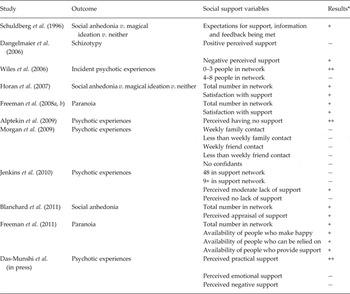
Wiles et al. (Reference Wiles, Zammit, Bebbington, Singleton, Meltzer and Lewis2006), in a large general population study of 1795 individuals followed over 18 months, found a dose-response effect whereby having a small primary network (0–3 people) at baseline was associated, independent of several confounders, with a 4–5-fold increased risks of having psychotic symptoms at follow-up compared with having a network of 4 or more people. The longitudinal design suggests restricted networks precede the development of symptoms. Moreover, in an even larger general population study (n = 7281), Freeman et al. (Reference Freeman, McManus, Brugha, Meltzer, Jenkins and Bebbington2011) found that respondents were at an increased risk of experiencing increasing severity of paranoid symptoms as the total number of friends and family that the respondent felt close to decreased (OR 0.9, 95% CI 0.87–0.94) and as the perceived availability of people who make the respondent happy, who can be relied on, and who provide support, decreased. Similarly, in a sample of 1268 individuals (Alptekin et al. Reference Alptekin, Ulas, Akdede, Tumuklu and Akvardar2009), those who perceived themselves as having no support were significantly more likely to experience psychotic symptoms (OR 4.5, 95% CI 2.3–8.6), independent of gender, education, marital status, economic support, family history of mental illness and substance use. In contrast, two comparatively small general population studies found no association between psychotic symptoms and size of social network (Jenkins et al. Reference Jenkins, Mbatia, Singleton and White2010) or frequency of contact (Morgan et al. Reference Morgan, Fisher, Hutchinson, Kirkbride, Craig, Morgan, Dazzan, Boydell, Doody, Jones, Murray, Leff and Fearon2009).
Freeman et al. (Reference Freeman, Gittins, Pugh, Antley, Slater and Dunn2008a; Reference Freeman, Pugh, Antley, Slater, Slater, Bebbington, Gittens, Dunn, Kuipers, Fowler and Garetyb) used an experimental design to investigate state measures of paranoia following a neutral virtual reality task in 100 individuals. Higher levels of state paranoia were weakly associated with decreased number of social supports (OR 0.87, CI 0.76–1.00); this, however, was no longer significant at p < 0.05 after adjusting for a range of confounders.
Studies that have investigated perceived adequacy of support and social networks within non-clinical samples (most often students) who score high on social anhedonia and magical ideation scales have found contrasting results. In one study of students, for example, Horan et al. (Reference Horan, Brown and Blanchard2007) compared with those who scored high on magical ideation (n = 17) and controls (n = 39), those who scored high on social anhedonia (n = 23) had smaller networks and were more dissatisfied with the support they received. Similar results were found by Blanchard et al. (Reference Blanchard, Collins, Aghevli, Leung and Cohen2011) in a sample of 86 students with high levels of social anhedonia and 89 controls. Dangelmaier et al. (Reference Dangelmaier, Docherty and Akamatsu2006) found that 47 students with magical ideation scored higher on negative support than a control group, with no differences in perceived positive support. In contrast, Schuldberg et al. (Reference Schuldberg, Karwacki and Burns1996) found that a perceptual aberration/magical ideation group of 88 students scored significantly lower on perceived social support from family and friends compared with a social anhedonia group (n = 21) and a control group (n = 89). Interestingly, the magical ideation group in this study was more likely to use support-seeking coping strategies in interpersonal situations.
Age, gender and ethnicity
Some studies have reported on associations between demographic and other variables and social support in samples with psychotic disorder, psychotic experiences or schizoptypal traits. Once again, the picture that emerges is mixed.
Some, for example, suggest restricted networks and fewer supports are associated with older age (Thorup et al. Reference Thorup, Petersen, Jeppesen, Ohlenschlaeger, Christensen, Krarup, Jorgensen and Nordentoft2006) and others do not (Horan et al. Reference Horan, Subotnik, Snyder and Nuechterlein2006). With regard to gender, some studies suggest women with a first episode of psychosis have larger networks, greater frequency of contact with friends, and more confidants than men (Thorup et al. Reference Thorup, Petersen, Jeppesen, Ohlenschlaeger, Christensen, Krarup, Jorgensen and Nordentoft2007) – perhaps reflecting general population norms. Willhite et al. (Reference Willhite, Niendam, Bearden, Zinberg, O'Brien and Cannon2008) found that women at ultra-high risk of psychosis endorsed positive support items on the Kessler scale of social support (Schuschter et al. Reference Schuschter, Kessler and Aseltine1990) more often than men, but there was no difference in endorsement of negative support items. In contrast, Thorup et al. (Reference Thorup, Petersen, Jeppesen, Ohlenschlaeger, Christensen, Krarup, Jorgensen and Nordentoft2006) found no difference between men and women in network size. Others, in various samples, have found no differences between women and men in number of those with a confidant (Salokangas, Reference Salokangas1996) and in perceived social support (Pruessner et al. Reference Pruessner, Iyer, Faridi, Joober and Malla2011). In samples of individuals scoring high on schizotypy, similar conflicting results have been found (Schuldberg et al. Reference Schuldberg, Karwacki and Burns1996; Dangelmaier et al. Reference Dangelmaier, Docherty and Akamatsu2006).
With regard to ethnicity and early psychosis, the current evidence tends towards social networks and support being more limited in minority groups compared with majority groups. This is a particularly important consideration because high rates of psychosis have been consistently reported for many (although not all) migrant and minority ethnic populations, especially in northern Europe (Fearon & Morgan, Reference Fearon and Morgan2006). Brugha et al. (Reference Brugha, Jenkins, Bebbington, Meltzer, Lewis and Farrell2004), in a large general population study, found significant differences between ethnic groups and support; for example, 9% of the white group included in the study had severe lack of perceived social support compared with 19% of all other ethnic groups. Das-Munshi et al. (in press), in a large general population study of 4281 individuals, found that within the minority ethnic group (i.e. all individuals from minority ethnic groups combined), reporting of high practical social support was significantly associated with a lower odds of reporting psychotic experiences, after adjusting for confounders. Perhaps more intriguingly, there was from this sample evidence that individuals from minority groups living in areas of low ethnic density who had low practical or emotional support were at the highest risk of reporting psychotic experiences. Further, Chakraborty et al. (Reference Chakraborty, McKenzie, Hajat and Stansfeld2010) found, in analyses of the same sample, that a higher prevalence of reporting psychotic experiences was associated with greater distance from the closest person in the black Caribbean and the Bangladeshi groups.
Discussion
This review, to our knowledge, is the first to systematically examine the literature on social networks and support in early psychosis. Most studies point in the same direction: individuals with a first episode of psychosis have reduced social networks (in number and amount of contacts) and less access to satisfactory social support compared with others. The reduced social networks appear to be a function specifically of reduced number of friends and confidants (rather than family). Further, social network deficiencies may precede onset, as indicated by studies demonstrating decreased social contacts and support among those with a first episode, those from the general population who report psychotic experiences and those who score high on measures of schizotypy.
Methodological issues
However, these broad conclusions are necessarily tentative given the methodological heterogeneity and limitations that characterizes this literature.
The studies we have reviewed here had sample sizes ranging from 10 to 9743, and included varying populations with psychosis or schizotypy (in-patient, out-patient, student and general population samples), diverse comparison groups (medical controls, general population controls, students and siblings), and used a wide range of measures of networks and supports (from the crude to the sophisticated). Network size is a good example in which the methodologies employed varies considerably. In those studies that used a detailed network interview (e.g. Tolsdorf, Reference Tolsdorf1976; Lipton et al. Reference Lipton, Cohen, Fischer and Katz1981), subjects were asked to name everyone they knew. In contrast, other studies asked participants to name only those who they were close to (e.g. Erickson et al. Reference Erickson, Beiser, Iacono, Fleming and Lin1989) or had contact with within a specified date range (e.g. in the last month; Thorup et al. Reference Thorup, Petersen, Jeppesen, Ohlenschlaeger, Christensen, Krarup, Jorgensen and Nordentoft2006). Moreover, some measures set a limit on the number of individuals participants could name [e.g. the Adolescent Social Relationship Scale (Macdonald et al. Reference Macdonald, Madden and Roods1996, Reference Macdonald, Hayes and Baglioni2000) which only allows up to six individuals to be named]. What is more, it seems that reduced networks among cases are a function of their having fewer friends (not family). Consequently, summing total number of contacts with others may be misleading and it is evidently problematic to draw direct comparisons.
There are other substantive methodological issues that limit what can be inferred from the literature, at least in relation to our questions concerning the possible impact of social networks and support on the onset of psychosis. These include selection bias (e.g. use of in-patient samples and non-random selection of comparison groups), information bias (e.g. use of study specific, non-validated assessments of social networks or support and limited attention to issues of reliability), confounding (i.e. few studies adjusted for alternative variables that might explain observed associations) and direction of causation (i.e. almost invariably studies were cross-sectional making it difficult to disentangle cause and effect). To take one example, the way in which information on support is gathered, and from whom, matters. Rabinovitch et al. (Reference Rabinovitch, Bechard-Evans, Schmitz, Joober and Malla2009), for example, found that the level of support received from family and friends, when rated by clinicians, was associated with medication adherence over a 6-month period (OR = 3.55, se = 0.58, p = 0.03). However, when rated by patients themselves there was no difference in the level of support between those who were adherent and those who were not. What is more, assessments of networks and supports tended to be generic (with only limited consideration, if any, of the multidimensional character of networks and support (Thoits, Reference Thoits1982)), which is useful in providing information on the extent of isolation and access to support, but is less useful when attempting to investigate the potential buffering effects of these variables. In other words, having a wide and generally supportive social network does not mean this is always activated and used in relation to specific stressors. Further, access to and perceptions of social support will inevitably change over time; the greater the distance between life events and the generic measure of support, the less likely the measure is to capture the availability of support at the time of the event.
Mechanisms and future research
The above considerations mean that, at this stage, our understanding of the relationship between networks, support and early psychosis is limited. This noted, the evidence does broadly suggest networks and support, particularly from close friends, diminished even during the early stages of psychosis. In the context of recent evidence that suggests adverse social contexts and experiences increase risk for psychosis, this raises the possibility that networks and support may be important in onset.
There are a number of possible ways this may happen. For example, it may be that smaller networks reduce self-esteem and allow, particularly in the face of threatening contexts and events, more malevolent appraisals of threat to develop in the absence of opportunities for the individual to access normalizing explanations for anomalous perceptions and unusual beliefs (Hodges et al. Reference Hodges, Byrne, Grant and Johnstone1999). Alternatively, greater received and perceived support following specific life events may mitigate the consequent distress and buffer individuals against the deleterious effects of stress. However, Thoits (Reference Thoits1982) argues that these two models are confounded in research because life events often consist of losses or gains of supportive relationships, and results will consequently sometimes be biased in favour of the buffering hypothesis. Horan et al. (Reference Horan, Subotnik, Snyder and Nuechterlein2006) argue that social support research is further biased by the fact that studies tend to only consider beneficial relationships, despite the fact that negative responses from others within social networks (i.e. negative social support) may have compounding effects (Taylor & Aspinwall, Reference Taylor, Aspinwall and Kaplan1996, p. 94). This applies particularly to social network research, in which it is invariably assumed that having a larger social network corresponds to receiving more beneficial support.
Investigating the relationship between social networks, support and onset of psychosis is not straightforward. A challenge that all research in this area faces is that psychosis, by its very nature, impacts on individuals' social circumstances and networks and there is evidence that the onset is often preceded by a period of functional decline. Disentangling cause and effect is a perennial problem. In responding to this challenge, it is often blithely concluded that longitudinal studies are required, without any serious consideration of what this entails and its feasibility. It also ignores the strengths of case-control studies, which – if well designed and fulfilling certain conditions (Susser et al. Reference Susser, Scwartz, Morabia and Bromet2006) – do allow inferences about causation. There is, then, a need for what might be termed a mixed economy of research. In this, there is a place for general population studies of the extended psychosis phenotype which, by virtue of being much more common, allows for informative cohort studies to be conducted more feasibly (i.e. with smaller numbers over shorter periods). There is equally a place for carefully designed case-control studies, with the advantages that clinical disorder can be studied and that a wide range of exposures (including potential confounders, effect modifiers and mediators) can be measured. Where there is then convergence of evidence from studies using different designs our confidence in the validity of the findings and their applicability to clinical disorder, as well as sub-clinical phenomena in the general population, will be increased.
These methodological issues notwithstanding, there is evident need for more robust research on social networks, support and early psychosis. Such a research may provide important clues about what can be done to both prevent onset and increase the likelihood of positive outcomes following a first episode.
Acknowledgements
Charlotte Gayer-Anderson is supported by funding from the European Union (European Community's Seventh Framework Program (grant agreement No. HEALTH-F2-2009-241909) (Project EU-GEI)); Craig Morgan is supported by funding from the Medical Research Council (Ref: G0500817), Wellcome Trust (Grant Number: WT087417) and European Union (European Community's Seventh Framework Program (grant agreement No. HEALTH-F2-2009-241909) (Project EU-GEI)).