Introduction
California is world-renowned for the success of its agricultural sector in exploiting its Mediterranean-type climate (George Reference Georgen.d.; Kottek et al., Reference Kottek, Grieser, Beck, Rudolf and Rubel2006) and available water resources to lead the globe in high yields and crop quality. However, although California produces over 300 different crops (including livestock), these crops are predominantly produced in highly specialized monocrop systems that entail a high dependence on external inputs. Intensive use of such inputs has created significant socioecological externalities (Tomich et al., Reference Tomich, Brodt, Dahlgren and Scow2016), including nitrogen pollution of groundwater (Harter et al., Reference Harter, Lund, Darby, Fogg, Howitt, Jessoe, Pettygrove, Quinn, Viers, Boyle, Canada, DeLaMora, Dzurella, Fryjoff-Hung, Hollander, Honeycutt, Jenkins, Jensen, King, Kourakos, Liptzin, Lopez, Mayzelle, McNally, Medellin-Azuara and Rosenstock2012), soil erosion and depletion of soil carbon stocks (Montgomery, Reference Montgomery2007), impairment of human and environmental health from toxic pesticides (Gunier et al., Reference Gunier, Bradman, Harley, Kogut and Eskenazi2016), loss of native biodiversity (Tilman et al., Reference Tilman, Cassman, Matson, Naylor and Polasky2002; Haden et al., Reference Haden, Liptzin, Rosenstock, Vanderslice, Brodt, Yeo, Dahlgren, Scow, Riddell, Feenstra, Oliver, Thomas, Kanter, Tomich, Tomich, Brodt, Dahlgren and Scow2016) and rising production costs (Champetier et al., Reference Champetier, Sumner, Tomich, Tomich, Brodt, Dahlgren and Scow2016). In addition, stressors such as drought, floods and rising temperatures continue to threaten the resilience of California's farming systems.
Ecological intensification is a strategy of designing agroecosystems to harness natural processes—especially biological processes and ecological relationships—to enhance system functioning and reduce reliance on external inputs. Increasing biological diversity and including perennial elements are two ways to achieve ecological intensification and increase the sustainability and resilience of production systems (Glover et al., Reference Glover, Reganold, Bell, Borevitz, Brummer, Buckler, Cox, Cox, Crews, Culman, DeHaan, Eriksson, Gill, Holland, Hu, Hulke, Ibrahim, Jackson, Jones, Murray, Paterson, Ploschuk, Sacks, Snapp, Tao, Van Tassel, Wade, Wyse and Xu2010; Koohafkan et al., Reference Koohafkan, Altieri and Holt Gimenez2012; Kremen and Miles, Reference Kremen and Miles2012; Asbjornsen et al., Reference Asbjornsen, Hernandez-Santana, Liebman, Bayala, Chen, Helmers, Ong and Schulte2014). Agroforestry embodies both diversification and perennialization, being defined as the intentional integration of trees or shrubs with other crops and/or livestock in order to optimize the benefits from biophysical interactions among the components (adapted from Gold and Garrett Reference Gold, Garrett and Garrett2009). The large diversity of perennial and annual crop and livestock species already produced in California appears to offer abundant opportunities for implementing agroforestry. However, to our knowledge, no prior formal documentation of such systems exists.
In this study, we set out to uncover the existence of agroforestry on commercial farms as a ‘proof of concept’ to explore the agronomic and socio-economic viability of such systems within an industrialized setting and Mediterranean-type climate. As in many industrialized economies, a small percentage of farms control a large share of the land and produce a large percent of the output [10% of farms account for 86% of total farm sales in California (UC Agricultural Issues Center 2009a)]. Therefore, we argue that if agroforestry practices are going to be widely adopted to address region-wide environmental externalities in the current California context, they need to be adaptable to relatively larger scales, and not be limited only to smaller farms or non-commercial demonstration farms. In this paper, we present the results of an exploratory study of agroforestry systems in California, compare their perceived benefits and constraints with findings from the literature, and discuss the potential for increased adoption of such systems in industrialized farm economies in semi-arid and temperate zones.
Methods
This exploratory study used guided, open-ended interviews conducted in person and by phone. Due to lack of a sampling frame and paucity of prior data regarding agroforestry practices in California, we used a snowball sampling method, starting with a few individuals known to the research team and then obtaining referrals for further respondents along the way. We conducted 26 interviews: 16 with farmers, and ten with non-farming professionals. Of these ten professionals, seven are public sector extension staff (with Cooperative Extension, a Resource Conservation District, and a federal conservation agency), two are academic researchers and one is a private sector on-farm biodiversity consultant. They were chosen for their long-standing familiarity with California agriculture and interest in diversified farming systems. For farmer interviews, we chose operators who were known to include at least one agroforestry practice on substantial portions of their farms (but not necessarily all their acreage). In keeping with our focus on the potential to ameliorate environmental disturbance from intensive high-input agriculture, we did not include any extensive oak savanna rangeland landscapes that are prominent throughout California foothill areas and are already known to offer high levels of biological diversity and ecosystem services (Sayre et al., Reference Sayre, Carlisle, Huntsinger, Fisher and Shattuck2012). Although some authors (e.g., Gold and Garrett Reference Gold, Garrett and Garrett2009) focus on agroforestry as the addition of woody plants to cash crop or livestock systems, we included a few examples of cover cropping in orchard systems, given the economic significance and geographic extent of orchard and vineyard crops in California and our ultimate interest in identifying strategies for reducing externalities. Although cover crops are not cash crops, these systems share many characteristics with alley cropping and thus we deemed them to offer additional learning opportunities for this study.
Our interviewees were initially contacted by email or phone to request their participation and to set interview times. Seven of the 16 farms were visited in person and the remaining interviews were conducted by phone. Interviews lasted from 30 to 90 min. The first few interviews were conducted jointly by the primary author (principal investigator), and the second author and some subsequent interviews were conducted individually by the second author. Detailed notes were taken both during and after the interview. All notes were reviewed by the primary author and items lacking clarity were pursued in follow-up contacts with interviewees. The interview guide included questions about observed benefits and constraints of agroforestry practices, opportunities for expansion, effects on farm resilience, information sources and, in the case of farmers, farm description and history, crops produced, details about agroforestry practices used, and motivations and challenges (see Supplementary Materials for full questionnaires). All questions were open-ended and thus any individual's responses were not construed as an exhaustive account of all possible benefits and challenges experienced by that individual.
The two interviewing co-authors categorized the text from each interview into the following broad topics: description of agroforestry practices, benefits of agroforestry practices, constraints or drawbacks of practices, motivations for practicing agroforestry and knowledge gaps. The primary author checked these categorizations against the original interview notes for consistency. We then coded responses within the benefits and drawbacks topics into the following emergent themes: biophysical benefits, economic/farm management benefits, external environmental benefits, regulation-related benefits, biophysical drawbacks, economic/farm management constraints, regulatory constraints and knowledge gaps. We then tallied the number of responses for each category and subcategory. To ensure consistency all coding was checked against the original interview notes by the primary author.
Results
Farm characteristics and typology of California agroforestry systems
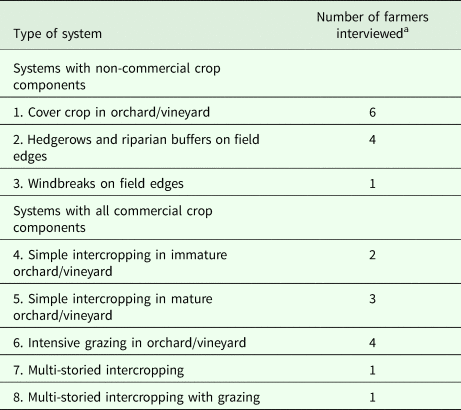
From the 16 farmers included in the study, we identified five distinct types of agroforestry systems and three additional subsystems within these types, for a total of eight different systems (Table 1). Our eight systems can be divided into those in which at least one defining component is non-commercial, and those in which all or most components provide commercial revenue. The three systems in the non-commercial category include the following:
Typology of intensive agroforestry systems and numbers of farmers interviewed

a Total exceeds the total number of farmers interviewed because several farmers practice more than one system.
(1) cover cropping in orchards and vineyards, (2) planting of hedgerows or riparian buffers (typically multi-species with a focus on California natives) along field and stream edges and (3) windbreaks along field edges. These systems are currently the most prevalent types of agroforestry in the intensively-farmed valleys. Among our interviewees, four farmers planted common winter cover crop mixes in orchards and one farmer used an uncommon summer orchard cover crop—heliotrope (Heliotropium sp.)—to provide bee forage for her commercial beehives. One farmer had several poplar windbreaks along field edges.
The remaining systems involved combinations of multiple commercial components, including the following: (1) alley cropping (vegetables and row crops like beans) in orchards and vineyards, subdivided into (a) only intercropping for 2–3 years when newly planted trees are still small, and (b) intercropping in mature orchards or vineyards; (2) intensive grazing of livestock (sheep or poultry) in orchards and vineyards; and (3) complex multi-story herbaceous, shrub and tree crop components grown in close proximity to each other, subdivided into those that (a) include livestock rotational grazing and (b) those that do not include livestock.
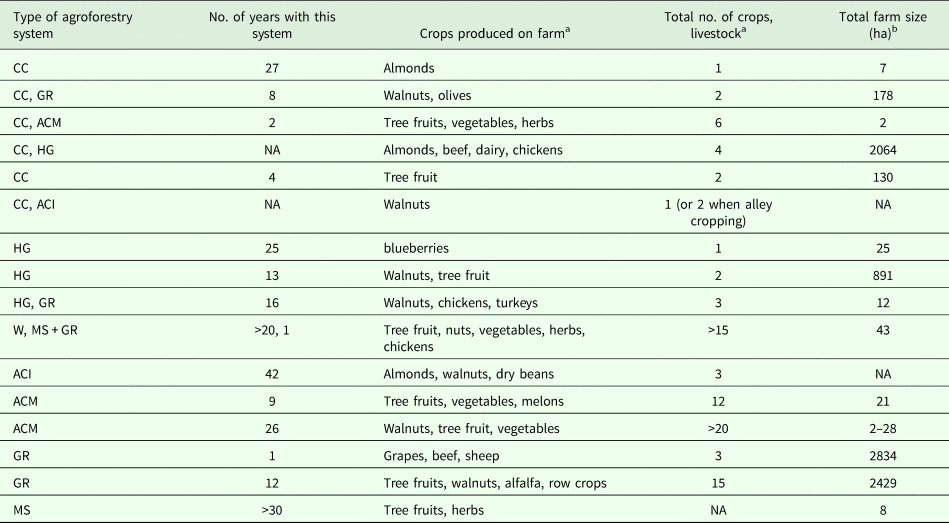
The median farm size of the interviewees is approximately 35 ha, with a mean of 619 ha, compared with a California state mean farm size of 133 ha in 2015 (CDFA, 2016). Nine of the 16 farms were smaller than the California mean farm size, and five were substantially larger (we did not obtain acreage information for two farms) (Table 2). Twelve farmers reported owning half or more of the land they farmed (with nine owning 100%), while two reported farming on exclusively rented land. The mean number of years they have been implementing agroforestry practices is 17, with a median of 15 years (and a range of 1–42 years). The mean number of crops produced is 4.5, with a range from one to 15 (Table 2). Overall, this group consists of smaller-sized and more diverse farms than the population of all farms in California.
Summary of farm characteristics of interviewed farmers

CC, cover crops in orchard/vineyard; HG, hedgerow; W, windbreak; GR, grazing in orchard/vineyard; ACI, alley cropping in immature orchard; ACM, alley cropping in mature orchard; MS, multistory intercropping; MS + GR, multistory intercropping with grazing.
a Denotes crops on whole farm operation, not exclusively those in the agroforestry system.
b Total farm size does not necessarily reflect the area devoted to agroforestry practices, as many farmers practice agroforestry on only a portion of their total farm area.
Perceived benefits of agroforestry practices
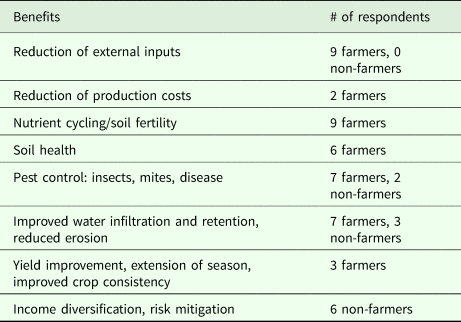
Both farmers and non-farmer interviewees identified a range of benefits of agroforestry systems, including enhanced biophysical functioning, improved economic and farm management and better off-farm environmental effects (Table 3). The most frequently mentioned biophysical benefits were improved soil health (nine farmers), improved nutrient cycling and soil fertility (nine farmers), as well as increased pollination (two farmers), pest control (five farmers), and presence of beneficial insects (three farmers). Two farmers also specifically mentioned having low or almost zero disease pressure in their orchard or vineyard crops, which they attributed to their cover cropping or vineyard grazing practices. One farmer also mentioned not spraying for spider mites in his cover cropped almond orchard, because he knows that over time the population of predatory mites will grow to control the spider mites. Whether or not he attributes this dynamic specifically to the cover crops is unclear, and causation might be difficult to ascertain at this point since he has been cover cropping continuously for over 25 years. Several non-farmers also specifically mentioned pollination benefits (three respondents) and pest control benefits (two respondents). Several farmers noted specific water-related benefits from the improvements in soil condition, including better water retention and improved orchard accessibility, due to better water infiltration. Another noted reduced soil erosion.
Perceived benefits of agroforestry practices

Finally, various economic and farm management benefits were mentioned, such as reduced production costs, better marketing opportunities with more diversified product offerings, increases in total income (especially when alley cropping in non-bearing orchards) and risk diversification. Some other benefits noted are essentially side-effects of having an additional crop in the field, rather than resulting from ecological relationships. For example, newly planted orchard trees were said to receive better care when they are intercropped because of the additional field visits, irrigation and fertilizer provided to the intercrop.
Perceived challenges and drawbacks of agroforestry practices
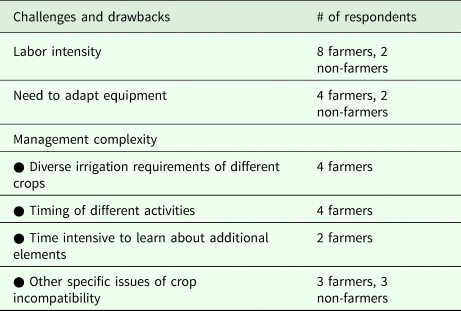
Stated challenges and drawbacks of agroforestry systems can also be broken down into biophysical issues and economic/farm management constraints (Table 4). Some of the most common issues included increased challenges in weed management (especially in hedgerows), and increased incidence of insect and mite pests and diseases. Three non-farming interviewees noted potential problems with pests such as lygus and Hymenoptera insects being attracted by an alley crop, such as beans, and then moving to the nut trees. One farmer noted issues with increased fungal growth (due to increased moisture from a cover crop in the orchard), and one noted that a cover crop attracted more rodents, which damage trees. Two farmers noted increased pest insects when intercropping vegetables in an orchard and when grazing in a multi-story system. Four farmers also mentioned increased challenges in irrigating two or more crops in proximity to each other when they have different water requirements and may need different irrigation systems (e.g., drip systems are commonly used in orchards, but do not provide any water to an intercrop grown between tree rows). The lack of appropriate equipment was mentioned by four farmers and three non-farmers, for example, needing grain harvesters that are small enough to fit between orchard or vineyard rows. One farmer also had to become creative in designing his own higher grape trellises that would keep vine biomass away from browsing sheep.
Perceived challenges and drawbacks of agroforestry practices

The most commonly expressed farm management concerns, however, focused on increased labor requirements and management complexity. Eight farmers and two non-farmers mentioned increases in labor requirements, particularly those farmers with livestock in orchards and vineyards, diverse buffers and hedgerows, and multi-story systems. Three farmers and three non-farmers noted increases in management complexity resulting from many factors, such as having to learn how to produce additional crops, and needing additional labor for hand weeding in complex tree crop assemblages (or in hedgerows) where using equipment was not feasible.
The only cases where respondents noted specific savings in labor needs were in orchard livestock grazing systems. Sheep, for example, perform necessary ‘mowing’ operations and directly reduce the number of equipment passes that would otherwise be required. In some cases, especially where sheep are grazed in vineyards, the livestock reduced the need for fertilizer applications, irrigation and disease prevention inputs (see Mulville, Reference Mulville2011 for a case study written by a California farm manager). However, sheep can also create new management challenges for orchard producers, such as where to keep the animals before and during harvest times, when they need to be out of the orchard. Another source of complexity stems from the fact that pesticides may be legally registered for use on one crop in the agroforestry system but not on another, which would preclude their use when the two crops are grown in close proximity to one another. Additional issues of crop incompatibility were noted. For example, winter grain crops are often incompatible with almonds or other orchard crops that need to be irrigated in the spring just when the grain crops need to dry down. One farmer also thought that dry grain crops can pose a fire risk for orchards in the late spring/early summer when conditions start to become drier and hotter.
Knowledge gaps and research needs for agroforestry in California
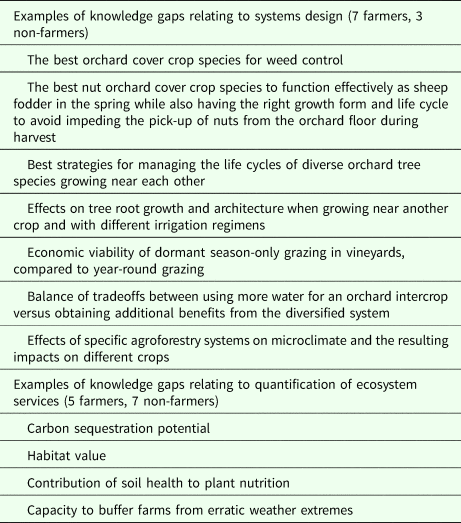
Many respondents detailed knowledge gaps and research needs for agroforestry systems in California. The most commonly stated concerns can be grouped into the following two categories: systems design issues and quantification of ecosystem services (Table 5). In general, the comments by farmers tended to focus primarily on how to design and manage systems to positively affect crop production and avoid negative trade-offs, while the researchers and extension respondents focused more heavily on the need to investigate the ecosystem services and related benefits.
Knowledge gaps and research needs for agroforestry systems

Both categories of respondents noted a need for more funding and extension support to incentivize adoption of agroforestry practices, development of more appropriate equipment and methods to address food safety concerns and regulations (especially with regard to livestock integration with other crops). Finally, two farmers wished to know whether there is any boost to the nutritional value of food crops produced in more diverse, integrated systems compared to those produced in monocropped systems.
Literature review
In this section, we review temperate-region agroforestry literature to shed more light on research evidence on the range of benefits and drawbacks of agroforestry in temperate, industrialized contexts, and to increase understanding of factors that might enhance adoption in this context. We searched English language literature on temperate zone agroforestry and focused, when possible, on studies set in industrialized economies.
Benefits of temperate agroforestry
The literature supports our findings regarding several of the ecosystem benefits noted by interviewees. In terms of nutrient cycling, studies demonstrate increased nitrogen and phosphorus storage in woody components (Montagnini et al., Reference Montagnini, Jordan, Machado, Ashton and Montagnini1999; Millard and Grelet, Reference Millard and Grelet2010), with potential to reduce fallow season nutrient loss, compared to the cycles of senescence and nutrient release in annual crops. Diverse crops with varying rooting depths have been shown to better utilize water and nutrients from the total volume of soil, and the presence of shallow-rooted intercrops can even cause tree roots to grow deeper than they otherwise would (Hauggaard-Nielsen and Jensen, Reference Hauggaard-Nielsen and Jensen2005; Jose et al., Reference Jose, Holzmueller, Gillespie and Garrett2009; Smith et al., Reference Smith, Pearce and Wolfe2011b). In southern France, Andrianarisoa et al. (Reference Andrianarisoa, Dufour, Bienaimé, Zeller and Dupraz2017) found that incorporating walnut trees (for timber) into arable cropland significantly reduced autumn mineral N content in soils compared to grain-only control plots, suggesting reduced winter N leaching potential. Several studies in US agroforestry systems have similarly shown a ‘safety net’ effect of tree roots scavenging soluble N and P, preventing these from leaching deeper in the soil profile (Jose et al., Reference Jose, Holzmueller, Gillespie and Garrett2009). Trees in cropland can also help to transport nutrients from deeper layers to the soil surface via leaf litter (Dosskey et al., Reference Dosskey, Brandle, Bentrup, Schoeneberger, Bentrup and Patel-Weynand2017). Riparian buffers of perennial plants also reduce nitrogen and phosphorus loss into nearby waterways (Jose et al., Reference Jose, Holzmueller, Gillespie and Garrett2009, Reference Jose, Gold, Garrett, Nair and Garrity2012; Schultz et al., Reference Schultz, Isenhart, Colletti, Simpkins, Udawatta, Schultz and Garrett2009; Zhang et al., Reference Zhang, Liu, Zhang, Dahlgren and Eitzel2010). Finally, hydraulic lift, whereby tree roots redistribute water between soil layers, has been demonstrated to make more soil moisture available to understory plants in arid conditions (Jose et al., Reference Jose, Holzmueller, Gillespie and Garrett2009).
Echoing soil health as an important motivating factor among our interviewees, results of a large-scale, multi-country and multi-system study of European agroforestry stakeholders and a survey of southeastern US landowners showed that soil conservation was one of the most important motivating factors for agroforestry practitioners across many systems (Workman et al., Reference Workman, Bannister and Nair2003; García de Jalón et al., Reference García de Jalón, Burgess, Graves, Moreno, McAdam, Pottier, Novak, Bondesan, Mosquera-Losada, Crous-Durán, Palma, Paulo, Oliveira, Cirou, Hannachi, Pantera, Wartelle, Kay, Malignier, Van Lerberghe, Tsonkova, Mirck, Rois, Kongsted, Thenail, Luske, Berg, Gosme and Vityi2017). Studies show that the reduction of soil disturbance with perennials, even in small buffers, can lead to more diverse soil microbial communities and more stable soil structure (Udawatta et al., Reference Udawatta, Kremer, Adamson and Anderson2008). Furthermore, increased plant diversity may reduce the abundance or frequency of soil borne pathogens through several mechanisms, including an increase in soil microbial species richness (Van Bruggen and Semenov, Reference van Bruggen and Semenov2000; Schnitzer et al., Reference Schnitzer, Klironomos, HilleRisLambers, Kinkel, Reich, Xiao, Rillig, Sikes, Callaway, Mangan, van Nes and Scheffer2011). Tree-based intercropping systems with certain species have also been shown to correlate with a greater diversity and abundance of arbuscular mycorrhizal fungi (Bainard et al., Reference Bainard, Klironomos and Gordon2011; Smith et al., Reference Smith, Pearce and Wolfe2011b; Sousa et al., Reference Sousa, Menezes, Sampaio, Lima, Oehl and Maia2013). The presence of these fungi can increase nutrient uptake and distribution within root systems (Sousa et al., Reference Sousa, Menezes, Sampaio, Lima, Oehl and Maia2013). They can also improve water use efficiency by enabling the ability of root cells to adjust their concentration of solutes to adapt to lower water availability (Wu and Xia, Reference Wu and Xia2006).
Studies have found that increases in soil organic carbon in diversified systems as well as an overstory of trees can increase water use efficiency (Kremen and Miles, Reference Kremen and Miles2012; Xiloyannis et al., Reference Xiloyannis, Montanaro, Dichio and Milatovic2016) and reduce evapotranspiration from crops below the canopy (Eastham and Rose, Reference Eastham and Rose1988; Smith et al., Reference Smith, Pearce and Wolfe2011b). Moreover, in a bimodal Mediterranean-type climate, perennial plants begin to grow and develop earlier in the spring than most warm-season annuals, and their already-developed root systems allow them to make more timely use of accumulated soil moisture in early spring (García-Barrios and Ong, Reference García-Barrios and Ong2004; Kantar et al., Reference Kantar, Tyl, Dorn, Zhang, Jungers, Kaser, Schendel, Eckberg, Runck, Bunzel, Jordan, Stupar, Marks, Anderson, Johnson, Sheaffer, Schoenfuss, Ismail, Heimpel and Wyse2016). Woody species may also be better adapted than annual crops to regulated deficit irrigation, which promotes intermittent water stress in plants and can increase water use efficiency (Kozlowski and Pallardy, Reference Kozlowski and Pallardy2002; Costa et al., Reference Costa, Ortuno and Chaves2007; Fereres and Soriano, Reference Fereres and Soriano2007). For example, cycles of wetting and drying can be used to induce earlier budding and dormancy. Also, as noted previously, some woody species have the ability to make osmotic adjustments (by changing concentrations of solutes) at the cellular level so as to decrease plant transpiration under water stress (Kozlowski and Pallardy, Reference Kozlowski and Pallardy2002; Fereres and Soriano, Reference Fereres and Soriano2007).
Studies have also quantified the effect of trees in cropping systems on carbon sequestration (Smith et al., Reference Smith, Pearce and Wolfe2011b; Jose et al., Reference Jose, Gold, Garrett, Nair and Garrity2012; Schoeneberger et al., Reference Schoeneberger, Bentrup and Patel-Weynand2017), a topic of interest expressed by the non-farmer respondents. One California study found that perennial hedgerows stored 18% of the farmscape's total carbon while occupying only 6% of the area (Smukler et al., Reference Smukler, Sanchez-Moreno, Fonte, Ferris, Klonsky, O'Geen, Scow, Steenwerth and Jackson2010). In France, Cardinael et al. (Reference Cardinael, Tiphaine, Cambou, Béral, Barthès, Dupraz, Durand, Kouakoua and Chenu2017) found that silvoarable systems and silvopastoral systems significantly increased above- and below-ground carbon content compared to control plots without trees.
With regards to pest management, studies show that diversified cropping systems, including agroforestry, promote increased insect diversity, greater abundance of natural enemies and decreases in crop pest populations (Stamps and Linit Reference Stamps and Linit1997; Smith et al., Reference Smith, Pearce and Wolfe2011b; Kremen and Miles Reference Kremen and Miles2012; Garrett et al., Reference Garrett, Niles, Gil, Gaudin, Chaplin-Kramer, Assmann, Assmann, Brewer, de Faccio Carvalho, Cortner, Dynes, Garbach, Kebreab, Mueller, Peterson, Reis, Snow and Valentim2017) (see also Altieri and Rosset, Reference Altieri and Rosset1996 for beneficial effects of cover crops in California almond orchards). Livestock integration into orchards has been shown to be effective in suppressing both weeds (Paolotti et al., Reference Paolotti, Boggia, Castellini, Rocchi and Rosati2016) and populations of pest organisms (Smith et al., Reference Smith, Pearce and Wolfe2011b; Buehrer and Grieshop, Reference Buehrer and Grieshop2014). Even limited additions of perennial vegetation within annual cropping systems can enhance both pollination by pollinators and pest control by natural predators (Schulte et al., Reference Schulte, Asbjornsen, Liebma and Crow2006; Asbjornsen et al., Reference Asbjornsen, Hernandez-Santana, Liebman, Bayala, Chen, Helmers, Ong and Schulte2014).
Finally, our interviewees' interest in income and risk diversification as a benefit was echoed by García de Jalón et al. (Reference García de Jalón, Burgess, Graves, Moreno, McAdam, Pottier, Novak, Bondesan, Mosquera-Losada, Crous-Durán, Palma, Paulo, Oliveira, Cirou, Hannachi, Pantera, Wartelle, Kay, Malignier, Van Lerberghe, Tsonkova, Mirck, Rois, Kongsted, Thenail, Luske, Berg, Gosme and Vityi2017), whose survey of European agroforestry stakeholders found that either product diversity or diversification of sources of income were among the top three stated benefits of agroforestry across nine different categories of agroforestry systems. In a North American setting, Valdivia et al. (Reference Valdivia, Gold, Zabek, Arbuckle, Flora and Garrett2009) summarized studies that found that on-farm diversification of enterprises or income sources was an important livelihood strategy for many farmers and many agroforestry practices could fulfill this strategy.
Challenges and drawbacks of temperate agroforestry
The labor intensity of diversified farming and agroforestry systems has been noted by several authors (Iles and Marsh, Reference Iles and Marsh2012; Ferguson and Lovell, Reference Ferguson and Lovell2017; McFarland et al., Reference McFarland, Elevitch, Friday, Friday, Lake, Zamora, Schoeneberger, Bentrup and Patel-Weynand2017), although returns to labor may also be higher (Ferguson and Lovell, Reference Ferguson and Lovell2017). Garrett et al. (Reference Garrett, Niles, Gil, Gaudin, Chaplin-Kramer, Assmann, Assmann, Brewer, de Faccio Carvalho, Cortner, Dynes, Garbach, Kebreab, Mueller, Peterson, Reis, Snow and Valentim2017) also discuss increased management complexity for integrated crop-livestock systems worldwide, and Orefice et al. (Reference Orefice, Carroll, Conroy and Ketner2017) for agroforestry systems in the US northeast. Increased labor needs and management complexity were noted as amongst the most negative aspects of agroforestry in the European study by García de Jalón et al. (Reference García de Jalón, Burgess, Graves, Moreno, McAdam, Pottier, Novak, Bondesan, Mosquera-Losada, Crous-Durán, Palma, Paulo, Oliveira, Cirou, Hannachi, Pantera, Wartelle, Kay, Malignier, Van Lerberghe, Tsonkova, Mirck, Rois, Kongsted, Thenail, Luske, Berg, Gosme and Vityi2017), especially for systems with high-value trees and those with arable crops or livestock integration. They likewise noted the challenge of having to adapt equipment to agroforestry systems, a challenge echoed by Bentrup and Schoeneberger (Reference Bentrup, Schoeneberger, Schoeneberger, Bentrup and Patel-Weynand2017) for windbreaks in the US Great Plains. Smith et al. (Reference Smith, Pearce and Wolfe2011b) noted that agroforestry systems establishment requires higher initial investments, often balanced, however, by higher long-term returns. For some growers, these higher initial costs may be prohibitive in transitioning towards agroforestry systems.
Implications for potential to expand agroforestry acreage
While temperate agroforestry systems appear to offer tangible production and ecosystem benefits, the question remains whether intensive, industrialized systems like those in California can successfully transition to agroforestry, in light of economic and management challenges. Contemporary California agriculture is shaped by several factors; key among them are high labor costs, accounting for almost 20% of total state farm expenditures (UC Agricultural Issues Center 2009b) and water scarcity caused by changing environmental conditions and regulations. As a result, farmers often prefer high value and mechanized cropping systems that can bring the highest immediate returns on investment for labor and water (DeJong et al., Reference DeJong, Day, Johnson and Palmer2008; Johnson and Cody, Reference Johnson and Cody2015), as attested by the phenomenal 50% expansion of land in almonds from 2005 to 2015 (CDFA 2015, 2016), often displacing annual crops.
Despite this widespread crop perennialization trend, adoption of diversity-enhancing features in California has occurred only to a limited extent, despite decades of extension and government cost-share programs (Garbach and Long, Reference Garbach and Long2017). For example, in a state measuring over 243,000 km2, we conservatively estimate that only approximately 282 km (175 miles) of hedgerows have been planted statewide in the last 20 years, according to a compilation of data (2017, unpublished) from the state Natural Resources Conservation Service office and three of the most active private sector technical service providers. Even in a relatively hedgerow-intensive case study area, only 4–5% of available farm edges are utilized, and farmers identify cost and labor requirements as major concerns (Brodt et al., Reference Brodt, Klonsky, Jackson, Brush and Smukler2008; Garbach and Long, Reference Garbach and Long2017). In a context of high land, labor and water costs, do profit generating multi-species agroforestry systems stand a better chance of being adopted than noncommercial cover crops and hedgerows? To answer this question, we identify two distinct problem domains: (1) adding diversity to perennial orchard and vineyard acreage, and (2) adding perennial elements to annual systems such as vegetable and grain crops.
In the case of diversifying orchards and vineyards, our interviewees suggested that already profitable and low-labor orchard crops provide little incentive to growers to take on the additional labor, management and equipment needed for an additional crop or livestock component, a dynamic also found by Di Falco and Perrings (Reference Di Falco and Perrings2005). Contracting out the management of a second crop to other producers may offer a feasible alternative, by allowing each producer to focus on the specialized knowledge and labor needs of his/her one crop. However, such arrangements also require careful coordination. For example, one orchard producer in our study found that a shepherd he contracted did not rotate the sheep through the orchard quickly enough to keep up with cover crop growth and prevent seed set. Management challenges like these suggest a potential niche for professional grazing coordinators who understand the primary needs on both sides, who can assist in timely communications, and who can also find alternative rangeland for grazing the livestock at times when they must be removed from the orchard. This need for institutional innovation to support farm diversification is also noted in the literature (e.g., Bacon et al., Reference Bacon, Getz, Kraus, Montenegro and Holland2012).
Equipment innovations or increased commercial availability of small-scale equipment (e.g., grain harvesters) capable of working annual crops between tree rows are also needed. Such small-scale equipment is typically more available in Europe than in the USA. The high value of many orchard crops, compared to most row crops, provides significant disincentives for reducing the density of trees by widening the space between rows. An intercrop must also either be profitable enough to warrant the additional irrigation needed to water orchard alleys during the summer season, or be a cool season crop that can be grown during the rainy season. Such options may only be palatable in the relatively wetter, northern half of the state.
In the second case, that of adding a perennial component to annual cropping systems, field edge hedgerows and windbreaks might offer producers an appealing option that does not interfere as much with annual crop production. Those with perennial species that have commercial potential may offer an additional incentive. For example, elderberries are often planted as a component in multi-species hedgerows, but very few elderberries in California are harvested commercially. This is despite the presence of craft producers of syrups, jams and wines, who must often source product from commercial operations in the US Midwest (Sarah Rosenoff and Katie Reneker, small business owners, personal communications 2017). Fruit and nut trees, vine crops, perennial Mediterranean herbs and medicinal plants and traditional California indigenous food plants may all offer more profitable alternatives to non-commercial hedgerow species. The need for new business opportunities and markets for ecosystem services (e.g., carbon credit payment schemes), that could compensate farmers for the positive externalities of agroforestry has also been noted by García de Jalón et al. (Reference García de Jalón, Burgess, Graves, Moreno, McAdam, Pottier, Novak, Bondesan, Mosquera-Losada, Crous-Durán, Palma, Paulo, Oliveira, Cirou, Hannachi, Pantera, Wartelle, Kay, Malignier, Van Lerberghe, Tsonkova, Mirck, Rois, Kongsted, Thenail, Luske, Berg, Gosme and Vityi2017) and Iles and Marsh (Reference Iles and Marsh2012).
In addition, farmers would be greatly assisted in their efforts to diversify and perennialize with better knowledge about optimal design options (see also Jose et al., Reference Jose, Gold, Garrett, Nair and Garrity2012). One plausible reason that several respondents perceived agroforestry as more labor and management intensive is that their systems are not designed to maximize functional ecological relationships that could actually reduce the need for external labor inputs. Livestock integration with tree/vine crops is the notable exception, supported by evidence that it can reduce weed control inputs (Garrett et al., Reference Garrett, Niles, Gil, Gaudin, Chaplin-Kramer, Assmann, Assmann, Brewer, de Faccio Carvalho, Cortner, Dynes, Garbach, Kebreab, Mueller, Peterson, Reis, Snow and Valentim2017).
Several of the systems we examined seemed to be designed primarily for the convenience of space and equipment availability and for the marketing potential of each component. While these are essential criteria, they do not necessarily lead to the most effective and efficiently functioning system. Often, the different species are managed simply to tolerate each other, and any benefits accrue incidentally, such as when newly planted orchard trees benefit from the added attention and inputs when beans are intercropped. This finding is echoed by Orefice et al. (Reference Orefice, Carroll, Conroy and Ketner2017) who found that managers of silvopasture systems in the northeastern US were usually focused on benefits to either the livestock component or the tree component, and seldom on both together as an integrated whole. We could learn from the example of agroforestry research for the tropics (García-Barrios and Ong, Reference García-Barrios and Ong2004), and from cover crops research in temperate zones, with a long history of trials to determine the best species mixes for specific climates, cropping systems, and functional goals, and a large suite of extension resources (e.g., Ingels, Reference Ingels1998; Smith et al., Reference Smith, Bugg and Gaskell2011a; Clark, Reference Clark2012).
Ideally, all agroforestry systems could be designed to take advantage of both facilitation effects—as when one species positively modify the environment for a second species—and competition effects—as when two species negatively affect each other but, in combination, utilize available resources more efficiently than in sole cropping (Vandermeer, Reference Vandermeer1989; García-Barrios and Ong, Reference García-Barrios and Ong2004). Our ability to design for these effects is currently limited by several factors. First, scientific research on ecological relationships between commercial agricultural species, especially in a temperate context, has to date been limited. Dynamic modeling and design work examining such relationships has most often been performed for tropical and developing economy environments (García-Barrios and Ong, Reference García-Barrios and Ong2004), and not temperate industrialized systems. Secondly, what research exists has not been translated into practical forms, such as easily accessible species databases that detail the ecosystem functionality of species. Respondents also noted that extension professionals lack training in multi-cropping systems and often advise against them, an issue also noted in other regions of the USA (Workman et al., Reference Workman, Bannister and Nair2003; Jacobson and Kar, Reference Jacobson and Kar2013; Orefice et al., Reference Orefice, Carroll, Conroy and Ketner2017). Thirdly, breeding for agricultural species has primarily selected for optimizing yield and other characteristics in monocropping contexts, and not for optimizing relationships in intercropping conditions.
Conclusions
Judging from the data we collected in our interviews, as well as information from the literature, several types of agroforestry systems are not only viable in an industrialized agriculture setting like that of California but also offer documented biophysical and environmental conservation benefits. The most prominently used systems include winter cover cropping and grazing in orchards, perennial plantings on farm edges (hedgerows, buffers, windbreaks), and alley cropping in newly planted orchards. Other more complex multi-story intercropping systems uncovered in this study also offer benefits, but their viability on a long-term, commercial scale is less proven. Some of the largest barriers appear to be socio-economic, especially in the case of diversifying already existing orchards. Orchard crops are such a high-value investment that their conversion to agroforestry seems most likely with systems that maintain existing orchard tree spacing, irrigation and other management practices to prevent any reduction in the high-profit potential of the tree crops. In addition, with any type of agroforestry system, considerations for optimizing water productivity—such as by focusing on either rainy season or highly drought-tolerant intercrops—are of paramount importance in a Mediterranean-like climate, where water is often a limiting factor during the primary summer growing season. Those seeking to disseminate agroforestry systems also need to pay careful attention to choosing species assemblages and/or institutional arrangements (e.g. subcontracting) that will minimize added labor and management demands, which are expensive inputs in industrialized economies.
More systematic development of climate-relevant and labor-reducing designs is needed in order to create more viable systems. Moving forward requires input from farmers actively experimenting with agroforestry systems, as well as controlled field trials where conditions of interspecific interactions can be better manipulated and measured. Farmer-researcher networks that can monitor and document the facilitative and competitive relationships in existing on-farm systems, as well as dedicated research station trials of new assemblages of species will both be important means to achieving viable agroforestry designs for temperate, industrialized contexts such as California.
Author ORCIDs
Sonja B. Brodt, 0000-0002-5979-7371
Supplementary material
The supplementary material for this article can be found at https://doi.org/10.1017/S1742170519000140
Acknowledgements
We gratefully acknowledge valuable comments from Dr Amber Kerr, which made this a stronger paper. This study was self-funded by the University of California Sustainable Agriculture Research and Education Program.