Introduction
Rice production in the mid-southern United States mostly relies on inbred long-grain cultivars with tropical japonica heritage; however, inbred medium-grain cultivars are also grown in moderation filling geographical or industrial niches (McKenzie et al. Reference McKenzie, Sha, Moldenhauer, Linscombe, Lyman, Nalley, Smith, Diers, Specht, Carver and Gains2014). In recent years, hybrid cultivars have increased in production hectarage due to their yield advantages, disease resistance, and shorter vegetative stage duration (Lyman and Nalley Reference Lyman and Nalley2013). Inbred long-grain cultivars, inbred medium-grain cultivars, and hybrid cultivars exhibit differing growth habits and may exhibit differential responses and tolerance to herbicides (Bond and Walker Reference Bond and Walker2011, Reference Bond and Walker2012; Montgomery et al. Reference Montgomery, Bond, Golden, Gore, Edwards, Eubank and Walker2014; Scherder et al. Reference Scherder, Talbert and Clark2004; Willingham et al. Reference Willingham, McCaulet, Senseman, Chandler, Richburg, Lassiter and Mann2008; Zhang et al. Reference Zhang, Webster and Braverman2000).
Previous research has indicated that long-grain cultivars exhibit greater tolerance to herbicides than medium-grain or hybrid cultivars (Bond and Walker Reference Bond and Walker2011, Reference Bond and Walker2012; Bond et al. Reference Bond, Walker, Webster, Buehring and Harrell2007; Scherder et al. Reference Scherder, Talbert and Clark2004; Willingham et al. Reference Willingham, McCaulet, Senseman, Chandler, Richburg, Lassiter and Mann2008). Bond and Walker (Reference Bond and Walker2011) compared the response to imazamox of the inbred long-grain cultivar ‘CL161’ with two hybrid cultivars ‘CLXL729’ and ‘CLXL745’. When imazamox was applied across five growth stages, hybrid cultivars exhibited less tolerance and greater yield reductions than the inbred cultivar (Bond and Walker Reference Bond and Walker2011). A similar study suggested variable tolerance to quinclorac among rice cultivars where yields of the inbred long-grain cultivar ‘Cheniere’ and the hybrid cultivar ‘XL723’ were reduced more than that for the inbred long-grain cultivar ‘Bowman’ (Bond and Walker Reference Bond and Walker2012). Willingham et al. (Reference Willingham, McCaulet, Senseman, Chandler, Richburg, Lassiter and Mann2008) observed the hybrid cultivar ‘XP172’ was less tolerant to penoxsulam than inbred long- or medium-grain cultivars. Zhang et al. (Reference Zhang, Webster and Braverman2000) evaluated cultivar differences to application of bispyribac-sodium and reported that five inbred long-grain rice cultivars exhibited equivalent tolerance, but two medium-grain cultivars exhibited differential tolerance between one another and to that of the long-grain cultivars. Applications of saflufenacil have produced greater injury on hybrid and medium grain cultivars compared with inbred long grain cultivars (Montgomery et al. Reference Montgomery, Bond, Golden, Gore, Edwards, Eubank and Walker2014).
Studies evaluating rice exposure to sublethal concentrations of non-target herbicides, have also reported differential tolerance may be observed among rice cultivars (Bond and Walker Reference Bond and Walker2011; Koger et al. Reference Koger, Shaner, Krutz, Walker, Buehring, Henry, Thomas and Wilcut2005; Kurtz and Street, Reference Kurtz and Street2003). Kurtz and Street (Reference Kurtz and Street2003) reported yield differences across the inbred long-grain cultivars ‘Cypress’, ‘Lemont’, and ‘Priscilla’ following exposure to glyphosate. Yield reductions were less for Lemont (8%) than that of Cypress (87%) or Priscilla (67%) when glyphosate was applied at the boot growth stage (Kurtz and Street Reference Kurtz and Street2003). Similarly, ‘Cocodrie’ exhibited greater yield reductions when exposed to glyphosate than ‘Priscilla’ (Koger et al. Reference Koger, Shaner, Krutz, Walker, Buehring, Henry, Thomas and Wilcut2005). The most likely explanation for varied herbicide tolerance among long- and medium-grain rice cultivars is differences in tolerance among the parent lines utilized in cultivar development. Wenefrida et al. (Reference Wenefrida, Croughan, Utomo, Meche, Wang and Herrington2004) reported that the parent line for ‘CL161’ was eight times more tolerant to imazethapyr than the parent line for ‘CL121’. Differences among parent lines explain tolerance differences between inbred and hybrid cultivars as well (Bond and Walker Reference Bond and Walker2011).
In Mississippi, rice is often grown in close proximity to soybeans, cotton, corn, or grain sorghum. Within these crops, particularly soybeans, desiccant use is widely distributed. It is estimated that 70% of Mississippi soybean hectarage receives a desiccant application. The most commonly used desiccant in these applications is paraquat, recommended at a use rate of 140 to 280 g ai ha−1 (Anonymous 2018). Glyphosate is also recommended as a desiccant at a rate of 842 to 3,932 g ae ha−1 for conventional soybean varieties (Anonymous 2018). Although early season rice response to herbicide exposure has been evaluated, the extensive usage of desiccants in Mississippi creates the potential for exposure later in the season. With the potential for late-season exposure coupled with differential herbicide tolerance among rice cultivars, a need for research evaluating rice cultivar response with a late-season desiccant exposure was created. The primary objective of this research was to evaluate rice cultivar crop injury response, rough rice grain yield, and milling quality response to exposure to sublethal concentrations of glyphosate and paraquat.
Materials and Methods
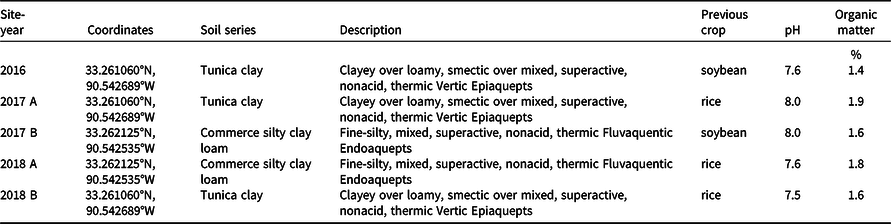
Five field studies, one in 2016 and two each in 2017 and 2018, were established at the Mississippi State University Delta Research and Extension Center in Stoneville, MS, to determine the effects of sublethal concentrations of glyphosate and paraquat on multiple rice cultivars. Global positioning system coordinates, soil series, soil description, previous crop, soil pH, and soil organic matter (OM) for each study are described in Table 1.
Geographic location, soil classification, and agronomic information for field studies evaluating rice cultivar response to sub-lethal concentrations of glyphosate and paraquat. a

a Studies were conducted at Mississippi State University Delta Research and Extension Center in Stoneville, MS.
Each year a management plan consisting of glyphosate (Roundup PowerMax 4.5 L, 1,120 g ae ha−1, Monsanto Company, 800 N. Lindburgh Blvd., St. Louis, MO 63167) and/or paraquat (Gramoxone 2.0 SL, 560 g ai ha−1, Syngenta Crop Protection, P.O. Box 18300, Greensboro, NC 27409) was applied at each site year prior to planting to control emerged vegetation. Clomazone (Command 3 ME, 498 g ai ha−1, FMC Corporation, 1735 Market St., Philadelphia, PA 19103) plus saflufenacil (Sharpen 2.85 SC, 4.5 g ai ha−1, BASF Crop Protection, 26 Davis Dr., Research Triangle Park, NC 27709) were applied PRE each site year for residual weed control. Propanil (Stam M4, 1,121 g ai ha−1, RiceCo, 5100 Poplar Avenue, Suite 2428, Memphis, TN 38137) and quinclorac (Facet 1.50 SL, 375 g ai ha−1, BASF Crop Protection) plus halosulfuron (Permit 75 DF, 12 g ai ha−1, Gowan Company, P.O. Box 5569, Yuma, AZ 85364) were applied preflood. Across all studies nitrogen fertilizer was applied at a uniform rate of 80 kg N ha−1 in the form of urea (46-0-0) prior to flood establishment. When rice reached the two tiller stage a 6- to 10-cm-depth permanent flood was established across all plots. Rice management closely followed the Mississippi State University Extension Service recommendations for stand establishment, pest management, and irrigation management (Buehring Reference Buehring2008).
A cultivar response study was conducted at the Mississippi State University Delta Research and Extension Center in Stoneville, MS, to determine the response to paraquat and glyphosate of five rice cultivars common to Mississippi. The rice cultivars were drill-seeded at their respective recommended seeding rates (41 kg ha−1 hybrid or 83 kg ha−1 inbred) using a small-plot grain drill (Great Plains 1520, Great Plains Mfg, Inc., 1525 East North St., Salina, KS 67401) into conventionally tilled plots. Plots measured 1.5 × 4.5 m, containing 8 rows of rice spaced 20 cm apart, 4.5 m in length, and separated by a perpendicular alley 1.5 m in width. Treated plots were bordered on either side by identically sized buffer plots to minimize treatment contamination across the experimental area.
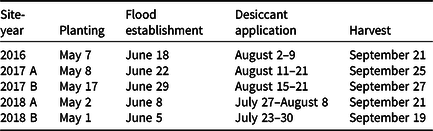
Individual studies were arranged with a 3 (desiccant treatment) × 5 (rice cultivar) factorial within a randomized block design with four replications. Desiccant treatments included no desiccant, paraquat at 28 g ha−1, and glyphosate at 126 g ha−1, applied at the 50% heading (when 50% of panicles had emerged from the leaf sheath) growth stage respective to cultivar (Table 2). All desiccant treatments were applied at 1/10 of the recommended desiccant use rate in Mississippi (Al-Khatib and Peterson Reference Al-Khatib and Peterson1999; Anonymous 2018; Wolf et al. Reference Wolf, Grover, Wallace, Shewchuk and Maybank1992) using a CO2-pressurized backpack sprayer equipped with flat-fan nozzles (AM11002 nozzle, Greenleaf Technologies, 230 E Gibson St., Covington, LA 70433) set to deliver 140 L ha−1 at 206 kPa using water as a carrier. These methods parallel simulated off-target movement previously tested with constant carrier volume, utilizing reduced herbicide rates to simulate low concentration exposure (Davis et al. Reference Davis, Scott, Norsworthy and Gbur2011; Ellis et al. Reference Ellis, Griffin and Jones2002). All desiccant treatments included methylated seed oil at 1% vol/vol. Rice cultivar treatments included the hybrid long-grain cultivars ‘CLXL 745’ (HorizonAg, 8275 Tournament Dr. Suite 255, Memphis, TN 38125) and ‘XL 753’ (RiceTec Inc., 13100 Space Center Blvd., Suite 300, Houston, TX 77059), the inbred long-grain cultivars ‘CL163’ (HorizonAg) and ‘Rex’ (Mississippi State University, Mississippi State, MS 39762), and the inbred medium-grain cultivar ‘Jupiter’ (LSU Ag Center, 101 Efferson Hall, Baton Rouge, LA 70803).
Selected dates of agronomic management events for research trials evaluating rice cultivar response to sublethal concentrations of glyphosate and paraquat. a

a Studies were conducted 2016–2018 at the Delta Research and Extension Center in Stoneville, MS.
Visible estimates of rice injury were recorded 3, 7, 14, 21, and 28 d after application (DAA) on a scale of 0% to 100%, with 0% indicating no visual effect of herbicides and 100% indicating complete plant death. At maturity, whole aboveground portions of rice plants were collected from a random 1-m section from rows 2 or 7 in each plot to determine rice dry weight, yield components (panicle number per square meter and 1,000-grain weight), and harvest index. Plots were then mechanically harvested with a small-plot combine (Wintersteiger Delta, Wintersteiger, Inc., 4705 W. Amelia Earhart Dr., Salt Lake City, UT 84116) to obtain rough rice yield. Rice yields were recorded and adjusted to 12% moisture for uniform statistical yield analysis. Hand-harvested samples were allowed to dry in the greenhouse for 2 wk at 32 to 49 (±5) C, then weighed to determine rice dry weight, and weights were converted to grams per square meter. The total number of panicles in each hand-harvested sample were counted to determine panicle number per square meter. Hand-harvested samples were then threshed using a plot thresher to determine seed 1,000-grain weight. Harvest index in each plot was calculated by dividing the grain weight by the total plant dry weight. Total milled (consisting of whole and broken kernels) and head rice (consisting of whole kernels) yields were then determined from cleaned 120-g subsamples of rough rice utilizing the procedure outlined by Adair et al. (Reference Adair, Bollich, Bowman, Jordon, Johnson, Webb and Atkins1972). Percentage of nontreated control data were calculated by dividing the data from the treated plot by that in the nontreated control plot in the same replication and multiplying by 100.
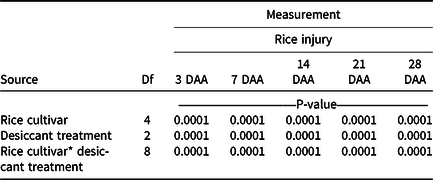
Data were subjected to ANOVA using the PROC MIXED procedure in SAS v. 9.4 (SAS Institute Inc., 100 SAS Campus Drive, Cary, NC 27513) with experimental replication (nested within site-year) as a random effect parameter (Blouin et al. Reference Blouin, Webster and Bond2011). Type III statistics were used to test the fixed effects of cultivar and desiccant treatment for rice injury (Table 3), rice grain yield, total aboveground dry weight, yield components (panicle number per square meter and 1,000-grain weight), harvest index, and milling component data (total milled and head rice yield; Table 4). For each relationship, maximum relative yield was defined as 5% less than the predicted maximum (100%; Slaton et al. Reference Slaton, Golden, Delong and Mozaffari2010). Least square means were calculated, and mean separation (P < 0.05) was produced using the PDMIX800 procedure in SAS, a macro for converting mean separation output to letter groupings (Saxton Reference Saxton1998).
Analysis of variance for rice injury at 3, 7, 14, 21, and 28 d after application in a study evaluating sublethal concentrations of glyphosate and paraquat. a,b

a Studies were conducted 2016–2018 at the Delta Research and Extension Center in Stoneville, MS.
b Abbreviation: DAA, days after application.
Analysis of variance for rough rice grain yield, dry weight, number of pannicles per square meter, 1,000-grain weight, harvest index, and milling component data in a study evaluating sublethal concentrations of glyphosate and paraquat. a

a Studies were conducted 2016–2018 at the Delta Research and Extension Center in Stoneville, MS.
Results and Discussion
Rice Injury
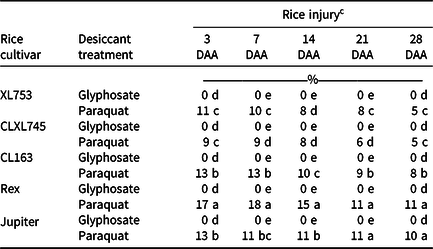
The interaction of rice cultivar and desiccant treatment influenced rice injury (Table 3). At all evaluations, no injury was observed from rice receiving glyphosate (Table 5). At 3 DAA, rice injury following a paraquat application was greatest (17%) for the inbred cultivar Rex. The hybrid cultivars XL753 and CLXL745 exhibited less injury, 11% and 9% respectively, than all inbred cultivars 3 DAA (Table 5). At 7 DAA, paraquat application to cultivar Rex produced the greatest visual injury (18%) followed by paraquat applications to cultivars in the order of magnitude of CL163 = Jupiter, CL163 > XL753, Jupiter = XL753 > CLXL745 (Table 5). Rex following a paraquat application produced the greatest visual injury (15%) 14 DAA, followed by paraquat applications to cultivars in the order of magnitude of Jupiter > CL163 > XL753 = CLXL745 (Table 5.). At the 21 DAA evaluation, rice injury was greatest with cultivars Rex and Jupiter, 11% respectively, followed by paraquat applications to cultivars in the order of magnitude of CL163 > XL753 > CLXL745 (Table 5.). At 28 DAA, rice injury had reduced to less than 11%. Paraquat applications to cultivars Rex and Jupiter produced the greatest visual injury 28 DAA, 11% and 10% respectively, followed by paraquat applications to cultivars in the order of magnitude of CL163 > XL753 = CLXL745 (Table 5).
Rice injury 3, 7, 14, 21, and 28 d after application (DAA) as influenced by the interaction of rice cultivar and desiccant treatment. a,b

a Studies were conducted 2016–2018 at the Delta Research and Extension Center in Stoneville, MS.
b Abbreviation: DAA, days after application.
c Means within a column followed by the same letter are not significantly different at P ≤ 0.05.
Cultivar sensitivity to glyphosate was observed to be similar across all cultivars tested, with glyphosate producing no rice injury at all evaluations (0%). Congruent with the current research, Davis et al. (Reference Davis, Scott, Norsworthy and Gbur2011) reported <3% visual injury with glyphosate exposure at reproductive growth stages. Glyphosate is a readily translocated, systemic herbicide and what little glyphosate symptoms appear are normally on new emerging vegetation (Shaner Reference Shaner2014). By 50% heading there is little to no new emerging vegetation rendering glyphosate injury symptoms undetectable. However, rice cultivar injury tolerance varied with paraquat applications. In general, hybrid cultivars XL753 and CLXL745 exhibited greater tolerance across evaluations with regards to injury than all inbred cultivars. Differential tolerance to paraquat applications was observed among inbred cultivars as Rex exhibited the greatest injury symptomology up to 21 DAA. Differential cultivar injury symptomology to herbicides has been observed in a number of crops including rice, soybean [Glycine max (L.) Merr.], corn (Zea mays L.), and wheat (Triticum aestivum L.; Edwards et al. Reference Edwards, Barrentine and Kilen1976; Griffin and Baker Reference Griffin and Baker1990; Renner et al. Reference Renner, Meggitt and Penner1988; Runyan et al. Reference Runyan, McNeil and Peeper1982). Physiological differences among rice cultivars may have been attributed to the differences observed in visible injury. Rex exhibits a prominent and wide flag leaf compared to other cultivars (Solomon et al. Reference Solomon, Kanter, Walker, Baird, Scheffler, Lanford and Shaifer2012). Previous research has suggested that medium-grain rice cultivars may exhibit lower herbicide tolerance than long-grain cultivars (Lanclos et al. Reference Lanclos, Webster and Zhang1999; Mudge et al. Reference Mudge, Webster, Leon and Zhang2005). However, in the current research, medium-grain inbred cultivar Jupiter exhibited similar injury with inbred long-grain cultivars. This research suggests hybrid cultivar tolerance in regards to visible injury following paraquat applications at the 50% heading growth stage is greater than that of inbred cultivars.
Rice Dry Weight
Rice dry weight was influenced by the main effect of desiccant treatment when pooled across rice cultivar (Table 4). Following glyphosate application rice dry weight was 98% of the nontreated. However, following paraquat application rice dry weight was 10% less than the nontreated (data not shown). Rice dry weight following paraquat application may be attributed to the visible injury measured with these applications. Rice injury may have allowed for faster desiccation of the plants than plots receiving no herbicide or glyphosate applications, resulting in reductions of rice dry weight at harvest.
Rough Rice Grain Yield
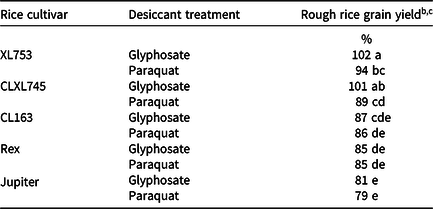
The interaction of rice cultivar and desiccant treatment influenced rough rice grain yield (Table 4). Following applications of glyphosate to the hybrid cultivars rough rice grain yield was 102% and 101% for XL753 and CLXL745, respectively (Table 6). XL753 and CLXL745 produced rough rice grain yield of 94% and 89% following an application of paraquat. Hybrid cultivars exhibited rough rice grain yields following paraquat application that were lesser than their respective yields following glyphosate application. The inbred cultivar CL163 exhibited a rough rice grain yield of 87% and 86% following glyphosate or paraquat application, respectively, and were similar to one another. Similarly, the inbred cultivar Rex produced a rough rice grain yield of 85% following glyphosate or paraquat application. Rough rice grain yield was similar, 81% and 79% for Jupiter (medium-grain, Inbred) following glyphosate or paraquat application, respectively. Among inbred cultivars applications of glyphosate or paraquat caused similar yield reductions to one another (Table 6). Rough rice grain yield of the hybrid cultivar CLXL745 was reduced in a way that was similar to that of the inbred cultivars following paraquat application (11%), while also similar to that of XL753 following paraquat exposure.
Rough rice grain yield as influenced by the interaction of rice cultivar and desiccant treatment. a

a Studies were conducted 2016–2018 at the Delta Research and Extension Center in Stoneville, MS.
b Means within a column followed by the same letter are not significantly different at P ≤ 0.05.
c Data presented as % nontreated.
Differences among cultivars and herbicide tolerance has been reported previously (Davis et al. Reference Davis, Scott, Norsworthy and Gbur2011; Golden et al. Reference Golden, Lawrence, Bond, Edwards and Walker2017; Lanclos et al. Reference Lanclos, Webster and Zhang1999; Mudge et al. Reference Mudge, Webster, Leon and Zhang2005). Previous research suggests that hybrid cultivars may incur greater yield reductions than inbred cultivars with glyphosate exposure (Davis et al. Reference Davis, Scott, Norsworthy and Gbur2011). However, in the current research hybrid cultivars exhibited no yield decrease with glyphosate applied at the 50% heading growth stage, whereas all inbred cultivars evaluated presented yield reductions of >14% with glyphosate exposure at the same growth stage. The inbred medium-grain cultivar Jupiter exhibited tolerance similar to the other inbred cultivars following application of glyphosate or paraquat at 50% heading, with yield reductions of 19% and 21%, respectively. In contrast, previous literature has suggested that medium-grain rice cultivars are less tolerant to some herbicides than long-grain cultivars (Lanclos et al. Reference Lanclos, Webster and Zhang1999; Mudge et al. Reference Mudge, Webster, Leon and Zhang2005). Paraquat applications resulted in rough rice grain yield reductions across all cultivars ranging from 6% to 21%. These observations were congruent with findings reported by Namenek et al. (Reference Namenek, Smith and Branson2001) and Calhoun et al. (Reference Calhoun, Barber, Norsworthy, Doherty and Hill2016), who suggested that yield reductions ranging from 45% to 96% when rice was exposed to paraquat at various growth stages. In the current research, yield reductions with glyphosate ranged from 13% to 19% among inbred cultivars. Likewise, Hensley et al. (Reference Hensley, Webster, Blouin, Harrell and Bond2013) reported rice yield reductions due to a glyphosate exposure at vegetative and reproductive growth stages. In the current research, rough rice grain yield was reduced following applications of paraquat across all cultivars or glyphosate with inbred cultivars. However, lesser reductions than previously reported evaluating these herbicides were observed. Lesser yield reductions in the current research could be due to the later timing of herbicide application (50% heading) when compared to previous studies.
Rice 1,000 Grain Weight
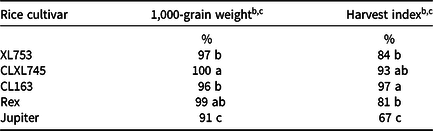
Rice 1,000-grain weight was influenced by the main effect of rice cultivar when pooled across desiccant treatment (Table 4). The inbred medium-grain cultivar Jupiter exhibited the least 1,000-grain weight (91% of the nontreated) following exposure to glyphosate or paraquat (Table 7). Rice 1,000-grain weight following glyphosate or paraquat exposure was greatest with cultivars CLXL745 and Rex. Rex 1,000-grain weight was also similar to those of CL163 and XL753. With the exception of Jupiter, all rice cultivars displayed 1,000-grain weight >95% of the nontreated.
Rice 1,000-grain weight and harvest index as influenced by the main effect of rice cultivar pooled across desiccant treatment. a

a Studies were conducted 2016–2018 at the Delta Research and Extension Center in Stoneville, MS.
b Means within a column followed by the same letter are not significantly different at P ≤ 0.05.
c Data presented as % nontreated.
Reductions in 1,000-grain weight were observed with the inbred medium-grain cultivar Jupiter following glyphosate or paraquat applications. Leaf removal or herbicide injury has been demonstrated to affect rice seed weight and yield (Counce et al. Reference Counce, Wells, Norman and Leong1994; Davis et al. Reference Davis, Scott, Norsworthy and Gbur2011). Research conducted by Davis et al. (Reference Davis, Scott, Norsworthy and Gbur2011) suggests rice injury due to glufosinate or glyphosate can reduce seed weight by up to 14%. Similarly, Counce et al. (Reference Counce, Wells, Norman and Leong1994) observed rice seed weight reductions due to leaf removal. Although rice injury was observed following paraquat application with all rice cultivars evaluated, Jupiter exhibited the greatest injury 21 and 28 DAA. This demonstrated the inability of Jupiter to exhibit any sort of recovery from paraquat application may have contributed to the reduction in 1,000-grain weight. Although previous studies have reported seed weight reductions due to glufosinate or glyphosate applications in both inbred and hybrid cultivars (Davis et al. Reference Davis, Scott, Norsworthy and Gbur2011), the current research observed a 1,000-grain weight reduction only in the inbred medium-grain cultivar Jupiter.
Rice Harvest Index
Rice harvest index was influenced by the main effect of rice cultivar when pooled across desiccant treatment (Table 3). The lowest rice harvest index (67%) was produced by Jupiter following glyphosate or paraquat exposure (Table 7). CL163 produced the greatest rice harvest index (97%) following glyphosate or paraquat exposure. The rice harvest index for CLXL745 was 93% and similar to those of CL163, Rex, and XL753. Rex and XL753 produced rice harvest indexes less than that of CL163 but greater than that of Jupiter. Of the five cultivars evaluated four produced a rice harvest index <95% following glyphosate or paraquat exposure.
Rice harvest index reductions have been suggested to be a strong predictor of yield reductions (Perez et al. Reference Perez, Laca, Mackill, Fernandez and Fischer2006). In the current research, rough rice grain yield was reduced following paraquat application across all cultivars and glyphosate application among inbred cultivars. Observed reductions in harvest index may be strong indicators of either grain or grain-fill loss due to glyphosate or paraquat exposure. The greatest harvest index reductions were with Jupiter, which also exhibited rough rice grain yield reductions following glyphosate or paraquat application. Harvest index reductions may also suggest that affected cultivars did not realize decreases in vegetative dry weight accumulation, but rather decreases in grain weight accumulation leading to rough rice grain yield losses.
Total Milled Rice
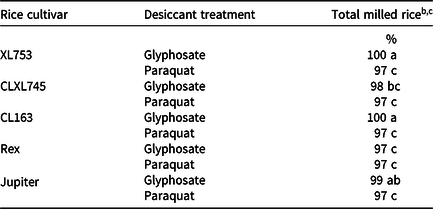
Total milled rice was influenced by the interaction of rice cultivar and desiccant (Table 4). Although an interaction was detected for total milled rice, all rice cultivars and herbicide treatments produced total milled rice >95% of the nontreated (Table 8). Therefore, data are not different than the relative maximum, rendering it not agronomically significant.
Total milled rice as influenced by the interaction of rice cultivar and desiccant treatment. a

a Studies were conducted 2016–2018 at the Delta Research and Extension Center in Stoneville, MS.
b Means within a column followed by the same letter are not significantly different at P ≤ 0.05.
c Data presented as % nontreated.
Head Rice Yield
Head rice yield was influenced by the main effects of rice cultivar and desiccant (Table 4). Pooled across rice cultivar, rice that received glyphosate application produced a greater head rice yield (99%) than that of rice that received paraquat application (92%). A head rice yield reduction following paraquat exposure of 8% suggests that across cultivar, rice grain quality expresses sensitivity to paraquat exposure, whereas glyphosate has no effect on milling quality.
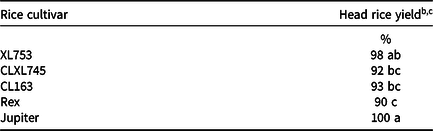
Pooled across desiccant, cultivar Rex produced the lowest head rice yield (90%) following exposure to glyphosate or paraquat (Table 9). The cultivars Jupiter and XL753 produced head rice yield similar to each another and >95%. XL753 produced a head rice yield also similar to that of CLXL745 and CL163. The rice cultivars CLXL745, CL163, and Rex produced head rice yields <95% and similar to those of each other, following exposure to glyphosate or paraquat.
Head rice yield as influenced by the main effect of rice cultivar pooled across desiccant treatment. a

a Studies were conducted 2016–2018 at the Delta Research and Extension Center in Stoneville, MS.
b Means within a column followed by the same letter are not significantly different at P ≤ 0.05.
c Data presented as % nontreated.
These data suggest that rice milling quality sensitivity to glyphosate or paraquat exposure varies among cultivars. Of the five cultivars evaluated here, three exhibited reductions in head rice yield. Observed reductions were due to paraquat exposure, as glyphosate application exhibited no effect on head rice yield across cultivar. This impact on grain quality combined with yield reductions suggests extreme rice sensitivity to paraquat exposure at the 50% heading growth stage.
In the current research, rice injury from glyphosate at 50% heading was nondetectable across all cultivars and therefore less than injury following paraquat application. These data suggest that visible injury may not be an accurate predictor of rough rice grain yield loss in a late-season exposure event of glyphosate or paraquat onto rice. Applications of sublethal concentrations of glyphosate or paraquat to rice at 50% heading caused rough rice grain yield decreases ranging from 0% to 20% and 9% to 21%, respectively. These data lead to the inference that some hybrid cultivars may have greater tolerance to glyphosate exposure at 50% heading than inbred cultivars. Across desiccant treatment, head rice yield was reduced in three of five cultivars in the study. When pooled across cultivar, paraquat applications caused a head rice yield reduction of 10%, whereeas rice following glyphosate application remained >95%. Rice response due to paraquat or glyphosate exposure suggests extreme rice sensitivity to these desiccants at the 50% heading growth stage. Rice milling quality reductions together with rough rice grain yield reductions across both hybrid and inbred cultivars in the study suggest that rice sensitivity to paraquat exposure may be greater than that of glyphosate at the 50% heading growth stage. It should be noted that in on-farm off-target movement events exposure levels may vary, therefore, accurately estimating crop response to unknown exposure levels must occur cautiously. Consequently, given the proximity of rice to corn, cotton, soybean, and sorghum in Mississippi, caution must be exercised when applying desiccants.
Acknowledgments
This publication is a contribution of the Mississippi Agricultural and Forestry Experiment Station. Material is based on work supported by the Mississippi Rice Promotion Board. We thank the Mississippi Rice Promotion Board for funding this research and personnel at the Mississippi State University Delta Research and Extension Center for their assistance. No conflicts of interest have been declared.