Introduction
When faced with stressful events, individuals respond to control and manage the emotions stemming from the trauma. These cognitive and behavioral responses are unique to each individual and are in a constant state of flux. Reference Lazarus and Folkman1 Thus, individuals take different approaches to resolving these stressors based on how they evaluate the situation and their resources, with a series of thoughts and actions determining how they will manage the event emotionally. Reference Stępka-Tykwińska, Basińska, Sołtys and Piórowska2,Reference Dautovich, Katjijova, Cyrus and Kliewer3 These efforts can be aimed at resolving internal demands positively and actively by developing adaptive strategies, such as problem-solving, positive reassessment, or expressing coping difficulties. Reference Echeburúa and Amor4–Reference Loef, Vloet and Vierhoven6 However, they can also be directed toward a behavioral disconnection from the stressful event when an individual uses maladaptive strategies such as avoidance, denial, and delay. Reference Barquín-Cuervo and Begoña Medina-Gómez7–Reference Bilsker, Gilbert, Alden, Sochting and Khalis9 The use of maladaptive strategies has adverse effects on people’s mental health. It poses a risk for the development of mental disorders. Reference Boland, Mink, Kamrud, Jeruzal and Stevens10,Reference Theleritis, Psarros and Mantonakis11 Several questionnaires that evaluate coping strategies have been validated world-wide, all of which are based on the theory established by Lazarus and Folkman in 1984. Reference Lazarus and Folkman1
First responders, including firefighters, paramedics, and rescuers, face daily stressful events as a result of their work, the continuous care of patients in critical condition, complex scenarios, and devastating situations. Reference Piñar-Navarro, Fuente, González-Jiménez and Hueso-Montoro12 This type of exposure makes them prone to the development of mental disorders, including posttraumatic stress disorder (PTSD). Reference Velásquez, Castillo, Mancilla, López and Arenales13 This mental health condition is characterized by the appearance of specific symptoms after the experience of a traumatic or shocking event, symptoms that can interfere with aspects of daily life, as well as personal or work relationships. Reference Brooks and Brooks14 Different studies have presented various rates of PTSD in first responders, specifically in North America, Europe, and Asia, which vary between four percent and 32%, being higher in the firefighter population – among the factors associated with PTSD in this population is exposure to critical incidents. Reference Lewis-Schroeder, Kieran and Murphy15–Reference Soravia, Schwab, Walther and Müller18 The importance of PTSD lies in its profound and negative impact on the overall health of emergency first responders, which also affects their performance and the quality of the services they provide. Due to the frequent exposure to these events as an inherent factor in the work carried out by first responders, mental disorders can be triggered that, if not identified early, can have irreparable consequences for their health. Reference Huang, Li and An19,Reference Aguas Escobar and Flores Hernández20 Despite this reality, there is a gap in knowledge about the coping strategies used by these professionals when facing critical incidents and how these strategies relate to the development of PTSD. In Colombia and Latin America in general, there is limited empirical evidence on coping patterns among firefighters and ambulance crew members. This population has unique characteristics: high exposure to critical incidents, demanding working conditions, and limited mental health coverage, which reinforces the contextual relevance and novelty of the study. Knowing what coping strategies these individuals use most frequently after witnessing these events can lead to the development, design, and implementation of intervention and training programs that strengthen the use of adaptive coping strategies to prevent or reduce the risk of developing PTSD and to promote overall well-being. Therefore, this study aimed to determine the coping strategies used by first responders when facing critical incidents and their association with PTSD.
Methods
Study Design
The design of the study was analytical and cross-sectional, and the possible factors associated with the diagnosis of PTSD in a group of firefighters in Colombia were evaluated.
Participants
Participants were first responders affiliated with a volunteer fire department in one of Colombia’s main cities. Eligible participants were identified through the department’s official personnel rosters, which included ambulance crews and firefighters across all operational stations. Recruitment was carried out in coordination with the department’s administrative leadership, who authorized the study and facilitated access to the personnel. Potential participants were approached during their scheduled shifts (morning, afternoon, and night) and invited to take part in the study. Contact was established in person at each station, where the objectives and procedures of the research were explained. A total of 215 staff members (28 ambulance crews and 187 firefighters) agreed to participate. Data were collected in person through validated questionnaires. Prior to participation, everyone was provided with detailed information about the study and gave written informed consent. The interviewer ensured that participants fully understood the content and purpose of each instrument before proceeding with data collection.
Institution and Ethics approval
The study was approved by the Health Research Ethics Committee of Universidad del Valle (Cali, Colombia), code 004–022, dated February 28, 2022. It was conducted following the Helsinki Declaration.
Instruments
Coping Strategies—Strategies were measured through the Modified Coping Strategy Scale (EEC-M) questionnaire, which assesses the different ways people deal with problems or stressful situations. This scale was validated in a Colombian sample by Londoño, et al in 2006. Reference Londoño, Henao López, Puerta, Posada, Arango and Aguirre Acevedo21 The scale consists of 69 items and 12 factors, with a Cronbach’s alpha value of 0.847. Each item was rated on asix-point Likert scale (one = never; two = almost never; three = sometimes; four = frequently; five = almost always; and six = always).
Posttraumatic Stress Disorder—Participants’ PTSD was measured through the Posttraumatic Stress Disorder Checklist for Diagnostic and Statistical Manual of Mental Disorders, Fifth Edition [DSM-5] (PCL-5), which is a 20-item self-report measure that assesses the 20 symptoms of DSM-5 PTSD. In 2021, Martínez-Levy, et al Reference Martínez-Levy, Bermúdez-Gómez and Merlín-García22 validated the PCL-5 instrument in Spanish. The original instrument was obtained from the United States Department of Veterans Affairs (Washington, DC USA) and was translated from English to Spanish. The back-translated version was evaluated for semantics and conceptual equivalence to ensure that there were no significant discrepancies between the versions. The internal consistency of the PCL-5 was excellent for the 20-item instrument, with a Cronbach’s alpha of α ≥ .94. The correlation between the 20-item PCL-5 and the DSM-5 criteria was positive (rs ≥ 0.73; P <.01), indicating adequate convergent validity.
Statistical Analysis
For the continuous variables, averages and medians were calculated along with their respective measures of dispersion. For the categorical variables, frequencies and percentages were calculated. The 12 factors of the coping form grouped the 69 questions of the scale (Supplement 1; available online only). The total scores were obtained through principal component analysis; the individual items were considered independent categorical variables in the adjustment of a logistic regression model to calculate the odds ratio (OR) of associations with PTSD. To identify the predictors of PTSD to include in the adjustment of the regression model, the Lasso penalty was used to select the most influential variables, utilizing cross-validation to determine λ, which forces some parameters of less-critical variables to be zero. The final model was chosen by comparing Akaike Information Criterion/AIC, Bayesian Information Criterion/BIFF, and Pseudo-R-Squared criteria. Statistical significance was set at P < .05, and statistical analysis was performed using R project version 4.2.2 (R Foundation for Statistical Computing; Vienna, Austria).
Results
General Characteristics of the Study Population
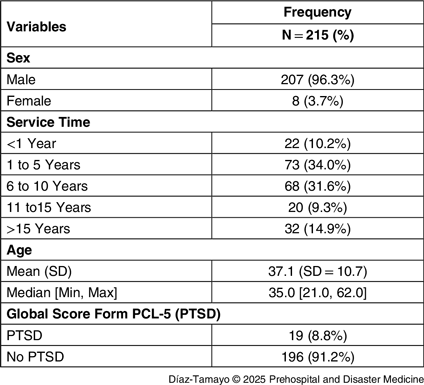
In the first responder population included in the study, 96.3% were men, with 34.0% reporting one to five years of experience, while 31.6% had been in their positions for between six and ten years. Additionally, the average age was 37 years, with a standard deviation (SD) of approximately ten years.
The PCL-5 scale score with which the diagnosis of PTSD symptoms was evaluated had a cutoff point of more than 33 points to show symptoms and negative cognitive and mood alterations. In this research, 19 firefighters (8.8% of the study participants) had symptoms of PTSD. The average global score on the scale was 13.8 points, with a standard deviation of 13.3 points. At least 50% of the participants scored up to ten points on the scale, with minimum and maximum values ranging from zero to 61 points (Table 1).
General Characteristics of the Study Participants

Abbreviations: PCL-5, Posttraumatic Stress Disorder Checklist for DSM-5; PTSD, posttraumatic stress disorder.
Results Modified Coping Strategies Scale (EEC-M)
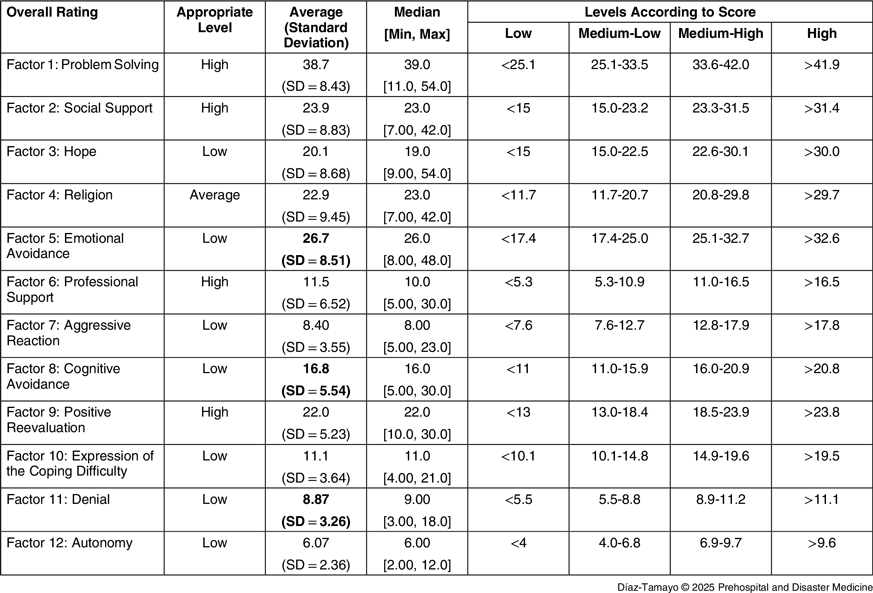
The factors of the coping scale fell within the range of scores established to determine appropriate levels on the scale. Regarding their classification, based on the scores obtained in each of the 12 evaluated factors, the averages of three of them were located within the medium-high to high ranges, considering that the appropriate levels should be low, which correspond to emotional avoidance, cognitive avoidance, and denial. These were the most frequent strategies used by the participants and are maladaptive strategies (Table 2).
Results by Factors of the Coping Strategies Scale

Analysis of the Principal Components with the Factors
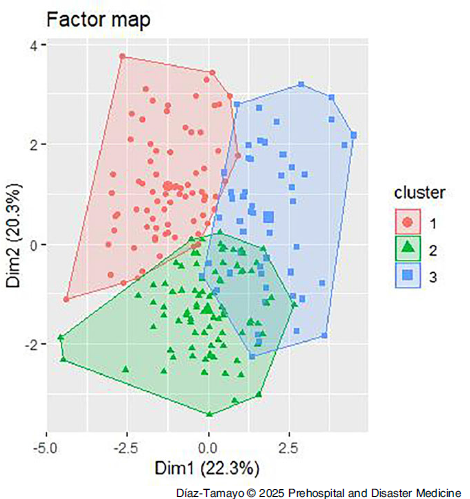
The factors of the coping scale are the products of the scores obtained for each item (or question) on the scale. A factorial analysis of the main components was carried out to relate the 12 factors to the total score for the diagnosis of PTSD. Component 1 and Component 2 captured almost 42% of the inertia. Likewise, the total score for the diagnosis of PTSD (Total PCL-5) was in the same quadrant as Factor 7, corresponding to aggressive reaction; Factor 10 for the expression of coping difficulty; emotional avoidance Factor 5; and autonomy Factor 12, indicating that these were the coping strategies most closely related to PTSD.
When generating groupings among the participants, three groups were obtained (Figure 1), of which group or Cluster 1 presented an average PTSD score of 17.4, which was significantly lower than the global score of 13.7, a score that, according to one of the criteria for the diagnosis of PTSD, would indicate alteration of the alert and reactivity associated with the event. When observing the other variables that characterized this group, it was found that the factors corresponding to cognitive avoidance, search for professional support, religion, search for social support, positive revaluation, and problem-solving in the scores that make up this Cluster were significantly lower than the global average scores, while the average score of the aggressive reaction factor was 9.9, which was higher than the global average score of 8.4 (Supplement 2; available online only).
Clusters of Participants According to the Scores of the 12 Factors.

Factors Associated with PTSD
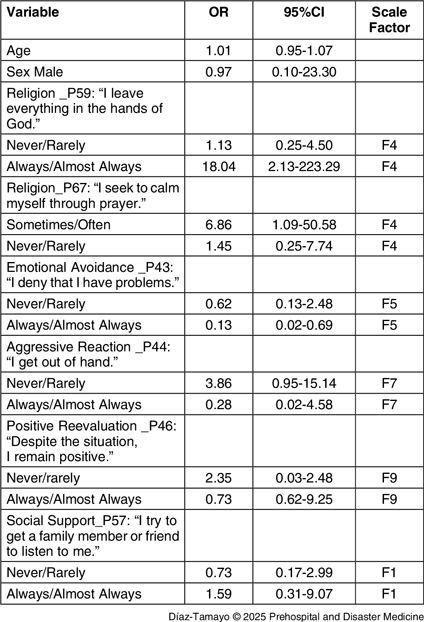
The final model focused on analyzing the questions that presented an association with PTSD. Responses to Question 67, which referred to whether participants used prayer to calm themselves, indicated that this coping strategy was a risk factor when performed sometimes compared to always or almost invariably; while responses to Question 59, which spoke about leaving everything in the hands of God, was a risk factor when performed almost always. Question 43, which represented the emotional avoidance strategy of denial, was a statistically significant protective factor when responses were not always or nearly always. At the same time, responses to Question 44, which referred to the aggressive reaction, were a risk factor when responses were never or rarely (Table 3).
Final Logistic Regression Model

The results highlighted the frequent use of maladaptive strategies such as avoidance and denial; however, they also presented religion as a means of emotional coping, offering novel cultural and contextual perspectives compared to previous studies conducted in other countries.
Discussion
First responders are exposed in the exercise of their work to the care of patients in critical condition and complex and devastating scenarios, which can cause mental disorders, including PTSD, in this population. The strategies they use to cope with these situations determine their adaptive capacity to minimize the risks of suffering from mental health problems.
In this research, it was found that the coping strategies that these personnel use most often are maladaptive, putting them at high risk of developing different mental disorders. Among these maladaptive strategies are emotional avoidance (individuals do not express their distress either because of the emotional charge or fear of social disapproval); cognitive avoidance (individuals seek to eliminate or neutralize negative thoughts through distraction); and denial (individuals behave as if the situation did not exist and move away from everything that is related to it temporarily, as a way of tolerating the emotional state that they are in). These three strategies aim to help first responders detach from situations that emotionally affect them. Studies conducted in Europe and the United States Reference Dautovich, Katjijova, Cyrus and Kliewer3,Reference Witczak-Błoszyk, Krysińska, Andriessen, Stańdo and Czabański23–Reference Zwetzig, Koch, Blount, Graham and Peterson25 have reported similar results regarding the use of avoidance and denial strategies in this population, which have a strong association with stress, depressive symptoms, and worse mental health outcomes. Lazarus and Folkman’s Reference Lazarus and Folkman1 theory explains that coping with traumatic situations depends on the meaning the individual assigns to the event. In disaster contexts, where perceived control is limited and the threat is high, emotional coping strategies are often used, some of which may be maladaptive. In this study, it was found that first responders employed maladaptive coping strategies, which were associated with PTSD symptoms.
Another strategy used by first responders is autonomy; they respond to the event by seeking to resolve their emotions independently, without resorting to external help. These self-sufficient characteristics and military-style training lead these individuals to believe that they can handle situations on their own. Other studies have emphasized the importance of social or professional support as a healthy coping strategy and the benefits of managing difficulties that arise, as well as controlling emotions and feelings. Reference Almutairi and Azza26–Reference Lobza, Korotkova and Bunakova28
In this population, one of the most commonly used strategies was religion, which was often expressed through prayer. When faced with complex situations, some individuals used prayer to cope with the emotions generated and surrendered the event that occurred to a higher power. Especially when things have not turned out as expected, they seek reassurance through prayer. Although this strategy can have positive effects on the emotional health of these workers, it is crucial that people not relinquish full responsibility for their actions and control over their emotions to a supreme power. This can be another means of avoiding confrontation of the problems and feelings they have. This strategy must be accompanied by other coping styles that help them resolve the situation and confront their difficulties. Similar results have been found in other studies where religious activities were part of the methods to relieve stress in firefighters. Reference Lee, Jeong and Choi29,Reference Henson, Truchot and Canevello30 Additionally, a relationship was found between spirituality and posttraumatic growth. Reference Torres and Gulliver31
Overall, PTSD was present in 8.8% of the study population, which is consistent with different investigations that report similar values. Reference Hoell, Kourmpeli and Dressing32–Reference Klimley, Van Hasselt and Stripling34
Regarding age and sex, no association was found in this population with PTSD. Other studies have shown that there is a higher risk of developing PTSD due to exposure to traumatic events at an earlier age in these personnel. Reference Muhammad, Ismail and Hanizah35 In addition, studies have reported that females are more likely to present symptoms of PTSD. Reference Obuobi-Donkor, Oluwasina, Nkire and Agyapong36
One of the main strengths of this study lies in its innovative methodology in several aspects. Culturally validated instruments specifically adapted to the Colombian context were used, ensuring the relevance and accuracy of the measurements. Advanced statistical techniques, such as principal component analysis and Lasso regression with cross-validation, were employed to identify the primary predictors of PTSD, thereby enhancing the robustness and precision of the findings.
Based on these findings, it is recommended that training programs for current and future first responders be designed and implemented to promote the development of adaptive coping strategies. These programs should reduce reliance on maladaptive responses, such as avoidance and denial, and instead foster resilience and mental health support mechanisms tailored to the occupational demands of this population.
It is recommended that future studies conduct an in-depth exploration of sociocultural, occupational, and religious factors within the context of low- and middle-income countries.
Limitations
One limitation of this study is that the coping strategies measurement tool has only been validated for Colombian populations, limiting the generalizability of the findings. However, the results can be adapted for use in other regions with similar characteristics, such as middle- or low-income countries, or in contexts where firefighters and ambulance crews work under conditions of psychosocial vulnerability. This opens the possibility of designing intercultural training programs tailored to the most prevalent coping mechanisms in each setting.
Another limitation is that the study population was drawn from a single institution in one city, which may restrict the generalizability of the results to other contexts. No random sampling was applied, as the entire target population (all first responders from the institution under study) was included.
Conclusions
This study identified that the coping strategies most frequently associated with PTSD among first responders were avoidance and denial. Additionally, the use of religious practices emerged as a common mechanism for managing emotional distress following critical incidents. These findings highlight the specific psychological responses of this population when exposed to traumatic events in the prehospital setting.
Conflicts of interest/funding
The authors declare that they have no conflicts of interest. The authors report that the study was conducted with their resources and that no external funding was received.
Supplementary Materials
To view supplementary material for this article, please visit https://doi.org/10.1017/S1049023X25101453
Acknowledgments
The authors thank the first responders of a volunteer fire department who took the time to participate in the study.
Author Contribution
All authors contributed to the design and writing of the article.