Sawflies are an ancient and diverse group of herbivorous Hymenoptera that use a saw-like ovipositor to insert eggs into host–plant tissues. This anatomy allows for careful placement of progeny but may also constrain the females to lay eggs only in hosts or modules that are suitably soft or that provide leverage to allow for egg insertion (Floate and DeClerck-Floate Reference Floate and DeClerck-Floate1993; Price Reference Price2003). Constraints such as these, coupled with significant variations in host–plant morphology and nutritional quality, appear to have selected for a high degree of host–plant specialisation in most sawfly species (Knerer and Atwood Reference Knerer and Atwood1973; Mattson et al. Reference Mattson, Lawrence, Haack, Herms and Charles1988; Björkman and Larsson Reference Björkman and Larsson1991).
In the present study, we investigated the host–plant oviposition preference of Atlantic Canadian populations of balsam fir sawfly, Neodiprion abietis (Harris) (Hymenoptera: Diprionidae). Neodiprion abietis is actually composed of a number of subspecies or strains distributed over much of the Nearctic Region, from California to the Atlantic seaboard (Knerer and Atwood Reference Knerer and Atwood1972). Although all subspecies possess similar morphological traits and can interbreed, throughout the group there are often striking regional differences in host–plant preference and developmental phenology (Ross Reference Ross1955; Knerer and Atwood Reference Knerer and Atwood1972; Nyman et al. Reference Nyman, Farrell, Zinovjev and Vikberg2006). Outbreaks have been reported in a range of different host species, including many species of true firs (Abies Linnaeus; Pinaceae), pines (Pinus Linnaeus; Pinaceae), spruces (Picea Dietrich; Pinaceae), and cedars (Thuja Linnaeus; Cupressaceae) (Bird Reference Bird1929; Struble Reference Struble1957; Carroll Reference Carroll1962). Whereas populations in western Canada tend to be found on spruces, those in Manitoba and Ontario are often on balsam fir. Populations in Nova Scotia have been reported on white spruce (Picea glauca (Moench) Voss) and black spruce (Picea mariana (Miller) Britton, Sterns, and Poggenburg) (Knerer and Atwood Reference Knerer and Atwood1972), whereas outbreaks in western Newfoundland have centred on stands of balsam fir (Abies balsamea (Linnaeus) Miller) (Carroll Reference Carroll1962; Moreau Reference Moreau2006). In some cases, females are highly selective and will die with all their eggs rather than lay on an unsuitable host, whereas others may spread their eggs onto several hosts (Knerer and Atwood Reference Knerer and Atwood1972). To date, most work on the oviposition preference of N. abietis has focused on populations west of Ontario (Knerer and Atwood Reference Knerer and Atwood1972), whereas eastern Canadian populations remain largely unstudied (but see Carroll Reference Carroll1962).
In eastern Canada, adult N. abietis emerge from cocoons on the tree in early August and insert their eggs into the lateral margin of needles on current-year shoots. Emergence of the sexes is protandrous, with males emerging slightly earlier than females (Carroll Reference Carroll1962). Like many other diprionid sawflies (reviewed in Price Reference Price2003), most female N. abietis eggs are fully mature at eclosion and may be laid on hosts immediately. Unmated females can lay viable, haploid eggs that produce all-male offspring, whereas mating allows females to selectively produce diploid females or haploid males (Carroll Reference Carroll1962). Overwintering occurs during the egg stage, and larvae emerge the subsequent season in midsummer to feed. Egg hatch occurs in the last week of June to mid July, and newly emerged larvae feed in gregarious clusters on the mature age classes of foliage (Anstey et al. Reference Anstey, Quiring and Ostaff2002). Larvae develop through four (male) or five (female) instars (Carroll Reference Carroll1962) and spin a cocoon on the branch of their host around mid August. Females do not feed following eclosion and so must obtain all resources for adult activity during the larval stage.
In 1999, we carried out “choice” and “no-choice” experiments to assess the oviposition preference of N. abietis females for three hosts, balsam fir, white spruce, and black spruce, in Atlantic Canada. Adults for all experiments were acquired from cocoons collected in mid August from balsam fir in each of three sites in southern New Brunswick (45°27′N, 65°76′W; 45°34′N, 65°56′W; and 45°32′N, 65°82′W). Collected cocoons were enclosed individually in gel capsules and then placed in an environmental chamber at 18 °C, 70% relative humidity with a 14:10 hour light:dark photoperiod and left until adults eclosed. Gel capsules were checked daily for newly eclosed adults. Foliage from the three conifer species was collected at various locations within a 10 km radius of Fredericton, New Brunswick. Branches were selected that had no noticeable prior herbivory; they were washed in a 3% bleach and water solution to remove any arthropods and pathogens. Rinsed branches were then placed in a plastic bag and stored at 3 °C until needed.
In the no-choice experiment, 25 unmated females were each placed in a separate chamber and provided access to a shoot from one of the tree species (three tree species × 25 females = 75 females total). Each chamber consisted of a 125 mL styrofoam cup (bottom) covered with an inverted 300 mL clear plastic cup (top). The top of each plastic cup was cut away and replaced with screen to allow better airflow, and a 1.5-cm wide hole was cut into the bottom of the styrofoam cup for insertion of the shoots. To maintain foliage quality throughout the experiment, we trimmed off the needles on the bottom third of each shoot, then inserted the cleared portion of the shoot stem into an 8 mL hydropic (Econoplastik Inc., Sainte-Foy, Québec, Canada). The hydopric was partially filled with a 1.5% bleach–water solution to prevent the shoot resin from clogging the water-conducting tissues. Females were placed in the chambers within 24 hours of eclosion, and branches were monitored daily for egg lay until death. Shoots bearing one or more egg slits were removed and placed in a small bag and stored at −2 °C until eggs and egg slits could be counted. Removed shoots were replaced with new shoots. After death, females were placed individually in glacial acetic acid and stored until they could be dissected to determine the number of eggs remaining in the ovaries. The choice experiment was run simultaneously with the no-choice experiment and employed the same methodology, except that shoots from the three conifer species were provided simultaneously within a 23 × 23 × 34 cm mesh-covered chamber (25 females per host, 75 total).
To analyse differences in potential and realised fecundity, female longevity, and oviposition success in the no-choice experiment, we used a generalised linear model with post hoc contrasts between treatments (proc GENMOD, dist = Poisson, Link = log, SAS Institute Inc 1999).
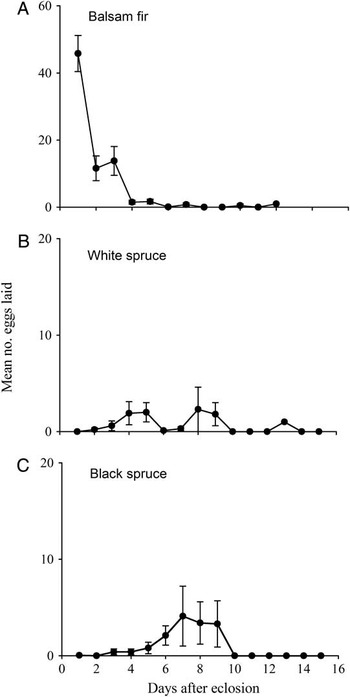
Females from the no-choice experiment that were provided shoots from only one of three tree species had similar potential fecundity and longevity, but significantly different realised fecundity (Table 1). Tree species also had a significant influence on the number of egg slits, with balsam fir needles having nearly four to eight times more empty slits than the two spruce hosts (Table 1). Within three days of eclosion, unmated females provided only balsam fir shoots had laid more than 95% of their eggs (Fig. 1A). It was several days before females on white and black spruce even began to lay eggs, and even then, only a small percentage of available eggs were laid (13% in white spruce and 7% in black spruce) (Fig. 1B, 1C). Host–plant had a significant influence on the number of eggs remaining in the ovaries at death (F 2,72 = 157.34, P < 0.01), with 68.2 ± 2.6 and 62.1 ± 4.3 eggs in females on white and black spruce compared with only 1.2 ± 0.6 on balsam fir. In the choice experiment, where adult females were provided access to shoots from each host, 16% (four of 25 females) laid no eggs at all. For those females that did lay eggs, there was only one instance of a single egg being laid on a host other than balsam fir – one day after eclosion, a female laid a single egg in a black spruce needle compared with an average of 47.5 eggs per female on the preferred balsam fir.
Longevity, fecundity, and empty egg slits of Neodiprion abietis females provided shoots of balsam fir, white spruce, or black spruce in the laboratory (no-choice experiment).

Note: Means with different letters were significant (P < 0.05).
Mean (±SE) number of eggs laid per day for unmated females provided cut shoots of either (A) balsam fir, (B) white spruce, or (C) black spruce from eclosion until death.

Results of this study provide experimental evidence for the oviposition preference of an economically and ecologically important forest sawfly pest that occasionally outbreaks in eastern Canada. Newly emerged N. abietis females of different strains are often highly selective in their host–plant preference when given a choice of two or more hosts (Knerer and Atwood Reference Knerer and Atwood1972). For most Neodiprion sawflies, fir (Abies Miller; Pinaceae) foliage is highly toxic, and even within the N. abietis complex, there are many strains that reject fir in favour of other hosts (Knerer and Atwood Reference Knerer and Atwood1972; Géri et al. Reference Géri, Allais and Auger1993). The New Brunswick strain we studied here exhibits a clear and almost exclusive preference for balsam fir, but appears able to lay at least some eggs on spruce if no other host is available (Fig. 1B, 1C). This preference was made all the more striking when females were given a choice among the three hosts and laid all but one egg on balsam fir. Unless they were given the favoured balsam fir foliage, females often died with the majority of their eggs still in the ovaries (Table 1). Populations of N. abietis in New Brunswick are more similar to those in central Canada and presumably represent a different strain than that reported previously to attack spruces in Nova Scotia (Knerer and Atwood Reference Knerer and Atwood1972). Past studies of pine sawfly have similarly shown significant variation in the oviposition preference of females among different Pinus species (Auger and Géri Reference Auger and Géri1993).
Developing conifer foliage has especially high concentrations of toxic resin acids that can negatively affect sawfly preference and performance (Géri et al. Reference Géri, Allais and Auger1993). In some instances, sawflies will actively seek out more toxic foliage to augment their chemical defenses (Müller and Arand Reference Müller and Arand2001). In contrast, several sawflies in pine appear to cut a “pre-slit” or a pocket near the base of needles, which may serve to reduce exposure to resin for eggs laid more distally (Benjamin Reference Benjamin1955; Knerer and Atwood Reference Knerer and Atwood1973; Tisdale and Wagner Reference Tisdale and Wagner1991). Although there were often empty slits cut into the balsam fir foliage, these slits were never on the same needle as eggs. We suspect, therefore, that the slitting behaviour in N. abietis is more a reflection of females testing needles prior to laying eggs. The fact that relatively few slits were cut into the foliage of spruces also suggests that females spent less time probing spruce needles, or that they had difficulty penetrating the needles. Spruce foliage tends to be tougher than that of firs (e.g. Richardson Reference Richardson2004) and egg-laying sawfly females tend to be highly sensitive to variations in substrate morphology due to high specificity of the saw-like ovipositor (Floate and DeClerck-Floate Reference Floate and DeClerck-Floate1993). This could at least partially explain why N. abietis females on spruce often died with most of their eggs still in the ovaries.
As with many sawflies, N. abietis has clear restrictions on its oviposition behaviour that appear to limit it in New Brunswick to balsam fir as a primary host. Further work examining the potential mechanical or biochemical limitations on N. abietis in different host–plants may help to explain large geographical variations in host–plant preference reported across the full range of this insect (Knerer and Atwood Reference Knerer and Atwood1972).
Acknowledgements
The authors thank K. Parsons and H. Piene for help with field work. They are grateful to C. MacQuarrie and D. Quiring for comments on an earlier version of the manuscript. Financial support was provided by a Natural Sciences and Engineering Research Council of Canada/Canadian Forest Service Research Partnership Grant with Abitibi-Consolidated, Corner Brook Pulp and Paper, Newfoundland and Labrador Department of Natural Resources, and Natural Resources Canada – Canadian Forest Service.