The deleterious effects of prenatal substance exposure on brain and behavioral development are well documented (Jacobson, Jacobson, & Nelson, Reference Jacobson, Jacobson, Nelson and Nelson2000; Streissguth et al., Reference Streissguth, Bookstein, Barr, Sampson, O’Malley and Young2004; Thompson, Levitt, & Stanwood, Reference Thompson, Levitt and Stanwood2009). Similarly, the negative impact of early life stress has been described extensively in the literature (Gunnar, Fisher, & The Early Experience, Stress, and Prevention Science Network, Reference Gunnar and Fisher2006; Pears & Fisher, Reference Pears and Fisher2005; Pollak et al., Reference Pollak, Nelson, Schlaak, Roeber, Wewerka and Wiik2010). However, few researchers have examined the combined effects of prenatal substance exposure and early adversity. This is especially concerning because the two experiences appear to co-occur with great frequency (Besinger, Garland, Litrownik, & Landsverk, Reference Besinger, Garland, Litrownik and Landsverk1999; Conners et al., Reference Conners, Bradley, Mansell, Liu, Roberts and Burgdorf2004; Smith, Johnson, Pears, Fishers, & DeGarmo, Reference Smith, Johnson, Pears, Fisher and DeGarmo2007). Among youths with child welfare system involvement, exposure to high levels of early adversity is virtually ubiquitous. Moreover, 80% of mothers with child welfare system involvement have substance abuse problems (Besinger et al., Reference Besinger, Garland, Litrownik and Landsverk1999; Young, Boles, & Otero, Reference Young, Boles and Otero2007). Although not all of these individuals necessarily use drugs and alcohol during pregnancy, such use is likely: the result is a large proportion of child welfare system youths who have experienced prenatal exposure and early adversity.
In the absence of relevant data, researchers, policymakers, and the general public might assume that youths with prenatal exposure and early adversity will manifest the poorest outcomes. However, this might or might not be correct. Alternatively, those concerned with prenatal exposure might overlook or underestimate the effects of early adversity, and those focused on early adversity might fail to account for the effects of prenatal substance exposure. In short, high-quality prospective data are urgently needed to better understand the unique and combined effects of these experiences on subsequent outcomes throughout development. Such data would better inform research, prevention/intervention efforts, and public policy in this area.
Allostatic Load Conceptual Framework
The allostatic load conceptual framework is of great utility in understanding the combined effects of prenatal substance exposure and early adversity. McEwen and colleagues (McEwen, Reference McEwen1998; Schulkin, McEwen, & Gold, Reference Schulkin, McEwen and Gold1994) originally conceptualized allostatic load as the toll taken on the body from repeated adaptations to chronic adversity. Specific physiological regulatory mechanisms, including the autonomic nervous system and the neuroendocrine system, help facilitate allostasis (i.e., homeostatic balance in the face of stress). Under conditions of acute stress, these systems are highly adaptive, leading to transitory bodily changes such as the metabolism of stored energy and stimulation of the immune system. However, research dating back to Selye's (Reference Selye1978) identification of the “general adaptation syndrome” has documented pathophysiologic responses in the face of chronic, overwhelming stress. This includes damage to metabolic, immunologic, and neurological systems.
The initial conceptualizations of allostatic load largely employed additive models of stress, wherein the likelihood that the effects of adversity would be observed on measures of allostatic load (e.g., blood pressure, cholesterol level, and neuroendocrine measures) was based on the extent to which cumulative experiences of stress impacted an individual's underlying regulatory physiology. However, more nuanced conceptualizations have been developed over time. Two areas of particular relevance to the current study were described in a recent paper by Shonkoff, Boyce, and McEwen (Reference Shonkoff, Boyce and McEwen2009): (a) evidence that the timing of stressors (especially those occurring prenatally through adolescence) might be particularly important to determining the nature of their impact and (b) evidence that delayed allostatic load effects might be observed months or years after stressors have occurred.
These advances in stress research are associated with the influence of developmental neurobiology in this area. This work has increasingly focused on parameterizing the effects of specific dimensions of stress (e.g., type, severity, and duration of maltreatment; number of months spent in orphanage care; and age at adoption) on key neural regulatory neural systems (Fisher & Gunnar, 2010). For instance, there is evidence from converging studies of children reared in institutional settings in developing countries (Gunnar, Morison, Chisholm, & Schuder, Reference Gunnar, Morison, Chisholm and Schuder2001) and in the US foster care system (Bruce, Fisher, Pears, & Levine, Reference Bruce, Fisher, Pears and Levine2009) that severe early neglect (but not physical or sexual abuse) is associated with disturbances in the diurnal rhythmicity of the hypothalamic–pituitary–adrenal (HPA) axis, which produces the “stress hormone” cortisol. In terms of developmental timing, the absence of responsive, nurturing care in the first 12–24 months of life appears to be particularly associated with flattened cortisol levels across the day (vs. the typical diurnal pattern of cortisol levels peaking shortly after awakening and decreasing throughout the day; Fisher & Gunnar, 2010). In addition to changes in diurnal activity, alterations in HPA axis reactivity (assessed via changes in cortisol following a laboratory induced stressor) have been reported in infants with prenatal cocaine exposure (Magnano, Gardner, & Karmel, Reference Magnano, Gardner and Karmel1992; Jacobson, Bihun, & Chiodo, Reference Jacobson, Bihun and Chiodo1999; Scafidi et al., Reference Scafidi, Field, Wheeden, Schanberg, Kuhn and Symanski1996). For example, in a study of 11-year-olds, cortisol reactivity to stress was more likely to be blunted in children with prenatal cocaine exposure (Lester et al., Reference Lester, LaGasse, Shankaran, Bada, Bauer and Lin2010). Cocaine-exposed children who experienced domestic violence showed the strongest effects. These findings are similar to the blunted diurnal cortisol pattern reported among child welfare system youths and that the cocaine effects were exaggerated by the child's experience of domestic violence supports the additional role of early adversity. Alterations in HPA axis regulation are, in turn, a known risk factor for the development of anxiety and affective disorders later in life (Lopez-Duran, Kovacs, & George, Reference Lopez-Duran, Kovacs and George2009; Simeon et al., Reference Simeon, Knutelska, Yehuda, Putnam, Schmeidler and Smith2009).
Neurobehavioral Disinhibition as a Behavioral Endophenotype Emanating From the Allostatic Load of Prenatal Exposure and Early Adversity
Research findings about stressor-specific effects on underlying neural systems have the potential to yield extremely useful information about the vulnerabilities and types of targeted interventions needed by individuals in high-risk populations. This is especially true for individuals with complex conditions, who might not respond to conventional mental health services or improved life circumstances. Most germane to the present study, such models might be particularly helpful in understanding a subgroup of multiproblem youths who exhibit a complex disinhibitory psychopathology (Iacono, Malone, & McGue, Reference Iacono, Malone and McGue2008) that has features of disruptive behavior disorders, affective and anxiety disorders, cognitive impairment, and poor self-regulation (i.e., not well characterized by a single diagnosis). Other researchers have referred to this condition as the “neurobehavioral disinhibition behavioral endophenotype” (ND; Tarter et al., Reference Tarter, Kirisci, Mezzich, Cornelius, Pajer and Vanyukov2003). Children with ND appear to follow fairly consistent negative longitudinal trajectories that include peer rejection, academic difficulties, and delinquency and high rates of mental health, special education, residential care, and juvenile justice system involvement (Clausen, Landsverk, Ganger, Chadwick, & Litrownik, Reference Clausen, Landsverk, Ganger, Chadwick and Litrownik1998; Harden, Reference Harden2004). In addition, ND is a significant risk factor for adolescent drug abuse (McNamee et al., Reference McNamee, Dunfee, Luna, Clark, Eddy and Tarter2008; Tarter et al., Reference Tarter, Kirisci, Mezzich, Cornelius, Pajer and Vanyukov2003).
One of the advantages of ND as a conceptualization of multiproblem youth is its parsimony as a multilevel construct. Prior discussions have emphasized the importance of incorporating measures from biological, behavioral, and interactional perspectives as a way to facilitate understanding of complex phenomena (Cicchetti & Curtis, Reference Cicchetti and Curtis2007; Cicchetti & Dawson, Reference Cicchetti and Dawson2002; Cicchetti & Toth, Reference Cicchetti and Toth2009); because the ND construct includes neurobiologically based functions (e.g., executive control) and psychological measures of behavioral dysregulation, it requires multiple levels of analysis.
There is undoubtedly considerable equifinality in the etiologic pathways to ND, including genetic vulnerabilities and various individual (e.g. temperament), familial (e.g., parenting styles and family structure), and contextual (e.g., socioeconomic status and school environment) variables. However, one highly probabilistic pathway to ND involves the combined effects of prenatal exposure and early adversity. There is preliminary evidence that each experience contributes to ND risk. For example, researchers have reported that ND is prevalent in individuals with prenatal substance exposure (Chapman, Tarter, Kirisci, & Cornelius, Reference Chapman, Tarter, Kirisci and Cornelius2007; Lester et al., Reference Lester, Bagner, Liu, LaGasse, Seifer and Bauer2009), although these studies did not involve an examination of early adversity effects. Similarly, there is evidence that children with early adversity show considerable difficulty with tasks that require response inhibition; converging evidence from two studies of foster children shows that disinhibition is more likely among children who have experienced high levels of placement instability or caregiver transitions early in development (Lewis, Dozier, Ackerman, & Sepulveda-Kozakowski, Reference Lewis, Dozier, Ackerman and Sepulveda-Kozakowski2007; Pears, Kim, & Fisher, Reference Pears, Kim and Fisher2008), although these studies did not involve an examination of prenatal exposure.
Given the evidence that ND has roots in prenatal exposure and early adversity, it is important to understand whether these effects are collinear (e.g., whether the shared variance between prenatal exposure and disinhibition can be explained by early adversity effects on disinhibition) or whether prenatal exposure and early adversity account for unique variance in ND. The growing evidence that stressful events occurring at specific points in development exert unique effects on the individual's epigenome (Franklin et al., Reference Franklin, Russig, Weiss, Gräff, Linder and Michalon2010), even in such social domains as behavioral adjustment and self-regulation, suggests that prenatal exposure and early adversity could act somewhat independently.
Goals of the Present Study
In the present study, we employed data from an ongoing longitudinal investigation that includes a large group of youths identified at birth for prenatal drug and alcohol exposure and for whom detailed measures of subsequent early life adversity exist. As such, these data represent a unique opportunity to examine the combined effects of prenatal exposure and early adversity. We explored the extent to which prenatal exposure and early adversity predicted later outcomes associated with ND. We were particularly interested in studying ND during the transition to adolescence, when there is extensive development in regions of the prefrontal cortex associated with many of the self-regulatory elements of ND. As such, we employed multivariate longitudinal growth modeling to predict ND at age 8/9 and growth in ND between age 8/9 and age 13/14 from prenatal exposure and early adversity measures.
Growth modeling allowed us to investigate a number of issues germane to current conceptualizations of allostatic load. First, because we included separate constructs for prenatal exposure and early adversity, we were able to examine timing issues with respect to whether each of these domains of stressors contributed independently to ND outcomes. In addition, because we examined ND at age 8/9 and ND growth between age 8/9 and age 13/14, we were able to investigate the effects of prenatal exposure and early adversity that might not emerge until adolescence, concurrent with expected development (or lack thereof) in the underlying prefrontal cortical systems involved in ND. This allowed us to consider how early stressful experiences might not be observable until much later in development (i.e., the delayed effects described by Shonkoff et al., Reference Shonkoff, Boyce and McEwen2009).
One issue worth noting is that ND has been operationalized in several ways in prior studies. Chapman et al. (Reference Chapman, Tarter, Kirisci and Cornelius2007) treated ND as a unitary construct including measures of executive functioning and behavioral dysregulation. This may be due in part to clinical observations of youths who exhibit ND and for whom problems in the areas tend to co-occur. Other researchers have treated executive functioning as a separate and distinct construct from behavioral dysregulation (Iacono et al., Reference Iacono, Malone and McGue2008). Thus, the modeling approach focusing on individual trajectories employed in the present study allowed us to examine longitudinal covariation in the co-occurrence of ND components. Prior researchers have examined static developmental endpoints or have focused on sample means over time. We initially attempted to create a single-factor solution or unitary construct from the executive functioning and behavioral measures. Although convergence was obtained in early adolescence, we found that the indictors did not covary or converge similarly across adolescence. In contrast, models with separate ND component constructs for behavioral dysregulation and executive functioning have been shown to yield excellent fit indices and more substantive findings on the contributions of precursors and their timing on development. The issue of whether ND should be treated as a unitary (vs. multicomponent) phenomenon is addressed further in the Discussion Section.
Methods
Participants
We used data from 1,073 families participating in The Maternal Lifestyle Study (MLS), a multisite (Detroit, Memphis, Miami, and Providence) longitudinal study of youths with prenatal cocaine exposure. Details on the enrollment and exclusion criteria are described elsewhere (Bada et al., Reference Bada, Bann, Bauer, Shankaran, Lester and LaGasse2011). The families were selected to be in the exposed group (i.e., maternal report of cocaine or opiate use during pregnancy or gas chromatography–mass spectrometry confirmation of presumptive positive meconium screens for cocaine or opiate metabolites) or the comparison group (i.e., maternal denial of cocaine or opiate use during the pregnancy and a negative enzyme multiplied immunoassay meconium screen for cocaine and opiate metabolites). The exposed and comparison youths were group matched on race, gender, and gestational age within each study site. Background substances associated with cocaine use (i.e., alcohol, tobacco, and marijuana) were present in both groups, enabling us to suggest that differences between the exposed and comparison groups were related to cocaine.
The study was approved by the institutional review board at each study site, and written informed consent (caregivers) and assent (youths) were obtained for all participants. Each site had a certificate of confidentiality from the National Institute on Drug Abuse. For this report, we used data from annual child visits to the hospital clinic at ages 8–14. Each visit lasted approximately 3.5 hr (youths) or 3 hr (caregivers). At each visit, the participants were reimbursed for their time and effort, birthday celebrations were held for the youths, and transportation to the clinic was provided.
Measures
Disinhibitory psychopathology
Two longitudinal construct scores were employed to assess growth in disinhibitory psychopathology over three assessment periods during early adolescence. The construct scores for behavioral dysregulation and executive function difficulties were computed from multimethod, multiagent, validated, well-established measures.
The behavioral dysregulation construct was a composite score of six measures of internalizing and externalizing problems: (a) problem behaviors reported by caregivers on the Child Behavior Checklist (Achenbach, Reference Achenbach1991) using the standardized T scores for total problem behaviors at ages 9, 11, and 13; (b) oppositional defiance, conduct disorder, attention deficit, and major depression symptom counts from the Diagnostic Interview Schedule for Children—IV (Shaffer, Fisher, Lucas, Dulcan, & Schwab-Stone, Reference Shaffer, Fisher, Lucas, Dulcan and Schwab-Stone2000) at ages 8, 11, and 14; and (c) delinquency summary scores for the number of self-reported crimes against people and acts of general delinquency and school delinquency from the Things That You Have Done (Ingoldsby, Kohl, McMahon, Lengua, & The Conduct Problems Prevention Research Group, Reference Ingoldsby, Kohl, McMahon and Lengua2006) at ages 9, 11, and 13. (Because the Diagnostic Interview Schedule for Children—IV was administered at years 8 and 14, we computed construct scores and have labeled the assessment periods as years 8/9, 11, and 13/14 throughout the text.)
The composite growth score was computed by rescaling each indicator on a 0:1 ratio level continuous scale and then averaging. The Cronbach α reliability coefficient was 0.73, 0.80, and 0.80, respectively, over time for the six indicators of behavioral dysregulation. Using principal components factor analyses, we obtained a single-factor solution at each time point: eigenvalues of 2.98, 3.27, and 3.25, respectively, explained over 50% of the variance.
Executive function difficulties was measured with two computerized tests from the Cambridge Neuropsychological Test Automated Batteries (Luciana, Reference Luciana2003) at ages 9, 11, and 13. The spatial working memory task is self-ordered and requires the respondent to find a “token” in an array of colored boxes; we measured the total number of errors on the task. The stockings of Cambridge task involves spatial planning, and the respondents must use “balls” in one display to copy the pattern shown in another display. Thinking time includes two trials measuring the time to select the initial stimulus. Shorter times have been related to impulsivity. We measured the total number of correct solutions in the minimal number of moves (reverse scored to indicate executive function difficulties). The composite growth score was the average of the two indicators rescaled to 0–1.
Key predictors
Prenatal substance exposure was measured as a summative index ranging from 0 to 5 for mother-reported use of cocaine, opiates, marijuana, alcohol, and tobacco during pregnancy: 0 (no) or 1 (yes). Youth sex was scored 0 (girl) or 1 (boy). Early adversity was a summative early adversity risk index from birth to the age 8/9 assessment and included 10 risk factors. Each risk factor that was either a continuous scale or a count score was dichotomized to create an overall risk index (0 = no/none, or 1 = yes/one or more): (a) annual assessments of postnatal substance use of cocaine, opiates, tobacco, alcohol, or marijuana; (b) chronic poverty status calculated as income below $10K over annual visits; (c) low social status scored from the Hollingshead Index of Social Position (Hollingshead, Reference Hollingshead1975) using education and occupation averaged over annual visits and scored as 1 SD below the mean; (d) primary caretaker changes; (e) sexual or physical abuse reported by caregivers; (f and g) community violence of 1 SD above the mean on averaged scores of the child-reported Things I’ve Seen and Heard (Edelson, Shin, & Armendariz, 2008) at age 8 and the caregiver-reported Survey of Exposure to Community Violence (Dahl, Ceballo, & Huerta, Reference Dahl, Ceballo and Huerta2010) at age 9; (h) caregiver depression of 1 SD above the mean for averaged depressive symptoms on the caregiver-reported Beck Depression Inventory (Beck, Steer, & Brown, Reference Beck, Steer and Brown1996); (i) caretaker psychological distress of 1 SD above the mean for averaged psychological symptoms above clinical cutoff on the Brief Symptom Inventory (Derogatis & Fitzpatrick, Reference Derogatis, Fitzpatrick and Maruish2004); and (j) poor quality home environment of 1 SD below the mean on the Home Observation Measurement of the Environment (HOME; Caldwell & Bradley, Reference Caldwell and Bradley1984).
Analytic strategy
The main study hypotheses were tested with structural equation modeling (SEM) path analysis to estimate effects of prenatal substance exposure and postnatal early adversity on behavioral dysregulation and executive function difficulties in early adolescence. More specifically, longitudinal outcomes were specified as latent variable growth models in Mplus 6.0 (Muthén & Muthén, Reference Muthén and Muthén2010). In contrast to the repeated-measures multivariate analysis of variance (MANOVA) method, in which only the factor means are of interest, growth models combine individual and group levels of analysis, taking into account mean growth and individual variation in growth trajectories. Growth models provide advantages for modeling developmental changes over time because they more reliably assess change (Singer & Willett, Reference Singer and Willett2003). In latent growth modeling (LGM), a multilevel modeling methodology in the SEM framework, repeated-measure outcomes at Level 1 are nested within individuals at Level 2.
Also known as random intercepts modeling, LGM was used to estimate the individual differences or variation in behavior dysregulation or executive function difficulties (random intercepts) and the increases or decreases in outcomes from age 8/9 to age 13/14 for each individual at Level 1. The individual intercepts and slopes were then summarized as latent variable factor components at Level 2, representing the aggregate sample means and aggregate growth slopes.
The present LGM analyses were modeled as two factors: initial status at age 8/9 (intercept) and linear growth rate from age 8/9 to age 13/14 (slope). This was obtained by fixing the three random intercept factor loadings at 1, respectively, for ages 8/9, 11, and 13/14 years and by specifying the chronometric time weights for the slope factor at 0, 1, and 2 (Biesanz, Deeb-Sossa, Papadakis, Bollen, & Curran, Reference Biesanz, Deeb-Sossa, Papadakis, Bollen and Curran2004). Missing data were modeled using full-information maximum likelihood (FIML), which uses all available information from the observed data in handling missing data. FIML estimates are computed by maximizing the likelihood of a missing value based on observed values in the data. Compared to mean-imputation, listwise, or pairwise models, FIML provides more statistically reliable standard errors. Individuals who have baseline data only and no follow-up data contribute nothing to the likelihood of estimates and are effectively excluded from change analyses (Brown et al., Reference Brown, Wang, Kellam, Muthén, Petras and Toyinbo2008).
Attrition analyses
In the present analysis, the sample was restricted to the 1,073 MLS families in which the mothers had prenatal substance exposure scores and the youths had outcome data by the adolescent follow-up period. The MLS study originally enrolled 1,388 mothers with prenatal substance exposure scores. By the age 8/9 assessment, 81% of mothers had data on the youths enrolled in the study. For attrition analyses, we examined two comparisons. In the first, we examined mothers with prenatal drug exposure data and youth data at follow-up (n = 1,073) compared with mothers with prenatal substance exposure scores and no youth data at follow-up (n = 259). There were no differences on prenatal substance exposure when comparing mothers with youth data at follow-up and those without. Significant differences were observed for early adversity, with mothers and youths in follow-up exhibiting more risk compared to mothers whose children were lost to follow-up (M = 1.80, SD = 1.14, and M = 1.56, SD = 1.07, respectively, p < .01). The second comparison was a standard attrition analysis of those youths with baseline initial status data at age 8/9 and complete follow-up (n = 933) compared with those youths with partial missing at follow-up assessments (n = 140). There were no significant differences in the behavioral dysregulation or executive function difficulties at age 8/9.
Results
Preliminary analyses
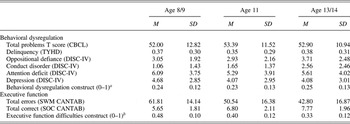
Our sample was characterized by a range of prenatal substance exposure and early adversity. The mean for the prenatal substance exposure summative index was 1.86 substances (SD = 1.37, range = 0–5). The mean for the total number of early adversity factors was 2.34 (SD = 1.51, range = 0–9). For the key developmental outcomes, the means and standard deviations for child behavioral dysregulation and executive function difficulties are presented in Table 1 across time, first by construct indicators in their raw form and then by the mean composite growth construct scored continuously from 0 to 1. The growth constructs for behavioral dysregulation and executive function difficulties showed a pattern of mean stability for behavioral dysregulation and a steady linear decline in executive function difficulties over time.
Means and standard deviations for developmental child outcomes over time

Note: CBCL, Child Behavior Checklist; TYHD, Things That You Have Done; DISC-IV, Diagnostic Interview Schedule for Children—IV; CANTAB, Cambridge Neuropsychological Test Automated Batteries; SWM, spatial working memory; SOC, stockings of Cambridge.
aIndicators were rescaled on a continuous 0–1 metric and averaged to compute the behavioral dysregulation construct.
bThe SOC total correct in minimum moves was reflected; indicators were then rescaled on a continuous 0–1 metric and averaged to compute the executive function difficulties construct.
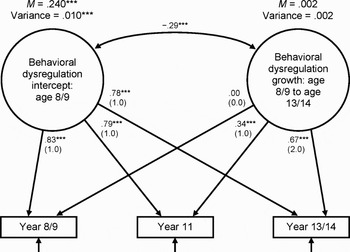
Formal tests for the patterns of growth over time are first provided by estimating the unconditional growth model sans covariates or predictors. The results for growth in behavioral dysregulation are presented in Figure 1 in the form of standardized path coefficients. The mean and variance components for the initial status intercept factor for behavioral dysregulation were significantly different from zero (M = 0.24, p < .001, and σ2 = 0.01, p < .001), indicating that, on average, the sample was elevated about a quarter of the 0–1 scale in behavioral dysregulation and that there were significant individual differences in youths at the age 8/9 assessment on the internalizing and externalizing measures. The stable means exhibited nonsignificant mean growth over time; however, the variance component was significant for the growth factor (σ2 = 0.002, p < .001). Significant variance components indicate that there were individual differences in the trajectories of the youths’ behavioral dysregulation, with youths increasing, decreasing, or remaining stable over time. The negative correlation between initial status and growth means that more youths who were elevated initially tended to decrease dysregulation and those that were lower initially tended to increase dysregulation. Variables that predicted the growth variance were interpreted as factors that predict increases in behavioral problems over time.
Means and variances for initial status intercept and growth factors for the unconditional growth model for behavioral dysregulation construct. Paths are standardized beta coefficients with fixed unstandardized loadings in parentheses; χ2 (1) = 20.49, p = .00; comparative fit index (CFI) = 0.90; standardized root mean square residual (SMSR) = 0.02. *p < .05. **p < .01. ***p < .001.

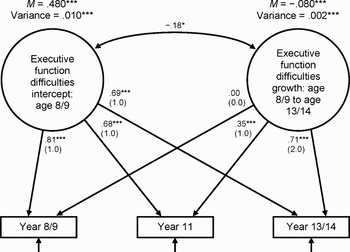
The results of the unconditional growth model of executive function difficulties are presented in Figure 2 using standardized path coefficients. The initial status factor obtained a mean of 0.48 (p < .001), with significant individual differences in executive function difficulties (σ2 = 0.001, p < .001). As is indicated by the means in Table 1, the growth factor also showed that the sample as a whole decreased in executive function difficulties over time (M = −0.08, p < .001), with significant individual differences (σ2 = 0.002, p < .001). Both unconditional models obtained adequate fit to the data given the large sample size indicated by the comparative fit indices above 0.90 and low standardized mean-square residuals.
Means and variances for initial status intercept and growth factors for the unconditional growth model of executive function difficulties construct. Paths are standardized beta coefficients with fixed unstandardized loadings in parentheses; χ2 (1) = 5.90, p = .02; comparative fit index (CFI) = 0.99; standardized root mean square residual (SMSR) = 0.02. *p < .05. **p < .01. ***p < .001.

Effects of prenatal substance exposure and early adversity on growth in adolescent outcomes
We next entered the main effects of prenatal substance exposure on growth in child outcomes. The model was specified as a cross-lag panel model estimating effects of initial status one outcome (behavioral dysregulation or executive function difficulties) on growth in the other outcome. Sex of the child was entered as a covariate. The results of prenatal substance exposure main effects are shown in Figure 3. For clarity, we have displayed the latent variable growth factors minus the repeated-measures manifest variables and their loadings, which are identical to those shown in Figures 1 and 2. Second, we have displayed only the significant effects of the predictor variables, although they were controlled for each dependent variable in the model.
Main effects of maternal prenatal substance exposure on growth in behavioral dysregulation and growth in executive function difficulties across early adolescence. Paths are standardized beta coefficients; χ2 (12) = 73.02; p = .00; comparative fit index (CFI) = 0.96; standardized root mean square residual (SMSR) = 0.05. *p < .05. **p < .01. ***p < .001.

The findings indicate that higher levels of prenatal substance exposure significantly predicted higher levels of behavioral dysregulation at age 8/9 (β = 0.14, p < .001) and increases in trajectories of dysregulation across early adolescence (β = 0.18, p < .001). Prenatal substance exposure was not associated with initial status or growth in executive function difficulties. For the longitudinal effects of initial status, initial behavioral dysregulation significantly predicted increases in trajectories of executive function difficulties (β = 0.32, p < .001) but not vice versa. This suggests that behavioral dysregulation is an important precursor to executive function difficulties. Boys exhibited higher levels of behavioral dysregulation relative to girls. Overall, the model explained 13% and 15% of the variance of growth in behavioral dysregulation and executive function difficulties.
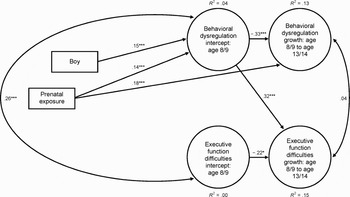
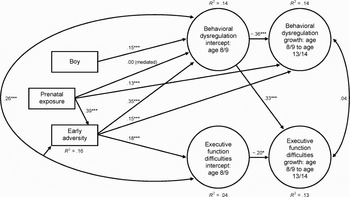
In the final model, the effects of early adversity were entered and were specified temporally as an intervening variable linking prenatal substance exposure to the dependent variables. The results of the final model entering early adversity are displayed in Figure 4. First, prenatal substance exposure was a significant predictor of early adversity (β = 0.39, p < .001). Second, early adversity was a salient environmental predictor of later child outcomes. Early adversity was associated with higher levels of age 8/9 behavioral dysregulation (β = 0.35, p < .001), age 8/9 executive function difficulties (β = 0.18, p < .001), and growth in behavioral dysregulation (β = 0.15, p < .001). Third, regarding the prior main effects of prenatal substance exposure, the effect of substance exposure on growth in behavioral dysregulation remained a significant independent effect after entering early adversity (β = 0.13, p < .001). Further, the main effect of prenatal substance exposure on initial status behavioral dysregulation was rendered nonsignificant upon entering early adversity in the model. This suggests that risk mediated the impact of prenatal substance exposure on initial levels of behavioral dysregulation. Having met the first three criteria of mediation (i.e., a main effect to the outcome rendered nonsignificant, a significant effect to the mediator, and a significant effect from the mediator to the outcome; MacKinnon, Reference MacKinnon2008), we formally tested for a significant indirect effect from prenatal substance exposure to behavioral dysregulation through early adversity. The results of the indirect path effects for prenatal substance exposure are shown in Table 2 and indicate that prenatal substance exposure had a main effect on long-term growth in behavioral dysregulation and had a significant indirect influence through early adversity to long-term growth in executive function difficulties. Early adversity added an additional 10% of explained variance to initial levels of behavioral dysregulation.
Entering effects of early adversity on growth in behavioral dysregulation and growth in executive function difficulties across early adolescence. Paths are standardized beta coefficients; χ2 (14) = 63.87; p = .00; comparative fit index (CFI) = 0.98; standardized root mean square residual (SMSR) = 0.04. *p < .05. **p < .01. ***p < .001.

Standardized specific indirect path effects of maternal prenatal substance use on early adolescent behavioral dysregulation and executive function difficulties across early adolescence

Note: BD, behavioral dysregulation; EFD, executive function difficulties.
*p < .05. **p < .01. ***p < .001.
Discussion
The present findings shed new light on the impact of prenatal exposure and early adversity on elements of ND. Before turning to an examination of the results of growth models predicting ND from prenatal exposure and early adversity, however, several noteworthy results from the preliminary analyses should be noted. Particularly interesting are the differences in the growth between behavioral dysregulation and executive function difficulties. Behavioral dysregulation scores remained stable from age 8/9 to age 13/14, suggesting that there was relatively little change in this domain over the onset of adolescence (although subsequent analyses, shown in Figure 1, revealed varied trajectories for different youths, including increases, decreases, and stability in behavioral dysregulation). In contrast, executive function difficulties exhibited a significant negative slope for mean growth, suggesting a decrease in executive function difficulties across this same time period. Thus, although these ND components and their respective indicators were highly convergent in early adolescence, their developmental trajectories did not converge at later stages of adolescence.
Further, these findings suggested that variance in behavioral dysregulation is an important precursor influencing changes in executive function difficulties. These preliminary results are consistent with what is known about the maturation of the underlying neural systems in regions of the prefrontal cortex associated with executive functioning. The prefrontal cortex is among the brain areas with the most protracted course of development, and much prefrontal cortical development occurs during adolescence. Thus, these results add to the body of evidence showing a general trend toward increasing executive control for all youths during this developmental period (although it is noteworthy that there was variation in the mean slopes for executive function difficulties, with youths increasing, decreasing, or remaining stable across time). That is not to say that behavioral and neurological systems are not highly related. There is substantial evidence that executive functioning and information processing regulate immediate behavioral responses. Rather, our findings help to inform the independent rate of maturation for these ND systems during this circumscribed period of development.
The growth model predicting components of ND from prenatal substance exposure (see Figure 3) yielded a number of interesting results. First, prenatal exposure was associated with behavioral dysregulation at age 8/9. In many ways, this is to be expected: youths with prenatal exposure are well documented to be at risk for behavioral and emotional problems. However, prenatal exposure was also associated with the youths’ trajectories on behavioral dysregulation across adolescence. Prenatally exposed youths became increasingly dysregulated over time. Although there is anecdotal evidence that prenatally exposed youths exhibit an escalation of behavior problems in adolescence (Streissguth et al., Reference Streissguth, Bookstein, Barr, Sampson, O’Malley and Young2004), there is very little empirical evidence to date of this phenomenon.
In contrast to the direct pathways from prenatal exposure to behavior dysregulation, the pathways from prenatal exposure to executive function difficulties were less direct and more subtle. In particular, it appeared that the impact of prenatal exposure on executive function difficulties was mediated through behavioral dysregulation and that this relationship only existed for the growth in executive function difficulties during adolescence. The lack of an association between prenatal exposure and executive function difficulties at age 8/9 is not entirely surprising; there is naturally occurring variation in executive functioning prior to adolescence, even among youths without early adversity. Thus, adjustment difficulties related to executive function difficulties might be more likely characterized by a lack of maturation in this domain during adolescence than by early difficulties.
More unexpected was the lack of direct effects of prenatal exposure on the trajectories of executive function difficulties during adolescence. Essentially, prenatal exposure might not represent a risk factor for executive function difficulties. Rather, a cascading causal chain might exist: among prenatally exposed youths, only those who enter adolescence with behavior problems are likely to experience executive function difficulties. The importance of these results for policy and programming cannot be understated. Given the limited resources available for prevention and intervention programs with high-risk populations, these results suggests that special attention should be focused on prenatally exposed youths who manifest behavioral problems at the onset of adolescence; it is among these youths that ND is mostly likely to emerge during adolescence.
These results are also important in advancing scientific knowledge in this area. It is a common assumption that prenatal exposure is associated with risk for general deficits in functioning across many emotional, behavioral, and cognitive domains. In contrast, our results suggest that prenatal exposure is directly associated with behavioral dysregulation but only indirectly associated with executive function difficulties. The results also provide evidence for a delayed effect of prenatal exposure that may not be fully evident until adolescence: prenatal exposure predicted only the trajectory of executive function difficulties during adolescence but did not predict executive function difficulties at age 8/9.
The results of the full model, which included prenatal exposure and early adversity as ND predictors, produced somewhat different but equally interesting results. As with the prior model, prenatal exposure predicted the trajectory of behavior dysregulation from age 8/9 to age 13/14. However, the path from prenatal exposure to behavior dysregulation at age 8/9 was mediated through early adversity effects. Early adversity also had a direct effect on behavior dysregulation trajectories during adolescence; as with prenatal exposure, though, its effect on executive function difficulties trajectories appeared to be mediated through behavior dysregulation at age 8/9. Also noteworthy was the association between early adversity and executive function difficulties at age 8/9, which was the only direct path to this outcome in either model.
These results are consistent with prior studies in documenting that prenatal exposure and early adversity are associated with the emergence of components of ND. However, they also extend prior research findings by providing evidence that both experiences, when included in the same model, contribute independently to ND. This is particularly remarkable given the time intervals between the predictor measures (prenatal exposure and early adversity) and the outcomes (behavior dysregulation and executive function difficulties) from age 8/9 to age 13/14. Overall, the results provide confirmation that a common pathway for ND exists among youths who experience both prenatal substance exposure and early adversity.
These results support the current conceptualizations of allostatic load described above. We cannot determine the specific mechanisms by which prenatal substance exposure and early adversity affected ND in our study, and there are likely a number of mechanisms involved. However, from the allostatic load perspective, it is possible that a common mechanism could be through alteration of the HPA axis. We already know that long-term chronic adversity can affect the neuroendocrine system and lead to long-term damage to metabolic, immunologic, and neurological systems. Although the pathophysiology of drugs such as cocaine are typically thought of as due to teratogenic mechanisms (effects on neurotransmitter systems), it has also been suggested that these substances could act as prenatal stressors affecting the expression of placental genes (epigenetic effects) that increase fetal exposure to maternal cortisol, thereby altering the responsivity of the infant's HPA system (Lester & Padbury, Reference Lester and Padbury2009). As is described above, early environmental adversity and prenatal cocaine exposure affect cortisol responsivity. Thus, it is possible that alterations to the HPA axis represent a common mechanism that could explain our findings of prenatal substance exposure and early adversity on ND.
Given these results, it might be particularly important to focus funding and resources on youths who experience both prenatal exposure and early adversity. This might be challenging in light of our finding that the executive function difficulties components of ND, although clearly predicted by prenatal exposure and early adversity, might not emerge until adolescence. Essentially, it would require that services be allocated based on specific experiential profiles rather than on current symptomatology. Nevertheless, if not targeted and mitigated, problems associated with ND might become particularly pernicious across adolescence and might ultimately result in much greater societal and financial costs without early intervention.
Our results also have implications for the field of prevention research. Cicchetti and Gunnar (Reference Cicchetti and Gunnar2008) noted that neurobiological measures have great potential to inform prevention science. In particular, such measures may help to better characterize the needs of high-risk populations and to inform preventive interventions. Our results indicated that children with both prenatal exposure and early adversity (vs. children with either experience alone) face unique and greater risks for later poor outcomes. Identifying these children in the context of early screening in infancy and preschool has the potential to lead to reduced costs and improved outcomes.
Conclusions
Our results provide some of the first evidence that prenatal exposure and early adversity contribute independently toward high-risk trajectories that might have an underlying neurodevelopmental basis and that might follow a distinct developmental pathway from prenatal substance exposure and early adversity to the onset and growth in behavioral dysregulation to changes in neurological deficits. However, before these findings can be expected to influence policy, further research is needed: replication studies and studies with expanded and alternative theoretical scopes that explore similar outcomes among youths with prenatal exposure and early adversity across early and late adolescence. To the extent that converging evidence from multiple studies of this population are found, it might be possible to leverage this information for policy changes that address the needs of these individuals. More comparative and experimental findings are also required to better inform policy. It is important to note the advantages of the present prospective data and the time-ordered theoretical sequencing for model specification. At the same time, causation cannot be inferred without rigorous experimental designs. In the interim, it is important that researchers studying populations with early adversity begin to collect high quality measures of prenatal substance exposure whenever possible. Similarly, researchers conducting longitudinal studies of prenatally exposed youths must begin to treat the early environment as more than a set of control variables. Integrating these two disciplines will help to develop an evidence base upon which intervention and policy work can be based.