Introduction
Working memory (WM) has received considerable attention as an underlying cognitive construct associated with various cognitively and linguistically related functions, since Baddeley and Hitch (Reference Baddeley, Hitch and Bower1974) embedded working components into the short-term storage buffer by developing the concept of WM. Among many cognitive functions, language-comprehension domains are one of the most actively studied areas in relation to WM capacity. WM capacity associated with language processing is an underlying cognitive construct involved in maintaining information and computing syntactic structures to correctly interpret the meaning of a sentence (Just and Carpenter, Reference Just and Carpenter1992). Just and Carpenter (Reference Just and Carpenter1992) suggested that individual differences in WM capacity can account for performance on language processing and efficiency; subsequently, many studies reported that sentence-comprehension abilities relate to individual differences in WM capacity, measured by various WM tasks (e.g. Waters and Caplan, Reference Waters and Caplan2003).
It is well known that WM capacity declines with age, based on the assumption that older adults have limited processing resources required to perform cognitive and linguistic operations (e.g. Morris et al., Reference Morris, Gick and Craik1988; Carpenter et al., Reference Carpenter, Miyake and Just1995; Waters and Caplan, Reference Waters and Caplan2001). Many studies reported that elderly adults performed significantly worse on various WM measures than younger populations (e.g. Waters and Caplan, Reference Waters and Caplan2001; Reference Waters and Caplan2005). Researchers have investigated the relationship between WM capacity and sentence comprehension in aging populations, suggesting that reduced WM capacity relates to decreased performance on sentence-comprehension measures in older adults (Kemper, Reference Kemper1986; Davis and Ball, Reference Davis and Ball1989; Light, Reference Light, Birren and Schaie1990; Obler et al., Reference Obler, Fein, Nicholas and Albert1991; Kemtes and Kemper, Reference Kemtes and Kemper1997). It seems relatively clear that WM relates to sentence-comprehension abilities and WM declines with age, resulting in reduced sentence-comprehension performance observed in elderly adults. However, the critical factor impacting age and WM is still unclear, along with how these two factors interact to account for sentence-comprehension abilities.
DeDe et al. (Reference DeDe, Caplan, Kemtes and Waters2004) investigated the relationship among age, WM, and language measures using a structural-equation modeling method. Language-comprehension measures consisted of three tasks: an online syntactic processing task with relative-clause sentences using a self-paced auditory moving window, and the two offline comprehension tasks of plausibility judgment and text comprehension. Results suggested an age effect exists for online syntactic processing, but no direct or mediated effects of WM for online processing, although WM mediated effects of age for offline sentence-comprehension tasks. Based on the results, DeDe et al. argued that individual differences in WM capacity were differentially involved in the level of sentence processing. Furthermore, they suggested that the inter-relation between WM capacity and age needed to be carefully interpreted considering whether the nature of sentence processing taps into online or offline levels.
A couple of studies examined age-group differences in sentence processing by treating age as a categorical variable. Researchers using this approach employed group comparisons between younger and older adults (e.g. Kemtes and Kemper, Reference Kemtes and Kemper1997; Waters and Caplan, Reference Waters and Caplan2001, Reference Waters and Caplan2005). Criteria to divide the age groups differed across studies. Age ranges for the younger group and older adults were 17–29 (mean = 21) and 65–80 (mean = 71), respectively, in Waters and Caplan (Reference Waters and Caplan2005). Waters and Caplan (Reference Waters and Caplan2001) divided participants into five age groups: 18–30, 50–59, 60–69, 70–79, and 80+ years. Younger adults ranged in age from 18 to 25 (mean = 22) and older adults from 63 to 84 (mean = 71) in the Kemtes and Kemper (Reference Kemtes and Kemper1997) study.
Although age is a continuous variable in nature, researchers categorized age into several groups to examine the age-related effects on WM and sentence comprehension. However, converting a continuous variable into a categorical variable may induce spurious effects on the dependent variables. One disadvantage of categorization of a continuous variable is the loss of statistical power and precision of estimated means, driven by spending more degrees of freedom. Within each interval of the categorization, a relation of the predictor and the response are assumed to be flat, which may not be realistic. Other issues in categorization of a continuous variable can be found at the Vanderbilt University Department of Biostatistics (Harrell, Reference Harrell2015) website. Considering these issues of categorization of a continuous variable, we carefully considered the statistical model for the current experimental design by employing a linear mixed-effect model. We delineate specific considerations and modeling procedures in the results section.
The current study employed passive syntactic structures to investigate age-related changes in sentence-comprehension abilities. Many researchers have argued that passive sentences are more difficult to process than active sentences, given that passivization involved the movement of thematic roles from their canonical places (Obler et al., Reference Obler, Nicholas, Albert and Woodward1985; Obler et al., Reference Obler, Fein, Nicholas and Albert1991; Rochon et al., Reference Rochon, Waters and Caplan1994; Waters et al., Reference Waters, Rochon and Caplan1998). Noun phrases to denote thematic roles are moved out of their canonical structure in passive sentences, resulting in greater processing cost imposed on passive sentences than active structures. Researchers investigated age-related decline in sentence-processing abilities and their relation to WM capacity, mostly focusing on sentences with relative clauses (Waters and Caplan, Reference Waters and Caplan2001; DeDe et al., Reference DeDe, Caplan, Kemtes and Waters2004; Waters and Caplan, Reference Waters and Caplan2005) or ambiguous sentences (Kemtes and Kemper, Reference Kemtes and Kemper1997; Reference Kemper, Kemtes, Kemper and Kliegl1999). In contrast, few studies exist on passive-sentence comprehension for elderly adults (Obler et al., Reference Obler, Nicholas, Albert and Woodward1985; Reference Obler, Fein, Nicholas and Albert1991). Passive sentences are clearly more complex than active sentences. However, compared to sentences with relative clauses such as object- and subject-relative clauses, passive sentences could be simple, given that passive sentences consist of one sentence, whereas sentences with relative clauses contain two sentences. It is important to sensitively examine the age-related effects that emerge in passive-sentence constructions, and how these effects interact with WM capacity.
The current study specifically focused on Korean passive constructions. Korean is a verb-final language with a canonical word order of subject–object–verb. Although verbs appear at the end of a sentence, other linguistic units can be scrambled rather freely. Due to syntactic features, Korean is often called a free word-order language (Sohn, Reference Sohn1999). Although Korean is considered to have a free word-order structure, the effects of word order clearly emerged from the sentence-picture matching task (Sung, Reference Sung2015a) in normal elderly adults. Sung (Reference Sung2015a) tested only elderly adults to examine the word-order effects on sentence comprehension with three different syntactic structures such as active sentences with two-place verbs, active sentences with three-place verbs, and passive sentences. She found the significant interaction between the word order and the syntactic structure, but the previous study did not examine how the combination of the factors, such as age, WM capacity, and word order affected sentence comprehension. The previous study found the significant correlations between sentence-comprehension abilities and WM capacity. However, it has limitations in that the previous study did not examine the age effects and the interactions among age, WM capacity, and word order. Furthermore, the previous study only included elderly adults with a limited range of age (65–85). The current study invested age effects with wider range from 21 to 86, specifically focusing on the passive syntactic structure, given that the previous study suggested that passive sentences were the most difficult syntactic structure to process. To our knowledge, no studies specifically examined the effects of age, WM capacity, and word order on Korean passive-sentence comprehension. The current study elaborated the previous study to further investigate the effects of WM capacity and age on passive-sentence comprehension in a verb-final language using a linear mixed-effect model. This approach is novel and the first attempt, and the results of the study will impact the interpretations of aging-related effects on sentence processing considering inter-relations among cognitive mechanism and psycholinguistic variables such as syntactic structure and word order in a verb-final language.
Methods
Participants
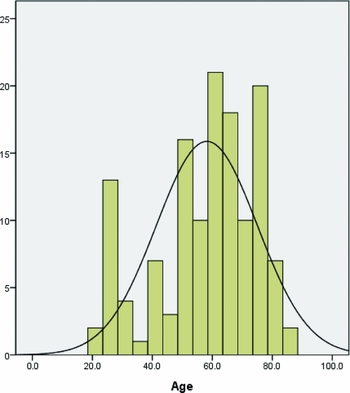
A total number of 134 individuals (men = 53; women = 81) participated in the study. The range of the age was 21 to 86 (mean = 58, SD = 17). Years of education ranged from 0.5 to 18.5 (mean = 12.87, SD = 3.98). We provided a histogram to represent the age distribution of all participants (see Figure 1).
Distribution of age.

All participants were native speakers of Korean, showed a normal range of age- and education-adjusted scores from the Korean Mini-Mental State Examination (Kang, Reference Kang2006). Participants reported they had no history of neurological disease, hearing loss, or language-developmental disorders. We excluded no participants from the data analysis. All participants provided a signed informed-consent form prior to participation. The research protocol was approved by Ewha Womans University's Institutional Review Board (Approval Number 78–23).
Materials
Passive-sentence-comprehension task
We employed a sentence–picture-matching paradigm to demonstrate the passive-sentence-comprehension task. An examiner presented a picture that consisted of two parts: A target picture (e.g. A is kicked by B) and a syntactic foil (e.g. B is kicked by A) of a target sentence. The target and the foil sentences were all passive structures. The syntactic foil of a target passive sentence was constructed by reversing the agent and dative (by- phrase) thematic roles. To make all sentences semantically reversible, we used three colors of humanized symbols to describe the sentence: “the Black,” “the Blue,” and “the Yellow,” as used in a previous study for a sentence-production paradigm (Sung, Reference Sung2015b). The current task had a very limited set of semantic vocabulary. Using the semantically controlled paradigm carries a variety of advantages to test syntactic-comprehension abilities, given that the task made participants focus on syntactic features of a sentence to correctly interpret the meaning of the sentence when they could not rely on semantic top–down processing.
Sentence stimuli consisted of two conditions of canonicity of word order: canonical versus non-canonical word order. In the canonical condition, noun phrase with a nominative case marker (ka) came first in a sentence, followed by a by- phrase (eykey), as provided in Example A (Table 1). In the non-canonical condition, by- phrase (eykey) was placed at the beginning of a sentence, followed by the noun phrase with a nominative case marker, as in Example B (Table 1). The picture stimuli for an example of “The Yellow is kicked by the Blue” were provided in Figure 2. The task consisted of a total of 12 items with six items for each word order. The presentation order for items was pseudo-randomized to ensure the same word order was presented no more than three times consecutively.
Sentence examples for passive-canonical and passive-non-canonical conditions

An example of a passive sentence comprehension task (the yellow is kicked by the blue).

Working-memory capacity measures
The current study employed four measures of WM capacity: digits-forward (DF), digits-backward (DB), words-forward (WF), and words-backward (WB). We took DF and DB tasks from the Korean version of the Wechsler Adult Intelligence Scale (Yeom et al., Reference Yeom, Park, Oh, Kim and Lee1992). The DF task contained a total of 14 trials, ranging from Span 3 to Span 9, with two trials for each span. The total possible score for the task was 14. The DB task had the same number of trials, but ranged from Span 2 to Span 8 with two trials for each span. Sung (Reference Sung2011) developed word-based span tasks, such as WF and WB. The procedures and number of trials from word-span tasks aligned with digit-span tasks. Examiners administered forward-span tasks prior to backward-span tasks, following instructions from the Wechsler Adult Intelligence Scale. The order of presentation counterbalanced between the word- and digit-span tasks.
Prior to the data analyses to examine the effects of WM, age, and word order on sentence comprehension, we conducted a preliminary analysis to explore whether the four WM measures loaded on a same construct. We conducted an exploratory factor analysis using a principal-component-extraction procedure to validate whether the four WM tasks loaded on the same factor. A one-factor solution accounted for 69.52% of the total variance. Based on the results, the sum of the four tasks served as a composite measure of WM-capacity index for further analysis, to increase the reliability and stability of WM (Waters and Caplan, Reference Waters and Caplan2003).
Experimental procedures
All participants were tested individually in the laboratory setting. Testing sessions lasted approximately 1 h, and all tasks were completed within one session. In the passive-sentence comprehension task, participants were asked to point to the picture that corresponds to the target sentence that was auditorily presented by the examiner. The picture consisted of the target and a foil in which thematic roles were reversed as in Figure 2. Participants were asked to respond to the task as quickly as possible, and they were given as much time as they need. It is allowed to repeat the target sentence once when participants asked examiners to repeat it, but the last response was scored.
Results
Correlational analyses
Prior to the main analyses, we explored correlations among the variables, including age, WM scores, and performance on canonical and non-canonical passive sentences. Performance on the sentence-comprehension task was based on the accuracy measured as percentage correct. The mean of WM scores from the current sample was 24.37 (Range: 6–49, SD = 8.15), and the mean of the passive-sentence-comprehension task was 90.42 (Range: 16.67–100, SD = 18.32) and 85.42 (Range: 16.67–100, SD = 21.51) for canonical and non-canonical conditions, respectively.
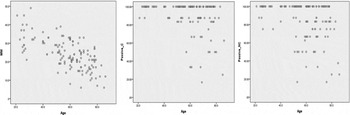
We computed Pearson-correlation coefficients and provide the results in Table 2. Age significantly and negatively correlated with WM, r = −0.654, p < 0.0001, and age also correlated negatively with both sentence types, indicating that those who are older tend to present reduced WM capacity and lower scores on passive sentences. We provided scatterplots of WM and sentence comprehension as a function of age in Figure 3. WM exhibited significant and positive correlations with canonical, r = 0.523, p < 0.0001, and non-canonical sentences, r = 0.516, p < 0.0001, indicating that those who have larger WM capacity performed better on the passive-sentence-comprehension task.
Pearson correlation coefficients among age, working memory, canonical and non-canonical passive sentences

Note: WM = working memory.
**p < .01.
Scatterplots of working memory (WM), passive-canonical (Passive_C), and passive-non-canonical (Passive_NC) as a function of age.

Age, word order, and working-memory capacity effects on passive sentences
In the current experimental design, we provided each participant a sentence-comprehension task with two different word orders, resulting in a cross-over design. We included age and WM capacity as covariates to account for word-order related changes in sentence-comprehension abilities. To choose an adequate statistical model for the analysis, we carefully considered the following two features of the design. First, we expected heavy subject-by-subject variation in the cross-over design; thus, it must be properly accounted to test the effects accurately. Second, the subject-by-subject variation was random and all three effects of interest were fixed. Therefore, a linear mixed-effect model was the most appealing statistical method for the analysis. In the analysis, we fitted and tested main effects of word order, age, and WM and their two-way interaction effects. Then, we removed the interaction terms of no or little significance to finalize the modeling.
More specifically, the statistical model, which is a mixed effect model with a random intercept and fixed effects for word orders, age, and WM, is as follows:
 $$\begin{equation*}
{y_i} = {\alpha _i} + {X_i}\beta + {\varepsilon _i},\;i = 1, \ldots \ldots ,139,
\end{equation*}$$
where yi = (yi 1, yi 2), i represent each participant, the intercept αi and the random error εi are independently normally distributed with mean 0 and 2×2 covariance matrices Σα and Σε , respectively.
The random intercept αi is random by the model construction and accounts for the participant-by- participant variation. Due to the randomness of αi , it is assumed to be normally distributed. The intercept is estimated for each participant, and the estimates are different from each participant. On the other hand, word orders and the two covariates of age and WM along with their interactions are fixed, and their coefficients remain the same for all participants. The coefficients measure the average effects of word orders, age, and WM to the response across the population.
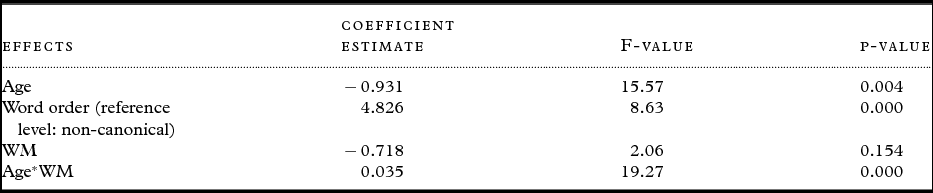
We fitted a model with PROC MIXED from SAS 9.3. A linear mixed-effect modeling procedure started with age, word order, WM, and their two- and three-way interactions for fixed effects and subject-to-subject variations for the random effect. In the model, we eliminated the effects of the three-way interaction term (p-value = 0.350) and the two-way interactions of Age*Word Order (p-value = 0.400) and WM*Word Order (p-value = 0.275) due to lack of sufficient significance. Finally, the model we selected for analysis included the main effects of age, word order, WM, and the two-way interaction between age and WM. The coefficient estimates, test statistics, and corresponding p-values appear in Table 3.
The coefficient estimates, test statistics and corresponding p-values from a linear mixed-effect model analysis

Note: WM = working memory.
With an α level of 0.05, the main effects of age and word order and the interaction effect were significant. Although the main effect for WM was not significant, we included it in the model, given that the Age*WM interaction was significant. Results revealed that canonical word-order scored about 5 (coefficient estimate = 4.826, p < 0.0001) points higher than non-canonical word order.
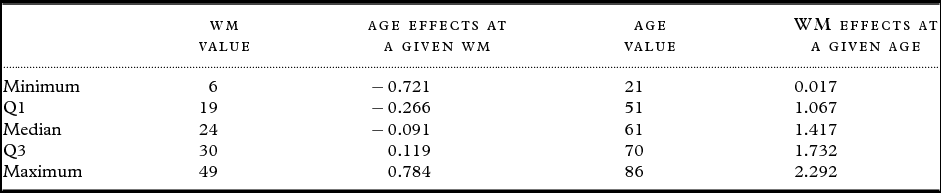
The significant two-way interaction between age and WM can be addressed by the specific equation from Table 2. When WM is fixed with a specific value, age effects on sentence comprehension can be represented in an equation of 0.035*(WM score)−0.931. When Age is fixed, the equation for WM effects is 0.035*(Age score)−0.718. Due to the interaction term, interpretation and size in changes of the effects of age and WM depend on their specific values. We calculated age and WM effects on sentence-comprehension abilities based on equations with specific values, such as minimum, 1st quartile, median, 3rd quartile, and maximum, shown in Table 4.
Age and working memory effects on sentence comprehension based on the equations with specific values such as minimum, 1st quartile, median, 3rd quartile, and maximum

Note: WM = working memory; Q1 = 1st quartile; Q3 = 3rd quartile.
As shown in Table 4, WM effects systematically increased as age increased, indicating that WM capacity elicited differentially larger effects on sentence-comprehension abilities for elderly adults compared to younger adults. In contrast, age effects varied depending on the WM value by either increasing or decreasing the score of sentence comprehension. Furthermore, the magnitude of WM effects on sentence-comprehension scores were relatively larger (0.017–2.292) than age effects (−0.091 to 0.784). It is important to note that WM effects increased as people get older, and those effects maximized when age had a maximum value of 86. In sum, results suggested that the magnitude of WM effects on sentence comprehension was greater than age effects on the task.
Discussion
The current study investigated the effects of WM capacity and age on passive-sentence comprehension in a verb-final language when a word order was systematically manipulated. Critical findings of the current study suggested that age was associated with both WM capacity and performance on passive-sentence-comprehension task. The significant two-way interaction between WM and age indicated that WM capacity became more critical as people age, suggesting WM capacity may serve as cognitive reserve to make people less vulnerable to age-related decline in sentence processing. More specific discussion for each finding was delineated as below.
Age significantly and negatively correlated with WM capacity, and results align with previous findings that WM capacity declines with age (e.g. Waters and Caplan, Reference Waters and Caplan2001; Reference Waters and Caplan2005). Age also negatively correlated with scores on the passive-sentence-comprehension task, indicating that elderly adults presented worse performance than younger adults. Results align with previous studies on aging-related decline in sentence-comprehension abilities (e.g. Zurif et al., Reference Zurif, Swinney, Prather, Wingfield and Brownell1995; Kemper and Kemtes, Reference Kemper, Kemtes, Kemper and Kliegl1999; Stine-Morrow et al., Reference Stine-Morrow, Ryan and Leonard2000; Caplan et al., Reference Caplan, DeDe, Waters, Michaud and Tripodis2011). However, the correlation between age and scores on the sentence-comprehension task was rather moderate, r = −0.329, suggesting that age can account for only about 10% of the total variance (R 2 = 0.11) from the sentence-comprehension score. Results suggested that other variables may engage to account for individual differences in sentence-comprehension abilities. Thus, we implemented variables of interest, such as age, WM capacity, and word order into a linear mixed-effect model. The linear mixed-effect model has advantages over other statistical procedures in the current experimental design, given that it takes subject-by-subject variability as a random effect into account. Furthermore, the continuous variables such as age and WM capacity were not categorized in the model; thus, we avoided the disadvantages that categorization of continuous variables could elicit.
When, we fit the model with the three factors of age, word order, WM, and their two-way and three-way interactions, the main effects for age, word order, WM and the two-way interaction between age and WM, significantly accounted for abilities to comprehend passive-sentence comprehension. Results revealed a significant main effect for word order, indicating that canonical word order elicited higher scores on the passive-sentence-comprehension task than non-canonical word order. It is interesting to note that a significant effect of word order emerged in Korean users especially in the sentence-comprehension domain. Results suggested that canonicity of word order significantly affected performance on sentence comprehension even in users of a relatively free word-order language. The word-order effects were confirmed consistently in the previous studies across the modalities such as in sentence-comprehension domains for elderly adults (Sung, Reference Sung2015a), sentence production paradigm (Sung, Reference Sung2015b), and case marker assignment task (Sung, Reference Sung2016). Sung (Reference Sung2015a) examined the effects of word order on sentence comprehension and their relations to WM capacity for elderly adults. She found that there were significant main effects for word order and the syntactic structure, indicating that elderly adults demonstrated greater difficulties in non-canonical than canonical word-order conditions. The significant effects for the syntactic structures indicated that elderly adults presented word performance on passive structures than active sentences either with two-place or three-place verbs. She reported overall moderate to high correlation coefficients among performance on sentence-comprehension measures and WM tasks with the range of r = 0.401–0.654. Previous results suggested that individual differences in WM capacity can partially account for differential performance on sentence-comprehension tasks for elderly adults and the word order played a role as a factor that affected performance. However, the study did not examine the interaction between WM and the word order specifically. Thus, it is hard to conclude whether the non-canonical word order in Korean is a factor that demands WM capacity for elderly adults. The current study found significant main effects for WM, age, and word order, but the interaction between WM and word order was not significant. Due to the lack of the interaction, it is difficult to say that the non-canonical conditions were differentially harder for those who have lower WM capacity. Given that we included participants with a wide range of age into the analyses to fit the model for the interaction between WM and word order, the ceiling effects on the sentence-comprehension task from younger adults (c.f., scatterplot in Figure 3) may wash out possible WM effects on the word order. Further, studies need to examine the word order effects and their relation to WM capacity for elderly adults who have reduced WM capacity to confirm the hypothesis that greater word-order effects would emerge for more cognitively vulnerable populations with a wide range of variability in sentence comprehension and WM capacity.
The current study found a significant interaction effect between age and WM to account for passive-sentence-comprehension abilities. The significant two-way interaction suggested that WM capacity effects on passive-sentence-comprehension abilities increased dramatically as people aged, whereas the effects of age on sentence comprehension were relatively small. In other words, as people get older, WM capacity plays a critical role to account for elders’ abilities to understand passive sentences, compared to younger adults. Results indicated that the importance of WM capacity increases as people age, suggesting that those who have larger WM capacity are less vulnerable to age-related decline in sentence-comprehension abilities. WM effects maximized when participants’ age reached a maximum value (see Table 4). The significant interaction between the age and WM capacity implied differentially greater impacts of WM capacity on passive-sentence comprehension as a function of age, indicating that preserved cognitive abilities, as measured by WM tasks in the current study, became more critical to perform complex linguistic computations such as passive sentences, especially as people aged. The evidence suggested that WM capacity may serve as a cognitive reserve associated with sentence comprehension for elderly adults. The concept of cognitive reserve refers to a potential cognitive mechanism that copes with aging-related changes in the brain (Stern, Reference Stern2002). Stern (Reference Stern2002) developed the notion of cognitive reserve to explain individual differences in aging-related changes of cognitive and linguistic tasks, based on the assumption that those who have greater cognitive reserve are less vulnerable to age-related decline in various cognitive measures and address tasks more efficiently than those with less available cognitive reserve (Stern, Reference Stern2002, Reference Stern2009, Reference Stern2012).
WM capacity likely plays a role as an underlying cognitive reserve to account for age-related changes in sentence comprehension. Current data clearly suggested that WM capacity is a critical factor to predict performance on sentence-comprehension abilities, especially as age increases. In other words, it seems that those who have greater WM capacity are likely to have a larger cognitive reserve available to be efficiently allocated to process syntactic computations, resulting in less vulnerability to age-related decline in sentence-comprehension abilities.
Previous studies reported that age-related decline in WM capacity aligns with decreased sentence-comprehension abilities (Waters et al., Reference Waters, Caplan and Rochon1995; Rochon et al., Reference Rochon, Waters and Caplan2000; Caplan and Waters, Reference Caplan and Waters2003; DeDe et al., Reference DeDe, Caplan, Kemtes and Waters2004). However, most researchers studied English, and the replicated effects of age and WM on sentence comprehension need to be validated in various languages to better understand the nature of age-related decline in WM capacity and the interaction effects between age and WM capacity on sentence-comprehension abilities. Korean is a good counterpart of English to cross-validate the effects from the previous studies of English-speaking participants, given that Korean has different syntactic structure (SOV) from English (SVO), and furthermore Korean can be manipulated by the canonicity of word order due to the freedom of scrambling the linguistic units. The current findings will contribute to adding evidence of age and WM effects on sentence processing in a verb-final language.
It is hard to systematically disentangle the effects of age and WM capacity on sentence comprehension, given that many studies replicated the outcome that those two variables are strongly interrelated factors. However, it is important to examine the relative contribution of each component to better account for age-related changes in sentence-comprehension abilities. The current study has limitations, given that only a couple of variables were entered into the analyses. More variables need to be studies as potential factors that may account for age-related decline in sentence processing such as education and other cognitive variables than WM.
To the best of our knowledge, this study is the first attempt to examine the canonicity of word-order effects and the interaction between age and WM capacity on passive-sentence comprehension in a verb-final language. Additional studies should explore what factors are critical to sensitively reveal age-related changes in linguistic and cognitive measures. Furthermore, it is critical to consider the underlying mechanisms that serve as a cognitive reserve to delay age-related changes in abilities to compute cognitive and linguistic tasks. The current study adds evidence of the role of WM capacity and word-order manipulation on age-related changes in passive-sentence comprehension in those who process a verb-final language.
Conflict of interest
None.
Description of authors’ roles
J.E. Sung designed the study, formulated research questions, and wrote the paper. J.K. Yoo performed statistical analyses data and wrote the results. S.E. Lee collected data and wrote the paper. B.Eom wrote the paper.
Acknowledgments
This work was supported by the National Research Foundation of South Korea Grant funded by the Korean Government (NRF-2014S1A5A8018080 and NRF-2016S1A5B6913884).