Introduction
Returning to Britain at the height of World War I, the Imperial Transantarctic Expedition 1914–1917 received little lasting attention from press, public or scientific community. The leader's first full account (South: the story of Shackleton's last expedition 1914–1917) appeared in 1919, soon after Shackleton's return from war service in Russia. It reported mainly the events for which the expedition is now chiefly remembered – the loss of the ship S.Y. Endurance in the Weddell Sea, the struggles of the stranded crew toward the South Shetland Islands, Shackleton's voyage in a lifeboat with five companions to South Georgia, and the subsequent rescue of the crew from Elephant Island. South included five chapters on the work of the Ross Sea party, and a final chapter summarising the expedition as a whole. In this Shackleton noted: ‘I have appended a short scientific memorandum to this volume, but the more detailed scientific results must wait until a more suitable time arrives, when more stable conditions prevail. Then results will be worked out’ (Shackleton Reference Shackleton1919: 388).
The memorandum included five brief reports by the expedition's scientists. There were two by James M. Wordie (geologist), and one each by Robert S. Clark (biologist), Leonard D.A. Hussey (meteorologist) and Reginald W. James (physicist). However, Shackleton's promise of further results was never realised. Loss of specimens and data, dispersal of scientists, lack of funding for publication, and Shackleton's death on his final expedition in 1922, combined to ensure that little further scientific information would emerge from the expedition. South achieved immediate popular success. A new impression emerged in December 1919, to be twice reprinted in the following year. A ‘first cheap edition’ appeared in 1921. This was an abbreviated version of the original edition, reduced from 368 pages to 259. Reduction mainly involved cutting long paragraphs to their opening sentences (thereby retaining the flow of narrative but omitting much detail), reducing the number of illustrations from 56 to 32, and omitting altogether the scientific memorandum. A facsimile version of the original 1919 edition was produced by Time-Life Books in 1983.
Worsley's records
In writing South, Shackleton drew heavily on the ship's logs, charts and diaries of Frank A. Worsley, the master of Endurance. The original diaries and logs, and copies of the charts, are now held in the archives of the Scott Polar Research Institute (Worsley Reference Worsley1915, Reference Worsley1916). Among the few documents to have survived the loss of the ship and its aftermath, these provide a detailed account of the day-to-day progress of the expedition through the early weeks in the ice.
Worsley, a meticulous navigator, also took a lively interest in natural history and people. Among his chartwork and notes on the ship's movements, he added detailed and often amusing comments on the birds, seals and whales encountered, and the activities of his shipmates. Together with trawling, dredging and scientific recording, these included dog-team racing, football matches on the pack ice, and an occasional involuntary swim.
A biology diary of Robert Clark, also held in SPRI archives (Clark Reference Clark1919) is entered in a commercially-printed desk diary for 1919, that is long after the events noted, presumably because his original diary and records were lost. This too echoes Worsley's account, containing little information on natural history that is not included therein. Clark, who was primarily a fisheries biologist, assiduously trawled and dredged during the passage south, collecting plankton and bottom samples, all of which went down with the ship. His contribution to South's scientific appendix, entitled ‘South Atlantic whales and whaling’, reported almost entirely on the South Georgia whaling industry and the whales involved. Though an interesting and timely contribution to whaling biology, it ignores almost completely all other fauna encountered during the voyage. Of emperor penguins he reports only that the stomachs of ‘hundreds’ examined invariably contained cephalopod beaks, but makes no comments on their abundance during the early voyage through the pack ice and subsequent drift or of the possible significance of Worsley's observations on the species.
Like Shackleton and Clark, Worsley himself remained unaware of any scientific value in his notes on emperor penguins. After an eventful war in which he was twice decorated, and during a colourful subsequent peacetime career, Worsley delayed writing his own popular account of the expedition until Reference Worsley1931. Endurance, like Shackleton's account, was concerned mainly with exploration, adventure and survival. Only in passing did he mention the natural history that had so fully occupied him during the voyage.
A breeding colony discovered
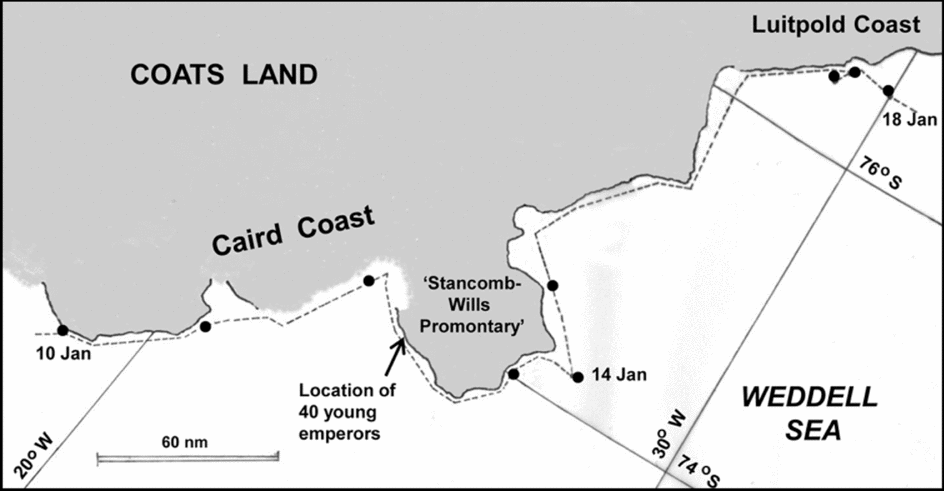
Endurance first met the pack ice off the South Sandwich Islands on 7 December 1914, and moved southwestward through loose floes toward the ice-cliffs lining the coast of Coats Land (Worsley Reference Worsley1915: Chart 3; Reference Worsley1916). On the evening of 10 January 1915, in 72°34′S, 16°40′W (Fig. 1), Worsley noted an appearance of land, and by midnight Endurance had broken into ‘. . . a lead of open sea along a barrier-edge’ (Worsley Reference Worsley1915). On the chart he noted that the seawater had changed colour from blue-green to brown and was ‘turgid with diatoms’. He noted also ‘hundreds of crabeater seals’ on the nearby pack ice, flocks of flying birds, and numbers of Adélie and emperor penguins, increasing as the ship moved along the coast.
Track of SY Endurance along the Weddell Sea coastal polynya, 10–18 January 1915, traced from Worsley's chart. Black dots mark the ship's noon positions.

This route, pioneered by the Scottish National Expedition in March 1904 (Speak Reference Speak1992, and see below), is now recognised as an annually-recurring polynya that forms and re-forms constantly within a few km. of the ice cliffs along the Weddell Sea coast, due to strong recurring katabatic winds (Eiken and others Reference Eicken, Grenfell and Stonehouse1988).
During the following week Endurance tracked slowly southwestward along the polynya, negotiating drifting pack ice that constantly impeded their way. On 11 January, in a noon position of 73°14′S, 20°40′W and in poor visibility, Worsley reported a sounding of 155 fathoms (283 m), confirming that they were close to the ice-covered land that lay beyond the ice cliffs. On 12 January, in clear weather and a charted noon position of 74°00′S, 22°50′W, a dredge run yielded ‘a very rich haul’. From there the ship was forced to move northwestward and west, along what proved to be the northern flank of a massive ice tongue, which Shackleton named the Stancomb-Wills ‘Promontory’ (now ice stream) to honour one of his patrons. Passing close to a wide ice-foot (a remnant of the current year's sea ice attached to the base of the ice cliff), Worsley annotated the chart and recorded in his diary ‘. . . 6 stormy petrels, Snow and Antarctic petrels, Emperors and Adelies, 1 Weddell seal, 2 Wilson petrels/skua gull’, and ‘. . .40 young Emperors 9 months’.
The diary entry included a fuller account of the young emperors, here slightly edited for clarity:
We proceed S 26°W 24 [miles] to noon in thick snow squalls then 2 more miles on same course. Stop at 12.20 pm, Sound 95 fathoms [173 m] . . . [In] 74°7′S, 22°59′W [crossed out: corrected elsewhere to 43’ W]. . .we dredge and obtain a rich haul for Clark the biologist. After this we proceed N 60° W 48 miles to what appears to be the barrier with a heavy pack ice foot in which are imprisoned and bound together numerous bergs. While steaming along this we observe 40 young emperors with very pretty fluffy pearly grey overcoats and dark about the head. One is so far on that he has unbuttoned his overcoat and shows an immaculate shirt front with the slight yellow stain of maturity on the upper part. They appear to be 8 or nine months old. We capture 11 of them (Worsley Reference Worsley1915)
Nine of the captured fledglings were killed to provide biological specimens (presumably skins), which were lost with the ship. Their meat, like that of many adult emperors encountered along the way, provided fresh food for the men. Of the two chicks that were spared, Worsley's entry for the following day records:
At 6 pm we reach the SW corner of the Barrier which here abruptly recedes to the SE or SSE, but we find our way heavily barred by very heavy pack, and at 6 pm moor to a floe and bank fires, to watch drift. Forthwith our two young penguins hop overboard and onto the floe, turn round, bow gracefully 3 times & then retire to the far side of the floe. Their judgement is quite correct – they were in a very unhealthy locality (Worsley Reference Worsley1915)
In his first edition of South (1919: 25) Shackleton describes the encounter in a brief and more prosaic note that is clearly based on Worsley's record:
Several young emperor penguins had been captured and brought aboard on the previous day. Two of them were still alive when the Endurance was brought alongside the floe. They promptly turned round, bowed gracefully three times, and retired to the far side of the floe. There is something curiously human about the manners and movements of these birds.
The first edition features also a photograph of the 11 chicks on the ice (1919: facing p. 8). Neither the written reference to the chicks, nor the photograph, appears in the shortened editions.
Shackleton had served with the British National Antarctic Expedition 1901–1904, on which was discovered the first-known breeding colony of emperor penguins. The colony, located on sea ice under the cliffs of Cape Crozier, was fully described and illustrated in the report of his colleague Edward Wilson (Reference Wilson1907), based on four visits during 1902–1903. Wilson had drawn attention to the remarkable facts of the breeding cycle, notably that chicks fledging in December and January must have hatched from eggs laid in winter, and were thus raised during the coldest months of the year, a cycle he described as ‘. . . eccentric to a degree rarely met with, even in Ornithology’.
Shackleton may not have known that the German South Polar (Gauss) Expedition 1901–1903), led by Erich von Drygalski, had reported the presence of a migrating colony on sea ice off the coast of Wilhelm II Land, some distance from their wintering site near Gaussberg, on the coast of east Antarctica (Drygalski Reference Drygalski1904, 1989: 256). He was more likely to have heard that a colony had certainly been discovered, also on sea ice, in November 1912, by a sledging party of Douglas Mawson's Australasian Antarctic Expedition. Though published accounts of that expedition did not appear until 1915 (after Endurance had sailed from Britain), the ship's company of Endurance included three who had served with Mawson. Frank Wild, Shackleton's second-in-command, had indeed been leader at the expedition's western base, whose members discovered the colony close to Haswell Island.
They had now discovered another breeding colony of this species – only the fourth-known in Antarctica if Drygalski's observation is taken into account. That this was a biological discovery of some significance seems not to have registered aboard Endurance. Shackleton's writings mentioned the group of chicks only in passing, without reference to their possible biological interest. Clark, the expedition biologist, omitted to mention them at all. Though no doubt trivial in comparison with the overwhelming later events, this small scientific success received surprisingly little attention on an expedition in which opportunities for scientific discovery were rare.
The omission of this discovery from later editions of South, and the lack of a bird-oriented scientific report, may explain why biologists have since overlooked the encounter and its significance (see for example Stonehouse Reference Stonehouse1953; Wienecke Reference Wienecke2010). In libraries where follow-up editions of important books are available, first editions quite reasonably tend to be regarded as valuable properties and locked away in special collections. Later editions are more freely available on open shelves, but their deficiencies in detail, in comparison with first editions are not always apparent. Discomfited ornithologists may reflect that Shackleton's discovery was overlooked even by the omniscient Robert Cushman Murphy, whose review of emperor penguin literature in Oceanic Birds of South America (Reference Murphy1936) missed very little of consequence.
The Scotia and Deutschland expeditions
In the light of today's knowledge of emperor penguin breeding, an earlier hint of the existence of a colony near the outlet of the Stancomb-Wills Ice Stream appears in the reports of William Bruce's Scottish National Antarctic Expedition. In March 1904 Bruce had discovered Coats Land and the polynya route that Endurance was following along the ice-cliff coast. The expedition ship Scotia first penetrated the Weddell Sea in February 1903, but turned back on encountering heavy pack ice in 70°21′S. On 5 March, in 72°31′S, 19°00′W, and on the following day, Bruce reported ‘Plenty of emperors’ in the Scotia diary (Speak Reference Speak1992: 218–221). On 7 March in 74°01′S, 22°00′W, the ship was beset in pack ice, and during the following week emperors were again frequently recorded.
On 9 March a group of 15 emperors appeared together. On the following day one tethered on the ice was entertained by a bagpipe recital, to which it responded with a disappointing lack of enthusiasm. Ornithologist Eagle Clarke (Reference Eagle Clarke1907: 332), who later summarised the bird notes of the expedition, reported:
In 74°1′S, 22°W, while the Scotia was for several days fast in the pack ice off Coats Land, until March 14 an extraordinary number of these [emperor] Penguins were seen on the ice around the ship, and many were captured with a view to providing food for the expedition should it be compelled to winter in the pack. . . . Some of the individuals captured weighed close on 80 lb.
Having left Britain before the findings of the British National Antarctic Expedition 1901–1904 had appeared, Bruce and his team would have had no knowledge of how, when or where emperor penguins bred. With hindsight, these were almost certainly birds approaching pre-nuptial condition, converging on the site close to the ice cliffs where Worsley in 1915 later reported the 40 chicks in down. To the relief of all on board, Scotia broke free from the ice, and headed back north. Had they remained frozen-in for the winter, the biological team might have found themselves within walking distance of an emperor penguin colony, and ideally placed to solve the mystery of the species’ winter breeding.
Wilhelm Filchner's German South Polar Expedition of 1911–1913 entered the Weddell Sea in late January and early February 1912. On a course a few km to the west of Bruce, they reached the ice cliff coast in about 76°40’, a latitude now regarded as the northern limit of the Luitpold Coast (Hattersley-Smith 1972: 364). Working southward to what is now the Filchner Ice Front, and after the Vahsel Bay disaster, becoming imprisoned in the pack ice, the ship encountered many emperor penguins. Substantial breeding colonies have since been recorded along this southern shore of the Weddell Sea.
Later observations from Endurance
Endurance navigated around the ‘Stancomb-Wills Promontory’ on 13–15 January (Worsley Reference Worsley1915: Chart 4) and continued southwestward. On 15–16 January offshore winds drove the pack ice westward, allowing the ship an unimpeded passage through open water. Worsley recorded locations under the ice cliff where fast ice remained, and points where the cliffs were disturbed by ice-falls, due to active ice streams within the ice sheet. He noted in particular ‘Glacier Bay’ in 75°31′S, where the fast ice was littered with Weddell seals, and ‘Dawson-Lambton Glacier’ in 76°06′S.
Shackleton too noted ‘Glacier Bay’, later regretting not having landed the expedition there (Shackleton Reference Shackleton1919: 27). This feature was subsequently renamed Halley Bay when used for landing by the Royal Society International Geophysical Year Expedition 1955–1959 (Hattersley-Smith 1991: 256). ‘Dawson-Lambton Glacier’, named by Shackleton for an expedition supporter (Shackleton Reference Shackleton1919: 27) is now Dawson-Lambton Ice Stream (Hattersley-Smith 1991: 180). Both locations have since been recognised as sites of large emperor penguin colonies (see below).
From 16 January the pack ice returned, and by 18 January Endurance was in difficulties, beset in pack ice that was carrying her away from the coast. Through February and March Worsley's chart noted the ship's slow progress: his diary continued its comments on natural history, including the presence of ‘juvenile’ emperors (presumably yearlings with distinctive pale auricular patches) and both moulting and post-moult adults, the latter crossing the ice eastward toward the now-distant coast. On 6 May 1915, in 75°10′S, 42°19′W, Worsley noted:
. . . no less than 5 Emperors out on the young ice . . . six more emerge . . . bag 9 for the day. All these penguins are fat and in wonderfully good condition & of the most dazzlingly bright clean plumage. None of our people have ever seen Emperors in such fine condition here or in the Ross Sea or Q[ueen] Mary Land.
Several members of the Endurance party, possibly including the veterans of Mawson's expedition, had indeed seen emperor penguins before, but not on pack ice during the critical months of early winter. They were now for the first time seeing birds that had completed their prenuptial moult, fattened, and were returning to colony sites under the coastal ice cliffs to begin courtship, preparatory to laying in late May or June.
With the ship beset and facing an uncertain future, more emperors were killed for food, revealing a segregation by gender as well as confirming their excellent condition. On 17 May Worsley noted that of 24 taken in the previous two weeks, all but two were females. This suggests that, as in colonies of other penguin species, groups of males tend to arrive first to establish their presence on the colony, to be followed by groups of females. While preparing carcasses for the table, Charles Green, the expedition cook, recorded several weighing over 80 lb (36 kg). One especially large bird, caught on 17 May, sent the cook's 50-lb scale twice round and 10 lb over (110 lb, 49 kg). The breast muscles trimmed for the pot weighed 16 lbs (7 kg), providing a reasonable meal for 28 men. This was by far the heaviest emperor that the cook had yet dressed, and remains among the heaviest on record.
Later discoveries in the eastern Weddell Sea
Following the loss of Endurance, few ships visited the eastern Weddell Sea until the period immediately preceding the International Geophysical Year (1957–1958), which heralded a new spate of exploration. Research stations Belgrano and Drushnaya were established in the far south, Halley Bay in mid-coast, and Atka Bay later in the north; for details see Wienecke (Reference Wienecke2010). Ships servicing the southern stations passed along the polynya mainly between February and April, that is between breeding seaons, when emperors are most widely dispersed. However, the establishment of stations and research facilities led to successive discoveries about the ever-shifting outline of the coast, and of emperor penguin colonies along it.
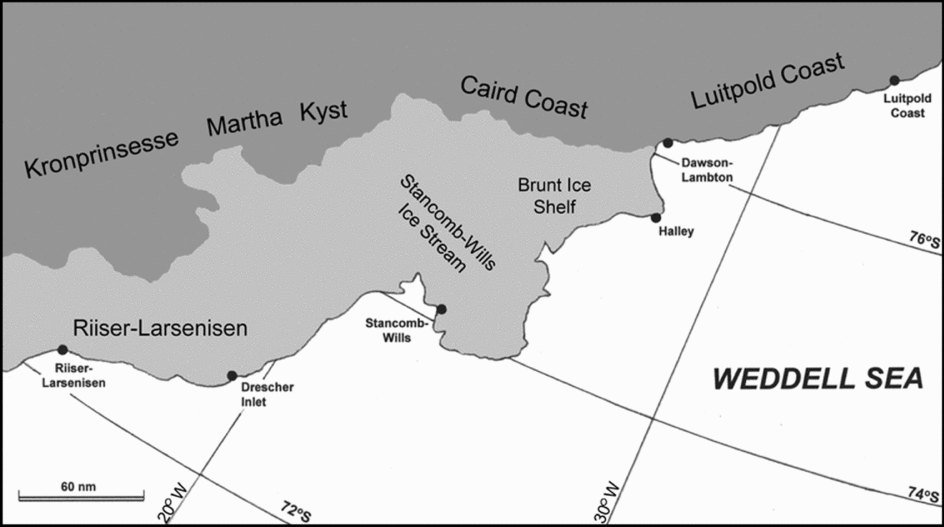
Glaciological studies based on Halley Station established that the ‘Stancomb-Wills Promontory’ is an intermittent feature – a floating ice tongue originating from an ice stream (now named the Stancomb-Wills Ice Stream) flowing between the Riiser-Larsenisen (Ice Shelf) and the Brunt Ice Shelf on the Caird Coast (Fig. 2). In 1955 the promontory had disappeared altogether (J.E. Thomas Reference Thomas1957: 354; see also Hattersley-Smith 1991: 541). Currently a tongue recurs in the same place from time to time, due to surges in the ice stream, which is a particularly active feature of a dynamic ice coastline. For a fuller account of Brunt Ice Shelf glaciology see R.H. Thomas (Reference Thomas1973).
Location of six emperor penguin colonies along the Weddell Sea coast between 72°S and 77°S, based on recent maps. The southernmost five were examined and assessed during the winter expedition of RV Polarstern.
Along the length of coast examined by Bruce, Filchner and Shackleton, the Halley Bay emperor colony was first reported in 1956, that at Gould Bay in 1957, Luitpold in 1963 and Drescher Inlet in 1985. Along the east coast of Antarctic Peninsula a colony near Snow Hill Island remained undiscovered until 1997 (Wienecke Reference Wienecke2010). Two more eastern colonies have since been located from satellite photographs (Fretwell and others Reference Fretwell, La Rue, Morin, Kooyman and Wienecke2012).
In November 1987, during the ‘Winter-Expedition of RV Polarstern to the Antarctic’, helicopter survey flights were made along the whole of the coast between longitudes 14° and 32°W. These disclosed three further emperor colonies at Riiser Larsenisen, and at the Stancomb-Wills and Dawson-Lambton ice streams, and also concentrations of Weddell seals, including many with young, generally in areas of disturbed sea ice close to the penguin colonies. Four of the five emperor colonies in the area were subsequently visited by parties from Polarstern, and colony size was estimated from counts of chicks (Hempel and Stonehouse Reference Hempel and Stonehouse1987). Close to several of the emperor colonies were concentrations of Weddell seals, many with recently-born young (Hempel and Stonehouse Reference Hempel and Stonehouse1987: 229: see also the related report by Gerdes and others (1987)).
The colony established on the northern flank of the Stancomb-Wills Ice Stream is clearly successor to the remnant of colony recorded by Worsley. The Halley, Dawson-Lambton and Luitpold Coast colonies are likely destinations for the penguins in pre-breeding condition that Worsley reported during Endurance's early drifting with the pack ice.
Colony occupation
Unpublished studies at the Halley Bay colony by Norman (Reference Norman1959) and Thurston (Reference Thurston1961) establish a useful time-frame for the annual cycle of colonisation and breeding in the region. When first seen by Norman in January 1959, 50–60 chicks in down remained on the ice foot and neighbouring ice shelf, unattended by adults – much as Worsley had found at the Stancomb-Wills site. By the first week of February all the chicks had died. The site remained empty through February and March, but a visit on 11 April revealed that:
. . . about 2000 fat, sleek penguins had returned. Subsequent visits during April and the beginning of May always showed increasing size of the rookery with a constant long procession of noisy penguins, stretching right to the horizon. Finally, we estimated about fifteen to twenty thousand birds by the middle of May. They were already beginning to form large, loose, noisy huddles – though they were still very active and the fights were frequent.’
The first egg was discovered on 10 June. Hatched chicks were first heard during the third week of July, at a time when the sea ice remained solid to the horizon, and many of the early chicks starved. A blizzard on 21 August broke up the ice, so that open water could be seen on the horizon, and ‘. . . Within a few days fat, sleek, fish laden penguins were streaming back across the ice. . .’, averting what had promised an impending tragedy.
In the following season Thurston reported a very similar time-table. The first arrivals appeared during the second week in April: by 18 April about 6600 birds were present, During late April and May many birds appeared to be making diurnal fishing trips to the nearby open sea. A peak number of 20,300 was recorded in late May. The first egg was seen on 9 June; about 8300 eggs were laid, and the first chicks were heard on 10 August, coinciding with the return of the first females. Open water was present nearby throughout the chick-rearing period: however, over 1300 chicks died of exposure in bad weather during the last week of September.
Location of colonies on the Weddell Sea coast
All the colonies surveyed by the Polarstern team were situated on fast ice of the current year, close by the ice cliffs, one or two kilometres inshore from the polynya, and typically close to tabular bergs that had calved from the cliffs and grounded in the relatively shallow water. Where a colony was found by the ice cliffs, there was always a gathering of several hundreds of penguins at the nearest point of the polynya. Thus the polynya, forming and re-forming throughout the year, provides access to open water for feeding during the winter and, more essentially, during the spring period of chick-rearing when most food is required. Tide-cracks surrounding the grounded bergs similarly remain open due to daily tidal movements, and are used by both penguins and seals as short-cuts to the sea.
As the ice cliffs are constantly moving seaward and calving at differential rates, the outline of the coast varies from year to year, yet the colonies form each season within a very few kilometres of their previous location. All those reported in this study form at points where continuity of the ice front is broken by ice streams or enclaves. Between them lie many kilometres of relatively stable, unbroken ice cliffs where neither penguins nor seals are found in substantial numbers.
Breeding at points of disturbance along the coast, as opposed to more stable ones, may at first appear disadvantageous. However, local concentration of predator species usually indicate local abundance of food. The emperor penguins examined during the Polarstern investigations were feeding mainly on krill, fish and squid (Klages Reference Klages1989), local abundance of which indicates local enrichment of phytoplankton. Why should this occur particularly at points of disturbance along the ice cliffs?
A most likely possibility is indicated by Gerringa and others (Reference Gerringa, Alderkamp, Laan, Thuroczy, De Baar, Mills, van Dijken, van Faren and Arrigo2012). Investigating seawater chemistry off the Amundsen Sea coast of Antarctica, they draw attention to local enrichment of polynya waters in summer by subglacial freshwater streams – enrichment that leads to high local concentrations of phytoplankton, which they ascribe particularly to dissolved iron washed down from the land. Similar situations may be expected along the Weddell Sea coast. At sites disturbed by ice streams, mineral-rich ground water flowing into the sea for several months each summer will provide local enrichment supporting concentrations of phyto- and zoo-plankton, and ultimately of penguins and seals.
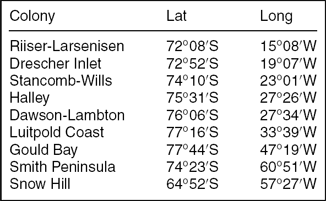
Based on satellite observations, Fretwell and others (Reference Fretwell, La Rue, Morin, Kooyman and Wienecke2012) have provided geographic coordinates of over 40 emperor penguin colonies around Antarctica, with estimates of colony size. Their coordinates and estimates for the six colonies here mentioned appear in Table 1.
Weddell Sea emperor penguin colonies. From Trathan and others (Reference Trathan, Fretwell and Stonehouse2011).
Conclusions
Sir Ernest Shackleton's note of fledgling emperor penguins chicks on sea ice below the ice cliffs of the Stancomb-Wills Ice Stream, Coats Land, Antarctica, published only in the first edition of his popular account of the expedition, unwittingly recorded the discovery of the species’ fourth-known breeding colony. His note was based on observations by F.A. Worsley, master of S.Y. Endurance, whose log, diary and charts were among the few records that survived the loss of the ship. Neither Shackleton, Worsley, nor the expedition biologist Robert Clark commented on the significance of the discovery. It was not reported in contemporary scientific literature, and has since been overlooked by avian biologists.
Worsley's observations from January to late May 1915, during Endurance's penetration of the pack ice and subsequent besetting, were valuable in noting the physical condition and migrations of emperor penguins during the autumn pre-breeding period, and also in indicating the likelihood of several other colonies along the eastern coast of the Weddell Sea. Subsequent exploration has revealed six emperor penguin breeding colonies between 72° and 78°S. Later observations have shown that colonies of emperor penguins, and concentrations of breeding Weddell seals form in areas where ice shelves are disturbed by ice streams, that is where subglacial freshwater streams provide local enrichment of nutrients, resulting in high concentrations of food for both species.
Acknowledgements
I thank Professor Gotthilf Hempel, the Alfred-Wegener-Institute for Polar Studies, and the scientific staff and crew of the icebreaker Polarstern for an unforgettable winter voyage of scientific exploration in the Weddell Sea. I thank also the library staff of the Scott Polar Research Institute for their help, in particular Ms Naomi Boneham, archivist, for providing access to the Worsley and Clark records, and the staff of British Antarctic Survey archives for access to valuable unpublished reports. I also am grateful to two anonymous referees for their thoughtful comments.