INTRODUCTION
The 10th century eruption of Baitoushan Volcano (Changbaishan volcano), located on the border between China and North Korea, has been estimated to be one of the biggest in the past two millennia (Machida et al. Reference Machida, Moriwaki and Zhao1990, Reference Machida and Arai2003; Sun et al. Reference Sun, You, Liu, Li, Gao and Chen2014a). The eruption has been estimated to have a volcanic explosivity index (VEI) of 7. This equals the VEI of the 1815 Mount Tombola eruption in Indonesia, which is considered a contributory factor of the so-called Year Without a Summer in 1816 (Horn and Schmincke Reference Horn and Schmincke2000).
The Baitoushan eruption clearly left traces in the Baegdusan (Baitoushan)-Tomakomai (B-Tm) tephra in the sediments of northern Japan; however, any official records strictly describing the eruptive year have not been found (Machida et al. Reference Machida, Moriwaki and Zhao1990; Machida and Arai Reference Machida and Arai2003; Horn and Schmincke Reference Horn and Schmincke2000; Sun et al. Reference Sun, You, Liu, Li, Gao and Chen2014a). Over the past two decades, many chronological studies have attempted to determine the eruptive year (Horn and Schmincke Reference Horn and Schmincke2000; Okuno et al. Reference Okuno, Kimura, Nakamura, Ishizuka, Moriwaki and Kim2004, Reference Okuno, Yatsuzuka, Nakamura, Kimura, Yamada, Kato-Saito and Taniguchi2010; Nakamura et al. Reference Nakamura, Okuno, Kimura, Mistutani, Moriwaki, Ishizuka, Kim, Jing, Oda, Minami and Tanaka2007; Kamite et al. Reference Kamite, Yamada, Kato-Saito, Okuno and Yasuda2010; Yatsuzuka et al. Reference Yatsuzuka, Okuno, Nakamura, Kimura, Setoma, Miyamoto, Kim, Moriwaki, Nagase, Jin, Jin, Takahashi and Taniguchi2010; Yin et al. Reference Yin, Jull, Burr and Zheng2012; Xu et al. Reference Xu, Pan, Liu, Hajdas, Zhao, Yu, Liu and Zhao2013; Sun et al. Reference Sun, Plunkett, Liu, Zhao, Sigl, McConnell, Pilcher, Vinther, Steffensen and Hall2014b). Most of these studies show that the eruptive year was in the 10th century, but the eruptive year was not determined with 1-yr resolution.
Recently, Oppenheimer et al. (Reference Oppenheimer, Wacker, Xu, Galván, Stoffel, Guillet, Corona, Sigl, Cosmo, Hajdas, Pan, Breuker, Schneider, Esper, Fei, Hammond and Büntgen2017) specified the eruptive year by measuring 14C contents in a subfossil larch sample buried by the explosive eruption. They determined the eruptive year as late AD 946 using following methods: detecting the AD 774–775 14C spike originated from a sudden increase of incoming cosmic ray intensities to the Earth, and counting tree-ring numbers from a ring possessing the AD 775 spike to an outermost ring accompanied with a bark. The AD 775 spike was first discovered in Japanese trees (Miyake et al. Reference Miyake, Nagaya, Masuda and Nakamura2012) and has been reproduced in an oak tree in southern Germany (Usoskin et al. Reference Usoskin, Kromer, Ludlow, Beer, Friedrich, Kovaltsov, Solanki and Wacker2013), a larch tree in northwestern Russia, a bristlecone pine tree in the western United States (Jull et al. Reference Jull, Panyushkina, Lange, Kukarskih, Myglan, Clark, Salzer, Burr and Leavitt2014), and a kauri tree in New Zealand (Güttler et al. Reference Güttler, Adolphi, Beer, Bleicher, Boswijk, Hogg, Palmer, Vockenhuber, Wacker and Wunder2015). Because remarkably similar results have been found in multiple independent investigations, the AD 775 14C spike can be regarded as reliable dating indicator. Also Oppenheimer et al. (Reference Oppenheimer, Wacker, Xu, Galván, Stoffel, Guillet, Corona, Sigl, Cosmo, Hajdas, Pan, Breuker, Schneider, Esper, Fei, Hammond and Büntgen2017) estimated that the eruption was not in mid- or late winter by analyzing data of Cl, nssCa, and nssS in the NEEM-2011-S1 ice core.
Since the B-Tm tephra has been found in many paleoenvironmental archives including ice cores NEEM and NGRIP (Sigl et al. Reference Sigl, Winstrup, McConnell, Welten, Plunkett, Ludlow, Büntgen, Caffee, Chellman, Dahl-Jensen, Fischer, Kipfstuhl, Kostick, Maselli, Mekhaldi, Mulvaney, Muscheler, Pasteris, Pilcher, Salzer, Schüpbach, Steffensen, Vinther and Woodruff2015) and the Lake Suigetsu (McLean et al. Reference McLean, Albert, Nakagawa, Staff, Suzuki and Smith2016), the results of Oppenheimer et al. (Reference Oppenheimer, Wacker, Xu, Galván, Stoffel, Guillet, Corona, Sigl, Cosmo, Hajdas, Pan, Breuker, Schneider, Esper, Fei, Hammond and Büntgen2017) are of essential importance in giving an annual time marker to these proxies. However, Oppenheimer et al. (Reference Oppenheimer, Wacker, Xu, Galván, Stoffel, Guillet, Corona, Sigl, Cosmo, Hajdas, Pan, Breuker, Schneider, Esper, Fei, Hammond and Büntgen2017) used only one wood sample, and we cannot exclude the possibility of any age errors mainly resulting from a counting error of tree-rings, e.g. an existence of missing rings. Therefore, we verified their result using other wood samples buried by the Baitoushan eruption.
METHODS
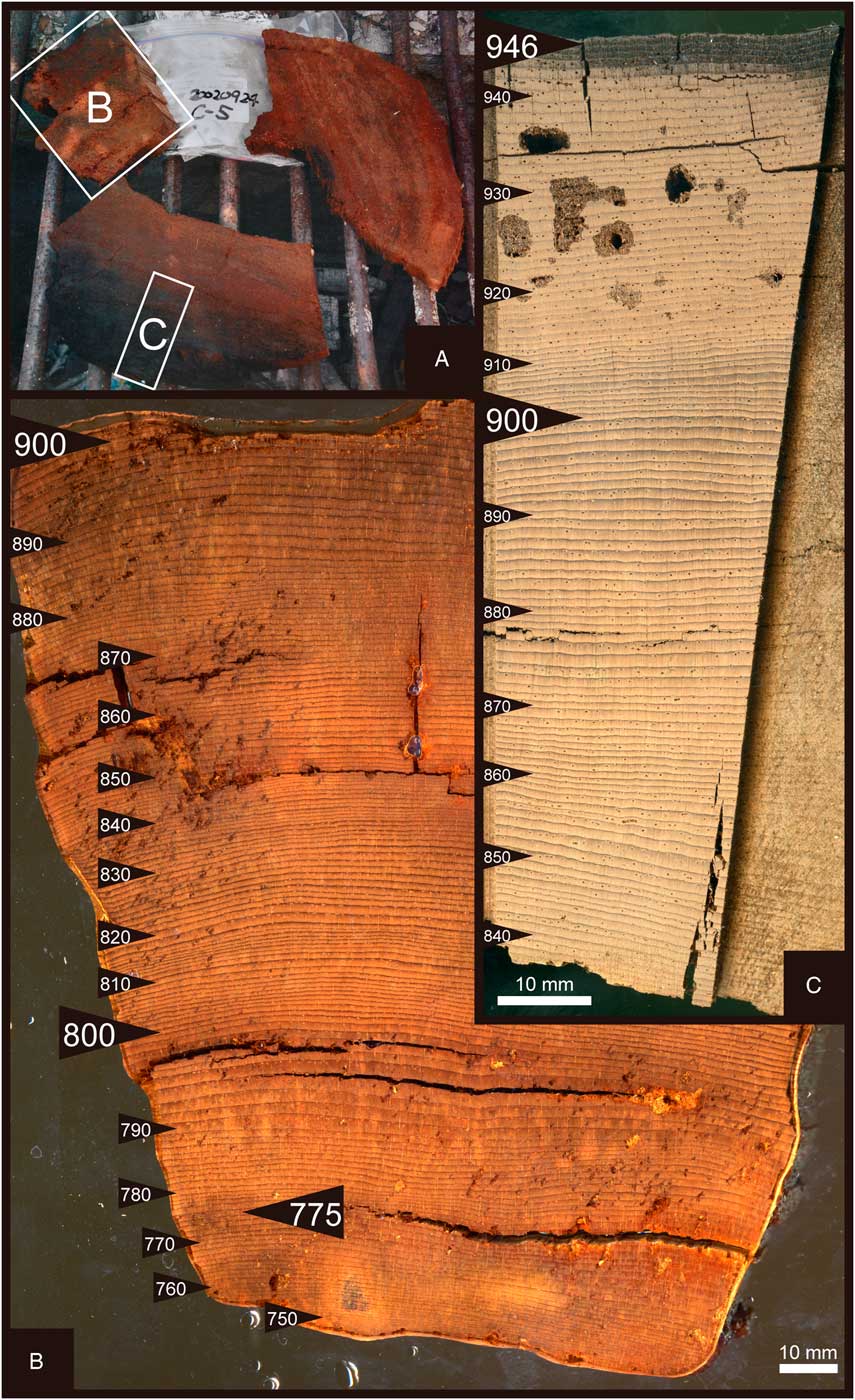
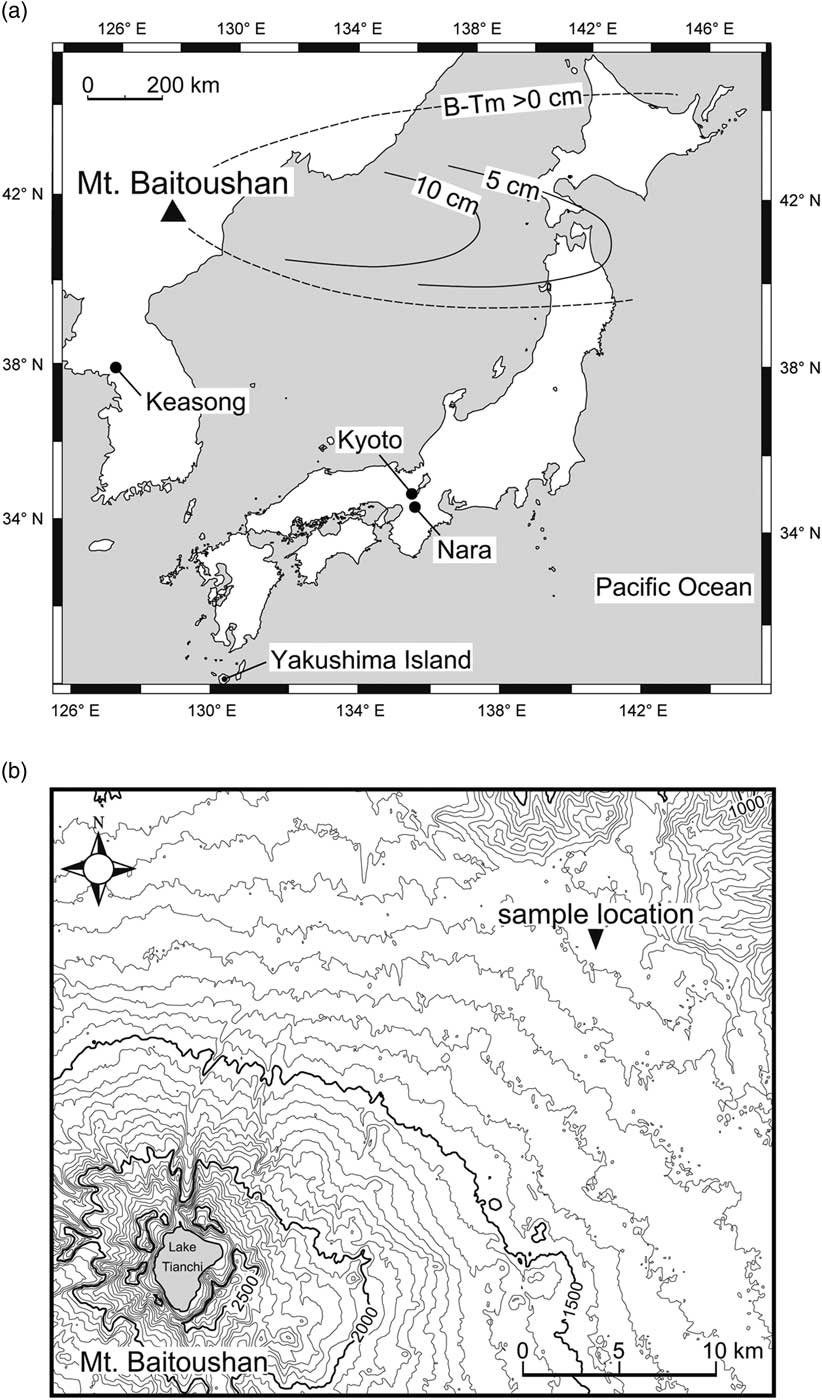
We used two Korean pine (Pinus koraiensis) samples, named C3 and C5 (Figure 1), which were dug up from a pumice quarry at the northeastern foot of the Baitoushan Volcano (42°20′24.1′′N, 128°21′2.9′′E, 1153 m asl; Figure 2) in 2002 (Okuno et al. Reference Okuno, Kimura, Nakamura, Ishizuka, Moriwaki and Kim2004). These samples had been buried in debris flow and pyroclastic flow deposits from the 10th century eruption. Both samples have bark. Whereas C3 (44 cm in diameter) was completely carbonized to the core, C5 (60 cm in diameter) was not carbonized except for approximately 3 cm of the outer layer.
Photo of sample C5: (A) overview of C5; (B) inner part of C5 including the ring corresponding to AD 775; (C) outer part of C5, including the carbonized outermost ring (AD 946). We could count continuous tree rings from the bark to the ring corresponding to AD 775. There are no missing rings for the whole period.

Index maps: (a) location of the Baitoushan Volcano and isopach map for the B-Tm tephra (Machida et al. Reference Machida, Moriwaki and Zhao1990); (b) topographic map showing the sampling location at the northeast foot of Mt. Baitoushan. Contour interval is 50 m.

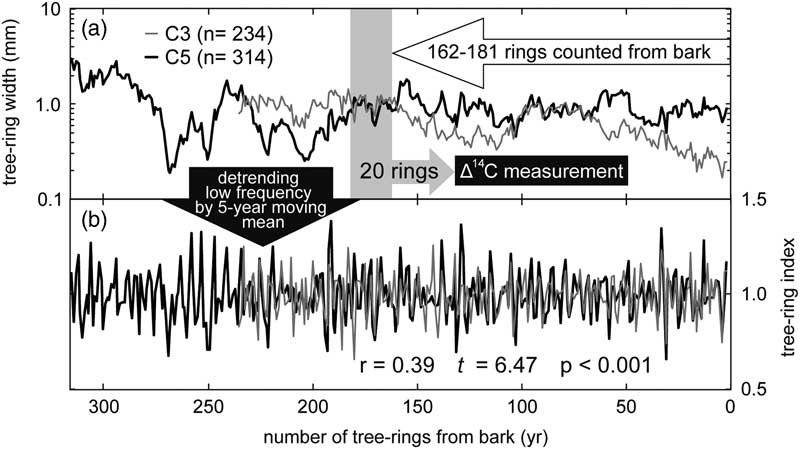
We measured tree-ring widths from both samples (Figure 3) and used a general dendrochronological technique to see if C3 and C5 died during the same year (Baillie and Pilcher Reference Baillie and Pilcher1973; English Heritage 2004). The ring widths were measured to an accuracy of 0.01 mm along multiple radii for each sample. The ring-width series were cross-dated statistically and visually using the program PAST5 (SCIEM Inc.). Semi-logarithmic plots of the raw ring-width series were used for visual cross-matching, and intra- and inter-disk matching was checked using Student’s t values (Baillie and Pilcher Reference Baillie and Pilcher1973). We detected the measurement error, false ring, and missing ring in this phase.
Results of tree-ring analysis: (a) raw tree-ring width series of Korean pine samples. As the C3 and C5 ring width series mismatch in the low-frequency component, they are likely to be from different individuals. We used 20 tree rings (nos. 162–181 from the bark) of C5 for 14C measurements: (b) detrended tree-ring series of Korean pine samples. We used the 5-yr moving-mean value for detrending low-frequency components according to the general dendrochronological method (Baillie et al. Reference Baillie and Pilcher1973; English Heritage 2004). The correlation between both series is extremely high if we assume that the outermost rings are the same year. This indicates that they died in the same year.

RESULTS AND DISCUSSION
C3 and C5 were found to have 234 and 314 annual tree rings, respectively. We could not find any missing rings from an observation of wood texture (Figure 1). Low-frequency trends in the raw ring-width series of C3 and C5 did not match (Figure 3; correlation value t=1.24), therefore it is highly probable that they are from different individuals. On the other hand, both de-trended ring-width series agree with each other well (t=6.47). This is clearly higher than a statistically significant correlation (t=3.5) in general dendrochronology (Baillie and Pilcher Reference Baillie and Pilcher1973; English Heritage 2004). This means that the two individuals died in the same year and all rings are identified as having a one-to-one correspondence between the two individuals. Also, as reported by Mitsutani (Reference Mitsutani2001) previously, the timing of the death year is confirmed to during a winter because the outermost rings in C3 and C5 had completed late wood formation, i.e., these trees died after a growing season (the Korean pine growing season at Baitoushan is April–September; Zhu et al. Reference Zhu, Fang, Shao and Yin2009).
We assumed that the outermost ring age of the C5 sample as AD 946, on the basis of the result of a wiggle-matching (946 +5/–9 cal AD) using the same tree sample in a previous study (Okuno et al. Reference Okuno, Yatsuzuka, Nakamura, Kimura, Yamada, Kato-Saito and Taniguchi2010). Because the tree samples have enough tree rings, the tree rings in C5 should contain the AD 774–775 cosmic ray event (AD 775 14C spike). We used C5 tree rings for 14C analysis (nos. 162–181 from the bark, which is assumed to be AD 766–785). An inside part of C5 was not carbonized, thus we could extract alpha-cellulose by chemical processing in the same way as a previous study (Miyake et al. Reference Miyake, Nagaya, Masuda and Nakamura2012). We carried out 14C measurements using an accelerator mass spectrometer at the Institute for Space-Earth Environmental Research at Nagoya University.
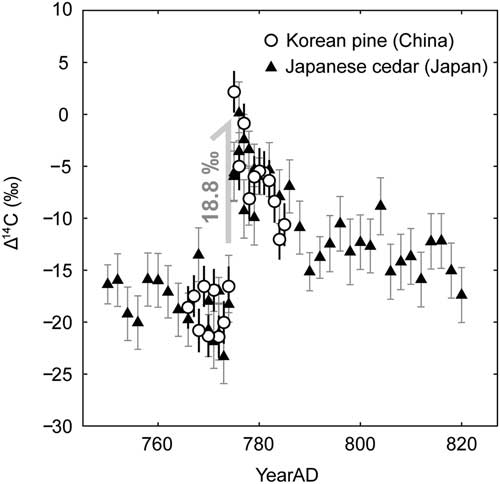
We observed a rapid increase of 18.8‰ in 14C content for tree ring nos. 173–172, which are assumed as being from AD 774–775 in C5. Figure 4 shows measured Δ14C results compared with a previous result of Japanese cedar samples (Miyake et al. Reference Miyake, Nagaya, Masuda and Nakamura2012). The rapid 14C increase and variations of two series are very similar, e.g., the correlation for the period from AD 770 to AD 779 is r=0.88 (p=0.0008). Therefore, we identified tree ring 172 as AD 775 and the outermost ring as AD 946. From these discussions, the Baitoushan Volcano eruption occurred in the winter of AD 946–947. This result completely agrees with the result of Oppenheimer et al. (Reference Oppenheimer, Wacker, Xu, Galván, Stoffel, Guillet, Corona, Sigl, Cosmo, Hajdas, Pan, Breuker, Schneider, Esper, Fei, Hammond and Büntgen2017).
Comparison of measured 14C contents (Δ14C: defined in Stuiver and Polach Reference Stuiver and Polach1977) between Korean pine from Mt. Baitoushan and Japanese cedar from Yakushima Island (Miyake et al. Reference Miyake, Nagaya, Masuda and Nakamura2012).

There are some chronicles that might have recorded the eruption. Our results match a few ancient documents from Japan and Korea. These documents are consistent that a large-scale eruption occurred in some distant place during the winter of AD 946–947 (Hayakawa and Koyama Reference Hayakawa and Koyama1998). The Kofuku-ji Nendaiki, a chronicle owned by the Kofuku-ji temple in Nara, Japan (see Figure 2 for location), describes a geological event as, “White ash like snow fell on November 3, AD 946.” The eruption might be also described as a loud noise in the Goryeosa chronicle, probably recorded at Kaesong in Korea (Figure 2), as “The sky sounded, and general pardon granted in AD 946.” In addition to these, the statement, “Sound like thunder has resounded in the sky on February 7, AD 947” was written in the Nihon Kiryaku and the Tei-shin Koki chronicles from Kyoto, Japan (Figure 2). These chronicles from Kyoto may not relate to the eruption since they just described the sounds, however, we mention them due to their closeness to the eruptive date. Manuscripts of these ancient documents can be viewed on the website of the National Diet Library and the Historiographical Institute the University of Tokyo (see supplementary text). It is estimated that the 10th century Baitoushan eruption can be divided into two phases with a time gap of about six months to one year, based on analyses of the lithology and distribution of volcanic deposits (Miyamoto et al. Reference Miyamoto, Nakagawa, Tanaka and Yoshida2004). It is suggested that the eruptions occurred in November of AD 946 and February of AD 947, if we take into account geological evidence and historical records. However, according to the assumption of Oppenheimer et al. (Reference Oppenheimer, Wacker, Xu, Galván, Stoffel, Guillet, Corona, Sigl, Cosmo, Hajdas, Pan, Breuker, Schneider, Esper, Fei, Hammond and Büntgen2017), the eruption in mid- or late winter is unlikely, therefore, it seems the possibility of the eruption in February AD 947 is lower.
The 14C spike-matching dating accuracy is the same as that of the dendrochronology (1-yr accuracy) because of the extreme 14C changes in one year. As 14C spikes are expected to be recorded in trees worldwide, the 14C spike-matching method has the potential to be applicable to all geological and historical wood samples containing the 14C spike. Wacker et al. (Reference Wacker, Güttler, Goll, Hurni, Synal and Walti2014) dated a historical wood sample of a Switzerland chapel with a 1-yr resolution using the 775 14C event. Therefore, a new method of 14C spike-matching using the 775 14C event is being established. Because of the AD 775 spike and the discovery of additional 14C spikes, the 14C spike-matching will play a very important role in high-accuracy dating of wood samples from now on.
CONCLUSIONS
We cross-checked the annual dating of the Baitoshan eruption in Oppenheimer et al. (Reference Oppenheimer, Wacker, Xu, Galván, Stoffel, Guillet, Corona, Sigl, Cosmo, Hajdas, Pan, Breuker, Schneider, Esper, Fei, Hammond and Büntgen2017) by detecting the AD 775 14C spike in an independent buried wood sample. We determined the eruptive year as winter of AD 946, which supported the result of Oppenheimer et al. (Reference Oppenheimer, Wacker, Xu, Galván, Stoffel, Guillet, Corona, Sigl, Cosmo, Hajdas, Pan, Breuker, Schneider, Esper, Fei, Hammond and Büntgen2017) and strengthened the existence of the annual time maker of the Baitoshan eruption.
Acknowledgments
The works by MH, FM, TN, and MO were supported by JSPS KAKENHI grant numbers JP26284120, JP16H06005, JP13480020, and JP17253007. We thank T Nagase, T Miyamoto (Tohoku University), and J Xu (Jilin University) for their great assistance with sample collection.
SUPPLEMENTARY MATERIAL
To view supplementary material for this article, please visit https://doi.org/10.1017/RDC.2017.75