Introduction
The rubber hand illusion (RHI) paradigm, developed by Botvinick & Cohen (Reference Botvinick and Cohen1998), has been widely used for investigating embodiment, including sensory-driven body ownership, body awareness and perceptual body image (Ehrsson et al. Reference Ehrsson, Spence and Passingham2004; Tsakiris & Haggard, Reference Tsakiris and Haggard2005; Tsakiris et al. Reference Tsakiris, Hesse, Boy, Haggard and Fink2007; Longo et al. Reference Longo, Schüür, Kammers, Tsakiris and Haggard2008, Reference Longo, Schuur, Kammers, Tsakiris and Haggard2009). Participants view a rubber hand placed in front of them, slightly to one side but in a similar position to their own hand, which is hidden from view. Both the rubber hand and the participant's own hand are then stroked, either synchronously or asynchronously. When the fake hand is stroked in synchrony with one's own hand, one feels the touch on the fake hand as if the fake hand belonged to oneself. However, this illusion is reduced if the stroking of the fake and real hand is asynchronous. A striking and easily quantifiable aspect of the illusion is that the perceived position of one's own hand shifts towards the fake hand.
The RHI is often interpreted as a three-way interaction between the sensory modalities of touch, vision and proprioception, whereby the synchrony of visual and tactile input leads to an overriding of the proprioceptive input (Pavani et al. Reference Pavani, Spence and Driver2000; Botvinick, Reference Botvinick2004). There are two essential components that underlie the emergence of the illusion and each represents a distinct aspect of body perception. The first component is that the participant sees a hand that is in a posture and location approximately consistent with the participant's real hand. This component is called ‘visual capture’, in that the visible fake hand overrides proprioception of the real hand and is experienced as the participant's own. This component of body perception is purely visual, and independent of any tactile input. It is therefore present in both the synchronous and asynchronous conditions of the RHI. Indeed, some studies have found clear effects of the RHI in the absence of any touch (Farne et al. Reference Farne, Pavani, Meneghello and Ladavas2000; Pavani et al. Reference Pavani, Spence and Driver2000). The second component underlying embodiment of the rubber hand is due to the multisensory temporal and spatial correlation of seen and felt touch. When visual and tactile input are synchronous, the participant integrates the two inputs, producing the feeling that the visual and tactile input both come from a single event, and relate to the participant's hand. This component of body perception requires multisensory integration and is present only in the synchronous stroking condition.
Body image is a major focus of psychopathology in eating disorders (EDs), but it has proved difficult to measure objectively. Subjective factors, which are a persistent limitation in examining body image in people with EDs, can strongly bias basic measures of bodily awareness, making it difficult to separate perceptual, emotional and cognitive contributions. However, the hand is a body part that is not considered to be salient or important in weight and shape evaluations for most individuals, including those with an ED (Mussap & Salton, Reference Mussap and Salton2006). As such, the RHI may be less confounded by emotional and cognitive factors than body image measures typically used to assess body image in EDs that are focused on weight and shape. The only previous RHI study relevant to EDs is that by Mussap & Salton (Reference Mussap and Salton2006), who tested a sample of undergraduates. They found that the strength of the self-reported experience of the illusion was significantly associated with bingeing and purging behaviours, drive for muscularity, exercise levels and chemical supplement use (e.g. dietary/nutritional supplements and growth chemicals). Furthermore, it was found that internalization of sociocultural standards mediated the relationship between the RHI and levels of both bulimic symptoms and body change behaviours (e.g. use of dietary supplements and exercise). These preliminary findings indicate that research examining the RHI in individuals with an ED and its relationship with ED psychopathology could be of benefit in gaining an understanding of the bodily self in people with an ED.
The aim of the present study was to investigate the experience of the bodily self in individuals with an ED by using the RHI paradigm. To the extent that EDs involve a strong attention to the visual appearance of the body (Wagner et al. Reference Wagner, Ruf, Braus and Schmidt2003; Uher et al. Reference Uher, Murphy, Friederich, Dalgleish, Brammer, Giampietro, Phillips, Andrew, Ng, Williams, Campbell and Treasure2005) and a disturbance in interoception, which is the internal representation of how one's own body really is (Bruch, Reference Bruch1962; Pollatos et al. Reference Pollatos, Kurz, Albrecht, Schreder, Kleemann, Schopf, Kopietz, Wiesmann and Schandry2008), we predicted that visual dominance over proprioception would be particularly strong in an ED group, relative to a healthy control group. Therefore, it was hypothesized that people with an ED would experience a stronger illusion with the RHI than healthy controls. It was further hypothesized that individual differences in the experience of the RHI would be related to ED psychopathology.
Method
Participants
Participants were eligible to take part if they were female, between 18 and 55 years of age, right-handed, had no history of head/brain injury, no history of drug/alcohol abuse, no learning disability, no medical illness with symptom overlap with EDs, and spoke English proficiently. In addition to these inclusion/exclusion criteria for all participants, participants in the healthy control (HC) group were required to have a body mass index (BMI) between 18.5 and 25 kg/m2, to not currently be on a diet to lose weight or have had a history of being underweight (BMI <17.5 kg/m2), to not have any history of an ED or disordered eating behaviour, and to not have a current or prior history of psychiatric illness (as defined in the DSM-IV-TR) (APA, 2000). Individuals in the ED group were also required to meet DSM-IV-TR diagnostic criteria for an ED (APA, 2000).
Participants were recruited from students and staff at a UK tertiary institution, an ED research volunteer database at this institution, and posters in public and medical settings. Ethical approval was obtained from the Psychiatry, Nursing and Midwifery Research Ethics Sub-Committee (PNM/09/10-19), King's College London. All participants provided informed consent and were offered financial reimbursement for their time and travel.
Measures
Structural Clinical Interview for Diagnosis, Research Version (SCID-I; First et al. Reference First, Spitzer, Gibbon and Williams2002)
A tailored version of SCID-I (only the overview, screening and EDs modules), which is a standardized interview for diagnostic assessment of DSM-IV disorders, was administered to assess participants to ensure that they met the inclusion criteria and to allocate them to the appropriate group.
Eating Disorder Inventory – 3 (EDI-3; Garner, Reference Garner2004)
The EDI-3 is a 91-item self-report questionnaire of psychological traits clinically relevant in individuals with an ED. Participants respond on a six-point Likert scale ranging from ‘Always’ to ‘Never’. This study reports only on the EDI-3 subscales of Drive for Thinness, Bulimia, Body Dissatisfaction, Interoceptive Deficits and Emotional Dysregulation. The sum of the Drive for Thinness, Bulimia and Body Dissatisfaction subscales comprises the ED Risk scale. Cronbach's α ranged from 0.82 to 0.95 for the EDI-3 subscales in this sample, which is similar to the published norms of 0.67–0.96 (Garner, Reference Garner2004).
Self-Objectification Questionnaire (SOQ; Noll & Fredrickson, Reference Noll and Fredrickson1998)
The SOQ is a 10-item self-report assessment of self-objectification. It assesses the extent to which individuals view their bodies in observable, appearance-based, objectified terms (e.g. physical attractiveness and body measurements) versus non-observable, competence-based, non-objectified terms (e.g. healthiness and physical energy level). Participants rank a list of 10 body attributes in order of how important each is to their physical self-concept.
Depression, Anxiety and Stress Scale – 21-Item version (DASS-21; Lovibond & Lovibond, Reference Lovibond and Lovibond1995)
The DASS-21 is a 21-item, three-scale, self-report measure of depression, anxiety and stress. Each scale consists of seven items and participants respond on a three-point Likert scale ranging from 0 (‘did not apply to me over the past week’) to 2 (‘applied to me very much or most of the time over the past week’). The DASS-21 provides a total score, which is the sum of all items. Cronbach's α was 0.95 for the Depression scale, 0.89 for the Anxiety scale and 0.90 for the Stress scale in this sample, which is similar to the corresponding values of 0.91, 0.84 and 0.90 reported by Lovibond & Lovibond (Reference Lovibond and Lovibond1995).
Edinburgh Handedness Inventory (EHI; Oldfield, Reference Oldfield1971)
The EHI is a 10-item self-report measure that assesses handedness. It was used to ensure participants were right-handed. Cronbach's α was 0.53 in this sample.
Outcome measures of the RHI
The RHI paradigm performed in this research was based on the original version (Botvinick & Cohen, Reference Botvinick and Cohen1998) and is outlined in detail in the Procedure section. The two most widely used outcome measures of the RHI were used in this study, namely (i) proprioceptive drift and (ii) self-report questionnaire (providing the embodiment score). Proprioceptive drift is a quantitative perceptual measure of the illusion. Participants are asked to indicate the position of their unseen hand using a ruler placed on the worksurface prior to and following visuotactile stimulation. Bias in these proprioceptive judgements towards the fake hand due to visuotactile stimulation is taken as a measure of the visual dominance of the fake hand over proprioception of one's own hand.
The self-report questionnaire provides a subjective measure of the illusion and is designed to summarize the experience of embodiment over the rubber hand. The questionnaire was developed from the 10 items found to comprise an embodiment factor in Longo et al.'s (Reference Longo, Schüür, Kammers, Tsakiris and Haggard2008) study. Cronbach's α was 0.94 in this sample for the questionnaire. Participants were required to respond to the 10 items on a seven-point Likert scale, ranging from –3 (‘strongly disagree’) to +3 (‘strongly agree’), and an embodiment score was calculated from the mean of the 10 item scores.
Height and weight
Height and weight were measured by the experimenter. Three participants with anorexia nervosa (AN) declined these measures and did not provide self-report estimates of weight, such that BMI could not be calculated for these participants.
Procedure
Each participant was tested individually in a single session. The SCID-I was administered first, followed by the questionnaires, the RHI task, and finally height and weight were measured. For the RHI task, the participant was seated at a table opposite the experimenter, with their left arm placed through an entrance hole and resting in a specially constructed box (100 cm×35 cm×18 cm). A life-size model of a left hand and forearm was placed in the box, directly in front of the participant at the body midline. The participant could see this fake hand through a hole on the top of the box. The box had a hinged cover to expose the fake hand and hide the experimenter from view (and vice versa). Participants wore a cloth smock that was attached to the front of the box and hid the participant's real arm from view. The distance between the participant's index finger and the index finger of the fake hand was 20 cm. The back of the box was removed to allow the experimenter to access the participant's hand and the fake hand.
Two visuotactile induction conditions, asynchronous and synchronous, were performed. Prior to each trial, a finger location judgement was obtained by placing a ruler across the top of the box and asking the participant to indicate where they felt the tip of their left index finger was located. The placement of this ruler varied from trial to trial to prevent participants repeating responses in subsequent trials. After this, the cover of the box was raised and the participant was instructed to focus on the rubber hand while two paintbrushes stroked the fake hand and the participant's real hidden hand for 60 s at approximately 1 stroke/s. In the synchronous condition, the timing of the brush strokes was synchronized, whereas in the asynchronous condition the timing of the brush strokes was out of phase by 180°. Following this, the box cover was lowered and a post-induction finger location judgement was obtained in the same manner as prior to the induction. The order of synchronous and asynchronous visuotactile conditions was randomized. The RHI questionnaire was administered verbally after each trial, with the scale visible on a card placed in front of the participant.
Analyses
Finger location judgement was calculated as the difference between the position reported by the participant and the actual position of the participant's finger. A positive value indicates a judgement to the right of a participant's actual finger location (i.e. towards the midline and the fake hand) and a negative value indicates a judgement to the left of the actual finger location (i.e. away from the midline and fake hand). Proprioceptive drift was calculated by subtracting the pre-induction finger location judgement from the post-induction finger location judgement.
The statistical software used was SPSS version 17 (SPSS Inc., USA). The significance level for all analyses was set at p<0.05 and the results reported are two-tailed. Analyses were performed to test for differences between the ED and the HC group, with subsequent analyses testing for differences between the ED diagnostic subgroups and the HC. ANOVAs and ANCOVAs were used to examine the effect of visuotactile stimulation between groups. Bivariate correlations were performed to investigate the relationship between the clinical measures and the RHI outcome measures. A multiple linear regression analysis was carried out on the entire sample to explore the predictive factors of clinical symptomatology on the experience of the illusion.
Results
Participants
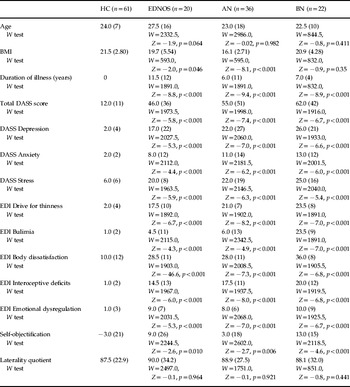
A total of 139 individuals participated in this study: 61 HC and 78 ED. Of those with an ED, 36 had AN (24 restrictive subtype and 12 binge/purge subtype), 22 had bulimia nervosa (BN), and 20 had an eating disorder not otherwise specified (EDNOS). The demographic and clinical details of these participants are reported in Table 1. There was no significant difference between AN, BN or EDNOS from HC on age or handedness. The AN group had a significantly lower BMI than HC, and each ED group had significantly higher scores than HC on all of the mood and ED-related measures.
Participant demographics and clinical details and comparisons with healthy control group (HC)

EDNOS, Eating disorder not otherwise specified; AN, anorexia nervosa group; BN, bulimia nervosa group; BMI, body mass index; DASS, Depression, Anxiety and Stress Scale; EDI, Eating Disorder Inventory.
Because of non-normal distributions, statistics reported are medians (interquartile range) and comparison tests reported beneath are Wilcoxon's rank-sum test (W test) compared with HC (for which Bonferroni correction was applied for significance value: 0.05/3=0.0167).
Results on the RHI task
Baseline finger location judgement
The HC group reported a mean finger judgement of 1.8 cm (s.d.=2.3) whereas the ED group reported a judgement bias of 2.5 cm (s.d.=3.5). One-sample t tests revealed that the bias towards the right (body midline) was significant for both HC [t(60)=5.98, p<0.001] and ED [t(76)=6.25, p<0.001] groups, but this difference was not significant between the ED and HC groups in an unequal variance-sample t test [t(131.8)=−1.48, p=0.142].
Proprioceptive drift
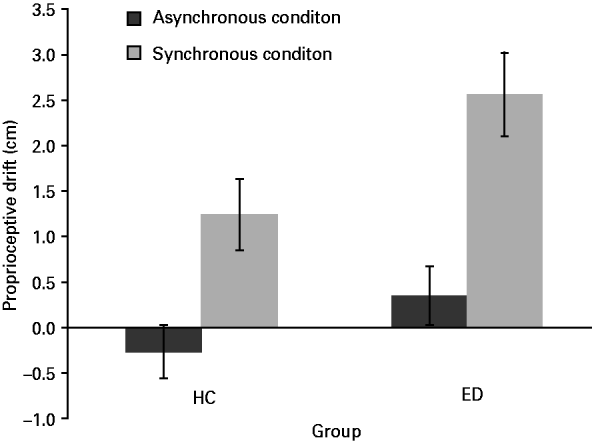
Proprioceptive drift (Fig. 1) was analysed in a 2×2 mixed effects ANOVA, with visuotactile stimulation as the within-subjects factor and diagnostic group as the between-subjects factor. The effect of type of visuotactile stimulation on proprioceptive drift was significant [F(1, 134)=25.5, p<0.001, η2 p=0.160], with significantly greater proprioceptive drift in the synchronous versus asynchonous condition. In addition, there was a significant main effect for diagnostic group [F(1, 134)=5.7, p=0.018, η2 p=0.041], with significantly greater proprioceptive drift in the ED than in the HC group. However, the interaction between type of visuotactile stimulation and diagnostic group was not significant [F(1, 134)=0.9, p=0.339, η2 p=0.007]. Controlling for mood (i.e. depression and anxiety) using ANCOVA did not change these findings.
Mean and standard error of proprioceptive drift in each group for each rubber hand illusion (RHI) condition. Error bars represent ±1 standard error of the mean. HC, Healthy control; ED, eating disorder.

Embodiment
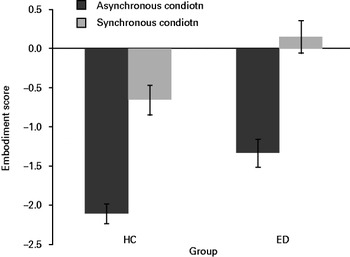
The embodiment score (Fig. 2) was also analysed in a 2×2 mixed effects ANOVA, with visuotactile stimulation as the within-subjects factor and diagnostic group as the between-subjects factor. The main effect for type of visuotactile stimulation on embodiment was significant [F(1, 135)=131.9, p<0.001, ηp2=0.494], with significantly greater embodiment in the synchronous versus asynchronous condition. The main effect for diagnostic group was also significant [F(1, 135)=11.6, p=0.001, ηp2=0.079], such that the ED group reported experiencing embodiment significantly more strongly than the HC group. However, the interaction between type of visuotactile stimulation and diagnostic group was not significant [F(1, 135)=0.01, p=0.960, ηp2 <0.001]. Controlling for mood using ANCOVA did not change these findings.
Mean and standard error of embodiment score in each group for each rubber hand illusion (RHI) condition. Error bars represent ±1 standard error of the mean. HC, Healthy control; ED, eating disorder.

Correlations between the RHI and ED psychopathology measures
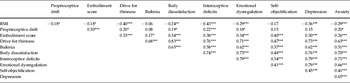
Because of the non-normal distribution of the questionnaire measures, Spearman's correlation coefficients were used to obtain estimates between the mean of the synchronous and asynchronous RHI measures and these measures, using the whole sample. The results are presented in Table 2. Proprioceptive drift was positively associated with the embodiment score [ρ=0.30, p<0.001]. Embodiment correlated significantly with each of the ED psychopathology variables examined (i.e. Drive for Thinness, Bulimia, Body Dissatisfaction, Interoceptive Deficits, Emotional Dysregulation, Depression, Anxiety and SOQ scores) in the expected directions. Proprioceptive drift also correlated significantly with the ED psychopathology variables examined in the expected directions, with the exceptions of the SOQ score and Depression.
Correlations (Spearman's ρ) between RHI outcome measures and clinical measures

RHI, Rubber hand illusion; BMI, body mass index.
* Correlation is significant at the 0.05 level (two-tailed).
** Correlation is significant at the 0.01 level (two-tailed).
*** Correlation is significant at 0.05/16=0.003 (Bonferroni corrected).
Regression analysis in predicting the RHI
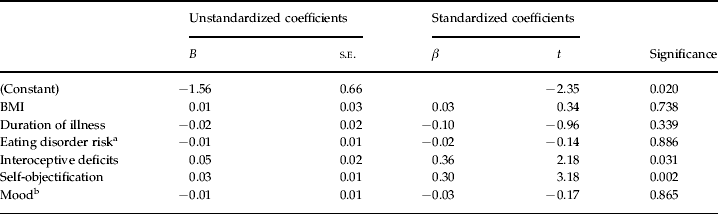
A multiple linear regression analysis (entry method, presented in Table 3) was carried out on the entire sample to explore the predictive factors of ED symptomatology and mood on the mean of the synchronous and asynchronous embodiment score. The ED Risk scale (sum of Drive for Thinness, Bulimia and Body Dissatisfaction scales), BMI, duration of illness, Interoceptive Deficits scale, SOQ score and the DASS-21 total score were regressed onto the mean embodiment score. The model was found to be significant [F(6, 127)=6.3, p<0.001], predicting 22.8% of the variance (adjusted R 2=0.191). Interoceptive deficits and self-objectification were predictors that made a significant contribution to the model.
An examination of the predictors of the RHI mean embodiment score

RHI, Rubber hand illusion; BMI, body mass index; s.e., standard index.
Dependent variable was the Synchronous embodiment score.
a Sum of Drive for Thinness, Bulimia and Body Dissatisfaction scales.
b DASS-21 total score, sum of Depression, Anxiety and Stress scale.
ED subgroup analyses
Preliminary analyses were undertaken to explore possible differences between the AN and HC groups and between the BN and HC groups. The EDNOS group was not examined because of the heterogeneity of this group.
Baseline finger location judgement
The AN group was significantly more biased than the HC group [t(51.9)=−2.2, p=0.035] whereas the BN group was not significantly different from the HC group [t(25.59)=−0.2, p=0.835].
Proprioceptive drift
Comparing the AN and HC groups, the effect of type of visuotactile stimulation on proprioceptive drift was significant [F(1, 92)=16.6, p<0.001, η2 p=0.153], with significantly greater proprioceptive drift in the synchronous versus the asynchronous condition. There was a significant main effect for diagnostic group [F(1, 92)=5.4, p=0.022, ηp2=0.056], with significantly greater proprioceptive drift in the AN versus the HC group. However, the interaction between type of visuotactile stimulation and diagnostic group was not significant [F(1, 92)=0.4, p=0.524, ηp2=0.004]. Controlling for mood using ANCOVA did not change these findings.
Comparing the BN and HC groups, the effect of type of visuotactile stimulation on proprioceptive drift was significant [F(1, 80)=19.7, p<0.001, η2 p=0.198], again with significantly greater proprioceptive drift in the synchronous versus the asynchronous condition. However, the main effect for diagnostic group was not significant [F(1, 80)=2.5, p=0.116, ηp2=0.031] and the interaction between type of visuotactile stimulation and diagnostic group was also not significant [F(1, 80)=2.4, p=0.128, η2 p=0.029]. Controlling for mood using ANCOVA revealed a non-significant main effect of type of visuotactile stimulation [F(1, 78)=1.8, p=0.190], a non-significant effect of group [F(1, 78)=1.2, p=0.275] and a non-significant interaction effect [F(1, 78)=0.05, p=0.832].
Embodiment
Comparing the AN and HC groups, the main effect for type of visuotactile stimulation on embodiment was significant [F(1, 93)=81.3, p<0.001, ηp2=0.466], with significantly greater embodiment scores in the synchronous versus the asynchronous condition. The main effect for diagnostic group was also significant [F(1, 93)=6.3, p=0.014, ηp2=0.064], such that the AN group reported experiencing embodiment significantly more strongly than the HC group. However, the interaction between type of visuotactile stimulation and diagnostic group was not significant [F(1, 93)=0.1, p=0.763, ηp2=0.001]. Controlling for mood using ANCOVA revealed a significant main effect for visuotactile stimulation [F(1, 91)=28.9, p<0.001] but a non-significant main effect for diagnostic group [F(1, 91)=0.5, p=0.504] and a non-significant interaction between visuotactile stimulation and diagnostic group [F(1, 91)=0.2, p=0.691].
Comparing the BN and HC groups, the main effect for type of visuotactile stimulation on embodiment was significant [F(1, 80)=75.4, p<0.001, η2 p=0.485], as was the main effect for diagnostic group [F(1, 80)=5.3, p=0.024, η2 p=0.062]. Thus, significantly greater embodiment scores were reported in the synchronous versus the asynchronous condition and the BN group reported experiencing the illusion (i.e. embodiment) significantly more strongly than the HC group. However, the interaction between type of visuotactile stimulation and diagnostic group was not significant [F(1, 80)=0.9, p=0.358, η2 p=0.011]. Controlling for mood using ANCOVA did not change these findings.
These results comparing the diagnostic subgroups with the HC group are consistent with the main results of the ED versus HC group.
Discussion
The aim of this study was to examine the bodily self in EDs by using the RHI paradigm and examining its relationship with ED psychopathology. The primary hypothesis that individuals with an ED would have greater susceptibility to the RHI was supported: participants with an ED experienced the RHI significantly more strongly than HC. The second hypothesis was also supported, such that individual differences in the experience of the RHI were related to ED psychopathology and the experience of the RHI was significantly predicted by interoceptive deficits and self-objectification.
The findings from this study indicate that the experience of the bodily self is more plastic in individuals with an ED, given that they experience the illusion more strongly than controls. This finding held for both perceptual (proprioceptive drift) and cognitive (questionnaire) measures of the RHI and was consistent between the ED diagnoses of AN and BN. Of note, this increased sensitivity of those in the ED group occurred generally, rather than specifically, in the synchronous condition. As outlined in the Introduction, the aspect of body perception underlying the RHI common to both the synchronous and asynchronous conditions is visual capture (the tendency for visual information about hand location to dominate proprioceptive information), whereas the second aspect is multisensory integration (a tendency for body ownership to be driven by spatiotemporal congruence of visual and tactile stimulation). We found that the ED group differed significantly from the HC group irrespective of the visuotactile condition, that is whether it was synchronous or asynchronous. This suggests that EDs are associated with a heightened sensitivity to visual capture.
The findings of this study also demonstrated that both perceptual and cognitive measures were related to each of the self-report ED psychopathology measures, except for BN. Approximately 23% of the variance in the experience of the illusion could be accounted for by ED psychopathology. In particular, interoceptive deficits and self-objectification were significant predictors of embodiment, a result consistent with previous research (Mussap & Salton, Reference Mussap and Salton2006). Specifically, the relationship found in the present study between self-objectification and the RHI is consistent with the relationship found previously between internalization of sociocultural standards and the RHI (Mussap & Salton, Reference Mussap and Salton2006). Self-objectification and internalization of sociocultural standards can be interpreted as similar constructs, given that self-objectification is a sociocultural factor in which women learn to value observable and physical body attributes, rather than non-observable attributes and abilities (Noll & Fredrickson, Reference Noll and Fredrickson1998). Previous research has found self-objectification to be associated with reduced interoception and self-awareness (Fredrickson & Roberts, Reference Fredrickson and Roberts1997; Noll & Fredrickson, Reference Noll and Fredrickson1998). One recent study examined the relationship between interoception and embodiment using the RHI in healthy individuals. That study found that interoception modulated embodiment, such that reduced interoceptive sensitivity was associated with a stronger experience of the illusion (Tsakiris et al. Reference Tsakiris, Tajadura-Jimenez and Costantini2011). In the present study, we also found that increasing interoceptive deficits were associated with a greater experience of the illusion, judged by both perceptual and cognitive measures. Thus, it may be that viewing oneself more from an appearance-based perspective, as in self-objectification, distorts the interoceptive experience of the bodily self. The contributions of both interoceptive sensitivity and self-objectification to embodiment merit further investigation. The measure of interoceptive deficits used in this study was a simple eight-item questionnaire subscale of the EDI-3. More refined measures of this concept, including experimental measures of interoceptive sensitivity, could account for a greater variance in RHI measures and overcome this limitation in the present study. Additionally, it would be worthwhile for future research to include a greater sample size that would allow separate analyses of the diagnostic subgroups (i.e. AN and BN) and confirm whether increased plasticity of the bodily self is found across ED diagnoses, as postulated in the present study. Our exploratory subgroup analyses indicated that it was unlikely that the differences found between our whole ED sample and HCs were driven by one subgroup (i.e. AN or BN) in the case of embodiment scores, whereas the difference may have stemmed from the AN group in the case of proprioceptive drift. However, these subgroup results should be interpreted with caution as the sample sizes for each subgroup were smaller than recommended for performing ANOVAs (Field, Reference Field2009), and they were performed for exploratory purposes.
Clinical implications and future research
The overall findings of the present study provide support for a model of a disturbed bodily self in individuals with an ED. In particular, the findings indicate that affected individuals demonstrate increased sensitivity to the visual aspects of body perception. This may be due to a disturbance in multisensory integration, including distorted integration, as reported previously by Grunwald et al. (Reference Grunwald, Ettrich, Krause, Assmann, Dahne, Weiss and Gertz2001, Reference Grunwald, Ettrich, Busse, Assmann, Dahne and Gertz2002), and/or altered sensitivity to visuotactile sensory information. Our results also show that interoception and self-objectification may be key factors in this disturbance. Such a body-specific visual hypersensitivity in affected individuals may play an important role in the key characteristics of body image disturbance in EDs, and shed light on the aetiology and maintenance of this disturbance that could, in turn, be targeted in treatment.
To date, the underlying bases of body image disturbance in EDs have not been clearly identified. Cognitive, emotional and perceptual processing problems are often conflated. Our findings indicate that some basic processes of body perception are altered in EDs. These processes could be specifically targeted in future treatments. As individuals with an ED have a heightened visual dominance over proprioceptive bodily signals, future therapies might aim to increase proprioceptive awareness, and interoceptive awareness. This could include developing such remediation approaches as attentional training to interoceptive bodily signals, particularly of touch and proprioception.
Furthermore, the finding in the present study of an association between the RHI and self-objectification indicates that cognitive and sociocultural processes are also involved in the disturbed experience of the bodily self in individuals with an ED. That is, processing the body from a third-person objectified perspective may account to some degree for the development of disturbed experiences of the bodily self. Therefore, the tendency of individuals with an ED to engage in excessive self-objectifying cognitive processes could be addressed in the treatment of body image disturbances.
Finally, as the RHI task is simple to administer, it could be used as a tool to assess somatosensory information processing in individuals with an ED and to index improvement from therapies designed to correct inaccurate body perceptions (Mussap & Salton, Reference Mussap and Salton2006). However, further research examining the RHI in individuals who have recovered from an ED is also necessary to help identify whether this disturbance of the bodily self is a vulnerability trait for EDs, or whether it is confined to the period of illness.
Conclusions
To our knowledge, this is the first study to examine the bodily self using the RHI paradigm in a clinical sample of individuals with an ED. This study provides initial support for increased plasticity of the bodily self in people with an ED, as it found that affected individuals experience the RHI more strongly than healthy controls, in both the perceptual and cognitive aspects of the paradigm. These findings indicate that somatosensory information processing of the body may be reduced in people with an ED, or visual information about the body may be excessively attended to, or both. With further research, these findings can contribute to our understanding of the aetiology and maintenance factors involved in EDs, such as perceptual body processing, interoceptive deficits, self-objectification, and the experience of the bodily self.
Acknowledgements
E.E. was supported in part by the Butterfly Foundation, a charity that provides support for Australians who suffer from eating disorders and negative body image issues and their carers. The funding sponsor did not play a role in the study design; in the collection, analysis and interpretation of data; or in the writing and submission of this article. J.T. was partly funded by a UK Department of Health National Institute for Health Research (NIHR) Programme Grant for Applied Research (ref. no. RP-PG-0606-1043) and receives support from the NIHR Specialist Biomedical Research Centre for Mental Health award to the South London and Maudsley National Health Service (NHS) Foundation Trust and the Institute of Psychiatry, King's College London. The views expressed in this paper are not necessarily those of the Department of Health or the NIHR. J.T. was also supported by grant 1206/87 from the Health Foundation (formerly the PPP Foundation) (Professor Treasure, Professor Collier, and Dr U. Schmidt), by grant QLK1-1999-916 from the European Commission Framework V programme, and the Nina Jackson Eating Disorders Research Charity. P.H. and M.L. were supported by a project grant from the Biotechnology and Biological Sciences Research Council (BBSRC). P.H. was additionally supported by European Union (EU) FP7 project VERE.
Declaration of Interest
None.