


I. INTRODUCTION
Paleosol is a soil formed in the geological past. Like modern soils, it was formed during times of relatively slow or no accumulation of sediment. During these times, the land surface and near-subsurface were exposed to chemical and physical weathering processes. Features within paleosols can give important clues about the climate and other environmental conditions during their formation (Mack and James, Reference Mack and James1994). Quantitative X-ray diffraction (XRD) analysis is performed on 172 samples containing paleosol sections of Unayzah and Basal Khuff clastics taken from the core of one well drilled by Saudi Aramco. The objective is to characterize the mineral compositions, including clay mineral type and abundance, in the paleosols to help geologists interpret the paleoclimate and paleoenvironment and understand the relation of paleosols to the underlying reservoirs.
II. ANALYTICAL METHOD AND PROCEDURE
XRD is the best available technique for the identification and quantification of minerals in paleosols. The application of the Rietveld refinement method in XRD quantitative phase analysis shows great advantages over conventional methods such as the reference intensity ratio (RIR) method for accuracy and convenience (Bish and Howard, Reference Bish and Howard1988; O'Connor and Raven, Reference O'Connor and Raven1988; Bish and Post, Reference Bish and Post1993; McCusker et al., Reference McCusker, Von Dreele, Cox, Loüer and Scardi1999; Gualtieri, Reference Gualtieri2000; Hillier, Reference Hillier2000). The advantages are: (1) using the full XRD profile rather than single-peak integrated intensity reduces the possible effect of mineral-preferred orientation; and (2) no standard or reference material is needed. However, a limitation of the Rietveld refinement method is that it restricts quantitative analysis of clay minerals such as montmorillonite and mixed-layer clays in the samples. A combination of the Rietveld refinement method and the RIR method was used to solve this problem in the XRD analysis of paleosols (see the procedure in Figure 1). For this study, a PANalytical XPERT PRO X-ray diffractometer with CuKα radiation (λ = 1.5418 Å) was used. A monochromator and a proportional detector were used in conjunction with a fixed 1° divergent slit, a 0.3-mm receiving slit, and a fixed 2° anti-scattering slit at instrument settings of 45 kV and 40 mA. All bulk samples were briefly disaggregated and lightly crushed in a mortar and pestle, and, then, ~3 g of sample were ground for 5 min in a McCrone micronizing mill (Figure 2) to get 10–20 µm of fine powder that can reduce the preferred orientation of particles (Figure 3) and does not affect the structure of clay in the sample as the sample can be kept at the room temperature while grinding by using isopropanol as a grinding agent, unlike a ball mill that increases temperature dramatically. The dried powdered samples were back-loaded by hand into sample holders and run in the XRD instrument from 4° to 70° 2θ, using a step size of 0.02° and a count time of 1 s per step.
(Color online) Procedure of XRD bulk and clay fraction analysis.

(Color online) McCrone micronizing mill and its accessories.

(Color online) Micronizing mill grinding reduces particle-preferred orientation.

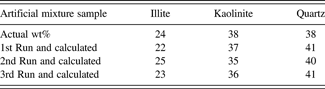
The Rietveld refinement method used the PANalytical HighScore Plus software for quantitative analysis of the mineral compositions of bulk samples. The semi-auto mode and background available were used during refinement. The parameters refined were zero shift, scale factor, unit-cell parameters, and profile function. The accuracy of the results was reasonable according to accuracy checking and quality control by the test of artificial mixture samples of standards (Tables I and II). For clay fraction analysis, the centrifuge technique was used to separate clays (<2 µm) from paleosols and prepare clay slurry with preferred orientations. Clay slurry was laid on a glass slide and exposed to ethylene glycol vapor for a minimum of 24 h to aid in detection and characterization of expandable clays. The total clay (<2 µm) was calculated from the separating weight percentage. The relative percentages of individual clay minerals were quantified using RIR factors (Chung, Reference Chung1974a, Reference Chungb). To obtain the RIR factor of each clay mineral, artificial mixture samples of clay mineral standards were made and compared with the intensities of each clay mineral (Table III).
Quantitative results of artificial mixture samples by the Rietveld refinement method.

Reproductivity of the results from the Rietveld refinement method.
Reference intensity ratio (RIR) factors of clay minerals.
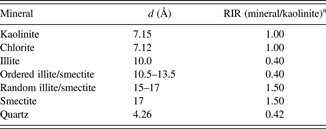
aRIR factors for clay minerals in glycolated slide sample.
III. ANALYTICAL RESULTS AND INTERPRETATION
Quantitative XRD results indicate that the samples from paleosol sections consist mainly of quartz and feldspar (microcline and albite) as framework constituents. In addition to silica cement, which can be identified only by petrographic analysis, the cement minerals detected are dolomite, hematite, anhydrite, siderite, gypsum, calcite, and pyrite. Hematite mainly occurs in the section with a depth of 8617.2–8649.1 ft, where the rocks are red and usually contain relatively high amounts of clays. Hematite is a common mineral in paleosols. It is generally formed in warm and humid climates, which facilitates chemical weathering (Blatt et al., Reference Blatt, Middleton and Murray1980). Clay minerals are important constituents in paleosols. The XRD results show that clay minerals in the samples are illite, a mixed layer of illite/smectite, kaolinite, and chlorite. No discrete smectite is present in the samples. On the basis of comparison of the data from XRD bulk mineralogy and XRD clay fraction analysis, the total percentages of clay minerals (illite, a mixed layer of illite/smectite, kaolinite, and chlorite) determined from XRD bulk analysis are usually found to be bigger than clay-size fractions determined using separation techniques. This is because some clay minerals (especially kaolinite) may be larger than clay size (<2 µm). The total clay data from XRD bulk analysis indicate that clay contents are variable by an average of 11.4% (0–43.5%), of which 5.0% is kaolinte (0–28.9%), 4.9% is illite and a mix of illite/smectite (0–28.1%), and 1.5% is chlorite. Many clayey paleosols were reported to be predominantly composed of illite, and in many soils illite or a mixed layer of illite/smectite is the main clay mineral, especially in young soils of desert regions with strong wet–dry seasons (Robinson and Wright, Reference Robinson and Wright1987). The predominantly illitic composition of many paleosols is also because of the alteration of smectite to illite during burial, a process now widely documented from studies of boreholes. The samples of paleosol sections in this study were collected from a depth of 8596.9–8988.7 ft, where temperatures are favorable to the transition of smectite to illite through a mixed layer of illite/smectite. The percentages of the smectite layer were 10–30% in these mixed-layer samples, which indicates the type is ordered illite/smectite. The clay mineral associations in these samples of paleosol sections can be classified into three types: Type I: illite and mixed layer of illite/smectite dominated (Figure 4); Type II: Kaolinite dominated (Figure 5); and Type III: illite, mixed layer of illite/smectite, and kaolinite associated (Figure 6). Most samples are of Type I, in which illite and a mixed layer of illite/smectite are predominant, whereas kaolonite is <30%. Type II mainly occurs at depths of 8612.3–8618.5 ft, in which the relative percentage of kaolinte is >50%. Type III mainly occurs at depths of 8609.2–8610.9 ft and 8915.8–8988.7 ft, in which illite and a mixed layer of illite/smectite are still major constituents, but kaolinite is >30%. The change of clay mineral association type with depth (Table IV) may indicate the change of paleoclimate and paleoenvironment. For example, kaolinite usually forms under strongly leaching conditions such as abundant rainfall, good drainage, and acid waters. Therefore, XRD mineralogical data of paleosol sections are important for petroleum geologists to study paleoclimate and paleoenvironment and predict the reservoir quality of the associated rock formations. However, the interpretation of clay mineral association should consider all factors including provenance and diagenesis.
(Color online) XRD patterns of clay mineral association: Type I.

(Color online) XRD patterns of clay mineral association: Type II.

(Color online) XRD patterns of clay mineral association: Type III.

Clay mineral association type change with sample depth.

IV. CONCLUSION
On the basis of the quantitative XRD analysis of 172 samples from paleosol sections, (1) the McCrone micronizing mill is highly recommended for grinding a bulk sample to reduce the particle-preferred orientation; and (2) the combined method of Rietveld refinement and RIR is a good solution for quantitative XRD analysis of geological samples containing clay minerals. The change of clay mineral association type with sample depth in paleosol sections may indicate the change of paleoclimate and paleoenvironment, and help petroleum geologists predict the reservoir quality of the associated rock formations.
ACKNOWLEDGMENTS
The authors would like to acknowledge Abdulelah A. Al-Naser, Yazeed A. Al-Dukhayyil, Awad M. Al-Mofleh, and Abbas S. Al-Ghamdi of Saudi Aramco for their help and support. Thanks are also given to Saudi Aramco for the permission to publish this paper.



