


1. Introduction
Underactuated mechanical systems have fewer independent actuators than the degrees of freedom [Reference Aminsafaee and Shafiei1, Reference Zabihifar, Navvabi and Yushchenko2]. Due to the reduction of actuators, these systems have some important merits which include lighter weight, lower cost, and less energy consumption and thus have been widely applied in industries [Reference He, Zhang, Sun and Geng3], such as cranes [Reference Chen and Sun4], robots [Reference Yin, Chen and Yu5, Reference Hota and Kumar6], hovercrafts [Reference Xie, Cabecinhas, Cunha and Silvestre7], surface/underwater vehicles [Reference Zhang and Yang8, Reference Zhang and Chai9], and spacecrafts [Reference Chen, Shan and Wen10]. The Pendubot system is a classical two-link underactuated robot with only one actuator [Reference Spong and Block11]. Due to the strong nonlinear coupling relationship between the two links, even though the actuated link is stabilized at the desired position, it is hard to guarantee the stability of the unactuated one. Consequently, the control problem of the Pendubot has received growing attention in recent years.
In refs. [Reference Spong and Block11], [Reference Fantoni, Lozano and Spong12], and [Reference Albahkali, Mukherjee and Das13], feedback control, energy-based control, and impulse momentum methods are proposed to stabilize the Pendubot. Nevertheless, none of them takes account of system uncertainties. Uncertainty, such as dynamic friction, external disturbances, and initial condition deviation, can bring unexpected consequences to the actual systems and will severely degrade the control system performance. Consequently, it is of prominent importance to compensate uncertainties in control design.
To eliminate the influence of uncertainties, the radial basis function (RBF) neural network and fuzzy RBF neural network are respectively employed in refs. [Reference Xia, Wang and Chai14] and [Reference Xia, Chai and Wang15], and a compensator using a nonlinear disturbance observer is designed in ref. [Reference Eom and Chwa16]. In ref. [Reference Wei, Chai, Xin, Chen and Chen17], a signal compensation-based robust control method is proposed. However, these methods only consider the matched friction in the actuated link. In ref. [Reference Yin, Chen, Huang and Lü18], a constraint-following-based robust control scheme is developed to cope with the mismatched uncertainty. However, the upper bounds of uncertainties need to be known beforehand. For the uncertainties such as the dynamic friction, modeling errors that exist in the actual Pendubot system, the upper bound is usually unknown. Consequently, it is necessary to design a controller that can deal with uncertainties with unknown upper bound so as to achieve the effective control of the Pendubot system.
This paper proposes an adaptive robust constraint-following control approach for the Pendubot system subjects to matched and mismatched uncertainty. To begin with, a nominal control is investigated for the Pendubot without uncertainty. Then, the uncertainty is specially decomposed into the matched portion and the unmatched portion. Based on that, an adaptive robust control law is devised to tackle initial condition deviation and uncertainty. By using the Lyapunov approach, the developed approach is proved to be both uniformly bounded and uniformly ultimately bounded, rendering approximate constraint-following to the Pendubot system subjects to initial condition deviation and uncertainty. Finally, simulation and experimental results are presented, demonstrating the good tracking accuracy and robustness of the proposed approach.
The major contributions of the research are the following. First, the robust control problem of the Pendubot subjects to matched and unmatched uncertainties is formulated as a constraint-following control problem with reduced-dimension equality constraints. Second, a robust constraint-following control method is proposed with a leakage-type adaptive law. Unlike the existing methods requiring the information of the uncertainty bound, the proposed approach removes this limitation and can well tackle uncertainties with unknown bounds. Third, the closed-loop Pendubot system is proved to be both uniformly bounded and uniformly ultimately bounded under the action of the proposed approach.
The remainder of the study is organized as follows. The task to be addressed is formulated in Section 2. Section 3 discusses the adaptive robust constraint-following control design. Section 4 presents the stability analysis. Simulation results are provided and discussed in Section 5. The paper is then concluded in Section 6.
2. Constraint-following task formulation
2.1. Dynamics
The schematic of the Pendubot is shown in Fig. 1, where
 $m_1$
(
 $m_2$
) stands for the mass of link 1 (link 2),
 $q_1$
denotes the angle of link 1 relative to the horizontal axis,
 $q_2$
refers to the angle of link 2 relative to link 1,
 $l_1$
(
 $l_2$
) is the length of link 1 (link 2),
 $l_{c1}$
(
 $l_{c2}$
) denotes the distance from the centroid to the connection point of link 1 (link 2), and
 $I_1$
(
 $I_2$
) is the moment of inertia of link 1 (link 2). For simplicity, we introduce five parameters:
 ${\theta _1} ={m_1}l_{c1}^2 +{m_2}l_1^2 +{I_1},\ {\theta _2} ={m_2}l_{c2}^2 +{I_2},\ {\theta _3} ={m_2}{l_1}{l_{c2}},\ {\theta _4} ={m_1}{l_{c1}} +{m_2}{l_1},\ {\theta _5} ={m_2}{l_{c2}}$
.
Diagram of the Pendubot.

According to ref. [Reference Wei, Chai, Yao and Wang19], the dynamics of the Pendubot with uncertainty can be obtained as
 \begin{equation} M(q)\ddot{q}+C(q,\dot{q})\dot{q}+G(q)+F(q,\dot{q})=B\tau, \end{equation}
 \begin{align*} M(q) &= \left [{\begin{matrix}{{\theta _1} +{\theta _2} + 2{\theta _3}\cos{q_2}}\;\;\;\;\; & {{\theta _2} +{\theta _3}\cos{q_2}}\\[5pt] {{\theta _2} +{\theta _3}\cos{q_2}}&{{\theta _2}} \end{matrix}} \right ],\\[5pt] C({q,\dot q}) &= \left [{\begin{matrix}{ -{\theta _3}{{\dot q}_2}}\;\;\;\;\;&{ -{\theta _3}\left ({{{\dot q}_2} +{{\dot q}_1}} \right )}\\[5pt] {{\theta _3}{{\dot q}_1}}&0 \end{matrix}} \right ]\sin{q_2},\\[5pt] G(q) &= \left [{\begin{matrix}{{\theta _4}g\cos ({q_1}) +{\theta _5}g\cos \left ({{q_1} +{q_2}} \right )}\\[5pt] {{\theta _5}g\cos \left ({{q_1} +{q_2}} \right )} \end{matrix}} \right ],\\[5pt] F(\dot{q})&=\left [{\begin{matrix} f_1(\dot{q})\\[5pt] f_2(\dot{q}) \end{matrix}}\right ],\, B = \left [{\begin{matrix} 1\\[5pt] 0 \end{matrix}} \right ], \end{align*}
where
 $q=[q_1\ q_2]^T$
and
 $\dot{q}=[\dot{q}_1\ \dot{q}_2]^T$
represent the angle vector and angle velocity vector, respectively,
 $M(q)$
is the symmetric positive definite inertia matrix,
 $C(q, \dot{q})$
denotes the centripetal and Coriolis torque vector,
 $G(q)$
stands for the gravitational torque vector,
 $F(q,\dot{q})$
is the system uncertainty, and
 $\tau$
denotes the input torque applied to link 1.
2.2. Constraints
The control goal is to stabilize both link 1 and link 2 of the Pendubot toward the desired vertical upright position. However, due to the underactuated Pendubot system exhibits nonholonomic constraint, it is impossible to design a stabilizing controller that can render both
 $q_1$
and
 $q_2$
converging to their target position
 $q_{1d},\; q_{2d}$
, with arbitrary independent convergence curves. These curves may be conflicting with the inherent dynamic coupling, since there is a strong nonlinear coupling between
 $q_1$
and
 $q_2$
. To solve this, the control objective for the dynamical system (1) is formulated as a constraint-following control problem with the constraint defined as follows between two states as shown in the following lemma.
 \begin{equation} \dot{s}+\varsigma s=-\frac{2\eta }{\pi }\mathrm{arctan}(s), \end{equation}
with
 \begin{align} s =\lambda (\dot{e}_1+\lambda _1 e_1)+(\dot{e}_2+\lambda _2 e_2), \end{align}
 \begin{align} e_1 =q_1 - q_{1d},\; e_2 = q_2 - q_{2d}, \end{align}
where
 $q_{1d}=\pi/2,\; q_{2d}=0$
,
 $\varsigma$
,
 $\eta$
,
 $\lambda$
,
 $\lambda _1$
, and
 $\lambda _2$
are positive constants, and
 $\eta$
is arbitrarily small. From (2) to (4), as
 $t \to \infty$
,
 $\dfrac{2\eta }{\pi }\mathrm{arctan}(s)$
will converge to
 $\eta$
. Since
 $\eta$
is arbitrarily small, from (2),
 $s$
will infinitely converge to zero, which means that both
 $q_1$
and
 $q_2$
will arbitrarily converge to their desired positions
 $q_{1d}, q_{2d}$
.
With (3) and (4), the constraint (2) is rewritten as
 \begin{align} &\lambda \ddot{q}_1 + \lambda \lambda _1 \dot{q}_1 + \ddot{q}_2 + \lambda _2 \dot{q}_2 +\varsigma [\lambda \dot{q}_1+\lambda \lambda _1 (q_1 -{\pi }/{2}) + \dot{q}_2+\lambda _2 q_2]\nonumber\\[5pt] &=-\frac{2\eta }{\pi }\mathrm{arctan}(\lambda \dot{q}_1+\lambda \lambda _1 (q_1 -{\pi }/{2}) + \dot{q}_2+\lambda _2 q_2). \end{align}
Remark 1. Obviously, the RHS of (5) is unintegrable, therefore, (5) is a nonholonomic constraint. When
 $t \to \infty$
,
 $-\dfrac{2\eta }{\pi }\mathrm{arctan}(\lambda \dot{q}_1+\lambda \lambda _1 \!\left(q_1 -\dfrac{\pi }{2}\right) + \dot{q}_2+\lambda _2 q_2)$
will converge to an arbitrarily small constant
 $\eta$
(but not equal to zero). As a consequence,
 $\lambda \dot{q}_1+\lambda \lambda _1 \!\left(q_1 -\dfrac{\pi }{2}\right) + \dot{q}_2+\lambda _2 q_2$
will converge to zero, hence
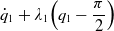 $\dot{q}_1+\lambda _1 \!\left(q_1 -\dfrac{\pi }{2}\right)$
and
 $\dot{q}_2+\lambda _2 q_2$
will converge to zero simultaneously, indicating both
 $q_1$
and
 $q_2$
will converge to their desired points. This shows that the motor torque can control both the actuated link angle and underactuated link angle to approximately follow their desired positions.
Integrating (5) from
 $0$
to
 $t$
, we obtain
 \begin{align} & \lambda (\dot{q}_1-\dot{q}_{1}(0))+\lambda \lambda _1 ({q}_1-q_{1}(0))+ (\dot{q}_2-\dot{q}_{2}(0)) +\lambda _2 ({q}_2-q_{2}(0))+ \varsigma \lambda ({q}_1-q_{1}(0)) \nonumber \\[5pt] &+\varsigma \lambda \lambda _1 \int _0^t{(q_1 -{\pi }/{2})d \tau }+ \varsigma ({q}_2-q_{2}(0))+\varsigma \lambda _2 \int _0^t{q_2 d\tau }\nonumber \\[5pt] &=-\frac{2\eta }{\pi }\int _0^t{\mathrm{arctan}(\lambda \dot{q}_1+\lambda \lambda _1 (q_1 -{\pi }/{2})+ \dot{q}_2+\lambda _2 q_2)d \tau }, \end{align}
where
 $q_1 (0)$
,
 $q_2 (0)$
,
 $\dot{q}_1 (0)$
, and
 $\dot{q}_2 (0)$
are the initial values of
 $q_1$
,
 $q_2$
,
 $\dot{q}_1$
, and
 $\dot{q}_2$
, respectively.
Let
 \begin{align} A &= \left [{\begin{matrix} \lambda\;\;\;\;\; & 1 \end{matrix}} \right ],\nonumber \\[5pt] b &=-\lambda \lambda _1 \dot{q}_1 - \lambda _2 \dot{q}_2 -\varsigma [\lambda \dot{q}_1+\lambda \lambda _1 (q_1 -{\pi }/{2}) + \dot{q}_2+\lambda _2 q_2] \nonumber \\[5pt] &\quad -\frac{2\eta }{\pi }\mathrm{arctan}(\lambda \dot{q}_1+\lambda \lambda _1 (q_1 -{\pi }/{2}) + \dot{q}_2+\lambda _2 q_2),\nonumber \\[5pt] c &= \lambda \dot{q}_{1}(0)-\lambda \lambda _1 ({q}_1-q_{1}(0)) +\dot{q}_{2}(0)-\lambda _2 ({q}_2-q_{2}(0)) \nonumber \\[5pt] &\quad - \varsigma \lambda ({q}_1-q_{1}(0))- \varsigma ({q}_2-q_{2}(0)) -\varsigma \lambda \lambda _1 \int _0^t{(q_1 -{\pi }/{2})d \tau }\nonumber \\[5pt] &\quad -\varsigma \lambda _2 \int _0^t{q_2 d\tau } - \frac{2\eta }{\pi }\int _0^t{\mathrm{arctan}(\lambda \dot{q}_1+\lambda \lambda _1 (q_1 -{\pi }/{2})+ \dot{q}_2+\lambda _2 q_2)d \tau }, \end{align}
then (5) and (6) can be rewritten as
 \begin{align} A\dot{q}&=c,\nonumber \\[5pt] A\ddot{q}&=b. \end{align}
3. Adaptive robust control design
3.1. Uncertainty decomposition
The Pendubot dynamics (1) contains both matched and mismatched uncertainties. Due to the lack of control input, mismatched uncertainties bring great obstacle to the control design. In view of this, the uncertainty
 $F$
is specially divided into the matched part
 ${B}(q,\dot{q})\hat{F}(q,\dot{q})$
, which is in the range space of
 ${B}(q,\dot{q})$
, and the mismatched part
 $\Delta \tilde{F}(q,\dot{q})$
, which is in the bull space of
 ${B}(q,\dot{q})$
, that is,
 \begin{align} F(q,\dot{q})&={B}(q,\dot{q})\hat{F}(q,\dot{q})+\Delta \tilde{F}(q,\dot{q}). \end{align}
Let
 $D={M}^{-1}$
, then we have
 \begin{equation} A{ M^{ - 1}} B = ADB = \frac{\lambda \theta _2}{{{\theta _1}{\theta _2} - \theta _{3}^{2}{{\cos }^2}{q_2}}} \gt 0, \end{equation}
therefore
 $AD{B}$
is invertible.
To exploit the constraint (8), we introduce an orthogonal decomposition approach [Reference Yu, Chen, Zhao and Sun20] and specially decompose the uncertainty
 $F$
based on the constraint matrix
 $A$
and the parameter matrixes
 $B$
,
 $D$
. Based on that, the decomposition is specified as
 \begin{align} \hat{F}(q,\dot{q})&=(A(q,\dot{q})D(q,\dot{q}){B}(q,\dot{q}))^{-1}A(q,\dot{q})D(q,\dot{q})F(q,\dot{q}),\nonumber \\[5pt] \Delta \tilde{F}(q,\dot{q})&=F(q,\dot{q})-{B}(q,\dot{q})\hat{F}(q,\dot{q}). \end{align}
 \begin{equation} A(q,\dot{q})D(q,\dot{q})\Delta \tilde{F}(q,\dot{q})\equiv 0. \end{equation}
The above decomposition arranges the unmatched portion
 $\Delta \tilde{F}(q,\dot{q})$
to be in the null space of
 $A(q,\dot{q})D(q,\dot{q})$
. Thus,
 $\Delta \tilde{F}(q,\dot{q})$
will not affect the constraint-following performance. This allows the control to be designed without considering the unmatched part and just based on the matched one, which will be used in later derivation.
3.2. Control design
Before the control design of the Pendubot system (1), we make the following two assumptions.
Assumption 1: There is a positive constant
 $\underline{\lambda }$
such that
 \begin{equation} AD{B}{B}^{T}DA^{T}\geq \underline{\lambda }. \end{equation}
Remark 2. In fact, Assumption 1 means that the minimum of
 $ADB$
always has a finite distance from
 $0$
. Since we already have
 $ADB\gt 0$
, it is reasonable to make this assumption.
Assumption 2: There is an unknown constant vector
 $\alpha \in (0,\infty )^k$
and a known function
 $\Pi (q,\dot{q})\;:\;\mathbf{R}^{2}\times \mathbf{R}^{2}\to \mathbf{R}^{k}$
such that for all
 $(q,\dot{q})\in \mathbf{R}^{2}\times \mathbf{R}^{2}$
,
 \begin{align} \mathop{\max }\limits \lVert \hat{F}(q,\dot{q}) \rVert \leq \alpha ^{T}{\Pi }(q,\dot{q}), \end{align}
where the function
 $\alpha ^{T}{\Pi }(q,\dot{q})$
refers to the uncertainty bound and the unknown vector
 $\alpha$
depends on the bound of the uncertainty
 $\hat{F}(q,\dot{q})$
.
Remark 3. In a sense, what Assumption 2 does is the parameterization of the worst effect of the uncertainty
 $\hat{F}(q,\dot{q})$
, which will be further elaborated in the proof of Theorem 1.
In practice, it is an arduous task to acquire the specific value of
 $\alpha$
, since it may be related to the bounding set. As a result, the following leakage-type adaptive law is designed
 \begin{equation} \dot{\hat{\alpha }}=\kappa _{1}{\Pi }(q,\dot{q})\lVert \hat{\beta }(q,\dot{q})\rVert -\kappa _{2}\hat{\alpha }, \end{equation}
where
 $\kappa _{1}\gt 0$
and
 $\kappa _{2}\gt 0$
are constants,
 $\hat{\alpha }\in \mathbf{R}^k$
is the estimated value of
 $\alpha$
,
 $\hat{\alpha }_{i}(t_0)\gt 0$
,
 $i=1,\dots,k$
.
Remark 4. According to (15),
 $\hat{\alpha }_{i}(t)\gt 0$
for all
 $t\geq t_0$
. This is because the first term
 $\kappa _{1}{\Pi }(q,\dot{q})\lVert \hat{\beta }(q,\dot{q})\rVert$
on the right half side of (15) is always non-negative and the second term
 $-\kappa _2\hat{\alpha }$
alone will render an exponentially decaying (to zero) solution from above. The leakage item
 $-\kappa _{2}\hat{\alpha }$
in (15) prevents the constantly increase of
 $\hat{\alpha }$
.
Then, the adaptive robust constraint-following control law is proposed as follows:
 \begin{equation} \tau =p_{1}(q,\dot{q})+p_{2}(q,\dot{q})+p_{3}(\hat{\alpha },q,\dot{q}), \end{equation}
where
 \begin{align} p_{1}(q,\dot{q})&=(A(q,\dot{q})D(q,\dot{q}){B}(q,\dot{q}))^{-1}[b(q,\dot{q}) +A(q,\dot{q})D(q,\dot{q})({C}(q,\dot{q})\dot{q}+{G}(q,\dot{q}))], \end{align}
 \begin{equation} p_{2}(q,\dot{q})=-\kappa \hat{\beta }(q,\dot{q}),\\[5pt] \end{equation}
 \begin{equation} p_{3}(\hat{\alpha },q,\dot{q})=-\gamma (\hat{\alpha },q,\dot{q})\mu (\hat{\alpha },q,\dot{q})\hat{\alpha }^{T}{\Pi }(q,\dot{q}), \end{equation}
where
 $\kappa \gt 0$
is a constant,
 \begin{equation} \hat{\beta }(q,\dot{q})={B}^{T}(q,\dot{q})D(q,\dot{q})A^{T}(q,\dot{q})\beta (q,\dot{q}), \end{equation}
 \begin{equation} \beta (q,\dot{q})=A(q,\dot{q})\dot{q}-c(q,\dot{q}), \end{equation}
 \begin{equation} \mu (\hat{\alpha },q,\dot{q})=\hat{\beta }(q,\dot{q})\hat{\alpha }^{T}{\Pi }(q,\dot{q}), \end{equation}
 \begin{equation} \gamma (\hat{\alpha },q,\dot{q}) = \left \{ \begin{array}{l@{\quad}l} \dfrac{1}{{\left \|{\mu (\hat{\alpha },q,\dot{q})} \right \|}}, & \mathrm{if}\;\left \|{\mu (\hat{\alpha },q,\dot{q})} \right \| \gt \varepsilon \\[16pt] \dfrac{1}{\varepsilon }, & \mathrm{if}\;\left \|{\mu (\hat{\alpha },q,\dot{q})} \right \| \le \varepsilon \end{array} \right .\!\!, \end{equation}
where
 $\varepsilon \gt 0$
is a given small constant, and
 $\hat{\alpha }$
is determined by the adaptive law in (15).
Remark 5. Different from ref. [Reference Wei, Chai, Xin, Chen and Chen17], which only considers the matched uncertainty, this paper considers both matched and unmatched uncertainty. In refs. [Reference Yin, Chen, Huang and Lü18, Reference Yu, Chen, Zhao and Sun20], the parameter
 $\alpha$
is assumed to be known. However, in this paper,
 $\alpha$
is unknown and is estimated using the leakage-type adaptive law in (15).
4. Stability analysis
Theorem 1.
Consider the Pendubot system (1) subjects to Assumptions 1–2 and let
 $\delta (t)\;:\!=\;[{\beta }^{T}(q(t),\dot{q}(t))\ (\hat{\alpha }(t)-\alpha )^{T}]^{T}$
, under the action of the adaptive robust control (16)–(23), the Pendubot system has the following performance:
-
(i) Uniformly bounded: For any
 $r\gt 0$
, there exists a
$d(r)\lt \infty$
such that for all
$t \geq t_0$
, if
$\lVert \delta (t_0) \rVert \leq r$
, then
$\lVert \delta (t) \rVert \leq r$
;
-
(ii) Uniformly ultimately bounded: For any
$r\gt 0$
with
$\lVert \delta (t_0) \rVert \leq r$
, there is
$\underline{d}\gt 0$
such that for any
$\bar{d}\gt \underline{d}$
,
$\lVert \delta (t) \rVert \leq \bar{d}$
as
$t \geq t_{0} + T(\bar{d},r)$
, where
$0 \leq T(\bar{d},r) \lt \infty$
.



Proof: Choose the Lyapunov candidate function as
 \begin{equation} V(\beta, \hat{\alpha }-\alpha )=\beta ^{T}\beta +\kappa _1^{-1}(\hat{\alpha }-\alpha )^{T}(\hat{\alpha }-\alpha ). \end{equation}
Then, the derivative of
 $V$
is represented as
 \begin{equation} \dot{V}=2\beta ^{T}\dot{\beta }+2\kappa _1^{-1}(\hat{\alpha }-\alpha )^{T}\dot{\hat{\alpha }}. \end{equation}
Next, we will make a separate analysis of each item. For the first item of (25),
 \begin{align} 2\beta ^{T}\dot{\beta }&=2\beta ^{T}(A\ddot{q}-b)\nonumber \\[5pt] &=2\beta ^{T}\{AM^{-1}[(\!-\!C \dot{q}-G-F)+B(p_1+p_2+p_3)]-b\}\nonumber \\[5pt] &=2\beta ^{T}\{AD[(\!-\!{C} \dot{q}-G)+(Bp_1+Bp_2)-F+Bp_3]-b\}. \end{align}
In view of
 $p_1$
in (17), we can obtain
 \begin{equation} AD[(\!-\!{C} \dot{q}-{G})+Bp_1]-b=0. \end{equation}
From the decomposition in (9) and (12), we have
 \begin{align} ADF&=ADB\hat{F}+AD\Delta \tilde{F}\nonumber \\[5pt] &=ADB\hat{F}+0\nonumber \\[5pt] &=ADB\hat{F}. \end{align}
Introducing (27) and (28) into (26), we have
 \begin{align} 2\beta ^{T}\dot{\beta } =-2{\beta }^{T}ADB\hat{F}+2{\beta }^{T}AD{B}p_2+2{\beta }^{T}AD{B}p_3. \end{align}
 \begin{align} -2{\beta }^{T}ADB\hat{F} &\leq 2\lVert{B}^{T}DA^T\beta \rVert \lVert{ \hat{F}}\rVert \nonumber \\[5pt] &\leq 2\lVert \hat{\beta }\rVert \alpha ^{T}{\Pi (q,\dot{q})}. \end{align}
With (18), we have
 \begin{equation} 2{\beta }^{T}AD{B}p_2=2{\beta }^{T}AD{B}(\!-\!\kappa{B}^{T}DA^{T}\beta ). \end{equation}
According to the Rayleigh’s principle and Assumption 1,
 \begin{align} 2{\beta }^{T}AD{B}(\!-\!\kappa{B}^{T}DA^{T}\beta ) &=-2\kappa \beta ^{T} (AD{B}{B}^{T}DA^{T})\beta \nonumber \\[5pt] & \leq -2\kappa \underline{\lambda }\lVert \beta \rVert ^2. \end{align}
Combining (31) and (32), we can get
 \begin{equation} 2{\beta ^T}AD{B}p_2\leq -2\kappa \underline{\lambda }\lVert \beta \rVert ^2. \end{equation}
 \begin{align} 2{\beta ^T}ADBp_3\ &=2{\beta ^T}AD{B}(\!-\!\gamma \mu \hat{\alpha }^T \Pi (q,\dot{q})) \nonumber \\[5pt] &=-2\gamma{\beta ^T}AD{B}\mu \hat{\alpha }^T\Pi (q,\dot{q})\nonumber \\[5pt] &=-2\gamma \lVert \mu \rVert ^2. \end{align}
By (23), for
 $\lVert \mu \rVert \gt \varepsilon$
,
 \begin{equation} -2\gamma \lVert \mu \rVert ^2=-2 \lVert \mu \rVert. \end{equation}
If
 $\lVert \mu \rVert \leq \varepsilon$
, then
 \begin{equation} -2\gamma \lVert \mu \rVert ^2=-2 \frac{\lVert \mu \rVert ^2}{\varepsilon }. \end{equation}
With (29), (30), (33), (34), and (35), for
 $\lVert \mu \rVert \gt \varepsilon$
,
 \begin{align} 2\beta ^T\dot{\beta } & \leq -2\kappa \underline{\lambda }\lVert \beta \rVert ^2-2 \lVert \mu \rVert +2\lVert \hat{\beta }\rVert{\alpha }^{T}{\Pi }(q,\dot{q})\nonumber \\[5pt] &=-2\kappa \underline{\lambda }\lVert \beta \rVert ^2-2\lVert \hat{\beta }\rVert \hat{\alpha }^{T}{\Pi }(q,\dot{q}) +2\lVert \hat{\beta }\rVert{\alpha }^{T}{\Pi }(q,\dot{q})\nonumber \\[5pt] &=-2\kappa \underline{\lambda }\lVert \beta \rVert ^2+2\lVert \hat{\beta }\rVert (\alpha -\hat{\alpha })^{T}{\Pi }(q,\dot{q}). \end{align}
For
 $\lVert \mu \rVert \leq \varepsilon$
, with (22) and (36),
 \begin{align} 2\beta \dot{\beta } & \leq -2\kappa \underline{\lambda }\lVert \beta \rVert ^2-2 \frac{\lVert \mu \rVert ^2}{\varepsilon }+2\lVert \hat{\beta }\rVert{\alpha }^{T}{\Pi }(q,\dot{q}) \nonumber \\[5pt] &=-2\kappa \underline{\lambda }\lVert \beta \rVert ^2-2\frac{\lVert \mu \rVert ^2}{\varepsilon } +{2\lVert \hat{\beta }\rVert \hat{\alpha }^{T}{\Pi }(q,\dot{q})}{-2\lVert \hat{\beta }\rVert \hat{\alpha }^{T}{\Pi }(q,\dot{q})}+2\lVert \hat{\beta }\rVert{\alpha }^{T}{\Pi }(q,\dot{q})\nonumber \\[5pt] &\leq -2\kappa \underline{\lambda }\lVert \beta \rVert ^2-2\frac{\lVert \mu \rVert ^2}{\varepsilon } + 2\lVert \mu \rVert +2\lVert \hat{\beta }\rVert (\alpha -\hat{\alpha })^{T}{\Pi }(q,\dot{q})\nonumber \\[5pt] &=-2\kappa \underline{\lambda }\lVert \beta \rVert ^2-2(\frac{\lVert \mu \rVert ^2}{\varepsilon }-\lVert \mu \rVert )+2\lVert \hat{\beta }\rVert (\alpha -\hat{\alpha })^{T}{\Pi }(q,\dot{q})\nonumber \\[5pt] &\leq -2\kappa \underline{\lambda }\lVert \beta \rVert ^2+2\frac{1}{4/\varepsilon } +2\lVert \hat{\beta }\rVert (\alpha -\hat{\alpha })^{T}{\Pi }(q,\dot{q})\nonumber \\[5pt] &=-2\kappa \underline{\lambda }\lVert \beta \rVert ^2+\frac{\varepsilon }{2}+2\lVert \hat{\beta }\rVert (\alpha -\hat{\alpha })^{T}{\Pi }(q,\dot{q}). \end{align}
The first equality above holds simply due to the addition and subtraction of an item simultaneously.
From (37) and (38), for all
 $\lVert \mu \rVert$
,
 \begin{equation} 2\beta \dot{\beta }\leq -2\kappa \underline{\lambda }\lVert \beta \rVert ^2+\frac{\varepsilon }{2}+2\lVert \hat{\beta }\rVert (\alpha -\hat{\alpha })^{T}{\Pi }(q,\dot{q}). \end{equation}
For the last term of (25), by utilizing the adaptive law designed in (15), one has
 \begin{align} 2\kappa _1^{-1}{({\hat \alpha -\alpha })^T}\dot{\hat{\alpha }} &=2\kappa _1^{-1}{({\hat \alpha - \alpha } )^T}({{\kappa _1} \Pi ({q,\dot q} )\lVert{\hat \beta } \rVert -{\kappa _2}\hat \alpha } ) \nonumber \\[5pt] &= 2{({\hat \alpha - \alpha })^T} \Pi ({q,\dot q} )\lVert{\hat \beta } \rVert - 2\kappa _1^{ - 1}{({\hat \alpha - \alpha })^T}{\kappa _2}\hat \alpha \nonumber \\[5pt] &= 2{({\hat \alpha - \alpha } )^T} \Pi ({q,\dot q,t} )\lVert{\hat \beta } \rVert - 2\kappa _1^{ - 1}{\kappa _2}{({\hat \alpha - \alpha } )^T}(\hat \alpha - \alpha + \alpha ) \nonumber \\[5pt] &= 2{({\hat \alpha - \alpha } )^T} \Pi ({q,\dot q} )\lVert{\hat \beta } \rVert - 2\kappa _1^{ - 1}{\kappa _2}{({\hat \alpha - \alpha } )^T}({\hat \alpha - \alpha } ) -2\kappa _1^{ - 1}{\kappa _2}{({\hat \alpha - \alpha })^T}\alpha \nonumber \\[5pt] &\le 2{({\hat \alpha - \alpha })^T} \Pi ({q,\dot q} )\lVert{\hat \beta } \rVert - 2\kappa _1^{ - 1}{\kappa _2}{\lVert{\hat \alpha - \alpha } \rVert ^2} +2\kappa _1^{ - 1}{\kappa _2} \lVert{\hat \alpha - \alpha } \rVert \lVert \alpha \rVert. \end{align}
With (39) and (40), (25) becomes (by using
 $\lVert \delta \rVert ^2=\lVert \beta \rVert ^2+\lVert{\hat{\alpha }-\alpha }\rVert ^2$
)
 \begin{align} \dot{V}\leq &-2\kappa \underline{\lambda }\lVert \beta \rVert ^2+\frac{\varepsilon }{2}-2\kappa _1^{-1}{\kappa _2} \lVert{\hat \alpha - \alpha } \rVert ^2 +2\kappa _1^{-1}{\kappa _2} \lVert{\hat \alpha - \alpha } \rVert \lVert \alpha \rVert \nonumber \\[5pt] \leq &-\underline{\kappa }_1\lVert \delta \rVert ^2+\underline{\kappa }_2\lVert \delta \rVert +\underline{\kappa }_3, \end{align}
where
 \begin{align} \underline{\kappa }_1&=\mathrm{min} \{2\kappa \underline{\lambda }(1+\rho _\Omega ),2\kappa _1^{-1}{\kappa _2}(1+\rho _\Omega )\},\nonumber \\[5pt] \underline{\kappa }_2&=2\kappa _1^{-1}{\kappa _2}(1+\rho _\Omega )\lVert \alpha \rVert,\nonumber \\[5pt] \underline{\kappa }_3&=(1+\rho _\Omega )\varepsilon/2. \end{align}
Therefore, by refs. [Reference Chen21] and [Reference Corless and Leitmann22], the uniform boundedness can be concluded with
 \begin{equation} d(r)=\left \{\begin{array}{l} \sqrt{\dfrac{{{\gamma _{M}}}}{{{\gamma _{m}}}}} R,\;{\rm{if}}\;r \le R,\\[16pt] \sqrt{\dfrac{{{\gamma _{M}}}}{{{\gamma _{m}}}}} r,\;\;{\rm{if}}\;r \gt R, \end{array} \right .\;\;\;\; R=\frac{1}{2\underline{\kappa }_1}\left(\underline{\kappa }_2+\sqrt{\underline{\kappa }_2^2+4\underline{\kappa }_1\underline{\kappa }_3}\right), \end{equation}
where
 \begin{align} \gamma _{m}&=\mathrm{min}\{\lambda _{\mathrm{min}}(P),2\underline{\kappa }_1^{-1}(1+\rho _\Omega )\},\nonumber \\[5pt] \gamma _{M}&=\mathrm{max}\{\lambda _{\mathrm{max}}(P),2\underline{\kappa }_1^{-1}(1+\rho _\Omega )\}. \end{align}
Moreover, uniform ultimate boundedness follows with
 \begin{equation} \underline{d}=\sqrt{\frac{\gamma _{M}}{\gamma _{m}}}R, \end{equation}
 \begin{equation} T(\overline{d},r)=\left \{\begin{array}{l@{\quad}l} 0, & {\rm{if}}\;r \le \overline{d}\sqrt{\dfrac{\gamma _{m}}{\gamma _{M}}},\\[14pt] \dfrac{\gamma _{M}r^2-(\gamma _{m}^2/\gamma _{M})\overline{d}^2}{\underline{\kappa }_{1}\overline{d}^2(\gamma _{m}/\gamma _{M})-\underline{\kappa }_{2}\overline{d}(\gamma _{m}/\gamma _{M})^{1/2}-\underline{\kappa }_{3}}, & {\rm{otherwise}}. \end{array} \right. \end{equation}
5. Simulation results
To verify the effectiveness and feasibility of the proposed approach, simulation results are provided in this section. Throughout the simulations, the physical parameters of the Pendubot are chosen as:
 $m_1$
=0.09 kg,
 $m_2$
=0.73 kg,
 $l_1$
=0.15 m,
 $l_{c1}$
=0.09 m,
 $l_{c2}$
=0.08 m,
 $I_1=0.0073\; \mathrm{kg\cdot m^2}$
,
 $I_2=0.0001\;\mathrm{kg\cdot m^2}$
,
 $g=9.8\;\mathrm{kg/m^2}$
. The initial conditions of the Pendubot system are:
 ${q_1} ( 0 )= 1\;{\rm{rad}},\;{q_2} ( 0 ) = 0.5\;{\rm{rad}},\;{\dot q_1} ( 0 )={\dot q_2} ( 0 )=0\;\rm{rad/s}$
. All the simulations are performed in Matlab by using the ode45 solver.
The standard linear quadratic regulator (LQR) is selected for comparison. The most common robustness of LQR can be attributed to a one-half gain reduction, an infinite gain amplification, or a phase error of positive or negative sixty degrees in the input channel. Furthermore, the robustness of LQR includes uncertainty in the real coefficients of the linearized model and certain nonlinearities such as switching and saturation.
According to (16), we choose
 \begin{equation} \Pi \left ({q,\dot q} \right ) ={{\left ({{\lVert{\dot e} \rVert } + 1} \right )}^2} +{{\left ({{\lVert{e} \rVert } + 1} \right )}^2}, \end{equation}
and the adaptive law (15) is given by
 \begin{align} \dot{\hat{\alpha }} &= \kappa _1\left ({{\left ({{\lVert{\dot e} \rVert } + 1} \right )}^2} +{{\left ({{\lVert{e} \rVert } + 1} \right )}^2}\right ) \lvert \frac{\theta _2}{\theta _1\theta _2-\theta _{3}^{2}cos^{2}q_2} \{ \lambda (\dot{q}_1-\dot{q}_{1}(0))+\lambda \lambda _1 ({q}_1-q_{1}(0))+ (\dot{q}_2-\dot{q}_{2}(0))\nonumber \\[5pt] &\quad +\lambda _2 ({q}_2-q_{2}(0))+ \varsigma \lambda ({q}_1-q_{1}(0)) +\varsigma \lambda \lambda _1 \int _0^t{(q_1 -{\pi }/{2})d \tau }+ \varsigma ({q}_2-q_{2}(0))+\varsigma \lambda _2 \int _0^t{q_2 d\tau } \nonumber \\[5pt] & \quad +\frac{2\eta }{\pi }\int _0^t{\mathrm{arctan}(\lambda \dot{q}_1+\lambda \lambda _1 (q_1 -{\pi }/{2})+ \dot{q}_2+\lambda _2 q_2)d \tau }\}\rvert -\kappa _{2}\hat{\alpha }, \end{align}
where
 $\hat{\alpha } (t_0)\gt 0$
. Next, three sets of simulations will be carried out.
Comparison of the outputs under LQR and the proposed control.

5.1. Matched constant uncertainty
Consider the Pendubot system with matched constant uncertainty (there are constant disturbances in the actuated link), that is,
 $f_1=2, f_2=0$
, the parameters of constraints are chosen as:
 $\lambda =2.25, \lambda _1=0.55, \lambda _2=0.7, \varsigma = 2, \eta =0.001$
. Obviously, the above initial condition does not satisfy the constraint (2). Hence, we use
 $p_1+p_2$
for the control, and the control parameter
 $\kappa =2$
. The parameters of LQR are chosen as
 $Q=I, R=1$
.
Figure 2 depicts the output angles of the Pendubot under the LQR control and the proposed control. As seen from Fig. 2, under the action of LQR, the Pendubot system can converge quickly; however, both the actuated and unactuated link angles suffer certain salient deviation from the target position. Comparing to LQR, the proposed control has better control performance. After some time, both the actuated and unactuated links achieve each control goal simultaneously and the positioning error is small enough in contrast with the LQR control. This is mainly due to the compensatory effect of
 $p_2$
. To demonstrate this point, the comparative simulation results of
 $p_1$
and
 $p_1+p_2$
are given in Fig. 3.
Comparison of the Pendubot outputs under
 $p_1$
and
 $p_1+p_2$
.

Figures 4, 5, and 6 provide the integral absolute error (IAE) (
 $\int _0^{t_f}{\lvert q_1-q_{1d}\rvert }dt$
,
 $\int _0^{t}{\lvert q_2-q_{2d}\rvert dt}$
, where
 $[0, t_f]$
is the considered interval of time), the maximal absolute error (MAE) (
 $\mathop{\max }\limits _{0 \le t \le{t_f}}\{\lvert q_1-q_{1d}\rvert \}$
,
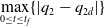 $\mathop{\max }\limits _{0 \le t \le{t_f}}\{\lvert q_2-q_{2d}\rvert \}$
), and the maximal absolute error during the last two seconds (MAE2) (
 $\mathop{\max }\limits _{t_f-2 \le t \le{t_f}}\{\lvert q_1-q_{1d}\rvert \}$
,
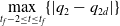 $\mathop{\max }\limits _{t_f-2 \le t \le{t_f}}\{\lvert q_2-q_{2d}\rvert \}$
) of
 $q_1$
and
 $q_2$
, respectively. From Figs. 4, 5, and 6, it can be seen that the values of IAE, MAE, and MAE2 of the proposed control are smaller than that of LQR, which indicates that the system presents better dynamic performance, transient performance, and final tracking accuracy under the action of the method presented in this paper.
The integral absolute error.

The maximal absolute error.

The maximal absolute error during the last 2 s.

5.2. Matched time-varying uncertainty
Considering the nonlinear time-varying friction model in ref. [Reference Wei, Chai, Yao and Wang19], we employ the matched uncertainty
 $F$
as follows:
 $f_1=4.18(\mathrm{tanh} (1.59 \dot{q}_1)-\mathrm{tanh}(3.15 \dot{q}_1))+0.09\mathrm{tanh}(3.52\dot{q}_1)+0.021\dot{q}_1, f_2=0$
. Since there are both uncertainty and initial condition deviation, we adopt the control law
 $\tau = p_1 + p_2 + p_3$
in (16) and the control parameters are
 $\kappa =2,\; \varepsilon =0.001, \kappa _1 =0.02, \kappa _2=2$
. Figure 7 shows the history of
 $AD{B}{B}^{T}DA^{T}$
. It can be found that
 $AD{B}{B}^{T}DA^{T}$
is not infinitely approaching to zero. Hence, there exists
 $\underline{\lambda }\gt 0$
such that Assumption 1 is verified.
History of
 $AD{B}{B}^{T}DA^{T}$
.

The outputs of the Pendubot.

The maximal error during the last 2 s.

The outputs of the Pendubot by LQR and the proposed adaptive robust control are depicted in Fig. 8. In Fig. 9, we also compare the maximal absolute tracking errors of
 $q_1$
and
 $q_2$
during the last 2 s. It shows that the proposed control has higher final tracking accuracy. The absolute constraint-following errors
 $|\beta |$
of the conventional LQR and the proposed control are shown in Fig. 10. After some time, the constraint-following error of the developed approach enters a small area near zero, which indicates that
 $|\beta |$
is uniformly ultimately bounded. Figures 11 and 12 show the accumulative absolute constraint-following error and the control effort, respectively. As seen from Figs. 11 and 12, the proposed method is superior to LQR.
5.3. Matched and unmatched time-varying uncertainty
For the matched and unmatched time-varying uncertainty, we consider the friction both in the actuated link and the unactuated link and choose
 $F$
as [Reference Eom and Chwa16]:
 $f_1=4.18(\mathrm{tanh} (1.59 \dot{q}_1)-\mathrm{tanh}(3.15 \dot{q}_1))+0.09\mathrm{tanh}(3.52\dot{q}_1)+0.021\dot{q}_1$
,
 $f_2=4.18(\mathrm{tanh} (1.59 \dot{q}_2)-\mathrm{tanh}(3.15 \dot{q}_2))+0.09\mathrm{tanh}(3.52\dot{q}_2)+0.021\dot{q}_2$
. To handle both uncertainty and initial condition deviation, we use the control law
 $\tau = p_1 + p_2 + p_3$
. The control parameters are the same as last session. Figure 13 shows the history of
 $AD{B}{B}^{T}DA^{T}$
. It can be found that
 $AD{B}{B}^{T}DA^{T}$
is not infinitely close to zero. Hence, there exists
 $\underline{\lambda }\gt 0$
such that Assumption 1 is verified.
The constraint-following error.

The accumulative absolute error.

The control input.

History of
 $AD{B}{B}^{T}DA^{T}$
with matched and unmatched uncertainty.

The outputs of the Pendubot system by the proposed new control are presented in Fig. 14. The constraint-following error
 $|\beta |$
is given in Fig. 15. We can see that
 $|\beta |$
enters a small neighborhood of zero after some time, which indicates the uniform ultimate boundedness of the constraint-following error. Figure 16 shows the control
 $p_1, p_2$
, and
 $p_3$
.
Outputs of the Pendubot with matched and unmatched uncertainties.

The constraint-following error.

The above three groups of simulation evidently illustrate that the proposed robust control can effectively eliminate the uncertainty, whether constant or time-varying, matched or unmatched.
The control input.

The experimental outputs of the Pendubot.

The control input.

6. Experimental results
To validate the effectiveness of the proposed adaptive robust control method, experiments were carried out on an actual Pendubot system, where there exist matched and unmatched uncertainties. The Pendubot experimental system consists of three parts: a PC monitor, an embedded controller, and the Pendubot system. The Pendubot is driven by a servo motor with rated voltage of 90 V and no-load speed of 2000 r/min. The control algorithm is implemented on the embedded controller with a PowerPC processor running at 1 GHz. The angles of the actuated and unactuated link are measured by two encoders of 1250 pulses per revolution. The parameters of the Pendubot system in (1) are identified as
 ${\theta _1} = 0.0096\; \mathrm{kg} \cdot \mathrm{m}^{2}$
,
 ${\theta _2} = 0.0054\; \mathrm{kg} \cdot \mathrm{m}^{2}$
,
 ${\theta _3} = 0.0046\;\mathrm{kg} \cdot \mathrm{m}^{2}$
,
 ${\theta _4} = 0.0679\;\mathrm{kg} \cdot \mathrm{m}^{2}$
,
 ${\theta _5} = 0.0332\;\mathrm{kg} \cdot \mathrm{m}^{2}$
, and
 $g=9.8\;\rm{m/s^2}$
, and the initial position is
 $\left ({{q_1},{q_2},{{\dot q}_1},{{\dot q}_2}} \right ) = \left ({ - \frac{\pi }{2},0,0,0} \right )$
. The swing-up control adopts the energy-based method [Reference Fantoni, Lozano and Spong12] and the control parameters are
 $k_P=66.35$
,
 $k_D=9.45$
, and
 $k_E=1$
. The switching conditions are
 $|{q_1} -{\pi/2}| \le 0.26,\; |{{q_2}} | \le 0.26$
. Furthermore, the proposed method was compared with the traditional LQR method.
The experimental results are shown in Figs. 17 and 18. From Fig. 17, it can be seen that the proposed method effectively decreases the fluctuation and tracking error. Figures 19 and 20 provide the IAE and the MAE2 of
 $q_1$
and
 $q_2$
, respectively. From Figs. 19 and 20, we can see that the values of IAE and MAE2 of the proposed new control are smaller than that of LQR, indicating that the Pendubot system exhibits better dynamic performance and final tracking accuracy under the proposed new control.
The integral absolute error.

The maximal absolute error during the last 2 s.

7. Conclusion
We investigate the constraint-following control for the Pendubot system subjects to both matched and unmatched uncertainty. An orthogonal decomposition method is adopted to deal with the system uncertainty. After decomposition, the mismatched part of the uncertainty “disappears". For the matched part, an adaptive law with a leakage term is adopted to estimate its upper bound. Based on that, an adaptive robust control law is developed. Through rigorous mathematical derivation, we show that the closed-loop system is uniformly bounded and uniformly ultimately bounded, without approximating or linearizing the original nonlinear dynamics. Simulation results suggest that the constraint can be effectively followed.
Author contributions
Cui Wei wrote the article. Ye-Hwa Chen, Tianyou Chai, and Jun Fu provided advice and supervision.
Financial support
This work was supported in part by National Natural Science Foundation of China under grants 62203215, 61991404, 61991400, and 61991402, National Key R&D Program of China under grant 2022YFB3305002, and the 2020 Science and Technology Major Project of Liaoning Province under grant 2020JH1/10100008.
Conflicts of interest
The authors declare no conflicts of interest exist.
Ethical considerations
No ethical issue with this paper.



