



Suicide is a major global health burden, requiring enhanced awareness, evidence-based interventions and targeted responses to severe suicidality. More than half of suicide attempts occur in the context of mood disorders, yet these conditions exhibit at least partially distinct molecular signatures. Reference Zhao, Lucassen and Swaab1 The human hippocampus has complex roles in both stress vulnerability and resilience, during which psychobiological signals emerge in parallel. Reference Boldrini, Galfalvy, Dwork, Rosoklija, Trencevska-Ivanovska and Pavlovski2 Disturbed purine metabolism is an important component of stress pathophysiology. The P2X purinoceptor 7 (P2RX7) is a member of the ATP-gated ion channel family, which is known to be a main sensor of extracellular ATP, the prototype of the danger signal released at sites of tissue damage. Reference Penolazzi, Notarangelo, Lambertini, Vultaggio-Poma, Tarantini and Di Virgilio3 It is increasingly recognised with respect to its involvement in depression and other psychiatric disorders, and P2RX7 genetic variations have been associated with elevated suicide risk. Reference Kristof, Gal, Torok, Eszlari, Sutori and Sperlagh4,Reference Deussing and Arzt5 In animal models, P2RX7 activation drives neuroinflammation, contributing to mood disorders, and modulates neurochemical, neuroimmune and neuroplastic processes in the hippocampal dentate gyrus. Reference Deussing and Arzt5 We hypothesised that alterations in purine receptors might occur in cases of suicide independent of the underlying mood disorders. Reference Zhang, Verwer, Lucassen, Huitinga and Swaab6–Reference Zhang, Verwer, Zhao, Huitinga, Lucassen and Swaab8
We obtained 77 paraffin-embedded tissue blocks containing the anterior or middle hippocampus (4/73; Fig. 1(a) and 1(b)) from the Netherlands Brain Bank (Director: Prof. Dr Inge Huitinga; Table 1). The donors or their next of kin provided permission for the autopsy, and for the use of brain material and clinical documentation for research purposes. Samples from donors who died by legal euthanasia were included to represent an alternative form of self-determined death. Reference Zhang, Verwer, van Heerikhuize, Lucassen, Nathanielsz and Hol9 To determine whether suicide or mood disorders acted as the main factor in purine receptor alterations, brain samples were divided into five groups, comprising samples from: 25 individuals with mood disorders who died of natural causes (MDN); 21 individuals with mood disorders and suicidal ideations that led to legal euthanasia (MDE); 10 individuals with mood disorders who completed suicide (MDS); 11 individuals who died of natural causes; and 10 individuals who died of legal euthanasia for incurable non-neuropsychiatric diseases such as cancer. In addition, to study the biological basis of suicide resilience, we subdivided MDN into patients with mood disorders who did not have any clinical history of suicidal ideation or attempts (MDNS), and those for whom suicidality had been reported but who died of natural causes (MDNFS).
P2RX7+ nuclei in the hippocampal dentate gyrus are related to fatal self-determined death ideation and resilience to suicide. Anatomical scheme (a) of the hippocampal subregions (b) employed in this study. (c) Granule cell density in the dentate gyrus was stable among different groups. (d–g) P2RX7 expression in the dentate gyrus of individuals without (d) and with (e–g) fatal self-determined death ideation. Notably, e–g show representative samples with progressively increasing numbers of P2RX7+ nuclei accompanied by elevated chromatin condensation and marginalisation. The boxes show magnifications of positive staining patterns of P2RX7+ nuclei in the granule cell layer. (h) and (i) show more granular nuclei expressing P2RX7 in both the non-psychiatric control and mood disorder groups in relation to those with fatal self-determined death ideations. (j) Ratios of P2RX7+ nuclei were increased in individuals who completed suicide compared with patients without suicidality and those with non-fatal suicidality. CA, cornu ammonis; CE, control individuals who died by legal euthanasia; CN, control individuals who died of natural causes; DG, dentate gyrus; Ent., entorhinal cortex; GCL, granule cell layer; HC, hippocampus; MDE, individuals with mood disorder who died by legal euthanasia; MDN, individuals with mood disorder who died of natural causes; MDNS, individuals with mood disorder who did not report suicidal ideation or attempt and died of natural causes; MDNFS, individuals with mood disorder who had suicidal ideation or attempt(s) but died of natural causes; MDS, individuals with mood disorders who died by suicide; ML, molecular layer; n.s., not significant; SGL, subgranular layer; Sub., subiculum. Scale bar, 15 µm. *P < 0.05, **P < 0.01, ***P < 0.001, ****P < 0.0001.
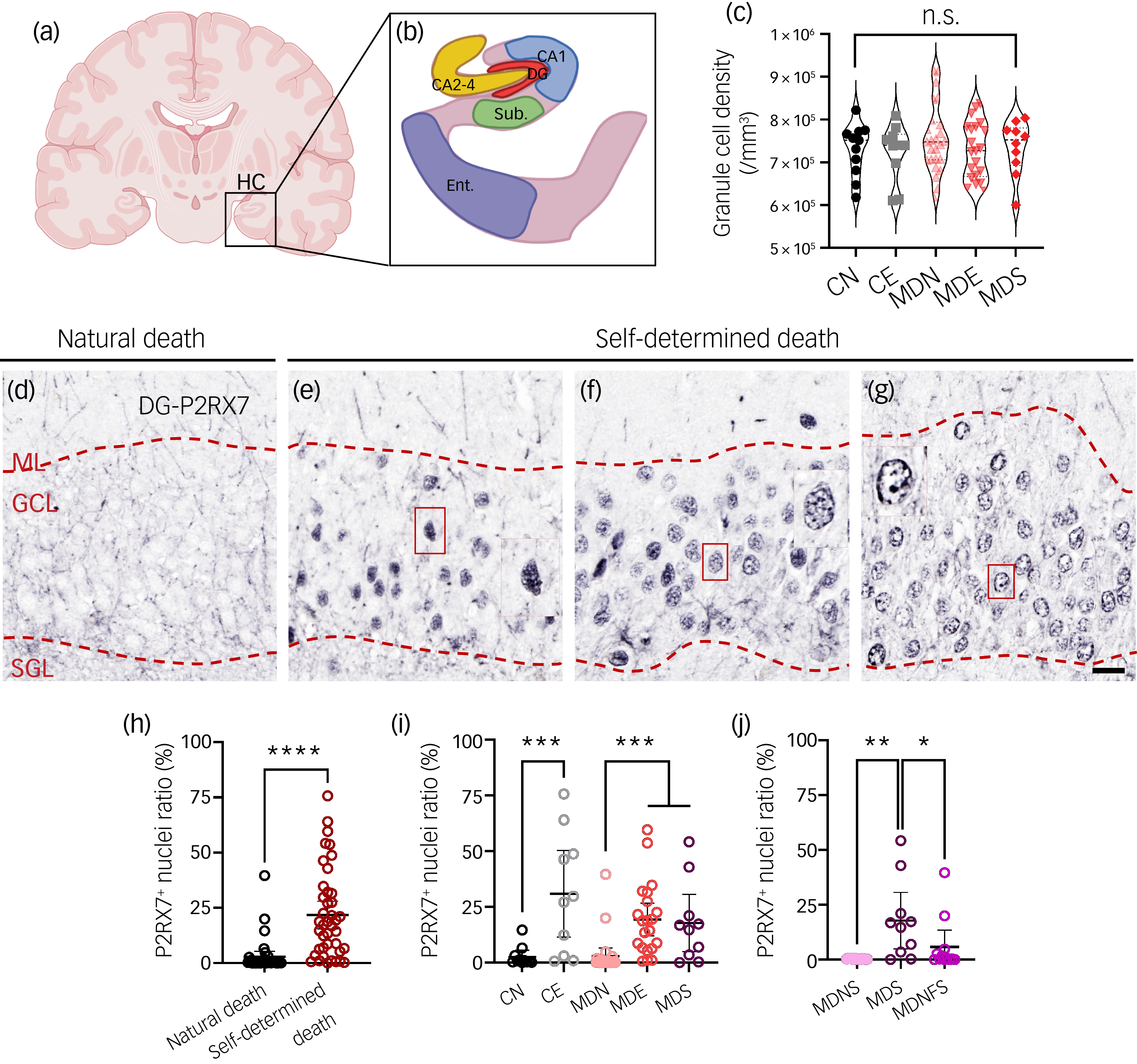
Fig. 1 Long description
Panel A: An anatomical scheme of the hippocampal subregions employed in the study. Panel B: A detailed diagram of the hippocampal subregions including CA1, CA2-4, DG, Sub., and Ent. Panel C: A violin plot showing granule cell density in the dentate gyrus among different groups, with the y-axis labeled Granule cell density (per cubic millimeter) and the x-axis labeled with group categories (CN, CE, MDN, MDE, MDS). The plot indicates no significant differences among the groups. Panels D-G: Microscopic images showing P2RX7 expression in the dentate gyrus of individuals without (D) and with (E-G) fatal self-determined death ideation. The images show progressively increasing numbers of P2RX7-positive nuclei accompanied by elevated chromatin condensation and marginalisation. The boxes in E-G show magnifications of positive staining patterns of P2RX7-positive nuclei in the granule cell layer. Panel H: A scatter plot comparing P2RX7-positive nuclei ratios between individuals who died naturally and those who died by self-determined death, with the y-axis labeled P2RX7-positive nuclei ratio (percent) and the x-axis labeled with the two groups. The plot shows a significant increase in P2RX7-positive nuclei ratios in the self-determined death group. Panel I: A scatter plot comparing P2RX7-positive nuclei ratios among different groups (CN, CE, MDN, MDE, MDS), with the y-axis labeled P2RX7-positive nuclei ratio (percent) and the x-axis labeled with the group categories. The plot shows significant differences among the groups. Panel J: A scatter plot comparing P2RX7-positive nuclei ratios among individuals with mood disorders who did not report suicidal ideation or attempt and died of natural causes (MDNS), individuals with mood disorders who had suicidal ideation or attempt(s) but died of natural causes (MDNFS), and individuals with mood disorders who died by suicide (MDS), with the y-axis labeled P2RX7-positive nuclei ratio (percent) and the x-axis labeled with the three groups. The plot shows significant differences among the groups.
Demographic information

a. In The Netherlands, legal euthanasia will be approved to end unbearable suffering with no prospect of improvement in physical/psychiatric diseases (https://www.government.nl/topics/euthanasia/is-euthanasia-allowed). For the practice of legal euthanasia in The Netherlands, see https://derechoamorir.org/wp-content/uploads/2018/09/2012-guia-eutanasia-colegio-medicos-pbajos.pdf.
b. One individual who died of legal euthanasia applied on the basis of a combination of physical disease and mood disorder. The others were approved because of either physical disease or mood disorder.
First, we determined the density of the granule cells in the dentate gyrus of every section following staining to assess structural stability (Fig. 1(c)). Second, we investigated the expression of P2RX7 by immunohistochemistry with an antibody that targets the N-terminus and image-processing cell quantification (Supplementary Figs 1–4 available at https://doi.org/10.1192/bjp.2026.10717). In the hippocampus of individuals who died of natural causes, P2RX7 was generally present in glial cells, mainly astrocytes (Fig. 1(d)). Notably, among individuals who died by either suicide or legal euthanasia, considerable numbers of granule cells contained P2RX7 within the nucleus (Fig. 1(e–g), Supplementary Fig. 5). Chromatin condensation and marginalisation were characteristic features of P2RX7+ nuclei. Quantitative results showed similar increases in the ratio of P2RX7+ nuclei to the total number of nuclei and in the density of P2RX7+ nuclei in the granule cell layer among individuals who died by suicide or legal euthanasia (odds ratio 32.3, marginal meansself-determined death 17.7% (95% CI: 11.4%, 28.0%), marginal meansnatural death 0.548% (95% CI: 0.248%, 1.59%); Fig. 1(h) and (i)). In the context of suicide resilience, the presence of P2RX7+ nuclei increased in individuals who completed suicide compared with patients without suicidality and was lower in patients with non-fatal suicidality (Fig. 1(j)). These cases represent an excellent framework for study of suicide-ideation-specific biomarkers in the context of mood disorders. In addition, a generalised linear model for the logit transformed P2RX7+ ratio as a function of manner of death, including possible confounding effects of post-mortem delay, brain pH, age, gender, brain weight and hippocampal segment, showed a strong effect of manner of death (beta = −3.8, P = 1.5 × 10⁻⁷; Supplementary Fig. 6 and Supplementary Table 1). No such alterations were observed with an antibody directed against the C-terminus of P2RX7, which showed massive nuclear staining in all subgroups (Supplementary Fig. 3).
Brain regions that differentiate suicide-related neuropathology from neuropathology observed in comorbid psychiatric disorders are key to further studies of biomarkers for novel therapeutic targets for suicide. Our data show the following: (a) fatal self-determined death ideations, including both completed suicide and legal euthanasia, may have a distinct molecular characteristic, i.e. nuclear localisation of P2RX7 N-terminus; this marker seemed to be independent of the psychiatric background, in which only astrocytic localisation of P2RX7 was observed, and (b) P2RX7 may serve as a potential therapeutic target in individuals resilient to suicide, distinct from the suicide-related pathological changes observed in the dentate gyrus. Translational relevance of nuclear P2RX7 is discussed in the Supplementary Material.
It is important to acknowledge that our findings reflect relative nuclear proportions within sampled tissue and density-based comparisons, which do not directly indicate changes in total P2RX7-positive cell numbers. The sample size for individuals who had completed suicide was limited, and post-mortem delay for these individuals was relatively long and often estimated rather than precisely recorded; this may have led to degradation of certain molecules and also limits sample inclusion for future downstream analyses. To preserve suicide-related biomarkers, we expanded our cohort with brain sample from donors who died by legal euthanasia, a group characterised by strong and persistent self-determined death ideation and for whom rapid post-mortem processing is feasible. In this study, there was no difference in post-mortem delay for the group of patients who had natural deaths and the expanded suicide group that included individuals who died by euthanasia (Mann–Whitney U-test, P = 0.97). Our findings indicate that individuals who die by legal euthanasia and completed suicide may have similar molecular alterations in the dentate gyrus that relate to an intense death wish.
Compared with suicide completion, resilience to suicide indicates an ability to recover from suicidal thoughts. Among depressed patients, those who have been at high risk for suicide but survived their suicidal ideations or attempts may undergo adaptive brain changes. Although the data used here were cross-sectional and based on post-mortem observations, biomarkers of resilience in suicide survivors seemed to resemble those seen in individuals who completed suicide and later to returned to the pre-suicide baseline, suggesting the presence of substrates that could serve as novel therapeutic targets for suicidal ideation. However, translation of resilience-focused comparisons into clinical psychiatry is limited by a lack of data for brain alterations due to suicidal ideation before individuals completed suicide. Use of donors who engaged in legal euthanasia seems a pragmatic solution to approximate donors with suicidal ideations. However, the molecular basis of impulsive behaviours in contrast to long-term planning warrants further investigation, as do the differences between physical and psychiatric suffering.
Given that our study identified a nuclear localisation of the P2RX7 in dentate gyrus neurons in individuals with fatal suicidal ideations that was not observed in suicide-resilient individuals, and that there is a lack of animal models for suicide, development of a conceptual framework that integrates molecular commonalities across suicide with the genetic basis of suicide resilience will be essential to advance research in this field.
Supplementary material
The supplementary material is available online at https://doi.org/10.1192/bjp.2026.10717
Data availability
All data are available in the Supplementary Material.
Acknowledgement
We thank Dr Evgenia Salta for theoretical support.
Author contributions
L.Z. and D.F.S. conceptualised the project. L.Z. performed the laboratory experiments and wrote the first draft. J.A.H. conducted statistical analysis and data interpretation. D.F.S. provided theoretical supervision and obtained financial support.
Funding
This research was supported by funding from Stichting Aan Boord by de Stichting Vrienden van het Herseninstituut, awarded to D.F.S. and L.Z.
Declaration of interest
None.





eLetters
No eLetters have been published for this article.