Introduction
Hookworms are blood-feeding intestinal parasitic nematodes that infect dogs, cats and other mammals, including humans, causing a variety of symptoms, including anaemia, diarrhoea and skin inflammation (George et al., Reference George, Levecke, Kattula, Velusamy, Roy, Geldhof, Sarkar and Kang2016; Nazzaro et al., Reference Nazzaro, Angileri, Parduccil and Verald2017). The common hookworms of dogs and cats worldwide are Ancylostoma caninum, A. ceylanicum, A. braziliense, A. tubaeforme and Uncinaria stenocephala (Bowman et al., Reference Bowman, Montgomery, Zajac, Eberhard and Kazacos2010). The first three Ancylostoma species are probably zoonotic hookworms from animals, where the zoonotic worms A. caninum and A. braziliense mainly cause larva migrans (Bowman et al., Reference Bowman, Montgomery, Zajac, Eberhard and Kazacos2010), and A. ceylanicum can develop into the adult form in the human intestinal tract, resulting in abdominal symptoms and iron-deficiency anaemia (Crompton, Reference Crompton2000). With the improvement of social and economic conditions, the numbers of dogs and cats as companion animals have been increasing in many countries, including China. Therefore, the rapid and accurate detection of canine and feline hookworms is very necessary for the epidemiological survey and risk assessment of hookworm diseases.
Traditional microscopic examination is a commonly used method for detecting hookworms, due to its simple operation and low cost. However, it is very difficult to discriminate between hookworms because of their morphological similarities. In recent years, molecular methods have been developed for the detection of hookworms; for example, conventional and semi-nested polymerase chain reaction (PCR) (Gasser et al., Reference Gasser, Hoste, Chilton and Beveridge1993), PCR-single strand conformation polymorphism (SSCP) (Gasser et al., Reference Gasser, Monti, Baozhen, Polderman, Nansend and Chiltonet1998), PCR-restriction fragment length polymorphism (RFLP) (Liu et al., Reference Liu, Zheng and Zhang2015) and multiplex PCR (Hu et al., Reference Hu, Wu, Yu, Abullahi, Song, Tan, Wang, Jiang and Li2015). Although these methods are practical, they still have some problems; for example, they are time consuming and easily contaminated.
High-resolution melting (HRM) is a recently developed technology. The high-precision melting of PCR products enables the discrimination of samples according to sequence length, GC content or strand complementarily, and down to single base-pair changes. No prior sequence information is needed to enable the detection of previously unknown, and even complex, sequence variations in a simple and straightforward way (Erali et al., Reference Erali, Voelkerding and Witter2008). HRM has been widely used in the rapid identification and differentiation of many parasitic protozoans (Tan et al., Reference Tan, Yu and Abdullahi2015) because of its high degree of automation, high throughput, closed-tube operation and low cost (Reed & Wittwer, Reference Reed and Wittwer2004; Wilson et al., Reference Wilson, Alker and Meshnick2005). In helminths, Areekit et al. (Reference Areekit, Kanjanavas, Pakpitchareon, Khawsaket, Khuchareontaworn, Sriyaphai and Chansiri2009) identified two closely related nematodes – Brugia malayi and B. pahangi – in cat reservoirs by using HRM analysis. Ngui et al. (Reference Ngui, Lim and Chua2012a) established an HRM assay for the identification and discrimination of five human hookworms, including Necator americanus, Ancylostoma duodenale, A. ceylanicum, A. caninum and A. braziliense, based on the internal transcribed spacer 2 (ITS-2) of ribosomal DNA (rDNA). However, to our knowledge there are few studies on the detection of canine and feline hookworms using the HRM method.
Our previous studies found that A. ceylanicum, A. caninum and A. tubaeforme are common canine and feline hookworms in South China (Liu et al., Reference Liu, Zheng and Alsarakibi2013; Shi et al., Reference Shi, Fu and Abdullahi2017). In the present study, a new HRM assay based on ITS-1 rDNA was developed for the detection of these three canine and feline hookworms and their mixed infections, so as to provide a rapid and effective method for the risk assessment and epidemiological investigation of canine and feline hookworms.
Materials and methods
Parasites and faecal samples
Adults of A. ceylanicum, A. caninum and A. tubaeforme were isolated, identified and stored in our laboratory (Liu et al., Reference Liu, Zheng and Alsarakibi2013; Shi et al., Reference Shi, Fu and Abdullahi2017). Faecal samples for clinical detection were collected from the stray cats and dogs of Animal Relief Stations in Shaoguan, Foshan and Guangzhou of Guangdong province, China and stored at 4°C before use.
DNA extraction
Adult hookworms of the three Ancylostoma species, preserved in 50% ethanol, were washed repeatedly with double-distilled water (ddH2O). The genomic DNA (gDNA) of individual hookworms was extracted using the DNA Stool Mini Kit (Omega, Guangzhou, China) according to the manufacturer's instructions. DNA samples were stored at −20°C until use.
PCR amplification of ITS-1
The ITS-1 sequences of three DNA samples from each of A. ceylanicum, A. caninum and A. tubaeforme were amplified using primers An-F and An-R (Liu et al., Reference Liu, Zheng and Zhang2015). The predicted amplification fragment was 404 bp long. All PCRs were performed in a reaction mix (volume 25 μl) containing 9.5 μl ddH2O, 12.5 μl Ex-Taq polymerase (TaKaRa, Dalian, China), 0.5 μl of each primer An-F/An-R (50 μmol/l) and 2 μl of DNA sample. PCR conditions used were: initial denaturation at 94°C for 5 min; followed by 35 cycles of denaturation at 94°C for 30 s, annealing at 61.5°C for 30 s and extension at 72°C for 45 s; and then a final extension at 72°C for 7 min. PCR products were analysed by ethidium bromide stained agarose gel electrophoresis, recycled using a DNA gel extraction Kit (Omega) and stored at −20°C until use.
Preparation of standard plasmids
The purified PCR products were cloned into the PMD-18 vector (TakaRa), transfected in Escherichia coli DH5α (TakaRa) and identified by bacterial liquid PCR. The positive plasmids were sequenced to further validate the plasmids of the hookworm species. After identification by sequencing, 50 μl of positive bacterium liquid were inoculated into 5 ml of lysogeny broth (LB) liquid medium with ampicillin (Amp+) and were shaken overnight at 37°C. The plasmid DNAs were extracted using the Plasmid Mini Kit (Omega), and stored at −20°C. The prepared A. ceylanicum, A. caninum and A. tubaeforme plasmids were named as Acep, Acap and Atup, respectively. The A260/A280 value and concentration of the plasmids (1 μl) were measured using an ultramicro-spectrophotometer, where the A260/A280 value and optimal concentration should be 1.8–2.0 and 50 ng/μl. The mixed plasmids Acep & Acap and Acep & Atup were prepared by mixing the individual plasmids, and all standard plasmids were stored at −20°C.
Establishment of the HRM method
A pair of primers, HRM-F (5′-AGTCTAAAGCTCAGCGAAACG-3′) and HRM-R (5′-TCGGGAAGGTTGGGAGTA-3′), was designed by the software Primer Premier 5.0 (PREMIER Biosoft, California, United States) according to the sequences LC177192.1 (A. caninum), KM066110.1 (A. ceylanicum) and JQ812691.1 (A. tubaeforme) downloaded from the National Center for Biotechnology Information (NCBI). The size of the predicted amplification fragment was 123 bp. The primers were synthesized by Shenggong Corporation (Shanghai, China), diluted with sterile ddH2O to a final concentration of 10 pmol/μl, and stored at −20°C until used. PCR amplification and HRM analysis were performed in one reaction of Rotor-Gene Q (Qiagen, Hilden, Germany). The reaction system contained 10 μl of 2×HRM Analysis PreMix (Tiangen, Beijing, China), 1.2 μl of HRM-F (10 μm), 1.2 μl of HRM-R (10 μm), 6.6 μl of ddH2O and 1.0 μl of plasmids. The optimized reaction conditions were as follows: pre-denaturation at 95°C for 2 min; followed by 40 cycles of denaturation at 95°C for 10 s, annealing at 61.2°C for 30 s and extension at 72°C for 30 s. Melting occurred at 75–99°C at a rate of 0.1°C/s.
Evaluation of the HRM method
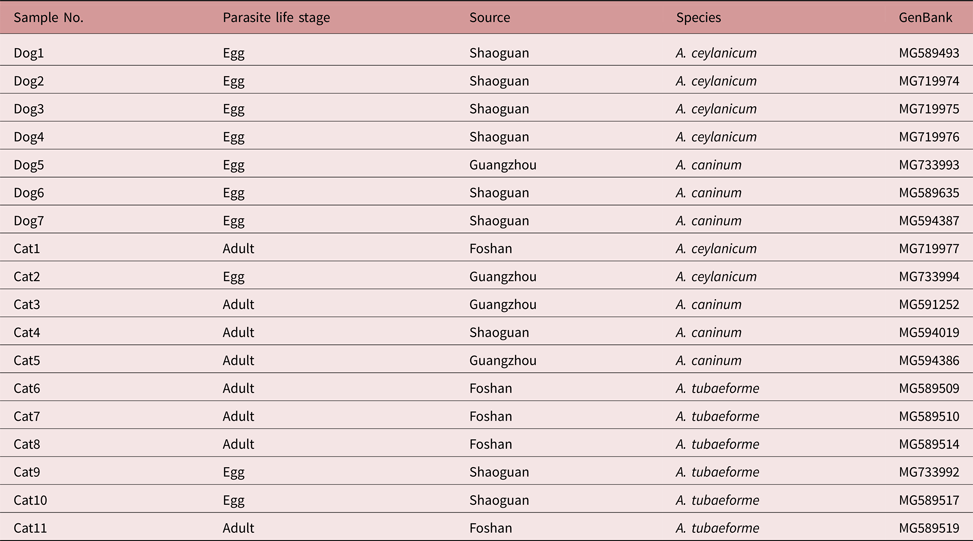
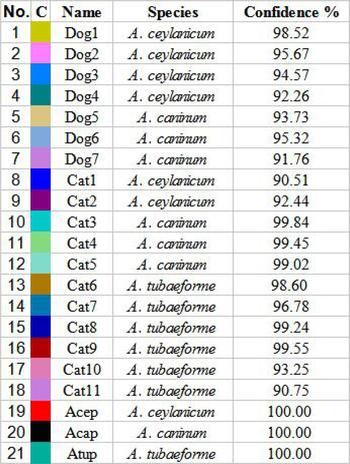
To evaluate the established HRM method, a series of experiments on its stability, sensitivity and accuracy were performed using the above-mentioned quantitative PCR (qPCR)-HRM reaction system and the conditions, with few modifications, reported in our previous work (Tan et al., Reference Tan, Yu and Abdullahi2015). Intra-assays were tested seven times, while inter-assays were tested three times for each plasmid. Three standard plasmids (Acep, Acap and Atup) were diluted ten times and concentrations of 1:10–1:108 were tested. Eighteen samples with unknown DNAs from canine and feline hookworms were detected by the HRM method and were compared with their sequencing results (table 1).
Sequencing results of 18 samples in the HRM accuracy experiment.

Clinical detection
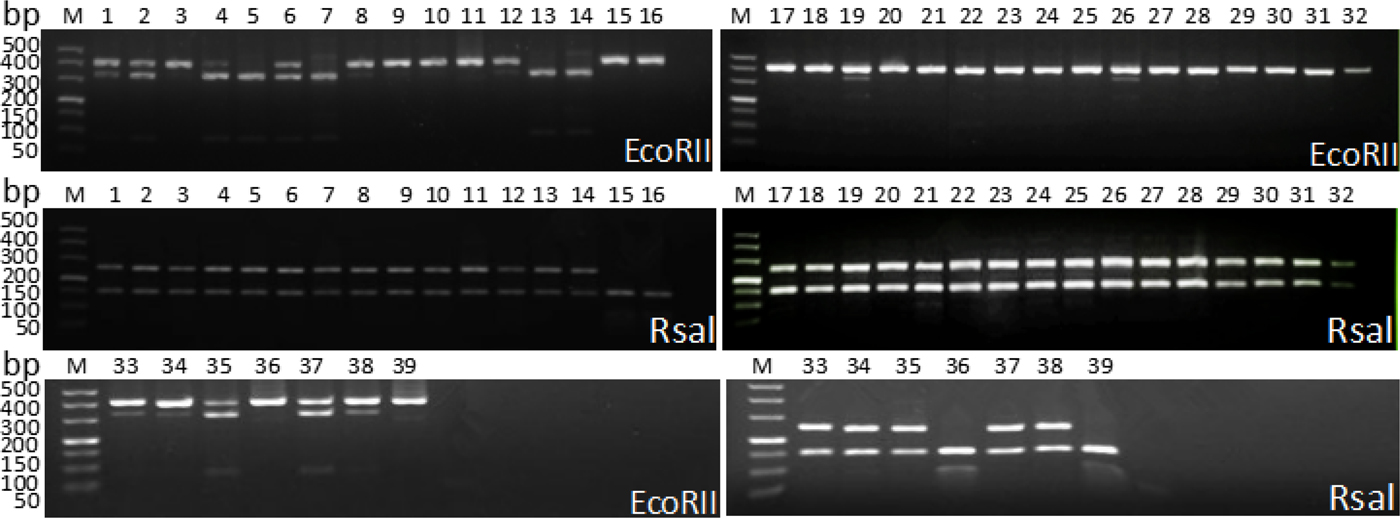
Ninety-eight faecal samples (2 g faeces for each sample) from cats and dogs were examined by the centrifugal flotation technique with saturated zinc sulphate. The gDNA of positive faecal samples (2 g) was extracted using the Omega DNA Stool Mini Kit (Omega) according to the manufacturer's instructions. All positive faecal samples were detected by using the established HRM method, and the detection results were compared with those of PCR-RFLP, where the RFLP analysis was performed according to Liu et al. (Reference Liu, Zheng and Zhang2015) with few modifications. The theoretical cutting patterns of ITS-1 fragments of the three hookworm species treated with endonucleases EcoRII and RsaI are shown in table 2. All PCR products were digested with EcoRII and RsaI restriction endonucleases (TaKaRa) in a final volume of 20 μl for 3 h at 37°C. The reaction system for EcoRII contained 10 μl of PCR product, 1 μl of EcoRII endonuclease, 2 μl of K buffer and 7 μl of ddH2O. The reaction system for RsaI contained 10 μl of PCR product, 1 μl of RsaI endonuclease, 2 μl of 0.1% bovine serum albumin (BSA), 2 μl of T buffer and 5 μl of ddH2O.
The theoretical cutting patterns of ITS-1 fragments of Ancylostoma caninum, A. tubaeforme and A. ceylanicum treated with endonucleases EcoRII and RsaI.

+, One digestive site; 3+, three sites.
aThe product was too small to view.
Results
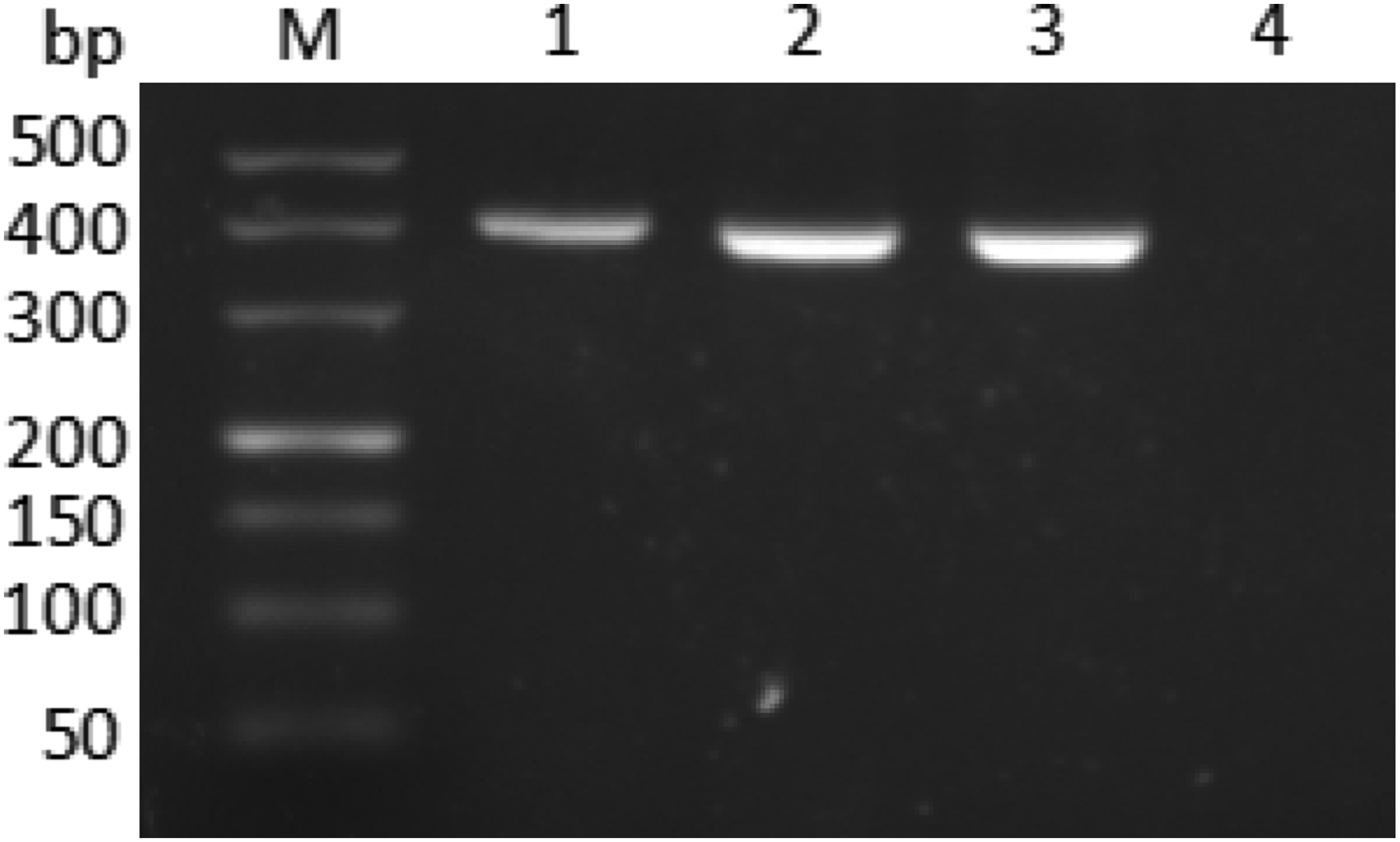
The amplified fragments of the gDNAs from the canine and feline hookworms A. ceylanicum, A. caninum and A. tubaeforme were 404 or 405 bp in size, which is consistent with the expected fragment length, without non-specific band (fig. 1). The accession numbers in GenBank for ITS-1 sequences from the three hookworm species were KY676846.1, MG589522 and MG589516, respectively. The A260/A280 values of the three positive plasmids Acep, Acap and Atup were between 1.8 and 2.0, as expected. Their concentrations were at optimal levels: 56.9, 54.7 and 54.6 ng/μl, respectively.
PCR amplification of the ITS-1 fragment of canine and feline hookworms. Lanes: M, DL5000 marker; 1, Ancylostoma ceylanicum; 2, A. caninum; 3, A. tubaeforme; 4, negative control.

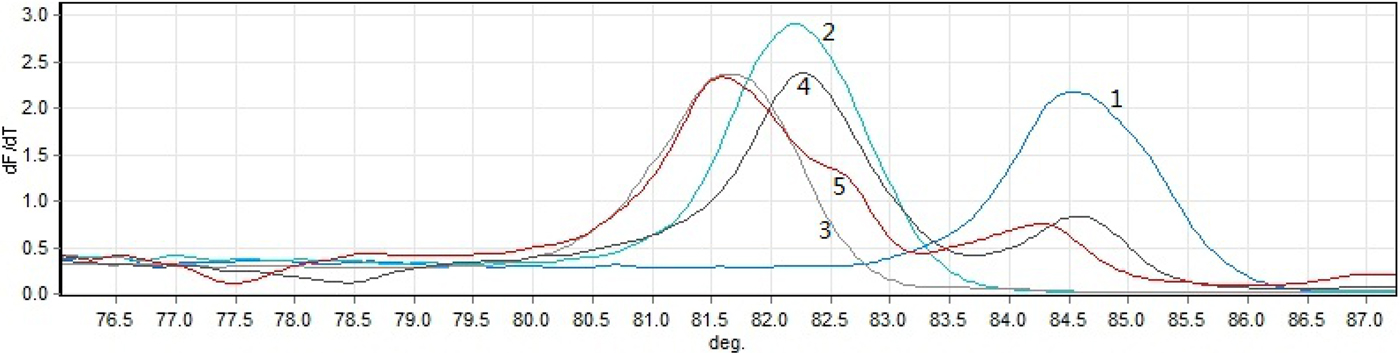
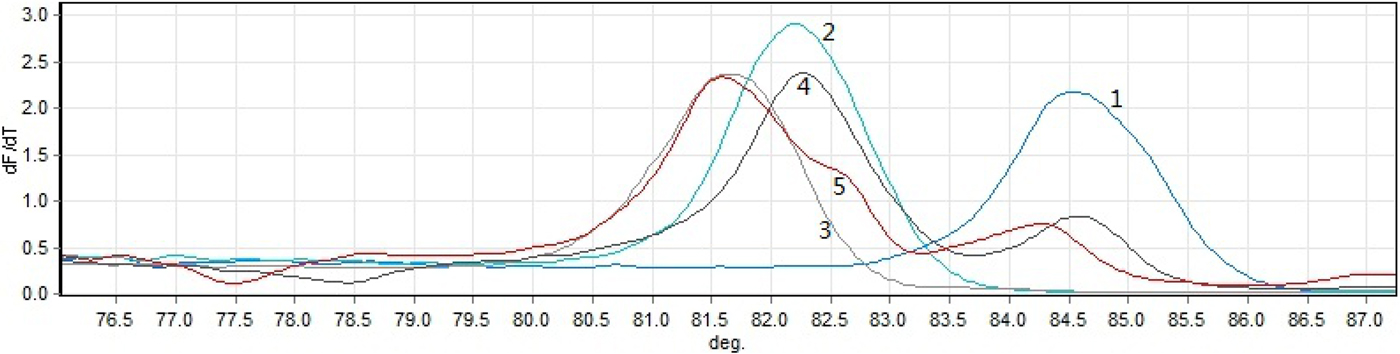
The HRM melting curves showed that the primers HRM-F/HRM-R could distinguish among the three hookworm plasmids (Acep, Acap and Atup) without non-specific amplification and primer dimers, and two specific peaks were generated in the mixed plasmids (Acep & Acap and Acep & Atup) (fig. 2). The software analysis of Rotor-Gene Q showed that the melting temperature (T m) value was 84.50°C for A. ceylanicum, 82.25°C for A. caninum and 81.73°C for A. tubaeforme. The result indicated that the HRM method was successful.
High-resolution melting curves of standard plasmids. 1, Acep; 2, Acap; 3, Atup; 4, Acep & Acap; 5, Acep & Atup.
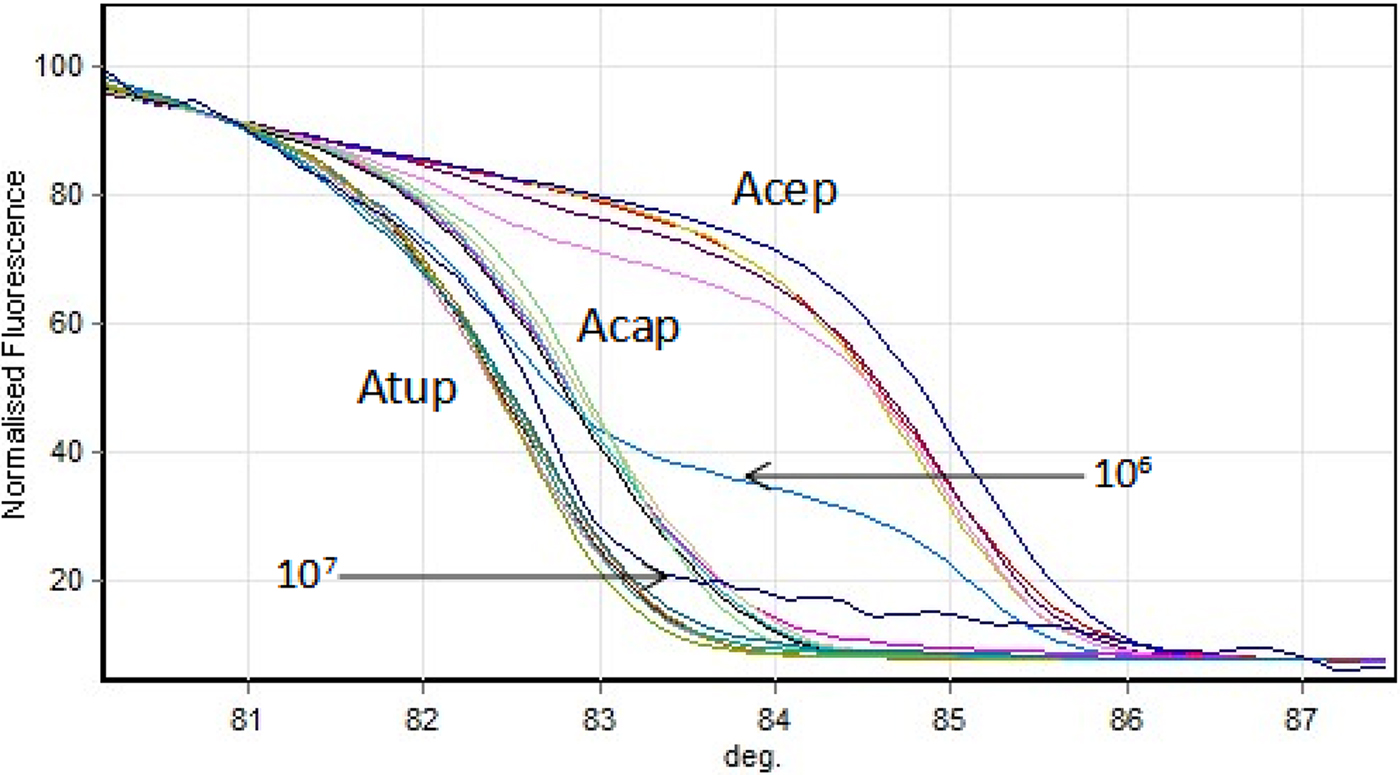
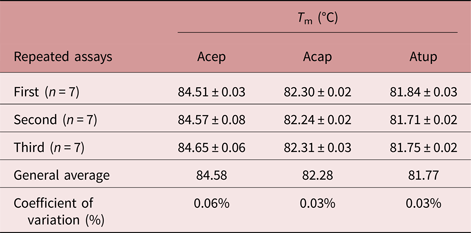
The intra-assay reproducibility of melting curves was almost perfect, and inter-assay comparison of melting curves showed that they were much the same shape. Statistical analyses demonstrated that the inter-assay variation coefficients (CV) of Acep, Acap and Atup were 0.06, 0.03 and 0.03%, respectively (table 3), thus indicating good stability of the HRM method. When Acep, Acap and Atup plasmids were diluted to 1:10–1:105 (5.69 × 10⁻⁴ ng/μl, 5.47 × 10⁻⁴ ng/μl and 5.46 × 10⁻⁴ ng/μl, respectively), the HRM method was still able to detect the three Ancylostoma species (fig. 3). When Acep and Acap samples were diluted to 1:106 and 1:107, the melting curves showed great deviation; while there was no deviation when the Atup sample was diluted to 1:107. The lowest concentration detected was about 5.69 × 10⁻⁴ ng/μl. Among the 18 hookworm DNA samples detected by the HRM method (7 dog-derived and 11 cat-derived), 4 dog-derived and 2 cat-derived hookworm samples were identified as A. ceylanicum; 3 dog-derived and 3 cat-derived hookworm samples were A. caninum; and 6 cat-derived hookworm samples were A. tubaeforme (fig. 4). Their accuracy of identification was in complete accordance with their sequencing results (table 1).
Sensitivity of the HRM method. Acep, 1:101 to 1:108 dilutions of plasmid Acep; Acap, 1:101 to 1:108 dilutions of plasmid Acap; Atup, 1:101 to 1:108 dilutions of plasmid Atup.

The results of detection of 18 canine and feline hookworm samples using the HRM method. The different colours represent distinct melting curves of samples detected by T m-shift method.

Statistical analysis of inter-assay data.

Forty-two out of 98 canine and feline faecal samples were microscopically positive for hookworm eggs. All positive faecal samples were identified using the HRM method as A. ceylanicum (n = 6), A. caninum (n = 15), A. tubaeforme (n = 4) and mixed infections of A. ceylanicum and A. caninum (n = 17). Only 39 positive faecal samples were detected by PCR-RFLP, including A. ceylanicum (n = 4), A. caninum (n = 18), A. tubaeforme (n = 4) and mixed infections of A. ceylanicum and A. caninum (n = 13) (fig. 5). The sensitivities of the HRM and PCR-RFLP methods were 100 and 92.9%, respectively, indicating that the HRM method was more sensitive.
PCR products digested by restriction endonucleases EcoRII and RsaI from 39 samples. Lanes: M, DL500 marker; 5, 7, 13, 14, Ancylostoma ceylanicum; 3, 9, 10, 11, 17, 18, 20–25, 27–32, A. caninum; 15, 16, 36, 39, A. tubaeforme; 1, 2, 4, 6, 8, 12, 19, 26, 33–35, 37–38, mixed infection of A. ceylanicum and A. caninum.

Discussion
The socio-economic and public-health impact of hookworm infection is extensive; an estimated 600 million people are infected worldwide, resulting in up to 135,000 deaths annually (Hotez, Reference Hotez2009). It has been reported that the prevalence of hookworm infection is over 50% in economically undeveloped areas of Pacific Asia (Pullan et al., Reference Pullan, Smith, Jasrasaria and Brooker2014). Since dogs and cats, as companion animals, are susceptible to zoonotic hookworms, the prevalence of canine and feline hookworms has an intimate relationship with human hookworm diseases. In Thailand, Malaysia and Laos PDR where the human hookworm was highly endemic, the prevalence of hookworms in dogs and cats ranged from 40.0 to 60.0% (Inpankaew et al., Reference Inpankaew, Traub, Thompson and Sukthana2007; Conlan et al., Reference Conlan, Khamlome, Vongxay, Elliot, Pallant, Sripa, Blacksell, Fenwick and Thompsonet2012; Mahdy et al., Reference Mahdy, Lim, Ngui, Fatimah, Choy, Yap, Al-Mekhlafi, Ibrahim and Surin2012). Ngui et al. (Reference Ngui, Lim, Traub, Mahmud and Mistam2012b) confirmed that the close contact between humans and animals (dogs and cats) increased the risk of human infection with hookworms. Therefore, it is of great significance for public health to establish a rapid detection and differentiation method for feline and canine hookworms.
Among detection methods for hookworms, microscopy was used for a long time in clinical diagnosis, because of its visual result, simple operation and low cost. However, this method has been hampered by the fact that many hookworms cannot be differentiated due to their morphological similarities (Lucioforster et al., Reference Lucioforster, Liotta, Yaros, Briggs, Mohammed and Bowman2012). To solve this problem, a variety of molecular methods, including nested PCR, PCR-SSCP, PCR-RFLP and multiplex PCR (Gasser et al., Reference Gasser, Hoste, Chilton and Beveridge1993, 1998; Palmer et al., Reference Palmer, Traub, Robertson, Hobbs, Elliota, While, Rees and Thompson2007; Hu et al., Reference Hu, Wu, Yu, Abullahi, Song, Tan, Wang, Jiang and Li2015), have been developed in recent years. However, they still have some disadvantages, such as being laborious; having poor specificity, with false positives occurring frequently in PCR-SSCP (Sheffield et al., Reference Sheffield, Beck, Kwitek, Sandstrom and Stone1993); and having low sensitivity, with many false negatives in PCR-RFLP (Tan et al., Reference Tan, Yu and Abdullahi2015; George et al., Reference George, Levecke, Kattula, Velusamy, Roy, Geldhof, Sarkar and Kang2016). Besides, the risk of contamination is increased in these methods because of complex operation steps. Interestingly, HRM technology has many advantages over the above methods, such as being rapid, with no post-PCR processing and closed-tube operation (Zhang et al., Reference Zhang, Liu, Alsarakibi, Li, Liu, Li and Li2012). The present study developed a new HRM method based on the ITS-1 for detecting three common hookworms from dogs and cats in South China. It could differentiate between the three hookworm species and their mixed infections, with the lowest concentration detected being about 5.69 × 10⁻⁴ ng/μl. According to the data provided by Gyawali et al. (Reference Gyawali, Ahmed, Sidhu, Jagals and Toze2017), the lowest number of hookworm eggs which could be detected by the HRM method is about 45. This method may provide important technical support for risk assessment and the epidemiological survey of canine and feline hookworms.
A mixed infection of canine and feline hookworms frequently occurs under poor feeding and management conditions, especially the mixed infection of A. ceylanicum and A. caninum (Palmer et al., Reference Palmer, Traub, Robertson, Hobbs, Elliota, While, Rees and Thompson2007; Ng-Nguyen et al., Reference Ng-Nguyen, Hii, Nguyen, Nguyen, Nguyen and Traub2015). To date, the available molecular methods for detecting mixed infection of hookworms have included DNA sequencing (Sato et al., Reference Sato, Sanguankiat, Yoonuan, Pongvongsa, Keomoungkhoun, Phimmayoi, Boupa, Moji and Waikagul2010; Jiraanankul et al., Reference Jiraanankul, Aphijirawat and Mungthin2011) and PCR-RFLP (Liu et al., Reference Liu, Zheng and Zhang2015). The present study compared detection by the HRM method with that by PCR-RFLP. The HRM method found 17 mixed infections of A. ceylanicum and A. caninum, four positive samples more than those found by PCR-RFLP. However, PCR-RFLP detected 18 samples with single A. caninum infection, three samples more than found by HRM. Perhaps, in the mixed infection, the A. ceylanicum in four samples could not be detected by PCR-RFLP.
In conclusion, the HRM method based on ITS-1 rDNA was established for detecting common canine and feline hookworms in South China, being able to differentiate between A. ceylanicum, A. caninum, A. tubaeforme and their mixed infections. This may provide important technical support for the zoonotic risk assessment and molecular epidemiological survey of canine and feline hookworms.
Financial support
This work was funded by the National Natural Science Foundation of China (grant no. 31672541) and the Science and Technology Planning Project of Guangdong Province, China (grant no. 2014A020214005).
Conflict of interest
None.