Introduction
As a result of the increase in numbers of elderly people in the population, nursing homes (NH) and long-term care facilities (LTCF) are becoming a major component of the healthcare delivery system.Reference Bonono1, Reference Garibaldi2 The elderly institutionalized are particularly susceptible to infections because of the physiological changes that occur with ageing, underlying chronic disease and the institutional environment. Infections occurring in these institutions represent a major cause of morbidity and mortality among residents.Reference Alvarez, Shell, Wooley, Berk and Smith3, Reference Norman, Castle and Cantrell4 Furthermore, in these settings infections may be more difficult to identify because of their subtle presentations and the lack of on-site diagnostic facilities.Reference Garibaldi2
During the past four decades, methicillin-resistant Staphylococcus aureus (MRSA) has spread in hospitals worldwide and is now endemic in many countries, particularly in Europe and the USA.Reference Fluit, Wielders, Verhoef and Schmitz5, 6 Patients who have been colonized with MRSA in general hospitals may introduce the organisms into LTCF or NH, and these can become reservoirs for this pathogen.Reference Strausbaugh, Jacobson, Sewell, Potter and Ward7 From the LTCF or the NH, MRSA can be transported back to the acute-care facility or can find their way into the community. In addition, new strains of MRSA termed community-associated MRSA have appeared recently. They are distinct from usual healthcare-associated MRSA by several characteristics, including the carriage of the genes for the Panton-Valentine leucocidin (PVL) and are often responsible for skin and soft-tissue infections.Reference Baba, Takeuchi and Kuroda8–Reference Miller, Perdreau-Remington and Rieg11 Strategies of MRSA control in the acute-care setting are controversial, especially those concerning the usefulness of screening cultures for identification of carriers.Reference Muto, Jernigan and Ostrowsky12, 13 Furthermore, it may not be possible to transfer such strategies directly to the NH or the LTCF environments that serve as both a healthcare setting and a resident's home.14 The objective of this review is to describe the epidemiology of MRSA in the older person and methods used to control MRSA spread in NH and LTCF. Full details of the search methods are available from the corresponding author.
The term LTCF refers to facilities that provide for the bio-psychological needs of people with sustained self-care deficits and includes NH, chronic disease hospitals, rehabilitation centres, institutions for the mentally retarded, etc. Therefore, the distinction between LTCF and NH is sometimes artificial. Moreover, definitions can be different from country to country, especially between the United States and Europe. In the following reviews, the terms LTCF and NH were used as they were named in the corresponding references.
Epidemiology of MRSA in older people
Prevalence of MRSA carriage in institutions for elderly people (NH and LTCF)
Initial studies of nursing homes focused on whether they serve as reservoirs for MRSA and other resistant organisms that were then introduced into acute care hospitals.Reference Bradley15 However, it has also been shown that 25% of patients are already colonized with MRSA upon admission to the nursing facility, and that only 10% of residents acquire MRSA during their NH stay.Reference Bradley, Terpenning, Ramsey, Zarins, Jorgensen and Sottile16 Therefore, a substantial proportion of patients never acquire MRSA while in the NH.
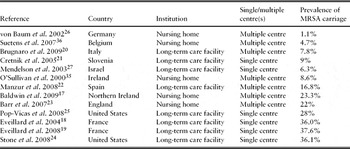
Numerous studies reporting prevalence of MRSA in institutions for older patients have been conducted in various countries because such studies are relatively simple, not labour-intensive, and less costly than prospective surveillance done at frequent intervals over long periods of time.Reference Baldwin, Gilpin, Hughes, Kearney, Cardwell and Tunney17–Reference Barr, Wilcox, Brady, Parnell, Darby and Tompkins23 Reported prevalence of MRSA carriage varied greatly. In all studies, identification of MRSA carriers was based on screening all residents at least by nasal swabbing, and sometimes by rectalReference Eveillard, Charru and Rufat19 or decubitus ulcer cultures.Reference Eveillard, Charru and Rufat19
In a study covering 45 NH in Northern Ireland,Reference Baldwin, Gilpin, Hughes, Kearney, Cardwell and Tunney17 the prevalence was 23.3% among the 1111 residents screened and 7.5% in the corresponding staff. There was an association between MRSA carriage in residents and carriage in staff. Indeed, residents were significantly more likely to be colonized if they lived in homes in which more than 12.5% of all screened healthcare workers were colonized with MRSA, and conversely healthcare workers were more often colonized when the MRSA prevalence was high in residents. High levels of MRSA carriage were also reported in staff (36.0%) and residents (67.0%) of a 120-bed LTCF near Paris in France.Reference Eveillard, Martin, Hidri, Boussougant and Joly-Guillou18 These results are consistent with the occurrence of MRSA circulation between residents and health care workers. In a subsequent prevalence study 5 years later in the same French LTCF, the prevalence of MRSA carriage, identified by nasal and rectal swabbing, was 37.6%.Reference Eveillard, Charru and Rufat19 In an Italian study performed in two LTCF, MRSA prevalence was 7.8%.Reference Brugnaro, Fedeli and Pellizzer20 In a study based on two prevalence surveys performed approximately 3 months apart in a 351-bed community LTCF for elderly people in Slovenia, the prevalence of MRSA colonization was around 9% and was similar in the two surveys (9.3% in the first vs. 8.8% in the second).Reference Cretnik, Vovko, Retelj, Jutersek, Harlander, Kolman and Gubina21 Manzur et al.Reference Manzur, Gavalda and Ruiz de Gopegui22 reported a prevalence of 16.8% in a group of several LTCF in Spain, but with a wide variation according to the institutions (varying from 6.7 to 35.8%). In a study including 39 NH in Leeds (United Kingdom),Reference Barr, Wilcox, Brady, Parnell, Darby and Tompkins23 the prevalence recorded was 22%.
In a study conducted in one LTCF in the United States,Reference Stone, Lewis and Lowery24 residents were screened weekly by nasal swabbing over 8 weeks to identify MRSA carriers. In addition, cultures were graded for growth on a semi-quantitative scale (from 0 to 6). During the study, 59% of the 83 residents included were found, in at least one sample, to be MRSA carriers. Among these 61.2% were persistent carriers (all cultures positive for MRSA), whereas 38.8% were intermittent carriers (at least one, but not all cultures, positive for MRSA). Persistent carriers and intermittent carriers differed in mean MRSA growth score (3.7 vs. 0.7; P < 0.001). In four nursing units of a 648-bed LTCF in Boston (United States), the prevalence of MRSA carriage was 28%.Reference Pop-Vicas, Mitchell, Kandel, Schreiber and D'agata25
The prevalence reported in a large study of 47 NH (3236 residents) in the Rhine-Neckar region of southern Germany was only 1.1%.Reference von Baum, Svoboda, Bock-Hensley and Wendt26 A low prevalence (6.3%) has also been identified in a large LTCF in Israel.Reference Mendelson, Yearmack, Granot, Ben-Israel, Colodner and Raz27 However, in this study, the carriage state was defined when two consecutive cultures were positive for MRSA. As demonstrated by Stone et al.,Reference Stone, Lewis and Lowery24 an important proportion of carriages are only transient. Therefore, the prevalence of MRSA carriage could have been underestimated in this study compared with other reports where only one positive sample assessed the carrier status. The variability of the prevalence of MRSA carriage in NH and LTCF is presented in Table 1.
Variability of the prevalence of MRSA carriage in nursing homes and long-term care facilities according to published studies

Lastly, MRSA strains have been identified in NH or LTCF from Scandinavian countries in which MRSA prevalence is very low. For instance, among the 603 cases of MRSA registered in Norway during 2006, 108 (17.9%) were isolated in residents of LTCF.Reference Sie, Thorstad and Andersen28 In Finland, another country with a low MRSA prevalence, 13 epidemic cases were identified in a NH during an outbreak involving this setting and the associated health centre ward.Reference Kotilainen, Routamaa and Peltonen29 Although most MRSA identified in NH and LTCF in Germany were hospital-acquired strains, MRSA producing PVL (PVL+ MRSA) were isolated from three LTCF.Reference Wagenlehner, Naber and Bambl30 They were initially isolated in six residents of those LTCFs. The investigation undertaken thereafter identified both resident carriage and healthcare worker carriage. The overall prevalence of PVL+ MRSA was 9.1% in the first period of the outbreak. The prevalence of PVL+ MRSA was more than 4-fold higher than the prevalence of other MRSA (PVL–). After an intervention that included the implementation of decontamination procedures and barrier precautions, the prevalence of PVL+ MRSA carriage dropped to 3.3%.Reference Wagenlehner, Naber and Bambl30 In Greece, an outbreak of PVL+ MRSA has been described among healthcare workers in a LTCF, but the strain did not spread among residents.Reference Maltezou, Vourli and Katerelos31 Another study conducted in 69 NH in Leeds (United Kingdom) failed to identify strains carrying the genes encoding PVL among residents.Reference Smith, Parnell and Hodgson32
Risk factors of MRSA carriage in LTCF and NH
Most of the preceding studies identified some factors independently associated with MRSA carriage in patients institutionalized in NH or LTCF. Among them, factors that were most often reported were recent hospitalizations (with variable delays from the hospital discharge to the admission to the institutions according to study protocol),Reference Brugnaro, Fedeli and Pellizzer20, Reference Barr, Wilcox, Brady, Parnell, Darby and Tompkins23, Reference von Baum, Svoboda, Bock-Hensley and Wendt26, Reference Vovko, Retelj and Cretnik33 invasive devices like urinary tract indwelling catheters and subcutaneous catheters,Reference Eveillard, Charru and Rufat19, Reference Manzur, Gavalda and Ruiz de Gopegui22, Reference Barr, Wilcox, Brady, Parnell, Darby and Tompkins23, Reference von Baum, Svoboda, Bock-Hensley and Wendt26, Reference Mody, Maheshwari, Galecki, Kauffman and Bradley34 wounds or decubitus ulcers,Reference Manzur, Gavalda and Ruiz de Gopegui22, Reference von Baum, Svoboda, Bock-Hensley and Wendt26, Reference O'Sullivan and Keane35 and recent antimicrobial treatments (treatments were often included if they had been administered within the preceding year).Reference Brugnaro, Fedeli and Pellizzer20–Reference Manzur, Gavalda and Ruiz de Gopegui22, Reference Vovko, Retelj and Cretnik33 Differentiating carriage sites, Mody et al. identified an association between the use of enteral feeding tubes and MRSA colonization in the oropharynx, whereas there was not any association with MRSA carriage in the groin and perianal area.Reference Mody, Maheshwari, Galecki, Kauffman and Bradley34
The associations between antimicrobial therapy and MRSA carriage were often characterized by odds ratios (OR) > 4.0, showing strong associations.Reference Brugnaro, Fedeli and Pellizzer20, Reference Cretnik, Vovko, Retelj, Jutersek, Harlander, Kolman and Gubina21, Reference Vovko, Retelj and Cretnik33 In a recent study conducted in a French 120-bed LTCF, fluoroquinolones and third-generation cephalosporins have been particularly strongly associated with MRSA carriage (OR = 12.07 vs. 4.40 for other antimicrobial agents).Reference Eveillard, Charru and Rufat19 According to the data collected in 24 NH spread over northern Belgium, the prevalence of MRSA colonization among residents who had received fluoroquinolones or nitrofuran derivates (11.9 and 18.0%, respectively) was significantly higher than the prevalence measured in residents overall (4.7%).Reference Suetens, Niclaes and Jans36 According to a study performed in a NH, the prescription of ciprofloxacin was appropriate in only 25% of the cases.Reference Pickering, Gurwitz and Zaleznik37 As in these studies, recent reports have demonstrated a strong and significant association between individual exposure to fluoroquinolones and MRSA carriage.Reference Pickering, Gurwitz and Zaleznik37–Reference Cook, Catrou and Gooch40 Other characteristics associated with MRSA carriage like cancer,Reference Eveillard, Martin, Hidri, Boussougant and Joly-Guillou18 the NH size,Reference Manzur, Gavalda and Ruiz de Gopegui22 a low ratio of nurses to beds,Reference Barr, Wilcox, Brady, Parnell, Darby and Tompkins23 and male sexReference Barr, Wilcox, Brady, Parnell, Darby and Tompkins23, Reference O'Sullivan and Keane35 have been identified less frequently. An association between MRSA carriage and at least one medical imaging session within the preceding year has been described in a LTCF.Reference Eveillard, Charru and Rufat19 Among these patients, the prevalence of MRSA carriage was significantly higher when the number of sessions was above two than when it was one or two (61.5 vs. 34.3%).Reference Eveillard, Charru and Rufat19 A recent study demonstrated that probes used for routine ultrasonography were usually contaminated with MRSA immediately after contact with patients.Reference Bello, Taiwo and Oparinde41
MRSA on admission to acute-care wards: association between carriage and older age
The prevalence of MRSA carriage at the time of admission to acute-care wards has been determined in numerous studies. Some studies demonstrated an association between patients’ age and MRSA carriage. At the time of admission to an acute medical ward, the prevalence was 1.4% for patients ≤ 60 years, 4.3% for patients 61–70 years, 6.5% for those 71–80 years, and 12.7% for patients > 80 years. In this study, age > 80 years was significantly associated with MRSA carriage upon admission.Reference Eveillard, Mortier and Lancien42 In another recent study,Reference Buke, Armand-Lefevre and Lolom43 all patients who spent more than 30 days in a 1100-bed teaching hospital underwent nasal or rectal swab samples on day 30. The mean age of MRSA carriers was significantly higher than the mean age of non-carriers (P < 0.001) and the proportion of patients > 69 years was also significantly higher among MRSA carriers (P < 0.01).
MRSA among elderly people in acute-care wards: association between carriage on admission and residing in LTCF or NH
Prevalence was consistently higher among patients coming from NH or LTCF than in patients coming from home. A study conducted in two acute geriatric wards of a French teaching hospitalReference Eveillard, Ernst and Cuviller44 reported a prevalence of 14.6%. However, this prevalence varied according to the place from which patients came and according to recent hospitalization. In patients arriving from home without any previous hospitalization during the last six months, the prevalence was only 6.7%, whereas it was 35.1% in patients who had been hospitalized in the same teaching hospital within the six preceding months. In another French teaching hospital, the prevalence obtained by screening all patients older than 75 years at the time of admission was 7.9%.Reference Lucet, Grenet and Armand-Lefevre45 In another study,Reference Merrer, Pisica-Donose, Neneveu and Pauthier46 nasal carriage was systematically screened in 179 patients with femoral neck fractures. The prevalence of MRSA carriage was 8.4%, varying widely according to the place from which patients came (2% in patients admitted from their home and 15.6% for patients admitted from NH or LTCF). This high prevalence had implications for antibioprophylaxis and consequences for infections. Indeed, only 27% of MRSA carriers received appropriate antibiotic prophylaxis. Although the difference was not significant, the incidence of surgical site infection was higher in MRSA carriers (6.6%) than in non-carriers (1.3%).
In a recent study conducted to identify predictive factors of methicillin resistance among patients with S. aureus bloodstream infection at hospital admission, Manzur et al.Reference Manzur, Vidal and Pujol47 demonstrated a strong and independent association between MRSA bloodstream infections and admission from LTCF. Moreover, whereas 15 MRSA bloodstream infections have been identified in patients arriving from LTCF, no bloodstream infection with methicillin-susceptible S. aureus was identified among those patients. Lastly, a prevalence of 31.7% was found among patients coming from NH or LTCF at the time of admission to an emergency department.Reference Eveillard, Leroy and Teissiere48
Consequences of MRSA carriage in elderly people
MRSA colonization and subsequent MRSA infection
In contrast to MRSA carriage, which is often encountered in LTCF or NH, MRSA infections are much less frequent. For instance, in a study performed by Bradley et al.Reference Bradley, Terpenning, Ramsey, Zarins, Jorgensen and Sottile16 in a LTCF, the proportion of residents colonized with MRSA was around 25%, whereas the MRSA infection rates were only 3%. In a French LTCF with a high prevalence of MRSA colonization, no MRSA infection had been identified within the year preceding the period of MRSA screening.Reference Eveillard, Charru and Rufat19 However, it is estimated that residents of LTCF who are colonized with MRSA have a 4- to 6-fold increase in infection rate. In a study including 197 patients from intermediate and long-term care units in a Veterans Affairs hospital,Reference Muder, Brennen and Wagener49 25% of MRSA carriers had at least one episode of MRSA infection, versus only 4% of carriers of methicillin-susceptible S. aureus (MSSA). In another study conducted in a skilled nursing facility,Reference Lee, Cesario and Gupta50 15 residents out of 121 MSSA carriers were infected by MSSA, whereas 14 residents out of 38 MRSA carriers were infected by MRSA. Therefore, it seems that MRSA colonization might predict the development of staphylococcal infection in LTCF.
In a study conducted in a LTCF and several community-based NH, the prevalence of MRSA colonization was significantly higher in the LTCF, whereas a trend was noted toward higher rates of infection among colonized residents of the NH than among those in the LTCF.Reference Mulhausen, Harrel, Weinberger, Kochersberger and Feussner51 However, this result has not been reported in other studies. A recent meta-analysis underscored that the predictive effect of carriage is also encountered in various intensive care units, liver transplant units, and adult or paediatric wards.Reference Safdar and Bradley52 Indeed, according to this study, compared with patients colonized with MSSA, patients colonized with MRSA are four times more likely to develop MRSA invasive infections. Several studiesReference Roghmann53–Reference Lesse and Mylotte57 indicated that among NH residents in the United States, who have S. aureus bacteraemia, methicillin-resistant strains now predominate. In the population of NH residents admitted to an acute geriatric ward of a US hospital, the increase in the incidence of S. aureus bacteraemia over a 7-year period was entirely due to an increased incidence of MRSA bacteraemia.Reference Lesse and Mylotte57
Older patients and reduced glycopeptide susceptibility in MRSA
The emergence of clinical infection due to MRSA with decreased susceptibility to glycopeptides is a recent and worrying phenomenon.Reference Hiramatsu, Aritaka and Hanaki58 Indeed, since 1996, vancomycin-intermediate S. aureus (VISA) strains have been increasingly identified in Europe, Asia and the United States. Moreover, several vancomycin-resistant S. aureus (VRSA) strains have been reported from the United States since 2002, and recently from northern India.Reference Appelbaum59, Reference Tiwari and Sen60 VISA and VRSA represent an important public health threat because they tend to be multidrug-resistant to a large number of currently available antibiotics, compromising treatment options and increasing the likelihood of inadequate antimicrobial therapy. VRSA acquire the vancomycin resistance gene vanA via interspecies transfer from vancomycin-resistant enterococci (VRE). Although the main risk factor of VRSA acquisition is probably a recent history of heavy antibiotic use, residence in LTCF has been also associated with the development of this resistance.Reference Appelbaum61 However, to the best of our knowledge, there has been no report concerning the epidemiology of those MRSA strains with a decreased susceptibility to glycopeptides (VISA or VRSA) in institutions for older patients.
MRSA and mortality in elderly people
Consequences of MRSA colonization or infection in terms of mortality for elderly people have also been reported. In a study conducted by Niclaes et al. in NH residents, the relative risk of dying within 6 months was greater for MRSA carriers than that for non-carriers.Reference Niclaes, Buntinx, Bunaro, Lesaffre and Heyrman62 This relative risk remained stable even after adjustment for co-variables. During a seven-year period, 24 episodes of MRSA bacteraemia were identified in NH residents from 22 separate facilities.Reference Lesse and Mylotte57 Hospital mortality was 33% among those patients, with all deaths occurring within 15 days of admission to the acute geriatric ward. Mortality was 24% in patients with MSSA bacteraemia. In this study, initial empiric antimicrobial therapy was appropriate in only 39% of the episodes and this was primarily related to ineffective empiric therapy for MRSA. NH residents tend to have multiple, significant chronic underlying diseases. A recent study that used the Charlson weighted index of comorbidity as a measure of chronic disease severity found that this index was an independent predictor of attributable mortality due to S. aureus bacteraemia.Reference Lesens, Methlin and Hansmann63
Several studies have also identified older age as a significant independent predictor of mortality from S. aureus bacteraemia.Reference Mylotte and Tayara64–Reference Jensen, Wachmann, Espersen, Scheibel, Skinhoj and Frimodt-Moller66 Comparisons of mortality rates between 145 patients, aged 66–99 years, and 240 patients, aged 18–60 years, hospitalized in a university medical centre in North Carolina with S. aureus bacteraemia,Reference McClelland, Fowler and Sanders65 indicate that, after adjusting for confounding variables, older patients had higher mortality from S. aureus bacteraemia. Moreover, infection with MRSA was associated with higher total mortality in elderly people (OR = 2.59).Reference McClelland, Fowler and Sanders65 Finally, it is often considered that older age accounts for the variation in mortality between MRSA and MSSA infections.Reference Cosgrove, Sakoulas, Perencevich, Schwaber, Karchmer and Carmeli67
Prevention of MRSA dissemination in institutions for elderly people
Risks of transmission
In NH and LTCF, two factors can favour the risk of MRSA transmission. First, the reservoir represented by colonized residents is often significant, as high prevalence is usually encountered in those institutions. The other factor potentially favouring transmission is that, once colonized, institutionalized residents appear to carry the same MRSA strain for prolonged periods of time. Indeed, the mean duration of asymptomatic colonization with MRSA has been reported variously to be 3 months to 3 years.Reference Bradley, Terpenning, Ramsey, Zarins, Jorgensen and Sottile16, Reference Sanford, Widmer, Bale, Jones and Wenzel68 However, in the absence of a documented outbreak of infection, analyses of phage groups, comparisons of antibiotic susceptibility or pulsed-field gel electrophoresis (PFGE) patterns suggest that multiple strains, rather than a single strain, circulate within NH and LTCF.Reference Bradley, Terpenning, Ramsey, Zarins, Jorgensen and Sottile16, Reference Eveillard, Charru and Rufat19, Reference Fraise, Mitchell, O'Brien, Oldfield and Wise69, Reference Hsu70
This concurrent circulation of multiple MRSA strains in the same institution was described in a French LTCF with high MRSA prevalence. The analysis of 38 PFGE patterns showed that 20 patterns differed by at least one band and that 4 patterns were identified in more than one strain: one was recovered in 8 strains, another in 7 strains, and another in 4 strains and the last in 3 strains.Reference Eveillard, Charru and Rufat19 Therefore it seems that recent cross-transmission of different MRSA strains occurred into this LTCF. Moreover, similar PFGE patterns have been identified in strains isolated in patients residing in units located on different floors of the LTCF, showing the spread of clones in the whole LTCF.Reference Eveillard, Charru and Rufat19 This suggests that different ways of transmission can occur: cross-transmission mainly mediated by hands of healthcare workers from resident to resident in the same unit, and direct transmission from resident to resident during shared activities or in shared premises like the dining room or the television room for instance. The latter MRSA pathway is probably considerably less encountered in acute-care wards where cross-transmission of organisms through contaminated hands of healthcare workers is the main way of transmission.Reference Pittet, Allegranzi and Sax71 The respective contribution of cross-transmission and resident-to-resident transmission in MRSA dissemination in LTCF and NH has not yet been determined. Implementing studies designed for this purpose would be useful to help define prevention strategies.
Finally, acquisition of MRSA from the environment should also be considered. Although no study has been performed specifically in LTCF or NH, several recent reports have demonstrated the importance of the environment in MRSA acquisition.Reference Dancer72–Reference Dancer, White, Lamb, Girvan and Robertson74 The risk of MRSA acquisition from the environment seems to be particularly high when a resident colonized with MRSA and a non-colonized resident share the same bedroom and therefore the same bathroom (and wet towels).
Infection control strategies for preventing the transmission of MRSA in LTCF and NH
A recent review failed to identify any research concerning infection control strategies for preventing the transmission of MRSA in LTCF or NH which fulfilled the following criteria: randomized and controlled clinical trials, or controlled before and after studies, or interrupted time series studies.14 However, it is apparent that some aspects of contact precautions that can be recommended in acute-care hospitals require modification when applied to institutions for older people where rehabilitation, socialization, and long-term custodial care are primary goals.14, Reference Bradley, Terpenning, Ramsey, Zarins, Jorgensen and Sottile16
In the absence of any documented outbreak, systematic confinement of MRSA-colonized residents to private rooms seems particularly difficult. It is usually considered that restriction to room is not necessary if colonized sites can be contained, and if the resident is capable of understanding and carrying out hand hygiene and correct general hygiene.Reference Bradley, Terpenning, Ramsey, Zarins, Jorgensen and Sottile16 Conversely, a private room may be required for residents with a productive cough, a tracheostomy, or large and often heavily colonized skin lesions that cannot be covered by dressings.Reference Bradley, Terpenning, Ramsey, Zarins, Jorgensen and Sottile16 Cohorting residents by unit or room is controversial because a significant proportion of them may carry more than one multiresistant bacteria,Reference Trick, Weinstein and DeMarais75, Reference O'Fallon, Gautam and D'Agata76 with an increase of multidrug-resistant gram-negative organisms, as has been recently demonstrated in a 750-bed LTCF.Reference O'Fallon, Pop-Vicas and D'agata77 Therefore, it seems that a strict compliance with standard precautions should be sufficient in most cases. Moreover, implementing more stringent policies including screening, contact precautions, and sometimes decolonization with mupirocin nasal ointment and/or topical antiseptics, seems to be unrealistic in facilities where a large proportion of long-term residents harbour MRSA,Reference Kotilainen, Routamaa and Peltonen29 because of the cost of such policies and the unavoidable occurrence of resident-to-resident direct transmission.
According to certain authors who consider that standard precautions are not sufficient, the use of chemicals to decolonize the nose and healthy skin could make barrier precautions unnecessary in a non-negligible proportion of cases.Reference Minary-Dohen, Bailly, Bertrand and Talon78 However, this opinion is controversial. One of the consequences of this lack of consensual recommendations is that certain institutions for older patients refuse to accept multiresistant-bacteria carriers. In a large study conducted in 331 LTCF in Iowa from December 2002 to March 2003, 7.3% acknowledged that they refused to accept individuals known to have MRSA, and 16.9% acknowledged that they refused those known to have VRE.Reference Kreman, Hu, Pottinger and Herwaldt79
Conversely, specific strategies of control have been effective in MRSA outbreaks.Reference Kotilainen, Routamaa and Peltonen29, Reference Wagenlehner, Naber and Bambl30, Reference Larssen, Jacobsen, Bergh, Tvete, Kvello and Scheel80 However, certain residents can remain colonized despite several eradication attempts.Reference Larssen, Jacobsen, Bergh, Tvete, Kvello and Scheel80 It has been recommended that screening of carriers should be reserved for outbreaks.Reference Bradley, Terpenning, Ramsey, Zarins, Jorgensen and Sottile16, Reference Kotilainen, Routamaa and Peltonen29 It could also be useful on admission of patients who have a higher risk of colonization (due to recent hospitalization in acute-care, invasive device, skin lesions for example) to NH or LTCF with a low prevalence of MRSA carriage that are located in an area with a high prevalence of MRSA. It is usually considered that anterior nares and skin wounds give the highest yield for detection of MRSA carriage.Reference Lucet, Chevret, Durand-Zaleski, Chastang and Régnier81–Reference Coello, Jiménez and Garcia83 However, some recent studies have demonstrated that other anatomical sites like rectum and throat could have an important role in the identification of MRSA carriers.Reference Eveillard, Charru and Rufat19, Reference Eveillard, de Lassence, Lancien, Barnaud, Ricard and Joly-Guillou84, Reference Batra, Eziefula, Wyncoll and Edgeworth85 During a prevalence survey of MRSA carriage in a LTCF, conducted by both nasal and rectal swabbing of all residents, half of the MRSA-positive samples were rectal swabs.19 In another studyReference Eveillard, de Lassence, Lancien, Barnaud, Ricard and Joly-Guillou84 conducted in the whole of a teaching hospital and the associated LTCF, 27.0% of MRSA carriers detected over a 1 year screening period would have been missed if nasal cultures alone had been used. Therefore, during an outbreak of MRSA infection, when it is important to identify all carriers within a short period of time, implementing a strategy of screening multiple anatomical sites could be relevant.
Finally, screening patients coming from NH or LTCF seems to be helpful to adapt surgical antibioprophylaxis.Reference Merrer, Pisica-Donose, Neneveu and Pauthier46 In circumstances of high prevalence of MRSA carriage in the institution from which the patient is coming, a systematic adaptation of the prophylaxis is possible without screening.
Compliance with hand hygiene in institutions for elderly people
In NH and LTCF, poor compliance with hand hygiene has usually been recorded in evaluation studies. In an Italian 50-bed NH, hand hygiene compliance was 17.5%. Contrary to most other reports, higher compliance was observed in physicians (30%), whereas it was 20.1% for nurses and 10.0% for nursing assistants.Reference Pan, Domenighini and Signorini86 The compliance measured concurrently in a rehabilitation medicine unit was 15.8%, whereas it was 53.7% in an infectious disease unit.Reference Pan, Domenighini and Signorini86 In another study conducted in three LTCF in Taiwan,Reference Huang and Wu87 a hand-hygiene training programme that included 1 hour of in-service classes and 30 minutes of hands-on training, provided a significant increase of hand hygiene compliance from 9.34 to 30.36%. In a French study performed in four NH and LTCF, and based on the observation of 760 hand hygiene opportunities, the overall prevalence of hand hygiene compliance was 61.2%.Reference Eveillard, Hitoto and Raymond88 Authors differentiated inter-series opportunities (before or after a single contact with the resident or his environment, and before the first contact and after the last contact of a series of successive contacts) and intra-series opportunities (from the opportunity following the first contact to the opportunity preceding the last contact in a series of successive contacts). Hand hygiene compliance varied widely and significantly between extra-series opportunities (73.7%) and intra-series opportunities (19.0%).Reference Eveillard, Hitoto and Raymond88 This poor compliance is a worrying observation. Indeed, according to certain authors, monitoring compliance should be performed during complete care episodes including successive contacts with patients or residents and their environment because patients or residents probably do not benefit from partial compliance.Reference Haas and Larson89 A study conducted in a LTCF in the United StatesReference Mody, McNeil, Sun, Bradley and Kauffman90 showed that, as in acute-care wards, the introduction of an alcohol-based hand rub in the facility improved the hand hygiene compliance. Therefore, using alcohol-based hand rub must be encouraged in NH and LTCF.
Conclusion
MRSA in LTCF and NH is a complex problem. No well-designed study has identified the best strategy for MRSA control in institutions for older patients in the absence of a documented outbreak. Actually, nothing really new about this has been reported since the reviews published in the 1990s.Reference Bradley15, Reference Bradley, Terpenning, Ramsey, Zarins, Jorgensen and Sottile16 Therefore, further studies are needed to define consensual strategies for controlling MRSA transmission and also preventing MRSA infections in colonized residents. Concurrently, studies specifically designed to identify the respective parts of the different ways of MRSA transmission (cross-transmission via healthcare workers, via environment, or direct transmission from resident to resident) in institutions for healthcare workers could be useful. Finally, improving compliance with standard precautions, and particularly with hand hygiene, would be an important first step towards MRSA containment.
Conflicts of interest
The authors do not report any conflicts of interest.