Introduction
Total thyroidectomy is indicated for the treatment of thyroid malignancies and most benign thyroid diseases.Reference Patel, Yip, Lubitz, Grubbs, Miller and Shen1 Among the major post-operative implications, palsy of the recurrent laryngeal nerve (RLN) and hypocalcaemia are reported in all current guidelines, given that both conditions can potentially be life-threatening.Reference Patel, Yip, Lubitz, Grubbs, Miller and Shen1,Reference Xing, Hu, Wang and Zhu2 Less frequently, a cervical haematoma can occur, with incidence rates between 1.5 per cent and 5 per cent.Reference Patel, Yip, Lubitz, Grubbs, Miller and Shen1 Surgical site infection, seroma, aerodigestive perforation, pneumothorax and chyle leak are included in post-thyroidectomy local complications, each having an incidence of less than 1 per cent.Reference Patel, Yip, Lubitz, Grubbs, Miller and Shen1 Hence, an excellent knowledge of neck anatomy and its variations is necessary for ensuring the best clinical outcome of total thyroidectomy.Reference Makay, Icoz, Yilmaz, Akyildiz and Yetkin3,Reference Page, Foulon and Strunski4
Nowadays, RLN identification is the ‘gold standard’ in thyroidectomy, to determine nerve function security and prevent severe complications.Reference Hisham and Lukman5 Iatrogenic injury of the RLN may lead to temporary nerve palsy, which usually recovers spontaneously within six months. Nevertheless, any malfunction exceeding this period is considered permanent, and, apart from the vocal, swallowing and breathing difficulties, it may affect the patient's psychology and social life.Reference Page, Foulon and Strunski4 Therefore, visualisation of the RLN location and its anatomical relations with adjacent structures, especially the inferior thyroid artery, is of great importance.Reference Ngo Nyeki, Njock, Miloundja, Evehe Vokwely and Bengono6
The present study aimed to assess the anatomical relationship between the RLN and the inferior thyroid artery in patients undergoing total thyroidectomy, and determine its clinical impact on nerve palsy and hypocalcaemia.
Materials and methods
Study cohort
A retrospective anatomical study was performed with prospectively collected data, comprising patients who underwent total thyroidectomy in the otolaryngology – head and neck surgery department over a six-month period, from October 2019 to March 2020. The study was approved by the Institutional Review Board. All patients signed an informed consent form prior to thyroid surgery, confirming their agreement to undergo the operation and the publication of their clinical details and images.
All patients who underwent total thyroidectomy for both malignant and benign thyroid diseases were considered eligible for the study. Patients who had undergone hemithyroidectomy, isthmusectomy or thyroid nodule excision, or a previous thyroid operation, were excluded from the study. A database was established to prospectively document patients’ characteristics regarding demographics, anatomical variations, serum calcium fluctuation and post-operative complications.
Technical details
Thyroidectomies were performed through Kocher's incision under general anaesthesia by four experienced ENT surgeons (IM, CS, JH and VL). All surgeons used the lateral approach, because this is the safest and most frequently utilised in thyroid gland surgery, according to the literature, following the same steps, as described below.
Specifically, superior and inferior flaps were undermined between the platysma and strap muscles. After thyroid gland exposure, isthmectomy was performed. Subsequently, the lateral surface of each lobe was dissected, accompanied by the ligation of the middle thyroid vein. Afterwards, dissection of the superior pole with ligation of the superior thyroid vessels ensued, followed by dissection of the inferior pole and ligation of the inferior thyroid vessels. Consequently, the RLN was identified, near the middle part of the thyroid lobe and approaching the inferior parathyroid gland, using surgical loupes. Additionally, the RLN presence and position were verified in every patient using intra-operative neuromonitoring. The electromyographic sign was acquired through endotracheal tubes equipped with surface electrodes (Medtronic NIM® electromyography tubes; internal diameter = 6.5 mm for females and 7.5 mm for males), while the sign recording was achieved using an electromyographic digital recording system (Medtronic NIM-Response® 3.0). Afterwards, the RLN was dissected progressively until its entrance to the larynx at the level of the cricoid cartilage. Great caution was exercised when identifying the relationship between the RLN and the inferior thyroid artery, because injury to the nerve at this point is very likely. Ultimately, after dissecting the ligament of Berry, each thyroid lobe was extracted. Before subcutaneous tissue and skin closure, a negative-pressure drainage system was placed.
Before surgery, vocal fold functionality was evaluated by an ENT surgeon (CS) using a 70-degree rigid endoscope. Post-operatively, laryngoscopy was repeated (by the same ENT surgeon) for the purpose of detecting any RLN injury. The most experienced and specialised ENT surgeon was chosen to examine pre- and post-operative vocal fold movement. In order for the evaluation to be as identical and objective as possible for every patient, no other doctor participated in this process. In addition, serum calcium was measured before surgery and on the 1st post-operative day. Blood sampling was performed without using a tourniquet, and every sample was analysed by the same microbiology laboratory. Every corrected serum calcium measurement over 8.5 mg/dl was considered normal (corrected serum calcium = (0.8 × (normal albumin – patient's albumin)) + serum calcium level); normal calcium levels are defined as 8.5–10.5 mg/dl.
Medical treatment and follow up
Post-operatively, patients were hospitalised until normal serum calcium measurements were achieved and patients remained asymptomatic (free of: oral, peri-oral and acral paresthesias, muscle spasms, numbness, laryngospasm, tetany, and electrocardiographic changes). In addition, calcium and vitamin D3 supplements were administered to every patient in order to prevent post-thyroidectomy hypocalcaemia. In the case of symptomatic hypocalcaemia, calcium gluconate was administered intravenously. The negative-pressure drain was removed on the 1st post-operative day, given that the drainage was less than 20 ml during the initial 12 post-operative hours. Follow up included clinical re-evaluation of the patients at the first and sixth post-operative month.
Statistical analysis
Continuous data were reported as means ± standard deviation. Categorical data were expressed as absolute numbers and percentages of prevalence in the study cohort. In the statistical analysis for continuous variables, we used the independent t-test for normally distributed data and the Mann–Whitney U test for non-parametric data. The Pearson's chi-square test was used for categorical variables. A p-value of less than 0.05 was considered significant. Statistical analysis was performed using SPSS 22.0 for Windows software (IBM, Armonk, New York, USA).
Results
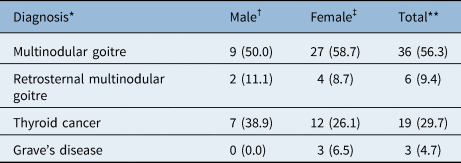
Sixty-four patients were included in the current study. The patients’ mean age was 51.7 years (range, 21–81 years); 72 per cent were female. The majority of patients (70.3 per cent) were treated for benign pathologies. The pre-operative diagnoses for all patients are presented in Table 1. In all cases, diagnosis was confirmed by histological examination of the extracted gland.
Pre-operative diagnosis in relation to patients’ sex

Data represent numbers (and percentages) of patients. *Confirmed by histological examination. †n = 18 (28.1 per cent); ‡n = 46 (71.9 per cent); **n = 64 (100.0 per cent)
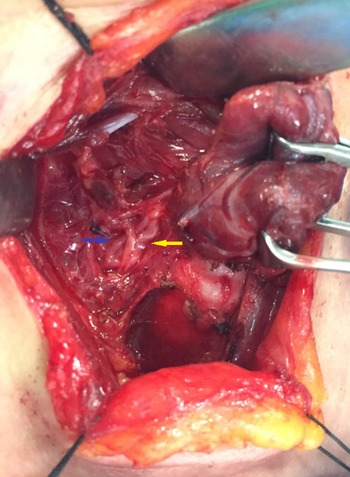
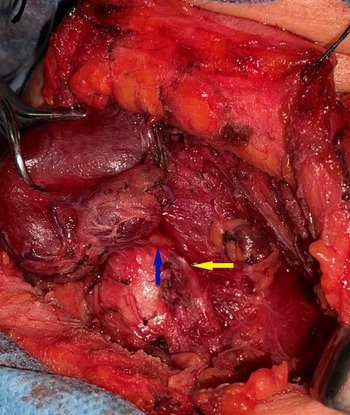
Regarding the topography of the RLN to the inferior thyroid artery, in 35 cases among 128 RLN dissections (27.3 per cent), the RLN was located anteriorly to the inferior thyroid artery (17 cases (13.3 per cent) at the right side and 18 (14.1 per cent) at the left)) (Table 2 and Figure 1). The classical retrovascular course of the RLN was identified in 72.6 per cent of the nerves dissected (Figure 2).
The recurrent laryngeal nerve (RLN) located anteriorly to the inferior thyroid artery. Yellow arrow indicates RLN. Blue arrow indicates inferior thyroid artery.

The recurrent laryngeal nerve (RLN) located posteriorly to the inferior thyroid artery. Yellow arrow indicates RLN. Blue arrow indicates inferior thyroid artery.

Position of RLN in relation to ITA, for each side

Data represent numbers (and percentages) of patients. *n = 64; †n = 64. RLN = recurrent laryngeal nerve; ITA = inferior thyroid artery
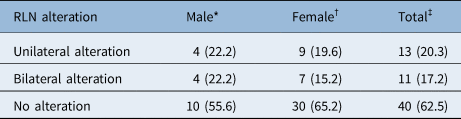
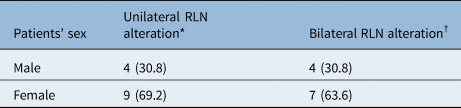
In terms of sex and RLN distribution, the analysis demonstrated that any unilateral or bilateral topographical alterations were more common in female patients: 69.2 per cent and 63.6 per cent, respectively (p = 0.812 in unilateral alteration, p = 0.504 in bilateral alteration). A unilateral alteration was recorded in 22.2 per cent of males, while a bilateral alteration was described in 22.2 per cent (Tables 3 and 4). There was no statistically significant association between topographical alterations and sex (unilateral, p = 0.8; bilateral, p = 0.5).
Presence or absence of RLN alteration in relation to patients’ sex

Data represent numbers (and percentages) of patients. *n = 18; †n = 46; ‡n = 64. RLN = recurrent laryngeal nerve
Patients’ sex in relation to unilateral and bilateral RLN alterations

Data represent numbers (and percentages) of patients. *n = 13; †n = 11. RLN = recurrent laryngeal nerve
No case of non-RLN was recorded. Overall, two cases of RLN bifurcation were observed, both on the left side, and no case of trifurcation. Apart from these, one right RLN was found to have a retrotracheal course.
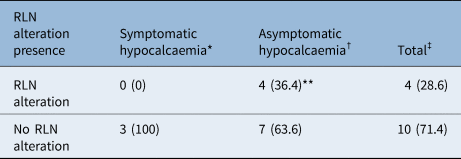
One case of vocal hoarseness (1.6 per cent) caused by transient right RLN palsy was observed, which recovered within six months. Regarding the post-operative serum calcium measurements, three cases of symptomatic hypocalcaemia were noted, but none of them were in patients with unilateral or bilateral alteration. The symptoms observed were oral or peri-oral (3.1 per cent) and acral paresthesias (1.6 per cent). No cases of tetany, laryngospasm or electrocardiographic changes were apparent. Furthermore, 17.2 per cent (11 out of 64) of the patients had non-symptomatic hypocalcaemia. In 4 out of 11 patients with non-symptomatic hypocalcaemia, an RLN alteration was identified (Table 5). However, the presence of RLN topographical variation was not associated with low serum calcium measurements (p = 0.52). No other local complications, including haematoma, seroma, wound infection, aerodigestive perforation, pneumothorax or chyle leak, were evident.
Presence or absence of RLN alteration in relation to hypocalcaemia

Data represent numbers (and percentages) of patients. *n = 3; †n = 11; ‡n = 14. **Two (18.2 per cent) unilateral cases and two (18.2 per cent) bilateral cases. RLN = recurrent laryngeal nerve
Discussion
Many variations of the relationships between the RLN and the adjacent anatomical landmarks, such as the Berry ligament, the triangle of Zuckerkandl and the inferior thyroid artery, have been described in detail.Reference Ardito, Revelli, D'Alatri, Lerro, Guidi and Ardito7 Among them, the inferior thyroid artery represents the classical and most frequently used point of reference in RLN dissection.Reference Ngo Nyeki, Njock, Miloundja, Evehe Vokwely and Bengono6,Reference Flament, Delattre and Palot8,Reference Kulekci, Batioglu-Karaaltin, Saatci and Uzun9 Thorough knowledge of thyroid gland anatomy and its variations is essential for the identification and preservation of vital structures, like the RLN, in order to avoid ruinous complications such as RLN palsy.
The presence of an RLN alteration may result in accidental RLN injury (stretching, cauterisation, cross-section), given that the nerve is not located in its usual position. Thus, even if the surgeon is aware of the possibility of RLN nerve variation, recognising it usually demands a more laborious dissection, which may result in damage to the RLN and other important structures, such as the trachea, the oesophagus, the vagus nerve, or the carotid artery and its branches.Reference Patel, Yip, Lubitz, Grubbs, Miller and Shen1 Nevertheless, in this study, the RLN topographical variation was not associated with post-thyroidectomy complications.
Over the last two decades, a plethora of studies has been conducted regarding the anatomical relations of the RLN with important entities of the thyroid surgical field, like the inferior thyroid artery.Reference Page, Foulon and Strunski4,Reference Campos and Henriques10–Reference Özgüner and Sulak13 However, the majority of these studies have been carried out on cadavers. In addition, pertinent studies have been conducted that include Asian, African or European populations, but, to our knowledge, no relevant study in the literature has focused on this anatomical detail in a purely Caucasian population.
Although multiple positions of the RLN in relation to the inferior thyroid artery have been reported, the ordinary position of the RLN is considered to be posterior to the inferior thyroid artery.Reference Lee, Lee, Lee and Han14,Reference Henry, Vikse, Graves, Sanna, Sanna and Tomaszewska15 In the present study, the nerve was identified to be running superiorly to the inferior thyroid artery in 27.3 per cent of the cases. Additionally, this topographical alteration was shown to be more frequent in females. A recent meta-analysis, which included studies both on cadavers and human patients, reported a pooled prevalence of 50.7 per cent for the RLN position posterior to the inferior thyroid artery. Henry et al. observed that there was no significant difference between the sexes, but a statistically significant difference existed between the right (37.1 per cent (95 per cent confidence interval (CI) = 30.7–41.5)) and the left side (17.2 per cent (95 per cent CI = 13.3–20.6)) (p < 0.001) regarding the presence of an RLN alteration.Reference Henry, Vikse, Graves, Sanna, Sanna and Tomaszewska15 In the current analysis, the pooled prevalence of RLN symmetry was 79.7 per cent, in compliance with the data encountered in similar studies.Reference Makay, Icoz, Yilmaz, Akyildiz and Yetkin3,Reference Sturniolo, D'Alia, Tonante, Gagliano, Taranto and Grazia Lo Schiavo16 Additionally, the frequency of extra-laryngeal branching of the RLN was considerably lower than that reported in the literature.Reference Sturniolo, D'Alia, Tonante, Gagliano, Taranto and Grazia Lo Schiavo16–Reference Henry, Vikse, Graves, Sanna, Sanna and Tomaszewska18
In our study, only one patient – whose right RLN crossed over the right inferior thyroid artery – developed hoarseness, which recovered spontaneously within six months. While, nowadays, thyroidectomy is considered to be a non-hazardous operation, among its most frequent complications are RLN palsy and hypocalcaemia.Reference Patel, Yip, Lubitz, Grubbs, Miller and Shen1,Reference Xing, Hu, Wang and Zhu2 Hoarseness may manifest post-operatively as the first symptom of unilateral or bilateral RLN injury or stretching. Bilateral vocal fold dysfunction, presenting with more severe symptoms such as stridor and breathlessness, can be a life-threatening situation, leading to re-intubation or tracheostomy.Reference Patel, Yip, Lubitz, Grubbs, Miller and Shen1,Reference Misron, Balasubramanian, Mohamad and Hassan19 Provided that no improvement in the vocal fold function is noted in the first six months post-operatively, RLN paralysis is assumed to be permanent.Reference Patel, Yip, Lubitz, Grubbs, Miller and Shen1,Reference Misron, Balasubramanian, Mohamad and Hassan19
Hypocalcaemia is one of the most frequent complications of thyroid surgery, especially total thyroidectomy, with an incidence ranging between 13 and 49 per cent.Reference Xing, Hu, Wang and Zhu2 A serum calcium level reduction is usually recorded 24–48 hours post-operatively, and is associated with symptoms like paresthesia, peri-oral or acral numbness, and tetany. Thus, hypocalcaemia can possibly turn into a hazardous condition, provoking laryngospasm, cardiac arrhythmias, coma or even death.Reference Xing, Hu, Wang and Zhu2,Reference Pãduraru, Ion and Carsote20,Reference Chahardahmasumi, Salehidoost, Amini, Aminorroaya, Rezvanian and Kachooei21 In order to minimise this risk, routine oral calcium and vitamin D supplementation may be beneficial.Reference Testa, Fant, De Rosa, Fiore, Grieco and Castaldi22 According to this suggestion, in this study, every patient participating was administered oral calcium and vitamin D supplements. Nonetheless, 21.9 per cent (14 out of 64) of the patients had hypocalcaemia, while, in three of them, symptoms such as oral, peri-oral and acral numbness were observed. Topographical alteration of the RLN was apparent in 28.6 per cent of the patients with a low serum calcium value.
Limitations
The most important limitation of this study is the small number of patients included, which does not allow further analysis and comparison of characteristics that could be responsible for the complications that arise. Another limitation is that the data were collected only from a single centre, while the presence of four surgeons may add bias.
• Recurrent laryngeal nerve (RLN) identification is ‘gold standard’ in thyroidectomy, to determine nerve function security and prevent severe complications
• This study assessed the topographic relationship between, and clinical impact of, the RLN and inferior thyroid artery in total thyroidectomy patients
• The RLN traversed the inferior thyroid artery anteriorly in 27.3 per cent, with equal distribution between sides, appearing more in females but with no significant sex association
• Post-operative complications were observed in 15 patients, but there was no significant association with RLN topographic variation
Conclusion
A superior course of the RLN to the inferior thyroid artery was identified in almost one-third of patients undergoing total thyroidectomy, in accordance with the recent literature. This anatomical variation had no clinical impact on local complications and hypocalcaemia. Ultimately, we deduce that the inferior thyroid artery is a significant landmark for identification of the RLN; however, we suggest that further studies need to be conducted regarding the relation between topographical variations of the RLN and post-thyroidectomy complications.
Competing interests
None declared