“Dear festive congregation here in the new University Church of Saint Paul in Leipzig and on screens across the country. What a joy it is to finally celebrate the dedication service in the finished church! With almost exactly eight years’ delay. Some of you were there when we took the university church back into use at the worship service on the construction site on the second Sunday of Advent in 2009. Freezing at first, many standing but from minute to minute more gripped by the miracle of Leipzig that it had actually come true—a new church on the same site and in fairly equal dimensions to the old one which was blown up in ideological blindness. Today, we celebrate, filled with gratitude, the visible achievement of this wonder. We need no longer freeze, everybody can sit, and the beauty of the room fills our hearts with joy.”
University Preacher Professor Peter Zimmerling, sermon at the dedication service of the Paulinum, December 3, 2017Footnote 1
When University Preacher Professor Peter Zimmerling opened his sermon at the consecration of the Paulinum as a church with these words, he gave expression to the end of a long process with many conflicts: the building of the Paulinum as the successor to the Church of Saint Paul—a medieval stone church blown up in 1968 by the Social Unity Party (SED) of the German Democratic Republic (GDR) in order to build a secular university.
At the center of attention in this article is the dramatic destruction of the University Church of Saint Paul in Leipzig in 1968 as a kind of iconoclasm and the recent building of the Paulinum as the inheritor of the Church of Saint Paul's cultural heritage and preserver of its memory. Being both a church historian and a cultural memory scholar, in this article I will study the University Church of Saint Paul and the Paulinum with a particular emphasis on trauma, resistance, and remembrance.
The outline of the article is as follows: After providing the background of the historic Church of Saint Paul, I will discuss the iconoclastic destruction of the church in relation to cultural memory. Then, moving ahead in time beyond the German unification, I will subsequently scrutinize the painful process of building the Paulinum as a dual secular-sacred university complex. Lastly, I will study the commemorative aspects of the Paulinum, expressed at its inauguration, which pay tribute to the destruction, suffering, and resistance to GDR rule.
I. A Brief Church History of Leipzig University
As with most old universities in Europe, the history of Leipzig University is a rather churchly one. It dates back to the year 1229 when the Dominicans founded a monastery in Leipzig. Not long after the foundation of the monastery, the Dominican friars started building a church, and on May 24, 1240, the Church of Saint Paul—or Paulinerkirche—was inaugurated.Footnote 2 The establishment of the university in Leipzig was directly connected with the struggle of the University of Prague, in which the reformer Jan Hus was a central character. In the wake of a power struggle between the Czech and German teachers and students—in which the Germans took a different stand on some crucial political and religious questions than, for instance, Jan Hus—the Germans decided to leave Prague and its university, and in 1409, there was a German exodus. The same year, a new university was established in Leipzig and, as per Enno Bünz's estimates, between 500 and 800 teachers and students came to Leipzig that year. By September 9, 1409, Frederick I, the margrave of Meissen and later elector of Saxony, had already founded Leipzig University, authorized through a bull by Pope Alexander V. The Church of Saint Paul was one of the buildings where university activities would take place, and many monks were involved in the university as students or teachers.Footnote 3
When the Protestant Reformation reached Leipzig from nearby Wittenberg, the Catholic monastery buildings in Leipzig were evacuated and the Church of Saint Paul was secularized. Through the diplomatic skills of Caspar Borner, Leipzig University obtained the evacuated monastery and its church from Duke Maurice of Saxony. Borner was a friend of Martin Luther and Philipp Melanchthon, and he was the first rector of the university after the Reformation. Naturally, the university would follow the teachings from Wittenberg. The Church of Saint Paul, then, came to belong to the university and became the first Protestant university church after the Reformation.Footnote 4 The first academic defense in the newly converted university church was held in October 1543. Two years later, on August 12, 1545, Marin Luther preached in the church and reconsecrated it.Footnote 5
The combined academic and spiritual usage of the University Church of Saint Paul grew in the early 1700s when the university introduced weekly academic Sunday services. Both the debating and the preaching in the university church can be viewed as traditions that took firm root through the Reformation.Footnote 6 That Leipzig University took these aspects seriously can be seen in the 1709 decision to refurbish the university church. For example, in an effort to transform the interior, a new baroque pulpit was ordered from Valentin Schwarzenberger and installed in the church in 1738.Footnote 7 In her monumental work about the Church of Saint Paul, Elisabeth Hütter describes how this transformation of the university church using a Baroque style (1710–1712) and the remodeling of the interior in terms of function were based on an intention within the university to “make the introduction of an academic worship next to the ‘Aula’ character of the space artistically vivid.”Footnote 8 This alternation between academic debates and solemnities on the one hand and regular church services on the other would last for some 120 years. The change came in 1836 when the building of the Augusteum at Leipzig University was finished. The Augusteum, which was the new main university building, had an assembly hall, and thus, the Paulinum was “reduced” to being solely a church, with considerably fewer secular functions than before.Footnote 9
During World War II, most of the university's buildings suffered major damage due to heavy aerial bombing by the Allied Forces, but the University Church of Saint Paul escaped unharmed. The Catholic Church of Saint Trinitatis was destroyed by bombs in 1943. This would have interesting consequences in terms of ecumenism when the university church reopened its doors to the Catholic Church for the first time since the Reformation. This medieval Dominican Church, desacralized and converted into a Lutheran Church, would subsequently host both Lutheran and Catholic Sunday services.Footnote 10
After the war, Augustusplatz was renamed Karl-Marx-Platz and Leipzig University became Karl Marx University. The devastation of the university buildings spurred discussions both among politicians and at the university about the future of Karl-Marx-Platz. The SED leadership and, in particular, Head of State Walter Ulbricht wished to tear down the damaged buildings as well as the undamaged university church and create a new university environment based on socialist values and ideals. It was during this critical period that Elisabeth Hütter defended her doctoral thesis at what was then Karl Marx University about the history and significance of the Church of Saint Paul. Probably because it brought attention to a church that the regime planned to destroy, Hütter's dissertation seemingly disappeared from the university and only in 1993 was it rediscovered and published.Footnote 11
On May 30, 1968, the University Church of Saint Paul was blown up, and a few weeks later, the neighboring buildings, including the Augusteum and Albertinum, were also detonated. The area was cleared of all remnants of the buildings. There were more than 600 graves underneath the church—including the remains of prominent individuals like Johann Tetzel and Paul Luther, the oldest son of Martin Luther. All of these were dug up and thrown into a pit in Probstheida together with the church rubble.Footnote 12 By 1978, the new main campus of Karl Marx University was finished. With the exception of a few details, there were no traces of the old university left. As a sign of complete socialist victory, a relief of Karl Marx was hung over the entrance to the new university complex, on the site where the altar had once stood.Footnote 13
II. Iconoclasm and Shattered Memories
The University Church of Saint Paul was destroyed on ideological grounds. It was an irritation to SED leadership, and particularly to Head of State Walter Ulbricht, a hard-core communist born in Leipzig. On an institutional level, the GDR regime saw the church as old fashioned and difficult to control. As regards the particular church of Saint Paul, it was not only considered geographically too close to the henceforth-secular university, but it was also condemned for its role as a gathering point for opponents of the regime.Footnote 14 After Ulbricht had made his opinion about the church clear, there was little that the authorities of the City of Leipzig could do. The fact that the church was listed as a protected German heritage site was of little avail.Footnote 15
The symbolic violence denoted by the destruction of the university church was a prime example of GDR iconoclasm. While acts of iconoclasm have mostly been studied in relation to religion, and above all the Abrahamic religions (Judaism, Christianity, and Islam),Footnote 16 here I am concerned with socialist ideology which distanced itself from religious faith of any kind. I am therefore employing a fairly simple definition of the term iconoclasm, viewing it as “the action of attacking or assertively rejecting cherished beliefs and institutions or established values and practices,” but also as a rejection or destruction of religious images as being heretical.Footnote 17 It would probably be fair to assert that the Western prototype of iconoclasm can be found in the second commandment in the Jewish Torah and Christian Old Testament.Footnote 18 However, the term was coined much later. As Miguel Tamen asserts, the term iconoclasm was created to describe a specific set of events in eighth- and ninth-century Byzantium of which we actually know quite little since both the “icons” and the defenses of iconoclasm have been lost.Footnote 19 Moreover, iconoclasm has not always implied conflict, as there are many examples of the peaceful removal of icons. However, in the Western world, iconoclasm has gradually come to be associated with more conflictual terms such as “vandalism.”Footnote 20 In the academic community as well as in society at large, the destruction of unwanted religious or secular objects has tended to be overly detested. As a result, the motives behind the iconoclasm have often been overshadowed in scholarly discussion by the act itself. Indeed, the decision to destroy the University Church of Saint Paul in Leipzig can be approached favorably from several perspectives. Firstly, it can be viewed as a demonstration of the power of one ideology over another. It was a display and warning from the SED leadership aimed at the Christian churches and those cooperating with them or using churches as vehicles for various purposes. Secondly, there was a geopolitical dimension to the destruction. The Prague Spring in neighboring Czechoslovakia gave the GDR leadership a reason to demonstrate who was in power and to put an end to all hopes of imminent political change. Thirdly, the destruction of the university church was an example of a clash of ideas as regards architectonic and symbolic environments. The GDR regime was influenced by contemporary Soviet city planning and was determined to turn Karl-Marx-Platz into a secular space charged with socialist political meaning. Fourthly, there was a temporal and progressive dimension to the destruction. The socialist regime viewed the church as backward looking and as standing in the way of development. Thus, the demolition of the Church of Saint Paul served as an example of how the SED wished to do things. The university was in ruins and the church was deemed unprogressive. Both had to give way to modernization.Footnote 21 In his book Heritage: Critical Approaches, Rodney Harrison writes about modernization and iconoclasm as follows:
The modernist dream of progress has often been placed in opposition to that of heritage preservation, with self-proclaimed modernisers caricaturing preservationists as antiquated and anti-modern. Yet, throughout history, iconoclasm and destruction have often formed the preconditions for the realisation of new regimes of social and political power, and the setting for the creation of new collective understandings of the past, with which to recreate the present and re-imagine the future. Like preservation, such acts often involve judgements of value by majorities or political elites about what should be removed and what should be preserved. These are thus creative performances, which are underpinned (and in some cases haunted) by the tacit acknowledgement of the symbolic power of the image being removed. Despite this, discussion of the role of destruction has remained largely undeveloped in the critical heritage studies literature.Footnote 22
Iconoclasm, therefore, is not only a destructive process whereby a heritage is removed, it is also a process where a new collective past, present, and future are introduced. Moreover, it is, as Harrison suggests, “a tacit acknowledgement of the symbolic power of the image being removed—if the image had no symbolic power, it wouldn't need to be erased.”Footnote 23 Harrison takes some of his examples from Afghanistan and the destruction of the Bamiyan Buddhas—two giant Buddha statues in the Bamiyan Valley in Afghanistan. The two statues were blown up by the Taliban in 2001 on the grounds that “icons and religious imagery were forbidden by Islamic law.”Footnote 24 At the same time as the statues were destroyed because they were icons forbidden in Islam, the iconoclasm was not aimed only “at the statues themselves, but at World Heritage in general, and the UN in particular, as a symbol of global imperialism.”Footnote 25
The iconoclasms in the Bamiyan Valley and Leipzig were both aimed at local symbols which the regimes detested but also at a global community which the regimes wished to challenge. Unlike that of the Taliban, however, the destruction by the SED was part of a “thought through” scheme. The destruction of the university church fit within a grandiose plan to create something it considered beautiful and valuable to humankind: a secular university.Footnote 26 Paul Fröhlich, Ulbricht's right-hand man in Leipzig and a key player in the destruction of the church, demonstrated the importance of creating a secular university in a speech to party comrades in Leipzig on May 22, 1968.Footnote 27 He informed his listeners about the imminent reshaping of the university, explaining that “the construction of such a university is the largest humanist deed of the German Democratic Republic!”Footnote 28
In this particular case and at this particular site, not only did ideologies collide, but the ideological battleground happened to be one of the oldest universities in Europe—a university with a distinct history of having a working relationship between faith and science and with a church dedicated to this purpose by none less than Martin Luther. To the SED leadership, the question of this particular church was a significant prestige issue. In the planning of the new Karl Marx University, according to Birk Engmann, one architect proposed a building solution where the university church was preserved and remained a part of the university. Another architect wanted to keep the university church intact but encapsulated and hidden behind a modern facade. However, writes Engmann, as Walter Ulbricht was personally involved in the planning of the university and was highly influential in the decision process, none of the solutions incorporating the university church were seriously considered.Footnote 29
Harrison's notion about the need for more scholarly research on the role of destruction, quoted above, may be justified. Nevertheless, the roles of identity, ideology, and collective memories (by those who have been wronged) beyond destruction in cases of iconoclasm have also not been the subject of thorough scholarly discussion. So often the extent of the damage has been interpreted as corresponding to the totality of the erasure of the targeted object or site; however, iconoclasm has frequently been accompanied by devastation of archives, other adjoining sites, and living communities. This was not the case in Leipzig. Though the church building was destroyed, the city authorities allowed civilians to rescue at least the majority of the artworks and artifacts and store them for potential future use. Similarly, although many of those who resisted the regime were taken in for questioning and then jailed or sent away,Footnote 30 most of those who mourned the university church were largely left unharmed. Therefore, a situation arose where a collective was left without its shrine—a collective that continued to envisage the days beyond the SED regime when they would be able to rebuild what they felt had been so wrongfully destroyed.
III. Rebuilding a Contested Heritage
When Leipzig University started the planning of a new university campus shortly after the reunification in 1990, it was faced with a dilemma: How should the site once again called Augustusplatz be reshaped? The leadership of the university saw that Leipzig University was the sole owner of the property where the University Church of Saint Paul had once stood. The question of ownership became particularly delicate after 2007 when the government of Saxony, under Minister of Finance Georg Milbradt of the Christian Democratic Union of Germany (CDU), sold the thirty-six-story Leipzig University skyscraper against the will of the university leaders. After this conflict, it was decided in court that only Leipzig University should have the area and buildings around Augustusplatz at its disposal.Footnote 31 Partly because of this conflict, the State of Saxony provided funding for the rebuilding of the university complex. This time, the leadership of Leipzig University was careful that the university's needs were put first;Footnote 32 whatever was being built had to meet the practical needs of the university. Nonetheless, in the zealous planning of a new and functioning campus, the university failed to acknowledge the church history at Augustusplatz. Here, it grossly underestimated the power of cultural memory.Footnote 33
In the early 1990s, considerable public demand for the rebuilding of the University Church of Saint Paul was expressed in a variety of ways, such as through the arranging of memorial services and concerts but also through public protests and letters to local newspapers. Because of the relative exclusion of the public by the university from the planning process,Footnote 34 the Pauliner Society (Paulinerverein) was established as a citizens’ initiative in 1992. This small but determined society directed all its efforts toward supporting the complete rebuilding of the university church and neighboring main campus buildings. The Leipzig town council and government of the state of Saxony arranged no less than three architectural competitions between 1994 and 2004 because of divergent public opinions and due to the active work by the Pauliner Society and influential individuals like the Nobel Prize Winner Günter Blobel.Footnote 35 Both the process and the result caused a considerable amount of tension. Once again, a power struggle took place between the university and the government of Saxony. Even the Catholic Church became involved when Cardinal Ratzinger promised to support the rebuilding of the “original” university church with a donation of ten million euros.Footnote 36 When the CDU-led government of Saxony decided to side with the Pauliner Society and, consequently, determined that none of the architects’ plans were “churchly” enough, rector Volker Bigl, tired of political interference, resigned.Footnote 37
According to Martin Helmstedt from the Pauliner Society, the majority of the citizens in Leipzig (64 percent in one media poll and 66 percent in another) were in favor of rebuilding the church.Footnote 38 However, the leadership of the university argued that the majority supported the opposite view, which they represented. Rector emeritus Cornelius Weiss complained that “a small minority . . . forced their opinion on the university.”Footnote 39 In a press release in January 2009, representatives of Leipzig University explained that the university and the majority of the citizens of Leipzig wanted to seek a solution “providing also architecturally a most dignified memory [of the old Church of Saint Paul] without becoming an atonement construction.”Footnote 40 The press release highlighted the importance of the campus being built according to the needs of the university and criticized the Pauliner Society for wanting to build a church which “would exclusively be used as a church.” While it is true that the Pauliner Society wanted to rebuild the university church, it is not true that they wanted it to be used solely for sacral purposes. What the Pauliner Society wanted was to rebuild the first evangelical university church in Germany—a church that they saw as having both a strong history and future which included secular, sacred, academic, and public utilization.
The struggle around the church history at Augustusplatz is not unique but follows a rather common pattern. As long as a given historic structure or piece of art is intact, few people tend to give it much consideration. Alternatively, when an antagonist commits iconoclasm and destroys a building or art piece, for a variety of reasons, a much larger number of people are shocked and angered and mourn the loss of the building or object. At the same time, and partly as a direct consequence of the act of iconoclasm, the community contributes to the creation or re-creation of a collective memory of the destroyed structure or piece of art; a memory which includes the iconoclasm and beautifies the lost item. The object previously taken for granted is suddenly viewed as a martyr and undergoes a kind of sanctification process. Similarly, as long as there are no thoughts or possibilities of rebuilding, the remembering community usually stands united. The problems tend to arise when the physical void left by the act of iconoclasm is to be filled. In Afghanistan, there are still ongoing discussions about rebuilding the two Buddha statues, or at least the smaller one, but UNESCO and various stakeholders and potential financiers have been unable to reach an agreement about how and what to build.Footnote 41 Essentially, there “are two opposing schools of thought,” writes Frédéric Bobin for the Guardian Weekly, and these are “complete reconstruction or keeping the status quo.” According to Bobin, those in favor of not reconstructing are in the majority—or at least they were in 2015—believing that the “the two niches should be left empty . . . so that subsequent generations can see how ignorance once prevailed” in Afghanistan. The two statues are interpreted as martyrs and one of the questions is how they could best be mourned.Footnote 42
Similarities aside, compared to the Bamiyan Valley, the destruction in Leipzig took quite a different shape. While in the Bamiyan Valley the icons were destroyed but the niches that housed them remained intact, in Leipzig the surrounding structure was ruined but most of the “icons” were rescued. However, some of the art treasures in Leipzig were damaged as, racing against time, the volunteering rescuers had to leave parts of some artifacts on site. Consequently, these artifacts needed not only restoration but a new home.
In the case of the Bamiyan Buddhas, the solutions sought in terms of replacing the missing statues have spanned from complete rebuilding based on the original to abstract, futuristic, or even virtual alternatives. For example, instead of rebuilding the Buddha statues, the government of Afghanistan has considered commissioning an artist to project colored laser images of the Buddhas onto the Bamiyan cliff.Footnote 43 In Leipzig too, the solutions considered, and ultimately chosen, represent a considerable leap from the essence of the original.
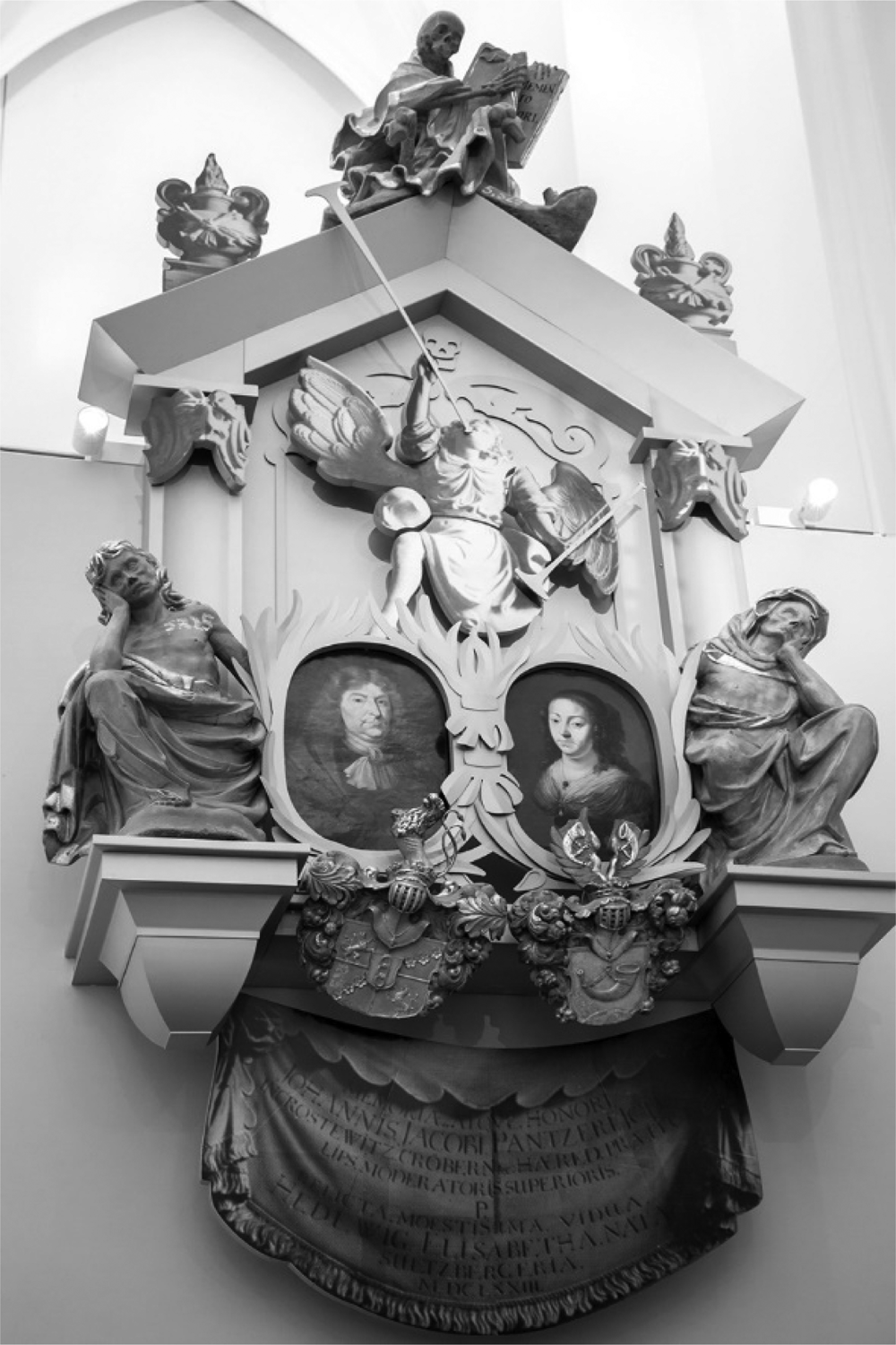
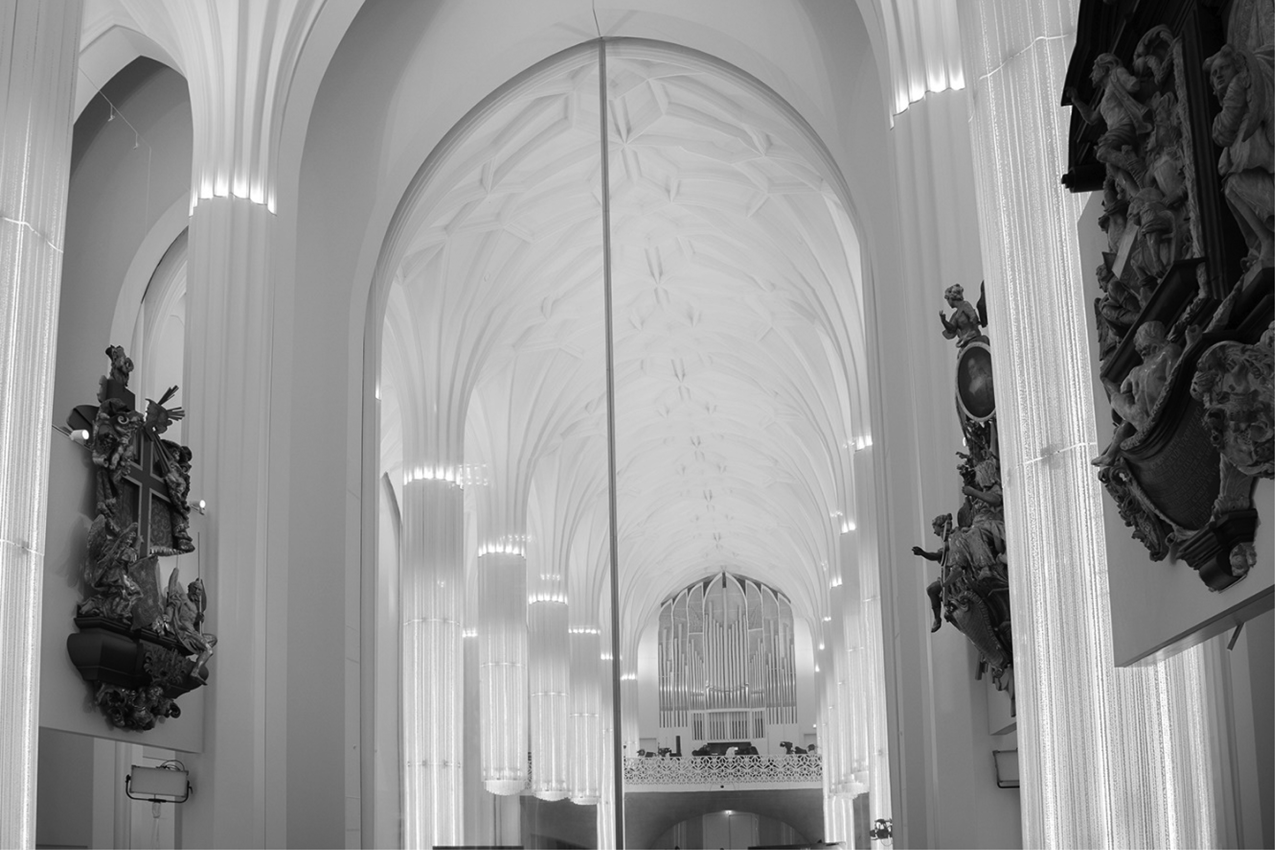
The Paulinum-Assembly Hall and University Church of Saint Paul, designed by Architect Erick van Egeraat, goes far beyond the old Church of Saint Paul. This hyper modern building is fascinating in the sense that it clearly resembles the old church while, at the same time, the materials and design are vastly different from the “original” which Egeraat was commissioned to commemorate. Like the old university church, the Paulinum has a main hall, a choir, two church organs, rib vault ceiling, and pillars. Some of the pillars, however, do not reach all the way to the floor and, being constructed of glass with LED-lights inside, their appearance can be altered using various colors. As for the art treasures saved from the original Church of Saint Paul, most of the epitaphs have undergone a thorough restoration. In some cases the Office for Art Collections chose not to attempt to restore badly damaged or incomplete epitaphs to their original state but rather opted for another solution, whereby images based on old photographs were permanently “projected” onto flat aluminum surfaces the same shape as the original. These one-dimensional simplistic replicas were then attached to the extant parts of the original piece (fig. 1). The difference between the original and the reproduced parts is obvious, but the new parts, nonetheless, provide the epitaphs in question with enhanced readability.Footnote 44 Some problems are still unsolved, though. One of them is how to relate to the sacred capacity of the Paulinum. When the new building was erected, the university leadership installed a giant movable glass wall between the choir and the assembly hall. This wall is occasionally opened, temporarily merging the two spaces during worship services, university festivities, and concerts. When the glass wall is closed, however, the choir is a church—viewed as a “sacred” and ritual space—and is predominantly utilized as such. This wall has thus created division—not only in terms of differentiating the space into areas which are sacred and those which are not, but also through the criticism from those who view the wall as harmful to the acoustic character of the space and as an artificial division which makes no sense at all.Footnote 45 Additionally, the wall has created another problem: Two years after the inauguration, the debate as to whether or not to bring back the old baroque pulpit lives on. If it were to be reinstalled at its “old” location in the assembly hall on the “secular” side of the glass wall, the university fears that it may enhance the sacral appearance of the supposedly secular space too much.Footnote 46
One of the restored epitaphs where a substantial number of parts have been re-created. This particular epitaph commemorates the lawyer Johann Jacob Pantzer who died in 1673. (Photograph by the author.)

According to retired rectors Cornelius Weiss and Franz Häuser, all parties involved in the university church discussions held shortly after the peaceful revolution wanted to build a “solemn space.” For Weiss and Häuser, the Paulinum is such a space.Footnote 47 The Pauliner Society, too, has accepted the present solution. Martin Helmstedt and Ulrich Stötzner from the Pauliner Society both describe Egeraat's architectonic solution in rather positive terms as something “which the Pauliner Society can live with.” The society has, nevertheless, criticized some aspects which it feels depart too much from the “original,” such as the dividing glass wall and the “hanging light pillars.”Footnote 48 In addition, the university's hesitation to have the baroque pulpit from the old church installed in the assembly hall has been met with critique from the Pauliner Society.Footnote 49
IV. The Sacrality and Secularity of the Paulinum
In August 2017, in his speech at the celebration for the completion of the construction, Prime Minister Stanislaw Tillich emphasized the dual use of the Paulinum as a site for secular as well as sacred usage; Leipzig University had “regained its intellectual and spiritual center.” Tillich hailed the return of a sacred space at Leipzig University—a space which had been lacking since 1968. The Paulinum, he stressed, “has become a reconstruction in terms of recovery of a space. The blast failed to separate faith and learning.”Footnote 50 In several instances in the speech, Tillich emphasized the dual character of the Paulinum but also its simultaneity: “In this space the two will reconvene. . . . Not only the name shows it: This new space at an old site is both—assembly hall and devotion room. Both are in accordance with a long history in the tradition of the university in this town. Here the mind [Verstand] and emotion [Gefühl] convene. Both together are in the position to give answers to questions of our time.”Footnote 51
Prime Minister Tillich was notably positive about the historic ties between Leipzig University and the Christian religion. He connected the Paulinum with this past by drawing attention to Martin Luther's inauguration of the Church of Saint Paul as a university church and the subsequent tradition of using the space for both university and church purposes. Tillich also gave two examples of other churches with a similar dual function: one (the monastery church in Zittau) an Evangelic church and a museum and the other (the cathedral in Bautzen) both a Catholic and Evangelical church. These two are cases where solutions were sought out of necessity between institutions with similar values. Through these examples, Tillich seemed to suggest that spaces with long and specific traditions can take new shapes and work in harmony with other institutions and traditions. Conversely then, what happens when you merge two institutions which have a history of being at odds with each other—like institutions of faith and those of science? Egeraat's solution had the advantage that the ground space in the Paulinum could serve not only as a chapel and assembly hall but also as a home for many of the art treasures from the old church. Providing a space for some of the pieces of art from the university church as a means of relating to its past was in line with the university's initial plans. However, the architectonic church resemblance—in combination with the epitaphs and the growing number of sacral objects being included, such as the altar, baptismal font, and potentially the baroque pulpit—started to further enhance the connection to the old university church. This was a development which the university had not initiated, and the glass wall separating the church from the assembly hall can be viewed as their solution to circumvent the delicate matter that the church posed for them (fig. 2).Footnote 52
Photograph showing examples of the epitaphs, the glass wall, the illuminated pillars, and the organ. The epitaphs are located in the choir/church whereas the main organ is in the assembly hall. (Photograph by the author.)

The “return” of the church to the university called for a new narrative. Leipzig University, the City of Leipzig, and the Evangelical Lutheran Church of Saxony also agreed to bring back the church “in name” and decided to call it the Paulinum-Assembly Hall and University Church of Saint Paul.Footnote 53 In the initial planning of the Paulinum, the university leadership had described it as the geistige (intellectual/spiritual) center of the university, that is, a place for intellectual debate, academic solemnities, music, and culture.Footnote 54 When the church realm in the Paulinum grew, the university added the word geistlich (religious) to the description and started calling it the geistig-geistliches—intellectual/spiritual-religious—heart of the university. In a press release in January 2009, Leipzig University presented the Paulinum-Assembly Hall and University Church of Saint Paul as being comprised of two spaces: the worldly (weltliche) part (the assembly hall) and the religious (geistliche) part (which the university called a “devotion room”).Footnote 55
It can be debated in what way the Paulinum is a “religious center.” In fact, this has been a source of conflict. Although everyone seems to agree about the history of the site, not everyone is in favor of continuing the tradition of uniting specifically Evangelical Christianity and science in this space. The 2008 brochure commemorating the 600th anniversary of Leipzig University contains an interview with the rector emeritus Franz Häuser where he discusses the building of the Paulinum. He expresses himself in diplomatic terms and avoids making any accusations. Häuser highlights what he sees as a positive development: the fact that the church and assembly hall have now been restored under one roof—a tradition which had been absent since 1836 when the Augusteum, a separate complex, was built featuring a new assembly hall. Nonetheless, it is apparent that Häuser has his doubts about the religious aspects of the Paulinum. “It is not the duty of the state and university to build a church,” he affirms. Instead, he emphasizes the role and needs of the university, and when mentioning sacral practice, he refers to the needs of the Faculty of Theology.Footnote 56
The director of the Office for Art Collections at the university, Professor Rudolf Hiller von Gaertringen, also broached the sacral use of the Paulinum or, perhaps more appropriately, the secular usage of the choir. Like Häuser, Hiller von Gaertringen referred to the lack of a post-1836 tradition of secular practice in the university church. He also raised questions about the right of admission for non-Evangelical Christians and about the lack of congruence between the multiculturality of the university and the Paulinum: “Nothing is discussed about allowing church services or the like for any other religious groupings. . . . Only the evangelic faculty, exclusively, [will have full access to this space, and] the first university preacher [erste Universitätsprediger]. We could also discuss [the fact that] we have a university which these days is a multicultural and religiously and spiritually very pluralistic institution. This fact is not established here [at the Paulinum].”Footnote 57
Whereas the division of the Paulinum into two spaces has been vividly debated in the German press in the past ten years, the question about the right of access to the choir has not been discussed. This can be taken as a sign that the division between faith and science has been considered more newsworthy than questions regarding specific religious utilization of the Paulinum, where news media has simply—and somewhat unspecifically—tended to favor “the return of the old church” to the university. However, this can also be taken as a sign that the German public in and around Leipzig still respects the church as an institution and chooses not to interfere with church praxis and tradition but to accept the church in the Paulinum despite its potential limitations in terms of utilization.
As the churchly sphere of the Paulinum increased after the initial planning of the whole complex, it developed from being a devotion room into a choir at the eastern side of the main hall. The medieval altar, rescued from the old university church, returned to its “original” location in the choir. Many other epitaphs were also restored to this area. When the choir was also furbished with a baptismal font, the devotion room in the Paulinum had turned into a church. In the introduction to their edited book Architecture and Order, Michael Pearson and Colin Richards write about such transformations as follows:
Through the cultural artefact of a name, undifferentiated space is transformed into marked and delimited place. Stories and tales may be attached to such places, making them resonate with history and experience. The culturally constructed elements of a landscape are thus transformed into material and permanent markers and authentications of history, experience and values. Although the stories change in the retelling, the place provides an anchor of stability and credibility.Footnote 58
The cultural artifacts in the Paulinum serve the purpose of turning a new, unknown space into a familiar place with connections not only to the past but also to Christian faith and spirituality. As in most churches, the sacral objects in the choir at the Paulinum are signals of solemnity—signals that, despite the advanced secularization of Eastern Germany, people still widely understand and respect. Moreover, despite the division into two spaces, both the choir and the assembly hall bear a resemblance to a church. Perhaps this is the reason why opinions remain divided over an artifact such as the baroque pulpit from the old university church. The Pauliner Society has fought hard to have this pulpit returned, with the intention that both the assembly hall and church could be utilized for a wide range of activities and that the pulpit would be an apt location for more than Lutheran sermons. However, opponents have called it too dominant, fearing that it will make the assembly hall too “churchly.”Footnote 59
Setting aside a space in the Paulinum for Christian sacrality has implied radical changes to Leipizig University's initial plans. The choir came to be primarily intended for Christian ritual performances with potentially limited access to those not participating in these devotional activities. Moreover, this space has tended to “move across” the sacred-secular divide. The proposed reinstallation of the pulpit is one example of this. In the old church, it stood at the fourth pillar—in what is now the “secular” assembly hall—and this is where many want it to be positioned once again.
When the glass wall was installed between the church and assembly hall, several individuals with interest in the building raised critical views in the German press. They feared that the wall would destroy the acoustic qualities of the Paulinum, interpreted it as an unwelcome division between science and faith, and saw it as a continuation of the unfortunate East German “tradition” of building dividing walls.Footnote 60 According to Professor Hiller von Gaertringen, the decision to build a glass wall was, above all, a practical solution. The choir constitutes a climatic environment which keeps the newly renovated artifacts from deteriorating. However, it has also been separated from the main assembly hall to maximize the utilization of the two spaces.Footnote 61
It seems that at the heart of the problem is the church history and tradition of Leipzig University and that this tradition has the capacity of embracing those who accept it and alienating those who do not feel quite at ease with it. Those confessing the Christian religion—to use Jonathan Z. Smith's understanding of religious materiality—are likely to have the greatest “spatial range” in the Paulinum.Footnote 62 They are more likely than individuals of other or no religion to feel a connection back to the religious foundations of Leipzig University. For instance, teachers and students of theology will feel at ease in both spaces. Ultimately, the Evangelic faculty preacher (at present, Professor Peter Zimmerling) will have the most connection to the Paulinum as the choir in the Paulinum is “his church.” The disadvantage with this solution is that those of other or no religion may feel some kind of exclusion or alienation in this space. With the Paulinum, Leipzig University has returned to its roots and pronounced its church historical heritage. What is still somewhat open is how the precedence of the Evangelic Christian religion and the Lutheran heritage in the Paulinum tally with the multiculturality of the university today.
Lastly, what is obvious is that there is an atonement aspect in the Paulinum. Probably everyone who wanted to tear down the building that had replaced the university church had some kind of reparation in mind. Some would have been satisfied with an assembly hall, albeit with a site for the rescued epitaphs, and maybe a memory plate commemorating the destroyed university church. Others wanted to rebuild, either with modern materials or by using, at least in part, the rubble from the old church.Footnote 63 The Paulinum represents a middle way. Nonetheless, as it has been presented in official speeches and documents, it seems to represent an “undoing” of some of the destruction of 1968. It brings back to the university a united space for science, religion, and culture—a space where citizens are allowed to participate. The Paulinum also proudly reconnects Leipzig University with its roots in the Dominican monastery and the Reformation and the rich musical tradition at this site.
V. The Paulinum and the Memory of Oppression and Struggle for Freedom
The Paulinum and the church heritage at Augustusplatz are intimately connected with the struggle for freedom and the peaceful revolution which ended with German unification in 1989/1990. This significance has been added as a layer to the narratives surrounding the Paulinum. Let us return to the quote by Michael Pearson and Colin Richards, who write that “stories and tales may be attached to” places so that they “resonate with history and experience,” and buildings, as culturally constructed elements of the landscape, “may be transformed into permanent markers and authentications of history, experience and values.” According to Pearson and Richards, the stories attached to these sites “change in the retelling,” but the place “provides an anchor of stability and credibility.”Footnote 64
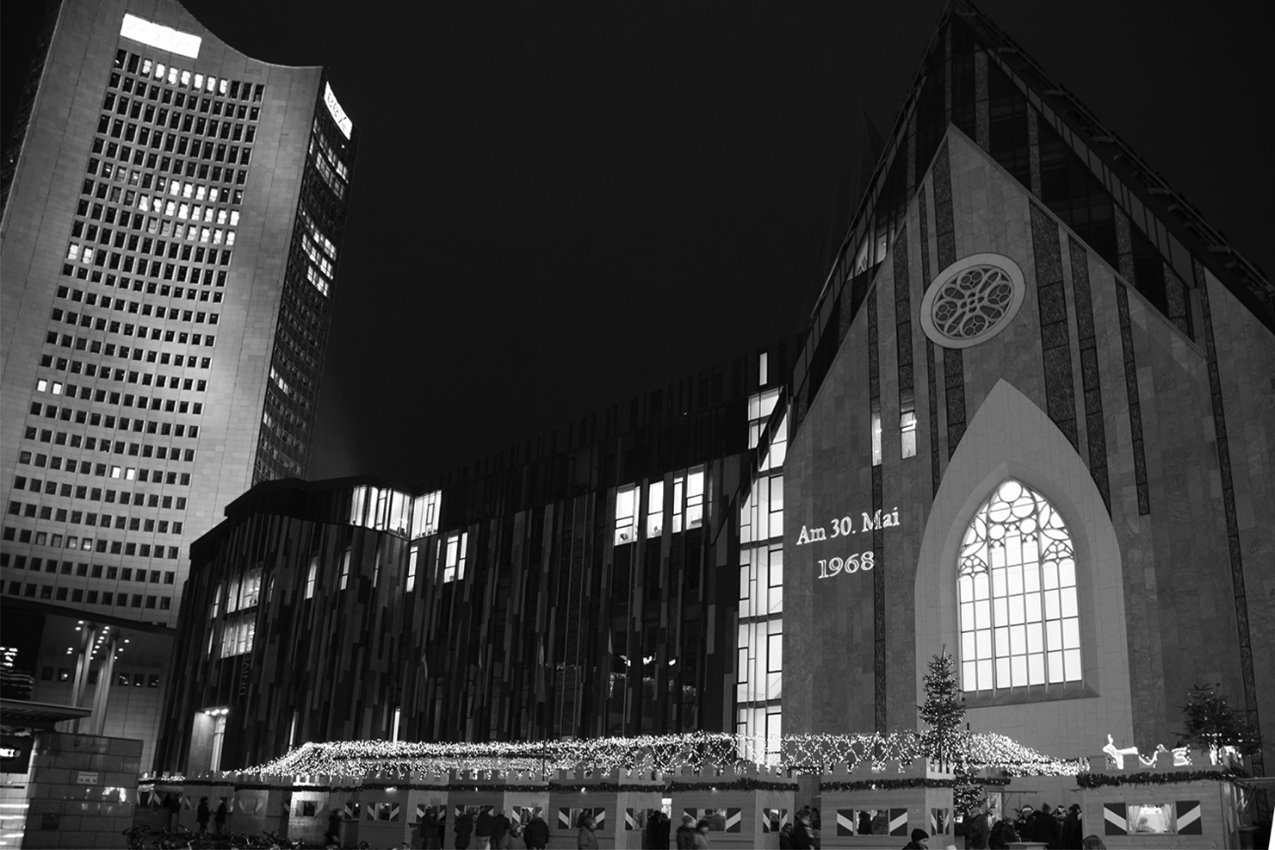
Despite the differences of opinion as regards its architectonic reconceptualization, the Church of Saint Paul is of great importance to Leipzig University and the legacy of its destruction has been commemorated in various ways. Firstly, it is commemorated through design. For example, architect Erick van Egeraat incorporated the moment of destruction into the Paulinum facade. The rosary window and the choir window are not in alignment and there is a cut on the upper right side of the choir window. The asymmetry and imperfection of the facade symbolize how the university church was destroyed in 1968.Footnote 65 Secondly, the old church has been commemorated through rites. Probably the strongest example of this was the consecration of the Paulinum as a church on December 3, 2017, the first Sunday of Advent. At the very beginning of the inauguration service, the rescued altar cross and candles from the old church were ceremonially brought back “to their original location.”Footnote 66 Likewise, on December 1, the day of the university's separate inauguration, Johann Sebastian Bach's Toccata in C-Major was performed at the inaugural concert, beginning from where it was interrupted on May 24, 1968 when the state police evacuated the concert in the middle of the performance.Footnote 67 Thirdly, the Church of Saint Paul and its destruction are commemorated through a number of popular narratives about the volunteers who rescued the many art treasures from the doomed university church, about the citizens who were punished by the state police for resisting the system, about the students who hoisted a “we demand rebuilding” flag at the local Bach concert shortly after the demolition in 1968, and, ultimately, about the peaceful revolution in Leipzig leading to the fall of the Berlin Wall.Footnote 68 These narratives were told in several books published after the German reunification and in speeches and presentations of various kinds at the inauguration of the Paulinum (fig. 3). They are also regularly retold in guided tours at the Paulinum.Footnote 69 These sculpted memories, rites, and narratives are not only exciting, but they interlink the Paulinum and Leipzig University with their shared past—both recent and distant. To some extent these memories, rites, and narratives also legitimize the (re)building of the Paulinum, which has not only been criticized for being too religious but also for being too expensive.Footnote 70
During the Paulinum's inauguration weekend in December 2017, a running text projected on its facade told the story of the destruction of the church in 1968 and its rebuilding. In the background of this photograph is the skyscraper which used to belong to the university—one of the buildings that replaced the University Church of Saint Paul in the early 1970s. (Photograph by the author.)

Since the German reunification in 1990, treating the many tragic and fascinating collective memories around Augustusplatz with ultimate care has been a primary imperative for all involved. This was visible in Prime Minister Tillich's speech at the construction celebration in August 2017. In this speech, he placed the destruction of the university church on a virtual East German timeline starting with the Uprising of 1953 and the building of the Berlin wall in 1961 and ending with the peaceful revolution in 1989. Tillich brought particular attention to one of the students behind the protest flag in 1968, the reluctance of Leipzig citizens to accept the destruction of the University Church of Saint Paul, and their determination to “use their [post-GDR] freedom to engage themselves to give back to the university this lost space.”Footnote 71
Similarly, the artifacts in the choir of the Paulinum are not only linked to the old university church and the individuals who were once buried here, but they are linked to the narrative of the volunteers who saved them shortly before the church was destroyed, and thus, they are linked to the struggle against the politics of the GDR. Likewise, the whole space, and the tangible bringing back of Leipzig University's religious heritage, should not predominantly be seen as a way of reintroducing Christianity to a university with a Marxist past. It should rather be viewed as a reconnecting with the roots of the university, and the stories about public participation serve as an invaluable, intangible complement in this process.
Jonathan Z. Smith discusses the notion of memory and space and what he calls “the postulation of an intimate connection between memory and place”:
Space is [often] conceived as being already existent, as being divided up into empty loci into which the images by which memories would be recalled are placed. The loci are thought both to preexist and to survive the memories. . . . But what if matters be reversed? What if space were not the recipient but rather the creation of the human project? What if place were an active product of intellection rather than its passive receptacle?Footnote 72
Smith's considerations are striking in the case of the Paulinum, which is both a sacred space and a part of the cultural memory of Leipzig University. Nevertheless, his notions above do not provide answers regarding the meaning imparted by this valued space to those who feel attached to it. Discussing place and space in relation to their meaning for a particular community, Smith dwells on the “persistent claim of the humanistic geographers that place is best understood as a locus of meaning.” Using the geographer Yi-Fu Tuan's notions of “space becom[ing] place as we get to know it better and endow it with value,” Smith writes: “Tuan defines place, broadly, as ‘a focus of value’ and of ‘intimacy.’ ‘When space feels thoroughly familiar to us, it has become place.’ Thus, ‘abstract space, lacking significance other than strangeness, becomes concrete place [only when it is] filled with meaning.’”Footnote 73
I would argue that the Paulinum would be a much less valued place (by the university and the City of Leipzig, by the State of Saxony, by the former citizens of the GDR, and many others) if it were not for “its” traumatic past. The tragic memories as well as the “sacralized” peaceful revolution and heroic narratives attached to this site fill it with meaning and fit within Smith's (and Tuan's) notion of space becoming place. The relative alienation which the religious capacity of the choir and the sacral pieces of art may engender among non-Christian visitors is probably counterbalanced by the architectonic solutions of the Paulinum. Moreover, such alienation is also counterbalanced by the collective memories of suffering under the SED dictatorship. In these memories, the destruction of the University Church of Saint Paul constitutes a barbaric act of iconoclasm. Consequently, it is precisely the resemblance in terms of architecture and furnishing to the old university church that may play an important role. These resemblances are not only evidence of a kind of undoing of the aims and effects of the iconoclasm but they also physically embody the connection of Leipzig University to its past.
VI. Concluding Remarks
In this article, I have studied the 1968 destruction of the University Church of Saint Paul in Leipzig and the recent building of the Paulinum-Assembly Hall and University Church of Saint Paul. The demolition of the university church by the SED regime was implemented both on ideological grounds and as a demonstration of power. The regime also had progress in mind, wanting to build a modern secular university. The devastation was complete insomuch as the site was concerned: the regime left no traces of the church (or of the other buildings), Augustusplatz was renamed Karl-Marx-Platz, and Leipzig University became Karl Marx University. As a sign of complete victory, a relief of Karl Marx was mounted above the entrance of the new building on the site where the church's altar had once stood.
If viewed as a form of iconoclasm, the destruction of the University Church of Saint Paul was efficient and, at the same time, incomplete. Throughout the GDR generally, the political program had a massive effect on churches, resulting (directly or indirectly) in a considerable amount of secularization. In Leipzig, the destruction of the university church was a tangible example of this political discourse. However, in what can be regarded as a mixture of pity for the defeated citizens and the self-confidence felt by the SED, the citizens of Leipzig were allowed into the doomed church to rescue most of the pieces of art. The regime failed to see that these artifacts would, in due time, call for a new context. Through the building of the Paulinum, between 2008 and 2017, most artifacts were returned to their “original” location, albeit into a very different world.
While the communist attack upon religion and, in particular, upon the relationship between science and faith has frequently been depicted as a horror story, not least by the German Christian Democratic Union Party, other stories have emerged in conjunction with this event. One grand narrative that has been emphasized is that of opposition to the destruction of the university church and of the suffering under SED rule in general. This discourse has been articulated through stories about the rescue operation when volunteers salvaged a large part of the art treasures before the church was demolished, as well as the stories about the students who, shortly after the destruction, signaled their opposition at a Bach concert in Leipzig and demanded the rebuilding of the church. In general, the Paulinum has come to be viewed as a victory over GDR oppression, as the converse of SED barbarity, and as a kind of undoing of some of the destruction inflicted by the East German dictatorship.
The reintroduction of the bond between faith and science—materialized in the Paulinum as the geistig-geistliche (intellectual/spiritual-religious) heart of Leipzig University—has stirred discussions regarding the role of Evangelic Christianity in the increased pluralism in this part of Germany. The faith-science dualism that succeeded in the university during both Catholic and Evangelic times has been challenged, and despite the university labeling the Paulinum the geistig-geistliche heart of the university, it is apparent that the leadership of the university has struggled to comprehend and internalize the term geistlich. Largely due to the vivid memory of political oppression, in which the Church of Saint Paul came to be seen as something of an architectonic and cultural martyr, a “historic” model prevailed with the building of the Paulinum. The painful collective memories have effectively overruled more practical and pluralistic alternatives.
Lastly, the fact that the dispute about the building of the Paulinum has often, in the media, been depicted as a contest between the Pauliner Society and the rectors of the university does not give much justice to the process and outcome. The reality is more complex than the German press has made it appear. The truth is that the memory of the Church of Saint Paul does not rest solely with the Pauliner Society, and the rectors of the university have not always been completely unsympathetic to demands for the return of the church. With these facts in mind, one could argue that it has, by necessity, taken time to build a complex which does the utmost justice to the painful memory of the destruction of the university church and, at the same time, meets the demands of the university. Many of the developments in the planning and building project were necessary in order for the various stakeholders, finally, to accept the church-like and simultaneously innovative Paulinum-Assembly Hall and University Church of Saint Paul.