


Existing studies project Muslims to overtake Christians as the world's largest religion in terms of followers by the end of this century (Pew Research Center, 2007, 2011, 2017). Why is Islam the fastest-growing religion in the contemporary world? Existing studies use a demographic approach to deem the comparatively young age and a high fertility rate of Muslims the major drivers of the growth of Islam (e.g., Pew Research Center, 2017). This demographic approach is problematic in that it overlooks the importance of politics in scientific inquiry. From the perspective of political science, this study explores the determinants of increased Muslim populations. More specifically, this study offers a novel theoretical perspective: terrorist campaigns, defined as terrorist attacks and online propaganda, are a significant yet overlooked factor in the growth of the Muslim population worldwide. Contrary to popular belief that terrorist attacks prompt fears of terrorismFootnote 1 and anti-Muslim fervor, the events of 11 September have led to widespread conversion to Islam and consequently contributed to an increase in Muslim populations.Footnote 2 Wilgoren (Reference Wilgoren2001) of the New York Times describes this paradox: ‘one expert estimates that 25,000 people a year become Muslims in [the US]; some clerics say they have seen conversion rates quadruple since Sept. 11.’ Similarly, Bright (Reference Bright2002) of the Guardian reports: ‘A year ago they feared their religion would be tarred by the atrocities that left over 3,000 dead in the terrorist attacks on New York and Washington. But Muslims across Britain are now crediting an “11 September factor” for the upsurge of interest in their religion.’ These two examples suggest that successful terrorist attacks made people curious about Islam, leading to conversion and thus enlarging the size of the global Muslim population.Footnote 3 In a similar vein, several scholarly works show that successful terrorist attacks are likely to mobilize, rather than undermine, public support for the terrorist cause (e.g., Pedahzur, Reference Pedahzur2005).
Given that demographics cannot be solely responsible for the rise of Muslim populations, academics and policy-makers need to explore other factors – especially the politico-security environment – such as conflict, crisis, and war that may also alter the growth trend of the Muslim population. In this study, I look at an emerging politico-security challenge in the context of terrorist campaigns. I contend that a series of terrorist attacks and online propaganda attract new Muslim converts and thus lead to increased Muslim populations globally. Whether they are in the form of attacks or online propaganda, terrorist campaigns stimulate vulnerable people to look to Islam for answers and consequently to convert. Without doubt, religious conversion is critical in Islam's spread. New converts serve as lynchpins, transmitting Islamic beliefs to family and peers through their social networks. New converts are likely to sway family members, relatives, childhood friends, colleagues, neighbors, and fellow inmates in prison to follow the preaching of the Quran. The increase of Muslim converts facilitates the expansion of Islamic beliefs throughout the world.Footnote 4
For example, Earnest James Ujaama was inspired by successful terrorist attacks against US security interests. Looking to understand American foreign policy, his research led him to conclude that the US military committed unthinkable atrocities in Muslim countries. He decided that Islam provided the solution to the conflict and converted to Islam around 1997, pressuring his family to convert as well. He created the StopAmerica.org website to protest American foreign policy and recruit non-Muslims to his radical belief system. On 22 July 2002, federal agents arrested Ujaama for attempting to establish a terrorist training camp near Bly, Oregon (Bernton et al., Reference Bernton, Heath and Carter2002). In another case, Carl Walters, a Black US serviceman stationed in the Netherlands, inspired his son, Jason Walters, to convert to Islam. Jason Walters later joined the infamous Hofstad group that murdered Theo van Gogh, a Dutch film director, in response to the director's controversial film portraying the mistreatment of women in Islam. Jason Walters, who was initially inspired by the September 2011 attacks in America, was responsible for the conversion of his younger brother, Jermaine Walters, who also became a member of the Hofstad group (Karagiannis, Reference Karagiannis2012). A conversion also occurred in the family of Swedish convert Michael Nikolai Skramo who moved his wife and four young children to Raqqa, Syria to join the Islamic State in September 2014 (Greenfield, Reference Greenfield2015).
To systematically examine the effect of terrorist campaigns on the rise of the Muslim population, I performed a cross-national, time-series data analysis of 152 countries from the period of 1970 to 2007. The empirical analysis shows strong evidence supporting my new perspective: while controlling for well-known socio-economic factors such as fertility rates and immigration flows, I discovered that terrorist campaigns contribute to the growth of Muslim populations. This result is alarming to the architects of the ‘War on Terrorism’ because some portion of the Muslim converts, who are usually deemed to be more radical than traditional Muslims, engage in terrorist activity.
This study proceeds in six sections. First, I presented a brief literature review. Second, I offered a new perspective that explains how terrorist campaigns propel the growth of Muslim populations. Third, I provided various cases to demonstrate the connection between terrorism and Muslims. Fourth, I explained how to perform hypothesis testing by highlighting statistical model building, measurements, and data sources. Fifth, I discussed the estimated statistical results. Last, I briefly summarized the main findings of this study and provide some policy implications.
1. A brief literature review
There are a few existing studies that examine the effect of terrorism on the growth of Muslim populations. Some studies look at the reverse causal direction – the influence of Islam on terrorism, though they do not examine the direct connection between religious ideology and terrorism. Empirical studies tend to include Islam as a control variable in their model specification, so they provide as little theoretical reasoning as possible since it is not the focus of inquiry (e.g., Piazza, Reference Piazza2008a; Acosta and Childs, Reference Acosta and Childs2013). Others catalog perpetrators of (suicide) terrorist attacks and in doing so observe that Islamic groups are likely to commit the majority (e.g., Moghadam, Reference Moghadam2009).
Political science is silent on the effect of terrorist campaigns on the growth of the Muslim population. Demographic economics frequently cites the comparatively young age and the high fertility rate of Muslims as the main driving forces of Muslim population growth worldwide (Pew Research Center, 2017). When countries have more educated couples, one can expect the delay of childbearing, resulting in a lower birth-rate among (Muslim) populations (Martin, Reference Martin1995; Pew Research Center, 2011). The socio-economic status may be inversely associated with Muslim population growth. Muslims of low socio-economic status pass on religion more successfully than those of high socio-economic status (Scourfield et al., Reference Scourfield, Taylor, Moore and Gilliat-Ray2012). Mortality rate, migration, family planning, and urbanization are also linked to Muslim population growth (Pew Research Center, 2007, 2011, 2017).
Although demographic economics helps us understand why Islam is the fastest-growing religion in the world, it does not give us the full story; it fails to account for political factors. Lasswell (Reference Lasswell1936) reputably defined politics as a competition about who gets what, when, and how – politics resolves how human resources are distributed. Political scientists should consider how political drivers explain the Muslim population growth worldwide. This study fills this gap by demonstrating that terrorist campaigns, defined as terrorist attacks and online propaganda, are an important yet overlooked factor in the global growth of Muslim populations during the past decades, via a positive conversion effect.
2. The effect of terrorist campaigns on Muslim populations
I started by recognizing that conversion is one of several ways in which religion diffuses throughout society, contributing to an increase in religious adherents. Conversion to Islam follows this diffusion-throughout-society pattern and helps attract more followers to Islam. Existing studies demonstrate that the spread of Islam occurred in three phases (see Lapidus, Reference Lapidus2002; El Hareir and M'Baye, Reference El Hareir and M'Baye2011). The first phase was hierarchical diffusion when Muslims conquered land in the Middle East and Africa in the seventh and eighth centuries; the second phase was contagious diffusion through trade routes such as the Silk Road; and the third phase is relocation diffusion through migration (e.g., escape from the conflict in Iraq, Syria, Sudan, etc.). I introduced another possible Islamic diffusion as the fourth phase. I argued that the contemporary world has been slipping into the fourth phase of Islamization in the wake of terrorist attacks and online propaganda, which trigger conversion to Islam. Terrorist organizations may employ terrorist and non-terrorist means to drive non-Muslims to convert to Islam; however, for this study, my discussion focuses on the first method – terrorism – making people interested in and converted to Islam and thereby growing the global Muslim population.Footnote 5
Convinced that there are non-Muslims who are sympathetic to their terrorist causes, terrorist organizations attempt to motivate non-Muslims to change sides. Sympathetic non-Muslims are those who perceive that Muslim men and women are treated unfairly and unequally (e.g., human rights violations against detainees in the Abu Ghraib prison in Iraq) (Karagiannis, Reference Karagiannis2012). The number of sympathetic non-Muslims is likely to increase when terrorist organizations strive to win the hearts and minds of non-Muslims under the pretext of creating a world that treats Muslim people fairly and equally (Bloom, Reference Bloom2005; Pedahzur, Reference Pedahzur2005; Kydd and Walter, Reference Kydd and Walter2006; Windrem, Reference Windrem2014; Geller and Saperstein, Reference Geller and Saperstein2015). One of the best organizational campaign efforts is often expressed in the form of terrorist attacks. When terrorist plots are successful, they are likely to boost recruitment and public support, especially among sympathizers. Successful terrorist attacks goad non-Muslims into investigating Islam as a way to understand the acts of terrorist organizations. As a consequence, some of them likely become eager to learn more and decide to convert to Islam. Converted Muslims then lure more non-Muslims to convert to Islam.
Furthermore, successful terrorist attacks impress non-Muslims captivated by jihadist terrorism that emerged since the early 1990s as an extreme political response to the Western politico-cultural invasion of Islamic lands (Faiola and Mekhennet, Reference Faiola and Mekhennet2015). By converting to Islam, the sympathizers ‘seek a means by which [they] can articulate [their] criticism of western society or share with others [their] sense of alienation from the dominant culture’ (Uhlmann, Reference Uhlmann2008: 34). Successful terrorist operations, such as the September 2011 attacks and the creation of the self-proclaimed Caliphate (the Islamic State in Iraq and Syria) – provide vulnerable populations with a vicarious outlet for expressing grievances and hostility (Pedahzur, Reference Pedahzur2005; Geller and Saperstein, Reference Geller and Saperstein2015). Following successful attacks, vulnerable non-Muslims may view terrorist organizations such as al-Qaeda and ISIS as winners and thus convert. Several studies support my argument. Wilgoren (Reference Wilgoren2001), Bright (Reference Bright2002), and Rodgers (Reference Rodgers2010), for example, show that about 40,000–60,000 American Christians converted to Islam in the wake of the attacks on the Twin Towers. Whittell (Reference Whittell2002) from The Times reports that ‘there is compelling anecdotal evidence of a surge in conversions to Islam since September 11, not just in Britain, but across Europe and America.’ A surge in Islamic conversions by indigenous, Christian Papua New Guineans since 2001 – an ~500% increase – coincided with a period of increased local media coverage on Muslims and Islam following the terrorist attacks of 11 September 2001 (Flower, Reference Flower2012).
While terrorist attacks worldwide, in general, contribute to terrorist diffusion globally, localized terrorist attacks also serve as a driver of conversions to Islam. The successful operations of local terrorist organizations such as Boko Haram in Nigeria, Al Shabaab in Somalia, the Taliban in Afghanistan and Pakistan, Lebanon's Hezbollah movement, Kurdish affiliated groups in Turkey (e.g., Kurdish Hezbollah), and the Palestinian Islamic Jihad in Israel have created a significant number of converts from sympathetic non-Muslim populations in past decades. The role of localized terrorist attacks can be better understood in the context of outbidding strategy: to distinguish themselves and gain public support, multiple terrorist organizations engage in a domestic competition by intensifying their political violence. The essence of this outbidding strategy is epitomized in Bloom's (Reference Bloom2005: 95) statement; ‘where there are multiple groups, violence is a technique to gain credibility and win the public relations competition.’ Kydd and Walter (Reference Kydd and Walter2006) elaborate that, despite the costs, terrorist organizations are likely to be received well for becoming more militant and successful at showing their determination to continue the armed struggle. Thus, victorious outbidding campaigns inspire non-Muslims to turn to Islam for answers and consequently attract more non-Muslim locals to Islam.
While successful terrorist attacks prompt sympathetic non-Muslims, social media serve as a vehicle for terrorist propaganda and recruitment. Many campaign videos circulated by Al-Qaeda or radical preachers incite non-Muslims to detest Western society and culture and convert to Islam. In a 48-minute video, Ayman al-Zawahri – al-Qaeda's number two man – and Adam Yehiye Gadahn – a Californian who converted to Islam – called on Americans to convert to Islam and for US soldiers to switch sides in the Iraq and Afghan wars (Associated Press, 2006). Not surprisingly, a 2007 Osama bin Laden video also urged Americans to convert to Islam (ABC News, 2007). According to Yayla and Speckhard (Reference Yayla and Speckhard2016), who participated in the ISIS Defector Interview Project at the International Center for the Study of Violent Extremism, ‘ISIS produces thousands of videos and memes to reach and radicalize those who are vulnerable.’ For example, on 4 October 2015, ISIS released a video saying that ‘convert to Islam, and no harm will befall you. But if you refuse, you will have to pay the jizya tax’ (Brown, Reference Brown2015). Converts are also being utilized in Islamic State propaganda aimed at the West, including videos for recruitment and for inciting fear. While terrorist campaign videos are popular propaganda tools, Twitter, Facebook, and Instagram have emerged as additional venues for recruitment. For example, Twitter has an automated list of ‘who to follow,’ making it easy for a person interested in terrorist violence to find like-minded individuals (Pazzanese, Reference Pazzanese2015).
The framework presented here does not argue that recent converts to Islam fuel terrorism. I propose that the causal arrow points in the opposite direction: terrorism is one of the factors driving conversion and that terrorism-influenced conversion accounts for some of the growth of the global Muslim population. Muslim converts are law-abiding citizens who promote interfaith understanding rather than espouse religious hatred. However, I look at a different role of Islamic conversion. I argued that religious conversions can help enlarge the size of the Muslim population when they ‘result from [terrorist] movement outreach and social networks that tie seekers to the movement through personal relationship’ (Wiktorowicz, Reference Wiktorowicz2005: 5).
3. Cases that link terrorist campaigns to Muslim populations via Muslim converts
Roy (Reference Roy2004: 317) points out that, ‘far from being a marginal phenomenon, the number and role of converts in radical Islamic networks have been growing since the early 1990s and are another indicator of the globalization and westernization of Islam.’ But there is no reliable and consistent statistical data on the number of Muslim converts in general, and those inspired by terrorist campaigns in particular. Statistics on conversions to Islam are scarce, and they are, if collected, only for a few countries in scattered periods. Pew Research Center (2011: 65) provides a reason for the data scarcity: ‘some national censuses ask people about their religion, but they do not directly ask whether people have converted to their present faith. A few cross-national surveys do contain questions about religious switching, but even in those surveys, it is difficult to assess whether more people leave Islam than enter the faith. In some countries, legal and social consequences make conversion difficult, and survey respondents may be reluctant to speak honestly about the topic.’ Given the difficulties in estimating conversions to Islam and the linkages between terrorist campaigns and growing Muslim populations, I discuss multiple cases in which terrorist campaigns inspired non-Muslims to convert to Islam in America, Europe, Middle East, Africa, and other regions. To be clear, this discussion does not assert that all Islamic converts engage in terrorist violence, though some portion of them do. The main purpose of this discussion is to provide some sense of the growing number of converts influenced by terrorist campaigns that consequently contribute to the increase of Muslim populations worldwide.
Islam is growing fast in the USA. Although the growth is largely due to recent immigration and the high birth rate of Muslim families (Pew Research Center, 2017), it is also notably affected by the number of those who are inspired by terrorist campaigns to convert (see Whittell, Reference Whittell2002; Karagiannis, Reference Karagiannis2012; Faiola and Mekhennet, Reference Faiola and Mekhennet2015). In an effort to see whether terrorist campaigns beget conversions, I examined how many of America's homegrown jihadists are converts during the period from 2001 to 2014.Footnote 6 I compiled an original database of 238 terrorists. The database includes individual information about America's homegrown jihadists from various open sources.Footnote 7 The homegrown jihadists consist of American citizens, legal permanent residents, and temporary visitors.Footnote 8 These individuals were radicalized within the USA after the September 2011 terrorist attacks, according to their court documents. They were either indicted or convicted for involvement in terrorist activities or were killed before they could be indicted. I excluded from the database those individuals acquitted of terrorism charges or charged with lesser crimes, such as immigration violations. By definition, militant environmentalists and anti-abortion activists are excluded. The sample is comprehensive in the sense that it includes American jihadists who supported, plotted, or committed terrorist violence regardless of whether or not they were successful. Of the 238 jihadists, 87 (about 37%) were converts, suggesting a close relationship between terrorist campaigns and Muslim converts (Choi Reference Choi2018). The percentage is significantly high, given that converts are less than a quarter of six million Muslims living in the USA (Pew Research Center, 2007).
More evidence that the growth of Muslim populations is inspired by terrorist campaigns is found among homegrown European terrorists among whom the percentage of converts is also high. As Roy (Reference Roy2017) puts it, ‘biographies of “homegrown” European terrorists show they are violent nihilists who adopt Islam, rather than religious fundamentalists who turn to violence.’ Roy's conclusion is based on his review of some 140 terrorists active in Europe. Note that European converts inspired by Salafist campaigns are usually radicalized within a small group of friends who meet in a neighborhood, prison, or sports club and who create a family-like brotherhood, often through biological ties. Bakker (Reference Bakker and Coolsaet2011) examines hundreds of Muslim Europeans convicted of terrorism and finds that more than one-third of them were converts mainly from Christian backgrounds. The Operational Briefing Note written by the Behavioural Science Unit at MI5 studies several hundred Islamic recruits to terrorism. They found that British homegrown jihadists tend to be converts (Travis, Reference Travis2008). Kleinman and Flower (Reference Kleinman and Flower2013) maintain that there are between 60,000 and 100,000 Muslim converts in the UK, representing between 2 and 3% of the 2.8 million Muslims. Yet, those converts were involved in 31% of British terrorism convictions from 2001 to 2010.
The Middle East is a magnet for Muslim converts. With its successful terrorist activities, ISIS emerged as a symbol of the global jihadist movement rapidly expanding in the Middle East, North Africa, and around the world, attracting recruits in unprecedented numbers. As many as one in six Europeans joining the Islamic State were converts from non-Muslim faiths including Christianity, as well as non-religious backgrounds. The ratio of converts among those moving from France to the self-styled Caliphate was about one in four (Faiola and Mekhennet, Reference Faiola and Mekhennet2015). After analyzing ISIS's past, present, and future, Stern and Berger (Reference Stern and Berger2015: 81) underline that ‘among Western recruits, a disproportionate number of converts can typically be found.’ While many Western recruits voluntarily converted to Islam, many of those who were already in the region were not given a choice. ISIS attempted to forcibly convert religious minorities in Iraq. For example, the Yazidi people of northern Iraq, who followed an ethnoreligious syncretic faith, were threatened with forced conversion by ISIS (O'Loughlin, Reference O'Loughlin2014). Terrorist attacks by Boko Haram in the northern regions of Nigeria have attracted or forced non-Muslims to convert to Islam, such as hundreds of kidnapped schoolgirls (BBC, 2016).
In the other regions of the world, conversion to Islam and the growth of the Muslim population are not new phenomena. Australia, Canada, Chile, China, Japan, New Zealand, Philippines, Russia, Singapore, and South Korea have experienced some serious religious conversions inspired by a series of terrorist campaigns. The swell of converts occurs as terrorist organizations actively attempt to woo converts with savvy social media outreach and recruitment drives, and successfully carry out violent plots (Neumann, Reference Neumann2015). Among the countries mentioned above, South Korea is an exemplar of how religious diffusion affects the growth of the Muslim population. Although followers of Islam used to be few in South Korea – a traditionally Buddhist country – their numbers increased in the 1960s and in the new millennium as terrorist campaigns have inspired many Koreans to turn to Islam for answers. Recently, four Koreans are publicly known to have converted to Islam and joined the Islamic State. The converted Koreans were inspired by the beheading of American journalist Steven Sotloff and the Islamic State's proclamation of itself as a worldwide Caliphate. Enticed by the Islamic State's propaganda via Twitter, they were thrilled to take up arms for jihadist causes. Once converted, they tried to persuade their childhood friends to come with them to Syria. The terrorist actions of the converted Koreans sent shockwaves through Korea, at the same time attracting more Koreans to Islamic beliefs (Ahn and Kim Reference Ahn and Kim2015; Park, Reference Park2015). The Korean Central Intelligence Agency notes that South Korea is no longer immune from radical Islam. The Korean case is consistent with the global trend of the growing Muslim population – a series of terrorist campaigns beget Muslim converts and consequently contributed to a rise in Muslim populations in Korea (Chun, Reference Chun2015).
4. Research design
In this section, I explain how to test the effect of terrorist campaigns on Muslim populations in a systematic way. The above discussion leads me to formulate the following hypothesis: all other things being equal, the number of Muslims in a given country will increase following a series of terrorist attacks and online propaganda. For hypothesis testing, I collected cross-national, time-series data on 152 countries from 1970 to 2007,Footnote 9 structuring the country-year as the unit of analysis. I filled missing observations with information from previous years. Existing studies do not agree on a standard statistical model of predicting the size of the Muslim population. I built a baseline model that includes terrorist campaigns variable and other predictors (that commonly appear in the Pew Research Center's Forum on Religion & Public Life (Pew Research Center, 2007, 2011, 2017).
 $$\eqalign{{\rm Muslim}\,{\rm Population}{\rm s}_{it} =\; &\beta _0 + \beta _1 \times {\rm Terrorist}\,{\rm Campaign}{\rm s}_{it \hbox{-} 1} + \beta _2 \times {\rm Fertility}\,{\rm Rat}{\rm e}_{it \hbox{-} 1} \cr & \quad + \beta _3 \times {\rm College}\,{\rm Educatio}{\rm n}_{it \hbox{-} 1} + \beta _4 \times {\rm Economic}\,{\rm Growt}{\rm h}_{it \hbox{-} 1} \cr & \quad + \beta _5 \times {\rm Democrac}{\rm y}_{it \hbox{-} 1} + \beta _6 \times {\rm Political}\,{\rm Instabilit}{\rm y}_{it \hbox{-} 1} \cr & \quad + \beta _7 \times {\rm Civil}\,{\rm Wa}{\rm r}_{it \hbox{-} 1} + \beta _8 \times {\rm Interstate}\,{\rm Wa}{\rm r}_{it \hbox{-} 1} \cr & \quad + \beta _{9\,{\rm to}\,i}{\rm Country}\,{\rm Dummie}{\rm s}_{it} + \beta _{10\,{\rm to}\,t}\,{\rm Year}\,{\rm Dummie}{\rm s}_{it} + \varepsilon _{it}} $$
where subscript i = 1,…, N indicates the country and subscript t = 1,…,T indexes the time period. Muslim Populationsit is the dependent variable; β 0 is a constant term; β 1 through β 8 are coefficients for independent variables; β 9 to i are for country dummies; β 10 to t are for year dummies, and ɛit is an error term. To ensure the causal time order-events of explanatory variables cause the outcome variable, all variables on the right-hand side are lagged by one year.Footnote 10
In operationalizing the dependent variable – Muslim Populations – I turned to Brown and James' (Reference Brown and James2018) Religious Characteristics of States (RCS) project. One of the key advantages of the RCS project is that it compiles annual data. Because prior data sets on religious characteristics report data at larger time intervals or contain no variation between years within a country, they mismatch studies of conflict and terrorism, most of which are aggregated annually. The Muslim Populations variable is measured in two ways: (a) the percentage of Muslims in the country's population and (b) the change in Muslim population (the first difference of the percentage of Muslims).
Since the dependent variable – Muslim Populations – is continuous, I employed ordinary least squares (OLS) regression with cluster-robust standard errors as the estimation method. The use of cluster-robust standard errors is a conservative approach because it reports more nuanced standard errors that take into account intra-country correlation. Since the impact of terrorism diffusion in Muslim minority countries may be very different from the ones in Muslim majority countries, I included spatial control (country fixed-effects) in the model specification. In addition, temporal control (year fixed-effects) is also included to account for the possibility that countries may experience more growth of the Muslim population in some years.Footnote 11
When the dependent variable is a percentage or a proportion, OLS regression may produce inconsistent estimates of the parameters, meaning that the coefficients from the analysis may not approach the true population parameters as the sample size increases. The main reason is that OLS regression can predict values that are not possible (values <0 or >100 in this case). I deal with this by introducing a two-limit Tobit regression model that treats the percentage as a censored continuous variable. The censoring means that we do not have information <0 and >100. A two-limit Tobit model works well when there is no excessive amount of censoring (values of 0 and 100), as in my case (see McDonald and Moffitt, Reference McDonald and Moffitt1980; Long, Reference Long1997). Yet, as no statistical model is perfect, pooled two-limit Tobit is also not a perfect estimator because it is not a time-series model in the regular sense of the word.
The main independent variable – Terrorist campaigns – is operationalized in three ways: (1) the total number of domestic terrorist incidents, (2) the total number of international terrorist incidents,Footnote 12 and (3) the total number of terrorist groups (Multiple groups are likely to engage in intensive online propaganda). I took a logarithm of each of the three terrorist campaigns measures to make a positively skewed distribution normal. Data for domestic and international terrorism is gathered from Enders et al. (Reference Enders, Sandler and Gaibulloev2011) who systematically separated LaFree and Dugan's (Reference LaFree and Dugan2007) Global Terrorism Database (GTD) into domestic and transnational terrorist incidents.Footnote 13 Data for the number of terrorist organizations is obtained from Young and Dugan (Reference Young and Dugan2014) who counted the total number of terrorist organizations that appear in the GTD.
As discussed, terrorist attacks are projected to increase the Muslim population as Muslim converts spread their religious beliefs through personal contacts and social ties. Due to the widespread yet unfounded perception that associates Islam with terrorism, people are likely intrigued by Islam after terrorist attacks. This means that people's perception prevails over the reality of whether terrorist plots are actually executed by Muslims or not, so a majority of terrorist attacks likely contribute to an increase in Muslim converts and populations. This is the conceptual reason I did not differentiate between Islamic and non-Islamic terrorist attacks. There is also an empirical reason for this choice. As Dugan (Reference Dugan2010: 16), one of the original compilers of GTD, points out, ‘nearly half of the attacks in the GTD are unattributed to any terrorist organization.’ The missing data problem discourages me from collecting data on Islamist terrorism since the estimation would be biased due to non-randomness of the terrorist incidents included or excluded.
Several confounding variables may influence the growth of the Muslim population. Upon consulting the Pew Research Center's (2007, 2011, 2017) Forum on Religion & Public Life and previous terrorist studies, I choosed five confounding variables as controls: fertility rate, college education, economic growth, democracy, and political instability.Footnote 14 As robustness checks, I added five more confounding factors in the statistical results section: youth age, mortality rate, migration, family planning, and urbanization (Pew Research Center, 2007, 2011, 2017).
Various surveys conducted by the Pew Research Center (2007, 2011, 2017) suggest a positive influence of high birthrates on the Muslim population. Data for fertility rates is garnered from the World Bank's World Development Indicators 2017. The total fertility rate is the number of children that would be born to a woman if she were to live to the end of her childbearing years and bear children as per age-specific fertility rates of the specified year.
Previous research shows that more educated couples are likely to have fewer children (Martin, Reference Martin1995). When couples attain higher levels of education, they are more likely to delay childbearing, resulting in a lower birth-rate (Pew Research Center, 2011). The college education variable is measured as the log of university enrollment per capita, collected from Banks' (Reference Banks2010) Cross-National Time-Series Data Archive.Footnote 15 The university enrollment refers to an education which requires, as a minimum condition of admission, the successful completion of education at the second level, or evidence of the attainment of an equivalent level of knowledge.
Scourfield et al. (Reference Scourfield, Taylor, Moore and Gilliat-Ray2012) uncover that Muslims in lower social classes pass on religion more successfully. This finding implies that developed economies are less likely to have rising Muslim populations than underdeveloped ones. This conjecture is operationalized by economic growth that is the log of the annual percentage growth rate of GDP, gathered from the World Bank's World Development Indicators 2017.
Democracies are more flexible in terms of religious freedom than their counterparts. Democracies are therefore likely to foster an environment of increased tolerance in which more diversified religious beliefs are accepted (James, Reference James2010). Thus, Muslims should thrive under democratic political systems. Collected from the Polity data set, the democracy variable is an 11-point additive score for democracies and autocracies that evaluates the overall quality of political systems. Each additive score goes from 0 to 10. Subtracting the autocracy score from the democracy score gives a composite democracy index, ranging from full autocracy (−10) to full democracy (+10) (Marshall and Jaggers, Reference Marshall and Jaggers2014).
In times of conflict, crisis, and war, when people suffer from socio-economic and political turmoil, they are more likely to turn to religious faiths such as Islam in an effort to console feelings of loss (Piazza, Reference Piazza2008a, Reference Piazza2008b; Paloutzian and Park, Reference Paloutzian and Park2013). To capture the effect of political instability, I used the logged composite index from Banks' (Reference Banks2010) data set of political events that include assassinations, general strikes, guerrilla warfare, government crises, purges, riots, revolutions, and anti-government demonstrations. Civil and interstate wars are two other indicators for socio-economic and political turmoil. Their measures are based on the Uppsala and PRIO Armed Conflict Data set. Both civil and interstate war variables are coded as 1 if a country experienced a civil war with at least 25 battle-related deaths during the year or interstate war, and as 0 otherwise.
5. Empirical results
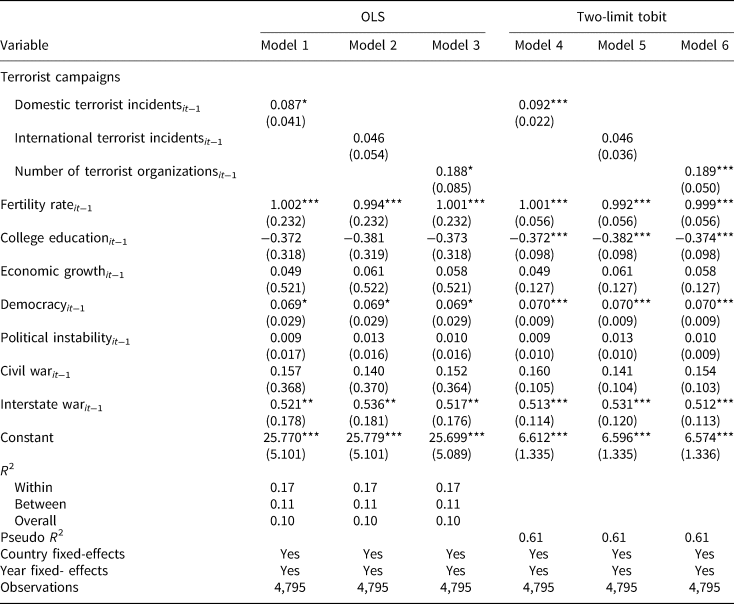
Table 1 shows the estimated coefficients and standard errors when the dependent variable is the percentage of Muslims in the population. The statistical significance levels of OLS coefficients in Models 1–3 appear weaker than those of the Tobit regression in Models 4–6.Footnote 16 The differences are likely caused by Tobit producing more consistent and less biased estimates than OLS, as the former handles the specific data type of the dependent variable – the percentage of Muslims in the country's population – better than the latter. When the effects of the three terrorist attack measures are examined across the table, I found that the results are worth considering. Models 1 and 4 indicate that the coefficient on the domestic terrorism variable is significantly different from zero; the international terrorism variable is not supported in Models 2 and 5; and in Models 3 and 6 the terrorist organization variable emerges as a positive predictor for the increase in the Muslim population.
Effect of terrorist campaigns on Muslim populations
Note: Robust standard errors, *P < 0.05, **P < 0.01, ***P < 0.001, two-tailed tests.
Those findings suggest that terrorist campaigns may be likely to increase the Muslim population globally. While terrorist campaigns carried out by domestic terrorist organizations may be likely to inspire non-Muslims to convert to Islam, those by international terrorists have little to do with the increase and decrease of Muslim populations. Given that a majority of terrorist attacks are domestic in nature, the statistical insignificance of the international terrorism variable may come as no surprise. In a similar vein, Mark Fallon, the former Head of the International Association of Chiefs of Police, said ‘the global environment is used to recruit these people, but it's generally some local condition or individual event in that person's life that turns them [to Islamic beliefs]’ (Saunders, Reference Saunders2013). Further, when considering how al-Qaeda affiliates and even the Islamic State's prioritize their global vs local allegiances, we could have expected the null finding on international terrorism. For example, al-Qaeda affiliates benefit from new sources of funding and operational cooperation, but most continue to pursue largely local agendas with both old members and new converts (Rollins, Reference Rollins2010; Mudd, Reference Mudd2012).
Among the five control variables, the indicators for fertility rate, democracy, and interstate war turn out to be powerful drivers for the growth of the Muslim population. As discussed, when countries have high fertility levels,Footnote 17 democratic tolerance (for diverse religious beliefs including Islam), and need for a religious consolation, Muslim populations are likely to proliferate. Other control variables, including civil war, fail to exert an independent effect consistently across the board.
The interpretations of the empirical results reported in Table 1 are based on the statistical significance of individual coefficients. But the statistical significance may not mean much in a practical sense, as a relatively large number of sample observations may have helped strengthen the significant result. To alleviate this issue, I calculated the substantive effects of the variables. I found that substantive effects are in line with statistical significance. For example, the probability that any country will experience an increase in the Muslim population heightens by 0.5% if it is exposed to one standard deviation increase of terrorist organizations and by 1% with two standard deviations (see correlations and descriptive statistics in Appendix 1). This calculation is based on Model 6.
The estimated results reported in Table 1 can be displayed in the form of graphs that help us to better see, which coefficients are significantly different from zero.Footnote 18 Furthermore, when the coefficients are standardized, they help gauge to decide which predictor is more influential in increasing the Muslim population. The estimated coefficients reported in Table 1 are not suitable for evaluating the relative importance of individual predictors because they are not standardized but instead measured in their natural units.
Based on Model 6 in Table 1, Figure 1 is drawn to display the relative importance of the standardized variables.Footnote 19 I found that the most influential factor is college education, followed by fertility rate, democracy, and the acts of terrorist organizations. This graphical presentation is consistent with the results of Model 6 in Table 1: terrorist campaigns are a significant driver for the increase in the global Muslim population. Although terrorist campaigns are not as influential as college education or fertility rate, their influence has policy implications since different factors likely lead to different outcomes. Some portion of converts who are inspired by terrorist campaigns may engage in a terrorist act, which could have a larger impact compared to their size.
Relative importance of the determinants of Muslim populations.
Note: Based on Model 6 in Table 1, the figure shows the point estimates and 95% confidence intervals.

The effect of terrorist campaigns may be conditioned on a number of country characteristics. For example, the transparency of democracy may facilitate the spread of information about terrorist campaigns and make it more accessible to non-Muslim sympathizers. To explore the possibility of conditional arguments, I first investigated whether any increase in the Muslim population may operate via one of the seven control variables. The nuanced assumption is that there is a direct effect of terrorism on Muslim populations, and an indirect effect of each of the control variables. Employing the Stata command, paramed, I conducted mediation analysis. Among the control variables, democracy exerts a relatively large, indirect effect on the size of the Muslim population. The other control variables appear to wield trivial influences. Based on the mediation results, I created an interaction term between democracy and each of the terrorism-related variables. I re-estimated Table 1 after adding the interaction term in each model and report the results in Table 2. Even after the interaction effect is considered, the main findings in Table 2 closely resemble those in Table 1: terrorist campaigns are a driver of the Muslim population growth.
Effect of terrorist campaigns on Muslim populations: interaction terms included

Note: Robust standard errors, *P < 0.05, **P < 0.01, ***P < 0.001, two-tailed tests.
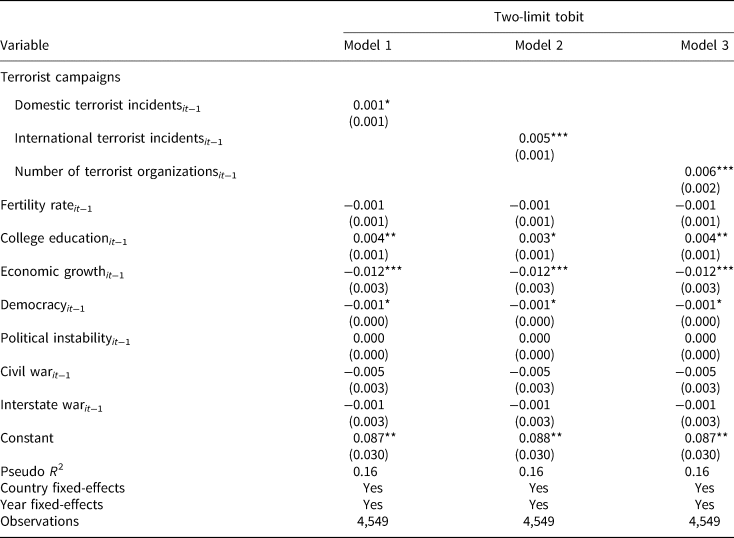
As robustness checks, Table 3 replicates Table 1 employing the second dependent variable – the change of Muslim populations. As far as the effects of the key predictors are concerned, the estimated coefficients do not deviate much from those reported in Models 4–6 in Table 1; the effect of terrorist campaigns remains significant and positive. Note that the proportion of the variance in the first dependent variable (population percentage) in Models 4–6 of Table 1 appears to be better explained by the regressors than that of the second dependent variable (the change of Muslim populations) in Models 1–3 of Table 3.
Effect of terrorist campaigns on the first difference of Muslim populations
Note: Robust standard errors, *P < 0.05, **P < 0.01, ***P < 0.001, two-tailed tests.
For the purposes of parsimony, the statistical models so far avoid including too many control variables. Excessive controls may produce results that are not stable from one specification to another. Political methodologists such as Ray (Reference Ray2003) and Achen (Reference Achen2002) contend that too many control variables in regression models spoil the pot. Nonetheless, as another robustness test, I added five more economic factors which Pew Research Center (2007, 2011, 2017) researchers believe affect the growth of Muslim populations: share of youth population – population ages 0–14 (% of total), mortality rate, neonatal (per 1,000 live births), net migration (i.e., the number of immigrants minus the number of emigrants), family planning – condom use, population aged 15–24, female (% of females ages 15–24), and urbanization – urban population growth (annual %). I gathered data for these variables from the World Bank's World Development Indicators 2017. Since the Tobit model with the first dependent variable (population percentage) is a suitable estimation method, Table 4 re-runs Tobit Models 4–6 of Table 1, adding the five economic controls. The estimated results in Table 4 coincide with those in Table 1: terrorist campaigns still emerge as a driver for the growth of the global Muslim population. Note that among the five newly added controls, the share of youth alone is a significant predictor of the population increase.
Determinants of Muslim populations: five economic factors added

Note: Robust standard errors, *P < 0.05, **P < 0.01, ***P < 0.001, two-tailed tests.
6. Conclusion
The empirical analysis that I performed in this study is important in understanding why Islam is growing worldwide. While existing studies provide demographic explanations such as high levels of fertility rates and immigration (Pew Research Center, 2007, 2011, 2017), I underscored the importance of exploring politico-security factors such as terrorism and conflict as drivers of increased Muslim populations. To be specific, I made three new contributions. First, I offered a novel theoretical perspective on why the world is witnessing the growth of the Muslim population. Second, I performed a first-cut systematic data analysis and find significant evidence for the terrorism and Muslims nexus. Even after controlling for popular demographic and socio-economic factors, I discovered that the rise of the Muslim population is positively associated with a series of terrorist attacks or organizational propaganda – terrorist attacks beget Muslim converts who then spread their religious beliefs to people they know, increasing the number of Muslims globally. The finding indicates that increases in the size of the Muslim population cannot be viewed exclusively as a result of non-politico-security factors such as high birthrates, immigration, and education level. But note that I generated the empirical finding without knowing exactly how many people, due to a lack of data, convert to Islam after successful terrorist campaigns. Third, my empirical analysis calls for broadening the scope of scientific inquiry. Researchers must build a bridge between the fields of demography and international relations to better explain why the world's Muslim population is growing fast.
The increase in religious conversions prompted by terrorist campaigns may not bode well for the architects of the ‘War on Terrorism’ in three ways. First, that terrorist attacks have occurred in an increasing number of countries since September 2011, and have grown deadlier should dismay counterterrorism officials. Future terrorist attacks will increase the exposure of potential converts to the lure of terrorist organizations. Second, the findings indicate that terrorist organizations are winning the hearts and minds of vulnerable populations, while the counterterrorism community fails to discourage many Muslim converts from becoming agents of terrorist violence. Third, the counterterrorism community will have a more difficult time deterring terrorist violence because many new Muslim converts are, as noted in Pérouse de Montclos (Reference Pérouse de Montclos2008), more prone to radicalization than traditional Muslims due to a zeal to prove their new-found faith. Jamal Ahjjaj, an imam at As-Soennah Mosque in The Hague, underscores that new converts are ‘the most vulnerable because they do not yet fully understand Islam.’ The imam also stated that ‘sometimes there are people – the wrong people – waiting outside the mosque to greet them’ (Faiola and Mekhennet, Reference Faiola and Mekhennet2015). I believe that the future of Islam depends not only on peaceful religious reform in Muslim communities, but also on the cultivation of a positive environment for new converts that assimilates them into non-violent societies.
Relying on a cross-national, time-series data analysis, I explored the relationship between terrorist campaigns and the growth of the global Muslim population through Islamic converts. My empirical exploration is more correlational than causal. It is difficult to directly test the theoretical perspective that I presented in this study to establish causality without using design-based causal inference techniques such as an instrumental variable approach, which would be challenging. Nonetheless, a possible research venue is to examine the effect of terrorist attacks on conversion rather than population growth, per se. However, such a research agenda requires a micro-level research design to establish a causal relationship between terrorism and conversion. A regression discontinuity or difference-in-difference design for one or a few countries could be used for this purpose. GTD provides geographic coordinates for each terrorist attack. It would be possible to conduct a micro-level analysis that examines spatial–temporal trends in conversion following terrorist attacks if conversion data can be compiled in the future. But coding which attacks are Islamist and which are not is prohibitive in a large cross-national, time-series context. Therefore, a micro-level approach with more careful coding of variables may be a better advancement for our scientific knowledge of terrorism, conversion, and the growth of the Muslim population.
Appendix 1 Correlations and descriptive statistics



