Introduction
Patients who visit their doctors very frequently pose a major problem in primary care. A small proportion of patients exert a disproportionate burden in terms of use of health care resources. Doctors often find high utilizers and patients with unexplained symptoms frustrating and difficult (Lin et al. Reference Lin, Katon, Von Korff, Bush, Lipscomb, Russo and Wagner1991; Hahn et al. Reference Hahn, Kroenke, Spitzer, Brody, Williams, Linzer and deGruy1996; Hanel et al. Reference Hanel, Henningsen, Herzog, Sauer, Schaefert, Szecsenyi and Löwe2009).
Research focused on trying to understand this patient group has consistently found that those who attend frequently are slightly more likely to be female and they are more likely to be: single, divorced, or widowed; of lower occupational social class; unemployed; suffering social adversity and lack of social support (Browne et al. Reference Browne, Humphrey, Pallister, Browne and Shetzer1982;Robinson & Granfield, Reference Robinson and Granfield1986; Karlsson et al. Reference Karlsson, Lehtinen and Joukamaa1994; Heywood et al. Reference Heywood, Blackie, Cameron and Dowell1998; Scaife et al. Reference Scaife, Gill, Heywood and Neal2000). A universal finding in this group is high rates of both psychological distress and psychiatric disorder (Karlsson et al. Reference Karlsson, Lehtinen and Joukamaa1995; Heywood et al. Reference Heywood, Blackie, Cameron and Dowell1998).
Rates of somatization among primary care frequent attenders are consistently high, varying between 16 and 45% (Katon et al. Reference Katon, Von Korff, Lin, Lipscomb, Russo, Wagner and Polk1990; Portegijs et al. Reference Portegijs, van der Horst, Proot, Kraan, Gunther and Knottnerus1996; Karlsson et al. Reference Karlsson, Joukamaa and Lahti1997; Jyvasjarvi, Reference Jyvasjarvi, Joukamaa, Vaisanen, Larivaara, Kivelä and Keinänen-Kiukaanniemi2001; De Waal et al. Reference De Waal, Arnold and Eekhof2004). Somatizing involves not only the experience of a medically unexplained symptom (MUS) but seeking medical care for this symptom. A recent cross-sectional primary care study found higher rates of both general practitioner (GP) attendance, and of the GP rating the doctor–patient relationship as difficult, in patients with any one of three mental disorders: anxiety, depression or somatoform disorder (Hanel et al. Reference Hanel, Henningsen, Herzog, Sauer, Schaefert, Szecsenyi and Löwe2009). Attachment theory has provided a framework for understanding care seeking and giving, and several reviews have suggested that it may be a fruitful line of enquiry in understanding doctor–patient relationships (Taylor & Mann, Reference Taylor and Mann1999; Hunter & Maunder, Reference Hunter and Maunder2001; Maunder & Hunter, Reference Maunder and Hunter2001; Thompson & Ciechanowski, Reference Thompson and Ciechanowski2003). Baseline results of the current study found that presentation to the GP with unexplained physical symptoms is associated both with insecure attachment style and with psychological distress when compared with presentations with organic symptoms (Taylor et al. Reference Taylor, Mann, White and Goldberg2000). A primary care study in the USA found an association between high utilization and insecure preoccupied attachment style in female patients (Ciechanowski et al. Reference Ciechanowski, Walker, Katon and Russo2002). The aim of this study was to test the hypothesis that patients with an insecure attachment style would display higher levels of care seeking from the GP through more frequent attendance. A secondary hypothesis was that amongst those with an insecure attachment style, those with insecure anxious attachment would be more likely to be frequent attenders than those with insecure avoidant attachment.
Method
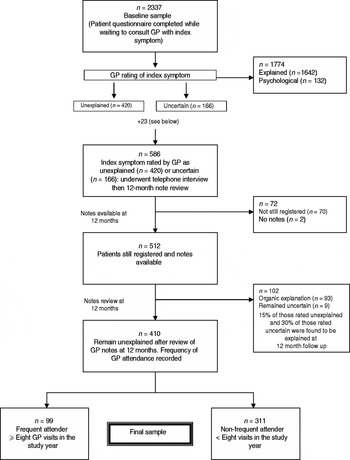
The process of recruitment and follow-up of patients in the study is outlined in a flow diagram (Fig. 1).
Flow diagram of the study, showing patient numbers at each stage. GP, General practitioner.

Patient recruitment and baseline measures
Recruitment took place in 10 general practices in and around London. Practices covered both suburban mainly white areas of Greater London and its outskirts; and severely deprived inner-city London areas with high ethnic minority populations.
Consecutive attenders waiting to see their doctor were asked to complete a brief self-completed questionnaire (Appendix 1, The Patient Questionnaire). All patients over 16 years, seeing the doctor about a problem that began within the previous 12 months, were included. Doctors completed a brief rating on all patients they saw of the type of presentation (Appendix 2, The Doctors' Rating Sheet).
Selection of the unexplained symptoms cohort
All patients attending with a physical complaint that had its onset in the past 12 months, and was rated B (GP unable to assign explained or unexplained as awaiting investigation result) or C (GP felt definitely non-organic symptom) by the GP on the The Doctors' Rating Sheet, were entered into the cohort for follow-up.
Follow-up of the unexplained cohort
Baseline telephone interview with the follow-up cohort
All patients recruited were telephoned by the first author (R.E.T.) as soon as possible after their consultation. The telephone interview was a modified version of the Short Explanatory Model Interview (SEMI; Lloyd et al. Reference Lloyd, Jacob, Patel, St Louis, Bhugra and Mann1998) and covered the following: worry about symptom and general health worry, reassurance, usefulness of the consultation, the patients' explanatory model of their symptom, and actions taken by the doctor.
Twelve-month follow-up note review
The notes of all patients included in the follow-up cohort were reviewed by R.E.T. and another doctor and three pieces of information extracted:
(1) Whether investigations found that the initial MUS had an organic explanation. This decision was also checked with each patient's own GP.
(2) The number of self-initiated GP visits was recorded, excluding visits for routine monitoring or screening at the request of the practice.
(3) The presence of any chronic physical or psychiatric illness diagnosis was recorded.
Method of analysis
All analyses were performed using Stata software (StataCorp LP, USA). The main outcome measure in this study was frequency of self-initiated GP consultation over the 1-year follow-up period. As the distribution of consultation frequency was very skewed, the outcome was dichotomized. Definitions of what constitutes a frequent attender in the literature varies between six (Corney & Murray, Reference Corney and Murray1998) and twelve visits (Heywood et al. Reference Heywood, Blackie, Cameron and Dowell1998; Scaife et al. Reference Scaife, Gill, Heywood and Neal2000), with eight being a common cut-off (Robinson & Granfield, Reference Robinson and Granfield1986). The sample was divided into quartiles and the top quartile (eight or more visits) was compared with the remaining three quarters. Exposure variables were grouped into three broad groupings:
(1) Sociodemographic.
(2) Background health factors.
(3) Factors in the index consultation with the unexplained complaint, including: (a) type and chronicity of initial unexplained symptom; (b) baseline level of non-specific symptoms [Brief Symptom Inventory (BSI; Derogatis & Melisaratos, Reference Derogatis and Melisaratos1983)], and baseline physical disability [Short Form 36 Health Survey (SF-36; Jenkinson et al. Reference Jenkinson, Layte, Wright and Coulter1996) physical subscale]; (c) psychological distress [General Health Questionnaire 12 Item Version (GHQ-12; Goldberg & Williams, Reference Goldberg and Williams1998)] and health worry (SEMI; Lloyd et al. Reference Lloyd, Jacob, Patel, St Louis, Bhugra and Mann1998); (d) patient's attribution of the cause of the unexplained symptom; (e) patient-; and (f) doctor-related factors in the initial consultation. The patient factors in the initial consultation included whether the patient felt reassured; whether patient felt the symptom was well explained, whether patient felt the consultation was useful, and level of satisfaction with the consultation. All these were collected in the telephone interview with the patient. The doctor-related factors in the initial consultation included: (i) the rating of psychiatric distress made by the doctor (from the questionnaire that the GP completed when rating the symptom); (ii) the explanation given for the symptom by the doctor: physical, emotional, mixed, no explanation; (iii) congruence of GP and patient view: congruent, incongruent, no GP/patient view; (iv) the doctor's management: investigation: yes or no, prescription of medication: yes or no; and (v) the prognosis offered by the doctor: either ‘none’, ‘good’ or ‘bad’. Factors (ii), (iii) and (iv) were collected by telephone interview of the patient after consultation.
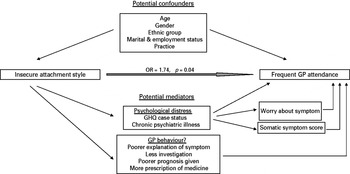
Initially, univariate analyses were used to establish any variables significantly related to both outcome (frequent attendance) and attachment style. Where these are not on the causal pathway they are controlled for as confounders, whilst those variables on the causal pathway are mediators (Fig. 2). Definite confounders or mediators were those variables which altered the crude odds ratio (OR) of insecure attachment in frequent attenders by more than 10%. Practice was also controlled for in case there was some practice effect operating.
Suggested model for the relationship between insecure attachment and frequent general practitioner (GP) attendance, showing potential confounders and potential mediating factors. OR, Odds ratio.

Logistic regression was used to investigate the association between insecure attachment and frequent attendance adjusting for confounders and mediators. The results are reported as ORs rather than as relative risk (Cook, Reference Cook2002).
Results
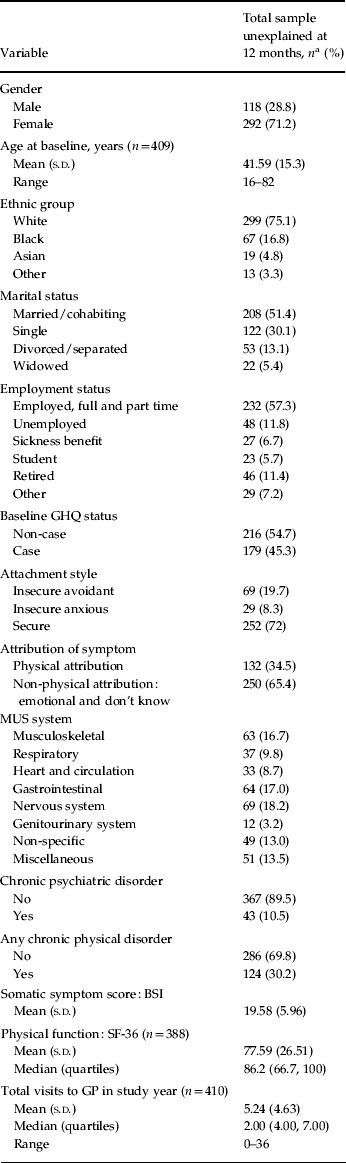
A total of 410 patients were included in the analysis. Their sociodemographic characteristics and scores on the main variables of interest are described in Table 1.
Characteristics of the final sample: patients recruited with unexplained complaints that remained unexplained at follow-up (n=410)

s.d., Standard deviation; GHQ, General Health Questionnaire; MUS, medically unexplained symptoms; BSI, Brief Symptom Inventory; SF-36, Short Form 36 Health Survey; GP, general practitioner.
a Where n<410, data are missing on that variable.
Testing the hypothesized relationship between insecure attachment and frequent attendance
There is a significant association between an insecure attachment style and being a high frequency GP attender (χ2=4.35, p=0.04).
Testing the secondary hypothesis that insecure anxious attachment is more associated with frequent attendance than insecure avoidant attachment
Patients with both avoidant and anxious styles of insecure attachment were more likely to be frequent attenders, and there was no significant difference between these subtypes of insecure attachment style (χ2=0.15, p=0.69). Therefore for the remainder of the analysis the two insecure attachment styles were combined.
Potential confounding and mediating factors
Exploration of the data identified age as the only definite confounder. Other potential confounders were considered which are established risk factors for frequent attendance: Sociodemographic factors including gender, marital status and employment status; and the pre-existing diagnosis of a chronic physical disease.
The following definite mediators were identified: variables indicating psychological distress – chronic psychiatric illness diagnosis, raised baseline GHQ score, and high baseline worry; and high baseline somatic symptom score (BSI).
None of the variables concerned with GP behaviour and management was a potential confounder. The causal attribution that patients made for the index symptom was a significant effect modifier (see below).
Testing the hypothesis adjusting for potential confounding and mediating variables in a multivariate analysis
Adjusting for confounders
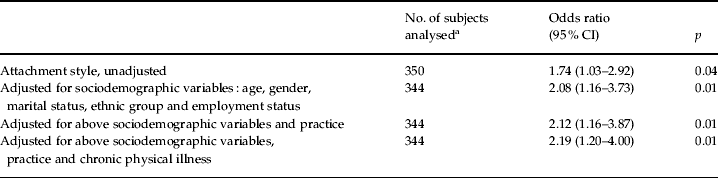
Adjustments were made in a stepwise manner and the results are displayed in Table 2.
Logistic regression estimates for the association between insecure attachment style and being a frequent attender to general practice adjusted for confounders (n=350)

CI, Confidence interval.
a Where n<350, this is due to missing observations on particular variables.
Simultaneous adjustment for all sociodemographic variables slightly increased the strength of the significant relationship between insecure attachment style and being a frequent attender. Adjustment for which practice the patient attended made little difference, showing that there is no significant effect of practice. Additional adjustment for the presence of a chronic physical disorder increased the strength of this relationship still further.
Causal attribution interaction
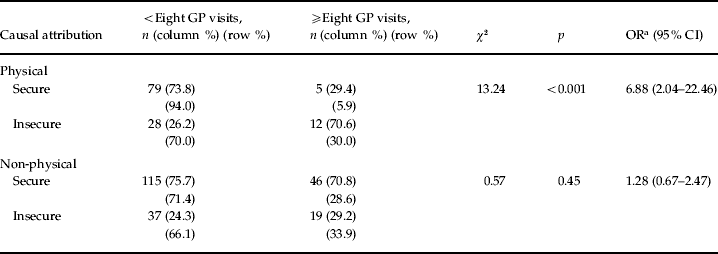
The relationship between insecure attachment and frequent attendance is shown separately for the two different types of attribution in Table 3.
Effect modification of causal attribution on the relationship between attachment style and frequent attendance

GP, General practitioner; OR, odds ratio; CI, confidence interval.
a This is the OR of insecure compared with secure attachment in the high-frequency attenders compared with low-frequency attenders.
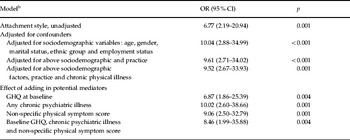
There is a particularly strong relationship between insecure attachment and being a frequent attender (OR 6.88, p<0.001) in the subgroup of patients who make physical attributions for their unexplained complaints. The presence of this interaction requires that the logistic regression be repeated including the interaction term. When this is done and the OR examined in the physical attribution subgroup (Table 4), there is a much stronger relationship between insecure attachment style and frequent attendance (OR 6.77 [95% confidence interval (CI) 2.19–20.94]). The CIs are much wider, as this relationship is based on a small number of cases, though the relationship is highly significant (p=0.001). The crude OR in the non-physical attribution subgroup is 1.28 (95% CI 0.67–2.46) and non-significant (p=0.45). The attachment–frequent attendance relationship remains non-significant in this subgroup after adjusting for confounders.
Logistic regression estimates for the association between insecure attachment style and being a frequent attender including the interaction term for interaction with causal attributionFootnote a

OR, Odds ratio; CI, confidence interval; GHQ, General Health Questionnaire.
a The Table shows crude ORs in the physical attribution subgroup, then adjusted for confounders and then mediators.
b The logistic regression model was fitted to the data for all subjects and included a term for the interaction of attribution and attachment style. Results for the effects of attachment style in the physical attribution subgroup are reported in this Table.
As the significant association between an insecure attachment style and frequent attendance only exists in the subgroup of patients who make physical attributions for their index unexplained symptom it is only meaningful to look at potential mediators in this subgroup. The potential mediators were added to the model including confounders together with an interaction term so that the effect of the mediators was only examined in the physical attribution subgroup. The results are shown in Table 4. The only mediating variables that could be considered were those in which there were not an undue number of missing values, because the sample was quite small at this stage. These were GHQ case status at baseline, the presence of any chronic psychiatric illness and the score of non-specific somatic symptoms at baseline (BSI). The only one of these which has a substantial effect on the OR is the baseline GHQ which reduces it by 2.65, though it remains highly significant (p=0.004). There was no evidence that the presence of a chronic psychiatric illness had any substantial mediating effect. Somatic symptom score (BSI) had no mediating effect.
Discussion
Attendance rates
This cohort of patients had a mean consultation frequency over the follow-up year of 5.24. This is higher than the mean of 2.9 found in the general population of GP attenders (McCormick et al. Reference McCormick, Fleming and Charlton1995). This is expected, as only patients who had an unexplained complaint at baseline were followed, and they are a group more likely to have abnormal illness behaviour.
Prevalence of insecure attachment
The prevalence of insecure attachment in this cohort is slightly lower than that reported in other studies, though there is a bias in the attachment literature to studies of young women who would be expected to have higher rates, and other available data are mainly on North American samples (Hazan & Shaver, Reference Hazan and Shaver1987; Gittleman et al. Reference Gittleman, Klein, Smidler and Essex1998; Stein et al. Reference Stein, Jacobs, Ferguson, Allen and Fonagy1998).
The relationship between attachment style and frequent attendance
A significant association was found between insecure attachment style and being a frequent attender, prior to any adjustment for potential confounders. A frequent attender was nearly twice as likely to report insecure attachment style (crude OR 1.74) (see Table 2). There was, however, no specificity of effect on frequency of attendance between the two insecure styles contrary to the second hypothesis. The only other study of attachment style and frequent attendance was conducted in an all-female US primary care sample, and found that those with avoidant styles actually attended less, and those with preoccupied/anxious styles attended more, than those with secure attachment (Ciechanowski et al. Reference Ciechanowski, Walker, Katon and Russo2002). The current study is smaller and so may have lacked power to distinguish between the insecure styles. Alternatively it may be that the relationship between anxious attachment and frequent attendance is specific to women and so the effect was diluted in the current study which also included men. Other studies have found an association between psychopathology and insecure attachment, with no difference between insecure styles (Mickelson et al. Reference Mickelson, Kessler and Shaver1997; Gittleman et al. Reference Gittleman, Klein, Smidler and Essex1998).
Adjusting for potential confounders did not remove, and actually strengthened the association of insecure attachment with frequent attendance. Further analysis revealed an interaction with the type of attribution that patients made for their baseline unexplained symptom, the relationship being very strong in patients who believed that there was a physical cause for their unexplained symptom. This finding supports clinical experience, as it is precisely the group of patients who not only present with an unexplained complaint, but who attribute this complaint physically who would fall within a clinical group defined as somatizers (patients who express psychosocial distress physically) (Goldberg & Bridges, Reference Goldberg and Bridges1988; Bridges et al. Reference Bridges, Goldberg, Evans and Sharpe1991). Clinical experience and other research identify somatizers as a distinct clinical group, with a particular aetiology and pattern of behaviour (Bridges et al. Reference Bridges, Goldberg, Evans and Sharpe1991; Craig et al. Reference Craig, Boardman, Mills, Daly-Jones and Drake1993, Reference Craig, Drake, Mills and Boardman1994). These data go a step further than previous work in suggesting that an insecure attachment style may be important in the consulting behaviour of patients who somatize. These patients have a pathological way of relating to others, which is reflected in a pathological relationship with a professional carer such as their doctor.
Limitations of the study
The main limitation of the study is that the attachment measure used is brief and only self-report. However the same relationship between insecure attachment and frequent attendance was found in a small subsample of patients using a more detailed interview-based measure of attachment (data not reported). Future studies are needed that focus on high-frequency attenders and use detailed interview-based attachment measures incorporating objective information, as well as gathering information on childhood experience of care. Further research into brief attachment measures is needed if they are to be useful in epidemiological research; particularly data are needed on their contamination by mental state measures such as the GHQ and their stability over time.
The interaction with attribution of physical symptom is interesting and suggests that persons with a secure attachment style and physical attribution of symptoms were very unlikely to be frequent attenders. It may be that patients with insecure attachment and physical attributions tend to somatize more and therefore attend their GPs more frequently. However, the numbers in this subgroup analysis are small and the CIs are large, so no definite conclusions can be drawn. Also this analysis is based on the patients' attribution in relation to the index symptom, and an assumption is made that this reflects a patient's general tendency to make physical attributions. This finding would need to be explored further in a larger sample.
Conclusion
This study found a significant association between insecure adult attachment style and frequency of GP consultation in a cohort of patients who had made an index presentation with a MUS. This association was particularly strong in the subgroup of patients who made physical attributions for their unexplained complaints, and it persisted after controlling for sociodemographic factors and the presence of chronic physical disease. The association was only partly mediated by psychological distress.
Implications of the study
Frequent attenders and particularly those who somatize are often managed using a narrow medical model. They can receive repeated investigations and referral, leading to excess consumption of resources and potential iatrogenic damage. Understanding their behaviour as pathological help seeking driven by difficulties in relating to caregiving figures may help doctors to see the behaviour of their frequently attending patients in a new way. This may reduce the frustration engendered in doctors by such patients, and enable doctors to devise different management strategies. Such strategies might include the following: (a) recognizing that the patient may want support rather than another test, and directly addressing pathological health anxiety and worry; and (b) placing explicit boundaries on consulting behaviour, for example, scheduling regular checks for reassurance rather than the patient driving frequency of consultation. This may enable a patient to receive regular care without it being contingent on symptom production. The finding that frequent attendance is associated with abnormal attachment style would suggest that efforts should be made to keep this group of patients seeing the same GP where there is a greater chance that a trusting relationship will develop than if they constantly see different doctors. Over time a therapeutic relationship can be developed in which underlying psychological and social issues may be revealed.
Appendix 1
The Patient Questionnaire
1. The presenting complaint: patients were asked about the reason for consultation and the duration of the symptom.
2. Sociodemographic information: age, gender, marital status, ethnic group, employment status and occupation.
3. Attribution of symptoms: patients were asked what they thought was the cause of their problem and were offered four possible response categories: (i) physical disease; (ii) emotional or stress related; (iii) a mixture of these; (iv) don't know. This rating has been used in previous primary care somatization studies (Morriss et al. Reference Morriss, Gask, Ronalds, Downes-Grainger, Thompson, Leese and Goldberg1998). For the purposes of some analyses, these groups were combined into two groups: emotional attribution (ii and iii) or no emotional attribution (i and iv).
4. Attachment style: a self-rated measure of adult attachment style, the Attachment Style Questionnaire (ASQ) (Hazan & Shaver, Reference Mickelson, Kessler and Shaver1997), was used. On the basis of their choice, patients can be divided into a secure attachment style, or one of two insecure styles: dismissive or anxious ambivalent.
5. Psychiatric distress: self-rated psychiatric symptoms were measured using the General Health Questionnaire 12 Item Version (GHQ-12) (Goldberg & Williams, Reference Goldberg and Williams1998).
6. Somatic distress: self-rated current somatic symptoms were measured using the Brief Symptom Inventory (BSI) (Derogatis & Melisaratos, Reference Derogatis and Melisaratos1983).
7. Physical disability: this was measured using the physical subscale of the Short Form 36 Health Survey (SF-36) (Jenkinson et al. Reference Jenkinson, Layte, Wright and Coulter1996).
Appendix 2
The Doctors' Rating Sheet
Throughout the period of recruitment the doctors filled in a one-line rating on every patient seen during each surgery. This sheet rated the following:
1. Main complaint: GPs recorded the main reason for consultation.
2. GPs' view of complaint: If the complaint was physical, GPs rated it into three categories:
A. Explained: patients who had presented to their doctor with a physical symptom for which the doctor thought there was an organic explanation.
B. The GP felt unable to assign the physical symptom as awaiting results of investigations.
C. Unexplained: patients who had presented with a physical symptom for which the doctor thought there was no organic explanation. These three categories were developed and used in a previous study of somatization in primary care (Morriss et al. Reference Morriss, Gask, Ronalds, Downes-Grainger, Thompson, Leese and Goldberg1998).
3. Action/management: GPs were asked to note briefly what action they had taken.
Acknowledgements
The authors are very grateful to the partners, staff and patients of all the surgeries that took part in the study. These surgeries were: Stonecot Surgery, Sutton, Surrey; Elm Lodge Surgery, Burbage Road, Dulwich; Cheam Family Practice, Parkside & Elmbrook branches, Cheam, Sutton, Surrey; The Acorn Surgery, Meeting House Lane, Peckham; The Surgery, Vassall Road, Camberwell; The Albion Street Health Centre, Rotherhithe; The Jenner Practice, Forest Hill; The Rowans Surgery, Streatham; The Waterloo Health Centre, Lower Marsh, Waterloo; The Rushey Green Group Practice, Lewisham. I would like to acknowledge the work of the following in assisting with data collection: Fiona Scott, Debbie Cooke, Alison Gould, Katherine Owen, Duncan Stevens, Phil Ferreira-Lay, Lucy Spirling, Arthur Spirling, Brendan Moran, David Hartley.
The study was funded by the Wellcome Trust through a Clinical Epidemiology Fellowship to R. E. T. All authors declare that they have not received any financial support from, nor do they have any financial interests in or affiliation with any organization whose financial interests may be affected by material in the paper.
Declaration of Interest
None.