Introduction
The mixed provision of welfare is a classic hallmark of European welfare states (Powell, Reference Powell and Powell2007). However, recent international scholarship has been pointing to a historically new process of institutional hybridisation between the state, the market and the third sector (Billis, Reference Billis2010; Bode, Reference Bode2006; Brandsen et al., Reference Brandsen, van de Donk and Putters2005, Reference Brandsen, Dekker and Evers2010; Evers, Reference Evers2005). The mixed welfare system as it took shape in the previous century was characterised by the primacy of the state, and a negotiated partnership with the third sector – yet with a clear separation between the structuring principles of both sectors (Evers, Reference Evers2005). This ‘organised welfare mix’ is currently undergoing a trend towards ‘disorganisation’ (Bode, Reference Bode2006), as a result of increasing governability problems (Ascoli and Ranci, Reference Ascoli, Ranci, Ascoli and Ranci2002; Bode, Reference Bode2006; Evers, Reference Evers2005; Jessop, Reference Jessop1999; Powell, Reference Powell and Powell2007). The state is no longer in a position to coordinate and control the provision of welfare, and its bureaucratic steering mechanisms are considered deficient. This has caused a trend towards new modes of coordination of social welfare in Europe, a trend usually referred to as a ‘shift from government to governance’ (Jessop, Reference Jessop1999). The system-wide coordination by the state is interchanged with modes of governance based on volatile and heterogeneous networks and partnerships with both the market and third sector (Bode, Reference Bode2006; Evers, Reference Evers2005; Jessop, Reference Jessop1999). Dominant hypotheses in the literature argue that competition rather than collaboration is emphasised, and welfare states increasingly act as regulators and purchasers of services provided by for-profit organisations and third-sector organisations (TSOs) (Bode, Reference Bode2006; Brandsen et al., Reference Brandsen, van de Donk and Putters2005; Henriksen et al., Reference Henriksen, Smith and Zimmer2012).
Furthermore, the changing governance of welfare also affects the operational principles of welfare provision, which are increasingly redesigned according to market-oriented principles. Public administrations are restructured in accordance with new public management (NPM) principles, which are characterised by performance results, contracting out, the attainment of accountability and efficiency through individual achievement of set targets, behavioural coaching and ongoing evaluation (Bode, Reference Bode2006; Evers, Reference Evers2005; Phillips and Smith, Reference Phillips, Smith, Phillips and Smith2010). Contractual relations and accountability demands increasingly replace traditional welfare partnerships based on trust and mutual agreement. For example, the state exhibits an increasing openness towards the market as a social service deliverer, and is more frequently involved in buying and regulating commercial services. For-profit organisations adapt non-profit values by behaving according to the (contested) principles of ‘corporate social responsibility’ (Rajak, Reference Rajak2011; Tulder and Zwart, Reference Tulder and Zwart2006). Market principles that intrude upon the public sector increasingly confront TSOs with a new contract culture based on competition, efficiency and output performance (Anheier, Reference Anheier2009; Dart, Reference Dart2004; Eikenberry and Drapal, Reference Eikenberry and Drapal2004).
As a result of this historical reconfiguration, a ‘new era of welfare hybridity’ has been heralded (Billis, Reference Billis2010), in which social services are increasingly being delivered by new types of ‘hybrid organisations’ that possess significant characteristics of more than one sector (public, private, third) (Billis, Reference Billis2010; Bode, Reference Bode2006; Brandsen et al., Reference Brandsen, van de Donk and Putters2005). As Billis (Reference Billis2010: 11–12) has argued, ‘the notion of “the mixed economy of welfare” does not entirely capture what is happening: what we are facing are fundamental changes in the nature of the organizations that are financing, planning and delivering welfare – it is not just the economy, but also the organizations themselves that have become “mixed”’ (emphasis added). This has convinced several scholars that the ‘sector metaphor’ has to be transcended, and that ‘hybridity’ instead has to be considered a permanent characteristic of the welfare system (Billis, Reference Billis2010; Brandsen et al., Reference Brandsen, van de Donk and Putters2005; Evers, Reference Evers2005).
Although ‘welfare hybrids’ thus seem to play an increasingly prominent role in social policy's organisational landscape and are claimed to pose radical challenges to conventional sector logics, empirical knowledge on the exact nature of these hybrid ‘mixes in the welfare mix’ (Evers, Reference Evers, Evers and Svetlik1993) is limited. As yet, ‘hybridity’ to a large extent remains a fuzzy concept and it lacks a comprehensive indicator model (Glänzel and Schmitz, Reference Glänzel and Schmitz2010). While there is a general notion of the dimensions of organisational hybridity, a multi-dimensional assessment of how these dimensions intertwine is lacking. Furthermore, the general diagnosis of hybridisation to a large extent is based on observed transformations in the Anglophone context. While it is assumed that current welfare reorganisations lead to a convergence between different welfare regimes, cross-national variations in institutional contexts need to be acknowledged (Bode, Reference Bode, Phillips and Smith2010; Henriksen et al., Reference Henriksen, Smith and Zimmer2012; Phillips and Smith, Reference Phillips, Smith, Phillips and Smith2010).
In this article, we aim to address these limitations by analysing the extent to which organisational hybridity is present among third-sector organisations in Flanders, the Dutch-speaking region of Belgium. This country is a typical example of a continental welfare state and a corporatist non-profit regime (Salamon et al., Reference Salamon1999). Against the broader theoretical background of heralded welfare reform, we explore in this particular context what types of organisational hybrids can be observed, if at all, and what their main features are. We thus provide a snapshot of the existing organisational hybridity under present-day conditions, using fine-grained data on the organisational characteristics of contemporary TSOs in the area of social welfare provision in a corporatist non-profit regime.
In the remainder of this article, we first aim to conceptualise and contextualise organisational hybridity within the specific context of our research. We argue that it is important to consider the particular ‘starting position’ of the welfare regime under scrutiny (compare Henriksen et al., Reference Henriksen, Smith and Zimmer2012; Bode, Reference Bode, Phillips and Smith2010). Second, we identify key dimensions of organisational hybridity for the purpose of measuring it empirically. Third, using data from a survey of 255 Flemish TSOs, we construct a classification of TSOs based on the extent and nature of their hybridity. Finally, we present and discuss our findings.
Conceptualising and contextualising organisational hybridity
In the existing literature, organisational hybridity in the third sector has been mainly discussed in terms of a binary distinction between ‘classic’ voluntary associations and ‘hybrid’ TSOs (Ascoli and Ranci, Reference Ascoli, Ranci, Ascoli and Ranci2002; Eliasoph, Reference Eliasoph2009; Milligan and Fyfe, Reference Milligan and Fyfe2005). Milligan and Fyfe (Reference Milligan and Fyfe2005) for instance find an increasing – though not entirely clear cut – ‘bifurcation’ of the third sector in the UK into more traditional ‘grassroots’ organisations and larger hybrid, corporatist organisations. The former are informally and non-hierarchically structured and focus on community participation and active citizenship. The latter are formally and hierarchically structured, influenced by processes of bureaucratisation, professionalisation and marketisation, and operate at a growing distance from the community, which results in a more passive consumership. In the US, Eliasoph (Reference Eliasoph2009) distinguishes between ‘old-fashioned’ civic or voluntary associations and newly prevalent ‘hybrid’ organisations. While the former represents the ideal typical and almost immaculate world of spontaneous, uncoerced, community-based grassroots association, the latter means that ‘the state operates in partnership with organizations that are not part of the state – especially organizations whose primary goal is not profit-making. In other words, instead of operating through a distant, central government, [hybrid organizations] operate through a dizzy array of semi-civic, semi-private, semi-state agencies’ (Eliasoph, Reference Eliasoph2009: 293). Salamon (Reference Salamon1999) draws a further division in the US landscape between ‘public-oriented’ and ‘commercial’ hybrid TSOs in terms of their financial resources and service delivering scope. Public-oriented TSOs depend largely on donations and cooperate with government, whereas commercial TSOs support their operations primarily by fees, service charges and other commercial forms of income and focus on fee-paying clients.
According to these scholars, in the Anglophone context, ‘organisational hybridity’ means a departure from the ‘pure’ voluntary associations and is seen as a consequence of increasing government intrusion in the traditional grassroots-based voluntary sphere. This interpretation, however, does not match the legacy of long-standing institutional collaboration between the state and the third sector in continental Europe. Indeed, as Bode (Reference Bode, Phillips and Smith2010) observes, ‘the respective dynamics in countries with a longer tradition of institutionalized partnerships between civil society and the state have hitherto been marginal to the international debate. This is a serious lacuna in the literature because taking these dynamics into account may change the overall picture regarding the future of state–non-profit relations in the twenty-first century’ (pp. 116–17).
In the particular context of the corporatist regime characteristic of Continental European welfare states, Bode (Reference Bode, Phillips and Smith2010) therefore argues that the ‘new’ hybridity in terms of close intersectoral collaboration actually is ‘old hat’. When it comes to the evolutionary dynamics of these regimes, he argues that a ‘post-corporatist’ model is evolving as a result of the (quasi)-marketisation of relationships between the third sector and its public stakeholders. This ‘creeping marketization’ stands for the deregulation of public service provision, which has introduced competition and rivalry in the corporatist mode of governance. As a result, traditional partnerships are in a permanent state of disorganisation.
In studying organisational hybridity empirically, we therefore argue that it is important to consider the ‘starting position’ of the TSO-sector in a particular welfare regime that is under scrutiny – such a contextualisation is currently insufficiently developed (compare Bode, Reference Bode, Phillips and Smith2010; Henriksen et al., Reference Henriksen, Smith and Zimmer2012). This starting position refers to what a ‘classic’ TSO consists of in a particular context. In our case, in Flanders/Belgium, an example of a corporatist regime, TSOs are historically private organisations that deliver services on behalf of government. In return, they receive subsidies by means of which a paid workforce can be engaged. Most of these TSOs can be observed in the welfare and health care sectors, as well as in education and (to a lesser extent) in the socio-cultural sector. Belgium is a typical example of a third-party government, in which private TSOs act as governmental agencies delivering public services on behalf of government (Salamon, Reference Salamon1987; Salamon et al., Reference Salamon1999). These ‘classic’ TSOs in a third-sector regime like Flanders can then be characterised as: being publicly financed, having professional staff (as service deliverers), having a stakeholdership that emphasises governmental needs, having low autonomy vis-à-vis government in terms of deciding on organisational tasks and mission and having public-sector values. This is a fundamentally different ‘starting position’ compared to countries with a TSO-sector that is (historically) mainly ‘grassroots’. Such TSOs, which typically have a much weaker bond with government, are characterised as: having private financing, engaging a lot of volunteers, having a stakeholdership that emphasises the owner's mission, focusing more on expression (advocacy), having grassroots values and independence in mission definition.
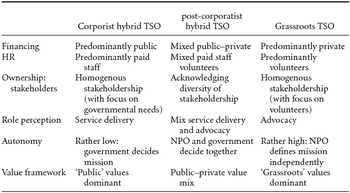
What does this mean in terms of the general diagnosis of a ‘hybridisation’ of TSOs? In a country that is characterised by third-party government, like Belgium, hybridisation would then mean a shift from a close relationship with government to a more mixed pattern of characteristics. On the contrary, in a country where TSOs traditionally are more grassroots, hybridisation could mean something else, e.g., stronger institutional bonds with government. While our study should be situated in the broader literature that describes a dynamic perspective, namely TSOs becoming more hybrid as a result of evolving government–third-sector relationships (e.g. Billis, Reference Billis2010; Phillips and Smith, Reference Phillips, Smith, Phillips and Smith2010; Henriksen et al., Reference Henriksen, Smith and Zimmer2012), our main aim is to examine the extent to which the heralded organisational hybridity is currently built into a particular (corporatist) context and how this is reflected by organisational characteristics taking shape in the third sector of the country under study. Therefore, based on our literature review, we distinguish between three ideal types of organisations. First, we distinguish between the two institutionally different ‘starting positions’ as described above: third-party government TSOs (like in Flanders) and grassroots TSOs (like in the US). While grassroots TSOs can be considered as idealtypically ‘pure’ voluntary associations, third-party government TSOs represent the classic corporatist form of hybridity. Both types of TSOs can be delineated on the basis of several dimensions that in the reference literature have been identified as key dimensions of hybridity: financial and human resources, ownership, role perception, level of autonomy vis-à-vis government and identity or value-orientation (Anheier, Reference Anheier2005, Reference Anheier2009; Billis, Reference Billis2010; Evers, Reference Evers2005, Reference Evers and Osborne2008; Glänzel and Schmitz, Reference Glänzel and Schmitz2010; Karré, Reference Karré2011). In the context of corporatist regimes, then, a ‘new’, ‘post-corporatist’ form of hybridity can be delineated as well. This ‘post-corporatist’ hybrid ideal type takes a middle position on each of these dimensions, between third-party and grassroots TSOs, which means, conceptually, that hybrid TSOs are organisations that:
-
• are financed by public and private means simultaneously;
-
• have a mix of paid staff and volunteers;
-
• have mixed stakeholders with an interest in what the TSO does;
-
• perceive their role as both service delivery and advocacy;
-
• are not totally autonomous vis-à-vis government – they determine mission, target groups, desired results and working procedures in cooperation with government;
-
• have a value set that mixes public-sector and private-sector values.
Table 1 provides a conceptual map for exploring different types of organisational hybridity depending on context. In Flanders/Belgium, given the starting position of third-party government, we expect that a large share of Flemish TSOs (still) will correspond strongly to the model of third-party government. The heralded changing welfare mix however would imply that we will discern a group of TSOs that resemble the post-corporatist hybrid idea type, meaning that their bonds with government are weaker than can be expected of a TSO in a third-party regime. Finally, while grassroots-like TSOs exist, we do not expect them to play a prominent role within the Flemish context.
Three idealtypes of third sector organisations

Method
Sample
Our sample should be situated in a particular institutional landscape. As already mentioned, Belgium has been identified as a corporatist third-sector regime, characterised by high government social spending combined with a large third sector (Salamon et al., Reference Salamon1999). Indeed, the Belgian third sector was ranked as the third largest (after the Netherlands and Ireland) among twenty-two countries (Salamon et al., Reference Salamon1999). As a result of its particular historical configuration, the influence of the two main socio-political pillars is still prominent: on the one hand, it depends heavily on government funding and public institutions (socialist heritance), but, on the other, it is based on collective services by volunteers in the realm of the private sector as well (Christian heritance) (Mertens et al., Reference Mertens, Adam, Defourny, Mareé, Pacolet, Van de Putte, Salamon, Anheier, List, Toepler and Wojciech Sokolowski1999). Both elements akin to the public sector as well as to the third sector are thus already embedded in the third sector's socio-genesis. With 86 per cent of TSOs involved in service-delivery, the Belgian third-sector is service dominant. In relation to the total workforce, 10.9 per cent of the economically active population was employed in the third sector, and 21.7 per cent of full time employees (FTEs) in the third sector were volunteers – a moderate share in a cross-national perspective (Salamon and Sokolowski, Reference Salamon, Sokolowski, Dekker and Halman2003). Between 1998 and 2005, the third sector in Belgium saw rapid professionalising, with a growth percentage of paid employment two times higher than that of total employment (3.1 per cent and 1.2 per cent respectively) (Marée et al., Reference Mareé, Gijselinckx, Loose, Rijpens and Franchois2008). Most new jobs were created in the sector of social services.
Our data are drawn from an online survey of urban TSOs in Flanders, the Dutch-speaking region of Belgium, which are active in four domains of welfare policy: poverty reduction, elderly care, special youth care and the integration of ethnic-cultural minorities. The welfare landscape in Flanders is characterised by the fact that services are delivered predominantly by (largely subsidised) TSOs, and to a lesser extent governmental (public) organisations. Only in preschool childcare and in elderly care do we observe the presence of private for-profit suppliers (Verschuere and Vancoppenolle, Reference Verschuere and Vancoppenolle2010). Hence, privatisation of welfare care is at present not an important phenomenon. This also supports our choice for TSOs as units of analysis. Because of the features of the particular landscape of TSOs in Flanders, we will analyse those TSOs that are presumed to be in the starting position of third-party government. The TSOs included in our sample have a permanent and formal character, which is reflected in the presence of paid staff. Thus, we only selected the more professionalised service agencies that have been able to develop long-term relationships with policy makers under the third-party government regime in Flanders.
This can be justified by the typical nature and role of Flemish TSOs in the welfare state (third-party system), and by the aim of our research, which is to test whether TSOs with these typical features have become more hybrid. A survey was developed and sent to 796 TSO managers. To ensure the validity of the instrument used, the questionnaire was piloted among executives of five representative organisations in the respective welfare domains to certify that all questions were adequately interpreted and well understood. In addition, the questionnaire was revised by (inter)national experts in the field. An invitation to participate in the online survey was sent by e-mail to the CEOs of the selected organisations at the beginning of January 2010, followed by a reminder two weeks later. In total, we received 255 responses, or a moderate response rate of 33 per cent. We acknowledge that we rely on self-reported data by managers of TSOs, which could lead to some socially desirable answering. Still, most issues addressed in the survey ask for factual data (income sources, number of personnel) or issues that are not too politically salient (like perceptions of autonomy, stakeholders, values and roles). Hence, we believe that the TSO managers have given us a fairly correct picture of how they conceptualise and perceive their organisation at present. Next to that, we acknowledge that the actual situation of a given voluntary association is a multi-stakeholder environment in which the board, professionals and volunteers may have a different view on their own role in the organisation. But we argue that our choice to address the managers of the TSOs is justified because of all actors involved managers may be assumed to have the most complete view on the whole of the organisation.
Measures
As indicated above, we will classify our sample of TSOs on the basis of six organisational dimensions: financial resources, human resources, ownership, role perception, autonomy and values.
Financial resources – To measure the revenue structure of the TSOs in the sample, we follow the approach of Salamon et al. (Reference Salamon1999), who generally distinguish between public-sector support, private philanthropy (gifts) and fees (membership fees and client fees). Survey questions inquired whether TSOs relied on these various types of financial resources, and to what extent. A measure was constructed to assess the nature of the revenue mix:
-
1 Score 1: there is one public income source representing more than 50 per cent of the organisations's total budget.
-
2 Score 2: there is one private income source representing more than 50 per cent of the organisation's total budget. By ‘private income’ we mean income from client fees, donations by individuals/other organisations or membership fees.
-
3 Score 3: there is a mix of public and private revenues.
Human resources – The extent to which TSOs rely on paid staff and volunteers varies. Starting from the survey questions that asked TSO managers to indicate the exact number of professional staff (FTE) and the number of volunteers (FTE), we created a variable measuring the relative weight of volunteers compared to the number of professional staff. This results in a unique score for each organisation that tells us something about the ratio of paid staff versus volunteers. The above variable was recoded into three positions:Footnote 1
-
1 Score 1: Organisation relies far more on professional staff than on volunteers (ratio < 0.30).
-
2 Score 2: Organisation relies far more on volunteers than on professional staff (ratio > 2).
-
3 Score 3: Organisation has a fairly balanced mix of professional staff and volunteers (ratio between 0.30 and 2).
Ownership: stakeholders – While TSOs can have various stakeholders, in this study we focus on two ‘contrasting’ types of stakeholders within the Flemish context of third-party government: government agencies with which the TSOs have a relationship (in terms of finance and control) on the one hand, and volunteers on the other. Respondents could indicate the importance of both stakeholders on a 7-point Likert scale. As a first step, we created two dummy variables distinguishing between respondents who indicated that the stakeholder is very important (score 6–7) and those who evaluate the stakeholder as less important. Combining both dummy variables (government 1/0 and volunteers 1/0), as a second step we created a new variable with four categories: government only (government = 1; volunteers = 0), volunteers only (government = 0; volunteers = 1); mixed stakeholders (government = 1; volunteers = 1); and moderate/weak support for both stakeholders (government = 0; volunteers = 0).
Role perception – The survey asked whether respondents considered their organisation as performing a service delivering role, an advocacy role, or both (1 = advocacy only; 2 = more advocacy than service delivery; 3 = equal commitment to both; 4 = more service delivery than advocacy; 5 = service delivery only). We have recoded this variable into three categories:
-
1 Score 1: the organisation is only or mainly committed to service delivery (original scores 1 + 2).
-
2 Score 2: the organisation is only or mainly committed to advocacy (original scores 4 + 5).
-
3 Score 3: the organisation is committed to making equal efforts for both roles (original score 3).
Autonomy – To measure the level of autonomy of a TSO, we started from four variables in which TSO managers indicate the extent to which strategic organisational decisions are made for them by government (score 1) or whether they are capable of taking these strategic organisational decisions in an autonomous way (score 5). A score of 3 then points to equal cooperation between both actors. These strategic decisions are: defining the mission, defining the target groups, defining the results TSOs have to obtain and defining the processes through which TSOs operate. We constructed a scale based on the sum scores on these four variables (Cronbach's Alpha 0.76). This resulted in a score for each organisation between a minimum of 4 and a maximum of 20, which was divided by 4. This variable was recoded into three categories:
-
1. Score 1: strategic organisational decisions are predominately made by government (low degree of independence) (score below 2.75).
-
2. Score 2: strategic organisational decisions are predominately made by the TSO (high degree of independence) (score above 4).
-
3. Score 3: strategic organisational decisions result from a close cooperation between government and TSO (score between 2.75 and 4).
Value framework – In the survey, TSO managers assessed the organisation's commitment to a series of values (7-point Likert scale). We constructed two new variables using exploratory factor analysis: ‘public values’ and ‘grassroots values’. Public values include ‘accountability’, ‘equality’, ‘quality’, ‘pluralism’ and ‘sustainability’ (Cronbach's alpha 0.70). Grassroots values are ‘participation’, ‘solidarity’ and ‘engagement’ (Cronbach's alpha = 0.77). Factor-based scores were calculated and the sum scores were divided by the number of items in order to return to the original 7-point scale. Descriptive analysis indicated that none of the respondents thought public and/or grassroots values were unimportant, with a minimum score of 3.67 and 3.40 respectively. Therefore, we constructed two dummy variables distinguishing between those respondents who deemed the values as ‘very important’ (an average score equal to or higher than 6) and those who considered the values ‘moderately important’ (an average score lower than 6). Combining both dummy variables (public values 1/0; grassroots values 1/0), we subsequently constructed a new variable with four categories: emphasis on public values (public values = 1; grassroots values = 0); emphasis on grassroots values (public values = 0; grassroots values = 1); both equally moderate (public values = 0; grassroots values = 0); and both equally strong (public values = 1; grassroots values = 1).
Findings
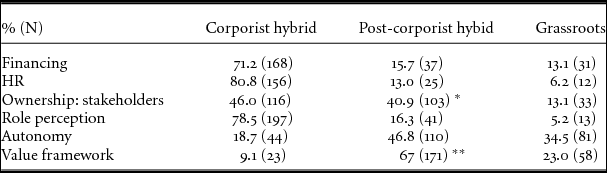
In Table 2, we have positioned the TSOs in our sample according to the conceptual framework developed above and shown in Table 1.
Positioning of Flemish TSOs along different dimensions of hybridity (% and N)

Notes: * sum of ‘mixed stakeholders’ and ‘moderate/weak support for both stakeholders’;
** sum of support for public and grassroots values is ‘equally strong’ and ‘equally moderate’.
As Table 2 indicates, for every variable in our typology, we can find organisations that display ‘corporatist’ or ‘post-corporatist hybrid’ organisational characteristics. This suggests that in the Flemish third sector, elements of organisational hybridity can be discerned. It however is important to note that hybridity is more apparent with regard to certain organisational dimensions. A large majority of organisations in our sample clearly reflect ‘corporatist hybridity’ with respect to financing, human resources and role perception. However, in relation to the ownership (stakeholders), and in particular the level of autonomy and the value framework, the organisations in our sample lean towards ‘post-corporatist hybridity’.
To understand the complex interplay between multiple organisational dimensions and to identify existing types of organisational hybridity in the third sector in Flanders, we conduct latent class analysis (LCA), using Latent Gold. This statistical technique allows constructing a classification of organisations based on patterns of association among the multiple indicators. First, LCA was used to generate latent class and conditional probabilities. Second, observed latent class scores were computed from the latent class model on the basis of the ‘modal classification rule’ (i.e., an observation will be assigned to that latent class for which the estimated classification probability is largest) (Hagenaars, Reference Hagenaars1993). The variables included were: financial resources, ownership, role perception, autonomy and values. Due to a high number of missing values (24.3 per cent), we had to exclude the human resources variable from our analysis (but we will consider the frequency distribution of this variable across the clusters after modal class assignment). In a first step, we had to determine the number of clusters. Our analysis revealed that we could reject the basic model (local independence) and the two-cluster model; all other models were accepted at the .05 significance level. The three-cluster model proved the most parsimonious model and thus the most optimal solution (Vermunt and Magidson, Reference Vermunt and Magidson2005).
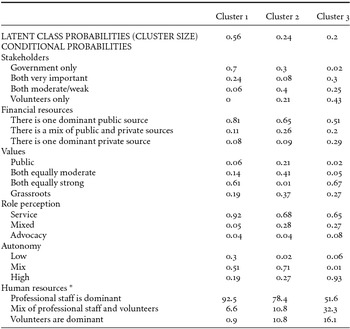
In Table 3, we examine the parameter estimates of the three-cluster model. As the conditional probabilities show, each cluster corresponds more or less to our ideal typical dimensions of corporatist hybrid TSOs, post-corporatist hybrid TSOs and grassroots TSOs. The table also indicates that, as expected, corporatist hybrid TSOs are still the dominant organisational type in the four welfare domains included in our study.
Parameter estimates of the three-cluster model

Notes: N = 155; NPar = 38; L-Square = 197.97; df = 180; p = .17; E = 0.14.
* Percentages after modal class assignment.
It however should be noted that, parallel to the descriptive results in Table 2, diversity is more manifest with respect to certain organisational dimensions than others. Stated differently, each cluster to some extent is hybrid, but differently. This is particularly apparent when looking at the value dimension: contrary to our hypothesis, Cluster 1 scores very low on public values, and rather subscribes to a mix of values. Similarly, organisations in Cluster 3 are also more likely to subscribe to a mix of values instead of focusing on grassroots values. And in Cluster 2, no consistent pattern exists. Contrary to the idealtypical grassroots, organisations in Cluster 3 also have mixed stakeholders and a mix of public and private sources. And contrary to the ideal typical corporatist hybrid organisation, organisations in Cluster 1 enjoy a fair degree of autonomy. Finally, it appears that our sample includes few organisations that are focused on advocacy only, Clusters 2 and 3 however are likely to combine service delivery with advocacy. Thus, across all clusters, it is possible to discern hybridity and the three clusters deviate to some extent from the idealtypical models. Nevertheless, the clusters correspond closely enough to the idealtypes to define them accordingly.
Corporatist hybrid TSOs (Cluster 1) – Our analyses show that a considerable number of TSOs in our sample still perceive themselves as operating in a typical corporatist regime. This should not surprise, given the institutional character of government–TSO relations in Flanders. This is also what we could call the ‘classic’ TSO in the Flemish welfare regime. Such TSOs can best be described as private organisations that in reality act as public agencies delivering governmental policies. Based on our empirical analysis, organisations in this cluster are characterised by:
-
• having governmental stakeholders;
-
• having mostly public resources;
-
• combining public and grassroots values;
-
• perceiving their role as service deliverers;
-
• having low to some level of autonomy from government;
-
• relying predominantly on paid staff.
Post-corporatist hybrid TSOs (Cluster 2) – Second, we observe a considerable number of TSOs that seem to combine features of the corporatist hybrid and grassroots model. Organisations in this cluster are characterised by:
-
• attaching only weak interest to governmental or volunteer stakeholders, although a considerable number of organisations acknowledged having governmental stakeholders;
-
• having mostly public resources or a mix of public and private resources;
-
• having moderate public and grassroots organisational value frameworks, although a considerable number of organisations have public or grassroots values;
-
• perceiving their role as service deliverers or combining service and advocacy roles;
-
• having mixed autonomy from government;
-
• having predominantly professional staff in the organisation.
Grassroots TSOs (Cluster 3) – Finally, and less expectedly, is our observation that one out of five TSOs in our sample reflects a considerable number of grassroots features. This is all the more interesting given that we have deliberately selected professionalised service-delivering TSOs in the welfare field (see method section), and we know that this field is mainly a third-party government field. Our empirical analysis points out that organisations in this cluster are characterised by:
-
• having volunteer or mixed stakeholders;
-
• having a substantial amount of private or mixed resources;
-
• combining public and grassroots values;
-
• perceiving their role as service deliverers or combining service and advocacy roles;
-
• having high autonomy from government;
-
• relying on a mix of paid staff and volunteers.
In sum, there are a lot of organisations in Cluster 1, the so-called ‘traditional’ Flemish TSOs (latent class probability = 0.56). But we also find a considerable number of organisations in Clusters 2 and 3, in which features of the classic Flemish TSO are mixed with grassroots features. However, as already noted, none of the clusters correspond fully with the ideal typical characteristics in Table 1. In this respect, all clusters carry elements of hybridity; thus our classification represents a more complex picture than a simple bifurcation would suggest.
Contextualising the findings
In a final step, we aim to contextualise our findings. Indeed, an important additional question that pops up is, what kind of organisations can we observe in each cluster? To answer this question, we analyse how the clusters are distributed across the four welfare domains included in our study. Our sample included TSOs that fight poverty, TSOs that are in elderly care, TSOs that work in youth care and TSOs that promote the integration of ethnic minorities.
Across the four welfare domains (poverty, elderly care, special youth, minorities), no significant differences between the clusters occur (chi-square test). Thus, in general, the distribution of the three types of TSOs is comparable across welfare domains. In other words, the four welfare domains display a similar degree and nature of hybridity. However, within these welfare domains, a heterogeneity of types of organisations exists (Verschuere and Vancoppenolle, Reference Verschuere and Vancoppenolle2010). In order to acknowledge the diversity of organisations within the four broad welfare domains, we also compare the clusters across types of organisations within each welfare domain.
The domain of poverty first includes facilities in the ‘social economy’, targeting people who are excluded from the regular economy for reasons of undereducation, disability, age, background, etc. These facilities provide vocational training and develop job opportunities. Second, there are social housing initiatives that rent or sell houses to people who have insufficient means to buy a home on the market. Third, this field consists of facilities that provide a range of services to people who live in poverty, often providing very tangible services such as distributing food, clothes, judicial support, shelter, etc. Among these facilities are the Centres for General Welfare (offering a diversity of support), and smaller single purpose organisations that provide material and social services. Finally, in ‘societies where the poor raise their voice’, professionals and clients cooperate to jointly find ways to increase the quality of life of people living in poverty. The domain of elderly care incorporates non-residential care and residential care. Non-residential care facilities most often provide care at home, assistance with housekeeping, or in some cases also organise leisure activities for the elderly in the community. Residential facilities are ‘resthouses for the elderly’, where people stay permanently. Residential and non-residental facilities also exist in the domain of youth care. The first category includes organisations such as shelters for abused children, or facilities for youngsters with a criminal background; the latter consists of facilities such as foster services, organisations providing educational support for families or promoting the well-being of vulnerable children. Finally, in the domain of integration of ethnic-cultural minorities, a distinction can be made between organisations that focus on integration of minorities (language training, integration courses, assistance to newcomers, etc.) and organisations that provide material or social assistance. Some of these organisations offer services to minorities living in vulnerable conditions (shelter, food and clothing, etc.), others are self-organisations of minority groups, aiming mainly at socio-cultural work and leisure, or sometimes advocacy for minority rights in society.
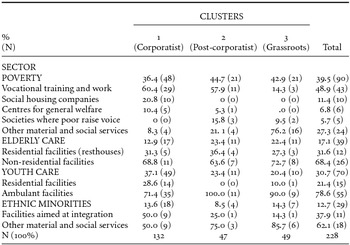
Table 4 compares the distribution of TSOs within each cluster (after modal class assignment) across welfare domains and types of organisation within each domain. Because of the small number of observations in some of the categories, we did not test for statistically significant differences, hence these comparisons are indicative only.
Distribution of TSOs over the clusters per welfare domain, and per type of organisation within each welfare domain (% and N)

In the corporatist hybrid cluster, we observe an overrepresentation of TSOs that are in vocational training and work (poverty), social housing (poverty), Centres for General Welfare (poverty), residential facilities for elderly care and organisations that work for the integration of ethnic minorities. This should not come as a surprise, because these are all examples of organisations that operate within a context that is characterised by a strong relationship between government and TSOs (Verschuere and Vancoppenolle, Reference Verschuere and Vancoppenolle2010). This relationship is characterised by large subsidies from the government for the TSOs, who in return are faced with a regulatory framework that defines mission, tasks, roles and accountability requirements and procedures (e.g., admission to the facility for clients is often strictly defined). To a certain extent, we could classify these organisations as quasi-governmental; hence it should also not come as a surprise that by being embedded in such a governmental context, these TSOs adapt some of the values and working processes that reflect this context such as professionalisation, bureaucratisation and a focus on service delivery for the eligible. Also, many of these organisations predominantly employ professional staff for which the government provides funding, because their task is often very specialised: working with criminal or abused youth, nursing the elderly, providing language courses to ethnic minorities, etc. Finally, given the regulatory context under which these organisations operate, their autonomy in choosing mission, tasks, target groups and even working processes is constrained by these regulations.
TSOs that provide material and social services, such as distributing clothes or food, or providing shelter to people living in poverty are overrepresented in the grassroots cluster. Societies where the poor raise their voice, organisations providing judicial support for minorities or the poor, or organisations that advocate for the rights of minorities, poor people or vulnerable children, and self-organisations of immigrants are also prominent in this cluster. Many of these organisations have weaker bonds with government, or operate under a less strict regulatory framework. They might receive governmental subsidies in most cases, but this is not related to the imposition of strict requirements by government in terms of mission, tasks and procedures. These TSOs to a large extent remain self-governing. Also, the engagement of volunteers in these organisations is more prominent. This may be due to necessity (not having enough resources to employ a lot of paid staff), but also due to the tasks and roles of these organisations, which are often less specialised (distributing material goods, campaigning, mobilisation, etc.), at least compared to tasks of organisations in the first cluster. From this also results a more autonomous positioning vis-à-vis government. Many of these organisations are thus typically grassroots: self-help organisations, bottom-up established (from within communities) and relying on volunteer work. These organisations often have a large stake in advocacy for the groups in society they serve. This is especially the case for ‘societies where the poor raise their voice’.
Discussion and conclusion
This article started from the ongoing debate about a fundamental shift in the provision of welfare, resulting from a historically new process of institutional hybridisation between state, third sector and market. As a result, scholars have heralded a new era of ‘welfare hybridity’, in which social services are increasingly delivered by a new type of hybrid organisation that possesses significant characteristics of more than one sector.
We however noted two important limitations in the current debate. First, while hybridity as a term is in vogue, it remains an ill-defined concept. Little effort has been done to develop a comprehensive indicator model and to explore hybridity empirically. Second, in the current debate, there is little sensitivity to cross-national variation depending on the particular welfare regime. The general diagnosis is to a large extent an Anglophone story within the context of a liberal welfare regime. In this study, we aimed to go beyond these limitations. First, we developed a new analytical framework that takes into account the different ‘starting positions’ of different welfare regimes. Next, we presented a multi-dimensional operationalisation of organisational hybridity, and conducted an empirical assessment among third-sector organisations within a corporatist welfare regime. We argued that within this type of welfare regime, organisational hybridity should be considered a long-standing characteristic of the third sector, so the question that arises then is whether and how the general diagnosis translates into this particular welfare context. Following Bode (Reference Bode, Phillips and Smith2010), we therefore distinguished between an ‘old’ or established form of ‘corporatist’ hybridity – the ‘classic’ TSO in a corporatist regime, and a ‘new’ form of ‘post-corporatist’ hybridity. Thus, rather than the ongoing bifurcation between ‘pure’ grassroots associations and ‘hybrid’ organisations in the (Anglophone) literature, we advanced a more complex and context-specific model that acknowledges the legacy of enduring intersectoral collaboration in corporatist welfare regimes.
As expected, our analysis confirmed that a small majority of organisations in our sample (still) resembled the traditional corporatist hybridity model. In addition, we also found a considerable number of TSOs that represented a ‘post-corporatist’ hybrid mixture of features, and that may be considered a ‘new’ and context-specific form of hybridity in corporatist regimes like Belgium. Finally, one fifth of the TSOs in our sample could be classified as grassroots TSOs, although this was not expected based on the criteria upon which we selected TSOs for this study. An important additional finding was that none of the clusters fully corresponded with the ideal typical characteristics in our conceptual model, and that, in this respect, all clusters carried different elements of hybridity. As already argued, our classification represents a more complex picture than a simple bifurcation would suggest, supporting the idea that hybridity is a crucial feature of contemporary TSOs.
A major limitation of our study, however, is its cross-sectional research design. As a result, while we were able to examine to what extent TSOs in the Flemish welfare sector are hybrid and to classify this organisational hybridity on the basis of a number of key characteristics, we cannot claim to have given evidence for the growing hybridisation of the sector. Based on existing knowledge of the main characteristics of the Flemish welfare regime, we however found a much wider diversity of types of organisations than could be expected on the basis of the prevailing model of third-party government – the traditional welfare mix model in the Flemish context. We however have no historically comparable data against which to compare the present level and nature of hybridity, and would need future measurements as well to assess whether, over time, this hybridity is increasing and/or changing in nature.
This limitation also implies that caution is needed when drawing conclusions about the contribution of our study to the international debate, in particular the question of whether the universally heralded process of hybridisation leads to a convergence across different welfare regimes. Existing comparative studies have observed some trends of convergence such as the broad diffusion of NPM-ideas, increasing government regulation, a push for greater accountability and more standardised and evidence-based services that can be evaluated, a greater uncertainty of funding and a shifting mix of welfare providers with market suppliers playing an increasingly important role (Henriksen et al., Reference Henriksen, Smith and Zimmer2012; Phillips and Smits, Reference Phillips, Smith, Phillips and Smith2010). However, these studies at the same time discern regime-specific divergences and mixed experiences. Our cross-sectional organisational data do not allow drawing general conclusions about trends of convergence in the third sector in Flanders. That a considerable number of TSOs rely on a mix of public and private income sources may indirectly point to a situation of growing competition in a regime in which TSOs historically have predominantly relied on public funding. On the other hand, that most TSOs experience moderate to high autonomy from government does not suggest a trend of increasing government regulation and pressures for accountability. However, Phillips and Smith (Reference Phillips, Smith, Phillips and Smith2010: 22) note that government regulation is not antithetical to collaboration; so well-crafted regulation does not necessarily reduce the discretionary space for TSOs. Finally, at this point, we have little indication of a process of hybridisation in the more liberal version of marketisation. While our study was focused on TSOs only, earlier research has indicated that the involvement of for-profit service providers remains marginal in Flanders and is mainly limited to the subfields of preschool childcare and elderly care (Verschuere and Vancoppenolle, Reference Verschuere and Vancoppenolle2010).
To conclude, our study mainly points to the crucial importance of contextualising the general diagnosis of hybridisation – depending not only on the welfare regime, but also on the welfare domains within a particular welfare regime (compare Bode, Reference Bode, Phillips and Smith2010; Henriksen et al., Reference Henriksen, Smith and Zimmer2012). We contextualised our clusters in terms of four welfare domains, and the diversity of TSOs in these welfare domains. While the four welfare domains displayed a similar degree and nature of hybridity, we observed variance between different types of organisations within these welfare domains and explained these differences in terms of the institutional context in which the TSOs operate. This context is mainly characterised by how the relation of the TSO with the government or its agencies is arranged. There exist regulatory frameworks that – amongst others – structure how, and to what extent, the TSO is financed, steered and controlled by government. This ‘regulated’ relationship then will also determine the level of autonomy of the TSO vis-à-vis government in terms of defining mission, target groups and working processes. In other words: how TSOs behave and are structured will be largely dependent on the institutional (regulatory) environment that applies. This preliminary conclusion may offer an interesting suggestion for further research that investigates features of hybridity (and differences in how hybridity unfolds in reality) in terms of the broader organisational environment.
Acknowledgements
The support of grant G.0336.10 of the Research Foundation – Flanders (FWO–Vlaanderen) to Lesley Hustinx, and a grant of the Research Council of University College Ghent to Bram Verschuere is greatly acknowledged. We also would like to thank Jozefien Godemont for her involvement in the initial phase of this research. The authors furthermore thank the Editors and the anonymous reviewers for their constructive and helpful comments.