Researchers have long observed that human beings are social animals. As such, we display a tendency to conform with the majority. In the domain of politics, such behavior is referred to as conformity voting. If a candidate is perceived to be leading, voters become more likely to support her. This behavior might arise as a mechanism to learn from the wisdom of crowds, as a response to peer pressure, or as a psychological preference for being on the winning side. Previous studies have provided empirical support for conformity in electoral settings, using both experimental data (Rothschild and Malhotra Reference Rothschild and Malhotra2014; Morton and Ou Reference Morton and Ou2015) and observational data (Niemi and Bartels Reference Niemi and Bartels1984). In addition, starting with Hinich (Reference Hinich1981), several papers have analyzed formal models of elections where voters desire to conform with the majority (Callander Reference Callander2008; Panova Reference Panova Elena2015).
The goal of this paper is to understand how public information impacts political selection when voters desire to conform with the majority. The model I develop is a variant of the global games framework of Morris and Shin (Reference Morris and Shin2001). Voters decide which of two candidates to support, and their payoff is increasing on the valence of the candidate they vote for. In addition, they obtain a fixed payoff if they vote for the winner. Voters receive private and public information about candidates’ relative valence,Footnote 1 and use this information to infer their chances of winning the election. In a voting context, public information refers to common knowledge elements that shape the collective perception or public image of a candidate. By contrast, private information refers to individual political perceptions that might be correlated across voters, but are not common knowledge.
I show that public information has a multiplier effect on equilibrium outcomes. In addition to its informational content, it induces a strategic effect arising from voters’ knowledge that the very same signal has been received by all other voters. This strategic effect is stronger when public information is precise relatively to private information; when voters have a strong desire to conform with the majority; and when voters expect a close race—that is, public information signals that both candidates have a similar valence. Such an environment is characterized by great fragility. Small perturbations to public information can dramatically alter vote shares: although voters’ beliefs about relative valence do not change significantly, their expectations about which candidate will win the election do change. Public opinion polls, if endowed with sufficient credibility, become self-fulfilling prophecies (Rothschild and Malhotra Reference Rothschild and Malhotra2014).
In addition, I find that more information does not always enhance politician selection. While a more precise private information unambiguously improves the better candidate’s probabilities of victory, that is not always the case with public information. When the public signal is imprecise relative to the private signal, the valence advantage of the better candidate is small, and voters’ desire to conform with the majority is big, increasing the precision of public information is likely to hurt the better candidate’s electoral chances. Although the odds of the public signal conveying the correct relative valence ranking between candidates increase, the weight voters place on the signal also increases—which drives the worse candidate to victory when the public signal is sufficiently favorable to her. Under the above conditions, the second effect dominates. Finally, the better candidate’s electoral prospects also suffer when voters’ desire to conform with the majority increases: voters increasingly support the candidate who is expected to win, at the expense of the candidate they think is more competent.
RELATED LITERATURE
The effects of public information on politician selection have been studied in the literature on information aggregation in a common value setting. In the strategic voting framework of Austen-Smith and Banks (Reference Austen-Smith and Banks1996), Kawamura and Vlaseros (Reference Kawamura and Vlaseros2017) and Liu (Reference Liu2017) show that when agents’ public information is precise, they tend to disregard their private information and information is inefficiently aggregated. Callander (Reference Callander2008) extends the information aggregation model by assuming voters also want to conform with the majority. He shows that information in some equilibria is used to select the worse candidate. This negative information aggregation, however, happens in lopsided elections, but not in close elections. In addition, his model does not differentiate between private and public information, and it generally contains multiple equilibria.
It is worth pointing out the difference of my model with respect to the information aggregation setting. While in Austen-Smith and Banks (Reference Austen-Smith and Banks1996) voters’ utility depends on the outcome—that is, on the valence of the candidate elected to office—in this model it instead depends on the valence of the candidate supported by the voter. As voters form a continuum and no voter is ever pivotal, this assumption ensures that, absent their desire to conform, voters would support the candidate they think is best (sincere voting).Footnote 2 The strategic voting channel arising from the pivotality effect is shut down, and instead the desire to conform is the only source of strategic voting.
To show that the results do not stem from the expressive voting assumption that voters derive utility according to the valence of the candidate they voted for—as opposed to the valence of the winning candidate—in Appendix B I alter the payoff function and instead assume that voters obtain the valence of the candidate they voted for as a payoff only if that candidate won the election. The ensuing game loses the upper-dominance region, and thus the existence of an interior threshold equilibrium is not guaranteed. However, when interior equilibria exist the main result of the paper—that an increase in the precision of public information might harm the better candidate’s electoral prospects—holds under similar conditions.
Additional references where public information is shown to be detrimental to politician selection include Taylor and Yildirim (Reference Taylor and Yildirim2010) and Goeree and Grosser (Reference Goeree and Grosser2007).Footnote 3 Although they obtain this negative result without including behavioral voting assumptions, their setting significantly differs from this paper. In particular, both models analyze costly voting in a private value setting, and voters obtain information about the distribution of political preferences in the population. When voters know they belong to the majority, they free-ride on other co-partisans and become less likely to vote. By contrast, in this paper I analyze a common value setting where voters care about the two candidates’ relative valence, voting is not costly and no voter is ever pivotal. In addition, the effect of public information on politician selection is not unambiguously negative—instead, it depends on the degree to which voters’ information comes from private and public sources.
This paper is related to a vast literature on “global games” (Morris and Shin 1998; Morris and Shin Reference Morris and Shin2001; Hellwig Reference Hellwig2002). This strand of literature shows that introducing uncertainty into agents’ information can yield a unique equilibrium in coordination games, which are prone to multiple equilibria under perfect information. In addition, the ensuing unique equilibrium is naturally linked to the underlying fundamentals. Morris and Shin (Reference Morris and Shin2002) showed in this setup that increased transparency of public information has ambiguous effects on social welfare. Due to its richness and tractability, this theoretical framework has since been applied to political economy questions that entail a coordination aspect. Notable examples include Myatt (Reference Myatt2007)—that studies the coordination problem faced by voters when three candidates compete for office and one of them is disliked by the supporters of the remaining two candidates—and Bueno de Mesquita (Reference Bueno de Mesquita2010)—that studies the role played by revolutionary vanguards in spurring regime change.
Although in this paper I analyze conformity voting in a static setting, several papers have analyzed bandwagon effects in sequential elections (Callander Reference Callander2007; Knight and Schiff Reference Knight and Schiff2010; Ali and Kartik Reference Ali and Kartik2012). These papers find that early public information signals induce herd behavior and significantly impact final outcomes. In this environment public information can have pernicious effects on information aggregation.
THE MODEL
There are two candidates, an incumbent (denoted as I) and a challenger (denoted as C). A continuum of voters of measure one vote for one of the two contenders. No single vote can influence the final outcome: instead, voters’ motivation to go to the polls stems from the expressive utility they obtain.
The voter utility function is given by
 $$U(\theta ,\,\gamma)\equiv\theta _{V} {\plus}\gamma I_{{\{ V\,{\equals}\,W\} }} ,$$
where θ denotes the candidate’s valence, subscript W refers to the winner, and V to the candidate the voter votes for.
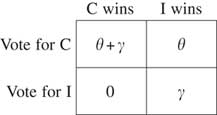
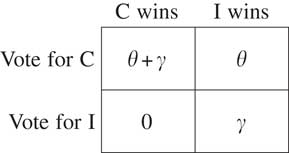
Voters wish to vote for the best candidate, but also for the winner. γ≥0 parameterizes the extra utility voters obtain if they conform with the majority. θ
V
captures their preference for voting for the best candidate. For simplicity, I assume the incumbent’s valence θ
I
is perfectly known.Footnote
4
By contrast, voters receive imperfect information about θ
C
. Without loss of generality, θ
I
is assumed to equal 0. Furthermore, to simplify notation, I denote the valence difference between the challenger and incumbent as θ, that is, θ
C
−θ
I
=θ
C
=θ. Thus,
 $$\theta \in{\Bbb R}$$
henceforth denotes the relative valence of the challenger. Figure 1 depicts the game in strategic form.
The game in strategic form
Information
Voters hold a common prior over the challenger’s valence
 $$\theta \sim{\cal N}\left( {y,\,\tau ^{2} } \right),$$
where y denotes the public signal, observed by all voters. For instance, the public signal corresponds to a pre-election poll, an approval rating, or the outcome of a television debate. The precision of the signal is equal to
 $${1 \over {\tau ^{2} }}$$
.
In addition, each voter receives a private signal, given by
 $$\zeta _{i} \equiv\theta {\plus}{\epsilon}_{i} ,$$
where
 $${\epsilon}_{i}\sim{\cal N}(0,\,\sigma ^{2} )$$
. Voter i’s posterior distribution over θ, given the public signal y and the private signal ζ
i
, follows a normal distribution with expectation and variance given by
 $$\eqalignno{ & E(\theta {\rm \,\mid\,}y,\,\zeta _{i} )\,{\equals}\,\overline{\theta } _{i} \,{\equals}\,{{\sigma ^{2} y{\plus}\tau ^{2} \zeta _{i} } \over {\sigma ^{2} {\plus}\tau ^{2} }}, \cr & {\rm Var}(\theta {\rm \,\mid\,}y,\,\zeta _{i} )\,{\equals}\,{{\sigma ^{2} \tau ^{2} } \over {\sigma ^{2} {\plus}\tau ^{2} }}. $$
EQUILIBRIUM ANALYSIS
The solution concept used is symmetric perfect Bayesian equilibrium: voter beliefs are consistent with the strategy profiles and Bayes’ rule, and strategies are sequentially optimal given beliefs and other voters’ strategies. Following the global games framework, I look for a unique threshold equilibrium surviving the iterated deletion of weakly dominated strategies. The strategy of voter i, t i , is
 $$t_{i} \left( {\overline{\theta } _{i} } \right)\,\equiv\,\left\{ {\matrix{ 1 & {{\rm if}} & {\overline{\theta } _{i} \,\gt\,\mu } \cr 0 & {{\rm if}} & {\overline{\theta } _{i} \leq \mu } \cr } } \right.,$$
where t=1 denotes voting for the challenger, t=0 denotes voting for the incumbent, and the threshold μ is labeled the strategic cutoff. The threshold voter’s beliefs about θ are such that she is indifferent between voting for the incumbent and the challenger. On the other hand, the incumbent wins the election whenever θ<θ*, where θ* is labeled the fundamental cutoff.
Lemma 1: The equilibrium strategic cutoff μ is implicitly defined by
 $${\rm \Phi }\left( {\beta (\mu {\minus}y)} \right)\,{\equals}\,{1 \over 2}{\plus}{\mu \over {2\gamma }},$$
where
 $$\beta \equiv{{\sigma ^{2} } \over {\tau ^{2} }}\sqrt {{{\sigma ^{2} {\plus}\tau ^{2} } \over {\sigma ^{2} \tau ^{2} }}} .$$
The equilibrium fundamental cutoff θ* is given by
 $$\theta ^{{\asterisk}} {\equals}{{\tau ^{2} {\plus}\sigma ^{2} } \over {\tau ^{2} }}\mu {\minus}{{\sigma ^{2} } \over {\tau ^{2} }}y.$$
The derivation of the equilibrium objects is presented in the Online Appendix.
Lemma 2: An equilibrium exists, and the number of possible equilibria are either one or three.
Proposition 1: A sufficient but not necessary condition for uniqueness of equilibrium is that
 $$\beta \leq {1 \over \gamma }\sqrt {{\pi \over 2}} .$$
This condition is satisfied if the private signal is sufficiently more precise than the public signal, and voters’ desire to conform with the majority is not too strong. This result is standard in global games. Multiplicity arises as a result of an excessive demand for coordination—when the degree of strategic complementarity among voters’ actions is strong.
Voters who receive extreme private signals always vote for their preferred candidate, regardless of the odds of that candidate winning. More precisely, Equation 1 shows that μ is always between −γ and γ. A voter with posterior expectation about θ greater than γ always votes for the challenger, and vice versa for voters with posteriors below −γ. As illustrated in Figure 2, I label these voters as partisan; even when their preferred candidate’s electoral prospects look grim, they unconditionally support her. By contrast, I label voters with intermediate beliefs about the challenger’s valence as “swing voters.” They initially lean toward one or the other candidate, but can be persuaded to vote for a candidate relatively easily through campaign messages, polls, and television debates. The voting literature has long entertained such a distinction between partisan and swing voters.
Partisans and swing voters

The Strategic Effect of Campaign Public Signals
Public information has a stronger effect on equilibrium outcomes, because it provides voters with information about other voters’ beliefs. The effect of public information on equilibrium thresholds can be disentangled into two distinct effects. The first is the direct effect, generated by the informational content of the announcement. The second pertains to the strategic effect: if the public signal hints that the challenger is the better candidate, voters become more bullish about the challenger’s winning chances, not only because of what the signal says, but also because they know everybody received the same signal.
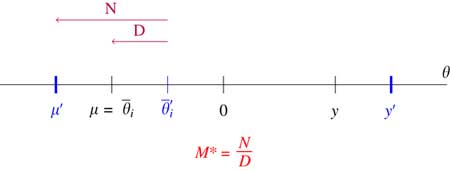
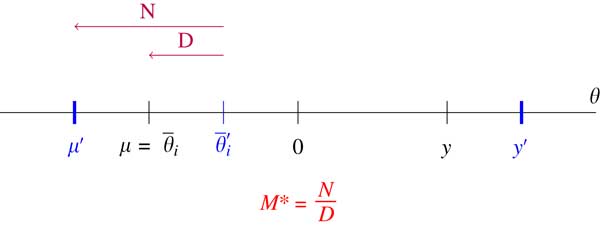
To measure the strategic effect of public information, I consider an infinitesimal increase in y. Next, I calculate how much ζ i needs to decrease (i) for the indifferent voter to still be indifferent between voting for the incumbent and challenger, and (ii) for the indifferent voter to hold the same posterior expectation about θ. The ratio between (i) and (ii) denotes the multiplier effect of public information.Footnote 5 It measures the responsiveness of the strategic cutoff μ to a change in y, normalized by the effect that the change in y exerts upon the indifferent voter’s posterior expectation. Figure 3 illustrates the concept. An increase in the public signal from y to y′ decreases the strategic cutoff, from μ to μ′. The new indifferent voter’s beliefs about θ are lower, but she is indifferent about voting for either the incumbent or the challenger: compared to the old indifferent voter, she is more confident about the challenger’s victory.
Multiplier effect of public information
In the following proposition I establish when the strategic effect of public information is largest.
Proposition 2: The strategic effect exerted by public information is largest when:
i) Public information is precise relative to private information (β is high).
ii) Voters’ desire to conform with the majority is strong (γ is high).
iii) A close race is expected by voters (y≈0).
When voters hold a strong desire to conform with the majority and public information is precise, the multiplier effect of public information is high and voters’ electoral decisions are strongly influenced by the public signal. Similarly, when y hints that both candidates are similarly competent and voters expect a close race, small perturbations to y spur large swings in voter sentiment.
Who Benefits from Information?
How do changes in the quality of information affect candidates’ ex ante probabilities of victory?
Lemma 3: The ex ante (given θ, but before y is drawn) probability of an incumbent victory is given by
 $${\rm Pr}\,({\rm I}\,{\rm wins\,\mid\,}\theta ){\equals}{\rm \Phi }\left( {{{y^{{\asterisk}} {\minus}\theta } \over {\sqrt {\tau ^{2} } }}} \right),$$
where y* is such that the incumbent wins whenever y<y*.
Proposition 3: The better candidate’s winning probabilities increase with:
i) A decrease in the voters’ desire to conform with the majority (γ↓).
ii) An increase in the precision of private information (σ 2↓).
iii) A decrease in the precision of public information (τ 2↑), provided that
 $$\phi \left( {\sqrt {{{\sigma ^{2} } \over {\tau ^{2} \left( {\sigma ^{2} {\plus}\tau ^{2} } \right)}}} \left( {\theta {\minus}y^{{\asterisk}} } \right)} \right)\sqrt {{{\tau ^{2} } \over {\sigma ^{2} \left( {\sigma ^{2} {\plus}\tau ^{2} } \right)}}} \,\gt\,{1 \over {2\gamma }}\left( {{{\sigma ^{2} {\minus}\tau ^{2} } \over {\sigma ^{2} {\plus}\tau ^{2} }}} \right).$$
The first result shows that voters’ desire to conform with the majority is detrimental to the better candidate’s electoral prospects. As voters increasingly value aligning their ballot with the majority of voters, they become more prone to backing the front-runner—as signaled by y—even when they believe she is not the better candidate. Thus y, even when far from θ, might become a focal point. When voter preferences shift toward following the crowd, the ability of the democratic process to select competent politicians is hindered.
The second result is also intuitive: as voters’ private information becomes more precise, they increasingly rely on it to decide their vote. As private signals are centered around θ, the majority of voters receive a private signal that correctly ranks the incumbent’s and challenger’s relative valence.
Finally, the third result demonstrates that the better candidate does not always benefit when voters become better informed. In particular, an increase in the precision of public information (τ 2↓) hurts the better candidate’s electoral chances when the relative precision of public information is low (τ 2 high and σ 2 low), the valence advantage of the better candidate is small (θ≈0), and voters’ desire to conform is high (γ high).
An increase in the precision of y generates two effects. First, y is more likely to be closer to θ, and second, voters attach more weight to it. For the better candidate, the first effect implies that an unfavorable public signal becomes less probable. At the same time, the second effect implies that fixing an unfavorable y, her vote share decreases, as voters rely on the signal to a greater extent. The second effect dominates when private information is precise relative to public information. In this situation, voters trust their private information and the better candidate is likely to win. An increase in the precision of public information increases voters’ proclivity to rely on the public signal, even when the signal is unfavorable to the best candidate. By contrast, when public information is precise relative to private information, public signals are already likely to be followed. Increasing the precision of public signals decreases the chances that the signal is unfavorable to the better candidate, thus increasing her electoral prospects.
The results in Proposition 3 provide a rationale for why candidates who are leading in the pollsFootnote 6 tend to avoid excessive public exposure and face-to-face television debates with their rival. Barring extraordinary events during the campaign, they are likely to win the election. Thus, avoiding mistakes—which could shift the electoral momentum toward the opponent—becomes paramount.Footnote 7 This is especially relevant for elections with few polls and television debates—when private information is precise relative to public information—and when the better candidate does not have a big valence advantage. In off-year state legislative races, primaries for US Congress, and local elections public information about candidates and policy proposals is scarce, and candidates instead rely on word of mouth, canvassing, and small campaign events to get their message across. In this environment the worse candidate will likely benefit from an increase in the number of polls and public debates: as public information is scarce, a single additional poll can anchor voters’ expectations about the likely winner of the race despite its noise.