


Introduction
Lifestyle risk behaviours such as an unhealthy diet and insufficient physical activity (PA) are important factors associated with an increased risk of diseases and premature mortality worldwide(1). Unhealthy lifestyle behaviours often tend to co-occur and cluster within populations(Reference Shankar, McMunn and Steptoe2). This clustering of multiple unhealthy behaviours is linked to an additional risk of diseases, such as cancer and cardiovascular diseases(Reference Shankar, McMunn and Steptoe2,Reference Doll and Peto3) . In addition, it seems to have synergistic effects on all-cause mortality(Reference Loef and Walach4,Reference Ford, Zhao and Tsai5) . This suggests the need for addressing multiple lifestyle behaviours in interventions aimed at the prevention of chronic diseases. In doing so, an in-depth understanding is necessary for the underlying determinants and motivational factors of various lifestyle behaviours to develop effective, multiple behaviour change interventions for adults. To make such interventions more efficient, higher-order determinants or factors related to multiple behaviours should be targeted. This paper examines whether motivation can be such a determinant for a higher-order lifestyle domain, as motivation is a critical determinant of both intentions towards a healthy diet and PA behaviour(Reference Rhodes, Janssen and Bredin6,Reference de Ridder, Kroese and Evers7) .
Studies have investigated how motivational constructs towards a certain domain are related to each other and to behaviour within that same domain(Reference Verloigne, De Bourdeaudhuij and Tanghe8,Reference Fuemmeler, Masse and Yaroch9) . For example, Verloigne et al. showed a simplex-like pattern for PA motivation, with stronger positive correlations between subscales that were more adjacent on the self-determination continuum (e.g. identified and intrinsic regulation)(Reference Verloigne, De Bourdeaudhuij and Tanghe8). Regarding motivation and behaviour, it has been demonstrated that more autonomous forms of motivation, and specifically intrinsic motivation, are regarded as a key factor to (the adoption of long-term) healthier eating patterns, mainly operationalised as fruit and vegetable intakes(Reference Fuemmeler, Masse and Yaroch9–Reference Trudeau, Kristal and Li13). The same accounted for sufficient PA(Reference Teixeira, Carraca and Markland14–Reference Fortier, Sweet and O'Sullivan16).
However, few studies have investigated whether and how motivational constructs between different (lifestyle) domains are related to each other(Reference Vallerand17). It could be, for instance, that a person is intrinsically motivated to improve their PA and that this person also feels motivated to change their current diet. One study demonstrated that autonomous motivation to exercise contributed to improved weight control via PA and spillover effects on eating behaviour(Reference Mata, Silva and Vieira18). These authors suggested that motivation in one behavioural domain may facilitate or conflict with self-regulation in other behavioural domains. This is in line with the trans-contextual model, stating that the motivation underlying one behaviour can transfer from one domain to another(Reference Hagger and Chatzisarantis19). Thus, the motivation between different behavioural domains can have facilitative or suppressing effects on each other, depending on their level of self-determination. But for some domains that are closely related, it is plausible that there are overarching motivational constructs.
The present study aimed to investigate whether motivational constructs for diet and PA based on self-determination theory (amotivation, controlled, autonomous and intrinsic motivation) cluster together, as one could be striving towards a general healthy lifestyle(Reference Deci and Ryan20). If this is the case, this may indicate that there is a higher-order motivation (e.g. motivation for a healthy lifestyle) that determines motivation for the separate lifestyle domains. Furthermore, we examine how motivational constructs relate to dietary and PA sub-behaviours. Specifically, the present study examines:
1. To which extent equivalent motivational constructs correlate between lifestyle domains (e.g. intrinsic motivation towards a healthy diet and intrinsic motivation towards sufficient PA).
2. How the motivational constructs for diet and PA cluster. The purpose here is to uncover the underlying structure of the items measuring the motivational constructs for the two lifestyle domains. Do the same unified concepts (autonomous motivation for diet and autonomous motivation for PA) arise, or do the separate motivational constructs make up new unified concepts, such as autonomous motivation for lifestyle?
3. To what extent these motivational constructs are cross-sectionally associated with both dietary and PA sub-behaviours.
As the present study is exploratory in nature, no a priori hypotheses are formulated. Insight into how lifestyle domain-specific motivational constructs relate to each other between lifestyle domains and how these constructs relate to behaviour is both of theoretical and practical relevance. It provides a better understanding of the concept of motivation, whether there are separate factors or whether these motivational constructs form a common factor (e.g. lifestyle) when multiple behaviour lifestyle domains are considered. The present study is also practically relevant. When the motivation for diet and PA turns out to cluster and be related to diet and PA behaviour to a similar extent, these motivational constructs do not have to be assessed separately for each (sub-)behaviour in a multiple behaviour intervention study. As a result, questionnaires that measure the quality of motivation could be shortened, and multiple behaviour interventions could be made more efficient.
Methods
Sample
For this cross-sectional study, data were used from the baseline questionnaire of the main trial (Dutch Trial Register NL7333). Participants for this trial were recruited from members of an online research panel in the period from mid-October 2018 until mid-May 2019. More information regarding the design of this trial can be found elsewhere(Reference Deci and Ryan21). The present study has been approved by the Committee for Ethics and Consent in Research of the Open University of the Netherlands (reference number: U2018/07266/SVW).
Participants for the present study were recruited via an Internet research panel and were eligible to participate when they were between 18 and 70 years old and had access to the Internet because the intervention was delivered on the Internet. Before enrolment, all participants signed an online consent form. In total, there were 1623 people who entered the trial, of which 1142 (70⋅4 %) participants completed the baseline questionnaire.
Measurements
Demographics
In the baseline questionnaire, several sample characteristics were assessed, such as gender, age, educational level, marital status (with or without a partner) and health status reported, as well as height and body weight to calculate body mass index (BMI; kg/m2). Educational level is categorised into low (i.e. primary, basic vocational or lower general school), moderate (i.e. medium general education or vocational school) or high (i.e. higher secondary education, higher vocational school or university level). Furthermore, we asked whether participants were strongly impaired to be physically active (yes/no). Self-reported health status was indicated on a visual analogue scale, ranging from 0 to 100(Reference Brooks22).
Motivation
Two questionnaires were used to assess motivation for diet and PA according to the SDT. The first questionnaire, the Treatment Self-Regulation Questionnaire (TSRQ), concerns why people would engage in health-relevant behaviour(Reference Levesque, Williams and Elliot23,Reference Williams, Grow and Freedman24) . It assessed the degree to which a person's motivation for PA and a healthy diet is relatively driven by autonomous or self-determined reasons. The TSRQ assesses three types (subscales) of motivation: amotivation (three items), controlled regulation (six items) and autonomous regulation (six items). Participants had to indicate the extent to which each of the 15 reasons for PA or healthy eating was true for them on a 7-point Likert scale (1 = not at all, 7 = very true). Responses to the respective items for each subscale were averaged to obtain a score for each of the three types of motivation. These scores are used to depict the means and standard deviations in Table 1.
Characteristics of the study population (N 1142)

m, mean; sd, standard deviation; BMI, body mass index; PA physical activity; MVPA, moderate-to-vigorous physical activity.
a The original constructs were used to depict the means and SDs and scores here represent the respective items for each subscale that were averaged.
b n 1127.
According to the SDT, autonomous motivation consists of identified, integrated and intrinsic regulation. This TSRQ does not further differentiate between these autonomous types of motivation. Therefore, the subscale ‘intrinsic regulation’ from the Dutch validated Behavioural Regulation in Exercise Questionnaire (BREQ-2) was administered to determine intrinsic motivation, as this is the only fully self-determined form of motivation(Reference Markland and Tobin25). Participants had to rate on a 5-point Likert scale to what extent each of the four items was true for them: not true for me (1) to very true to me (5). An example item was: ‘I exercise because it's fun’. However, we translated exercise to ‘bewegen’ (to be physically active) in our Dutch items, as our goal was to measure motivation to be physically active in general. To obtain a measure for intrinsic motivation for healthy eating, the BREQ-2 was adapted for healthy eating. We replaced ‘exercise’ in all items with ‘eating healthily’. Supplementary Table S1 shows the questionnaire's items for both the TSRQ and BREQ-2.
Diet
Fruit, vegetable and fish frequency were assessed with a validated Food Frequency Questionnaire (FFQ)(Reference Huybrechts, Bornhorst and Pala26,Reference van Assema, Brug and Ronda27) . It assesses the frequency and quantity of a variety of food items eaten in a typical week in the last month. Participants reported on how many days they typically consumed fruits, vegetables and fish (ranging from 0 to 7 d/week). We added questions assessing the size of vegetables and fruit portions based on Willems et al. (Reference Willems, Bolman and Mesters28). The intake of pieces of fruit per day was calculated by multiplying the frequency by the number of pieces with the reported number of consumption days, divided by seven (days a week). In addition, participants reported the consumption frequency of a particular snack food in a typical week in the last month on a 7-point Likert scale: never/less than once a week (1), one to three times a week (2), four to six times a week (3), one time per day (4), two times per day (5), three times per day (6) or four or more times per day (7). Eight types of snacks were assessed, namely unsalted nuts, dried fruits, chocolate, candy, cookies, chips, ice cream, and savoury pastries. The consumption frequency of unhealthy snacks per day was determined by summing up the recoded frequencies for chocolate to savoury pastries and divided by the number of days in a week.
PA level
PA behaviour was assessed using the validated self-administered Dutch Short QUestionnaire to ASsess Health (SQUASH)(Reference Wendel-Vos, Schuit and Saris29). Participants had to complete the questionnaire for a typical week in the past month on the following PA behaviours: (1) walking to work/school, (2) cycling to work/school, (3) work, (4) household activities, (5) walking, (6) cycling, (7) gardening, (8) odd jobs and (9) sports. Except for work and household activities for which already a distinction was made between lower and higher intensity based on MET-values, participants indicated how intense each activity felt (low, moderate or vigorous). PA behaviour was operationalised as the total number of minutes of moderate-to-vigorous physical activity (MVPA) per week. This was calculated by multiplying the frequency (how many days per week) and duration (how many hours and minutes per day) of these activities that were performed with moderate or vigorous intensity (light work and light household activities were excluded here). Individuals who reported spending more than 6720 min on PA per week were excluded according to the SQUASH manual, as these data were considered to be unreliable (n 15). This self-report was used as this was the most feasible method (i.e. convenience, low costs and proven as a reliable and valid tool) in assessing PA compared to objective observations(Reference Helmerhorst, Brage and Warren30). Besides minutes of MVPA per week, we also focused on the voluntary physical activities such as walking, cycling and sports, which can serve as behaviours to improve health.
Statistical analyses
Descriptive statistics were used to depict the demographic and motivational characteristics of the participants included in the present study. To describe the relationships between all motivational constructs (amotivation, controlled motivation, autonomous motivation and intrinsic motivation), dietary (fruits, vegetables, fish and unhealthy snacks) and PA behaviours (MVPA, leisure walking, leisure cycling and sports), Spearman's rank correlation coefficients were calculated. The strengths of the correlation coefficients were defined as small when rs ≥ 0⋅1, medium when rs ≥ 0⋅3 and large when rs ≥ 0⋅5(Reference Cohen31).
First, two exploratory factor analyses (EFAs) were conducted to determine whether the original structure of the SDT holds in each lifestyle domain. Thus, the TSRQ and BREQ items for diet were entered in the first EFA, whereas the TSRQ and BREQ items for PA were included in the second EFA. Second, another EFA was conducted to examine whether the motivational constructs (TSRQ and BREQ for diet and PA together) relate to separate factors or form a common factor. We used parallel analyses as a method to determine the optimal number of factors. The EFAs were performed with an oblimin rotation, as factors were expected to correlate. The maximum likelihood estimation was used to estimate the parameters of the EFA models. The EFA analyses were conducted using guidelines outlined in Preacher and MacCallum(Reference Preacher and MacCallum32).
Furthermore, to assess the associations between the motivational constructs, regression analyses using the ‘enter’ method (two-step approach) were conducted separately for each of the dietary sub-behaviours and PA behaviours as the outcomes and motivational constructs as predictor variables while controlling for demographic characteristics (in the first step). The dietary sub-behaviours are daily fruit intake, daily vegetable intake, the consumption frequency of fish per week and unhealthy snacks per day. The PA behaviours are the minutes of MVPA, leisure walking, leisure cycling and sports per week. The motivational constructs included in these analyses are the average scores of the items belonging to the factors identified in the EFA.
In line with the SQUASH manual, respondents were excluded (n 15) for specific analyses when they reported more than 6720 min of PA since being physically active over 16 h/d, for 7 d/week, which was considered to be unlikely(Reference Wendel-Vos, Schuit and Saris29). All statistical analyses were performed with the statistical software R (version 3.6.0).
Results
Participants
The study population consisted of 692 women (60⋅6 %) and 450 men (39⋅4 %). The mean age was 52⋅1 years (sd = 13⋅0). Furthermore, 4⋅3 % of the participants had a low level of education, 25⋅5 % had a medium educational level and 70⋅2 % had a high level of education. Of this sample, 65⋅3 % had a paid job (full-time or part-time), whereas 34⋅7 % of this sample had not (thus volunteering, being unemployed, incapacitated to work, being retired, mainly engaged in doing household chores or studying). The mean BMI was 26⋅4 (sd = 5⋅2); 1⋅7 % was classified as underweight, 43⋅1 % had a healthy weight, 35⋅9 % was classified as overweight and 19⋅4 % of this sample was classified as obese. See Table 1 for an overview of the characteristics of the study population.
Original factor structure diet and PA
An EFA was used to analyse the underlying factors in the TSRQ and BREQ-2 together, separately for diet and PA. Bartlett's test indicated correlation adequacy for both the diet (χ2(171) = 13 346.92, P < 0⋅001) and PA domain (χ2(171) = 17 021.65, P < 0⋅001), and the Kaiser–Meyer–Olkin (KMO) test indicated sampling adequacy, MSAdiet = 0⋅92 and MSAPA = 0⋅91.
A parallel analysis examination suggested four overall factors for both diet and PA, and a 4-factor model was tested based on the SDT. After testing all 19 items (15 items from the TSRQ and 4 items from the BREQ together), one item for diet (TSRQ7) loaded on two factors and two items for PA loaded on two factors (TSRQ7 and TSRQ10, see Supplementary Table S1) using the criterion that loadings must be higher than 0⋅300. These items were eliminated from further analyses(Reference Field33). Consequently, these four-factor models were again tested without these items. The factor loadings are presented in Table 2. These models achieved a simple structure with each item loading on only one factor. The model for diet had an acceptable fit: the root mean square error of approximation (RMSEA) indicated an acceptable fit at 0⋅063, 90 % CI 0⋅058, 0⋅069, the Standardized Root Mean Squared Residual (SRMR) with an excellent fit (0⋅02), and the comparative fit index (CFI; 0⋅967) and the Tucker–Lewis index (TLI; 0⋅942) indicated a satisfactory fit. The model for PA also had a satisfactory fit: the RMSEA indicated an acceptable fit at 0⋅067, 90 % CI 0⋅062, 0⋅073, the SRMR with an excellent fit (0⋅02), and the CFI (0⋅975) and the TLI (0⋅954) indicated a satisfactory fit.
Summary of the four-factor models for diet and PA (n 1142)

TSRQ, Treatment Self-Regulation Questionnaire; BREQ, Behavioural Regulation in Exercise Questionnaire.
Notes: The full description of the items can be found in Supplementary Table S1. The bold values indicate factor loadings larger than 0.3. The cells of item TSRQ10 are empty for PA, as this item has been excluded due to factor loadings higher than 0.3 on more than one factor.
a Cronbach's α reported as this factor only contained two items.
Factor 1 included six items that are in line with the original autonomous motivation items. Factor 2 included the four items that measured intrinsic motivation (BREQ). Divergent findings were found for Factor 3. For diet, Factor 3 included the six items that measured controlled motivation. However, the original item 10 of the TSRQ was intended to measure amotivation (Factor 4) but had a higher loading on Factor 3 and its content fitted better to the controlled motivation factor. For PA, Factor 3 included five items that measured controlled motivation. Finally, Factor 4 included two items (instead of the original proposed three items that measured amotivation). The reliability, percentage of explained variance, means and standard deviations of these factors are reported in Table 2. The description of the items can be found in Supplementary Table S1.
Correlations of motivational constructs between behavioural lifestyle domains
Our first aim was to examine to which extent the behaviour-specific motivational constructs between behavioural lifestyle domains (e.g. intrinsic motivation towards, respectively, PA and diet) are related to their equivalents. See Table 3 for an overview of these results. Here, the motivational constructs were used that were based on the first EFAs. We found large correlation coefficients between amotivation for diet and PA (rs = 0⋅63), controlled motivation for diet and PA (rs = 0⋅76) and autonomous motivation for diet and PA (rs = 0⋅78), but a medium correlation for intrinsic motivation for diet and PA (rs = 0⋅41). These results demonstrate a considerable overlap between the lifestyle domains diet and PA for amotivation, controlled motivation and autonomous motivation.
Spearman's intercorrelations for study variables

PA, physical activity; AM, amotivation; AUM, autonomous motivation; CM, controlled; IM, intrinsic motivation.
* Statistical significance after the Bonferroni correction.
Clustering of motivational constructs of two lifestyle domains
Our second aim was to examine whether the motivational constructs cluster between diet and PA. We performed an EFA to explore the underlying factorial structure when the items of the TSRQ and BREQ-2 for diet and PA were combined. This approach was chosen to explore the theoretical structure of the motivational constructs for the two lifestyle domains. As autonomous motivation also includes intrinsic motivation, and this has been measured using a separate questionnaire (BREQ-2; the TSRQ did not include intrinsic motivation), the items of both questionnaires were integrated. Bartlett's test of sphericity, χ² (703) = 35 579.66, P < 0⋅001, indicated that correlations between items were sufficiently large for an EFA. The KMO test verified the sampling adequacy for the analysis (KMO = 0⋅94), and all KMO values for individual items were at least 0⋅87, which is well above the acceptable limit of 0⋅5.
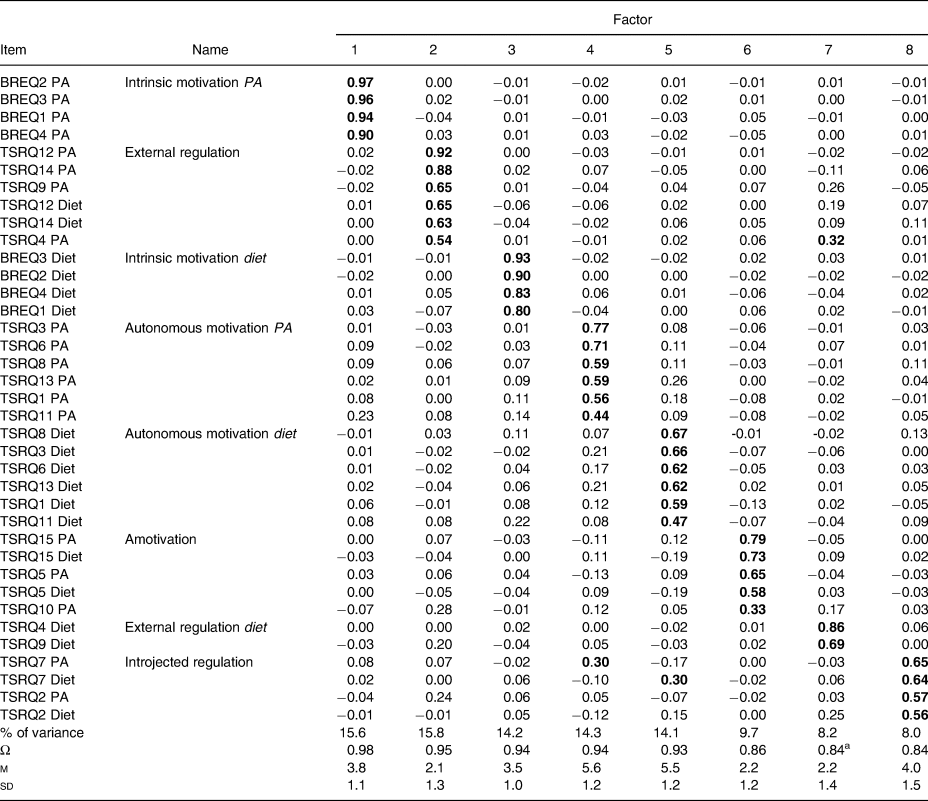
A parallel analysis suggested eight factors. After testing all 38 items, three items were split across two factors (TSRQ item 4 for PA, TSRQ items 7 and 10 for diet). Item 10 was subsequently removed, as this item did not actually differentiate between two factors. The factor loadings for the model without this item are presented in Table 4. The model had an acceptable fit: the RMSEA indicated an acceptable fit at 0⋅061, 90 % CI 0⋅058, 0⋅063, the SRMR with an excellent fit (0⋅02), and the CFI (0⋅950) and the TLI (0⋅915) indicated a satisfactory fit.
Summary of the eight-factor model for diet and PA combined
TSRQ, Treatment Self-Regulation Questionnaire; BREQ, Behavioural Regulation in Exercise Questionnaire.
Notes: The bold values indicate factor loadings larger than 0.3. The description of the items can be found in Supplementary Table S1.
a Cronbach's α reported as this factor only contained 2 items.
Factors 1 and 3 included four items that are in line with the original intrinsic motivation items from the BREQ, separately for PA (Factor 1) and diet (Factor 3). Factors 4 and 5 included the six items that represent autonomous motivation, separately for PA (Factor 4) and diet (Factor 5). Factor 2 contained several items from the originally controlled motivation subscale for diet and PA combined. These items seem to have pressure from others in common; thus, these items seem to measure external regulation. However, Factor 7 comprised two items specifically addressing diet: ‘because others would be upset with me if I did not’ and ‘because I feel pressure from others to do so’. Factor 6 contained five items addressing amotivation for both diet and PA. Finally, Factor 8 included four items, encompassing ‘because I would feel guilty or ashamed of myself if I did not eat a healthy diet/engaged in sufficient PA’ and ‘because I would feel bad about myself if I did not eat a healthy diet/engaged in sufficient PA’. This factor represents introjected regulation for both diet and PA. The reliability, percentage of explained variance, means and standard deviations of these factors are reported in Table 4. The description of the items can be found in Supplementary Table S1.
Regression analyses of motivational constructs and sub-behaviours
Our third aim was to examine how the motivational constructs that have been identified in the previous EFA were related to dietary sub-behaviours (fruits, vegetables, fish and unhealthy snacks) and PA sub-behaviours (MVPA, walking, cycling and sports). Initially, the variance inflation factors (VIFs) were inspected in each regression analysis. VIFs that are larger than 10 indicate multicollinearity. None of our predictors exceeded this threshold. The tables that only contain the controlling variables (basic model) are presented in Supplementary Table S2 (diet) and Table S3 (PA). All models that included the motivational constructs had a significantly better fit, except for the model with fish consumption as the outcome. This model showed a marginally significant improvement. As can be seen, the additional explained variance by adding the motivational constructs to the basic model was considered small for each outcome.
Regarding intrinsic motivation for eating (more) healthily, the results showed that it was significantly associated with all dietary sub-behaviours, except for unhealthy snack consumption frequency (see Table 5). Being more intrinsically motivated to eat (more) healthily was linked to a higher fruit (β = 0.13), a vegetable intake per day (β = 0.16) and a higher fish intake per week (β = 0.11). Autonomous motivation to eat (more) healthily was significantly associated with a higher fruit intake and with a lower unhealthy snack consumption frequency. The strongest association was found for autonomous motivation for eating (more) healthily with a higher fruit consumption (β = 0.22) and a lower consumption frequency of unhealthy snacks (β = −0.22). The other motivational constructs towards eating (more) healthily were not significantly associated with any of the dietary sub-behaviours. Lastly, none of the motivational constructs for eating (more) healthily was related to the PA sub-behaviours (see Table 6).
Regression coefficients of demographic information and motivational constructs on dietary behaviour (n 1142)

B, unstandardised coefficient; se, standard error; β, standardised coefficient; PA, physical activity; IM, intrinsic motivation; AUM, autonomous motivation; ER, external regulation; IJM, introjected motivation; adj., adjusted; ΔR 2, the additional explained variance compared to the basic model.
Note: The bold values indicate significance after the Bonferroni correction (P < 0.0125).
a Women are the reference category.
b Medium education is the reference category.
c No partner is the reference category.
d Unemployed is the reference category.
e Not physically impaired is the reference category.
* The model was significantly better than the basic model (P < 0.05).
† Marginal significance (P < 0.1).
Regression coefficients of demographic information and motivational constructs on PA behaviour (n = 1127)

B, unstandardised coefficient; se, standard error; β, standardised coefficient; MVPA, weekly minutes of moderate-to-vigorous physical activity; PA, physical activity; IM, intrinsic motivation; AUM, autonomous motivation; ER, external regulation; IJM, introjected motivation; adj., adjusted; ΔR 2, the additional explained variance compared to the basic model.
Note: The bold values indicate significance after the Bonferroni correction (P < 0.0125).
a Women are the reference category.
b Medium education is the reference category.
c No partner is the reference category.
d Unemployed is the reference category.
e Not physically impaired is the reference category.
* The model was significantly better than the basic model (P < 0.05).
Regarding intrinsic motivation for PA, the results showed that it was significantly associated with all PA sub-behaviours (MVPA, walking, cycling and sports; see Table 6). Being more intrinsically motivated to engage in sufficient PA was linked to more minutes of MVPA (β = 0.25), walking (β = 0.17), cycling (β = 0.21) and sports (β = 0.28) per week. The strongest association was the latter, thus for intrinsic motivation for PA and sports. The other motivational constructs were not significantly associated with the PA sub-behaviours. In addition, several motivational constructs for PA were significantly associated with some of the dietary sub-behaviours (see Table 5). For example, a higher intrinsic motivation PA was related to a higher fruit intake and a lower snack consumption frequency. Furthermore, being more autonomously motivated towards PA, in general, was significantly associated with a higher unhealthy snack consumption frequency.
Discussion
This paper examined to which extent motivational constructs derived from SDT are related to the lifestyle domains of diet and PA. Furthermore, it has been examined how these motivational constructs for two lifestyle domains cluster and how these clustered motivational constructs are associated with dietary and PA behaviour. Although insight into these issues can provide directions to support lifestyle change, no empirical studies are known in this area. Our findings showed that amotivation, controlled motivation and autonomous motivation are highly correlated with their equivalents concerning the other lifestyle behaviour and were thus very comparable between lifestyle domains. It seems that individuals tend to align these types of motivation across similar domains. This is in line with the trans-contextual model and is supported by a study by Mata et al. (Reference Mata, Silva and Vieira18,Reference Hagger and Chatzisarantis19,Reference Gurtner, Gulfi and Genoud34) . As the correlation for intrinsic motivation between the diet and PA domain was relatively lower, namely moderate instead of strong, intrinsic motivation could be a lifestyle domain-specific construct.
Our second aim was to examine how the motivational constructs for diet and PA cluster. If these motivational constructs cluster when both lifestyle domains are combined, this may indicate that there is a higher-order motivation that determines motivation for the separate lifestyle domains. Separate factors arose for the more self-determined forms of motivation for diet and PA separately. On the other hand, less self-determined forms of motivation, such as amotivation, were less dependent on their lifestyle domain, as these items clustered. More self-determined forms of motivation seem to be specific to their lifestyle domain. In contrast, non-self-determined forms of motivation seem to be more diffuse and more general and lifestyle domain-independent.
However, the original construct of controlled motivation did not arise as one (clustered) or two factors (for diet and PA specific) in our EFA. These findings were a little more complicated to understand as three factors emerged instead of one (overall construct of controlled motivation) or two (controlled motivation for diet and PA separately). One factor measured introjected regulation (towards lifestyle in general). Another factor measured external regulation for diet (lifestyle domain-specific) based on the items related to pressure from others and that others would be upset. Last, a factor measured external regulation (towards lifestyle in general), including the items from the diet and PA domain. Amotivation also seemed to be independent of a lifestyle domain, suggesting that this concept is lifestyle-related. Thus, people may feel a more general sense of obligation (externally or internally) or may not feel motivated at all to engage in healthy behaviours, such as a healthy diet and to engage in sufficient PA. Nevertheless, not all specific (healthy) behaviours may be equally appealing to them. For example, someone may like engaging in PA more than in healthy eating. Interestingly, the original four-factor structure of amotivation, controlled motivation, autonomous and intrinsic motivation emerged when the EFAs were performed separately for each lifestyle domain (diet or PA). Conversely, a different and unexpected structure arose when the items for both lifestyle domains were combined. Thus, more self-determined forms of motivation were more lifestyle domain-specific, whereas more non-self-determined forms of motivation clustered.
Our third aim was to cross-sectionally investigate to what extent these motivational constructs are associated with dietary and PA sub-behaviours. The present study showed that predominantly lifestyle domain-specific intrinsic motivation was associated with behaviours in that same lifestyle domain. Thus, intrinsic motivation towards PA was only positively linked to the PA sub-behaviours and intrinsic motivation towards diet was associated with the diet sub-behaviours, except for unhealthy snacks(Reference Teixeira, Carraca and Markland14,Reference Teixeira, Patrick and Mata35) . The other motivational constructs were less relevant in their relation with behaviour. This is consistent with a review in which null findings were found for the association between exercise behaviour and controlled forms of motivation and amotivation(Reference Teixeira, Carraca and Markland14). For dietary behaviour, the evidence is mixed. Some studies report null findings for the association between controlled forms of motivation and eating behaviour(Reference Fuemmeler, Masse and Yaroch9). Other studies found that controlled motivation was negatively associated with dietary behaviour(Reference McSpadden, Patrick and Oh11). Most of the studies measured motivation in the same domain as the outcome measure, where we used our clustered constructs. It is worth mentioning that we also conducted these analyses with the original four-structure motivational constructs, but no major diverging results were found (see Supplementary Tables S4 and S5). The more non-self-determined forms of motivation overlap more between lifestyle domains but they are in their clustered forms which are less predictive in their relationships with sub-behaviours. Thus, people appear not to be driven by controlled reasons to engage in dietary and PA behaviours in the present study.
Furthermore, a higher autonomous motivation to eat healthily was also linked to a higher intake of fruits and a lower consumption frequency of unhealthy snacks. This is to some degree in line with previous studies that found that autonomous motivation was related to eating healthily and engaging in sufficient PA(Reference Pelletier and Dion10,Reference McSpadden, Patrick and Oh11,Reference Trudeau, Kristal and Li13–Reference Fortier, Sweet and O'Sullivan16) . One of the reasons that autonomous motivation on top of intrinsic motivation to eat healthily was associated with fruits and unhealthy snacks may be that identified and integrated regulation may play an important role in these behaviours. In other words, it is not only because of interest or enjoyment that eating healthily brings (intrinsic motivation) but it could be because a higher consumption of fruits and a lower frequency consumption of unhealthy snacks are important for certain values (identified regulation) and fit within one's lifestyle (integrated regulation). However, it is difficult to interpret why this is not found in vegetables and fish. Interestingly, a higher intrinsic motivation towards PA was associated with a lower consumption frequency of unhealthy snacks. Being motivated to perform PA behaviour for inherent reasons can serve as a strengthening force for healthy eating, including eating unhealthy snacks less often. Thus, motivation regarding PA sub-behaviours seems to be lifestyle domain-dependent, as only an association of intrinsic motivation towards PA was found. In contrast, both motivational constructs for diet and PA were relevant for dietary sub-behaviours, as intrinsic motivation towards PA was associated with fruit consumption, for example.
Besides strengths, such as being the first study to investigate the relationships between lifestyle domain-specific motivational constructs between lifestyle domains, and their association with current dietary and PA behaviour, the study also has limitations. Due to the cross-sectional nature of the study, we are unable to draw causality from our findings. It could be that motivation predicts behaviour, but it is also conceivable that behaviour affects motivation. Future studies could use a different (analytical) approach, i.e. considering behaviour change in a longitudinal design. Furthermore, the use of self-reports may be subjected to several biases, such as recall bias or social desirability bias. Another limitation is that there could be a self-selection effect, as our participants are allowed to decide entirely for themselves whether or not they wanted to participate in the present study. Thereby, the characteristics of our participants may not represent the entire target population. This may limit the validity of the present study and generalisability of our findings. Future research could conduct a similar study in which a different population is recruited, for instance, in a sample that has more external reasons for engaging in dietary or PA behaviour or a sample that does not adhere to the PA guidelines. In addition, the same scales with similar items were used except for that they were adapted to a specific lifestyle domain. It could be argued that the high correlations found between items indicate a methodological artefact. However, the correlation coefficients do not indicate a perfect correlation, with even a moderate correlation between intrinsic motivation for the two lifestyle domains. Despite the promising results of this exploratory study, further work using different questionnaires, such as the whole BREQ to measure motivation for PA and the Regulation of Eating Behaviour Scale for the regulation of eating, are necessary to replicate and validate our findings.
Lastly, it is interesting to further examine whether the factorial structure for motivation, a combination of higher-order and lifestyle domain-specific constructs, holds when other lifestyle domains are added, such as sedentary behaviour, sleep, smoking and alcohol use. Finally, the motivational constructs were measured for one lifestyle domain (contextual level) and the behaviours at a different (situational) level. It could be further examined how these findings extend when motivation and behaviours are measured at the three hierarchical levels (situational, contextual and global) as proposed by Vallerand(Reference Vallerand17).
Although much is already known about the theoretical structure of motivation, advances still occur concerning the conceptualisation of motivation within SDT(Reference Vallerand17,Reference Howard, Gagne and Bureau36,Reference Howard, Gagné and Morin37) . Our findings contribute to understanding motivation within the scope of different (lifestyle) domains that may interrelate. Given the results of the present study, it is advised to measure more self-determined forms of motivation (i.e. intrinsic motivation) separately for each lifestyle domain (thus either PA or diet and not lifestyle). In contrast, measurements of more externally determined motivational constructs could be combined over domains or even omitted. This could lead to the composition of shorter questionnaires when not all motivational constructs have to be measured, thereby lowering the response burden and making multiple behaviour interventions more efficient(Reference Edwards, Roberts and Clarke38). It seems that particularly intrinsic motivation is relevant in relation to behaviour(Reference Teixeira, Carraca and Markland14). However, further research should be undertaken to investigate to what extent the present study's findings may differ when motivation is measured at a sub-behavioural level (e.g. eating fruit) or at a more general level (e.g. a healthy lifestyle) and how this is linked to behaviour change.
Conclusion
Equivalent motivational constructs between lifestyle domains are (strongly) correlated. Our findings further demonstrate that more self-determined forms of motivation seem to be more specific to their lifestyle domain. In contrast, non-self-determined forms of motivation seem to be more diffuse and more general and lifestyle domain-independent. Furthermore, it is concluded that lifestyle domain-specific intrinsic motivation is particularly relevant for predicting sub-behaviours. These findings could help researchers make decisions regarding the composition of questionnaires and interventions.
Supplementary material
The supplementary material for this article can be found at https://doi.org/10.1017/jns.2022.12.
Acknowledgments
The study was funded by an internal fund.
The authors declare no conflict of interest.


 Open access

