Introduction
Enormous progress has recently been made in the evolutionary and taxonomic knowledge of the genus Ramalina, with the work of Pérez-Ortega et al. (Reference Pérez-Ortega, Pérez-Vargas, Blázquez, Garrido-Benavent, Aptroot, Bungartz, Blanchon, Cáceres, Divakar and Ertz2019), LaGreca et al. (Reference LaGreca, Lumbsch, Kukwa, Wei, Han, Moon, Kashiwadani, Aptroot and Leavitt2020) and Spjut et al. (Reference Spjut, Simon, Guissard, Magain and Sérusiaux2020). The preliminary evolutionary tree of Sérusiaux et al. (Reference Sérusiaux, van den Boom and Ertz2010) has been broadly confirmed, and the generic boundaries within the fruticose Ramalinaceae are now well established (Spjut et al. Reference Spjut, Simon, Guissard, Magain and Sérusiaux2020): three genera endemic to coastal deserts benefiting from regular fog along the Pacific coasts in the New World (Niebla and Vermilacinia) and the Atlantic coasts of SW Africa (Namibialina and a single Vermilacinia species shared with the New World), and a globally distributed genus with a much larger ecological amplitude (Ramalina).
Numerous works recently published for many well-established genera of macrolichens, based on easily accessible molecular data and being processed in an evolutionary context, has led to the recognition of more species than would be supported by data based only on morphological and chemical characters (production of secondary metabolites in the medulla). Examples can be found with Cora (Lücking et al. Reference Lücking, Dal-Forno, Sikaroodi, Gillevet, Bungartz, Moncada, Yánez-Ayabaca, Chaves, Coca and Lawrey2014), Dendricosticta (Simon et al. Reference Simon, Goffinet, Wang, Spribille, Goward, Pystina, Semenova, Stepanov, Moncada and Lücking2021), Peltigera (N. Magain et al., unpublished data), Usnea (Truong & Clerc Reference Truong and Clerc2016) and Vulpicidia (Saag et al. Reference Saag, Mark, Saag and Randlane2014). However, problems may remain (Miadlikowska et al. Reference Miadlikowska, Magain, de la Hoz C, Niu, Goward, Sérusiaux and Lutzoni2018) and the merging of previously widely accepted species may also be supported by molecular and statistical evidence (Bryoria: Boluda et al. Reference Boluda, Rico, Divakar, Nadyeina, Myllys, McMullin, Zamora, Scheidegger and Hawksworth2019).
Within the genus Ramalina, the delimitation of species as proposed by reference literature for geographic areas (Cannon et al. (Reference Cannon, Ekman, Kistenich, LaGreca, Printzen, Timdal, Aptroot, Coppins, Fletcher and Sanderson2021) for Great Britain and Ireland; Stenroos et al. (Reference Stenroos, Velmala, Pykälä and Ahti2016) for Finland) is either supported (or almost so) or requires major revision. An example of the first case can be found with LaGreca et al. (Reference LaGreca, Lumbsch, Kukwa, Wei, Han, Moon, Kashiwadani, Aptroot and Leavitt2020) who confirmed that only two species can be recognized within the R. siliquosa group, a chemically variable assemblage of saxicolous lichens in coastal areas of Western Europe, as previously demonstrated by Sheard (Reference Sheard1978) based on morphological and chemical data. However, populations of the same species complex from East Asia are shown to belong to a distinct species. An example of the second case is the R. bourgeana clade in Macaronesia (Pérez-Ortega et al. Reference Pérez-Ortega, Pérez-Vargas, Blázquez, Garrido-Benavent, Aptroot, Bungartz, Blanchon, Cáceres, Divakar and Ertz2019) which is expected to include many more species than the three recognized by Krog & Østhagen (Reference Krog and Østhagen1980), R. bourgeana, R. cupularis and R. crispatula.
A further example of a highly variable group that could be resolved into several species by assembling detailed morphological data and DNA-barcoding is the Ramalina pollinaria complex (Gasparyan et al. Reference Gasparyan, Sipman and Lücking2017). Indeed, three species are currently recognized: R. labiosorediata restricted to North America (Canada and USA) and two species found in Europe including the Caucasus region, R. europaea and R. pollinaria.
In the study of Gasparyan et al. (Reference Gasparyan, Sipman and Lücking2017), one accession was left as ‘R. aff. pollinaria Switzerland GU827324’ in an unresolved phylogenetic position. This material was included in Sérusiaux et al. (Reference Sérusiaux, van den Boom and Ertz2010) as R. pollinaria, collected in Switzerland by P. van den Boom (#41227, hb. van den Boom, LG). It represents a further species in the R. pollinaria complex, known from France, Germany, Spain and Switzerland, that can be distinguished by its distinct ITS barcode and its ecological niche (underhangs of slightly calcareous rock outcrops at mid elevations in montane areas). As no epithet is available, it is described as new in this paper. In addition, ITS barcodes of our own records of R. europaea were assessed; thus the distribution of this species is expanded to further countries, including Belgium, Iran, Norway and Romania.
Material and Methods
Specimens held in LG and the private herbarium of P. van den Boom were examined with a Wild M5A stereoscopic microscope (Heerbrugg, Switzerland). All four species dealt with in this paper and forming the so-called pollinaria-group have been studied (c. 60 specimens examined).
Genomic DNA was isolated following the protocol of Cubero et al. (Reference Cubero, Crespo, Fatehi and Bridge1999). The nuclear internal transcribed spacer region (ITS) was amplified via polymerase chain reaction (PCR) for 18 specimens from available recent collections, using the primers ITS1F (Gardes & Bruns Reference Gardes and Bruns1993) and ITS4 (White et al. Reference White, Bruns, Lee, Taylor, Innis, Gelfand, Sninsky and White1990).
PCR products that yielded high quality bands in agarose gel electrophoresis were purified using ExoSAP (Affymetrix, Santa Clara, California, USA). Amplicons were sequenced by Macrogen Inc. (Seoul, South Korea) using the amplification primers. Sequences were edited using Sequencher v. 4.9 (Gene Codes Corporation, Ann Arbor, Michigan, USA) and subjected to MegaBLAST searches (Wheeler et al. Reference Wheeler, Barrett, Benson, Bryant, Canese, Chetvernin, Church, DiCuccio, Edgar and Federhen2007) in GenBank to detect potential contamination. Accessions of the three species recognized in the R. pollinaria group by Gasparyan et al. (Reference Gasparyan, Sipman and Lücking2017) were assembled, together with our own collections of R. europaea and those assumed to represent a further species. Alignment was performed using MAFFT run in auto mode (Katoh et al. Reference Katoh, Asimenos, Toh and Posada2009) and checked manually. All sequences newly generated for this study were deposited in GenBank (Table 1).
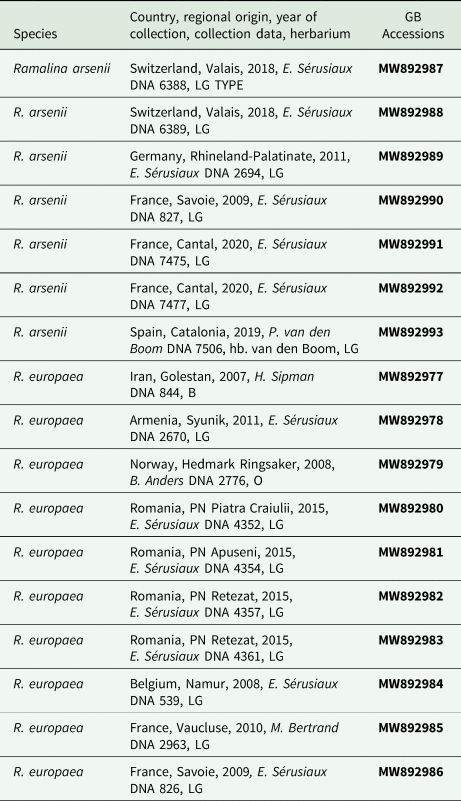
Voucher information and GenBank Accession numbers for ITS sequences newly generated for Ramalina arsenii and R. europaea included in this study.
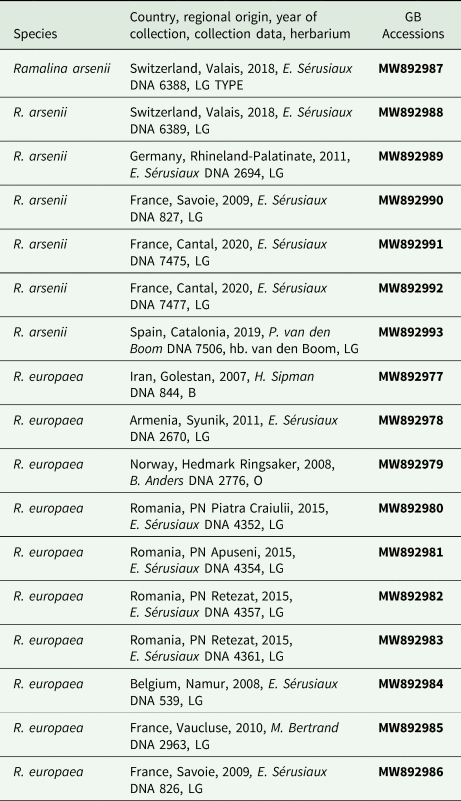
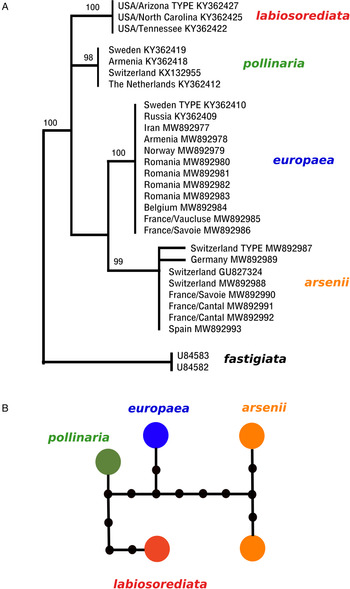
An initial ITS data matrix was generated with accessions retrieved from Gasparyan et al. (Reference Gasparyan, Sipman and Lücking2017): three accessions of Ramalina labiosorediata including the type collection, four of R. pollinaria and two of R. europaea including the type collection. Our own accessions included 10 of R. europaea and eight of the putative new species. GenBank Accession numbers for all samples used in our analyses are included in Fig. 1A.
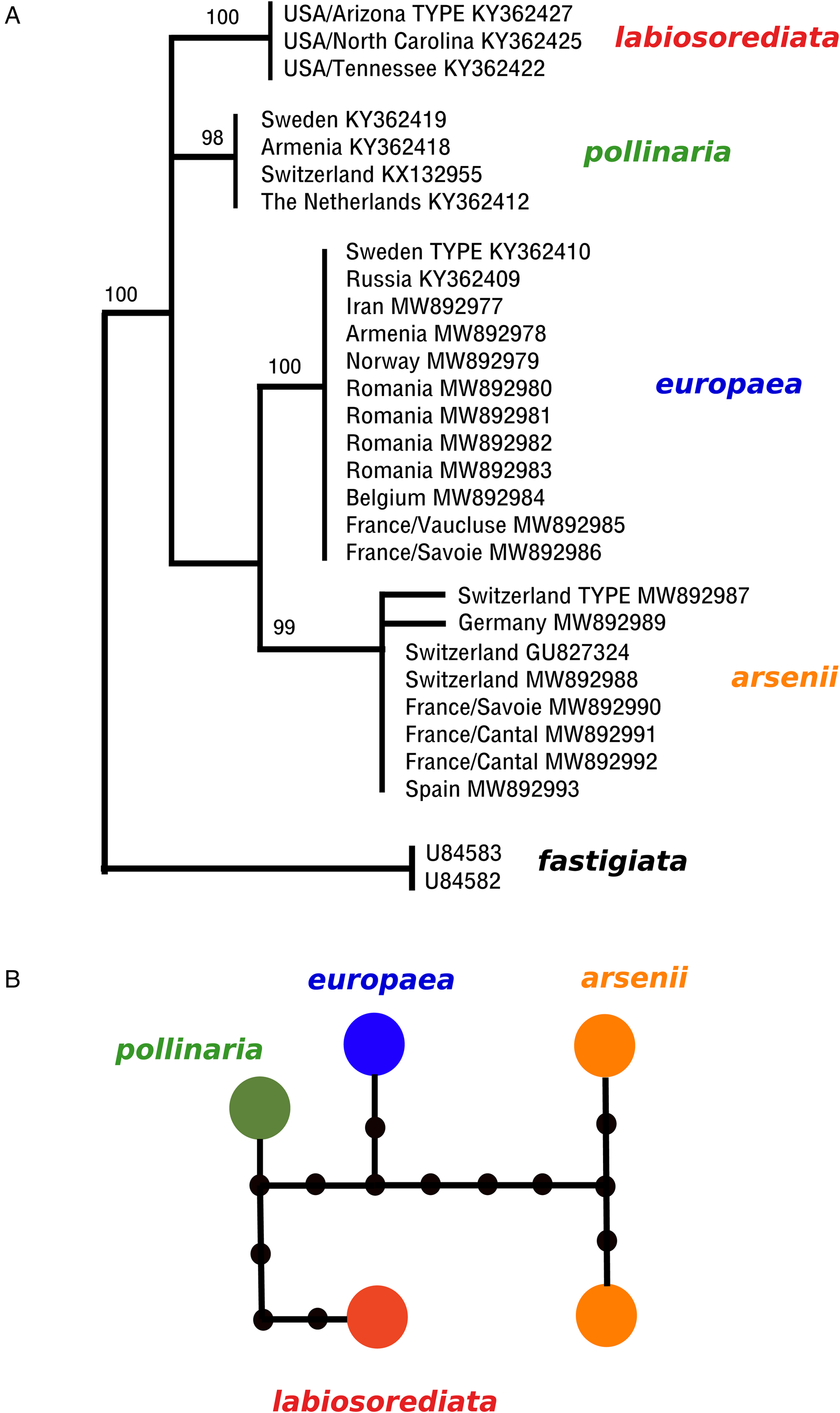
A, evolutionary tree based on ITS sequences for the four species of the Ramalina pollinaria group, as circumscribed by Gasparyan et al. (Reference Gasparyan, Sipman and Lücking2017) and optimized under maximum likelihood, with R. fastigiata as outgroup. GenBank Accession numbers are included and country of provenance provided. Numbers on branches indicate those with statistical support > 75%. B, haplotype network constructed with TCS v. 1.21 (Clement et al. Reference Clement, Posada and Crandall2000) with all four species of the R. pollinaria group; each bar between circles in the network represents a single mutation step, and each dot is an additional change. In colour online.
A maximum likelihood analysis (ML) was run with RAxML v. 8.0.0 (Stamatakis Reference Stamatakis2006) on this data matrix. Optimal tree and bootstrap searches were conducted with the rapid hill-climbing algorithm for 1000 replicates using the GTRCAT substitution model.
To analyze the genealogical relationships among the haplotypes, we constructed a haplotype network for all four species. This network was calculated using the program TCS v. 1.21 (Clement et al. Reference Clement, Posada and Crandall2000), which implements the statistical parsimony estimation as described by Templeton et al. (Reference Templeton, Crandall and Sing1992). The connection limit of the networks was fixed to 90% of the positions and gaps were treated as a fifth character state.
An additional ML analysis was performed with a more extensive sampling of Ramalina species, using the ITS subset of the data matrix build for the evolutionary tree of the genera Namibialina and Ramalina (fig. 9 of Spjut et al. (Reference Spjut, Simon, Guissard, Magain and Sérusiaux2020)). It includes three accessions of R. labiosorediata, four of R. pollinaria, eight of R. europaea and seven of the newly described R. arsenii. In total 130 accessions were included, with nine belonging to the genus Namibialina.
Thin-layer chromatography (TLC) was carried out following Orange et al. (Reference Orange, James and White2010) using solvents C and G for all new accessions of R. europaea and for R. arsenii.
Results
The ML and TCS analyses based on the first data matrix included 479 characters, of which 453 are constant, 3 are variable parsimony-uninformative and 23 parsimony-informative. All four expected taxa are retrieved with strong support (BS varying from 98 to 100); all other branches were not supported, except the branch supporting the four species, all producing evernic acid. All new accessions of both R. europaea and the newly described R. arsenii produce evernic acid in their medulla. The evolutionary tree and the haplotype network are presented in Fig. 1A & B.
The ML and TCS analyses based on the second data matrix included 446 characters, of which 257 are constant, 49 variable parsimony-uninformative and 140 parsimony-informative. The branch comprising all four species here referred to the pollinaria group is not supported. This evolutionary tree is presented in Supplementary Material Fig. S1 (available online).
The haplotype of the single accession ‘aff. pollinaria’ from Switzerland (Gasparyan et al. Reference Gasparyan, Sipman and Lücking2017) is shared by other collections from the Alps (Switzerland and France), the ‘Massif Central’ (France) and the Pyrenees (Spain), and is also known at lower elevations in Germany. It is described as a new species that can be recognized by subtle morphological characters (see description and identification key). Furthermore, it is easily recognized by its ITS barcode, differing from the other three species by at least 7 substitutions in the haplotype network. We identify a 16 bp segment in ITS2 that provides a quick and accurate way for the recognition of all four species:
-
R. europaea GGGT C CTTCGCCCGGG AGAT CCC
-
R. labiosorediata GGGT C CTTCGCCCGGG ATAC CCC
-
R. pollinaria GGGT T CTTCGCCCGGG AGAT CCC
-
R. arsenii sp. nov. GGGT C CTTCGCCCGGG ATAT CCC
Ramalina arsenii is the only species with detectable variation in the ITS: one accession with a single substitution in ITS1, and an additional one plus an inversion in ITS2.
Taxonomy
Ramalina arsenii Sérus., van den Boom & Magain sp. nov.
MycoBank No.: MB840281
In a European context, distinguished from other sorediate species producing evernic acid in their medulla by its ecological preference for slightly calcareous rocks, best developed in underhangs, rather small thalli (not exceeding 3 cm long), with soralia developing mainly on the underside of lobe apices.
Type: Switzerland, Valais canton, Saastal, near Saas-Grund, slightly calcareous rocks at edge of coniferous forest, 1680 m, 46°08.13′N, 007°56.19′E, August 2018, E. Sérusiaux s. n. (LG DNA 6389)(G—holotype; LG—isotype). GenBank Accession no.: MW892987.
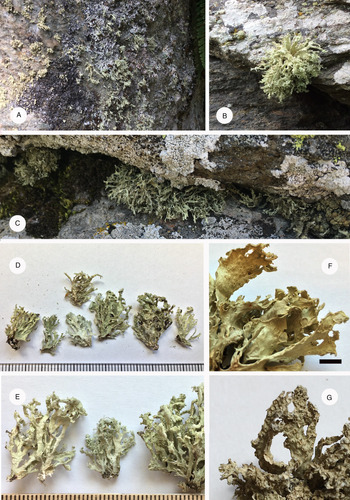
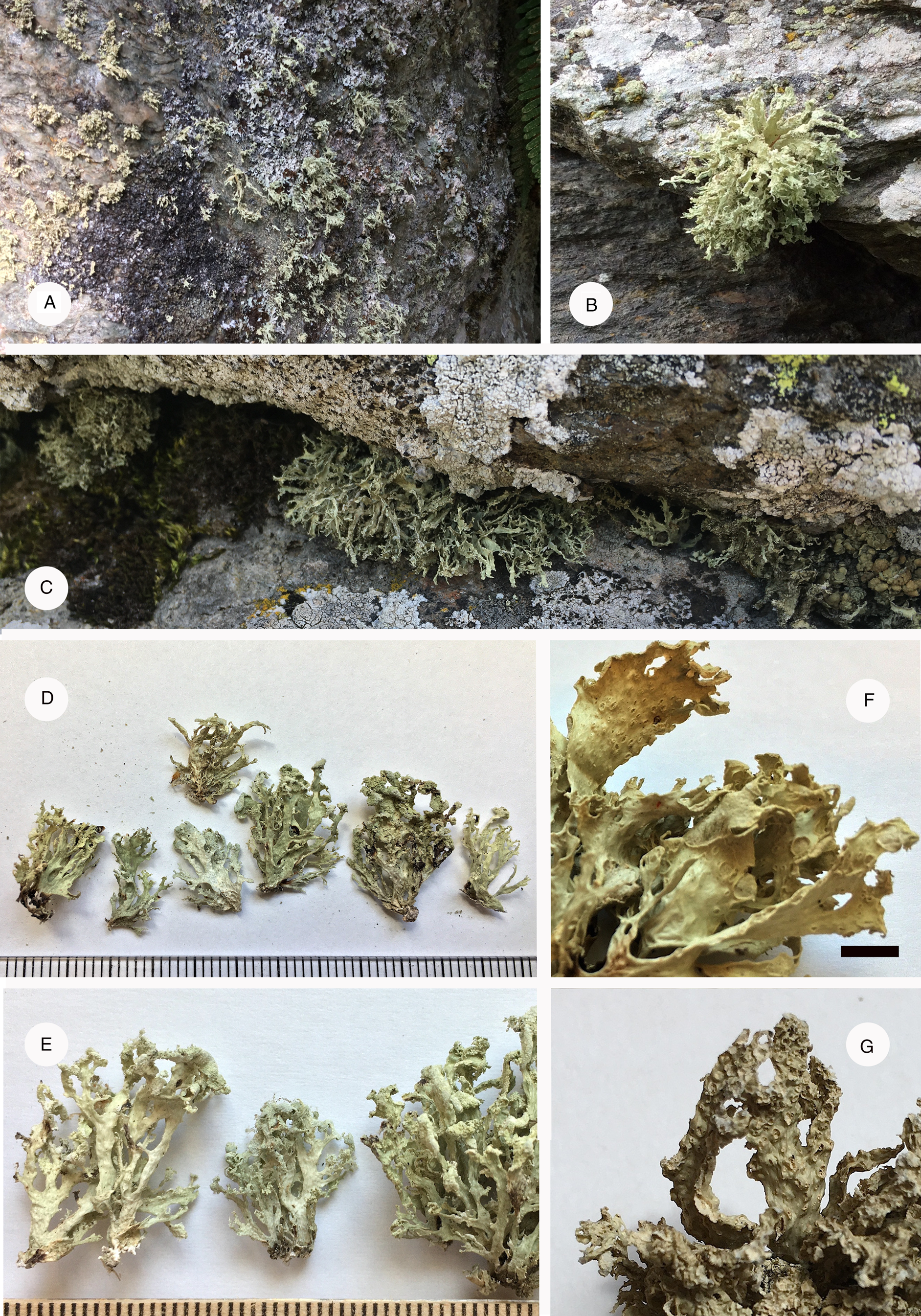
Ramalina arsenii (A–E) and R. europaea (F & G). A & B, type locality of R. arsenii. A, general view of a sheltered outcrop where the species is abundant and easily detected. B, well-developed isolated thallus. C, sheltered underhangs in Cantal Dept., France, where the species thrives. D & E, individual lobes of the holotype collection (scales in mm). F, corticolous collection of R. europaea with typical ovoid excavate depressions on underside. G, the only saxicolous population found for R. europaea, occurring together with genuine R. arsenii (not seen here), with the same depressions, albeit much smaller than in epiphytic material. Scale: F = 4 mm. In colour online.
Thallus saxicolous, fruticose, pale yellowish green to green; branches erect and ascending, or pendulous, especially for old individuals growing in dark underhangs, 1–2 cm long, rarely longer but specimens up to 3 cm long seen, starting as erect cushions of dichotomously divided and applanate lobes, with younger parts palmately or dichotomously branching; narrow longitudinal cortical pseudocyphellae seen on tiny branchlets, rarely opening with margins producing tiny verrucae; soralia first forming on dissolving, old lateral or terminal flattened branches, and eventually getting larger and expanding mainly on underside and/or at upper parts of lateral branches; in such cases, a soredioid underside may be extensive; smaller branches may not have soralia but produce delicate phyllidioid flattened lobes that can be a dominant feature of some thalli; old lobes may develop a helmet-shaped apex.
Apothecia very rare, found only once and only immature apothecia seen, with urceolate and pruinose discs < 0.2 mm diam.; ascospores not seen.
Chemistry
Usnic acid in the cortex and evernic acid in the medulla.
Etymology
This new species is named after our distinguished colleague Dr Arsen Gasparyan, who revised the taxonomy of the Ramalina pollinaria group (Gasparyan et al. Reference Gasparyan, Sipman and Lücking2017); he also published an interesting account of epiphytic lichens in Armenia (Gasparyan & Sipman Reference Gasparyan and Sipman2016).
Selected specimens examined (TLC performed for all; DNA extracted and ITS sequence produced)
Ramalina arsenii. Switzerland: same locality as type, E. Sérusiaux s. n. (LG DNA 6388; not included in the ML and TCS analyses). W of Chur, S of Flims Waldhaus, Safiental, N of Thalkirch, 46°39.33′N, 009°17.47′E, 1745 m, vertical N-exposed rock, 2008, P. van den Boom 41227 (hb. van den Boom, LG DNA 501).—Germany: Rhineland-Palatinate: NW of Koblenz, southern shore of Laacher Zee, 50°24′32″N, 007°17′39″E, 275 m, slightly calcareous outcrop at edge of forest, 2011, E. Sérusiaux s. n. (LG DNA 2694).—France: Dept. Cantal: Vic-sur-Cère, 44°59.98′N, 002°38.80′E, 775 m, on rocks by river in deep shade, 2020, E. Sérusiaux s. n. (LG DNA 7477); ibid., S of Mandailles-Saint-Julien, 45°03.77′N, 002°39.88′E, 1560 m, crevices in exposed outcrops, 2020, E. Sérusiaux s. n. (LG DNA 7475). Dept. Savoie: Haute-Maurienne, vallée de l'Arc en amont de Bessans, La Roche-du-Château, 45°20′48″N, 007°01′38″E, 1800 m, ophiolite outcrops by a river, 2009, E. Sérusiaux s. n. (LG DNA 827).—Spain: Catalonia: Val d'Aran, 42°50.14′N, 00°43.43′E, 915 m, under overhang in crevice, inside mixed forest, 2019, P. & B. van den Boom 58555 (hb. van den Boom, LG DNA 7506).
Ramalina europaea. Armenia: Syunik Prov.: E of Goris, Khndzoresk, 39°30′18″N, 046°25′54″E, 1300 m, volcanic breccia, 2011, E. Sérusiaux s. n. (LG DNA 2670).—Belgium: Prov. Namur: Ave-et-Auffe, along road to Han/s/Lesse, 50°07′01″N, 005°10′14″E, 235 m, underhang of calcareous outcrop, 2008, E. Sérusiaux s. n. (LG DNA 539).—France: Dept. Savoie: Haute-Maurienne, vallée de l'Arc en amont de Bessans, La Roche-du-Château, 45°20′48″N, 007°01′38″E, 1800 m, ophiolite outcrops by a river, 2009, E. Sérusiaux s. n. (LG DNA 826). Dept. Vaucluse: Fontaine de Vaucluse, bordure D24, 43°55′N, 005°08′E, 700 m, calcareous outcrop, facing north, 2010, M. Bertrand s. n. (hb. M. Bertrand, LG DNA 2963).—Iran: Golestan: Gorgan Distr., Tuskestan Forest, 36°44.98′N, 054°34.01′E, 650 m, disturbed deciduous forest, 2007, H. Sipman 55215B (B)(LG DNA 844).—Norway: Hedmark: Ringsaker, Brøttum sag, V for UTM WGS84: NN 8371 6447, 125 m, on tree, 2008, Breili Anders (O—L159241)(LG DNA 2776).—Romania: Parcul Natural Piatra Craiulii, 45°32′24″N, 025°16′38″E, 1300 m, on Quercus trunk in open forest, 2015, E. Sérusiaux s. n. (LG DNA 4352). Parcul Natural Apuseni, Gârda de Sus, 46°27.36′N, 022°49.42′E, 800 m, 2015, on Tilia trunk by river, E. Sérusiaux s. n. (LG DNA 4354). Parcul Natural Retezat, S of Hateg, 45°29.30′N, 022°55.28′E, 600 m, on trees at edge of forest, 2015, E. Sérusiaux s. n. (LG DNA 4357, 4361).
Discussion
In a European context and within the group comprising species producing soralia and evernic acid (R. europaea and R. pollinaria), Ramalina arsenii is easily recognized by its ecological niche (slightly calcareous rocks, especially in underhangs at low and mid elevations in Western Europe), its ITS barcode, its small size (less than 3 cm long), and its soralia developing mainly on the underside of lobe apices. This latter character makes it similar to R. labiosorediata, an endemic North American species that is usually epiphytic.
Ramalina carminae R. Arroyo & Sériñá (Arroyo et al. Reference Arroyo, Seriñá and Araujo2011; Nimis Reference Nimis2016) shares the same ecology as R. arsenii, growing in underhangs of rock outcrops in mountains. It is reported from Portugal, Spain and Sardinia in Italy. It is easily distinguished from R. arsenii by the more palmately branched lobe apices and the production of variolaric acid. Furthermore, it belongs to the capitata-polymorpha clade (Pérez-Ortega et al. Reference Pérez-Ortega, Pérez-Vargas, Blázquez, Garrido-Benavent, Aptroot, Bungartz, Blanchon, Cáceres, Divakar and Ertz2019) which is part of the so-called ‘early diverging clades’ of the genus (Spjut et al. Reference Spjut, Simon, Guissard, Magain and Sérusiaux2020), whereas the fastigiata group mainly includes only species producing evernic acid (R. breviuscula, R. carpatica, R. fastigiata and all species of the pollinaria assemblage).
With the data available, Ramalina arsenii appears to be a rather widespread species, being found in the Western Alps (Switzerland and France), the ‘Massif Central’ (France) and the southern side of the Pyrenees (Spain), and is further known at lower elevations in Germany. Interestingly, it has been found once with Ramalina europaea, its sister species in our ML analysis (but without support), on the same rock outcrop in the French Alps (GenBank Accession MW892986 for R. europaea and MW892990 for R. arsenii). In such a context, the development, especially on the lower side, of ovoid excavate depressions is a reliable diagnostic character for R. europaea. Such depressions are usually quite conspicuous in epiphytic material of R. europaea but are much smaller when saxicolous (Fig. 2F & G).
Phylogenetically closely related species thriving in the same locality and also in the same ecological microniche might not be a rare pattern in fungi (Taylor et al. Reference Taylor, Hollingsworth, McFarland, Lennon, Nusbaum and Ruess2014; Peay Reference Peay2016; Truong et al. Reference Truong, Mujic, Healy, Kuhar, Furci, Torres, Niskanen, Sandoval-Leiva, Fernández and Escobar2017). The genus Ramalina may provide an interesting model as a further similar case has been detected with the duo Ramalina inaequalis and R. tingitana (Spjut et al. Reference Spjut, Simon, Guissard, Magain and Sérusiaux2020); indeed, these two species are easily recognized, even in the field, and are resolved as two distinct phylogenetic entities but share the same niche (e.g. rocky seashores in the western part of the Mediterranean Sea).
Key to the species of the Ramalina pollinaria group (expanded from Gasparyan et al. Reference Gasparyan, Sipman and Lücking2017)
1 Soralia mainly originating from the underside, irregularly lip-shaped and rather large (North America and Western Europe)………2
Soralia marginal to laminal, elongate to rounded, if terminal then starting out as small, punctiform structures on small, spine-like branchlets; Eurasia………3
2 (1) North America; mainly on trees but also reported from rock………R. labiosorediata
Western Europe; only on rock underhangs ………R. arsenii
3 (1) Soralia starting out terminally as small, punctiform structures on small, spine-like branchlets; old lobes may develop a helmet-shaped bulge at their apex, and develop ovoid excavate soralia, 0.1–0.2 mm across, rarely regular in saxicolous population; soredia granular, 50–70 μm diam.; on rocks and trees ………R. europaea
Soralia from the beginning subterminal to laminal-marginal, irregularly elongate, not starting out on small branchlets and such branchlets absent or rare; soredia farinose, < 50 μm diam.; on rocks and trees………R. pollinaria
Acknowledgements
We warmly thank Dr H. J. M. Sipman from B for the loan of several collections of Ramalina, including one of R. europaea from Iran, and M. Bertrand and the O herbarium for the loan of several interesting species of Ramalina, including R. europaea. We would like to acknowledge Mr L. Gohy for technical assistance with DNA extractions and amplifications at the University of Liège.
Author ORCIDs
Emmanuël Sérusiaux, 0000-0002-0456-0131; Pieter van den Boom, 0000-0002-1929-2088; Nicolas Magain, 0000-0001-5409-9518.
Supplementary Material
To view Supplementary Material for this article, please visit https://doi.org/10.1017/S0024282921000372.