

We present here the results of an interdisciplinary study focused on the coastal region of La Libertad, a department in northern Peru. The study’s objective was to recover voices that could be connected to the ancient language of Chimor, Quingnam, and to certify their presence in the region’s variety of Spanish. While previous attempts to compile Quingnam vocabularies do exist, with Urban’s thorough study as a standout (Urban Reference Urban2019), we saw a need to revisit the available material, returning to primary sources and filtering candidate words through the application of a variety of linguistic and historical-geographical criteria. Later, we evaluated their contemporary use in the field, applying ethnographically informed lexical surveys in Huanchaco, Moche, and Virú (Figure 1).
Map of La Libertad Department with study locations and major localities. By María del Carmen Escobedo.

Figure 1. Long description
A political map of La Libertad Department in northern Peru. The map shows department and province boundaries, major rivers, and key locations. Study locations are marked with circles, department capital with a filled circle, and province capitals with open circles. Notable locations include Trujillo, Chepén, San Pedro de Lloc, Ascope, Cascas, Otuzco, Huamachuco, Julcán, Santiago de Chuco, Virú, Huanchaco, and Moche. An inset map in the top right corner shows the location of La Libertad within Peru.
Andean linguistics has prioritized the study of Mochica over Quingnam (Cerrón-Palomino Reference Cerrón-Palomino1995; Eloranta-Barrera Reference Eloranta-Barrera Virhuez2020; Urban Reference Urban2019). This is because, unlike the former, Quingnam is poorly documented. Toribio de Mogrovejo’s second visit, in 1593, and a document presented in 1950 by Josefina Ramos Cabredo, the Memoria de las doctrinas […] en los valles del Obispado de Trujillo, written in 1630, referred to the lenguas pescadoras (fishermen’s tongues). The landscape is further complicated by Reginaldo de Lizárraga’s early seventeenth-century distinction between two separate linguistic entities: a fishermen’s language, “difficult in the extreme,” and a second one, “not as difficult.” The first explicit mention of the name Quingnam comes from Calancha (Reference Calancha1638). The current consensus is that the expressions lengua pescadora and Quingnam refer to sociolectal variants of a single language (Cerrón-Palomino Reference Cerrón-Palomino1995, 31; Torero Reference Torero2002, 217). Furthermore, Salas García has established a straightforward equivalence between the labels Quingnam and pescadora (Salas Reference Salas2010, Reference Salas2023). A recent proposal considers lenguas pescadoras to be a broader term encompassing the languages spoken along the seaboard versus lenguas yungas, or the languages spoken in the coastal valleys, whether Quingnam or Mochica (Eloranta-Barrera Reference Eloranta-Barrera Virhuez2020, 27–35).
Amid the scarcity of information about Quingnam, onomastics provides one source for the study of the language. Zevallos Quiñones (Reference Zevallos Quiñones1993a, 1993b) compiled toponyms and anthroponyms recorded in sixteenth- and seventeenth-century documents from the region between the Jequetepeque and Virú Valleys. His collection is yet to be mined at sufficient depth; nevertheless, it is partly on that basis that earlier literature proposes some phonetic features and segments attributable to Quingnam.
The phonetic features that allow contrast with neighbor Mochica are the presence of [w] (Cerrón-Palomino Reference Cerrón-Palomino1995, 39–40; Torero Reference Torero2002, 222; Urban Reference Urban2019, 156), as in toponyms Huanchaco and Cao [kaw], and an “increased frequency of <b> in the Chicama and Moche valleys, including a fairly large number of tokens in initial position” (Urban Reference Urban2019, 166), as in budú ‘wild pigeon’ and binchín, the name of an unidentified warbling bird. Eloranta-Barrera (Reference Eloranta-Barrera Virhuez2020, 353) adds final accent in words, as in <munà> ‘mummy ancestor’ and <patà> ‘caught’ and ‘Orion’s belt,’ as another criterion to distinguish between Quingnam and Mochica, which lacks this trait.Footnote 1 More specifically, Urban (Reference Urban2019, 172) states that “stress (whatever its precise phonetic correlates) fell on the last syllable lexically,” because, in the few words of possible Quingnam origin in colonial documents for which the accentuation was marked, the accent appeared on the last syllable, as the previous examples show. Put differently, stress in the last syllable, as a nonmarked pattern, allowed for lexical opposition.
Beyond the phonological realm, a morphological feature of Quingnam is lexical reduplication, involving mostly monosyllabic roots of the CVC shape, resulting in CVCCVC words (Urban Reference Urban2019, 173), as in the anthroponym Solsol. However, as Eloranta-Barrera notes (Reference Eloranta-Barrera Virhuez2020, 196–198), this trait is also present in Mochica. Urban (Reference Urban2019, 162) also highlights the presence of the ending -an in toponyms and anthroponyms from the Moche and Virú Valleys, as in Guacharan and Sepanan; apparently, -an was a Quingnam classifier for stones or grains (Rojas-Berscia and Eloranta, Reference Rojas-Berscia and Eloranta2019). Nevertheless, it must be noted that in Mochica, the homophone an means ‘house’ and is also productive in place-names, for example, in Sian, meaning ‘house of the moon,’ a name recorded by the friar Antonio de la Calancha (Reference Calancha1638, 552) in his Coronica Moralizada, and Paiján, meaning ‘big house’, the name of a town in the department of La Libertad (Salas Reference Salas2023, 18). Thus, only the first three features—the phonological ones—enable a sound contrast with Mochica.
A highlight among recent works on Quingnam is the analysis of a seventeenth-century list of numerals discovered in a colonial church associated with the El Brujo archeological complex, in Magdalena de Cao (Quilter et al. Reference Quilter, Zender, Spalding, Jordán, Mora and Castañeda Murga2010). This finding not only provided the first explicitly recorded Quingnam words but also revealed a marked Quechua influence. Salas (Reference Salas2010) interrogated the southern boundary traditionally given for Quingnam based on information from the Crónica de Ocxaguaman and Toribio de Mogrovejo’s visits in the Archbishopric of Lima’s territories. Later, in a review of current research on the language, Salas proposed other sources and compiled words collected by other researchers, especially Zevallos Quiñones (Salas Reference Salas2023).
Our main precedent (Urban Reference Urban2019) provides an expanded compilation of words of possible Quingnam origin. His detailed list is very useful, but greater methodological precision is required. For instance, the dispersal of some of the words included in Urban’s compilation is not limited to the coast but also reaches into the highlands, which may make them attributable to languages like Quechua and Culle. This is the case, respectively, of chuño, from Quechua chuñu, ‘germinated corn kernels,’ and choloque, a type of tree (Sapindus saponaria). Urban also picks up words that are too widely dispersed, whether in the Peruvian coast, like chita, a species of fish (Anisotremus scapularis), or in other South American countries, like huabina, another edible fish (Hoplias malabaricus). Other words in his list can easily be understood as Spanish in origin, like colao, ‘a type of chicha,’ from colado (‘filtered, passed through a strainer’), and sarupico, a bird species (Numenius sp.), from Galician zarapico. For these reasons, we found it necessary to formulate a list of our own, based on a rechecking of the sources.
Our fieldwork confirmed the marked prevalence of sea-related terms among extant words of Quingnam origin. The use of such words in the region’s Spanish tends to occur in connection to activities and objects like fishing and fishing gear, marine species, and the cultivation of totora. This emphasis was already noticeable in our base list and became even more evident through our surveys. Maritime-related knowledge was thus revealed as a fertile area for exploring linkages between our lexical findings and regional history.
In what follows, after detailing the procedure, we present our main lexical results and sketch a historical approach to the fishing populations of Peru’s north and north-central coast. In closing, we summarize our conclusions and note pending items for future research.
Building a base word list
The initial list emerged from a review of earlier works that identify specific indigenous-origin words as characteristic of La Libertad’s coast. Mainly, we considered the ninety-nine “indigenous words from the Trujillo region” listed by the Lambayecan historian Jorge Zevallos Quiñones (Reference Zevallos Quiñones, de Matos and Ravines1975), with the help of the shaman Alejandro Calderón, “El Tuno.” Our second step was to review the list of possibly Quingnam words proposed by Urban (Reference Urban2019, 157–160, 293–298), directly contrasting his various sources (e.g., Zevallos Quiñones Reference Zevallos Quiñones, de Matos and Ravines1975). Then, we examined the traditional fishermen’s lexicon compiled by Prieto (Reference Prieto2013) in the strip of coast that extends between the Santa Valley in the north and the Huacho Valley in the south. Finally, Brüning’s Diccionario etnográfico (2017) proved highly pertinent for our purposes, for both its extensive word list and for the precision with which it ascribes them to localities both in the North Coast and in the Northern Andes.
With a first version of the list on hand, we consulted historical dictionaries to filter out any peninsular Spanish words or indigenous words from Central America or the Caribbean that may have been adopted early, a possibility pointed out by Rostworowski (Reference Rostworowski1981, 100) and Cerrón-Palomino (Reference Cerrón-Palomino1995, 40–41) in their assessments of our main source (Zevallos Quiñones Reference Zevallos Quiñones, de Matos and Ravines1975). We also took advantage of our earlier work in the northern Peruvian Andes to eliminate words used in both the coast and the highlands. Later, the list was enhanced in the field, with contributions from our survey respondents.
Given the scarcity of linguistic criteria for identifying Quingnam word origins, resorting to geographical and historical criteria (i.e., the dispersion of lexical items in regional varieties of Spanish, both historical and contemporary, on the one hand, and the possible attribution of these words to Quechua, Mochica and Piura indigenous languages, on the other) was necessary as a rule of thumb for refining our lexical list. These types of criteria are not ideally suited for linguistic affiliation, since, as Howard (Reference Howard, Eithne and van de Kerke2010) has argued in the case of Cañari and the first author in the case of Culle (Andrade Ciudad and Ferrell Reference Andrade Ciudad, Ferrell Ramírez, Seibane, Sánchez and Palacios2021), the elimination logic they entail can lead to inaccurate results. However, we must stress that they remain the best procedure available for expanding our understanding of Quingnam and its lexicon, given the current state of our knowledge of the language.
In the initial list, which comprises 124 words, we noticed a significant number of entries concerned with marine species and with fishing or navigation on caballitos de totora (the etic label) or balsas (the emic one), the traditional local watercraft. In consequence, we decided to focus our interviews on the seaside town of Huanchaco. However, given the origin of many of the words compiled by Calderón and Zevallos Quiñones (Reference Zevallos Quiñones, de Matos and Ravines1975), we thought it advisable not to exclude Moche. Finally, since there were also some agriculture-related words, we opted to also visit the Virú countryside (Huancaquito Alto).
Lexical list in hand, in October 2022 we interviewed five Huanchaco fishermen, two Huancaquito Alto farmers, and a pottery maker from the Moche countryside.Footnote 2 All our informants were members of traditional families in their respective localities. The interviews lasted between forty-five minutes and one hour, and consisted of articulating the word aloud, asking the subject whether they recognized it, and, after an affirmative answer, inquiring about its meaning. If the lexical item brought any other words to mind, participants were asked to mention them and later to elaborate on the pertinent information. Andrade Ciudad and Torres (Reference Andrade Ciudad and Torres Menchola2027) further elaborate on the ethnographic basis of our lexical survey.
After this, the words on the list were again contrasted with historical Spanish dictionaries and several dictionaries of Americanisms. The last step consisted in contrasting the list with available lexicons for Lambayeque (Cumpa Pizarro Reference Cumpa Pizarro2002) and Piura (Arámbulo Palacios Reference Arámbulo Palacios1995; Arellano Agurto Reference Arellano Agurto1996; Arrunátegui Novoa Reference Arrunátegui Novoa1996; Puig Reference Puig1985). Finally, we performed a thorough review of Brüning’s (2014, Reference Brüning, Urban and Barrera-Virhuez2017) dictionaries and Middendorf’s (Reference Middendorf1892) grammar to filter out as much as possible any words of Mochica origin. Despite these filters, however, some words of Quechua and Mochica origin did seep through, as is explained in the following section.
To keep the list at a manageable length and avoid extending the duration of the survey, we set aside in our assessment the following historical words, considered of possible Quingnam origin in the earlier literature but in all likelihood no longer in use: <munaos> ‘ancestor mummies’ (Arriaga [1621] Reference Arriaga1999, 21), <morpi> ‘conopa’ (Arriaga [1621] Reference Arriaga1999, 80), <yale> ‘chicha’ (Arriaga [1621] Reference Arriaga1999, 50), <ñaca> ‘lock of hair,’ ‘clump’ (Arriaga [1621] Reference Arriaga1999, 65), <guaxme> ‘fisherman’ (Santo Tomás Reference Santo Tomás1560, 85, 136), <vini> ‘god’ (Calancha Reference Calancha1638, 368), and <namo> ‘father, lord,’ proposed by Torero (Reference Torero2002, 223) on the basis of onomastics.Footnote 3
Toward a corpus of words of possible Quingnam origin
Contrasting the list with historical and dialectal Spanish dictionaries confirmed that the attribution of possible Quingnam origin to words from the regional lexicon has suffered from insufficient methodological precision. Earlier lists failed to effectively filter certain words of Spanish origin and, as noted by Cerrón-Palomino (Reference Cerrón-Palomino1995, 40–41) and Rostworowski (Reference Rostworowski1981, 100), indigenous words originating in Central America and the Caribbean. Despite the initial comparison and contrast phase, it was also for this reason that at a later stage we still identified and rejected from our base list some Peninsular Spanish words. Examples of this are the words patacho, the name given to a type of watercraft larger than a caballito de totora, and sinamón, the local name for the Cipressus lusitanica tree (Bussmann and Sharon Reference Bussmann and Sharon2015). The former derives from patache, a word of Arabic or French origin meaning ‘small craft often used in port tasks and services’ (Real Academia Española Reference Real Academia2014; Corominas Reference Corominas1954; Salas Reference Salas2023, 204); the latter ultimately derives from cinamomo, a Latinism for a tree species in the Meliaceae family (Melia azedarach), distinct from the referent associated with this word in Peru’s North Coast. A special case of a word of possible indigenous origin with Castilian influence is tildío, the name for a marine and terrestrial bird (Charadrius vociferus), as it contains a simplified variant of the diminutive -illo, after yeísmo. In this instance, we decided to keep the word to preserve its possibly onomatopoeic root. Similarly, we retained chepón ‘glutton,’ despite the possible presence of a Spanish augmentative joined to an indigenous base.
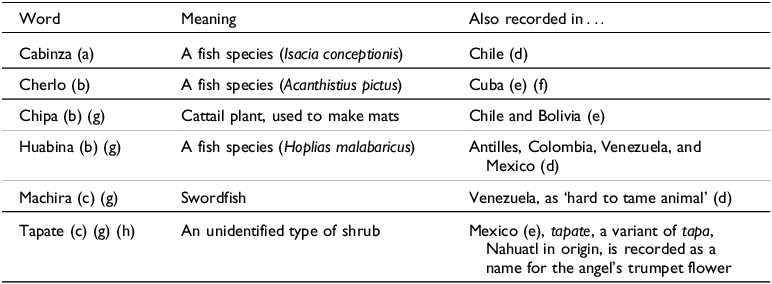
We also rejected words that, while incorporated into the La Libertad coast’s vernacular Spanish and seemingly of indigenous origin, are too widely distributed across Latin America and could easily be loans from other languages. The dispersal of these words points in two directions: along the central and southern coast toward Chile in the south, and toward the Colombian and Venezuelan Caribbean region in the north. An example of the former is cabinza, a fish species (Isacia conceptionis), and of the latter, huabina (Hoplias malabaricus). Table 1 lists these cases of widely dispersed indigenous words.
Indigenous words with a wide Latin American dispersal in our initial list

Table 1. Long description
A table listing indigenous words with wide Latin American dispersal. The table has 6 rows and 3 columns. The columns are labeled ‘Word’, ‘Meaning’, and ‘Also recorded in ...’. Row 1: Word, Cabinza; Meaning, A fish species (Isacia conceptionis); Also recorded in ..., Chile. Row 2: Word, Cherlo; Meaning, A fish species (Acanthistius pictus); Also recorded in ..., Cuba. Row 3: Word, Chipa; Meaning, Cattail plant, used to make mats; Also recorded in ..., Chile and Bolivia. Row 4: Word, Huabina; Meaning, A fish species (Hoplias malabaricus); Also recorded in ..., Antilles, Colombia, Venezuela, and Mexico. Row 5: Word, Machira; Meaning, Swordfish; Also recorded in ..., Venezuela, as ‘hard to tame animal’. Row 6: Word, Tapate; Meaning, An unidentified type of shrub; Also recorded in ..., Mexico, tapate, a variant of tapa, is recorded, Nu00e1huatl in origin, as a name for the angel’s trumpet flower.
Sources: (a) Prieto Reference Prieto2013, (b) Zevallos Quiñones Reference Zevallos Quiñones, de Matos and Ravines1975, (c) Lecuanda Reference Lecuanda1793, (d) ASALE 2010, (e) Malaret Reference Malaret1931, (f) Pichardo Reference Pichardo1836. (g) Cited in Urban (Reference Urban2019) as of possible Quingnam origin. (h) Urban’s source (Manuel A. Fuentes’s edition of Lecuanda) mistakenly reads taparte (Lecuanda Reference Lecuanda and Manuel1861).
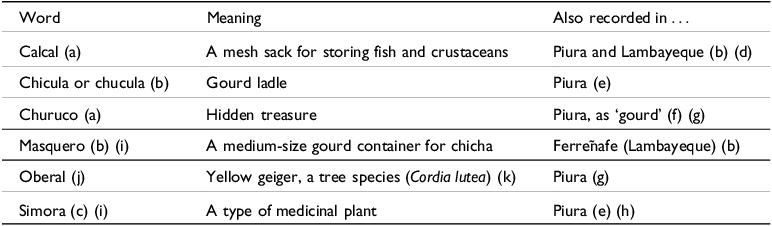
Also rejected were words equally in use in Trujillo’s, Lambayeque’s, and Piura’s coastal regions, since they could have their origin in other North Coast languages, such as Mochica, Tallán, and the language of Sechura. This is the case of churuco ‘hidden treasure,’ used in Sechura to name a “small gourd for carrying water” (Arrunátegui Novoa Reference Arrunátegui Novoa1996). Another example is calcal, ‘mesh sack for fish and crustaceans, smaller than a cabán,’ which is also recorded in Sechura (Arrunátegui Novoa Reference Arrunátegui Novoa1996) and in the Mochica region (Brüning Reference Brüning and García2004). Table 2 lists words rejected for this reason.
Indigenous words also recorded in Lambayeque and Piura in our initial list

Table 2. Long description
A table with three columns and six rows. The columns are labeled ‘Word’, ‘Meaning’, and ‘Also recorded in...’. The rows list indigenous words, their meanings, and the regions where they are also recorded. Row 1: Word: Calcal (a), Meaning: A mesh sack for storing fish and crustaceans, Also recorded in...: Piura and Lambayeque (b) (d). Row 2: Word: Chicula or chucula (b), Meaning: Gourd ladle, Also recorded in...: Piura (e). Row 3: Word: Churuco (a), Meaning: Hidden treasure, Also recorded in...: Piura, as ‘gourd’ (f) (g). Row 4: Word: Masquero (b) (i), Meaning: A medium-size gourd container for chicha, Also recorded in...: Ferreñafe (Lambayeque) (b). Row 5: Word: Oberal (j), Meaning: Yellow geiger, a tree species (Cordia lutea) (k), Also recorded in...: Piura (g). Row 6: Word: Simora (c) (i), Meaning: A type of medicinal plant, Also recorded in...: Piura (e) (h).
Sources: (a) Zevallos Quiñones Reference Zevallos Quiñones, de Matos and Ravines1975, (b) Brüning Reference Brüning, Urban and Barrera-Virhuez2017, (c) Gillin Reference Gillin1945, (d) Arrunátegui Reference Arrunátegui Novoa1996, (e) Arellano Reference Arellano Agurto1996, (f) Arámbulo Reference Arámbulo Palacios1995, (g) Puig Reference Puig1985, (h) Robles Rázuri Reference Robles Rázuri2012. (i) Cited in Urban (Reference Urban2019) as of possible Quingnam origin. (j) Cited in Urban (Reference Urban2019, 153, 298) as a northern regional term, but also as of possible Quingnam origin in his final list. (k) Bussman and Sharon (Reference Bussmann and Sharon2015).
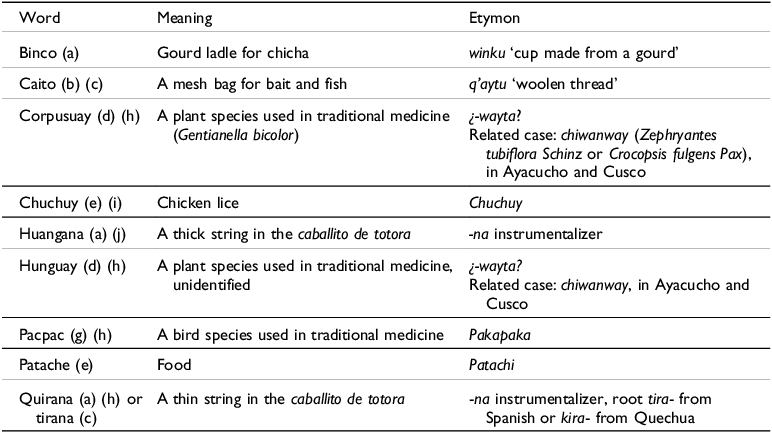
At the same time, both previous research and our list failed to adequately filter words of possible Quechua origin. Some of them appear to have been incorporated early into northern languages or in regional varieties of Spanish, as in the case of caito ‘small mesh bag for carrying small amounts of bait and fish,’ derived from q’aytu ‘woolen thread.’ These and other words of Quechua origin initially not detected in our list are presented in Table 3.
Words of Quechua origin not detected in our initial list

Table 3. Long description
A table with three columns labeled Word, Meaning, and Etymon. The table contains 9 rows, each describing a word of Quechua origin, its meaning, and its etymology. Row 1: Binco (a), Gourd ladle for chicha, winku ‘cup made from a gourd’. Row 2: Caito (b) (c), A mesh bag for bait and fish, q’aytu ‘woolen thread’. Row 3: Corpusuyu (d) (h), A plant species used in traditional medicine (Gentianella bicolor), ¿-wayta?. Row 4: Chuchuy (e) (i), Chicken lice, Chuchuy. Row 5: Huangana (a) (j), A thick string in the caballito de totora, -na instrumentalizer. Row 6: Hunguay (d) (h), A plant species used in traditional medicine, unidentified, ¿-wayta?. Row 7: Pacpac (g) (h), A bird species used in traditional medicine, Pakapaka. Row 8: Patache (e), Food, Patachi. Row 9: Quirana (a) (h) or tirana (c), A thin string in the caballito de totora, -na instrumentalizer, root tira- from Spanish or kira- from Quechua.
Sources: (a) Brüning Reference Brüning, Urban and Barrera-Virhuez2017, (b) Prieto Reference Prieto2013, (c) our interviews, (d) Gillin Reference Gillin1945, (e) Zevallos Quiñones Reference Zevallos Quiñones, de Matos and Ravines1975, (f) Rostworowski Reference Rostworowski1981, (g) Zevallos Quiñones and Castañeda Murga Reference Zevallos Quiñones and Murga1991. (h) Cited in Urban (Reference Urban2019) as of possible Quingnam origin. (i) Also cited in Salas (Reference Salas2023) as of Quechua origin. (j) Also cited in Urban (Reference Urban2019) as of possible Quechua origin.
The issue of Quechua roots in words of possible Quingnam origin deserves detailed commentary, as Quingnam seems to have been strongly influenced by the Andean tongue, even to a greater degree than Mochica. Witnesses to this are the numbers compiled in the Magdalena de Cao colonial-era document (Quilter et al. Reference Quilter, Zender, Spalding, Jordán, Mora and Castañeda Murga2010). Similarly, the anthroponymy of Trujillo ethnic lords reveals markedly Quechua components, such as Chumbi and Guaman (Zevallos Quiñones Reference Zevallos Quiñones1993a). However, how these Quechua loans were adapted to Quingnam is yet to be studied. We thus deemed it not advisable to reject all apparent Quechua loans from our final list, which explains the retention of cases like pac pac (Q. pakapaka; Glaucidium peruanum) and chicana ‘ladle for chicha,’ which, like quirana, tirana, and huangana, features the Quechua instrumental suffix -na, but also a possible root chika-, unidentified for the Andean language.Footnote 4
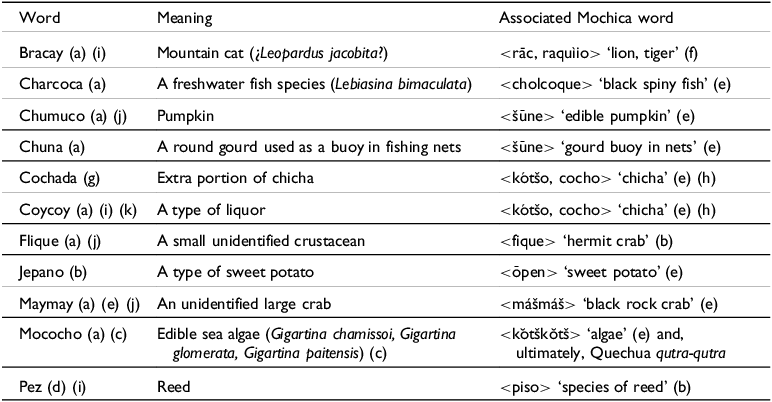
Meanwhile, from the start, our initial list also included words of apparent Mochica origin. We decided to retain them to take full advantage of our interviews and our time in the field. This is the case of openec ‘sweet potato,’ and the phrases cuchumic ‘you are drunk,’ amisequec ‘don’t be uppity,’ and maimenec ‘shut up.’Footnote 5 Interestingly, the four examples come from the Moche vocabulary compiled by the shaman Calderón for Zevallos Quiñones (Reference Zevallos Quiñones, de Matos and Ravines1975). Verifying their current status was important, since, in the case of maimenec and cuchumic, Urban (Reference Urban2019, 175) categorizes them as surviving, but our fieldwork disproved this. The Mochica origin of other words was revealed only during the second contrast phase; for example, flique, the name for a small unidentified crustacean, was recorded by Brüning (Reference Brüning, Urban and Barrera-Virhuez2017, 32) as fique in Santa Rosa (Chiclayo, Lambayeque), with the meaning “hermit crab, crustacean living inside an empty shell.” Other words of Mochica origin not detected in our initial list are presented in Table 4.
Words of Mochica origin not detected in our initial list

Table 4. Long description
A table with 11 rows and 3 columns. The columns are labeled ‘Word’, ‘Meaning’, and ‘Associated Mochica word’. Each row lists a word of Mochica origin, its meaning, and the associated Mochica word. Row 1: Bracay, Mountain cat (Leopardus jacobita?), <r c, raquío> ‘lion, tiger’. Row 2: Charcoca, A freshwater fish species (Lebiasina bimaculata), <cholcoque> ‘black spiny fish’. Row 3: Chumuco, Pumpkin, <š ne> ‘edible pumpkin’. Row 4: Chuna, A round gourd used as a buoy in fishing nets, <š ne> ‘gourd buoy in nets’. Row 5: Cochada, Extra portion of chicha, <kótsho, cocho> ‘chicha’. Row 6: Coycoy, A type of liquor, <kótsho, cocho> ‘chicha’. Row 7: Flique, A small unidentified crustacean, <fique> ‘hermit crab’. Row 8: Jepano, A type of sweet potato, <pen> ‘sweet potato’. Row 9: Maymay, An unidentified large crab, <mašmaš> ‘black rock crab’. Row 10: Mococho, Edible sea algae (Gigartina chamissoi, Gigartina glomerata, Gigartina paitensis), <kobreve, tsik> ‘algae’. Row 11: Pez, Reed, <piso> ‘species of reed’.
Sources: (a) Zevallos Quiñones Reference Zevallos Quiñones, de Matos and Ravines1975, (b) Brüning Reference Brüning, Urban and Barrera-Virhuez2017, (c) Bussman and Sharon Reference Bussmann and Sharon2015, (d) Mogrovejo Reference Mogrovejo and Benito2006, (e) Brüning Reference Brüning and García2004, (f) Carrera Reference Carrera and Altieri1939, (g) our interviews, (h) Middendorf (Reference Middendorf1892). (i) Cited in Urban (Reference Urban2019) as of possible Quingnam origin. (j) Also cited in Urban (Reference Urban2019) as of possible Mochica origin. (k) Also cited in Salas (Reference Salas2023).
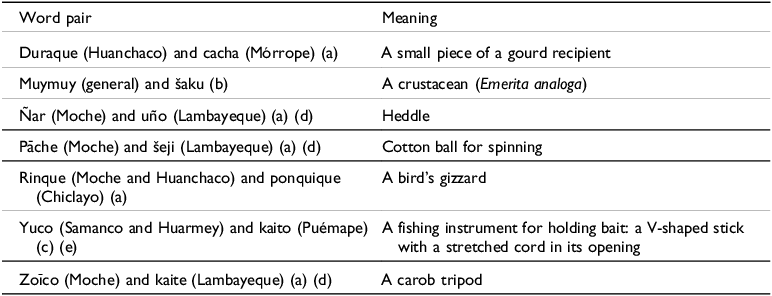
Once we filtered our list, we determined that the best criterion for identifying words of possible Quingnam origin was the existence of lexical pairs comprising indigenous words with the same meaning or the same referent, in which one element could be attributed to Mochica and the other to Quingnam (see also Urban Reference Urban2019, 157). This is the case of the pairs <rinque> and <ponquique> (Brüning Reference Brüning, Urban and Barrera-Virhuez2017). Both are alternative names for a bird’s gizzard. Brüning recorded the former in Moche and Huanchaco, within the Quingnam area, and the latter in Chiclayo, in the heart of the Mochica area. In Moche we verified the survival of rinque. With outstanding precision, one of our informants defined it as follows: “In a chicken or any bird, I don’t know the name, but it is where it grinds its food.” Table 5 presents other possible pairs of words of Mochica and Quingnam origin with the same meaning or referent.
Word pairs with the same meaning or referent in the Mochica and Quingnam areas

Table 5. Long description
A table with two columns and seven rows. The columns are labeled ‘Word pair’ and ‘Meaning’. The rows list word pairs from Mochica and Quingnam areas along with their meanings. Row 1: Duraque (Huanchaco) and cacha (Morrope), A small piece of a gourd recipient. Row 2: Muymuy (general) and šaku, A crustacean (Emerita analoga). Row 3: Ñar (Moche) and uño (Lambayeque), Heddle. Row 4: P che (Moche) and šeji (Lambayeque), Cotton ball for spinning. Row 5: Rinque (Moche and Huanchaco) and ponquique (Chiclayo), A bird’s gizzard. Row 6: Yuco (Samanco and Huarmey) and kaito (Puémape), A fishing instrument for holding bait: a V-shaped stick with a stretched cord in its opening. Row 7: Zo co (Moche) and kaite (Lambayeque), A carob tripod.
Sources: (a) Brüning Reference Brüning, Urban and Barrera-Virhuez2017, (b) Brüning Reference Brüning and García2004, (c) Prieto Reference Prieto2013. (d) Cf. Andrade Ciudad (Reference Andrade Ciudad2024). (e) Cf. Pastor (2012) for a different definition of yuco.
The case of muymuy merits special note. Despite its wide distribution along Peru’s coast (and not only Trujillo’s), we retained the word in our list because of its structure, based on a reduplicate syllable, but also, and especially, because Bruning’s dictionary records it as an alternative for the Mochica <šaku>, with the same referent. At any rate, the semantics of the latter word appears to have been broader, since its first meaning is “black conch (from the pier pillars),” seemingly in reference to the Aulacomya ater species of mollusk. On the other hand, a lexical structure based on reduplicate syllables is not an exclusive feature of Quingnam; it appears to be present in the entire North Coast region (pace Urban Reference Urban2019, 173; see Eloranta-Barrera Reference Eloranta-Barrera Virhuez2020, 196–198). Piura’s indigenous lexicon features a different word for the species (cuñús) according to Rodríguez Suy Suy (Reference Rodríguez Suy Suy1997, 89).
A last aspect to which the specialized literature has so far been insufficiently attentive is the relationship with the Andes region. For example, Urban (Reference Urban2019) proposes a Quingnam origin for some words that are frequently found in the highlands, such as maichill ‘medicinal plant (Thevetia peruviana),’ chimbil (in reality, shimbil) ‘fruit of a cactus,’ and choloque (Sapindus saponaria). In our research, we relied on previously accumulated knowledge of the indigenous languages of the northern Andes as a filter for words of this kind. Even so, two of them seeped through, and we identified them only later as in use in Cajabamba, in southwestern Cajamarca: carrahuay ‘beetle’ and alliguanga ‘black-colored scavenger bird.’ We attributed them a possible Quingnam origin because of the presence of the segment /w/, not featured in the Mochica phonological system. Initially, our list included carrahuay, a beetle species (Lygirus maimon), and huayguanga or iguanga ‘red-headed turkey vulture’ (Cathartes aura).Footnote 6 In the latter instance, our ultimate rejection of the word is supported by the use of an alternative name for the same species in the area of Virú: <Vll>, albeit the word is somewhat illegible in the documentary source (Zevallos Quiñones and Castañeda Murga Reference Zevallos Quiñones and Murga1991, 101; Urban Reference Urban2019, 154).Footnote 7
After applying all the filters, we were able to formulate a final list of words of possible Quingnam origin. The results summarized in Table 6 confirm the quality of the compilations by Zevallos Quiñones (Reference Zevallos Quiñones, de Matos and Ravines1975), Prieto (Reference Prieto2013), and Brüning (Reference Brüning, Urban and Barrera-Virhuez2017). It must also be noted that some words came up only in the context of our interviews. In the cases of ancoco, meñoca, muymuy, and paypay we should point out that Brüning (Reference Brüning and García2004) included them in his Mochica dictionary, not as indigenous-language headwords, but as glosses of other autochthonous words, which suggests that they were considered part of local Spanish.Footnote 8
Final list of words of possible Quingnam origin

Table 6. Long description
A table listing words of possible Quingnam origin with meanings and locations of use. The table has 12 columns and 100 rows. Column headers are: Word, Meaning, and Location of use. Row 1: Anchor, a type of cane, Chimbote (H). Row 2: Ancoco, a fish variety, Chimbote (H). Row 3: Asnoco, a dangerous weed used in the open sea, Chimbote (H). Row 4: Ayampe, a fish variety, (Graveteo species). Row 5: Buche, an unidentified shell, (PMH). Row 6: Cachito, a small variety of fish, (unidentified species). Row 7: Cachiy, a type of fish, (unidentified species). Row 8: Cachiy, a type of fish, (unidentified species). Row 9: Cachiy, a type of fish, (unidentified species). Row 10: Cachiy, a type of fish, (unidentified species). Row 11: Cachiy, a type of fish, (unidentified species). Row 12: Cachiy, a type of fish, (unidentified species). Row 13: Cachiy, a type of fish, (unidentified species). Row 14: Cachiy, a type of fish, (unidentified species). Row 15: Cachiy, a type of fish, (unidentified species). Row 16: Cachiy, a type of fish, (unidentified species). Row 17: Cachiy, a type of fish, (unidentified species). Row 18: Cachiy, a type of fish, (unidentified species). Row 19: Cachiy, a type of fish, (unidentified species). Row 20: Cachiy, a type of fish, (unidentified species).
Notes: * = not in use, H = in use in Huanchaco, M = in use in Moche, and V = in use in Virú.
Sources: (a) Zevallos Quiñones and Castañeda Murga Reference Zevallos Quiñones and Murga1991, (b) our interviews, (c) Zevallos Quiñones Reference Zevallos Quiñones, de Matos and Ravines1975, (d) Rodríguez Suy Suy Reference Rodríguez Suy Suy1997, (e) Prieto Reference Prieto2013, (f) Feijoó de Sosa [1763] Reference Feijoó de Sosa1984, (g) Brüning Reference Brüning, Urban and Barrera-Virhuez2017, (h) Bussman and Sharon Reference Bussmann and Sharon2015, (i) Calancha Reference Calancha1638, (j) Lecuanda Reference Lecuanda1793, (k) Pastor Reference Pastor Seperak2012, (l) Mogrovejo Reference Mogrovejo and Benito2006, (m) Gillin Reference Gillin1945. (n) Also cited in Urban (Reference Urban2019) as of possible Quingnam origin. (o) Also cited in Salas (Reference Salas2023). (p) Urban (Reference Urban2019) attributes it a Mochica origin. (q) See Pastor (Reference Pastor Seperak2012) for another definition.
It is worth noting that twenty-six of the eighty-nine words listed in Table 6 show features previously attributed to Quingnam that contrast with Mochica. The phoneme [w] is apparent in the words huacala ‘a saltwater fish’; huanchaco ‘Peruvian meadowlark’; huiri huiri or huirhuira ‘shorttail fanskate’; paucay, an unidentified shrub species; pausa, an unidentified snail species; saucha ‘reed’; guauche (variant of cocho ‘pelican’) and cahuán (variant of cabán), ‘a mesh bag for muymuy.’ Besides cabán, a variant of cahuán, the presence of the grapheme <b> can be observed in initial position in biquín, an unidentified species of crab; as well as in binchín, bircoya, and budú, the names of three bird species. Nineteen terms exhibit final stress: besides biquín, binchín, budú, cabán/cahuán and paucay, we list cañán ‘a type of lizard’; caycay ‘burnt stone’; chancullay, an unidentified fish; chemoy, a creeping plant; circil ‘fabric used to store corn underground’; mismís ‘snakehead kingcroaker’; muymuy, a small crab; pacán, ‘painted ghost crab’; paypay, a tree species; pilcay, ‘cochineal’; pinuquil, ‘sand mound in the dunes,’ pucún, a species of bird; puquión, a small, unidentified shrimp, and samás ‘bignose anchovy’ (with the variant with paragoge samasa).Footnote 9
Thus, specific linguistic criteria suggest a possible Quingnam origin for these items. In spite of the remaining sixty-three words not exhibiting these features, we also propose a Quingnam origin for them because they meet the other established criteria; that is, they have passed through the historical and geographical filters we previously described. The words caycay, mismís, muymuy, and paypay (and perhaps circil) not only present stress in the ultima but also reduplication; nevertheless, this trait is not diagnostic of Quingnam origin, since it is also present in Mochica. In the same vein, the words cabán, cañán, and pacán share the final segment -an, which is attributed to Quingnam, but, as explained previously, there was a homophonous element in Mochica meaning ‘house.’ However, it bears mentioning that, given the referents of the three words—namely, a small fishing pouch, a type of lizard, and a type of crab, respectively—we find a Mochica origin rather unlikely in these cases.
In the third column of Table 6, we differentiate words found to remain in use from those that appear to have fallen into oblivion. For the former, we specify the locality of their recording. Moche is revealed as the location where the largest number of such words are preserved, even though only one individual was interviewed there, unlike Virú, where we interviewed two farmers, and Huanchaco, where we interviewed five fishermen. Our fieldwork confirmed that the Moche countryside is the most promising site for further research on the region’s indigenous lexicon.
As expected, many words recorded in historical documents are no longer in use. Indeed, almost all the words found by Zevallos Quiñones (Reference Zevallos Quiñones, de Matos and Ravines1975) in various archives have vanished. Similarly, all words related to traditional textile production, an activity that had died out in the region by the mid-twentieth century (see Holmberg Reference Holmberg1954 for Virú), are not known today. Words connected to astronomical and climate knowledge have also been lost.
Last, the presence of words related to marine life and fishing activities stands out both among extant words and among those that do not survive. We find names not only for fish, crustaceans, and other animal species (some still unidentified) but also for subspecies, as in the case of several varieties of ray. A remarkable fact is that the Mochica names for crabs and shrimp, registered in the available lexical sources, are not formally related to the items listed. Since we have applied all the filters previously specified, this contrast strongly suggests a Quingnam origin for these words. Particularly striking is the sophisticated semantics of a word referring to the growth processes of marine animals: capusa, used for the molting muymuy, but also for a small species of shrimp that also serves as bait (Callichirus islagrande). One of our informants indicated that there are also capusa crabs, so called “because they are soft.” Thus, capusa seems to be a generic adjective associated with the youthful stages of marine species. Along the same lines, some of the words found are connected to the cultivation of totora, a valuable resource in traditional seafaring. In the following section, we present a sociohistorical explanation for this finding.
Words and knowledge in the history of fishing communities
Our lexical analysis reveals the clear preponderance of words associated with the sea and with fishing activities. This coincides with the recording of a greater number of words of possible Quingnam origin in coastal locations (Huanchaco and Moche) than in interior valleys (Virú). Although it is true that a larger sample could dilute this preponderance, our findings suggest a tendency that matches prior observations. For example, referring to our main source—Zevallos Quiñones’s (Reference Zevallos Quiñones, de Matos and Ravines1975) list—Urban (Reference Urban2019, 156) argues that “given the strong maritime adaptation of life on the Peruvian coast, types of fishing implements, species of fish, and crustaceans figure strongly on the list.” Unlike Urban, we believe this pattern is not entirely explained by predictable adaptations to the local geography.
It is often thought that Quingnam became extinct in the Trujillo region at some point between the seventeenth and eighteenth centuries (Salas Reference Salas2023, 95–96; Urban Reference Urban2019, 175–176). In the period of transition to extinction, whether the language was retained or discarded probably had to do with the nature of the interactions between local populations and colonial authorities. In a pioneering work on fishing communities, Rostworowski (Reference Rostworowski1977) argued that in the colonial period (and perhaps in earlier times), fishing was a specialized and relatively autonomous activity. In colonial times, the degree of the autonomy enjoyed by fishermen depended on the colonial administration’s limited (or nonexistent) interference with the activity itself and on the linkages between the fishing community’s population and the tax system. In that connection, Flores Galindo underscored the fact that fishermen often lived far from cities and haciendas, which afforded them a convenient distance from the colonial administration. In that way, he noted, fishing became a pillar of support for indigenous culture (Flores Galindo Reference Flores Galindo1981, 163–164). Based on a sixteenth-century inquiry, Ramírez highlights that the fishermen of the Chicama Valley enjoyed greater independence than their farmer neighbors, despite maintaining an interdependent relationship with them based on exchange. Indeed, because of their ability to provide protein and other products, communicate, and transport people and supplies, they were able to negotiate rights (Ramírez Reference Ramírez, Prieto and Daniel2020, 418).
The situation outlined in these authors’ arguments strongly suggests that the realm of fishing provided a favorable context for the survival of indigenous languages. Nevertheless, such a hypothesis requires a more solid empirical foundation, controlling for possible temporal and spatial extrapolations. Rostworowski (Reference Rostworowski1977, 224) herself pointed out that at least some fishing communities in the North Coast used their products to pay tax, and the same has been established for Lima (Vergara Reference Vergara1999, 44). Similarly, heavy tribute is reported to have been extracted from fishing communities in Arica and Tarapacá, due to Potosí’s massive demand for marine products (Hidalgo et al. Reference Hidalgo, Cisternas and Aguilar2019, 282–283). Other sources highlight situations of tension and conflict between fishermen and inland local lords (Ramírez Reference Ramírez1995), as well as with colonial authorities who sometimes required them as mitayos for fishing or agricultural tasks (Castañeda Murga Reference Castañeda Murga and Álvarez2004). In both cases, we find fishermen displaying a clear sense of identity amid the scenario of the early colonial years.
We must, therefore, explore the historical information that exists about the fishing communities of the Peruvian North Coast to assess the nature of their economic activities, their links with the colonial administration, and the way those two factors affected their social dynamics. While sources for a detailed approach to the issue are unfortunately lacking, some scattered clues allow us to formulate tentative answers to those questions.
The oldest reference we have found is in the minutes of the Trujillo town council for March 28, 1601. Those minutes record a formal complaint by indigenous fishermen from Huanchaco, Moche, Guamán and Guañape, concerning the low fish prices mandated by the council. The plaintiffs asked not only for that mandate to be rescinded but also for greater freedom to market their products, allowing them to sell in places other than Trujillo. The text reads as follows:
Los indios pescadores de los pueblos de Moche y Guaman y guanchaco que están junto a la ciudad de Truxillo dicen que el corregidor fiel executor y otras justicias de ella les conpelen a llebar pescado a la dicha ciudad para que lo den y lo bendan a muy bajo precio de suerte ques mas trabajo que tienen que no probecho y como es notorio muchas beses sucede estar la mar braba por lo qual y porque suelen acudir a otras obligaciones que no pueden coger ningún pescado… suplican a Vuesa Excelencia se sirva de mandar quel pescado que tomaren y coxieren lo puedan vender y vendan en la dha ciudad libremente al precio que les pareciere para que puedan tener algún aprovechamiento y premio de su trabajo sin que el corregidor ni justicias sentremetan a ponerles tassa y que quando no ubiere el dcho pescado por las causas que rrefieren no les prendan ni molesten ni lleven derechos ni costas algunas. (Zevallos Quiñones Reference Zevallos Quiñones1969, 183)Footnote 10
In this case, Vega Loyola (Reference Vega Loyola2013a, 68) noted that, not finding a satisfactory resolution to their complaint, some fishermen migrated to other locations in the colony. His assertion appears to be based on the significant presence of Trujillo-area fishermen in Lima some twelve years later. Those fishermen were included in the Indian census of Lima prepared in 1613 by the notary Miguel de Contreras (Reference Contreras1968). One such notable presence is the fishermen’s cacique Juan Gonzales (Vergara Reference Vergara1999, 45; Vega Loyola Reference Vega Loyola2013b, 188); another is Alonso Guarcay, who, unlike all the others, is not registered as a fisherman but as a navigator. Of Guarcay, the document states that “he is a mariner and has gone to Guayaquil maybe eight days ago” (“es marinero y es ido a Guayaquil habrá ocho días”) (Contreras Reference Contreras1968, 341).
Vega Loyola (Reference Vega Loyola2013b, 187) notes that, indeed, of the sixty-two individuals who declare fishing as their craft in the Lima census, twenty-six (42 percent) come from various localities in the Trujillo corregimiento, such as San Pedro de Lloc, Paiján, Cao, Mansiche, Huanchaco, and Huarmey. He also points out that surnames like Huanchaco, Chumo, Chimaza, Guamán, Morán, Cipirán, Piserán, Piscarán, Ymarán and Suysuy occur frequently among this population, suggesting a connection with the Mochica language (Vega Loyola Reference Vega Loyola2013b, 189). From our lexical review and Urban’s (Reference Urban2019, 162) study, we believe these are Quingnam surnames. Others like Chumbi, Guarcay and Sulcabisa (Contreras Reference Contreras1968, 256, 341, 373, 432) can be added to the list. A Quechua influence is visible in the latter examples, as is Aymara in the last case (chumpi ‘girdle,’ warqa ‘curl,’ sullka ‘youngest son,’ wisa ‘priest’).
Another important observation made by Vega Loyola is that fishermen appear to have preferred to marry the daughters of fishermen. Wives often came from fishing localities in the Central Coast, such as Huaura, Chilca, Lunahuaná, and Chincha (Vega Loyola Reference Vega Loyola2013b, 188). In 1669, there is a record of a significant presence of individuals from Santiago de Cao married to local women in the Central Coast town of San Pedro de Quilcay. Explicit mention was made of the fact that local women married outsider fishermen instead of farmers from the area (Rostworowski Reference Rostworowski1977, 217).
Moving into the eighteenth century, Flores Galindo (Reference Flores Galindo1981, 160) found, in the Lima council minutes for 1786, that indigenous communities monopolized the supply of fish in the city and could set prices for their products. According to his research, these were small communities, relatively isolated from colonial society as a whole, which regulated access to fishing activities. Flores Galindo (Reference Flores Galindo1981, 162–164) describes this as a “resistance strategy” that, among other things, allowed fishing groups to gain autonomy from tribute or doctrinal obligations.
There are, then, suggestive clues for a hypothetical scenario. First, it appears that life and economic activity in the fishing communities of the North and Central Coast took place in relative autonomy from administrative or religious demands. Second, those populations moved with striking frequency, indicating that their apparent administrative isolation during the early periods of colonial occupation concealed fluid contacts with other fishing communities in various coastal regions (Ramos Reference Ramos, Heggarty and Pearce2011, 24–26).
By way of preliminary conclusion, the information recovered suggests that the manner in which fishing took place in the colonial era, under conditions of relative autonomy and with an emphasis on endogamic practices, resulted in more favorable conditions for the survival of indigenous-language words than was the case in contexts focused on different productive activities during the same period. We expect that future research will test this hypothesis and eventually develop it forward.
Conclusions and perspectives
The procedure we followed to identify words of possible Quingnam origin, involving several analytical filters and a verification period in the field, produced eighty-nine words attributable to the ancient language of Chimor (see Table 6); thirty-five candidates were rejected from our list for the reasons detailed previously. These eighty-nine words should be added to the historical items already identified by the literature as Quingnam words and to the numerals recorded in the Magdalena de Cao document (Quilter et al. Reference Quilter, Zender, Spalding, Jordán, Mora and Castañeda Murga2010). We were able to confirm the survival of forty-six of the eighty-nine words (51.6 percent), while forty-three appear to have been forgotten at least in Huanchaco, Moche, and Virú. Additionally, twenty-six of these words—binchín, biquín, bircoya, budú, cabán/cahuán, cañán, caycay, chancullay, chemoy, circil, guauche, huacala, huanchaco, huiri huiri/huirhuira, mismís, muymuy, pacán, paucay, pausa, paypay, pilcay, pinuquil, pucún, puquión, samás and saucha—exhibit linguistic features attributable to Quingnam. The low proportion they represent (29.2 percent) underscores the methodological relevance of going beyond linguistic criteria in the current state of the study of this language.
Both in the extant and in the forgotten words of possible Quingnam origin, as in our base list, an association with the sea and with fishing is clearly prevalent. Rostworowski (Reference Rostworowski1981, 100) and Rabinowitz (Reference Rabinowitz and Daniel1983, 258) believed that this prevalence was because the “lengua Pescadora” was spoken by fishermen in the North Coast, distinct from Mochica and Quingnam. We propose, instead, an interdisciplinary hypothesis to explain it. In linguistic terms, our proposal is grounded on a broad equivalence between the language entities called Quingnam and Pescadora in colonial documents (Cerrón-Palomino Reference Cerrón-Palomino1995, 31; Torero Reference Torero2002; Salas García, Reference Salas2010, Reference Salas2023), although it is also compatible with the interpretation proposed by Eloranta-Barrera (Reference Eloranta-Barrera Virhuez2020); in historical terms, it is based on the relative religious and fiscal autonomy of fishing communities in the colonial period. The sources reviewed here and earlier studies also suggest intense interactions between these communities along the coast during that era, including recurring endogamic practices.
From a methodological standpoint, we underscore the usefulness of the list as a platform for interviews geared towards lexical recovery. The final list proposed here can be an instrument for more in-depth research into the legacy of Quingnam in Northern Peruvian Spanish. Based on our experience, the Moche countryside is a promising site for such research. Last, save for some initial lexical inquiries (Pastor 2012; Prieto Reference Prieto2013), the coastal regions of Áncash, not covered in our work, await systematic investigation.



 Open access

