Management Implications
The annual grass Taeniatherum caput-medusae (medusahead) is invasive and continues to threaten rangelands in the western United States despite different methods utilized to control the weed. The chemical composition of T. caput-medusae is reported to be similar to other desired grasses during the early vegetative stages of growth. Utilizing livestock that are already grazing these rangelands can be a low-cost option to reduce T. caput-medusae. Previous work has shown that livestock do not prefer T. caput-medusae as it matures. However, preserving the nutritional content of T. caput-medusae in its early vegetative growth stages can provide a nutritional forage for livestock to graze throughout the year. Treating T. caput-medusae in the spring with glyphosate, when the plant is in the early vegetative growth stages, preserved the water-soluble carbohydrates of T. caput-medusae. Cattle grazed the treated T. caput-medusae over the summer months and by early fall had removed most of the T. caput-medusae biomass. The combination of glyphosate application and livestock grazing is a viable option to aid in the reduction of T. caput-medusae. The use of glyphosate application followed by grazing of T. caput-medusae to remove its biomass can be combined with seeding of desirable grasses and forbs for a useful approach toward integrated weed management.
Introduction
Medusahead [Taeniatherum caput-medusae (L.) Nevski] is an invasive annual grass that has spread throughout the western United States, resulting in increased fire frequencies, reduced forage value for livestock and wildlife, and diminished biological diversity (Davies and Svejcar Reference Davies and Svejcar2008), negatively impacting land value and productivity. Increased fire frequency eliminates the shrub portion of the plant community, and T. caput-medusae displaces perennial grasses within the sagebrush (Artemisia tridentata Nutt.) steppe by competing for resources (Young Reference Young1992).
Integrated management is recommended to effectively control T. caput-medusae through a combination of tools; burning, tillage, herbicides, and reseeding with perennial species (Monaco et al. Reference Monaco, Osmond and Dewey2005; Nafus and Davies Reference Nafus and Davies2014). Temporary control of T. caput-medusae can occur with certain herbicides such as imazapic. Imazapic has been used alone to provide short-term control, but effectiveness is increased when the chemical is combined with burning (Kyser et al. Reference Kyser, DiTomaso, Doran, Orloff, Wilson, Lancaster, Lile and Porath2007; Monaco et al. Reference Monaco, Osmond and Dewey2005). Low rates of glyphosate have been used in sagebrush ecosystems to reduce T. caput-medusae cover without affecting sagebrush (Kyser et al. Reference Kyser, Creech, Zhang and DiTomaso2012).
Grazing represents a sustainable and low-cost tool for T. caput-medusae removal (Brownsey et al. Reference Brownsey, James, Barry, Becchetti, Davy, Doran, Forero, Harper, Larsen, Larson-Praplan, Zhang and Laca2017; Olson Reference Olson, Sheley and Petroff1999). However, as the phenological stage progresses, this weed decreases in palatability (George Reference George1992; Lusk et al. Reference Lusk, Jones, Torell and McKell1961), and thus livestock tend to avoid the invasive grass due to its low palatability (Hironaka Reference Hironaka1994) and undesirable oral texture (McNaughton et al. Reference McNaughton, Tarrants, McNaughton and Davis1985), resulting in varying outcomes in livestock utilization (DiTomaso et al. Reference DiTomaso, Kyser, George, Doran and Laca2008; Stonecipher et al. Reference Stonecipher, Panter and Villalba2016). Grazing T. caput-medusae when it is relatively high in nutrition but before seed awn emergence can substantially reduce T. caput-medusae abundance in subsequent years (Davy et al. Reference Davy, Roche, Robertson, Nay and Tate2016; DiTomaso et al. Reference DiTomaso, Kyser, George, Doran and Laca2008). Treating T. caput-medusae with glyphosate within this time frame can prevent seed production and reduce subsequent years’ population growth. Treating T. caput-medusae with glyphosate at a later stage of growth may provide increased forage for grazing; however, waiting until T. caput-medusae has started seed production and after the seed awns are starting to emerge may be too late to modify the weed’s palatability, as Stonecipher et al. (Reference Stonecipher, Panter and Villalba2016) reported that cattle (Bos taurus L.) increase avoidance of T. caput-medusae after the sharp seed awns are present and Lusk et al. (Reference Lusk, Jones, Torell and McKell1961) reported that sheep (Ovis aries L.) will eat T. caput-medusae during the vegetative stage but avoid it once seed and awns are present. Grazing T. caput-medusae when it is most susceptible to grazing was shown to decrease T. caput-medusae abundance (James et al. Reference James, Gornish, DiTomaso, Davy, Doran, Becchetti, Lile, Brownsey and Laca2015). However, this window is a short period of time, about 2 wk, when T. caput-medusae is palatable and susceptible to defoliation (Brownsey et al. Reference Brownsey, James, Barry, Becchetti, Davy, Doran, Forero, Harper, Larsen, Larson-Praplan, Zhang and Laca2017). Grazing is becoming increasingly considered in restoration of degraded ecosystems (Papanastasis Reference Papanastasis2009; Van Uytvanck and Verheyen Reference Van Uytvanck and Verheyen2014), and complementing grazing with extra tools, such as herbicide application, can help increase utilization levels of annual grasses.
The chemical composition of T. caput-medusae is reported to be similar to other, more desirable grasses during the early vegetative stages of growth (Hamilton et al. Reference Hamilton, Burritt and Villalba2015; Montes-Sánchez and Villalba Reference Montes-Sánchez and Villalba2017a; Villalba and Burritt Reference Villalba and Burritt2015). Preserving T. caput-medusae when it is in the early vegetative growth stages can extend the period it will be palatable and utilized by grazing livestock. Certain herbicides such as 2,4-D, tebuthiuron, picloram, and glyphosate have been proven to temporarily increase palatability of treated plants through improvements in nutrient concentration due to growth retardation (Kisseberth et al. Reference Kisseberth, Buck, Mansfield and Manuel1986; Scifres et al. Reference Scifres, Scifres and Kothmann1983). Applying herbicides before plants reaching anthesis may enhance the concentration of protein and nonstructural carbohydrates in its tissues (Biondini et al. Reference Biondini, Pettit and Jones1986; Kay and Torell Reference Kay and Torell1970; Masters and Scifres Reference Masters and Scifres1984). Applying glyphosate at low rates to Wimmera ryegrass (Lolium rigidum Gaudin) between seed head emergence and anthesis improved digestible dry matter over forage that was not treated and naturally progressed to maturation (Gatford et al. Reference Gatford, Simpson, Siever-Kelly, Leury, Dove and Ciavarella1999). Nutritive value can also be preserved by delaying the loss of water-soluble carbohydrates and crude protein (Gatford et al. Reference Gatford, Simpson, Siever-Kelly, Leury, Dove and Ciavarella1999). Preserving nutrient content in plants can improve livestock utilization and animal production (Kay and Torell Reference Kay and Torell1970; Sneva et al. Reference Sneva, Raleigh and Turner1973).
Targeted grazing of T. caput-medusae after it has been treated with herbicides has not been adequately explored and provides possible alternatives for T. caput-medusae control. The removal of T. caput-medusae through burning and/or tillage eliminates a potential forage source for livestock. Grazing following herbicide treatment may provide additional forage value to livestock while extending the period of time that T. caput-medusae is palatable. Heavy utilization of T. caput-medusae and its thatch can potentially aid in the preparation of a seedbed for revegetation and provide a viable option for large-scale rehabilitation. Revegetation is often necessary to reintroduce propagules following invasive plant removal (Kettenring and Adams Reference Kettenring and Adams2011) and is an important component in the control of T. caput-medusae (Nafus and Davies Reference Nafus and Davies2014; Seabloom et al. Reference Seabloom, Harpole, Reichman and Tilman2003).
Glyphosate [N-(phosphonomethyl) glycine] is a nonselective, systemic, POST herbicide that controls a wide range of weeds in both agricultural and nonagricultural situations (Baylis Reference Baylis2000). Glyphosate is available as various salt formulations connected to the glyphosate parent acid. These different salt formulations provide a variety of functions, such as improving the handling and stability of the product and greater absorption of the product into the plant (Hartzler Reference Hartzler2001). Golob et al. (Reference Golob, Williams and Johnston2008) determined that the potassium salt formulation resulted in better control of many broadleaf and grass weeds compared with the isopropylamine salt formulation. Travlos et al. (Reference Travlos, Cheimona and Bilalis2017) reported that there are varying responses to the different salt formulations of glyphosate in various weed species.
When glyphosate is applied at rates recommended by the manufacturer, there is no waiting period between treatment and feeding or grazing of livestock. Glyphosate used in weed control has low acute toxicity to animals and humans (Giesy et al. Reference Giesy, Dobson, Solomon and Ware2000; Kier and Kirkland Reference Kier and Kirkland2013; Williams et al. Reference Williams, Watson and DeSesso2012).
Application of glyphosate to T. caput-medusae in its early vegetative stages may be used to preserve the chemical content of the plant and encourage prolonged grazing. If timed properly, these tools may aid in the removal of T. caput-medusae and its thatch layer. Thus, the objective of this study was to determine whether glyphosate treatment would preserve nutrient concentrations of T. caput-medusae and increase utilization of the weed by cattle.
Materials and Methods
All animal procedures were approved by the Utah State University Institutional Animal Care and Use Committee (approval nos. 2761 and 10223) and were conducted under veterinary supervision.
Study Site
Plots were established at two locations, in eastern Washington and northern Utah. The eastern Washington site was located 14 km southeast of Ritzville, WA, in the Channeled Scablands within the Columbia Plateau (47.064°N, 118.225°W, 522 m). The soil is a Benge very stony silt loam (coarse-loamy over sandy or sandy-skeletal, mixed, superactive, mesic Typic Haploxerolls) and the ecological site is a cool loamy within a 254- to 406-mm precipitation zone and has the potential to produce 1,120 kg ha−1 (0.27 aum ha−1). The original plant community was classified as a sagebrush steppe (Daubenmire Reference Daubenmire1970; West and Young Reference West, Young, Barbour and Billings2000) but has been degraded to a state dominated by annual grasses, bulbous bluegrass (Poa bulbosa L.), and weedy forbs (Stonecipher et al. Reference Stonecipher, Panter, Jensen, Rigby and Villalba2017). Six vegetation categories were assigned: T. caput-medusae (medusahead); T. caput-medusae thatch (thatch); other annual grasses (AG) consisting of downy brome (Bromus tectorum L.), Japanese brome (Bromus japonicus Houtt.), and ventenata [Ventenata dubia (Leers) Coss.]; perennial grasses (PG) consisting of P. bulbosa and Sandberg bluegrass (Poa secunda J. Presl); annual forbs (AF) consisting of western salsify (Tragopogon dubius Scop.), tall annual willowherb (Epilobium brachycarpum C. Presl), prickly lettuce (Lactuca serriola L.), and redstem filaree [Erodium cicutarium (L.) L’Hér. ex Aiton]; and perennial forbs (PF) consisting of rush skeletonweed (Chondrilla juncea L.), poverty weed (Iva axillaris Pursh), and yarrow (Achillea millefolium L.).
The northern Utah site was located 8 km southeast of Wellsville, UT (41.571°N, 111.911°W, 1,647 m). The soil is a fine, montmorillonitic, frigid, Pachic Palexeroll (Goring-Obray association). The ecological site is a mountain stony loam within a 457- to 635-mm precipitation zone and has the potential to produce 1,962 kg ha−1 (0.54 aum ha−1) of total air-dried herbage (USDA-NRCS 2018). AG consisted of B. tectorum and V. dubia. PG consisted of primarily Canada bluegrass (Poa compressa L.) with very small amounts of bluebunch wheatgrass [Pseudoroegneria spicata (Pursh) Á. Löve] and sheep fescue (Festuca ovina L.). AF consisted of tarweed (Madia glomerata Hook.), L. serriola, and E. brachycarpum. PF consisted of field bindweed (Convolvulus arvensis L.), tapertip onion (Allium acuminatum Hook.), mule-ears [Wyethia amplexicaulis (Nutt.) Nutt.], fleabane [Erigeron speciosus (Lindl.) DC.], curly dock (Rumex crispus L.), and arrowleaf balsamroot [Balsamorhiza sagittata (Pursh) Nutt.].
Experimental Design
The study at the Washington site was arranged as a randomized complete block design consisting of four blocks. Each block contained seven plots (3 by 15 m) with a nontreated control plot; three plots treated with glyphosate in the form of its potassium salt (RT 3®, Monsanto, 800 N. Lindbergh Boulevard, St Louis, MO) at low (236 g ae ha−1; 2.6 g ai L−1), medium (394 g ae ha−1; 4.3 g ai L−1), and high rates (788 g ae ha−1; 8.6 g ai L−1); and three plots treated with glyphosate in the form of its isopropylamine salt (Ranger Pro®, Monsanto) at low (236 g ae ha−1; 2.8 g ai L−1), medium (394 g ae ha−1; 4.7 g ai L−1) and high rates (788 g ae ha−1; 9.4 g ai L−1). Herbicides were applied to the plots on April 26, 2016. Taeniatherum caput-medusae was in the early vegetative stage, before the elongation of internodes and boot stage. Poa bulbosa was still green but had matured and set seed. Annual forbs that were present at this time were in the early vegetative stage. Plots were established within a 97-ha pasture, and this larger pasture was treated with RT 3® (788 g ae ha−1) on May 4. Twelve Angus-cross cow–calf pairs and 12 Angus-cross yearling heifers were turned into the pasture on May 13 and allowed unlimited access to graze the pasture and all plots, including the unsprayed control, through October 3, 2016. Cattle had free access to a trace-mineral salt block and water. Salt was located near water, and the water was located at one end of the pasture, with plots located centrally in the pasture at a distance of 1.24 km.
At the Utah site, the study was arranged as a randomized complete block design consisting of four blocks. Each block contained seven plots (3 by 15 m) with two nontreated control plots and five plots treated with glyphosate in the form of its isopropylamine at the high rate. There was not a difference between glyphosate in its different salt forms at the Washington site, and the high application rate was the most effective; therefore, only the isopropylamine salt formulation was used at the Utah site and at the highest application rate. Glyphosate was applied on June 5, 2019. Taeniatherum caput-medusae was in the early vegetative stage, prior to the boot stage. Ventenata dubia was in the early vegetative stage, and B. tectorum was in the boot stage. The AF M. glomerata and L. serriola were in the vegetative stage. The PF C. arvensis, W. amplexicaulis, and B. sagittata were in the vegetative growth stage. Plots were established within a 373-ha pasture. The 373-ha pasture was not treated with glyphosate, because T. caput-medusae is contained within small areas of the pasture and the vegetation in the remaining pasture is not invaded with T. caput-medusae. Fifty Angus-cross cow–calf pairs were given access to the plots on June 27 and allowed unlimited access to the pasture and all plots through September 24. Cattle had free access to a trace-mineral salt block and water. Salt was located near water, and the water was located at one end of the pasture, with plots located centrally in the pasture at a distance of 1.14 km.
Herbicides were applied using a CO2-pressurized backpack sprayer at a rate of 153 L ha−1 at 207 kPa at 4.0 km h−1. The spray boom consisted of six 8002 flat-fan nozzles (Spraying Systems, Wheaton, IL) spaced 51 cm apart.
Measurements
Foliar cover was estimated with the line-point intercept method (Bonham Reference Bonham2013; Heady et al. Reference Heady, Gibbens and Powell1959), by running a tape measure down the middle of each plot and taking a measurement at every decimeter, before glyphosate treatment. Aboveground standing plant biomass production was determined before glyphosate treatment, at 15 d post-glyphosate treatment, and at the end of the study following grazing by hand harvesting all vegetation within a 0.25 by 0.5 m frame to a 1-cm stubble height. Four quadrants were clipped per plot at each sampling period (before glyphosate treatment, at 15 d post-glyphosate treatment, and at the end of the grazing period) and samples were separated into the six previously described vegetation categories: medusahead, thatch, AG, PG, AF, and PF. Plant material was dried in a forced-air oven at 60 C to a constant weight. Dried samples were weighed to determine biomass and then ground in a Wiley mill to pass through a 1-mm screen. Ground plant samples were analyzed for nitrogen (N) content with the combustion method (AOAC 1995) using a Leco FP-528 Series Nitrogen Analyzer (Leco, St Joseph, MO). Crude protein (CP) was determined by multiplying N content by 6.25. A two-stage method was used to determine in vitro true digestibility (IVTD), with the first stage consisting of a 48-h in vitro fermentation in an ANKOM Daisy II incubator (ANKOM Technology, Fairport, NY). Analyses of the second stage of IVTD and of neutral detergent fiber (NDF) were made using procedures modified for use in an ANKOM-200 Fiber Analyzer (ANKOM Technology). Taeniatherum caput-medusae samples were analyzed for acid-insoluble ash (AIA) using the sand and silica in plants gravimetric method (Official Method 920.08; AOAC 2000), and water-soluble carbohydrates (WSC) were determined using a colorimetric method described by Dubois et al. (Reference Dubois, Gilles, Hamilton, Rebers and Smith1956) performed by an analytical lab (Cumberland Valley Analytical Services, Hagerstown, MD).
Data Analysis
Biomass production, foliar cover, and forage quality (CP, AIA, WSC, IVTD) were assessed as a randomized block design using a generalized linear mixed models (PROC GLIMMIX) method in a mixed model ANOVA in SAS v. 9.4 (SAS Institute, Cary, NC). Biomass, foliar cover, and forage-quality values were averaged over plots, with the means used as data in the analysis. Plots were the experimental units, and the four blocks were the replicates. There was only a difference in thatch biomass, following grazing, between herbicide formulations (potassium salt vs. isopropylamine salt) and in other annual grass biomass, following grazing, for the herbicide formulation by herbicide rate interaction, at the Washington site, so the data were combined for analysis (Supplemental Table 1). Glyphosate rate was the fixed-effects factor and block was the random-effects factor. Data were analyzed separately for each sample collection time (pre-herbicide, post-herbicide, and post-graze) and each location (Washington and Utah). Models for biomass, AIA, WSC, and CP were fit with the gamma distribution at both locations, and IVTD and NDF were fit with the poisson distribution at both locations. These distributions gave the lowest corrected Akaike information criterion (AICC) and Pearson chi-square values, indicating best model fit. Treatment means are reported with standard errors of the mean. Treatment means were separated using the LSMEANS method, and main effects were adjusted for type I error inflation using the Tukey method.
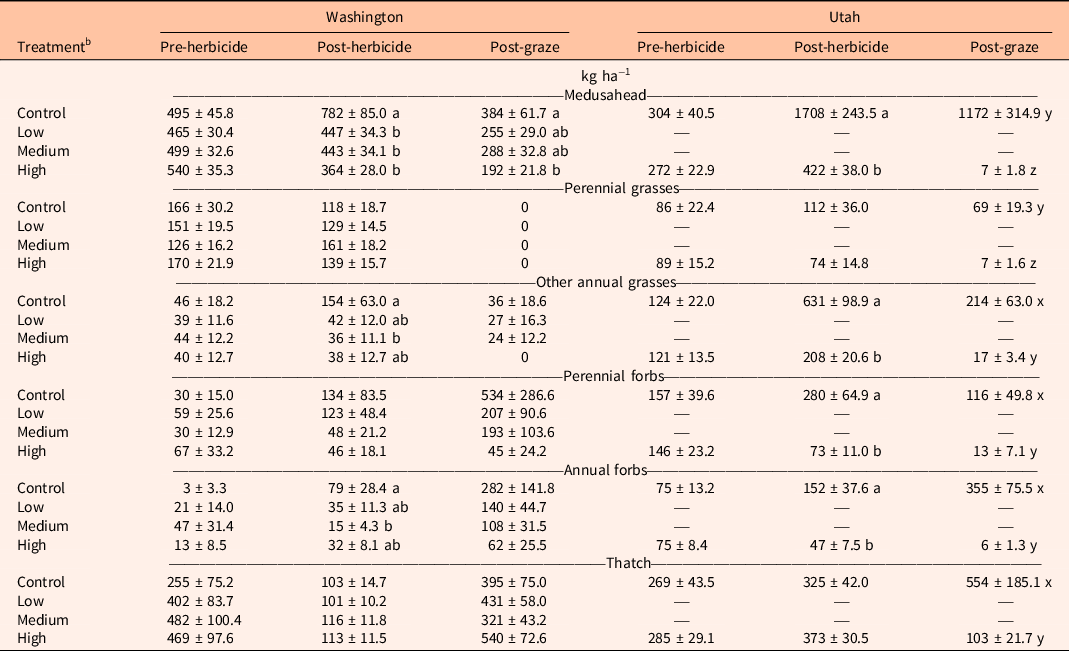
Biomass of associated forage classes at the study locations in Washington and Utah. a

a Means followed by the same letter (a, b, and x, y) within each forage group at each location and within each period are not different at P < 0.05.
b Treatments consist of no herbicide treatment (control) and glyphosate applied at 236 g ae ha−1 (low), 394 g ae ha−1 (medium), and 788 g ae ha−1 (high).
Results and Discussion
Taeniatherum caput-medusae was the dominant forage class at the start of the study, followed by its thatch, at both locations, representing 62 ± 1% and 16 ± 1% cover at the Washington location and 47 ± 1.3% and 21 ± 1.3% at the Utah location, respectively. Large native perennial bunchgrasses were absent from the Washington study site, and the vegetation has been degraded to a state dominated by T. caput-medusae and other annual grasses. There were small perennial grasses present at the Washington study site consisting of P. bulbosa and P. secunda and averaged 14 ± 1% across plots. There were few large native perennial grasses present at the Utah location and averaged 5 ± 1.3% across plots. Perennial forbs represented 4 ± 1% and 14 ± 1.3% at the Washington and Utah locations, respectively. Annual forbs represented <1 ± 1% and 5 ± 1.3% and other annual grasses consisted of 3 ± 1% and 7 ± 1.3% at the Washington and Utah locations, respectively.
Biomass of T. caput-medusae and all other forages was similar across treatment groups before glyphosate application (P > 0.05; Table 1) at both locations. At 15 d following glyphosate application (post-herbicide), T. caput-medusae biomass was greater in the nontreated control plots than in glyphosate-treated plots (P < 0.05), at both locations, which would be expected, as T. caput-medusae in the glyphosate-treated plots was suppressed and growth stopped, while T. caput-medusae in nontreated plots continued to grow. Taeniatherum caput-medusae biomass production was similar for all three glyphosate application rates in Washington (Table 1).
At the Washington site, P. bulbosa and P. secunda were mature at the post-herbicide collection period and did not show any adverse effects from the glyphosate treatment. The other annual grasses (B. tectorum, B. japonicus, and V. dubia) were all stunted, and growth stopped following treatment. The annual forbs (E. brachycarpum and E. cicutarium) that had germinated at time of glyphosate treatment were no longer growing, but there were new plants that had germinated after treatment and continued to grow with no signs of injury. Lactuca serriola displayed signs of injury to the upper leaves. The perennial forb I. axillaris did not show any signs of injury. Chondrilla juncea and A. millefolium displayed slight signs of damage but appeared to be recovering. At the Utah site, B. tectorum and V. dubia were preserved similar to T. caput-medusae following treatment. Pseudoroegneria spicata and F. ovina had slight damage at the ends of the leaf blades. The annual forb M. glomerata did not appear to be affected by the glyphosate treatment. Lactuca serriola displayed signs of injury to the upper leaves. Epilobium brachycarpum plants were no longer growing. Among the perennial forbs, C. arvensis had signs of injury on the end leaves, and W. amplexicaulis and B. sagittate had slight injury on the leaf tips.
Cattle grazed T. caput-medusae at all three glyphosate application rates at the Washington location, with the greatest utilization occurring at the high-glyphosate application rate (P < 0.05; Table 1). The greatest amount of biomass remaining was in the nontreated control plots; however, the control biomass was not different from the low or medium application rates. Cattle also grazed the glyphosate-treated T. caput-medusae at the Utah location, removing more biomass in the T. caput-medusae treated with glyphosate than the nontreated control (Table 1). The reason for the high amount of T. caput-medusae biomass remaining in all plots in Washington may be due to T. caput-medusae germinating sometime after glyphosate treatment. This could have resulted from the thatch of T. caput-medusae preventing glyphosate deposition on seedlings within the thatch canopy (Kyser et al. Reference Kyser, Creech, Zhang and DiTomaso2012). There were not a lot of T. caput-medusae plants in the plots, but the plants that were present were large with a lot of seed awns present. This could be due to the lack of competition from the few plants remaining in the plots. At the Utah location, there was a lack of plants that germinated after treatment, and thus cattle consumed the T. caput-medusae treated with glyphosate, removing its biomass.
Perennial grass biomass was similar between treatments before herbicide application at both locations and also at the post-herbicide collection (Table 1). There was no perennial grass biomass remaining within any treatments at the post-graze collection in Washington. The perennial grasses present in Washington were P. bulbosa and P. secunda. Both plants mature and senesce early in the season, and when P. bulbosa loses its fruit, there is little biomass remaining. It would be difficult for cattle to graze around the plants, and even though the plants mature early, the glyphosate treatment may have altered the plants so that the livestock found them palatable.
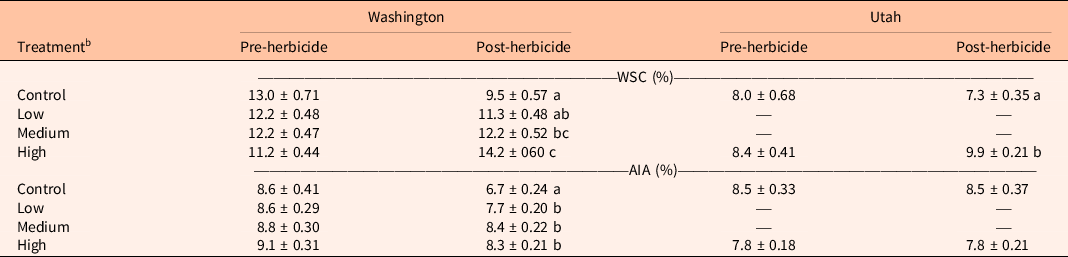
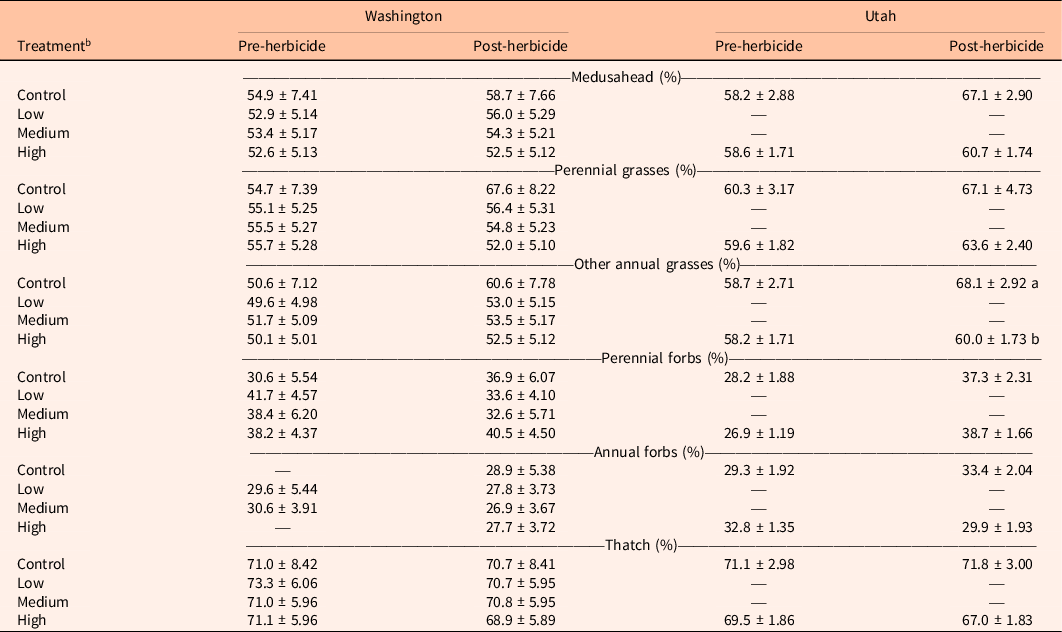
In an attempt to increase the preference for T. caput-medusae, the nutritional content of T. caput-medusae was preserved through the application of glyphosate, given that livestock exhibit increased preference for forages that supply greater concentrations of readily available sources of energy (i.e., WSC) and/or protein (Provenza and Villalba Reference Provenza, Villalba and Bels2006). The WSC content of T. caput-medusae declined in the nontreated control plots between pre-herbicide application and post-herbicide collection at the Washington location but not at the Utah location (Table 2). The WSC content of the low- and medium-glyphosate treatment groups in Washington was preserved and was similar between pre-herbicide application and post-herbicide collection (Table 2). The WSC content of the high-glyphosate treatment group increased at both the Washington (P < 0.05; Table 2) and Utah locations (P < 0.05; Table 2). Gatford et al. (Reference Gatford, Simpson, Siever-Kelly, Leury, Dove and Ciavarella1999) measured improvements in the nutritive value of L. rigidum following glyphosate application, attributed to a delay in the loss of WSC due to growth retardation. Leys et al. (Reference Leys, Cullis and Plater1991) also reported preserved WSC content following glyphosate treatment of vulpia [Vulpia bromoides (L.) Gray], a nonnative winter annual grass. Spraying annual grasses with low rates of glyphosate shortly before anthesis slows or inhibits the growth of upper-stem seed heads and roots, delaying the loss of WSC and CP in the plant’s tissues and improving cell wall digestibility (Gatford et al. Reference Gatford, Simpson, Siever-Kelly, Leury, Dove and Ciavarella1999).
Water-soluble carbohydrate (WSC) content and acid-insoluble ash (AIA) content of Taeniatherum caput-medusa at the study locations in Washington and Utah. a

a Means followed by the same letter (a–c) within each nutritional variable at each location and within each period are not different at P < 0.05.
b Treatments consist of no herbicide treatment (control) and glyphosate applied at 236 g ae ha−1 (low), 394 g ae ha−1 (medium), and 788 g ae ha−1 (high).
AIA is a fraction of the total ash not solubilized in acid, and it is a measure of the total amount of silica present in the sample (Sales and Janssens Reference Sales and Janssens2003). The AIA content of glyphosate-treated T. caput-medusae was similar at the post-herbicide collection to levels of the pre-herbicide plants at the Utah location and for the low and medium treatment groups at the Washington location (P > 0.05; Table 2). The AIA content in the high treatment group in Washington declined after treatment but not at the level that the nontreated control group declined (P < 0.05; Table 2). The AIA content of T. caput-medusae treated with glyphosate in this study was lower than AIA content reported in other studies in which T. caput-medusae was collected at the reproductive stage (Montes-Sánchez and Villalba Reference Montes-Sánchez and Villalba2017a). Taeniatherum caput-medusae has a high ash content, composed of 75% silica, which amounts to more than 10% of the dry matter of the plant (Bovey et al. Reference Bovey, LeTourneau and Erickson1961). The deposition of silica occurs in the barbs of awns and the epidermis of the leaves (Bovey et al. Reference Bovey, LeTourneau and Erickson1961), aiding in its low palatability. Silica may reduce forage intake by herbivores (Massey et al. Reference Massey, Massey, Ennos and Hartley2009; Mayland and Shewmaker Reference Mayland and Shewmaker2001) through a decrease in forage digestibility (Smith et al. Reference Smith, Nelson and Boggino1971; Van Soest and Jones Reference Van Soest and Jones1968). Silica content of T. caput-medusae has been reported to be high in other studies (Bovey et al. Reference Bovey, LeTourneau and Erickson1961; Swenson et al. Reference Swenson, Tourneau and Erickson1964) and is often used as a variable to explain the low consumption of T. caput-medusae by herbivores.
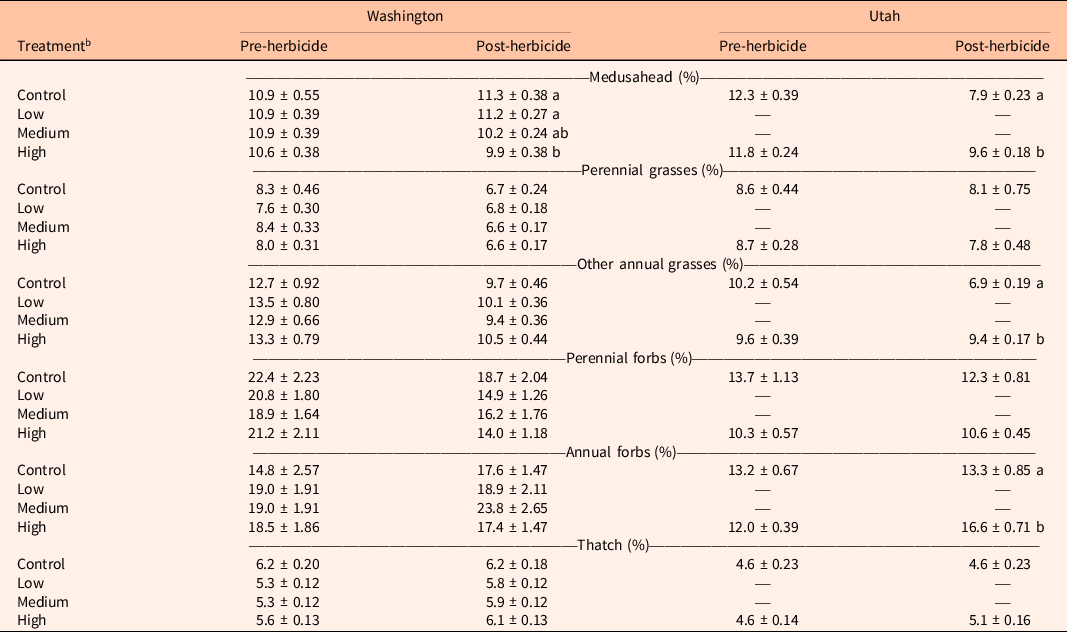
CP content of T. caput-medusae was similar between nontreated and glyphosate-treated plants before glyphosate application at both locations and at 15 d post-herbicide application at the Washington location (P < 0.05; Table 3). However, CP concentration of T. caput-medusae at the post-herbicide collection at the Utah location was greater in the glyphosate treatment than in the nontreated control (P < 0.05; Table 3). Taeniatherum caput-medusae was still green and growing in the nontreated control plots in Washington at the post-herbicide collection, which could explain the CP content remaining high in these plants. Bovey et al. (Reference Bovey, LeTourneau and Erickson1961) reported similar protein values for T. caput-medusae in the leaf stage and a decrease to 8.8% as T. caput-medusae began reproductive growth. Taeniatherum caput-medusae growth was stopped due to glyphosate application, and the CP content was preserved (>9%) in all glyphosate treatments (Table 3). Likewise, Leys et al. (Reference Leys, Cullis and Plater1991) reported preserved CP levels in V. bromoides through glyphosate treatment.
Crude protein content (dry matter basis) of associated forage classes at the study locations in Washington and Utah. a

a Means followed by the same letter (a, b) within each forage group at each location and within each period are not different at P < 0.05.
b Treatments consist of no herbicide treatment (control) and glyphosate applied at 236 g ae ha−1 (low), 394 g ae ha−1 (medium), and 788 g ae ha−1 (high).
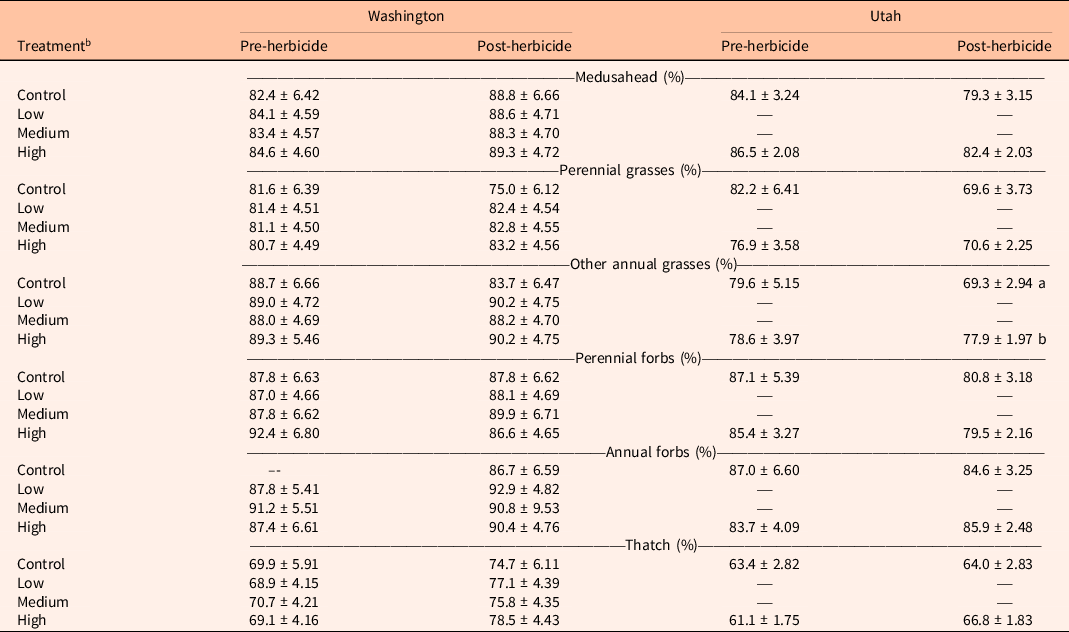
The arrest in growth of T. caput-medusae following glyphosate treatment may have stopped the deposition of silica, aiding in the increase in T. caput-medusae digestibility. Digestibility of T. caput-medusae was near 89% and 80% following glyphosate treatment at the Washington and Utah locations, respectively (Table 4). Montes-Sánchez and Villalba (Reference Montes-Sánchez and Villalba2017b) also reported high values of apparent digestibility in T. caput-medusae. Digestibility of nontreated T. caput-medusae was high and similar to glyphosate-treated T. caput-medusae (P > 0.05; Table 4), which may be due to an earlier phenological state of T. caput-medusae with lower concentration of AIA in the nontreated control than in the glyphosate-treated T. caput-medusae (P < 0.05; Table 2).
In vitro true digestibility (IVTD) content (dry matter basis) of associated forage classes at the study locations in Washington and Utah. a

a Means followed by the same letter (a, b) within each forage group at each location and within each period are not different at P < 0.05.
b Treatments consist of no herbicide treatment (control) and glyphosate applied at 236 g ae ha−1 (low), 394 g ae ha−1 (medium), and 788 g ae ha−1 (high).
In this study, fiber content (NDF) of T. caput-medusae following glyphosate treatment was similar to the pre-herbicide treatment at the Washington location (P > 0.05; Table 5). At the Utah location, NDF concentration increased following glyphosate application, with the greatest increase occurring in the nontreated T. caput-medusae plants (P < 0.05; Table 5).
Neutral detergent fiber (NDF) content (dry matter basis) of associated forage classes at the study locations in Washington and Utah. a

a Means followed by the same letter (a, b) within each forage group at each location and within each period are not different at P < 0.05.
b Treatments consist of no herbicide treatment (control) and glyphosate applied at 236 g ae ha−1 (low), 394 g ae ha−1 (medium), and 788 g ae ha−1 (high).
There was no difference in T. caput-medusae thatch biomass between any of the treatment groups at all three collection times at the Washington location (P = 0.3156; Table 1). However, at the Utah location, T. caput-medusae thatch was lower in the glyphosate treatment than in the nontreated control following grazing (P < 0.05; Table 1).
Targeted grazing is a tool that can be utilized to suppress invasive annual grasses when applied at the right time and intensity (Diamond et al. Reference Diamond, Call and Devoe2012; Hempy-Mayer and Pyke Reference Hempy-Mayer and Pyke2008). In this study, the application of glyphosate expanded the window for grazing T. caput-medusae. This expanded time frame allows for a reduction in the intensity of grazing. Animals in this study grazed glyphosate-treated plots within large pastures for 144 and 89 d following glyphosate treatment at the Washington and Utah locations, respectively. Cattle utilized the T. caput-medusae as a forage source during the summer months when T. caput-medusae not treated with glyphosate matured and was avoided by livestock. Cattle utilization of T. caput-medusae at the Utah location was low early in the season when other forages were green and growing; however, later in the season, as other forages matured and senesced, cattle increased their utilization of T. caput-medusae.
The ecosystem in the Channeled Scablands of eastern Washington has been degraded to a state dominated by annual grasses, primarily T. caput-medusae, with very few perennial grasses remaining (Pfister et al. Reference Pfister, Panter and Lee2014; Ralphs et al. Reference Ralphs, Pfister, Panter, Lee and Motteram2011; Stonecipher et al. Reference Stonecipher, Panter, Jensen, Rigby and Villalba2017). In Utah, T. caput-medusae is also occurring in small patches that are starting to increase in magnitude. Treatment with glyphosate, which is a nonselective herbicide, results in decreased forage yield in all treated plants due to the suppression of plant growth following treatment; however, if treatment is early in the season, before other forages are emerging and growing, herbicide damage to desirable forages can be minimized. On rangelands where the primary component of the vegetation is T. caput-medusae and other weedy species, which is occurring in eastern Washington, this does not pose a problem. It is more beneficial to stop growth and prevent seed production of T. caput-medusae than to provide increased biomass. Preserving the nutritional quality of T. caput-medusae through glyphosate application provides a palatable forage source for livestock. This is highlighted in the present study by the greater utilization of T. caput-medusae by cattle at the highest glyphosate application rate. Heavy grazing pressure on annual grasses in the early spring reduces the seedbank and stand abundance (Daubenmire Reference Daubenmire1940; Vallentine and Stevens Reference Vallentine and Stevens1994). Glyphosate treatment before seed development can reduce T. caput-medusae seed production while also preserving the nutritional quality of the annual grass. The combination of glyphosate application and grazing can be used to remove more plant material and thatch than herbicide or grazing alone. Caution should be taken when not all T. caput-medusae is killed by the glyphosate treatment. Kyser et al. (Reference Kyser, Creech, Zhang and DiTomaso2012) determined that overall seed production was decreased by glyphosate treatment, but individual plants tended to produce more seed at lower plant densities. Thus, plants that germinate after glyphosate treatment can potentially increase seed production.
Cattle grazing can be economically feasible for annual grass–infested rangelands (Sheley et al. Reference Sheley, Sheley and Smith2014), and T. caput-medusae control using glyphosate is also a low-cost option (Kyser et al. Reference Kyser, Wilson, Zhang and DiTomaso2013). In a cost/benefit analysis conducted by Sheley et al. (Reference Sheley, Sheley and Smith2014) comparing grazing annual grasses versus herbicide treatment of annual grasses, the authors suggest that the more annual grasses that can be eaten by livestock, the lower the breakeven cost becomes. In our study, glyphosate application at the high rate increased livestock utilization of T. caput-medusae. In locations, such as the Channeled Scablands of eastern Washington, where T. caput-medusae and other annual grasses have replaced the native vegetation, drastic measures must be taken to restore the landscape. We demonstrated success of using the combination of glyphosate application and targeted grazing as viable tools to suppress T. caput-medusae and recommend them at other locations dominated with T. caput-medusae. Further research is warranted to determine the optimal timing to treat T. caput-medusae with glyphosate to achieve the greatest utilization of T. caput-medusae by livestock and also to determine whether sheep can be used as an alternative to cattle to graze glyphosate-treated T. caput-medusae.
Supplementary material
To view supplementary material for this article, please visit https://doi.org/10.1017/inp.2021.12
Acknowledgments
Research was partially funded by the USDA–Agricultural Research Service, Western SARE (SW15-003), and the Utah Department of Agriculture and Food Invasive Species Mitigation grant. No conflicts of interest have been declared. Any use of trade or product names is for descriptive purposes and does not imply endorsement by the U.S. government. ARS is an equal-opportunity provider and employer.