Both child-based and parent-based factors contribute to early risk for internalizing problems (Weissman, Leckman, Merikangas, Gammon, & Prusoff, Reference Weissman, Leckman, Merikangas, Gammon and Prusoff1984), often through interactions that shape trajectories of children's development. The differential susceptibility hypothesis posits that children who are traditionally identified as “at risk” for negative developmental outcomes are better defined as more susceptible to the impact of environmental factors than are other children (Belsky & Pluess, Reference Belsky and Pleuss2009). Highly susceptible children tend to show the most negative outcomes in the most challenging environments, but the most positive outcomes in enriched environments (Bakermans-Kranenburg & van IJzendoorn, Reference Bakermans-Kranenburg and van IJzendoorn2007; Belsky & Pleuss, Reference Belsky and Pleuss2009). However, the pathways by which processes of risk may operate are understudied, as are possible moderators of the associations between risk factors and developmental outcomes. The current study examines the extent to which children's attention influences the development of internalizing problems in the context of different levels of environmentally and genetically based risk. Given that its link with attention is well supported in the literature, this model is based upon previous research that highlights the importance of attention control for the development of anxiety problems; however, we recognize that internalizing problems encompass far more than only anxious behaviors. It is important that we also incorporate the influences of parenting and genes on early risk for internalizing problems.
The Impact of Children's Characteristics on Developing Internalizing Problems
Attention control refers to the ability to shift and focus attention. This capacity is central to emotion regulation early in life, before the broader systems of effortful control and executive control develop (Rothbart & Sheese, Reference Rothbart, Sheese and Gross2007). Though the terms attention control, effortful control, and executive control are used almost interchangeably later in development, effortful control and executive control are unique from attention control in that the former include volitional or willful aspects of behavior that are undeveloped before preschool (Kopp, Reference Kopp1982; Rothbart, Reference Rothbart2011; Rothbart & Sheese, Reference Rothbart, Sheese and Gross2007). A sizable amount of work has focused on the effortful and executive control systems, but little is understood about how individual differences in early-developing attention control interact with early risk factors to predict adjustment after infancy.
By 3 to 6 months of age, infants can independently shift and focus attention to alter engagement with their environment (Rothbart, Ziaie, & O'Boyle, Reference Rothbart, Ziaie, O'Boyle, Eisenberg and Fabes1992). Attention-based strategies are favored modes of regulation by age 2 (Grolnick, Bridges, & Connell, Reference Grolnick, Bridges and Connell1996), prior to the emergence of most other regulatory strategies (Calkins, Reference Calkins, Brownell and Kopp2007; Kopp, Reference Kopp1982). By the second year of life, children use attention control to regulate negative emotion; successful regulation mitigates negative emotional arousal, while unsuccessful regulation is often followed by sustained or increased negativity (Kopp, Reference Kopp, Eisenberg and Fabes1992). Attention control does not, however, necessarily reference visual fixation. Attention control also reflects covert shifts in resources for cognitive processing that occur independently from looking (Richards, Reference Richards2000).
Existing literature indicates that attention control is an effective strategy for changing the intensity or temporal dynamics of an emotional experience. For example, as early as 6 months of age, shifting attention away from negative stimuli is associated with decreases in distress (Crockenberg, Leerkes, & Bárrig Jó, Reference Crockenberg, Leerkes and Bárrig Jó2008; Johnson, Posner, & Rothbart, Reference Johnson, Posner and Rothbart1991). However, orienting toward negative stimuli is associated with both increases in observed distress and more negative outcomes over time (Crockenberg et al., Reference Crockenberg, Leerkes and Bárrig Jó2008; Kiel & Buss, Reference Kiel and Buss2010). Links between attention control and increased distress are particularly relevant for studies of early risk for internalizing problems given that habitually orienting toward and/or failing to reorient away from negative aspects of the environment is a proposed mechanism of anxiety problems in adults (Mogg & Bradley, Reference Mogg and Bradley1998).
To our knowledge, only one study has examined associations between individual differences in attention control in infants and postinfancy behavior problems (Crockenberg et al., Reference Crockenberg, Leerkes and Bárrig Jó2008). In this study, attention toward a frustrating event (i.e., toy removal) in 6-month-old infants was positively associated with mother-reported aggressive behaviors 2 years later. In addition, attention away from the frustrating event at 6 months was negatively associated with aggressive behaviors at age 30 months for girls. Given the robust link between attention and anxiety symptoms in older children, it is reasonable to suspect that a similar measure of infant attention control would predict early risk for anxiety problems, in the form of internalizing behaviors, early in life. Therefore, we examined the association between attention control in infancy and longitudinal risk for internalizing problems from infancy into toddlerhood.
Environmentally Based Risks for Children's Anxiety Symptoms
Because development is a cumulative, dynamic process, early individual differences in risk can be offset by protective factors or compounded by additional vulnerabilities (Sroufe & Rutter, Reference Sroufe and Rutter1984). Parents may contribute to processes of risk or resilience via multiple pathways. For example, parents serve as working examples of emotional responding to distressing events (Gerull & Rapee, Reference Gerull and Rapee2002). Given that regulatory deficits are common in anxious adults (Cole, Michel, & Teti, Reference Cole, Michel and Teti1994; Gross, Reference Gross1998), children of anxious parents likely observe greater numbers of dysregulated emotion behaviors in caregivers than do children whose parents have no disorder. Imitating a parent's dysregulated emotion behavior may result in children's acquisition of less effective strategies for regulating their own negative emotions. Consistent with this idea, previous work has shown that young children imitate naturalistic and simulated negative emotion in their mothers (Muris, Steerneman, Merckelbach, & Meesters, Reference Muris, Steerneman, Merckelbach and Meesters1996; Radke-Yarrow, Zahn-Waxler, Richardson, Susman, & Martinez, Reference Radke-Yarrow, Zahn-Waxler, Richardson, Susman and Martinez1994). This effect remained significant even when controlling for other child characteristics (e.g., sex, fearfulness; Muris et al., Reference Muris, Steerneman, Merckelbach and Meesters1996). Thus, it is plausible that poor or ineffective regulatory strategies may be directly modeled by parents and subsequently adopted by children. It is also notable that most research is conducted with parents and children who are genetically related, making it impossible to distinguish between purely environmental factors, such as modeling, and genetically transmitted risk.
A second way that anxious parents may impact internalizing problems in children is by indirectly undermining the development of regulatory skills. Anxious parents show fewer of the parenting behaviors associated with healthy psychological outcomes in children, such as warmth and positivity (Turner, Beidel, Roberson-Nay, & Tervo, Reference Turner, Beidel, Roberson-Nay and Tervo2003; Warren et al., Reference Warren, Gunnar, Kagan, Anders, Simmens and Rones2003), than do nonanxious parents. Anxious parents may also display more behaviors that enhance children's negative emotional experiences (Whaley, Pinto, & Sigman, Reference Whaley, Pinto and Sigman1999; Woodruff-Borden, Morrow, Bourland, & Cambron, Reference Woodruff-Borden, Morrow, Bourland and Cambron2002). Greater maternal harshness and criticism predicts less committed compliance in children, a necessary precursor for the development of skills for self-regulation (Kochanska & Aksan, Reference Kochanska and Aksan1995). Similarly, greater maternal negative control predicts increasing trajectories of anxiety symptoms in middle childhood (Feng, Shaw, & Silk, Reference Feng, Shaw and Silk2008). In this way, parents do not directly model dysregulated behavior, but the rearing environment is structured such that the optimal development of self-regulatory skills is not supported.
Though most work examining the pathways by which parents impact developing internalizing problems in children has only included mothers,Footnote 1 anxiety symptoms in both mothers and fathers contribute to developing internalizing problems in children (Rapee & Melville, Reference Rapee and Melville1997). Again, one possible pathway linking parent anxiety to children's internalizing problems is parenting, which would sensibly apply to both mothers and fathers. Greater numbers of social anxiety symptoms in middle childhood are associated with more observed negative feedback, control, and overprotection in fathers (Greco & Morris, Reference Greco and Morris2002; Hummel & Gross, Reference Hummel and Gross2001). Nevertheless, paternal contributions to children's risk for internalizing remain understudied.
Genetically Based Risk for Child Anxiety
Studies of children as young as 4 years of age provide evidence for genetic influences (h 2 = 0.32–0.76) on children's anxious behaviors (Eley et al., Reference Eley, Bolton, O'Connor, Perrin, Smith and Plomin2003; Hettema, Neale, & Kendler, Reference Hettema, Neale and Kendler2001). Work with infants also supports links between genetic risk for anxiety and anxious behaviors in children (Natsuaki et al., Reference Natsuaki, Leve, Neiderhiser, Shaw, Scaramella and Ge2013). These studies indicate the presence of heritable biological facets of anxiety risk. Furthermore, because parents and their biological children typically share about 50% of their genetic makeup, inherited biological factors of anxiety risk can account for the correlation between anxiety symptoms in parents and their children.
As previously stated, we recognize that defining anxiety and anxious behaviors in infants is a difficult and still ongoing process. Symptoms of discrete internalizing disorders appear to be persistent across early development, but they are frequently co-occurring (Briggs-Gowan, Carter, Bosson-Heenan, Guyer, & Horwitz, Reference Briggs-Gowan, Carter, Bosson-Heenan, Guyer and Horwitz2006; Egger & Angold, Reference Egger and Angold2006). For this reason, it is perhaps more appropriate to focus on a broader spectrum of internalizing problems, antecedents of which are inarguably present during infancy. Moreover, these antecedents, which include emotion regulation and aspects of attention control, show heritability in infancy (Canli, Ferri, & Duman, Reference Canli, Ferri and Duman2009; Goldsmith, Lemery, Buss, & Campos, Reference Goldsmith, Lemery, Buss and Campos1999).
In sum, previous studies indicate that attention control abilities, early exposure to an anxious parent, and genetic risk are predictive of anxiety symptoms in children. However, important gaps exist in our knowledge of how these factors cumulatively contribute to children's internalizing problems. First, a focus on maternal anxiety has disregarded roughly half of the genetic and environmental influences that contribute to childhood outcomes. Second, work has not considered genetic and environmental factors as moderators of the link between children's attention control and internalizing problems. We addressed these issues in the current study. We included assessments of paternal anxiety symptoms to more fully characterize parent-based risk for internalizing problems. In addition, we examined genetic and environmental risk factors as moderators of the link between infant attention control and internalizing problems during toddlerhood.
Another problem arises in that, despite acceptance that some factors of risk are environmental in nature (e.g., caregiving) while others are genetic (e.g., heritable liability for anxiety), familial confounds have prevented relative biological and environmental effects from being separated. That is, most studies include children living with at least one biological parent, resulting in a correlation between children's environment and genetic makeup, given that both arise from biological parents. Such a confound means that even if one could determine that parent-based factors moderated the link between infant attention control and internalizing problems, the nature and origin of these influences would be unclear.
In the prospective adoption design, children are raised by parents to whom they are genetically unrelated. Thus, associations between the adoptive parents' and children's behavior are, by necessity, environmental in nature (Leve et al., Reference Leve, Neiderhiser, Shaw, Ganiban, Natsuaki and Reiss2013). In contrast, associations between birth parent characteristics and the adopted child's behavior are best explained, after controlling for prenatal influences, by genes shared with the child. Through this design, it is possible to disentangle genetic and environmental effects on child outcomes.
We previously used a prospective adoption design to test birth and adoptive parent anxiety (i.e., genetic and environmental risk, respectively) as moderators of the association between infant attention control and concurrent markers of risk for anxiety when the sample was 9 months old (Brooker et al., Reference Brooker, Neiderhiser, Kiel, Leve, Shaw and Reiss2011). When children of birth parents with social phobia were raised in adoptive homes where environmental risk for anxiety was high (i.e., high levels of anxiety symptoms in adoptive parents), greater attention control was associated with greater anxiety risk. In contrast, when these children were raised in adoptive homes where environmental risk for anxiety was low (i.e., low levels of anxiety symptoms in adoptive parents), greater attention control predicted less anxiety risk. Note that it was not necessarily the case that attention control differed in infants of more and less anxious adoptive parents; rather, the consequences of high levels of attention control were distinct for the two groups.
These effects were consistent with the differential susceptibility hypothesis and the putative role of attention control as a pathway for the transmission of risk. Differential susceptibility refers to genetically based differences in vulnerability to environmental influences. According to this theory, biological markers can be used to identify children who are more impacted by the conditions of their early environment, under both impoverished and enriched conditions. Specifically, highly susceptible children appear to benefit the most from enriched environments, typically showing the best outcomes. Similarly, impoverished environments seem to take the greatest toll on highly susceptible children, where they tend to show the most negative outcomes. In contrast, low susceptible children are less swayed by environmental conditions; their outcomes are similar across contexts. In the case of our previous work (Brooker et al., Reference Brooker, Neiderhiser, Kiel, Leve, Shaw and Reiss2011), highly susceptible children were identified based on high levels of birth parent anxiety. These children used attention control in such a way that it predicted greater anxious behaviors when they were raised by anxious parents, but it predicted less anxious behavior when they were raised by nonanxious parents. Thus, this work goes somewhat beyond the basic tenets of differential susceptibility to identify one possible mechanism of developmental outcomes for high and low susceptible children.
Despite the contributions of this work, it is unclear whether the pattern of results remains meaningful over time, given that both parent anxiety and child behavior in this report were assessed when adopted children were 9 months of age. By expanding such a study to include longitudinal outcomes, we become able to determine whether attention control, birth parent anxiety symptoms, and adoptive parent anxiety symptoms remain relevant aspects of developing internalizing problems early in life. Extending this work into toddlerhood, as systems of attention control continue to develop (Gerardi-Caulton, Reference Gerardi-Caulton2000), is particularly important for understanding whether our earlier work identifies true facets of long-term risk for anxiety problems or simply differences in the early stages (e.g., onset) of a process that becomes normalized over time. Moreover, tracking factors that contribute to early risk over multiple assessments enables us to assess whether the importance of individual factors and their interactions shift across development.
Hypotheses
We tested the contributions of infant attention control, genetic risk, and environmental risk on toddlers' internalizing problems, with two primary hypotheses. First, based on work linking genetic risk and parents' own anxiety symptoms with children's risk for internalizing problems, we expected that greater anxiety symptoms in birth and adoptive parents would predict greater internalizing symptoms in children over time. Second, in light of recent evidence (Brooker et al., Reference Brooker, Neiderhiser, Kiel, Leve, Shaw and Reiss2011; Crockenberg et al., Reference Crockenberg, Leerkes and Bárrig Jó2008; Kiel & Buss, Reference Kiel and Buss2010) that attention control can either exacerbate or mitigate negative emotional arousal, we expected that the link between attention control and children's internalizing symptoms would be moderated by their genetic and environmental context. Specifically, consistent with the differential susceptibility hypothesis and evidence from previous work, we expected that infants whose birth parents showed high levels of anxiety symptoms would be more susceptible to the rearing environment. For these infants, we expected that when environmental risk (i.e., anxiety symptoms in adoptive parents) was high, there would be a positive association between attention control and internalizing problems. This type of association would illustrate the potential for attention control to maintain or exacerbate internalizing problems under conditions of high genetic susceptibility and high environmental risk. In contrast, we expected that highly susceptible children would show a negative association between attention control and internalizing problems at low levels of adoptive parent anxiety symptoms. This type of association would illustrate the potential for attention control to mitigate internalizing problems under conditions of high genetic susceptibility and low environmental risk. Finally, consistent with both the differential susceptibility hypothesis and the results of our work with 9-month-old children from the same sample, we expected no context-related interactions for infants of low-anxious birth parents, because these infants would be less susceptible to environmental effects.
Method
Participants
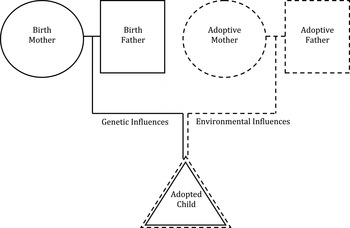
The sample consisted of participants in the first cohort of the Early Growth and Development Study (EGDS), an ongoing, multisite, longitudinal sample of 561 sets of adopted children, adoptive parents, and birth parents in two cohorts (Leve et al., Reference Leve, Neiderhiser, Shaw, Ganiban, Natsuaki and Reiss2013; Figure 1). Participants were recruited through US adoption agencies. The following criteria had to be met for participation: (a) the adoption placement had to be domestic, (b) infants had to be placed in their adoptive homes within 3 months of birth, (c) placements had to be with an unrelated adoptive family, (d) infants had to have had no known major medical conditions such as extreme prematurity or extensive medical surgeries, and (e) parents had to be able to read or understand English at the eighth-grade level.
An illustration of the Early Growth and Development Study (EGDS) prospective adoption design.

The majority (71.7%) of birth mothers were Caucasian (African American = 11.1%, American Indian/Alaska Native = 2.9%, Asian American = 1.7%, Native Hawaiian/Pacific Islander = 0.3%, more than 1 race = 4.6%, unknown/did not report = 0.9%), as were birth fathers (Caucasian = 72.4%, African American = 8.7%, American Indian/Alaska Native = 0.8%, more than 1 race = 4.7%, unknown/did not report = 4.7%). Roughly 6.9% of birth mothers and 8.7% of birth fathers were Hispanic. Most birth parents reported high school as their highest completed level of education (birth mothers = 50.5%, birth fathers = 62.9%). Those birth parents who reported their annual household income (96.6%) most frequently reported earnings of less than $15,000 per year (birth mothers = 43.7%, birth fathers = 42.1%).
The majority (91.7%) of adoptive mothers were also Caucasian (African American = 3.6%, American Indian/Alaska Native = 0.3%, Asian American = 0.6%, more than 1 race = 1.1%), as were adoptive fathers (Caucasian = 90.7%, African American = 5.1%, Asian American = 0.6%, Native Hawaiian/Pacific Islander = 0.3%, more than 1 race = 1.1%). Roughly 2.2% of adoptive mothers and 1.7% of adoptive fathers were Hispanic. Adoptive mothers most frequently reported having earned a 4-year college degree (43.0%) as their highest completed level of education; similarly, adoptive fathers most frequently reported having earned a graduate degree (36.6%). Of those adoptive parents who reported their annual household income (96.9%), half (53.0%) reported earning more than $100,000 per year. Eligible families who enrolled in the study did not differ from those who declined on education level, income, or age.
Most (92.3%) infants were placed in adoptive homes within 1 month of birth (M = 7.29 days, SD = 13.46). Infants placed in adoptive homes within 1 month of birth did not differ from those placed between ages 1 and 3 months on any variables (ts < 0.92, ps > .10). Full details of the EGDS design, recruitment procedures, and sample can be found elsewhere (Leve et al., Reference Leve, Neiderhiser, Shaw, Ganiban, Natsuaki and Reiss2013).
The current sample was drawn from the first cohort of EGDS and included 361 sets of adopted children, their adoptive parents, and their birth parents, who participated in EGDS through three phases of assessment. Participants in the second cohort were not included because the coding of observational data for that cohort is ongoing. Children's mean ages at each assessment were as follows: 9-month assessment M = 8.81 months (SD = 0.96); 18-month assessment M = 17.82 months (SD = 1.59); 27-month assessment M = 27.20 months (SD = 1.31). With the exception of age at placement, the sample of infants included in the current report did not differ from the parent sample on any of the demographic variables (χ2s < 7.10, ps > .10; ts < 1.02, ps > .10). Infants not included in the current sample were placed in homes, on average, roughly 3 days earlier than infants who were included in the current study, t (504) = −2.17, p < .05.
Home visit procedure: Toy behind the barricade
As part of a 90-min home visit at child age 9 months, children participated in a 3-min activity designed to assess child responses to frustrating events (e.g., Goldsmith & Rothbart, Reference Goldsmith and Rothbart1999). This activity was part of a battery of temperament, parent–child, and family interaction episodes; it began approximately 15 min after the first episode. The experimenter showed the child an attractive toy with which the child was allowed to play. Once the child was engaged with the toy for 30 s, the experimenter placed the toy where it was visible but out of the child's reach, where it remained for 30 s (frustration trial 1). After this, the experimenter retrieved the toy and allowed the child to play with it for 30 s (neutral trial 1). This sequence was repeated three times, alternating frustration trials with neutral trials. All episodes ended with the child being allowed to play with the toy.
Measures
Attention control
Attention control was measured during the barricade task because of its developmental appropriateness and similarity to other studies measuring attention control during infancy (Brooker et al., Reference Brooker, Neiderhiser, Kiel, Leve, Shaw and Reiss2011; Crockenberg et al., Reference Crockenberg, Leerkes and Bárrig Jó2008; Leve et al., Reference Leve, Kerr, Shaw, Ge, Neiderhiser and Scaramella2010). For every trial, videotapes were coded for the duration that each child engaged or attempted to engage with the toy using a 9-point Likert scale (1 = not at all characteristic, 9 = mainly characteristic; Dogan et al., Reference Dogan, Lei, Milne-Kahn, Pong, Wu and Conger2005). Thirty-five percent of infants were double coded in order to establish reliability (intraclass coefficients = 0.91–0.97). Ratings were standardized within trial by subtracting the overall mean of the trial from the child's score for that trial and dividing by the standard deviation.
An exploratory factor analysis with oblique rotation returned a two-factor solution, indicating that attention to the toy was similar within each type of trial (frustration vs. neutral), but differed across trial types. On average, children showed better attention control during neutral (M = 4.97, SD = 1.47) than during frustration trials (M = 3.19, SD = 1.35), suggesting that the majority of infants were able to shift to the changing goals of the neutral trial from the periods of frustration.
Attention control was thus characterized as the degree to which children engaged or attempted to engage with the toy during neutral trials. We focused on neutral trials, given that attention to the toy during frustration trials confounds two different processes: enhanced focus on a distressing stimulus (i.e., dysregulation) and goal persistence (i.e., context-appropriate regulation). In contrast, during neutral trials, the singular goal of the task is to engage with a readily available toy. Thus, it is only attention to the toy during neutral trials that indexes infants' abilities to regulate negativity induced by frustration trials in order to accomplish the task goal.
Separate ratings used to validate the measure revealed that negative affectFootnote 2 was slightly greater during neutral (M = 1.57, SD = 0.83) than during frustration trials (M = 1.45, SD = 0.85; t = 3.07, p < .01).Footnote 3 Thus, consistent with our definition of attention control, engagement with the toy during neutral trials would have required the downregulation of negative affect to support engagement with the toy. This is also consistent with suggestions that unsuccessful attempts at regulation result in sustained or increased negative affect (e.g., Kopp, Reference Kopp, Eisenberg and Fabes1992).
Based on this definition, a score of attention control was created for each child as the mean of standardized ratings on neutral trials (α = 0.77). Higher ratings thus reflected better attention control. In contrast, low scores reflected more difficulty shifting attention from a negative-emotion eliciting task to engagement in play and poorer attention control.
Parent anxiety symptoms
Birth and adoptive parents reported their anxiety symptoms on the Beck Anxiety Inventory (BAI; Beck & Steer, Reference Beck and Steer1993) when children were 4 (birth parents) and 9 (adoptive parents) months of age. Birth parents returned completed questionnaires via mail. Adoptive parents completed questionnaires during the home visit at child age 9 months. Respondents indicated the degree to which they experienced symptoms of anxiety on a 4-point scale (1 = not at all, 4 = severely). Scores for the BAI were created by summing all items. Reliability was high for adoptive mothers (α = 0.75), adoptive fathers (α = 0.73), birth mothers (α = 0.91), and birth fathers (α = 0.88).
BAI scores of 0–7 are interpreted as minimal anxiety, 8–15 as mild anxiety, 16–25 as moderate anxiety, and 26–63 as severe anxiety. Scores ranged from 0 to 17 for adoptive mothers (n = 353; M = 3.82, SD = 3.54) and 0 to 19 for adoptive fathers (n = 339; M = 3.02, SD = 3.09). Scores for adoptive mothers and fathers were uncorrelated (r = .07, p > .10). Anxiety symptoms in both mothers and fathers exacerbate negative outcomes in children, but there is no evidence to suggest that low levels of anxiety in one parent necessarily “undo” the effects anxiety in their co-parent. Therefore, the maximum BAI score for mothers and fathers was used to represent children's environmental risk for anxiety.
Scores ranged from 0 to 62 for birth mothers (n = 358; M = 9.88, SD = 9.06) and 0 to 37 for birth fathers (n = 145; M = 7.58, SD = 7.62). Again, scores were uncorrelated for birth mothers and fathers (r = .05, p > .10) and maximum BAI score across birth mother and birth father report was used to represent genetic risk for anxiety in children based on existing literature.
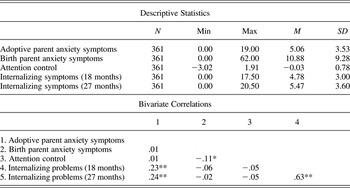
Scores for birth parent anxiety symptoms were not correlated with scores for adoptive parent anxiety symptoms (r = .01, p > .10). As suggested by Table 1, birth parent anxiety symptoms were significantly greater than adoptive parent anxiety symptoms, t (360) = −11.17, p < .01.
Descriptive statistics and bivariate correlations for among study variables

*p < .05. **p < .01.
Internalizing problems
During the 9-month home visit, adoptive parents reported on children's internalizing problems at child ages 18 and 27 months using the Child Behavior Checklist for Ages 1.5–5 (CBCL; Achenbach & Rescorla, Reference Achenbach and Rescorla2000). The CBCL is a 100-item questionnaire that asks parents to rate on a 3-point scale how true behaviors are of their child over the past 2 months (0 = not true, 2 = very true or often true). Given our focus on risk for internalizing problems, analyses focused on the CBCL internalizing scale. Scale reliability was high for mothers and fathers at the 18-month (mothers: α = 0.71; fathers: α = 0.78) and 27-month assessments (mothers: α = 0.77; fathers: α = 0.82). Mother and father reports were correlated at both 18 (r = .29, p < .01) and 27 (r = .43, p < .01) months. Therefore, an average composite of mother and father ratings was created.
Missing data
Families with adopted children who participated in the 9-month assessment are included in the current study (N = 361). Scores of attention control were not calculated for two children who completed only one trial of the barricade task. An analysis of patterns of missing data suggested that data were missing completely at random (Little's missing completely at random = 701.38, p >.10). The highest rate of missing data was for birth parent anxiety (7.5% missing). Rates of missing data did not exceed 4.4% on any of the other predictor variables. Therefore, missing data were imputed for continuous predictor variables using multiple imputation (n imputation = 7) using an expectation-maximization algorithm in IBM SPSS Statistics 19 (IBM, Somers, NY). The number of imputations was based on the amount of missing information and the recommendations of Graham, Olchowski, and Gilreath (Reference Graham, Olchowski and Gilreath2007). An a priori power analysis suggested that in a sample of this size, moderate and large effects (f 2 = 0.048) could be detected.
Results
Descriptive statistics
All variables were normally distributed. Descriptive statistics and bivariate correlations are shown in Table 1. Infant attention control was unrelated to 18- and 27-month internalizing problems. Consistent with our first hypothesis, greater anxiety symptoms in adoptive parents were related to more child internalizing problems at 18 and 27 months, although birth parent anxiety symptoms and children's internalizing problems were unrelated. Better attention control was linked to fewer anxiety symptoms in birth parents but was unrelated to anxiety symptoms in adoptive parents. Birth parent and adoptive parent anxiety symptoms were uncorrelated, suggesting the lack of an evocative effect.
Attention control and the moderation of 18-month internalizing problems
A hierarchical linear regression was used to test whether birth and adoptive parent anxiety symptoms moderated the association between infant attention control and children's internalizing problems at 18 months of age. Birth and adoptive parent anxiety symptoms and attention control were entered in Step 1, all two-way interactions were entered in Step 2, and the three-way interaction among birth parent anxiety symptoms, adoptive parent anxiety symptoms, and attention control was entered in Step 3.Footnote 4 All continuous variables were centered prior to the creation of interaction terms.
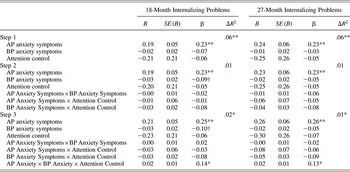
Consistent with our first hypothesis, greater anxiety symptoms in adoptive parents were linked to greater internalizing problems when infants were 18 months old (Table 2). In addition, consistent with our second hypothesis, a significant three-way interaction emerged among birth parent anxiety symptoms, adoptive parent anxiety symptoms, and children's attention control predicting internalizing problems at 18 months of age (Table 2). Following the suggestions of Aiken and West (Reference Aiken and West1991), this interaction was probed by recentering adoptive parent anxiety symptoms at low (−1 SD), mean, and high (+1 SD) levels. Probing the interaction by recentering continuous variables eliminates the need to create arbitrary groups, preserving the power to detect significant effects. Examining the interaction in this manner revealed a significant interaction between birth parent anxiety symptoms and children's attention control at low (B = −0.09, SE = 0.03, β = −0.22, p < .01), but not at mean (B = −0.03, SE = 0.02, β = −0.08, p > .10) or high (B = 0.02, SE = 0.03, β = 0.06, p > .10), levels of adoptive parent anxiety symptoms.
Regressions testing moderation of attention control for 18- and 27-month outcomes

Note: AP, adoptive parent; BP, birth parent.
†p < .10. *p < .05. **p < .01.
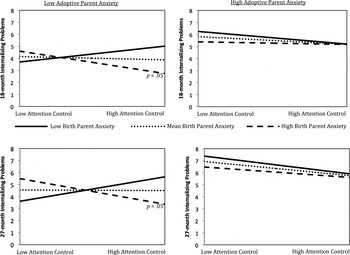
Focusing on low adoptive parent anxiety symptoms, the simple slope of attention control predicting 18-month internalizing problems was probed by recentering birth parent anxiety symptoms at low (−1 SD), mean, and high (+1 SD) levels. When children were raised by adoptive parents with low levels of anxiety symptoms, greater attention control predicted fewer 18-month internalizing problems when birth parents reported more anxiety symptoms (B = −0.93, SE = 0.40, β = −0.24, p < .05; Figure 2, top). In contrast, attention control was unrelated to internalizing problems when birth parents reported low (B = 0.66, SE = 0.42, β = 0.17, p > .10) or mean (B = −0.13, SE = 0.29, β = −004, p > .10) levels of anxiety symptoms. Greater adoptive parent anxiety symptoms predicted greater internalizing for infants at all levels of birth parent anxiety symptoms (βs > 0.23, ps < .01).Footnote 5
The associations between attention control and internalizing problems at low (left column) and high (right column) levels of adoptive parent anxiety. Probability levels are noted for significant effects.

Attention control and the moderation of 27-month internalizing problems
Analyses for 27-month outcomes, including the probing of significant interactions, proceeded in an identical fashion to those for 18-month outcomes. Consistent with our first hypothesis, greater adoptive parent anxiety symptoms were associated with more internalizing behaviors in 27-month-old children (Table 2). Consistent with our second hypothesis, a significant three-way interaction emerged among birth parent anxiety symptoms, adoptive parent anxiety symptoms, and children's attention control predicting internalizing problems at 27 months of age. Again, a significant interaction between birth parent anxiety and children's attention control was seen at low (B = −0.11, SE = 0.04, β = −020, p < .05), but not at mean (B = −0.05, SE = 0.03, β = −0.09, p > .10) or high (B = 0.02, SE = 0.04, β = 0.03, p > .10), levels of adoptive parent anxiety symptoms.
As was true at 18 months, at low levels of adoptive parent anxiety symptoms, we found that greater attention control predicted fewer 27-month internalizing problems when birth parents reported more anxiety symptoms (B = −1.06, SE = 0.56, β = −0.23, p = .05; Figure 2, bottom). In contrast, attention control was unrelated to internalizing problems when birth parents reported mean (B = −0.02, SE = 0.36, β = −0.01, p > .10) or high (B = 1.02, SE = 0.53, β = 0.22, p > .05) levels of anxiety symptoms. Again, the effect of adoptive parent anxiety symptoms was significant at all levels of birth parent anxiety symptoms (βs > 0.24, ps < .01).
Post hoc analyses
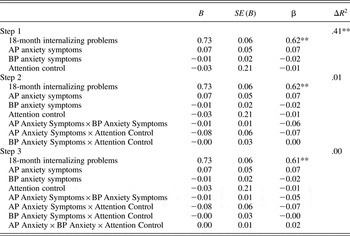
Although we found that attention control at 9 months of age interacted with birth and adoptive parent anxiety risk to predict levels of internalizing problems 9 and 18 months later, it was unclear whether this prediction was linked to stable levels of internalizing or whether early factors could predict changes in internalizing problems over time. To test the degree to which birth parent anxiety, adoptive parent anxiety, and attention control predicted changes in internalizing symptoms between 18 and 27 months, an additional analysis was run that was identical to the model used at 27 months except that it controlled for 18-month internalizing problems. In this way, associations with 27-month internalizing problems would not reflect whether the 9-month measures directly predicted 27-month problems (as in the previous analysis) but would instead reflect whether the 9-month measures predicted increases or decreases in internalizing problems between the 18- and 27-month assessments. As can be seen in Table 3, the three-way interaction among birth parent anxiety symptoms, adoptive parent anxiety symptoms, and attention control was not significant (B = 0.00, SE = 0.01, β = 0.02, p > .10).
Regression testing moderation of attention control for changes in internalizing problems between 18 and 27 months

Note: AP, adoptive parent; BP, birth parent.
**p < .01.
Discussion
Attention control in infancy predicted internalizing problems at 18 and 27 months of age in the context of birth and adoptive parent anxiety symptoms. In addition, birth and adoptive parent anxiety symptoms moderated the link between infant attention control and internalizing problems 9 and 18 months later, but did not predict changes in internalizing problems between assessments.
Attention negatively predicts internalizing in children with anxious birth parents
In line with our previous work, we showed that within a caregiving environment characterized by low levels of anxiety symptoms, greater attention control in infancy may protect individuals from the development of internalizing problems. Among infants whose birth parents reported high levels of anxiety symptoms, attention control was only protective for children whose adoptive parents reported low levels of anxiety symptoms. This pattern of findings is at least partially aligned with a theory of genetically influenced susceptibility to one's environment (Bakermans-Kranenburg & van IJzendoorn, Reference Bakermans-Kranenburg and van IJzendoorn2007; Belsky & Pleuss, Reference Belsky and Pleuss2009). That is, infants who were more susceptible based on levels of birth parent anxiety symptoms, who may be the most malleable to the conditions of their environment, showed the best outcomes (i.e., the least number of internalizing problems) in adoptive environments characterized by low levels of anxiety symptoms.
In addition, our work goes beyond a basic examination of genetically influenced susceptibility to the environment by implicating attention control as a possible pathway by which risk or protective factors may be conferred. That is, it was not simply the case that children born to more anxious birth parents and raised by less anxious adoptive parents showed low levels of internalizing problems. Rather, children's attention control predicted fewer internalizing problems in the context of genetic and environmental risk. Thus, attention control may function as a regulatory skill by which genetic risk is mitigated. For example, in contrast to less susceptible children, highly susceptible children may reap greater benefits from environments where low-anxiety parents model appropriate, attention-based regulatory behaviors or scaffold behaviors that promote independent regulation.
Thus, results suggested that children reared by nonanxious adoptive parents benefitted from attention control in ways that were not seen in other children. Our data do not illuminate whether this benefit is the product of an earlier acquisition of attention-related skills of regulation (i.e., maturational lag in other infants) or whether such skills are qualitatively different in highly susceptible children during infancy and toddlerhood. Although attention control emerges well before the age of the infants in the current study (Johnson et al., Reference Johnson, Posner and Rothbart1991), skills of basic attention control provide the foundation for a host of more sophisticated regulatory behaviors that will not be fully developed for some time. Thus, it may be the case that less anxiety in the rearing environment hastens the development of attention-related regulation. However, it may also be the case that individual children use these skills differently, such as to attend toward or away from environmental threat. Because the current study does not allow a direct test of these possibilities, incorporating multiple measures of attention control over time will be important for future research.
It is also unclear whether the current findings are specific to regulation via attention control. Although one may posit that attention control is undergoing rapid development during the period during in which it was measured (9 months of age), additional regulatory strategies would have been coming online across the assessment periods. Therefore, it will be important to design future studies to discern whether other regulatory strategies might also act as pathways linking regulation to childhood outcomes within the differential susceptibility framework. Ideally, strategies would be measured in both parents and children in order to further clarify issues about generational transmission of regulatory skills.
Environmental risk and emerging internalizing problems
The moderation of attention control by birth parent anxiety occurred only in the context of low adoptive parent anxiety. In previous work, we found that in the context of high adoptive parent anxiety symptoms, greater attention control predicted greater anxious behavior at 9 months of age (Brooker et al., Reference Brooker, Neiderhiser, Kiel, Leve, Shaw and Reiss2011). This was believed to illustrate the possibility that anxious adoptive parents may model inefficient or ineffective attention strategies for regulating negative affect. However, similar effects were not seen in the current report. Rather, a direct association between adoptive parent anxiety symptoms and children's internalizing problems appears to have emerged between the 9- and 18-month assessments. By 27 months of age, this effect had slightly increased in size. One should note, of course, that this association between adoptive parent anxiety and children's internalizing problems occurs in the context of a significant interaction between birth parent anxiety symptoms and adoptive parent anxiety symptoms. It should be acknowledged, therefore, that this effect reflects an association under a specific set of circumstances: one in which other effects are held constant (Aiken & West, Reference Aiken and West1991). While we understand that debate exists regarding the practical significance of such a finding, there is value in noting it within the framework of development. That is, under the same conditions, adoptive parent anxiety symptoms did not predict internalizing at 9 months of age, but they did predict internalizing at 18 and 27 months of age.
Although methodological differences exist between the 9-month investigation and the current study, one may speculate that there is an increasingly robust direct link between adoptive parent anxiety symptoms and child outcomes that, over time, obscures the impact of child-based effects. In this scenario, the link between attention control and genetic risk would be visible only at low enough levels of risk in the adoptive home, as was observed in the current study. Our findings generate speculation that prolonged exposure to the affective style of anxious parents may increase the likelihood that children develop internalizing problems, at least in early childhood. Although this notion cannot be tested using the current data, there is work suggesting that infant sensitivity to “sad” behaviors in depressed mothers increases over time (Hatzinikolaou & Murray, Reference Hatzinikolaou and Murray2011). Thus, levels of exposure to anxious parents may be an important factor for future research on the development of internalizing problems in children.
Contextual risk moderates overall internalizing problems but not change
While the importance of adoptive parent anxiety, birth parent anxiety, and infant attention control predicting children's internalizing problems up to 18 months later should not be understated, it is notable that these measures were unrelated to changes in internalizing problems between 18 and 27 months of age. Work with animals has shown that early interactions between genotype and the caregiving environment are powerful precursors to lifetime functioning (Meany, Reference Meany2001; Suomi, Reference Suomi1997). However, given a more protracted developmental period for regulatory skills in humans, it may be that changes in attention control skills over time would more strongly predict changes in internalizing problems than does a single, early estimate of attention. Thus, although additional measures of attention control are not available in the current data, tracking concurrent changes between attention control and internalizing problems is an avenue for future research.
In addition, as previously stated, attention control is believed to underlie self-directed skills of regulation such as effortful control and executive control. Steep increases in these more complex regulatory sills are observed as children reach school age (Kopp, Reference Kopp1982; Eisenberg et al., Reference Eisenberg, Cumberland, Spinrad, Fabes, Shepard and Reiser2001; Rothbart, Reference Rothbart2011). To the extent that self-regulation comes to rely more heavily on increasingly complex regulatory skills as they develop, one might expect a trend of decreasingly robust associations with basic attention control. Ongoing data collection in this sample will allow us to test this developmental pattern as children age. If true, it may not be surprising that attention control measured at 9 months of age did not predict changes in internalizing problems between ages 18 and 27 months. However, given that such shifts in preferred methods of regulation are occurring during this time, it is perhaps even more remarkable that a 9-month measure of attention control was associated with levels of internalizing problems at 27 months of age, as attention control becomes a more distal marker of regulation.
In addition, levels of internalizing problems were highly stable between 18 and 27 months of age. Minimal change results in limited variability and increases the difficulty in testing precursors to change. The prediction of change might be better measured during a period of development where greater increases or declines in internalizing problems are observed, such as during late childhood or at the onset of puberty. Nonetheless, it remains noteworthy that a measure of attention control at 9 months of age is associated with levels of internalizing problems almost 2 years later. This finding implies that intervention programs targeted at improving attention control in infancy can have effects that persist through toddlerhood.
Limitations
This work is not without limitations. First, although both birth and adoptive parents reported minimal, mild, and moderate anxiety symptoms as defined by the BAI, mean anxiety was generally low in the sample as a whole. For example, despite scores recentered at high levels of birth and adoptive parent anxiety symptoms reaching moderate and severe thresholds, respectively, it is possible that not every parent displayed notable anxiety symptoms. These low scores likely reflect individuals in the current study being unselected for clinical levels of anxiety. The generalizability of the current results to disordered populations is therefore unknown. With regard to the findings themselves, however, one should note that a greater-than-anticipated number of low anxious parents would increase the chances of observing null results rather than the pattern of significant findings reported above.
Second, both parent anxiety symptoms and children's internalizing problems were obtained via parent report. Using composites from multiple raters should limit associations owing to rater bias. Similarly, patterns of results are preserved when adoptive mother anxiety is used to predict father reports of child internalizing and when adoptive father anxiety is used to predict mother reports of child internalizing. Even so, this remains a limitation of the current study.
Third, we used empirical data to justify a focus on the importance of attention control for internalizing problems in children in the context of parent-based risk for anxiety. However, as previously acknowledged, the internalizing spectrum is composed of more than only anxiety problems. Similarly, problems with attention control are not anxiety specific. For example, work has begun to emerge suggesting that rumination, related to the disrupted control of attention, is an important factor of risk for depression in children (Broderick & Korteland, Reference Broderick and Korteland2004). It will therefore be important for future work to determine whether the associations reported here can be generalized to other symptoms of parent risk and/or the full spectrum of risk for disorders in young children.
Fourth and finally, according to our a priori power analysis, small effect sizes may not have been detectable in the current sample. Although our sample is quite large for a multimeasure, longitudinal study of young children, given the number of terms included in the regression model interactions, this may represent a limitation of the current data.
Conclusions
The current study provided novel evidence for the importance of early attention control as a facet of risk for internalizing problems in early childhood. In addition, it offered empirical evidence for the moderating roles of genetic and environmental influence on the pathway linking attention control to risk for internalizing problems in young children. Finally, these results show that interactions between early risk factors and regulatory skills predict early internalizing problems across infancy and toddlerhood, suggesting that the development of skills such as attention control early in life can have lasting implications for mental health and risk for disorder in young children.