




No CrossRef data available.
Article contents
Parasite infracommunity diversity in eels: a reflection of local component community diversity
Published online by Cambridge University Press: 17 October 2003
Abstract
The intestinal macroparasite communities of freshwater eels (Anguilla anguilla) captured in the south of England from Windsor (River Thames) during August 2001, and Leckford (River Test) during late June/July 2000, are reported for the first time. Parasite component communities were among the most species rich and diverse recorded from European eels. A total of 13 intestinal macroparasite species were encountered during the study, 8 from each eel host population with 3 being common to both. Acanthocephalans, nematodes and cestodes were recovered from each host population. Eels from Windsor additionally harboured Nicolla gallica (Digenea), which was also the most prevalent and abundant macroparasite species in these hosts. Each component community followed a log normal rank abundance distribution and demonstrated reduced species dominance and increased species equitability compared with previous studies. As such, the study component communities were suitable for testing the hypothesis of low infracommunity diversity in European eel hosts. Specifically, this hypothesis predicts that the intestinal macroparasite infracommunities of European eels are species-poor, displaying low density and diversity with high dominance, irrespective of component community diversity, and that this may be more pronounced in UK host populations. This hypothesis was not upheld; study findings demonstrate that higher infracommunity diversity in eel hosts is possible, and suggest that infracommunity diversity in individual eel hosts may be a simple, stochastic reflection of component community diversity.
Information
- Type
- Research Article
- Information
- Copyright
- 2003 Cambridge University Press
INTRODUCTION
The intestinal macroparasite infracommunities of eel populations from the UK and mainland Europe display low density, diversity and species richness, and high dominance usually by a single acanthocephalan or nematode species (Kennedy, 1990, 1993, 1997; Kennedy et al. 1998; Sures et al. 1999; Di Cave et al. 2001). Uninfected eels are common, as are single-species infections, suggesting vacant niches in the eel intestine are the norm (Kennedy & Guégan, 1996). Although low infracommunity diversity has been reported from both UK and mainland European studies, eel populations from mainland Europe have generally displayed greater component community species richness (CCR) than eel populations from the UK. The small number of UK studies that encountered species-rich component communities also reported low diversity infracommunities (Kennedy, 1993, 1997). Kennedy (1990, 1993, 1997) concluded from these and other studies that used species-rich component community data, that eel infracommunities were of low diversity and restricted to what appeared to be an upper limit in this respect, rather than simply a function of component community diversity. But, if infracommunities are simply stochastic subsets of the parasite species available to eels, species-rich component communities are expected to lead to comparatively species-rich and diverse infracommunities.
The study objective was to test the hypothesis that the intestinal infracommunities of eels are of limited and low diversity. However, a lack of firm baseline data restricted the present study to a comparative investigation of the strength of a prediction generated from the hypothesis, i.e. that richer more diverse eel component communities would also be composed of typical (low diversity) infracommunities. The null hypothesis, that eel infracommunity diversity at the study sites was not constrained within predicted bounds, was examined using data from species rich eel-parasite component communities from 2 ecologically contrasting catchments on the rivers Thames and Test, and comparing them with the literature, and with one another. Host data were recorded to test the assumption that eels could be regarded as replicates in terms of body (and alimentary tract) length, weight and age.
MATERIALS AND METHODS
Eels were captured from the River Test at Leckford in Hampshire using a weir trap during mid-June to mid-July 2000, and from the River Thames at Windsor (between Romney Island and Eton) using fyke nets during August 2001. The Test at Leckford is a lowland chalk river supporting a fish fauna dominated by salmonids, and a Site of Special Scientific Interest (SSSI). Large stretches of the river flow shallow over a gravel bottom. The Thames at Windsor is also lowland but the fish fauna is dominated by cyprinids, and the water flows deeper over a predominantly muddy bottom. Both Leckford and Windsor are entirely freshwater sites.
Eels were transported to aquaria at Royal Holloway, University of London, where they remained unfed, until killed by overdose of Benzocaine (max. 4 days post-capture). Each eel was measured to the nearest centimetre (alimentary tract and total body length) and weighed to the nearest gram, prior to dissection and examination for intestinal macroparasites. Both sagittal otoliths were also removed, dried, and stored together in a labelled Eppendorf tube. Eels were later aged in whole years by counting annulations within each otolith (ISAF, 1974); whole otoliths were wet-ground in the horizontal plane, and viewed in immersion oil under low-power magnification with transmitted light. Eels were sexed according to the appearance of the gonads (Tesch, 1977 and T. Bark, personal communication). All eel hosts examined during the study were female, typical of larger eels captured from inland locations (Tesch, 1977), and host sex was not considered further. Total body length among Leckford eels ranged between 54 and 79 cm (mean: 63 cm; S.D. 4·9 cm); among Windsor eels this range was 38–77 cm (mean: 59 cm; S.D. 9·9 cm).
Parasites were generally stored individually, along with the host's identification number, in Eppendorf tubes containing 70% ethanol. Cestodes and digeneans were initially fixed in formalin or Bouin's fixative prior to staining with Meyer's paracarmine. Acanthocephalans and nematodes were satisfactorily preserved in, and identified from, 70% ethanol. Laterly, digeneans were counted in situ using a hand-held count meter, and cestode scolices and proglottids were satisfactorily preserved in, and identified from, 70% ethanol. Acanthocephalans with invaginated proboces were dissected to facilitate identification. Parasites were identified to species using the keys of Dollfus (1958); Brown, Chubb & Veltcamp (1986); Chubb, Pool & Veltcamp (1987); Hoffman (1999); Bykhovskaya-Pavlovskaya et al. (1962) and Moravec (1994).
Infra- and component community parameters were assembled after Bush et al. (1997); mean intensity values were derived using data from infected hosts only, while mean abundance values were derived using data from all hosts. Additional community descriptors were used for direct comparison with previous studies that adopted them i.e. Kennedy (1993), Kennedy & Guégan (1996), Kennedy et al. (1998), Sures et al. (1999) and Sures & Streit (2001). The parameters used to describe infracommunities per location included the mean number of helminths±S.D. (infected eels and all eels separately), the mean Brillouin diversity index±S.D. (infected eels only), infracommunity species richness (ICR) calculated as the number of parasite species, the maximum and mean parasite species richness for all eels per sample (ICRmax, ICRmean), the proportion of eels infected, and the proportion with 0–1 parasite species per sample. The parameters used to describe component communities per study location were: total number of helminths (N), total number of species (S), prevalence (% P), aggregation indices (variance over the mean, k of the negative binomial and Poulin's index of discrepancy D), Simpson's index (reciprocal form, for diversity), Shannon–Wiener's diversity index H′log2, Shannon evenness index [H′/log2(S)], Berger–Parker dominance index, and the dominant species. Rank abundance curves were also constructed for component communities. Indices of component community diversity are displayed alongside those from published studies from the UK and mainland Europe that published suitable data, to determine the suitability of Leckford and Windsor eels for testing predictions of infracommunity diversity in eels.
The independence of infracommunity parameters from eel host parameters was tested using data from both study locations. Because the variances of ICR data and eel host data remained unequal after log transformation, with one exception (ICR vs eel weight for Windsor eels) where linear regression was used, non-parametric Spearman's rank correlation coefficients were calculated. Each parameter of the eel host was ranked individually first with ICR, and then total number of helminths.
Test statistics were computed using SPSS 7.5, PRIMER V5, Microsoft Excel 97 and the Quantitative Parasitology program of Rózsa, Reiczigel & Majoros (2000) accordingly. Regression analyses used the least squares method (LSR). Spearman's rank test (rs) was used for non-parametric correlation analyses.
RESULTS
Results are presented in 3 sections. The first section details the results from analyses that tested the assumed independence of infracommunity parameters and host parameters. The second section details findings from the component community analyses, conducted to determine the suitability of Thames and Test component communities for the study objective. Necessary criteria were met and findings from the infracommunity analyses that followed are presented in the third results section.
The effect of host size on infracommunity parameters
Findings suggested that host size was not influencing the infracommunity parameters chosen for investigation. Although ICR was positively and significantly correlated with eel body length (P=0·025, rs30=0·316), and weight (P=0·015, rs30=0·342) among the 50 river Test eels, the low rs values undermine these correlations and they were rejected. A similar situation was observed between ICR and alimentary tract length (P=0·009, rs30=0·365). ICR was not correlated with age in the 47 eels whose age was established (rs30=0·150, P=0·315). The total number of helminths per infracommunity did not correlate with host body length (rs30=0·218, P=0·129) or host weight (rs30=0·196, P=0·172).
In the 32 eels captured from the Thames at Windsor, the significant relationships with ICR described above were not replicated (alimentary tract length: rs30=0·139, P=0·449; body length: rs30=0·37, P=0·840; weight: LSR F31=0·0034, P=0·95). Nor did the total number of helminths per infracommunity correlate with host body length (rs30=0·044, P=0·812) or weight (rs30=0·009, P=0·961).
Parasite component community profiles
Component communities from Leckford and Windsor were similar in that each contained a total of 8 species, and included 3 species of acanthocephalan, 2 species of cestode and at least 2 species of nematode (generalist, specialist and accidental helminth species were all present). The only digenean species, Nicolla gallica, was found at Windsor.
Of the previous UK studies, 2 were suitable (Kennedy, 1993, 1997) for comparison with this study. Selected years from these long-term studies are presented, reflecting the highest CCR values from each with the exception of River Clyst in 1981, selected because the component community displayed highest diversity and evenness and lowest dominance found during the 13-year study, although CCR was typically low.
Table 1. Component community diversity of Leckford and Windsor eels, and comparison with selected publications (Superscripts: 1Kennedy, 1993; 2Kennedy, 1997; 3Sures et al. 1999; 4Sures & Streit, 2001; 5Schabuss et al. 1997. *Denotes a value calculated from published data; [dagger]denotes a value derived from both intestinal and swimbladder communities; [Dagger]denotes the highest and §the lowest values found by Kennedy (1993, 1997). Dominant species: E.t, Echinorhynchus truttae; N.g, Nicolla gallica; A.c, Acanthocephalus clavula; A.l, A. lucii; A.a, A. anguillae; P.a, Paratenuisentis ambiguous; P.m, Proteocephalus macrocephalus; S.i, Spinitectus inermis; P.t, Paraquimperia tenerrima.)

Leckford and Windsor component communities demonstrated similar values for both Shannon and Simpson diversity indices, and Shannon evenness. Shannon diversity values for the study component communities exceeded all those from previous studies. Simpson's indices exceeded all but 3 values recorded in previous studies, were very similar to 2 of these (River Otter 1994, 1995 – not shown), but not to the highest (River Otter 1991) (Kennedy, 1997).
Dominance at Leckford was similar to that found throughout Kennedy's (1997) River Otter study but lower than values from the river Clyst (Kennedy, 1993). The component community at Windsor (present study) was dominated by a single parasite species to a lesser degree than the majority of studies, a lower value being found in only one case i.e. River Otter 1991 (Kennedy, 1997). However, the lower Berger–Parker indices calculated for Leckford and Windsor during the present study do not reflect the full picture at either study site. Each component community was dominated by 2 species, and principally by a generalist species (Fig. 1): Echinorhynchus truttae and Paraquimperia tenerrima at Leckford, and Nicolla gallica and Acanthocephalus anguillae at Windsor. The co-dominance pattern interpreted here could not have occurred in the majority of previous cases, with the exception of River Otter in 1986 (not shown), since the published Berger–Parker indices did not leave a large enough proportion of the total number of helminths to compete with the dominant species. It appears that the co-dominance observed at Leckford and Windsor is not common. Rank abundance curves were constructed to visualize dominance and evenness in communities, and revealed a strong similarity between Leckford and Windsor. Based on appearance alone, both rank abundance curves appeared to fit a log-normal distribution (Fig. 2). The only study found that reported rank abundance from rich component communities (River Clyst study, years 1987, 1991 and 1992) also reported a log-normal distribution (Kennedy, 1993).

Fig. 1. Co-dominance and evenness of helminth species from Leckford () and Windsor (□) component communities. Relative abundance refers here to the number of parasites (per species) as a proportion of all parasites contained in the component community.

Fig. 2. Rank abundance of helminth species per component community. Leckford ([bull ]), Windsor (○). Data points are joined to assist visual assessment of best curve (after Magurran, 1988), interpreted here as approximately log normal.
Table 2. Parasite component population summaries (N, total number of helminths; % P, prevalence; I, mean intensity (infected eels only, with standard deviation); A, mean abundance (all eels, with standard deviation); D, Poulin's index of discrepancy; k, negative binomial distribution; s2/, variance over mean ratio. Confidence intervals are 95%. Values calculated where sample sizes were sufficiently large.)

Infracommunity profiles
Infracommunity measures are displayed alongside those from published studies from the UK and mainland Europe that reported suitable infracommunity data (Table 3). Leckford and Windsor infracommunities were almost identical in all four measures of diversity. When all measures were compared, infracommunities from Leckford and Windsor eels had more in common with one another than with those found in previous studies (in particular the UK studies), which reported lower ICRmax and ICRmean values, lower or comparable mean number of helminths per infracommunity, and lower diversity.
Table 3. Infracommunity diversity from Leckford and Windsor eels, and comparison with selected publications (Superscripts: 1Kennedy, 1993; 2Kennedy, 1997; 3Sures et al. 1999; 4Sures & Streit, 2001; 5DiCave et al. 2001.)

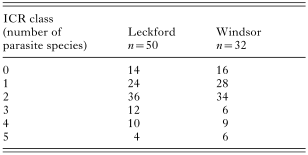
In terms of the proportion of eels infected with at least 1 parasite species, values for the Leckford and Windsor eel samples were similar to, or exceeded, the highest values from the other studies. The proportion of study eels infected with either 0 or 1 species was conspicuously lower than most previous studies (Table 3). It appeared that Leckford and Windsor eels were at least as likely to be infected as the eels from other studies, and often more so. The frequency distribution of ICR values (Table 4) supports this, and shows that the most frequently encountered parasite species richness class in eels from both Leckford and Windsor was 2 species, not 0 or 1 as previous studies have reported (Kennedy & Guégan, 1996). In fact, a considerable proportion of infected eels harboured more than 2 species. Not only were Leckford and Windsor eels at least as likely to be infected, but they were less likely to harbour single species infections.
Table 4. Percentage of eels in each ICR class, Leckford and Windsor (n=Number of eels per sample.)
DISCUSSION
The study objective was to test the hypothesis that infracommunity diversity in eel hosts is low, regardless of component community diversity. The first part of the present study assessed the suitability of the Thames and Test eel-component communitites for this purpose. In summary, the component communities from Leckford and Windsor were of higher species richness than generally reported and among the highest yet reported. In past studies eel–parasite component communities have varied considerably in species richness, but general diversity has been low, as reported for the infracommunities contained within them. The component communities from Leckford and Windsor appeared to differ from previous studies in terms of their greater general diversity, not just species richness, and as such were suitable component communities for the study objective. Component communities from Leckford and Windsor eels were highly similar. They appeared to follow the common and widely reported log normal rank abundance distribution, were among the most diverse yet recorded from eels, and displayed lower species dominance and increased species equitability than previously reported from eels. The component community in Windsor eels was unusual in that it was dominated by a digenean (Nicolla gallica). No previous record of N. gallica in UK eels was found, although this species has previously been recovered from UK populations of bullhead Cottus gobio (from the river Test: NHM parasite collection), and stone loach Neomacheilus barbatulus (Kennedy, 1974), and from Anguilla anguilla in Egypt (Fischthal & Kuntz, 1963).
Infracommunities from Leckford and Windsor were, on average, more species rich than those from the majority of previous studies. The mean number of helminth species (ICRmean) at Leckford and Windsor was exceeded only in the River Otter eels (in 1996) and Italian lagoon eels (in 1997). However, a greater proportion of eels was infected at the Leckford and Windsor study sites compared to other studies, inflating ICRmean values from these eel samples. The mean number of helminth species (all eels) and maximum infracommunity richness (ICRmax) together better describe infracommunity richness values when all eels are considered (as in previous studies). ICRmax from Leckford and Windsor exceeded the highest value (3 spp.) from the 64-location study published by Kennedy & Guégan (1996) and equalled the highest of the subsequent studies summarized in Table 3 (River Clyst reached 4 during 2 years, River Otter reached 5 during 1 year). When ICRmean and ICRmax were compared between studies, Leckford and Windsor contained among them the highest ICR values yet recorded from UK and European eel populations.
The mean number of parasite species (infected eels only) gives a better comparison with mainland European studies. This value was not available for the UK studies but Leckford and Windsor values were identical, and reached the highest previously recorded levels when this index is compared together with ICRmax: both measures mirrored those found from the River Rhine at Alb 1999 by Sures & Streit (2001). While the percentage of Alb eels at ICRmax was low and similar to values recorded during the present study, the most frequently encountered richness class at Alb was zero, and multiple species infections were less likely than that observed in Leckford or Windsor eels.
The question then remained as to whether the study infracommunities could also be described as more diverse, historically measured using the Brillouin diversity index. The mean Brillouin index recorded from Windsor infracommunities was the highest i.e. most diverse, among all the studies considered here. The mean value for Leckford infracommunities was only exceeded by one of the River Clyst years (1980) and 1 Italian lagoon (Kennedy et al. 1997 recorded a value of 0·5 – not shown). The most diverse infracommunity (Brillouin max.) in any study was from Leckford, and the most diverse from Windsor exceeded all but one recorded elsewhere. The prediction generated by the stated hypothesis of infracommunity organization was not upheld: richer more diverse component communities delivered richer more diverse infracommunities. The null hypothesis was accepted; study findings suggest the intestinal infracommunities of eels are probably simple, stochastic subsets of the component community.
ICR correlated positively with host size at Leckford, but the total number of helminths did not. Similar findings have been reported by a small number of eel–macroparasite studies (Moravec, 1985; Conneely & McCarthy, 1986), although such analyses have been rare in the past with hosts generally being regarded as replicates in sampling terms. If the ICR/host size relationship can be replicated at Leckford, hosts could no longer be regarded as replicates. However, if the ICR/host size relationship is real, and mean host size and range from Leckford were unusually high, both might together explain the generally high species richness among these infracommunities. But the ICR/host size relationship was not strong, nor found among eels with a similarly diverse parasite fauna from Windsor (eels which had a similar mean length but larger standard deviation and range). Host size ranges also compared well with the European studies that published host data. Thus, the evidence for an ICR/host size relationship, and the implications for eel–parasite infracommunity diversity, remains weak.
Dr Neil Morley, Guy Robinson, Mike Anderson, Gareth Hughes, Chris Dutton, Warren Gilchrist and Drs Tony Bark and Rod Bray are thanked for advice and technical support during the project. The John Spedan Lewis Trust for the Advancement of Science supported the project and provided access to eels and facilities at Leckford.
References
REFERENCES
BROWN, A. F.,
CHUBB, J. C. &
VELTCAMP, C. J.
(
1986).
A key to the species of Acanthocephala parasitic in British freshwater fishes.
Journal of Fish Biology 28, 327–334.CrossRefGoogle Scholar
BUSH, A. O.,
LAFFERTY, K. D.,
LOTZ, J. M. &
SHOSTAK, A. W.
(
1997).
Parasitology meets ecology on its own terms: Margolis et al. revisited.
Journal of Parasitology 83, 575–583.CrossRefGoogle Scholar
BYKHOVSKAYA-PAVLOVSKAYA, I. E.,
GUSEV, A. V.,
DUBININA, M. N.,
IZYUMOVA, N. A.,
SMIRNOVA, T. S., SOKOLOVSKAYA, I. L.,
SHTEIN, G. A.,
SHUL'MAN, S. S. &
EPSHTEIN, V. M.
(
1962).
Keys to Parasites of Freshwater Fish of the U.S.S.R.
Zoological Institute,
Academy of Sciences of the U.S.S.R.
CHUBB, J. C.,
POOL, D. W. &
VELTCAMP, C. J.
(
1987).
A key to the species of cestodes (tapeworms) parasitic in British and Irish freshwater fishes.
Journal of Fish Biology 31, 517–543.CrossRefGoogle Scholar
CONNEELY, J. J. &
McCARTHY, T. K.
(1986).
Ecological factors influencing the composition of the parasite fauna of the European eel, Anguilla anguilla (L.), in Ireland.
Journal of Fish Biology 28, 207–219.CrossRefGoogle Scholar
DI CAVE, D.,
BERILLI, F.,
LIBERATO, DE. C.,
ORECCHIA, P. & KENNEDY, C. R.
(2001).
Helminth communities in eels from Adriatic coastal lagoons in Italy.
Journal of Helminthology 75, 7–13.CrossRefGoogle Scholar
DOLLFUS, R. PH.
(
1958).
Sur un distome de la famille des Coitocaecidae pourvu d'un receptaculum seminis.
Bulletin de la Société Zoologique de France 88, 370–376.Google Scholar
FISCHTHAL, J. H. &
KUNTZ, R. E.
(
1963).
Trematode parasites of fishes from Egypt. Part 5. Annotated record of some previously described forms.
Journal of Parasitology 49, 91–98.Google Scholar
HOFFMAN, G. L.
(
1999).
Parasites of North American Freshwater Fishes.
Cornell University Press, New York.
ISAF (1974).
International Symposium on the Ageing of Fish. The proceedings of an International Symposium held at the University of Reading (ed. Bagenal, T. B.).
Unwin Bros.,
Old Voking, UK.
KENNEDY, C. R.
(
1974).
A checklist of British and Irish freshwater fish parasites with notes on their distribution.
Journal of Fish Biology 6, 613–644.CrossRefGoogle Scholar
KENNEDY, C. R.
(
1990).
Helminth communities in freshwater fish: structured communities or stochastic assemblages? In
Parasite Communities: Patterns and Processes (ed. Esch, G. W., Bush, A. O. &
Aho, J. M.). Chapman and Hall, London.
KENNEDY, C. R.
(
1993).
The dynamics of intestinal helminth communities in eels Anguilla anguilla in a small stream: long-term changes in richness and structure.
Parasitology 107, 71–78.CrossRefGoogle Scholar
KENNEDY, C. R.
(
1997).
Long term and seasonal changes in composition and richness of intestinal helminth communities in eels (Anguilla anguilla) of an isolated English river.
Folia Parasitologica 44, 267–273.Google Scholar
KENNEDY, C. R.,
BERRILLI, F.,
DI CAVE, D.,
DE LIBERATO, C. &
ORECCHIA, P.
(
1998).
Composition and diversity of helminth communities in eels Anguilla anguilla in the River Tiber: long term changes and comparison with insular Europe.
Journal of Helminthology 72, 301–306.CrossRefGoogle Scholar
KENNEDY, C. R.,
DI CAVE, D.,
BERRILLI, F. &
ORECCHIA, P.
(
1997).
Composition and structure of helminth communities in eels Anguilla anguilla from Italian coastal lagoons.
Journal of Helminthology 71, 35–40.CrossRefGoogle Scholar
KENNEDY, C. R. & GUÉGAN, J.-F.
(
1996).
The number of niches in intestinal helminth communities of Anguilla anguilla: are there enough spaces for parasites?
Parasitology 113, 293–302.Google Scholar
MORAVEC, F.
(
1985).
Occurrence of endoparasitic helminths in eels (Anguilla anguilla (L.)) from the Mácha lake fishpond system, Czechoslovavia.
Folia Parasitologica 32, 113–125.Google Scholar
MORAVEC, F.
(
1994).
Parasitic Nematodes of Freshwater Fishes of Europe.
Academia, Praha.
RÓZSA, L.,
REICZIGEL, J. &
MAJOROS, G.
(
2000).
Quantifying parasites in samples of hosts.
Journal of Parasitology 86, 228–232.CrossRefGoogle Scholar
SCHABUSS, M.,
KONECNY, R.,
BELPAIRE, C. &
SCHIEMER, F.
(
1997).
Endoparasitic helminths of the European eel, Anguilla anguilla, from four disconnected meanders from the rivers Leie and Scheldt in western Flanders, Belgium.
Folia Parasitologica 44, 12–18.Google Scholar
SURES, B.,
KNOPF, K.,
WURTZ, J. &
HIRT, J.
(
1999).
Richness and diversity of parasite communities in European eels Anguilla anguilla of the River Rhine, Germany, with special reference to helminth parasites.
Parasitology 119, 323–330.CrossRefGoogle Scholar
SURES, B. &
STREIT, B.
(
2001).
Eel parasite diversity and intermediate host abundance in the River Rhine, Germany.
Parasitology 123, 185–191.CrossRefGoogle Scholar

Table 1. Component community diversity of Leckford and Windsor eels, and comparison with selected publications
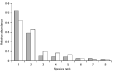
Fig. 1. Co-dominance and evenness of helminth species from Leckford () and Windsor (□) component communities. Relative abundance refers here to the number of parasites (per species) as a proportion of all parasites contained in the component community.

Fig. 2. Rank abundance of helminth species per component community. Leckford ([bull ]), Windsor (○). Data points are joined to assist visual assessment of best curve (after Magurran, 1988), interpreted here as approximately log normal.

Table 2. Parasite component population summaries

Table 3. Infracommunity diversity from Leckford and Windsor eels, and comparison with selected publications
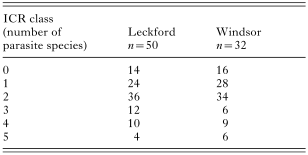
Table 4. Percentage of eels in each ICR class, Leckford and Windsor
 You have
Access
- 17
- Cited by