Introduction
The numbers and the breeding success of many seabirds in the western Arctic and the north-eastern Atlantic have been declining steadily in the recent decades (Descamps et al., Reference Descamps, Anker-Nilssen and Barrett2017; Oil Spill Prevention, Administration and Response, 2017a, b; Conservation of Arctic Flora and Fauna, 2020). The decline concerns especially the birds foraging within the surface water layer such as gulls, terns, skuas, storm-petrels, shearwaters and northern fulmar (Mitchell et al., Reference Mitchell, Daunt, Fredriksen and Wade2020). The same tendency is characteristic of the black-legged kittiwake (Rissa tridactyla Linnaeus, 1758), a common species of gulls with a circumpolar distribution in the Northern Hemisphere. A stable decline of the kittiwake populations has been noted in most of the large breeding colonies in different parts of its distribution (Conservation of Arctic Flora and Fauna, 2020).
Many researchers have attempted to identify causal links between the decline of seabird populations and climate change at high latitudes. The Arctic is one of the fastest-warming regions of the world (Walsh et al., Reference Walsh, Overland, Groisman and Rudolf2011; Box et al., Reference Box, Colgan and Christensen2019; Landrum & Holland, Reference Landrum and Holland2020), and fluctuations of the temperature and hydrological regime necessarily affect the structure and productivity of marine ecosystems. Among the climate change effects which have a key importance for seabirds are a possible shift in the distribution borders of their food items (small pelagic fish and zooplankton) and a temporal mismatch between the abundance peaks of the food items and the periods when energy demands of birds are particularly high (Gaston et al., Reference Gaston, Gilchrist, Mallory and Smith2009; Mitchell et al., Reference Mitchell, Daunt, Fredriksen and Wade2020). A significant inverse correlation has also been found between the population dynamics of the kittiwake and spring water temperature throughout its breeding range (Descamps et al., Reference Descamps, Anker-Nilssen and Barrett2017; Goert et al., Reference Goert, Garton and Poe2018) and between its breeding success and water stratification off the British Isles (Carroll et al., Reference Carroll, Butler and Owen2015). Changes in the phenology of the North Sea kittiwakes mostly preying on the lesser sand eel (Ammodytes marinus) during the breeding season have been shown to be associated with the fish growth dynamics (‘trophic mismatch’) (Burthe et al., Reference Burthe, Daunt, Butler, Elston, Frederiksen, Johns, Newell, Thackeray and Wanless2012).
In addition, endothermic animals living or breeding in high latitudes are particularly sensitive to the temperature increase, which is observed in the Arctic. Changes in the thermal environment may pose a serious threat to seabirds, which are active, move a lot and have a high metabolic rate. During the breeding season, the most vulnerable bird species are those nesting in habitats exposed to solar radiation, such as rock ledges and terraces, and foraging in the open sea (Oswald & Arnold, Reference Oswald and Arnold2012). Since Arctic seabirds possess morphological and physiological adaptations for reduction of the heat loss such as specific plumage structure and a high metabolic rate (Gabrielsen et al., Reference Gabrielsen, Mehlum and Karlsen1988; Bryant & Furness, Reference Bryant and Furness1995), temperature stress can markedly reduce the breeding success even if the food is sufficient. Under conditions of temperature stress, adult birds are forced to spend more time on thermoregulation (bathing and drinking water) than on care for the offspring (Oswald et al., Reference Oswald, Bearshop, Furness, Huntley and Hamer2008).
One of the most frequently predicted consequences of climate warming in the Arctic are changes in the parasitological situation in pelagic and especially coastal biocenoses such as the expansion of new parasites to new geographical areas, an increased intensity of transmission, colonization of new intermediate and definitive hosts due to the removal of ecological barriers, and an increased parasitic pressure on the ecosystems (Marcogliese, Reference Marcogliese2008; Galaktionov, Reference Galaktionov2017). The most reliable indicator of these processes is the parasitic fauna of tip predators such as predatory fish, seabirds and marine mammals. So far, however, there is little solid evidence on the crosslinks between climate change, parasitic infection and seabird population dynamics (Muzaffar et al., Reference Muzaffar, Hoberg and Jones2005; Muzaffar, Reference Muzaffar2009; Gaston & Elliot, Reference Gaston and Elliot2013; Hoberg et al., Reference Hoberg, Kutz, Cook, Galaktionov, Haukisalmi, Henttonen, Laaksonen, Makarikov, Marcogliese and Meltofte2013).
The manifestations of climate change such as the reduction of ice cover, the temperature increase in the upper water column and the near-surface atmospheric layers, and water stratification dynamics can be clearly seen at the Barents Sea (Årthun et al., Reference Årthun, Eldevik, Smedsrud, Skagseth and Ingvaldsen2012; Lind & Ingvaldsen, Reference Lind and Ingvaldsen2012; Zabolotskikh & Myasoedov, Reference Zabolotskikh and Myasoedov2017; Lind et al., Reference Lind, Ingvaldsen and Furevik2018). These processes have brought about considerable reconstructions of the composition and distribution of the main ecosystem components and the network of connections between them (Fossheim et al., Reference Fossheim, Primicerio, Johannesen, Ingvaldsen, Aschan and Dolgov2015; Kortsch et al., Reference Kortsch, Primicerio, Fossheim, Dolgov and Aschan2015; Dalpadado et al., Reference Dalpadado, Arrigo, van Dijken, Skjoldal, Bagøien, Dolgov, Prokopchuk and Sperfeld2020). In many areas of the Barents Sea (coast of Norway, Murman and Spitsbergen), the numbers of kittiwakes have decreased and changes in their diet have been recorded (Fauchald et al., Reference Fauchald, Anker-Nilssen and Barrett2015; Anker-Nilssen et al., Reference Anker-Nilssen, Barrett and Christensen-Dalsgaard2018; Ezhov, Reference Ezhov2019). At the same time, many specific aspects of the causal relationships between climate change and the state of the birds, in particular, from the parasitological viewpoint, have never been studied in detail in the Barents Sea region.
The causes of the changes in the biology and ecology of seabirds can only be elucidated in studies that:
1. provide reliable information on the dynamics of abiotic factors in the study area;
2. focus on bird species most sensitive to changes in these factors; and
3. examined the same or similar number of birds during different study periods.
To achieve this, we conducted a two-stage study of the helminth fauna of kittiwakes in a Gorodetskie bird colonies on the Rybachiy Peninsula (Murman coast of the Barents Sea), where the numbers of breeding birds have decreased by 36% since 2000 (Krasnov & Ezhov, Reference Krasnov and Ezhov2020). It is important to note that the surface water temperature in the Barents Sea near our study area has been increasing at a high rate from 1998 to 2017 (by 2.2 °C) and the total biomass of the mesozooplankton has been increasing too (Dalpadado et al., Reference Dalpadado, Arrigo, van Dijken, Skjoldal, Bagøien, Dolgov, Prokopchuk and Sperfeld2020). The air temperature near the Gorodetskie bird colonies has also shown positive dynamics. Its average value during the peak of the birds’ activity (May–July), which used to be +5.24 °С in the 1990s, has increased to +7.27 °С in 2018–2020 (Weather archive in Tsypnavolok).
The aim of our study was to determine the main trends in the dynamics of the species composition of the parasite fauna, the quantitative infection indices and the diet of the kittiwakes against the background of a long-term decrease in the numbers of breeding individuals.
Materials and methods
Geographical description of the study area
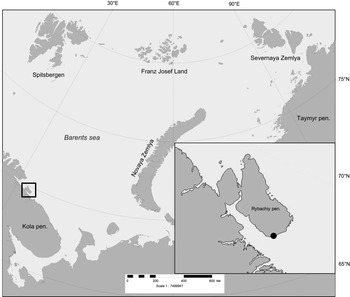
The studies were conducted in seabird colonies on the Rybachiy Peninsula (69°44′N, 32°30′E), situated in the subarctic zone of the south-western part of the Barents Sea (fig. 1), in June 2006–2008 and in June 2018–2020. During the breeding season (from March to August), the rocky ledges, stretching along the coastline for 10–12 km in the study area, serve as nesting grounds of seabirds, mainly of the black-legged kittiwake (R. tridactyla) and two murres, the common murre (Uria aalge) and the thick-billed murre (Uria lomvia) (Ezhov, Reference Ezhov2019).
A schematic map of the study area.

Samples of birds
Adult kittiwakes were caught by poles with loops at the end and euthanized with chloroform. In 2006–2008, 29 individuals (15 males and 14 females) were caught, and in 2018–2020, 30 individuals (20 males and 10 females) were caught. The birds were weighed, their sex was identified, and the fat level was assessed using a four-point scale (Ashford, Reference Ashford1971). Fat levels were recorded as follows: (1) emaciated birds; (2) no abdominal fat; (3) abdominal fat; and (4) abdominal far extending over the breast.
All applicable international, national, and/or institutional guidelines for the care and use of animals were followed.
Parasites of the intestinal tract
During parasitological dissections of the kittiwakes, their intestinal tract was excised, and the stomach was separated and examined to identify its contents (diet) and the presence of parasites. We looked for helminths in the stomach cavity, on the surface of the proventriculus and under the cuticle of the gizzard. The nematodes found were fixed in Barbagallo's solution. The small and the large intestine were divided into fragments 10 cm long, and each fragment was cut lengthwise. The chyme and the mucous membrane were transferred with the help of a scraper to measuring glasses, and a 1:1 mixture of fresh water and seawater was poured over them. The sediment was washed by sedimentation and stirring, and examined under a Leica binocular microscope (Germany) for the presence of the helminths. Flatworms (trematodes and cestodes) were extracted, washed with water, and fixed in 70% ethanol. Nematodes were clarified in 10% glycerol solution, and their temporary mounts were made. Trematodes and cestodes were stained with mucicarmine (Fluka, Germany) and embedded in Canadian balsam. The helminths were identified under a light microscope at ×300 magnification using the identification keys (Barus et al., Reference Barus, Sergeeva, Sonin and Ryzhikov1978; Ryzhikov et al., Reference Ryzhikov, Rusavy, Khokhlova, Tolkatchova and Kornyuchin1985; Sonin, Reference Sonin1986). We determined the species composition of the helminth fauna and calculated quantitative indices of infection, that is, prevalence (P), infection intensity, mean intensity and mean abundance (MA). Prevalence is percentage of infected birds; abundance is sum of parasite individuals in infested bird divided by the number of dissected birds. Infection intensity is minimal and maximal values of parasite individuals on infected birds, and mean infected intensity is average number of parasites individuals on infected birds.
Diet
The contents of the stomachs were washed with water and their composition was examined under a binocular microscope. The food items were identified based on solid remains, mostly otoliths of fish, molluscan shells, jaws and chaetae of polychaetes, chitinous fragments of crustaceans, etc. Based on the results, a relative occurrence of different groups of food items was calculated as the ratio of the number of recorded items of a certain food group to the total number of recorded items of all food groups: F rel = n/N × 100%, where n = number of recorded items of a certain food group, and N = total number of recorded items of all food groups.
Statistical analyses
For the statistical processing of the parasitological results, we calculated and compared the boundaries of confidence intervals of P and MA at 5% significance level using F-distribution (Quantitative parasitology 3.0 computer software) (Rozsa et al., Reference Rozsa, Reiczigel and Majoros2000). The similarity of the composition of the helminth fauna of kittiwakes in 2006–2008 and in 2018–2020 was assessed using Sørensen's coefficient: Ks = 2c/(a + b), where: a = number of helminth species during the first study period, b = number of helminth species during the second study period, and c = number of species common for the first and the second period.
The dependence of infection with the dominant helminth species on the sex of the kittiwakes was evaluated using Pearson's χ2 test. The values of the body weight of the females and the males, the fat levels, and the intensity of infection by the dominant parasite species were compared using a one-way analysis of variance (ANOVA) included in the Statistica 10 software package.
Results
Body weight and fat level (bird characteristics)
There were no statistically significant differences in the body weight between the males and the females studied in 2006–2008 and, respectively, that of the males and the females studied in 2018–2020 (in males: F 4.3 = 0.43, P = 0.5; in females: F 4.6 = 3.0, P = 0.1) (table 1). The fat level of each individual was scored as 3 or 4 during both study periods, but the average value of this characteristic in 2018–2020 (3.6 ± 0.09) was lower than in 2006–2008 (3.9 ± 0.05) (F 4.0 = 7.3, P < 0.01).
Body weight and fat level of female and male kittiwakes in the Gorodetskiy bird colonies (Rybachiy Peninsula, Western Murman) in 2006–2008 and in 2018–2020.

SE, standard error; N, number of birds.
Diet
In 2006–2008, the stomachs of 13 kittiwakes out of 29 (44.8%) were empty or contained only mechanical admixtures such as stones, wood chips, dry grass, etc. In 2018–2020, this situation was observed in 12 individuals out of 30 (40.0%). Fish food dominated in the diet of the kittiwakes (table 2).
Composition and relative occurrence of food items (F rel) in the stomachs of kittiwakes in the Gorodetskiy bird colonies (Rybachiy Peninsula, Western Murman) in 2006–2008 and in 2018–2020.

The only food item found in all groups of the kittiwakes was capelin. It should be noted that the proportion of empty stomachs in males made up 40% and 35% in 2006–2008 and in 2018–2020, respectively, while the proportion of empty stomachs in females was 50% in 2006–2008 and as low as 10% in 2018–2020. In 2018–2020, a statistically significant correlation between the sex of the kittiwakes and the fullness of their stomach was found (χ26.6 = 6.787, df = 1, P < 0.01).
Helminth fauna of the kittiwakes
In 2006–2008, 11 helminth species (four species of trematodes, three species of cestodes and four species of nematodes) were registered in kittiwakes in the Gorodetskiy bird colonies (table 3). The highest values of P and MA were characteristic of the cestodes Alcataenia larina Krabbe, 1869 and Tetrabothrius erostris Loennberg, 1889 and the nematode Paracuaria adunca Anderson, Wong, 1981. Five helminth species were represented by solitary individuals.
Composition and inter-annual dynamics of the helminth fauna of kittiwakes in the Gorodetskiy bird colonies (Rybachiy Peninsula, Western Murman) in 2006–2008 and in 2018–2020.

P, prevalence; MA, mean abundance.
NOTE: figures in parentheses after the values of P and MA are the lower and the upper boundaries of the exact 95% confidence interval.
In 2018–2020, we also found 11 helminth species (three species of trematodes, three species of cestodes and five species of nematodes) in kittiwakes from this region (table 3). The highest values of P and MA were recorded in the same species as in 2006–2008. Six helminth species were represented by solitary individuals.
Eight helminth species were registered in kittiwakes both in 2006–2008 and in 2018–2020, with the similarity coefficient of the fauna (Sørensen's coefficient) being 0.73.
Out of the 29 kittiwakes examined in 2006–2008, four were free of infection. The number of helminth species in one bird varied from 1 to 4 (fig. 2). Infection with trematodes was recorded in five birds, infection with cestodes, in 16 birds, and infection with nematodes in 19 birds. Five birds were infected only with cestodes, while nine birds were infected only with nematodes. Simultaneous infection with trematodes and nematodes was recorded in one bird, while simultaneous infection with cestodes and nematodes was recorded in six birds. Representatives of all the three groups of helminths (trematodes, cestodes and nematodes) were found in four birds.
Frequency of occurrence of different numbers of parasite species in a single kittiwake individual.

In 2018–2020, only one out of the 30 examined kittiwakes were uninfected with helminths. As in 2006–2008, the number of helminth species in one bird varied from 1 to 4 (fig. 2). Trematodes were found in three kittiwakes, cestodes were found in 24 kittiwakes and nematodes were found in 17 kittiwakes. Infection with cestodes alone was recorded in 12 birds, while infection with nematodes alone was recorded in five birds. Simultaneous infection with cestodes and nematodes was found in nine birds, while simultaneous infection with trematodes, cestodes and nematodes was found in three birds.
Statistically significant differences in MA and infection intensity of kittiwakes with cestodes A. larina and T. erostris in the two study periods were found: for both parasites these indices were lower in birds surveyed in 2018–2020 (table 3, fig. 3). Comparison of mean intensity with the use of one-way ANOVA showed that this index decreased 9-fold for A. larina (F 4.2 = 4.9, P < 0.05) and 5.3-fold for T. erostris (F 4.4 = 12.2, P < 0.01) in kittiwakes examined in 2018–2020 as compared with those examined in 2006–2008. No statistically significant differences in the infection intensity of kittiwakes with nematodes of P. adunca in the two study periods were found (F 4.3 = 1.4, P = 0.26).
Intensity of infection of kittiwakes with cestodes. Alcataenia larina and Tetrabothrius erostris in 2006–2008 and in 2018–2020.

Characteristics of infection depending on the sex of kittiwakes
No correlation between the sex of the kittiwakes and their infection with the dominant helminth species (A. larina, T. erostris and P. adunca) was revealed with the use of Pearson's χ2 test. Neither did we find any differences in the parasite infection depending on the sex of the birds in different study periods (table 4).
Comparison of infection intensity (average infected intensity, minimal and maximal values) with dominant helminth species in kittiwakes in the Gorodetskiy bird colonies (Rybachiy Peninsula, Western Murman) depending on sex in 2006–2008 and in 2018–2020.

Average infected intensity is given as mean ±standard error; minimal and maximal values given in parentheses.
At the same time, a lower infection intensity with A. larina (F 4.4 = 6.8, P < 0.05) and P. adunca (F 5.0 = 8.1, P < 0.05) was registered in male kittiwakes in 2018–2020 than in 2006–2008, while a lower infection intensity with T. erostris (F 5.3 = 9.4, P < 0.05) was registered in females in 2018–2020 than in 2006–2008 (fig. 4).
Infection intensity with Alcataenia larina, Tetrabothrius erostris and Paracuaria adunca of male and female kittiwakes in 2006–2008 and in 2018–2020.

Discussion
The results of our study indicate that no significant changes in the helminth fauna of the kittiwakes nesting in the Gorodetskiy bird colonies occurred from 2006–2008 to 2018–2020. The parasite species recorded only during one of the study periods (in 2006–2008 or in 2018–2020) were represented by solitary individuals, and these species were common components of the parasitic fauna of birds at the Barents Sea, often recorded previously at the Murman coast. No statistically significant differences in P of helminths in the kittiwakes during the first and the second study period were found.
Taking into account the climatic and ecosystem changes in the Barents Sea region described previously, as well as a steady decline of kittiwakes breeding on the Rybachiy Peninsula (Ezhov, Reference Ezhov2019), we can suggest two possible interpretations of our results:
1. No significant ecosystem changes affecting the dynamics of the helminth fauna of the kittiwakes occurred in the study area from 2006–2008 to 2018–2020. The decrease in the numbers of the kittiwakes may be associated with natural long-term fluctuations, and it has not reached a critical level below which a successful transmission of the helminths using kittiwakes as the definitive hosts in the area would be impossible.
This interpretation is supported by the absence of new invading species (in particular, those from the North Atlantic) in the helminth fauna of the kittiwakes surveyed in 2018–2020, by the absence of statistically significant changes in most quantitative parameters of infection and by the stable proportion of the dominant parasite species. In addition, despite general long-term trends (increased sea surface and air temperature, and decrease in the kittiwake population) (see ‘Introduction’) during 2018–2020 the situation remained very similar to that of the 2006–2008. There were no significant differences in the number of birds (fig. 5). The air temperature near the study area in May–July has increased by 0.86 °С only between 2006–2008 and 2018–2020 (+6.41 °С and +7.27 °С, respectively) (Weather archive in Tsypnavolok) and the sea surface temperature in the adjacent water area has increased by 0.65 °С in the same seasons (+6.26 °С and +6.91 °С, respectively) (NOAA NCEP EMC CMB GLOBAL Reyn_SmithOIv2 monthly). It is possible that such fluctuations in abiotic parameters can affect some quantitative indices of bird infestation (see below). But the composition and structure of the kittiwakes’ helminth fauna have not changed.
2. Changes in the food web of biocenoses near the coast of the Gorodetskiy bird colonies associated with climate perturbations did take place, but the helminths, due to their broad specificity to intermediate and transport hosts, continue to implement their life cycles in the study area using other hosts. Therefore, the helminth fauna of kittiwakes cannot be considered as a reliable indicator of climate-related ecosystem changes.
The dynamics of the number of kittiwakes in the colony ‘Gorodetskie ptich'i bazary’ (after Krasnov & Ezhov, Reference Krasnov and Ezhov2020).

The second interpretation may be supported by the changes in the birds’ diet (table 2) at the background of a high similarity of the helminth fauna composition during the two study periods. This may be due to fact that infection of kittiwakes with the same helminth species can occur when eating different foods. For example, metacercariae of Cryptocotyle lingua can develop in the cod (Gadus morhua) (Hemmingsen et al., Reference Hemmingsen, Lombardo and Mackenzie1991), Arctic charr (Salvenius alpinus) (Kristoffersen, Reference Kristoffersen1992), and herring (Clupea harengus) (Tolonen & Karlsbakk, Reference Tolonen and Karlsbakk2003). Probably, tetrabothriid larvae are contained in metacestoda complex identified as Scolex pleuronectis (Galaktionov, Reference Galaktionov1996). Infestation with these larvae is described in 37 fish species from many regions of the Barents Sea (Karasev, Reference Karasev2003). Anisakid larvae are registered in many of the Barents Sea fishes also (Karasev, Reference Karasev2003).
There is, however, a circumstance that does not allow us to disregard the relationship between the helminth infection of the kittiwakes and a possible restructuring of pelagic communities under the influence of climate change in the region. Based on the results of the parasitological survey in 2018–2020, a marked decrease of MA of the most abundant cestode species (dilepidids A. larina and tetrabothriids T. erostris) was recorded in the kittiwakes as compared with the results from 2006–2008 (table 3). The only intermediate hosts of A. larina are planktonic crustaceans from the family Euphausiidae (Shimazu, Reference Shimazu1975). The life cycle of T. erostris is not fully elucidated, but indirect evidence suggests that it involves two intermediate hosts: pelagic crustaceans; and fish (Temirova & Skrjabin, Reference Temirova and Skrjabin1978; Hoberg, Reference Hoberg1987). The absence of reliable differences in P of these two helminths in birds between the two study periods and the decrease of MA in 2018–2020 suggest that the kittiwakes ingested fewer cestode larvae in the second period, while the rates of consumption of the intermediate hosts were similar. This may be due to the reduced infection intensity of intermediate hosts in 2018–2020 associated with their decreased individual ‘parasite capacity’ due to smaller size. The predominance of small forms against the background of a complex dynamics of total zooplankton biomass is a characteristic consequence of climate warming in high latitudes, alongside with the northwards shifts of the distribution areas and seasonal shifts in phenology (Richardson & Schoeman, Reference Richardson and Schoeman2004; Balazy et al., Reference Balazy, Trudnowska, Wichorowski and Blachowiak-Samolyk2018). As concerns euphausiids, in many areas of the Barents Sea a decrease in the biomass of large individuals (>15 mm) has been noted in recent years, while an overall abundance, dominated by small forms, has increased (Eriksen et al., Reference Eriksen, Skjoldal, Dolgov, Dalpadado, Orlova and Prozorkevich2016). This phenomenon has many causes and nuances (Orlova et al., Reference Orlova, Dolgov, Renaud, Boitsov, Prokopchuk and Zashihina2013), but is undoubtedly linked to changing climatic conditions. In turn, since small planktonic crustaceans cannot accumulate large numbers of cestode larvae, this could also lead to a decrease of MA in the definitive hosts, both directly (in the case of A. larina) and indirectly (in the case of T. erostris).
However, this is not the only possible interpretation. Other factors, such as changes in the spatial distribution of the intermediate hosts, may also play a role, because the distribution of infection in oceanic zooplankton is patchy. At present, however, it is unknown which crustacean species serve as intermediate hosts for the above cestodes in the Barents Sea.
We found no connection between the sex of the kittiwakes and their infection with the dominant parasite species (T. erostris, A. larina and P. adunca). This indicates that the probability of being infected with these helminths is the same for male and for female kittiwakes.
The decrease in the fat level of the kittiwakes in 2018–2020 as compared to 2006–2008 can also be considered as an indirect consequence of climate change. As mentioned above, the distribution of pelagic fish and planktonic crustaceans, which are the major food items of the birds, tends to shift northwards, and this trend is becoming more pronounced as the warming progresses (see above). As a result, the kittiwakes have to cover an increasingly large distance in order to find food for themselves and their chicks, which requires an additional energy expenditure. The digestive efficiency of kittiwakes is the lowest among seabirds (Hilton et al., Reference Hilton, Ruxton, Furness and Houston2000), and an increased distance between feeding and breeding areas may negatively affect their physiological condition and their ability to accumulate energy reserves in the form of subcutaneous fat. Under Arctic conditions, reduced fatness makes the birds more sensitive to additional stressors such as intraspecific and interspecific competition, disturbance, weather anomalies, and pollution of water and breeding areas (Wingfield et al., Reference Wingfield, Suydam and Hunt1994). In addition, prolonged absence of parents from nesting sites makes the kittiwake offspring more vulnerable to predators. Taking into account the 24-hour solar activity (polar day) at this time of the year, the characteristic features of kittiwake nesting (in open rocky areas of the coast) and a high energy expenditure for foraging, an additional heat stress may negatively affect the birds both at the individual and at the population level and contribute to the cumulative effect causing the decline of the kittiwake population.
Conclusion
In our study of the parasitic fauna of kittiwakes in a breeding colony on the Rybachiy Peninsula (Murman coast of the Barents Sea), we did not find any signs of increased parasitic pressure on the kittiwakes, as there were no noticeable changes in the species composition of the helminths and the quantitative indices of infection between the two study periods. At the same time, a decreased MA of the dominant cestode species (A. larina and T. erostris) can be considered as an indirect indication of the changes in the size structure of the populations of their intermediate hosts, pelagic crustaceans, towards the dominance of smaller forms. This is a common effect of climate warming on zooplankton communities at high latitudes. Accordingly, climatic fluctuations may have brought about some changes in the stability of host–parasite relationships, without disrupting the structure of the parasitic systems. Nonlinear responses to changes in the climatic and foraging conditions are generally characteristic of seabirds in the Arctic (Gremillet et al., Reference Gremillet, Fort, Amelineau, Zakharova, Le Bot, Sala and Gavrilo2015). They are driven by a local effect of a particular group of factors in a particular region. Therefore, in order to obtain a more robust picture of the fundamental effects of climate warming, it is necessary to take into account the specific features of the kittiwakes’ biology and abiotic conditions in different breeding areas.
Acknowledgements
We thank Alexey V. Ezov for their help with sampling of the material. We are grateful to Natalia Lentsman for her help with the manuscript preparation.
Financial support
This work supported by the Ministry of Science and Higher Education of the Russian Federation.
Conflicts of interest
None.
Ethical standards
The authors assert that all procedures contributing to this work comply with the ethical standards of the relevant national and institutional committees on human experimentation and with the Helsinki Declaration of 1975, as revised in 2008.