INTRODUCTION
Killer whales are known to be polymorphic and exhibit variation in body size and pigmentation patterns (Evans et al., Reference Evans, Yablokov and Bowles1982; Baird & Stacey, Reference Baird and Stacey1988; Visser & Mäkeläinen, Reference Visser and Mäkeläinen2000; Pitman & Ensor, Reference Pitman and Ensor2003; Pitman et al., Reference Pitman, Perryman, LeRoi and Eilers2007, Reference Pitman, Durban, Greenfelder, Guinet, Jorgensen, Olson, Plana, Tixier and Towers2011; Foote et al., Reference Foote, Newton, Piertney, Willerslev and Gilbert2009; Mäkeläinen et al., Reference Mäkeläinen, van Ginneken and Pietiäinen2013). The pigmentation patterns of the grey ‘saddle patch’ behind the dorsal fin and the white ‘eye patch’ have been shown to vary among locations, populations and morphotypes (Evans et al., Reference Evans, Yablokov and Bowles1982; Baird & Stacey, Reference Baird and Stacey1988; Visser & Mäkeläinen, Reference Visser and Mäkeläinen2000; Pitman & Ensor, Reference Pitman and Ensor2003; Pitman et al., Reference Pitman, Durban, Greenfelder, Guinet, Jorgensen, Olson, Plana, Tixier and Towers2011; Mäkeläinen et al., Reference Mäkeläinen, van Ginneken and Pietiäinen2013). Individual variation in the saddle patch pigmentation pattern can be sufficient to identify individuals, but normally acquired marks such as scars and nicks are needed for individual identification (Bigg, Reference Bigg1982). A previous study found the saddle patches of 471 North Pacific individuals from different populations could be categorized into five variants (Baird & Stacey, Reference Baird and Stacey1988) and the proportions of these variants can vary among populations (Ford et al., Reference Ford, Ellis and Balcomb2000). These patterns can also be asymmetrical between the sides of the same individual (Mäkeläinen et al., Reference Mäkeläinen, van Ginneken and Pietiäinen2013). Eye patch shapes can be more variable in small details, and there is often asymmetry between sides (Evans et al., Reference Evans, Yablokov and Bowles1982; Visser & Mäkeläinen, Reference Visser and Mäkeläinen2000). Due to the large variation in eye patch shape, population-specific shapes are uncommon. Eye patch shape variants from each area are presented in the Supplementary Material. Orientation and relative size of the eye patch can be more easily shown to be population/type specific (Visser & Mäkeläinen, Reference Visser and Mäkeläinen2000; Pitman & Ensor, Reference Pitman and Ensor2003; Pitman et al., Reference Pitman, Durban, Greenfelder, Guinet, Jorgensen, Olson, Plana, Tixier and Towers2011).
Variation in pigmentation patterns can be determined by a variety of processes, which may include genetic drift, natural selection and gene flow (Barton & Charlesworth, Reference Barton and Charlesworth1984; Barton, Reference Barton1996). If pigmentation patterns are evolving under neutrality, then diversification in pigmentation patterns should to some extent reflect phylogenetic relatedness and the relative level of gene flow among populations, but genetic drift, and, therefore, the speed of evolution, may also be influenced by population size. In this study, we compare killer whale eye and saddle patch pigmentation patterns among populations found in waters off Norway, Iceland, Greenland, Britain and Spain.
MATERIALS AND METHODS
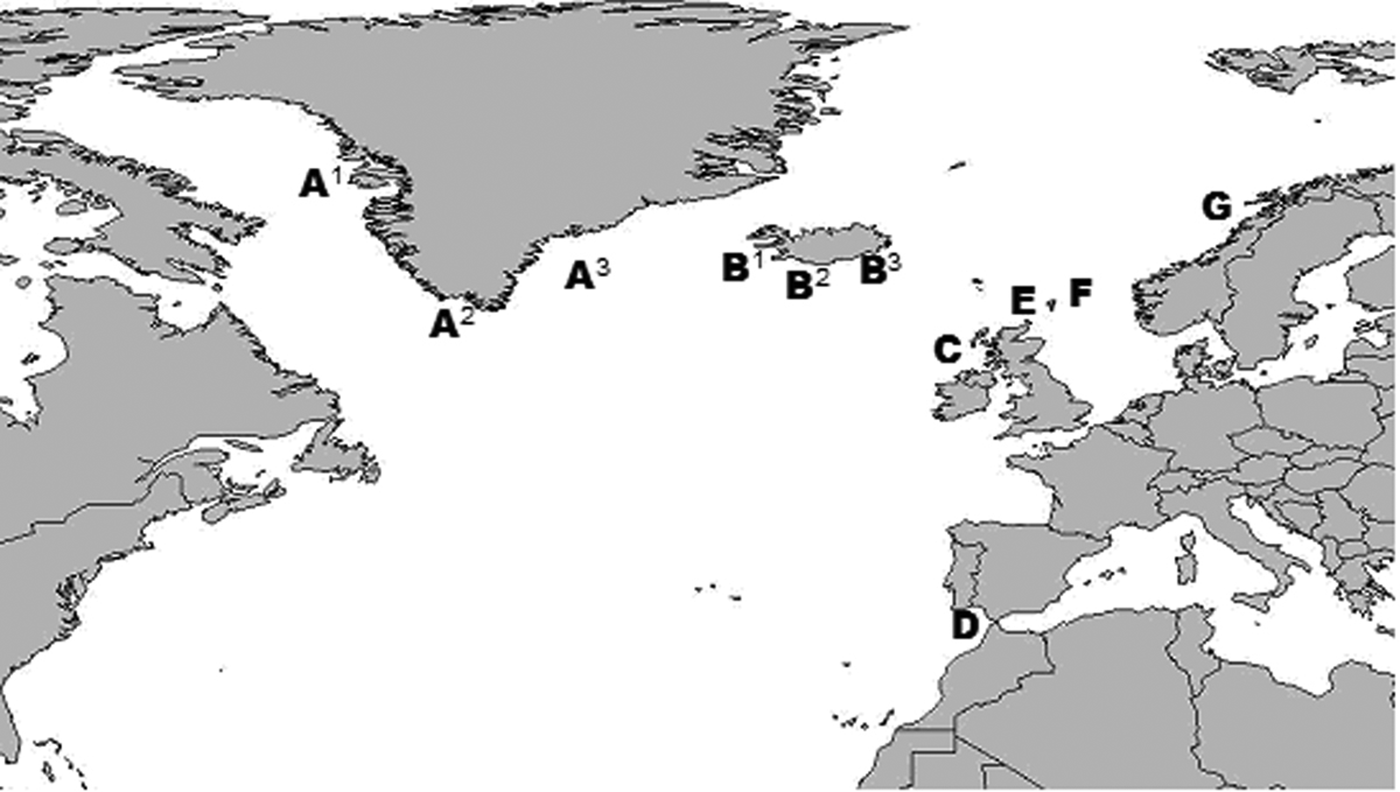
Killer whales were photographed on the Norwegian spring-spawning (NSS) herring wintering grounds of Northern Norway (1987–2008), and from the spawning and feeding grounds of the Icelandic summer-spawning (ISS) herring (1985–1995 and 2009–2012; Figure 1). Killer whales in both locations have mainly been observed consuming herring (Sigurjonsson et al., Reference Sigurjonsson, Lyrholm, Leatherwood, Jonsson and Vikingsson1988, Similä et al., Reference Similä, Holst and Christensen1996; Simon et al., Reference Simon, McGregor and Ugarte2007), share some vocalizations (Samarra et al., Reference Samarra, Deecke, Vinding, Rasmussen, Swift and Miller2010) and have been genetically assigned to a single panmictic population (Foote et al., Reference Foote, Vilstrup, de Stephanis, Verborgh, Abel Nielsen, Deaville, Kleivane, Martin, Miller, Øien, Perez-Gil, Rasmussen, Reid, Robertson, Rogan, Similä, Tejedor, Vester, Vikingsson, Willerslev, Gilbert and Piertney2011). Further photographic data were collected (2005–2012) around the north-east and northern Isles of Scotland (Shetland and Orkney; Figure 1). The individuals photographed in these locations were mostly observed hunting seals (Deecke et al., Reference Deecke, Nykänen, Foote and Janik2011), although some individuals were previously photographed on the former ISS herring wintering grounds (Foote et al., Reference Foote, Similä, Víkingsson and Stevick2010; Beck et al., Reference Beck, Kuningas, Esteban and Foote2012). Photographs taken from a pelagic trawler fishing for mackerel in the North Sea east of the Shetland Isles were incorporated (see Luque et al., Reference Luque, Davis, Reid, Wang and Pierce2006; Foote et al., Reference Foote, Similä, Víkingsson and Stevick2010). A small, socially isolated community of just 10 individuals photographed in the Hebrides on the west coast of Scotland (1992–2012; Figure 1) were also included (Foote et al., Reference Foote, Similä, Víkingsson and Stevick2010; Beck et al., Reference Beck, Kötter, Foote, Harries, Mandleberg, Stevick, Whooley and Durban2013). All individuals in this community are linked by association, but are more regularly photographed in smaller groups (Beck et al., Reference Beck, Kötter, Foote, Harries, Mandleberg, Stevick, Whooley and Durban2013). Photographic data collected in the Strait of Gibraltar (1999–2008; Figure 1) from a small population that mainly preys on bluefin tuna (Thunnus thynnus) (Esteban, Reference Esteban-Pavo2008) were also incorporated. Finally, pictures of opportunistically photographed groups around the coast of Greenland (2009, 2010 and 2012) were available for inclusion in this study.
Locations of photographic data collection: (A) Greenland; (B) Iceland; (C) Hebrides, west Scotland; (D) Strait of Gibraltar; (E) north-east Scotland; (F) North Sea; (G) north Norway.

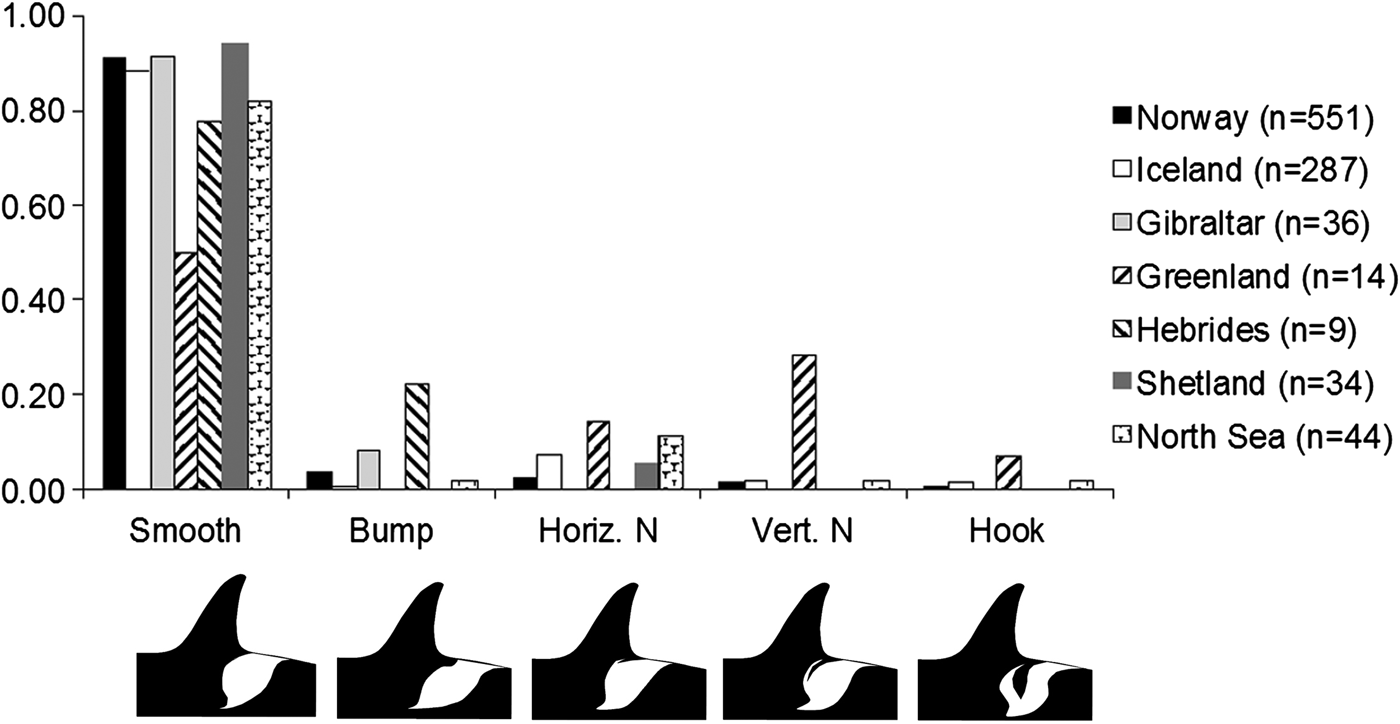
Photo-identification images of killer whale saddle patches and dorsal fins are mostly photographed from their left sides for identification following the method of Bigg (Reference Bigg1982). This is a standard method in locations such as Norway and Iceland, where individuals are encountered on a predictable basis. Smaller populations and killer whale groups that are encountered randomly and opportunistically are photographed on either side. We preferentially used left side photographs of dorsal fin and saddle patches when available. Only one side of each individual was included in this study. Saddle patches were categorized by the lead author to one of five pre-defined shape variants based on the categories of Baird & Stacey (Reference Baird and Stacey1988; see Figure 2).
Chart showing the proportional occurrence of different saddle patch types in North Atlantic killer whale populations. Variants of saddle patch patterns are as defined by Baird & Stacey (Reference Baird and Stacey1988): 1. smooth (no black pattern on saddle patch); 2. bump (close to dorsal fin's rear base a bump or angle); 3. horizontal notch (black notch horizontally, often small); 4. vertical notch (larger than horizontal notch, and direction downward); 5. hook (large black pattern on saddle).
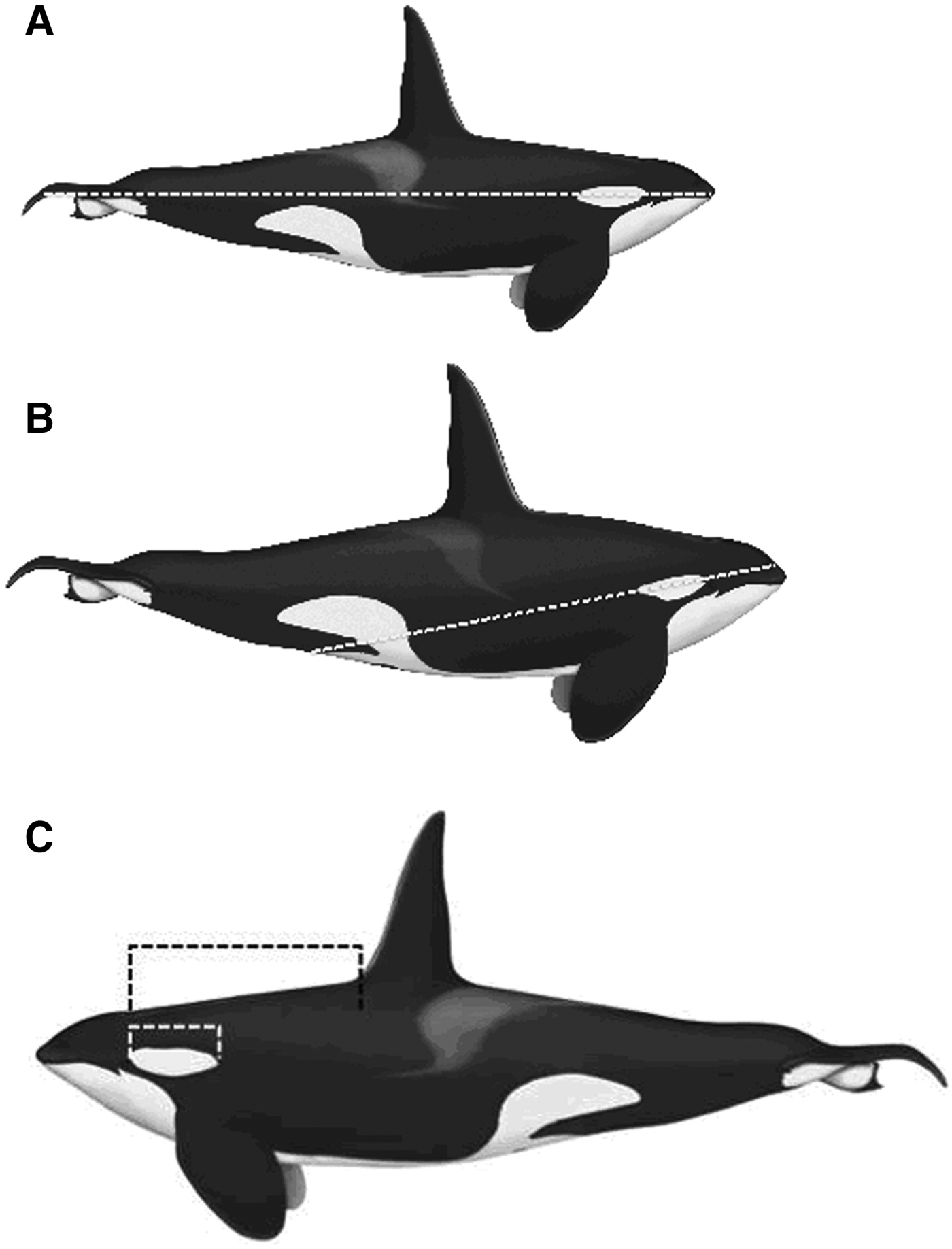
Eye patch orientation was categorized as ‘parallel’ or ‘sloping’ based on the categories of Visser & Mäkeläinen (Reference Visser and Mäkeläinen2000; see Figure 3). Eye patch size was measured as the length of the long axis of the eye patch. Since the eye patch size depends on individual size, the distance between the blow-hole to the base of the dorsal fin was used as a proxy for individual size, and used as a covariate in analysis of covariance.
Orientation of eye patch (after Evans et al., Reference Evans, Yablokov and Bowles1982; Visser & Mäkeläinen Reference Visser and Mäkeläinen2000). (A) ‘parallel’ orientation; (B) ‘sloping’ orientation; (C) measures used to compare the blowhole-to-dorsal fin/eye patch ratio. Illustrations by Lucy Molleson.
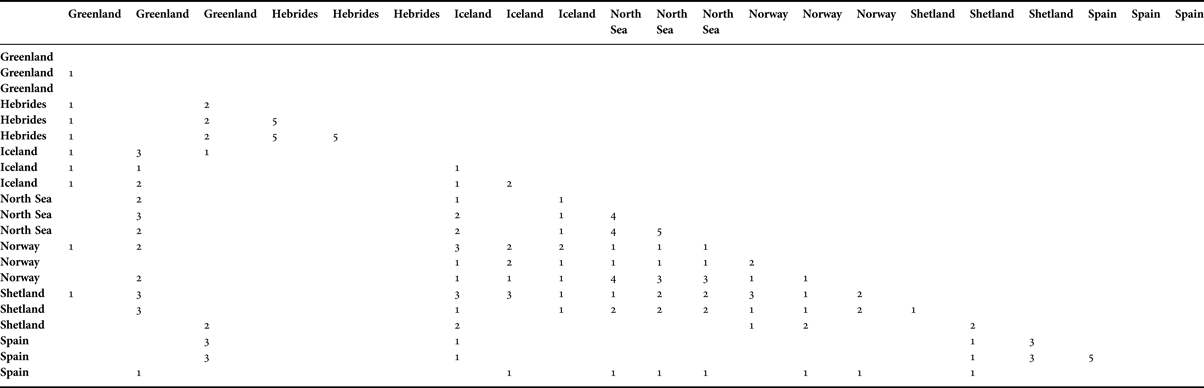
Eye patch photographs were taken from both sides and opportunistically from each geographical area. Different shapes of eye patches from each area were observed (see Supplementary Material). In order to test whether the eye patch shape can be used to distinguish between original locations of whales, eye patches were studied qualitatively. Three eye patch photographs from each area were chosen randomly. Five persons, one experienced and four inexperienced in classifying eye patches, compared the same eye patch photographs and grouped similar ones together. These five persons did not know the origin of the whales. Each of the test persons evaluated the similarity between the images, giving a value of 1 if the patches resembled each other, and 0 if not. Five-person test results are summed up in Table 1.
Qualitative comparison of the eye patches from seven North Atlantic areas. Three randomly chosen eye patch photographs from each area were compared by five test persons. Each person evaluated the similarity between images giving a value of 1 if the samples resembled each other (0, no resemblance). The most similar individuals scored 5 points, and smaller numbers in the table are less-resembled individuals.
RESULTS
Saddle patch shape was categorized for 975 individually identified whales, where left side photographs were available from 923 and right side from 52 individuals. The smooth variant of saddle patch was by far the most common pattern in killer whales from all locations included in this study (Figure 2). Killer whales from Greenland had the most varied saddle patches, with four different saddle types (Figure 2). However, the sample size of Greenland killer whales was very small, only 14 individuals. These individuals were encountered in three different groups over a wide geographical area that may not represent a single population. Therefore, we did not test for the statistical significance of this result.
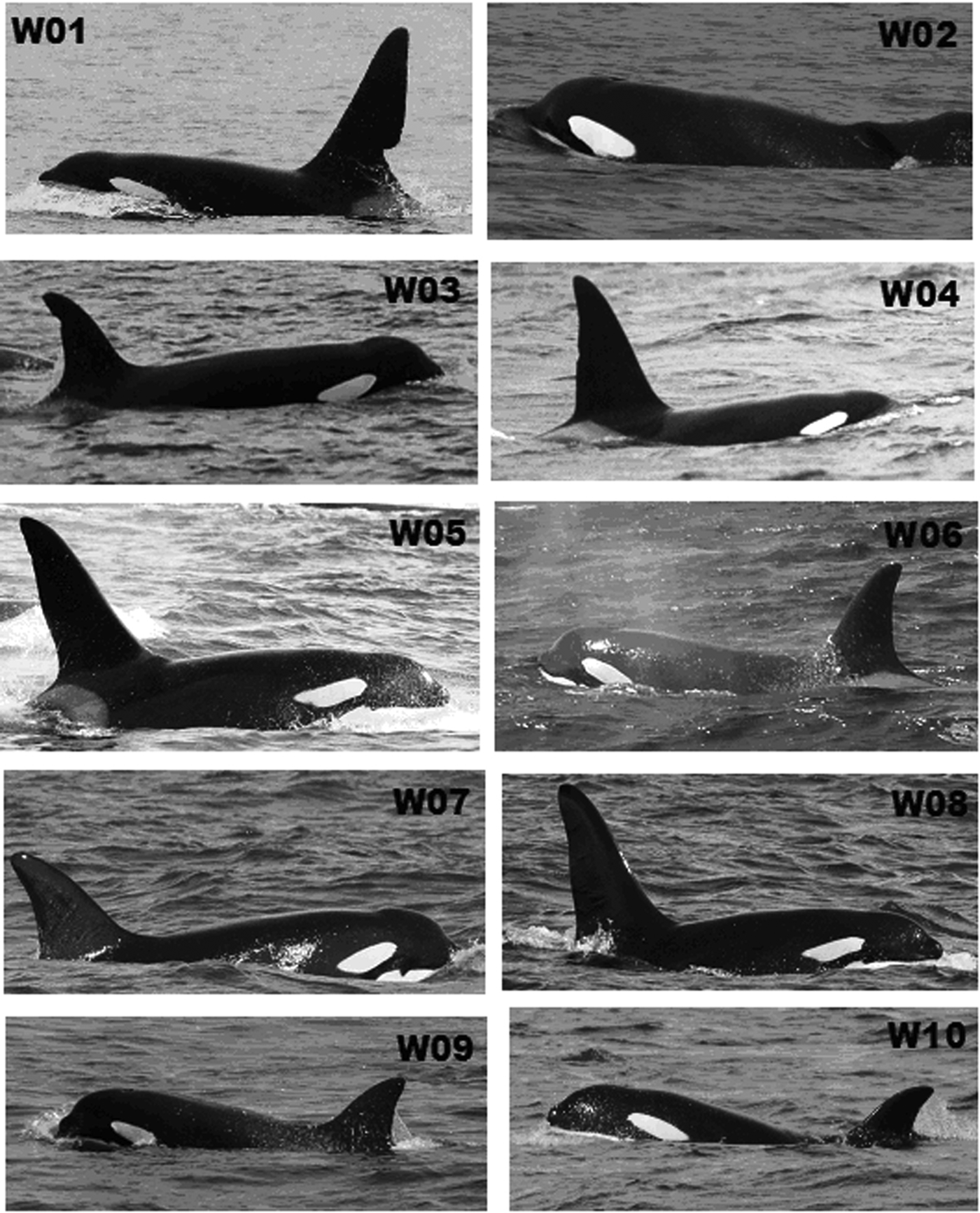
All those North Atlantic individuals, whose eye patches were photographed had parallel oriented eye patches (see Figure 3), except the community of 10 individuals photographed in the Hebrides (Figure 4). All the individuals in this small group of killer whales have ‘sloping’ eye patches, as previously reported (Foote et al., Reference Foote, Newton, Piertney, Willerslev and Gilbert2009; Foote, Reference Foote2011). However, they differ from previously described sloping eye patches from other regions, for example as seen in the type C killer whales found in Antarctic waters (Pitman & Ensor, Reference Pitman and Ensor2003), as they are posteriorly sloping.
Eye patches of the ten individuals photographed off the west coast of Scotland. The sloping eye patch was fixed in this population and was distinct from the eye patches of neighbouring populations.
We analysed eye patch size between populations using individual size and sex as covariates (see Packard & Boardman (Reference Packard and Boardman1988) for the use of ANCOVA in size-related traits). We used the distance from the blow hole to the base of the dorsal fin as a proxy for individual size. As expected, there was a strong effect of body size on eye patch size (F = 270.6, df = 1, 107). However, neither sex (F = 0.7, df = 1, 107) nor population (F = 1.8, df = 5, 107) affected eye patch size. The total model explained 82% of the variation in eye patch size.
In the qualitative comparison of the eye patches, five persons compared the eye patches from three individuals from each of the seven areas (Greenland, Norway, Iceland, North Sea, Shetland, Hebrides and Spain) without knowing the origin. The Hebridean killer whales were always grouped together by all observers. There was more variation in the grouping of the other whales (Table 1), as eye patch shapes, such as ‘narrow front’ and ‘hooked’ were found in all of these North Atlantic populations. Therefore, the eye patch shape of killer whales occupying North Atlantic waters was considered a non-suitable feature to characterize whales from different populations/locations, with the exception of the Hebridean group.
DISCUSSION
There was relatively little variation in saddle patch pigmentation among North Atlantic killer whales, based on the categories used in this study. The smooth saddle patch type is the most common in the North Atlantic killer whales. In the north-east Pacific, over 90% of marine mammal-eating ‘transient’ killer whales were also found to have smooth saddle patches, while the fish-eating ‘resident’ killer whales have a greater variety of patch types (Baird & Stacey, Reference Baird and Stacey1988).
Among North Atlantic killer whales there was some variation in relative eye patch size and orientation. The individuals belonging to the small population or community of killer whales photographed around the Hebridean Islands off the west coast of Scotland were the most differentiated, and this was based mainly on eye patch orientation, as previously reported (Foote, Reference Foote2011). This kind of posterior sloping orientation has not been described as being fixed in any other known population in the southern or northern hemispheres so far (Evans et al., Reference Evans, Yablokov and Bowles1982; Baird & Stacey, Reference Baird and Stacey1988; Visser & Mäkeläinen, Reference Visser and Mäkeläinen2000; Pitman & Ensor, Reference Pitman and Ensor2003; Pitman et al., Reference Pitman, Durban, Greenfelder, Guinet, Jorgensen, Olson, Plana, Tixier and Towers2011).
Given that many of the mitochondrial DNA lineages in the north-east Atlantic belong to two closely related clades (Foote et al., Reference Foote, Vilstrup, de Stephanis, Verborgh, Abel Nielsen, Deaville, Kleivane, Martin, Miller, Øien, Perez-Gil, Rasmussen, Reid, Robertson, Rogan, Similä, Tejedor, Vester, Vikingsson, Willerslev, Gilbert and Piertney2011), the low variation in saddle patch and eye patch pigmentation among most individuals compared in this study may reflect their recent common ancestry. Killer whales would most likely have colonized the waters north of the Iberian Peninsula following the retreat of the sea ice after the last glacial maximum approximately 12–18 thousand years ago (Hewitt, Reference Hewitt2000). Diversification to their respective ecological niches could have occurred before or after this colonization. Whilst there has been sufficient temporal–spatial separation for discrete gene pools to form (Foote et al., Reference Foote, Vilstrup, de Stephanis, Verborgh, Abel Nielsen, Deaville, Kleivane, Martin, Miller, Øien, Perez-Gil, Rasmussen, Reid, Robertson, Rogan, Similä, Tejedor, Vester, Vikingsson, Willerslev, Gilbert and Piertney2011), the relatively high abundance of north-east Atlantic killer whales that follow the herring and mackerel stocks (Kuningas et al., Reference Kuningas, Similä and Hammond2013) would reduce the influence of drift on phenotypic traits such as pigmentation patterns and therefore reduce the rate of divergence between large populations (see Barton & Charlesworth, Reference Barton and Charlesworth1984; Barton, Reference Barton1996). At least two of the populations included in this study, the Gibraltar and Hebridean populations, are critically small (Esteban, Reference Esteban-Pavo2008; Beck et al., Reference Beck, Kötter, Foote, Harries, Mandleberg, Stevick, Whooley and Durban2013) and may, therefore, be influenced to a greater extent by genetic drift. These two populations also exhibited the greatest differences in eye patch size from the other north-east Atlantic killer whales. However, other processes may contribute to the more exaggerated and fixed differences in the Hebridean whales.
Just as the similarity in pigmentation patterns among most north-east Atlantic killer whales may reflect common ancestry, the differences between the Hebridean killer whales and the other north-east Atlantic killer whales may reflect phylogenetic distance. Foote et al. (Reference Foote2011; unpublished data) found that the complete mitochondrial genome sequence of two killer whales that stranded on the west coast of Scotland and the Outer Hebrides in 2008 and 2005 clustered with the Antarctic (type A) killer whales and were highly divergent from most other North Atlantic killer whale lineages. Biopsy sampling of the Hebridean killer whales is needed to confirm that they are descended from this lineage and further investigate this hypothesis. However, the orientation of the eye patch of the Hebridean killer whales is also distinct from published descriptions of Antarctic type A killer whales (Pitman & Ensor, Reference Pitman and Ensor2003).
Given that this eye patch shape is not fixed in any other populations and has, therefore, not arisen in parallel, suggests that natural selection is unlikely to be a driver of the evolution of fixation of this eye patch shape in this population. A more parsimonious process would be that if this small Hebridean population has remained reproductively isolated from neighbouring killer whale populations, then this would result in the fixation of pigmentation traits within the population, and in differentiation from neighbouring populations, which would become more accentuated over time due to drift.
ACKNOWLEDGEMENTS
We would like to thank the anonymous referees for their helpful comments and Sara Tavares, Annemieke Podt and Timothy Carden for the patch work.
SUPPLEMENTARY MATERIALS AND METHODS
The supplementary material referred to in this article can be found online at journals.cambridge.org/mbi.