

Introduction
Livestock production faces specific challenges as a result of a rise in human population numbers, urbanization and economic development, especially in developing countries. In the future these developments will lead to a significant rise in demand for livestock products, and they are referred to as the Livestock Revolution (Delgado et al., Reference Delgado, Rosegrant, Steinfeld, Ehui and Courbois1999). The number of meat animals globally will have to increase to meet this demand (Steinfeld et al., Reference Steinfeld, Gerber, Wassenaar, Castel, Rosales and de Haan2006). However, a significant increase in production levels is also crucial.
There is growing evidence that improving the productivity of subsistence, smallholder and emerging farmers operating on a noncommercial level has the potential to address poverty in agriculturally based economies (Hazell et al., Reference Hazell, Poulton, Wiggins and Dorward2007), while the more commercialized (industrialized) production systems remain in balance with the natural environment (International Water Management Institute, 2007; United Nations Environment Programme, 2007).
There are significant differences between the cattle of the African continent and the New World countries of the Americas, Australia and New Zealand. Livestock was not endemic to these continents, and livestock farmers had to rely entirely on imported material to establish herds of cattle. In contrast, Africa is one of the centres of domestication (Bruford, Bradley and Luikart, Reference Bruford, Bradley and Luikart2003; Hanotte et al., Reference Hanotte, Bradley, Ochieng, Hill and Rege2002) and is richly endowed with a large number of indigenous breeds that have adapted to the continent's prevailing conditions (Scholtz, Reference Scholtz1988, Reference Scholtz2005).
The type of production strategy to be followed in Africa will depend primarily on the environment and level of management. Experimental evidence of the fertility of cross-bred cows as summarized by Long (Reference Long1980) and Schoeman (Reference Schoeman, Scholtz, Bergh and Bosman1999) indicated that, with a few exceptions, the fertility and calf viability of cross-bred cows was higher than that of the parent breeds. However, this was not the case in East and southern Africa under normal production conditions (Scholtz, Reference Scholtz1988). According to Doren et al. (Reference Doren, Shumway, Kothmann and Cartwright1985), Ferrell and Jenkins (Reference Ferrell and Jenkins1985), Thompson, Woods and Meadows (Reference Thompson, Woods and Meadows1986) and Calegare et al. (Reference Calegare, Alencar, Packer and Lanna2007), a high level of nutrition and management is required before the potentially higher fertility of cross-bred cows can be utilized. With the relatively low level of nutrition and management that prevails in many parts of Africa, it seems fruitless to try to improve maternal performance by cross-breeding.
In the more developed areas where managerial skills may be better but conditions are often harsh with relatively low levels of natural nutrition, terminal cross-breeding (all cross-bred progeny are slaughtered) with small indigenous cows may succeed in improving the output of beef cattle farming (Calegare et al., Reference Calegare, Alencar, Packer and Lanna2007). A large proportion of the breeding herd must be available for cross-breeding for such a system of terminal cross-breeding to be successful. There is also the danger that some of the cross-bred females may leak and be used for indiscriminate crossing. With a reproductive life span of 16 years for cows and an average calving of 90 percent, which is possible with Nguni cattle, two-thirds of the herd can be utilized for terminal cross-breeding whereas one-third has to be reserved for maintaining the purebred population (Roux, Reference Roux1992). Another issue of concern is the possible incidence of calving difficulties.
Research conducted some years ago in South Africa will be used in this article to demonstrate the performance of two indigenous breeds of South Africa as dam lines in terminal cross-breeding: the Nguni and Afrikaner.
Material and methods
The research on the Nguni was conducted over a 3-year period (1988–1990) and was partially reported by Scholtz and Lombard (Reference Scholtz and Lombard1992). In this experiment Nguni females, the smallest beef breed in South Africa, were inseminated with Charolais and Simmentaler semen, and the Nguni (N) were also mated to a Chianina (Ch) type bull. Semen from the same Charolais (C) and Simmentaler (S) bulls was used to produce both the cross-bred and purebred offspring. It is important to note that heifers were not used for cross-breeding. The bulls were chosen because they were known to cause calving difficulties, and the S bull was withdrawn from an artificial insemination station for this reason. The cross-breds were compared to purebreds sired by the same bull and to purebred Ngunis from the same herd. This research was conducted on the farm Loskop South (25°18′ south, 29°20′ east) situated in a Bushveld Region in the eastern part of South Africa. Acocks (1975) classified the veld type as a tree savannah consisting of fairly dense bush with sour grass types as the main grazing component. Rainfall varies between 350 and 650 mm per year.
A number of the male progeny were also evaluated for postweaning growth rate and feed conversion ratio (FCR) under intensive feedlot conditions in a test that consisted of a 35-day adaptation period followed by a 140-day test.
The research on the Afrikaner (A) as a dam line was carried out at the Vaalhartz Research Station from 1980 to 1984. Els (Reference Els1988) presented this information in his Ph.D. thesis, but it was never published elsewhere. The purpose of the research was to evaluate the performance of cross-breeding under natural grazing conditions in the northern Cape region of South Africa. Four sire breeds were used in cross-breeding with the Afrikaner as the dam line: the Brahman (B), Charolais (C), Hereford (H) and Simmentaler (S). Vaalhartz is near the town of Jan Kempdorp in the Northern Cape Province and is situated at 27°51′ south, 24°50′ east with a mixed Tarchonanthus thornveld type (Acocks, 1988). The annual rainfall is 440 m per year. Vaalhartz can be regarded as a more suitable area for cattle farming than Loskop South.
In all cases the weaning weights were corrected to 205 days with the formula used by the South African National Beef Cattle Recording and Improvement Scheme (Bergh, Reference Bergh, Scholtz, Bergh and Bosman1999):

where the correction factor = corrected 205-day weaning weight.
Both studies utilized Harvey's (Reference Harvey1972, Reference Harvey1976) computer program for the analyses.
Results
Foetal dystocia and preweaning deaths
No calving difficulties or perinatal deaths occurred in 29 C × N, 17 S × N and 17 Ch × N cross-bred calves or in 301 comparable purebred Nguni calves. Although the S bull had been withdrawn from an artificial insemination station because of calving difficulties, none were experienced in this experiment. If a 10 percent chance of dystocia or death exists, the probability of observing one or more cases in a sample of 63 would be 100 × (1 – 0.963) = 99.9 percent. If a 5 percent chance exists, the probability would be 100 × (1 – 0.9563) = 96.1 percent. With only a moderate change of dystocia there would have been a very high chance of observing it in 63 births. Therefore, it seems that dystocia will be negligible if the Nguni is used as a dam line.
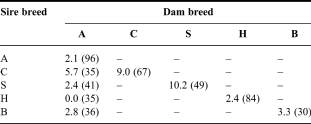
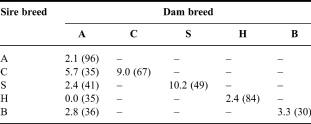
The percentage of dystocia observed in pure breeds and crosses at Vaalhartz is summarized in Table 1. A slightly higher percentage of dystocia was found in A cows when C, S or B bulls were used compared to A bulls. There was no dystocia when H bulls were used. In purebred C and S the percentage dystocia was higher than when these breeds were crossed with A cows. Thus, although calving difficulties were experienced with A as a dam line, they were limited and were lower than that of the purebred C and S.
The percentage of dystocia in pure breeds and crosses (number of births) Vaalharts data.
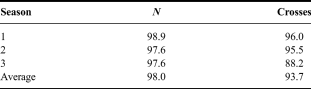
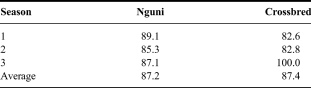
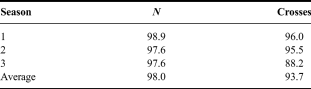
The percentages of survival from birth to weaning of the N and its crosses are presented in Table 2. Although the percentage of preweaning deaths in the crosses was slightly higher (4 percent) than the N, the difference was not significant at the 10 percent level.
The percentage of survival from birth to weaning of the Nguni and its crosses.
Preweaning performance
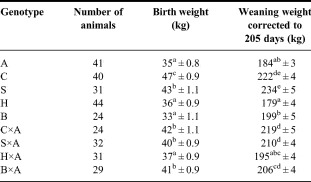
The preweaning performance values of the different breeds and crosses are provided in Table 3 and Table 4. The N calves had an average birth weight of 26.8 kg and the C × N calves 32.2 kg, but the pure C calves from the same sire had an average birth weight of 46.8 kg. The Nguni cows restricted the birth weight of the cross-bred calves to a level of 13 percent below the mid-parent value of 36.8 kg. In the Ch × N calves the average birth weights were almost the same as that of the pure N and significantly lower than the 34.0 kg average of the pure Ch. The average birth weight of S × N calves was also restricted to only 31.3 kg. These results indicate that maternal restriction of offspring birth sizes may be evident if the differences between sire and dam lines are large enough.
The preweaning performance of the different breeds and crosses at Loskop South.

Note: Means in the same column with different superscripts differ significantly (p < 0.10).
The preweaning performance of the different breeds and crosses at Vaalharts.

Note: Means in the same row with different superscripts differ significantly (p < 0.10).
The average birth weight of C × N was 13 percent below the mid-parent value, but the average weaning weight (Table 3) was 6 percent above and the preweaning growth rate 12 percent above the mid-parent value. In the Ch × N the average weaning weight was 12 percent above and the average preweaning growth rate was 16 percent above the respective mid-parent values. The average weaning weight of all crosses was approximately the same and was even higher than that of pure Ch (Table 3). An almost complete favourable dominance, and even over dominance, in the weaning weight of crosses is evident from these results.
The preweaning performance of the purebred breeds and the A crosses at Vaalhartz is presented in Table 4. The birth weight of C × A (42 kg) and S × A (40 kg) calves was restricted only to the mid-parent value. It appears that A cows, which are larger than N cows, did not restrict the birth weight of the C and S cross-bred calves to the same extent as N cows. In the H × A and especially B × A calves, the birth the weight was higher than that of both parent breeds, indicating over dominance.
The weaning weights of C × A (5 percent), H × A (7 percent) and B × A (7 percent) calves were higher than the mid-parent values of 203, 182 and 192 kg, respectively, whereas that of S × A only approximated the mid-parent value of 209 kg. The C × A calves were the heaviest at weaning (219 kg), followed by the S × A (210 kg) and B × A (206 kg).
The results at Loskop South and Vaalhartz suggest that A cows did not yield the same heterotic effect (negative on birth weight, and positive on weaning weight) as N cows. Furthermore, the C sire line seemed to yield more favourable heterotic effects than S, H or B sire lines when mated with A cows.
Postweaning feedlot performance
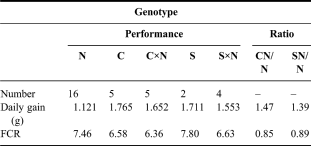
The postweaning feedlot performance of a limited number of N, C, S and their crosses produced at Loskop South is provided in Table 5. The table indicates that the daily gain of C × N calves was 47 percent higher and that of S × N 39 percent higher than that of pure N. The growth rate of C × N calves is only about 6 percent lower than that of purebred C, indicating an almost complete dominance. This agrees with the well-documented results of Olentine et al. (Reference Olentine, Bradley, Boling and Moody1976), Smith et al. (Reference Smith, Laster, Cundiff and Gregoryl976), Southgate, Cook and Kempster (Reference Southgate, Cook and Kempster1982), Baker, Bryson and Knutson (Reference Baker, Bryson and Knutson1987) and De Bruyn (Reference De Bruyn1991). All of these results indicate that the C is superior when utilized as a terminal sire in cross-breeding.
Postweaning feedlot performance of Nguni, Charolais, Simmentaler and Nguni crosses.
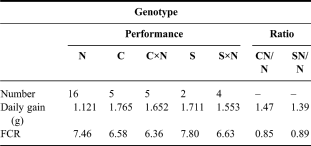
Note: FCR, Feed conversion ratio (feed intake/weight gain).
The FCR of C × N calves was better by 3 and 17 percent than that of purebred C and N, respectively, indicating over dominance. The same applied to S × N calves, where the FCR was 18 percent better than that of the purebred S and 11 percent better than that of the purebred N (Table 5), showing that the FCR may be improved when indigenous Sanga cattle are crossed with large European Taurus breeds.
Cow performance
There was no additional drain on cows producing cross-bred offspring because there was no difference in the weight change during the suckling period between N cows that suckled pure N or cross-bred calves. The N is a relatively high milk producer (7 kg/day) with a high butterfat content (6 percent). Together with the better efficiency of the cross-bred calves, larger weaner calves could be produced without any negative effect on the cow. This is also illustrated by the reconception rates (pregnancy percentage after the mating season) in Table 6, where there was no difference between cows that suckled pure N and cross-bred calves.
Reconception rates of Nguni cows that suckled pure Nguni and cross-bred calves.
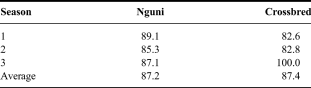
Note: The Reconception rate is defined as the pregnancy percentage after the next mating season.
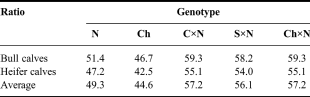
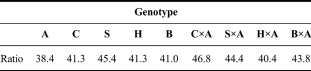
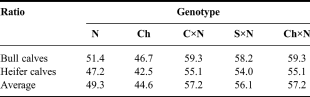
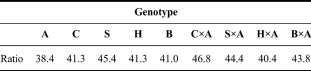
The ratio of the weaning weight of the calf to the dam weight at the birth of the calf (calf/dam) is an important estimate of productivity of the cow herd. It was calculated for Nguni cows (Loskop South) weaning pure N calves and cross-breds (Table 7) and for the Afrikaner cows (Vaalharts) weaning pure A calves and cross-breds (Table 8).
The ratio of the weaning weight of the calf/dam weight (birth of calf) of Nguni cows at Loskop.
The ratio of the weaning weight of the calf/dam weight (birth of calf) of the different breeds and crosses at Vaalharts.
On average the ratio was 56.8 percent for cross-bred calves compared to 49.3 percent for pure N calves. The values of C × N and Ch × N calves were the highest at 57.2 percent with male calves approaching 60 percent (Table 7). In comparison, the national average for beef cattle in South Africa is 43.8 percent.
In the A cows the highest weaning ratio of 46.8 was achieved with C × A calves, followed by S × A (44.4) and B × A (43.8), compared to the 38.4 of pure A calves (Table 8).
Discussion
These results supply evidence that maternal restriction of birth weight exists in crosses between animals of widely divergent mature weights and that some breeds may possess this ability as a special trait.
Despite the negative suppression on birth weight, the weaning weight and growth rate of the different crosses was close to that of the larger parent, especially in the Nguni crosses, indicating an almost complete dominance in postnatal growth and efficiency traits. The negative maternal effect on body weight at birth attributable to the smaller cows does not seem to persist up to postweaning performance but is to a large extent cancelled, especially with C as the sire line.
The advantages of terminal cross-breeding do not lie in the higher growth rates or better FCR of the cross-bred progeny per se. They instead depend on the extent to which the weight of the slaughter animal or feeder can be increased relative to that of the dam or breeding cow. This advantage follows because any system with large feeders from small breeding cows must be more efficient than one with feeders and breeders of equivalent size, simply because small dams eat less than large dams. This higher efficiency arises from a potential increase in weaning weight of up to 26 percent per cow exposed to mating, whereas the feed energy requirement only increases by 1 percent (MacNeil, Reference MacNeil2005; MacNeil and Matjuda, Reference MacNeil and Matjuda2007; MacNeil and Newman, Reference MacNeil and Newman1991). In addition and of particular importance to the countries of Sub-Saharan Africa is the use of locally adapted, low input maternal breeds and the improvement of the production potential of the progeny using terminal sire breeds (Scholtz et al., 1990). However, such a system will only be viable in Sub-Saharan Africa if the natural environment can support the higher production, the managerial demands can be met and other indigenous breeds react the same to cross-breeding as the Afrikaner and Nguni.
There is little advantage in the higher rate of growth per se, but the longer feedlot holding period of late maturing, fast growing animals will optimize a positive feed margin (low feed prices that makes it economical to feed animals longer). Thus, the highest profit margin for intensive feeding of slaughter cattle under such a scenario will most likely be realized with Charolais or other late-maturing crosses. This situation will be reversed if a positive feed margin changed to a negative margin (high feed prices), in which case earlier maturing, smaller framed, exotic breeds such as Angus should be used as sire lines. The advantage of terminal cross-breeding is the ease of catering for the prevailing feed margin by manipulating the type of sire to be used while keeping the dam herd the same. This is in contrast to pure or rotational cross-breeding where the breed type of the dam has to be changed each time there is a change in the feed margin.
Conclusion
Indigenous African breeds, such as the Nguni and the Afrikaner, seem to be ideally suited as dam lines in terminal cross-breeding, because calving difficulties are limited and the feedlot performance of the F1-crosses is highly desirable. The utilization of terminal cross-breeding involving indigenous breeds deserves more attention as a means of increasing output for beef cattle enterprises, especially in the subtropics and tropics of Africa. However, the sustainable implementation of such a system remains a challenge.
The first option is that smallholder farmers can act as a source of purebred indigenous animals for the more commercialized (industrialized) farmers, thereby ensuring a constant and viable market for their animals. This will result in benefit sharing by the communities that maintained these breeds in the past. Another option is to use the innovative mating system reported by Scholtz (Reference Scholtz2007). It is well known that the most fertile cows tend to come in heat early in the mating season. This system suggests that all cows are straight bred to indigenous bulls during the first part of the mating season, after which the indigenous bulls are all replaced by terminal sire bulls. The first calves to be born are thus purebred calves from the most fertile cows, and replacement heifers are selected from these calves. This system is currently being evaluated at Vaalharts Research Station with Angus as the sire line and Nguni as the dam line.
The biggest threat to the system is that farmers may start to use some of the cross-bred females as replacement heifers. In such cases, the advantages of terminal cross-breeding associated with heterosis, adaptability, hardiness, low maintenance and ease of calving are lost. With respect to the conservation of animal genetic resources, this is unacceptable because it may result in indiscriminate crossing to the detriment of indigenous genetic resources.
Perhaps the most important advantage of any system of terminal cross-breeding utilizing indigenous breeds is that the conservation and utilization of the indigenous breeds of Africa is ensured, because it requires a constant steam of purebred indigenous females.