Introduction
Few control options are available to manage phloem-feeding bark beetle population outbreaks across large spatial scales, which creates challenges for managers concerned with maintaining forest productivity. Accordingly, there has been an extensive body of research focusing on the role of tree vigour and tree defence in resistance to bark beetle colonisation (e.g., Raffa and Berryman Reference Raffa and Berryman1983; Christiansen et al. Reference Christiansen, Waring and Berryman1987; Raffa and Smalley Reference Raffa and Smalley1995), and it is generally presumed that elements of forest structure and composition can be appropriately managed to alter resistance of forest stands (Fettig et al. Reference Fettig, Klepzig, Billings, Munson, Nebeker, Negrón and Nowak2007; Wallin et al. Reference Wallin, Kolb, Skov and Wagner2008). Constitutive secondary chemistry is a key component of tree defence and is often defined as the preformed chemical structures that play generalised roles in repelling invading organisms (Lieutier Reference Lieutier, Lieutier, Day, Battisti, Grégoire and Evans2002; Franceschi et al. Reference Franceschi, Krokene, Christiansen and Krekling2005); to this end, many coniferous species exhibit variation in the secondary metabolites of their resin exudates and phloem tissues (Phillips and Croteau Reference Phillips and Croteau1999; Smith Reference Smith2000). This variation may have consequences for bark beetle survival and reproduction (e.g., Smith Reference Smith1963; Chiu et al. Reference Chiu, Keeling and Bohlmann2017). One of the most abundant classes of secondary metabolites in resin and phloem are monoterpenes, and exposure to monoterpenes is presumed to be one of the first lines of defence for many coniferous species attacked by bark beetles (Seybold et al. Reference Seybold, Huber, Lee, Graves and Bohlmann2006).
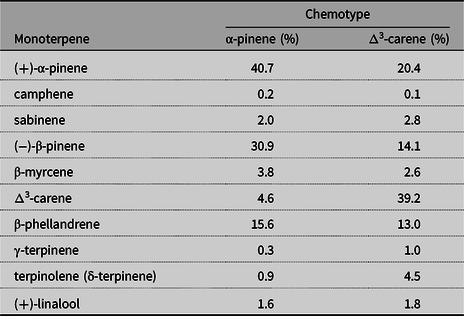
The spruce beetle, Dendroctonus rufipennis Kirby (Coleoptera: Scolytinae), is a primary agent of biological disturbance in the montane forests of the southern Rocky Mountains (and throughout western North America); approximately 81 000 ha were reported as actively infested in Colorado alone in 2017, and considerable tree mortality has occurred as a result of high-density beetle populations in the region during the past two decades (Rocca and Romme Reference Rocca and Romme2009; Jenkins et al. Reference Jenkins, Hebertson and Munson2014; Colorado State Forest Service 2017). The primary host for spruce beetle in the contiguous United States of America is Engelmann spruce (Picea engelmannii Parry ex. Engelm.) (Pinaceae), which occupies a vast geographic area. Recently, variation in the constitutive phloem chemistry of Engelmann spruce across high-elevation populations in Colorado was characterised, and it was determined that two distinct chemotypes co-occurred in surveyed stands: in one chemotype, the monoterpene fraction is composed primarily of α-pinene; in the other, the primary monoterpene is Δ3-carene (Davis et al. Reference Davis, Horne, Yetter and Stewart2018; Table 1). Although previous tests showed that variation in phloem chemistry had significant effects on the symbiotic fungus (Leptographium abietinum (Peck) M.J. Wingf. (Ophiostomataceae)) associated with spruce beetle, it remains undetermined whether chemotype variability has direct effects on spruce beetle survival during the process of host-tree colonisation. In other Dendroctonus species, it is well known that tree-to-tree or species-to-species variability in conifer phloem chemistry has important effects on both the survival and fitness of beetles exposed to different combinations of fumigants (Smith Reference Smith1964; Manning and Reid Reference Manning and Reid2013; Reid et al. Reference Reid, Sekhon and LaFramboise2017).
The mean relative composition (per cent) of 10 monoterpenes comprising two identified Engelmann spruce phloem chemotypes. (Data are summarised from Davis et al. Reference Davis, Horne, Yetter and Stewart2018).

Here, the hypothesis that these two distinct phloem chemotypes differ in their toxicity to spruce beetle is tested. Using laboratory assays to determine a range of lethal concentrations, the toxicity of synthetic blends of monoterpenes representative of each phloem chemotype was evaluated. Spruce beetles actively orienting to pheromones in the field were collected and used for monoterpene toxicity tests. Spruce beetles were live trapped in June 2018 by deploying ten 12-unit multi-funnel traps (Lindgren Reference Lindgren1983) across an actively infested forest site (Monarch Pass, Colorado, United States of America; approximate coordinates: 38.501 N, 106.326 W; elevation: 3380 m). Traps were baited with a standard spruce beetle pheromone lure containing frontalin, 1-methylcyclohex-2-en-1-ol, and a proprietary blend of host-tree kairomones (Synergy Semiochemicals, Victoria, British Columbia, Canada). Collection cups were supplied with moist paper towels, and traps were collected within 48 h. Trap contents were collected into plastic bags, placed on ice, and immediately returned to the laboratory. Although this study did not control for the life history of test beetles (e.g., via rearing), beetles actively responding to pheromones are appropriate for testing monoterpene toxicity because these individuals must contend with tree defences when actively colonising new hosts in the field. In addition, previous studies found that up to 2.5% of the flying population may be represented by re-emerging adults (Hansen and Bentz Reference Hansen and Bentz2003), indicating that a large majority of trapped beetles are newly emerged adults at this time of year.
Before use in assays, beetles were first made to pass a simple fitness test, as described in Chiu et al. (Reference Chiu, Keeling and Bohlmann2017). Beetles deemed to be fit were weighed to the nearest 0.1 mg and placed into 20-mL scintillation phials containing a 1 × 1 cm filter paper at 23 °C in the dark. Monoterpene blends were mixed at the ratios shown in Table 1. The commercial source of the monoterpenes (and relative purity) was as follows: (+)-α-pinene (98%) (Sigma-Aldrich Corp., St Louis, Missouri, United States of America, Lot SHBH6338); camphene (95%) (Sigma-Aldrich Corp., Lot MKCF0227); sabinene (natural, 75%) (Sigma-Aldrich, Lot MKCB3706); (−)-β-pinene (99%) (Sigma-Aldrich Corp., Lot MKBX4513); β-myrcene (> 95%) (Sigma-Aldrich, Lot MKCB0205V); Δ3-carene (> 90%) (Sigma-Aldrich, Lot MKBZ9655V); β-phellandrene (96%) (BOC Sciences, Shirley, New York, United States of America); γ-terpinene (> 95%) (Sigma-Aldrich, Lot MKCD9808); terpinolene (δ-terpinene) (> 90%) (Sigma-Aldrich, Lot MKCB5134); (+)-linalool (97%) (Sigma-Aldrich Corp., Lot STBG6050V). Immediately before placement of beetles into phials, monoterpene blends were added to filter papers at the following concentrations: 0 (control), 10, 50, 100, 200, and 500 µg/L; this corresponded to the addition of 1.5 µL acetone (control), 1.5 µL monoterpene blend diluted 1:5 in acetone, 1.5 µL monoterpene blend, 3.0 µL monoterpene blend, 6.0 µL monoterpene blend, and 15.0 µL monoterpene blend, respectively (Chiu et al. Reference Chiu, Keeling and Bohlmann2017). Each concentration × chemotype concentration was replicated 20 times (n = 240 for the entire experiment). After 24 h, phials were checked, and each beetle was scored as alive (1) or dead (0).
The effects of monoterpene concentration, chemotype, and their interaction were modelled on the response of probability of spruce beetle mortality using generalised linear regression (family = binomial) and a logit link function (R Core Team 2018). Logit functions were solved to determine the values for each chemotype that corresponded to the lethal monoterpene blend concentration (LC) for 25, 50, and 75% of the test population (i.e., LC25, LC50, and LC75). The effects of adult beetle body mass on the probability of mortality in each test were also analysed using a logit function, and statistical significance of logit models was assessed using a type I error rate of α = 0.05.
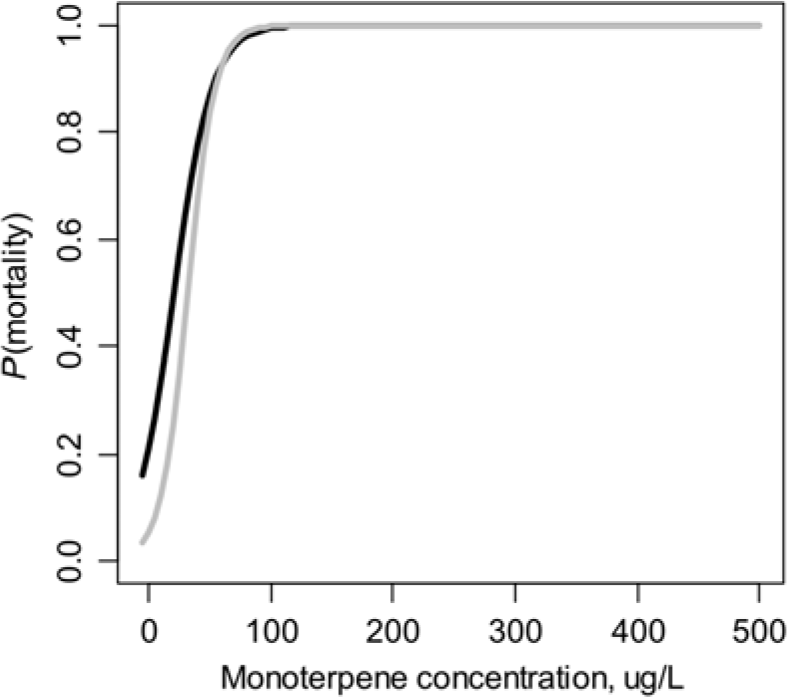
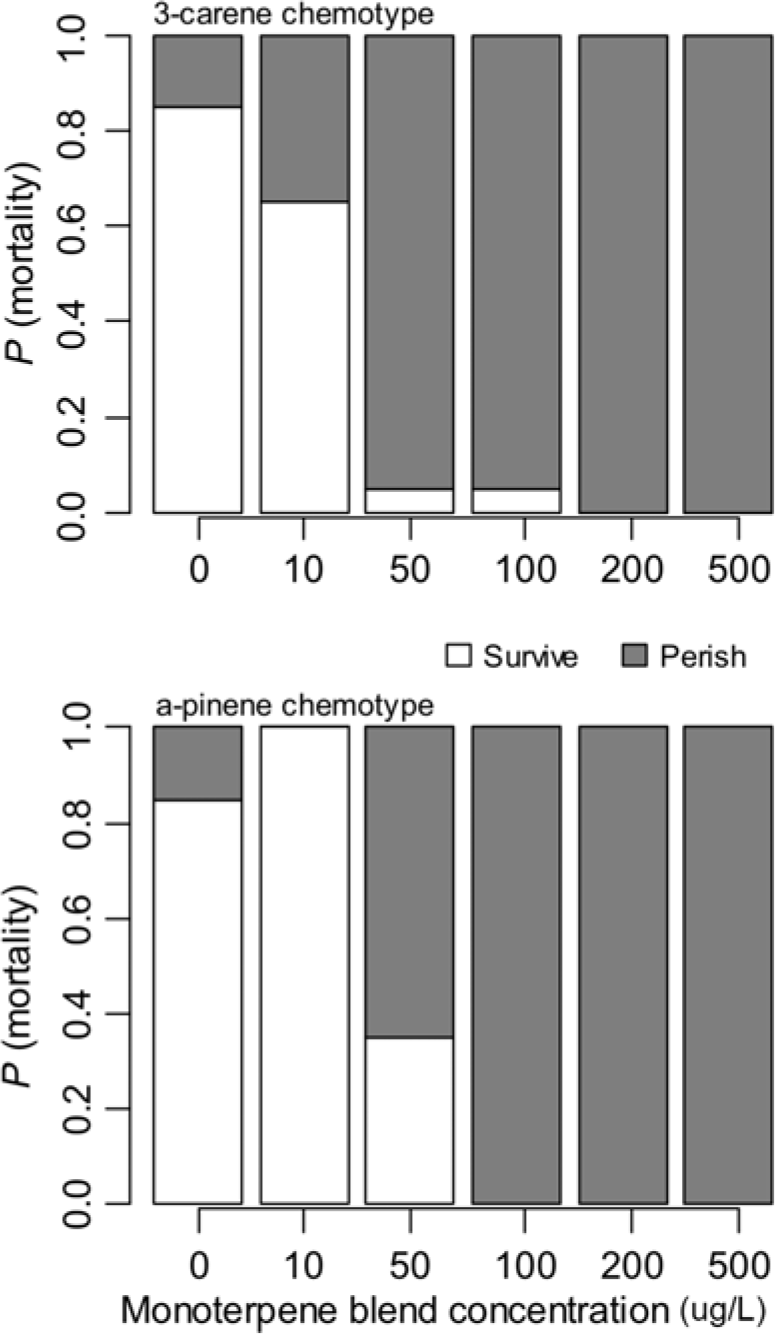
As the concentration of monoterpene blends increased, so too did the probability of spruce beetle mortality (Z = 4.326, P < 0.001), with complete mortality at concentrations ≥ 100 µg/L for both chemotypes. In addition, there was a significant difference between chemotype blends in terms of their effects on probability of beetle survival during the test period (Z = −2.038, P = 0.041), with the Δ3-carene blend exhibiting slightly lower LC25, LC50, and LC75 than the α-pinene blend did (Fig. 1). The LC25, LC50, and LC75 of the Δ3-carene blend were 4, 21, and 38 µg/L, respectively; the LC25, LC50, and LC75 of the α-pinene blend were 20, 32, and 45 µg/L, respectively (Fig. 1). There was no evidence that an interaction between monoterpene concentration and chemotype impacted proportion of spruce beetle survival (Z = 1.098, P = 0.272; Fig. 2). Body mass did not have a significant effect on the probability of spruce beetle survival when beetles were exposed to the Δ3-carene blend (Z = −1.290 P = 0.197) or the α-pinene blend (Z = −0.686, P = 0.493).
The effect of monoterpene chemotype blend concentration on probability of mortality of spruce beetle (Dendroctonus rufipennis). The black line represents the dose–response curve for the Δ3-carene chemotype, and the grey line represents the dose–response curve for the α-pinene chemotype.

Proportion of spruce beetle mortality relative to each tested monoterpene concentration and blend.

A variety of studies indicate that individual monoterpenes vary in their toxicity to bark beetles (e.g., Smith Reference Smith1963, Reference Smith1964; Cook and Hain Reference Cook and Hain1988; Chiu et al. Reference Chiu, Keeling and Bohlmann2017; Reid et al. Reference Reid, Sekhon and LaFramboise2017); however, in most cases, the phloem resources colonised by beetles under natural conditions are defended by complex blends of monoterpenes. Consequently, an understanding of the toxicity of monoterpene blends is likely to reflect beetle–host-tree interactions in the field and may be more realistic than tests investigating individual compounds.
The current study shows that the concentration of monoterpene blends representing two widespread Engelmann spruce phloem chemotypes is likely to impact the probability of spruce beetle survival during initial colonisation of host trees. Moreover, the two Engelmann spruce chemotypes tested here differed in their relative toxicity to beetles, indicating that tree chemical composition also impacts spruce beetle survival (Raffa and Smalley Reference Raffa and Smalley1995; Eidson et al. Reference Eidson, Mock and Bentz2017; Hammer et al. Reference Hammer, Bowser, Snyder, Synder, Archila and Snyder2020). However, this difference was small and eroded as monoterpene concentrations increased, and total mortality of beetles (100%) was observed over a 24-h period for both chemotypes when concentrations exceeded 100 µg/L.
Total monoterpene concentrations in Engelmann spruce range from 42 to 1796 µg/g of phloem tissue, with mean constitutive phloem monoterpene concentrations of ~400 µg/g phloem (Davis et al. Reference Davis, Horne, Yetter and Stewart2018) and no statistical difference in concentration between chemotypes. This would suggest that even the “average” tree should be lethal to attacking spruce beetles, but this is clearly not the case in the field. Accordingly, it seems probable that spruce beetles must exhaust or avoid these defences through mechanisms other than tolerance of monoterpenes (Roth et al. Reference Roth, Hussain, Cale and Erbilgin2018). In contrast, Chiu et al. (Reference Chiu, Keeling and Bohlmann2017) found in a nearly identical assay that the mountain pine beetle (Dendroctonus ponderosae Hopkins (Coleoptera: Curculionidae)) was, by comparison, highly tolerant of monoterpenes, and beetles were able to survive exposure to individual monoterpenes at concentrations in excess of 500 µg/L. One hypothesis that might explain spruce beetle colonisation success in the field is association with fungal symbionts, which may have the metabolic pathways necessary for detoxifying monoterpenes. Earlier studies indicate that the primary fungal symbiont of spruce beetle (Leptographium abietinum) is capable of metabolising at least some monoterpenes (Davis et al. Reference Davis, Stewart, Mann, Bradley and Hofstetter2019). In addition, in the toxicity assay reported here, beetles were prevented from avoiding exposure to monoterpene vapours, but active behavioural avoidance and repeated emergence during gallery construction and oviposition may also help beetles to limit toxic effects of exposure to monoterpenes.
Accordingly, a description of the interactions between spruce beetle behaviours, symbiont metabolic contributions, and spruce defensive induction responses in situ is needed to better understand how spruce beetle populations overcome Engelmann spruce defences (Six Reference Six2020). The ability of Engelmann spruce to mount an “induced” defensive reaction – which generally refers to de novo biosynthesis of defensive structures or chemicals following tissue damage (Franceschi et al. Reference Franceschi, Krokene, Christiansen and Krekling2005) – in response to beetle colonisation has not yet been tested, although the species commonly forms traumatic resin ducts in response to spruce beetle attack (DeRose et al. Reference DeRose, Bekker and Long2017), indicating a likely important role of upregulated monoterpene defences during the colonisation process. In addition, recent studies suggest that induction mechanisms may be under environmental control (Kolb et al. Reference Kolb, Keefover-Ring, Burr, Hofstetter, Gaylord and Raffa2019). In order to better understand tree resistance mechanisms in the Engelmann spruce–spruce beetle system, it would be useful for future work to focus on elucidating the magnitude of Engelmann spruce-induced responses following exposure to spruce beetle attack or inoculation with fungal symbionts, as well as the rate of decline in these defences following exposure, especially in the context of ongoing environmental stresses such as drought (Hart et al. Reference Hart, Veblen, Eisenhart, Jarvis and Kulakowski2014).
Acknowledgements
Andrew Mann assisted in the fieldwork for this project. This work was supported with internal funds from Colorado State University. The author is also grateful to the efforts of the anonymous referees for helping to improve the manuscript.