Heart failure in children results from various aetiologies including primary cardiomyopathy, rejection in cardiac transplant patients, myocarditis, and congenital heart disease. Ventricular assist devices are becoming a more common therapy as a bridge to recovery or transplant for patients with end-stage heart failure. Recent data suggest a 32% increase in the use of paediatric ventricular assist devices from 2003 to 2006.Reference Morales, Zafar and Rossano 1 The most common diagnosis in patients requiring ventricular assist device placement was cardiomyopathy followed by congenital heart disease and myocarditis. With a growing experience with ventricular assist device implementation, the use of ventricular assist devices will likely continue to increase.
Arrhythmias are known to be associated with advanced heart failure in adults.Reference Fong, Grazette, Cesario, Cao and Saxon 2 , Reference Maskin, Siskind and LeJemtel 3 Patients requiring ventricular assist device placement are at very high risk for both atrial and ventricular arrhythmias; however, little data exist regarding clinical tolerability and management strategies including the use of implantable cardiac defibrillators.Reference Boyle 4 – Reference Allen and Sidebotham 6 In adult patients with heart failure who were placed on a left ventricular assist device, a significant increase in the incidence of monomorphic ventricular tachycardia has been reported post placement.Reference Ziv, Dizon, Thosani, Naka, Magnano and Garan 7 In a separate study, over 266 months of total follow-up, sustained ventricular tachycardia or ventricular fibrillation occurred in 52% of patients supported with a HeartMate II.Reference Andersen, Videbaek, Boesgaard, Sander, Hansen and Gustafsson 8 Pre-ventricular assist device ventricular arrhythmia has been found to be predictive of post-ventricular assist device ventricular arrhythmia in adults with left ventricular assist devices, and in a study by Brenyo et al, 45% of mortality events occurred within 1 month of a post-ventricular assist device ventricular arrhythmia.Reference Brenyo, Rao and Koneru 9 , Reference Raasch, Jensen and Chang 10 Post-ventricular assist device ventricular arrhythmias have not been shown to have a significant impact on survival or transplantation.Reference Brenyo, Rao and Koneru 9 , Reference Raasch, Jensen and Chang 10
Even less data are available with respect to arrhythmias in the paediatric ventricular assist device population. We sought to quantify and qualify the nature of arrhythmias in children with heart failure before, during, and after ventricular assist device support. To our knowledge, this is the largest study of arrhythmias in children with ventricular assist devices to date.
Methods
Institutional review board approval was obtained for the project. The electronic medical record, including physician and nursing inpatient progress notes, interim summaries, and outpatient clinic notes for every patient who had a ventricular assist device placed at Texas Children’s Hospital (June of 1998 through August of 2011) were reviewed. Patients supported with Berlin Heart Excor devices were excluded from this study as they were part of a multi-centre FDA trial at the time of data collection. Patient demographics including gender, age, and weight at the time of device placement were documented. Data were collected on the type of device placed, cannulation site, duration of device utilisation, and aetiology of heart failure that led to ventricular assist device placement. Arrhythmias were determined a priori to include: (1) ventricular tachycardia, sustained (≥30 seconds duration) and non-sustained (≥3 beats, <30 seconds duration), monomorphic (1 morphology) and polymorphic (≥2 morphologies); (2) ventricular fibrillation; (3) atrial arrhythmias – for example ectopic atrial tachycardia, atrial flutter, or atrial fibrillation – sustained (≥30 seconds duration) and non-sustained (≥3 beats, <30 seconds duration); and (4) supraventricular tachycardia. We used available 15-lead electrocardiograms, 24-h Holter monitor reports, and telemetry data, as well as inpatient and clinic documentation, to determine whether the patient had any history of arrhythmia before, during, or after placement of the ventricular assist device and the type of arrhythmias that occurred. Continuous telemetry was obtained for all patients admitted in decompensated heart failure or on ventricular assist device support. Data were collected on antiarrhythmic use. Records for patients who were able to wean from the ventricular assist device without requiring transplant were analysed to establish the incidence of new or continued arrhythmia during follow-up. Electrocardiograms were reviewed to determine the corrected QT interval (QTc) using the Bazett formula (QT interval divided by the square root of the preceding RR interval) for patients before, during, and after ventricular assist device support. QTc≥460 ms was considered prolonged. Echocardiography was also reviewed by a paediatric cardiologist to assess ventricular function in follow-up. Ventricular dysfunction was determined based on standard transthoracic echocardiography using Simpson’s biplane method when available. Ventricular dysfunction was classified as follows: mild (ejection fraction 45–54%), moderate (ejection fraction 30–44%), or severe (ejection fraction <30%).
The data are presented as patient and ventricular assist device-specific variables. Continuous variables are presented as means with standard deviations if normally distributed and medians with ranges if not normally distributed. Categorical variables are presented as counts and percentages. The two-sample t-test was used for normally distributed data. The Fisher’s exact test was used for categorical data. The level of significance was set at p<0.05. All statistical analyses were performed using SPSS version 20.0 for Windows (Chicago, Illinois, United States of America).
Results
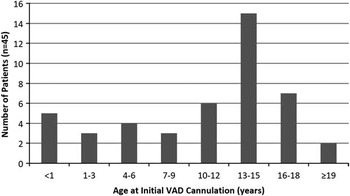
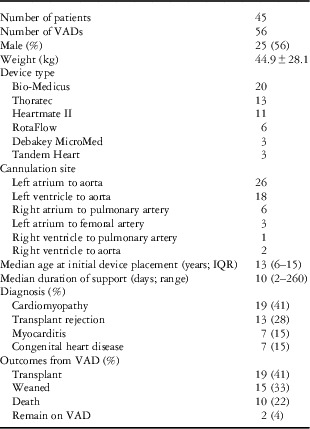
From July of 1998 to August of 2011, 56 ventricular assist devices, excluding Berlin Excor, were placed into 45 patients (Table 1). The discrepancy in the number of patients and the number of ventricular assist devices is a result of the use of biventricular support in five patients, with four patients having their device changed for an alternative device, and two patients requiring ventricular assist device support on two separate occasions. The number and types of assist devices were as follows: 20 Bio-Medicus, 13 Thoratec, 11 HeartMate II, 6 RotaFlow, 3 Debakey MicroMed, and 3 Tandem Heart. Left atrium to aorta cannulation was performed with 26/56 (46%) devices, and left ventricle to aorta cannulation was performed with 18/56 (32%) devices. Right ventricular cannulation was performed with 3/56 (5%) ventricular assist devices. The median age at the time of initial ventricular assist device placement was 13 years (interquartile range 6–15 years; Fig 1). The median duration of ventricular assist device support was 10 days (interquartile range 5–53 days). There were two patients who remained on ventricular assist device support at the time of data collection and had been supported for 4 and 7 months.
Distribution of patients by age at time of initial VAD cannulation. VAD=ventricular assist device.

Patient and VAD characteristics.

IQR=interquartile range; VAD=ventricular assist device
Patients required a ventricular assist device for heart failure as a result of the following diagnoses: 19 cardiomyopathy (41%), 13 transplant rejection (28%), seven myocarditis (15%), and seven congenital heart disease (15%). There was one patient with cardiomyopathy who required ventricular assist device as a bridge to transplant and subsequently required another ventricular assist device for transplant rejection. Thus, there are 46 diagnoses in our 45-patient cohort. Of the 45 patients, 19 (42%) went on to have an orthotopic heart transplant from ventricular assist device support; 15 (33%) were able to wean from the ventricular assist device without requiring transplant, with one patient weaning from two separate episodes of ventricular assist device support; and 10 patients (22%) died while being supported with a ventricular assist device. At the time of data collection, two patients continued to be supported with a HeartMate II as outpatients.
Of the 45 patients, 32 (71%) had an arrhythmia at some point during their course of care. Of the 32 patients who had an arrhythmia, 25 (78%) had ventricular tachycardia, making it the predominant arrhythmia. Non-sustained, monomorphic ventricular tachycardia was documented in 16 patients, whereas non-sustained, polymorphic ventricular tachycardia was documented in four patients. Both monomorphic and polymorphic non-sustained ventricular tachycardia were documented in two patients. Sustained monomorphic ventricular tachycardia was documented in one patient. Ventricular tachycardia was not fully classified in six patients, that is, documentation of sustained versus non-sustained or monomorphic versus polymorphic was incomplete. The median rate of ventricular tachycardia was 157 beats/minute (interquartile range 145–194). Of the 32 patients who had an arrhythmia, 12 (38%) had an atrial arrhythmia and seven (22%) had both atrial and ventricular arrhythmias. Atrial arrhythmias were non-sustained in seven patients and sustained in two patients. The classification was incomplete for three patients with atrial arrhythmias. The median rate of atrial ectopic tachycardia was 150 beats/minute (interquartile range 140–225).
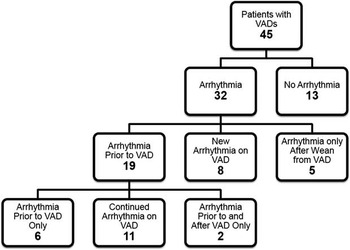
In all, 19 patients had an arrhythmia before initiation of ventricular assist device support. This comprised 42% of the total cohort of 45 patients and 59% of the 32 patients who had an arrhythmia. Of the 19 patients who had an arrhythmia before ventricular assist device placement, 11 (58%) continued to have an arrhythmia while on ventricular assist device, whereas the arrhythmias resolved in eight patients while supported. Of the patients who continued to have an arrhythmia, 9 out of 11 had the same class of arrhythmia on ventricular assist device support as before ventricular assist device support. For most, 7 out of 11 (64%), the continued arrhythmia was ventricular tachycardia. There were 8 out of 45 patients (18%) without a history of arrhythmia before ventricular assist device placement who developed a new arrhythmia while on ventricular assist device support. Of the patients with ventricular cannulation, 10 out of 20 (50%) had ventricular tachycardia while supported. For 5 out of 20 (25%), the ventricular tachycardia was a new arrhythmia, whereas the other 5 out of 20 patients (25%) had ventricular tachycardia both before and during ventricular assist device support. Figure 2 outlines the incidence and timing of arrhythmias in the study cohort. There was no correlation between age at cannulation or duration of cannulation and occurrence of arrhythmia. Using two-sided Fisher’s exact analysis, there was no correlation between the presence of arrhythmia before or during ventricular assist device placement and the overall risk of death or transplantation (p=0.14), nor was there correlation between the development of a new arrhythmia during ventricular assist device support and overall risk of death or transplant (p=0.1). There was no correlation between ventricular cannulation and new-onset ventricular arrhythmias (p=1).
Arrhythmias and VAD support. VAD=ventricular assist device.

Prolonged QTc was present on electrocardiogram of 20 out of 45 patients (44%) while on ventricular assist device support. There was no association between prolonged QTc and risk for arrhythmia on ventricular assist device. Further, there was no consistent change in QTc when comparing electrocardiograms before and during ventricular assist device support.
Of the 32 patients in this study with an arrhythmia, 24 (75%) were treated with antiarrhythmics. Amiodarone was the most commonly used medication, with 17 out of 24 (71%) patients being treated with amiodarone. Carvedilol (5/24, 21%), lidocaine (5/24, 21%), and digoxin (3/24, 13%) were the next most commonly utilised antiarrhythmic medications. In all, 11 (46%) patients were treated with more than one antiarrhythmic.
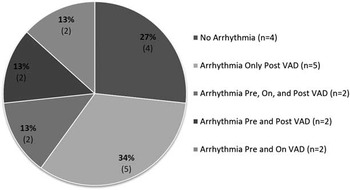
A total of 15 patients (33%) weaned from ventricular assist device support without requiring cardiac transplantation. This group was followed for a mean of 3.2±4 years after the ventricular assist device was removed. Only one (7%) of these patients had ventricular cannulation. Post-ventricular assist device arrhythmias were present in 9 out of 15 patients (60%), with 5 out of 15 patients (34%) having their first documented arrhythmia after weaning from ventricular assist device (Fig 3). In two patients, the arrhythmias noted before ventricular assist device were different from the arrhythmias after ventricular assist device. There was one patient who had ventricular tachycardia before ventricular assist device and atrial tachycardia and accelerated ventricular rhythm after ventricular assist device. The other had accelerated junctional rhythm before ventricular assist device and ventricular tachycardia after ventricular assist device. The most common arrhythmia in this post-ventricular assist device cohort was again ventricular tachycardia, with six out of nine (67%) having documented ventricular tachycardia. All of the arrhythmias that occurred following ventricular assist device removal were considered significant enough to warrant treatment, and two patients underwent placement of an implantable cardiac defibrillator.
Arrhythmias in patients who weaned from VAD. VAD=ventricular assist device.

Of the 15 patients, six (40%) who weaned from ventricular assist device support had ventricular dysfunction documented during follow-up. Moderate or severe dysfunction was demonstrated during follow-up in five out of six patients (83%). Mild dysfunction during follow-up was demonstrated in one patient (17%). Ventricular dysfunction during follow-up was an independent risk factor for arrhythmias, with all six patients (100%) who had dysfunction also having an arrhythmia and three out of nine patients (33%) without dysfunction having an arrhythmia (p=0.01).
Discussion
As the use of ventricular assist devices for heart failure becomes increasingly common,Reference Morales, Zafar and Rossano 1 understanding the effect of ventricular assist device support on cardiac rhythm becomes important. There is a growing body of literature on ventricular assist device support and arrhythmia in adult patients. There is a paucity of similar data in the paediatric age range.
Some studies have reported a reduction in the incidence of ventricular arrhythmias after ventricular assist device placement.Reference Arai, Swartz and Pennington 11 Others conclude that the incidence of new-onset monomorphic ventricular tachycardia is increased in adult patients with heart failure who require ventricular assist device support.Reference Ziv, Dizon, Thosani, Naka, Magnano and Garan 7 Ventricular assist devices have been employed to treat arrhythmias that are refractory to medical therapy in both adultsReference Fasseas, Kutalek, Samuels, Holmes and Samuels 12 and children.Reference Tatewaki, Masuda and Nishida 13 In this study, 71% of patients had an arrhythmia at some point during care. A high incidence of arrhythmias is not surprising given that the disease processes that led to heart failure and ventricular assist device support in the majority of these patients (cardiomyopathy, transplant rejection, and myocarditis) are known to increase the risk for development of arrhythmias.Reference Lakdawala and Givertz 14 – Reference Blauwet and Cooper 17 The incidence of arrhythmias in this study population is increased compared with patients with dilated cardiomyopathy (23%) and hypertrophic cardiomyopathy (27%) who were awaiting transplant or those with myocarditis (45%).Reference Kuhl, Pauschinger and Seeberg 16 , Reference Kirk, Naftel and Hoffman 18 , Reference Gajarski, Naftel and Pahl 19 Many patients (19/45, 42%) experienced an arrhythmia before ventricular assist device placement, which can only be attributed to their disease. Most of these patients (11/19, 58%) continued to have arrhythmias while supported, suggesting that children with arrhythmias before ventricular assist device support remain at risk for continued arrhythmias while on ventricular assist device because of their primary pathology and/or ventricular cannulation for ventricular assist device implantation. In 8 out of 19 patients (42%), however, ventricular assist device placement resulted in a quiescence of arrhythmias while supported, implying that in some cases unloading the myocardium in its decompensated state may decrease arrhythmia burden.
In this small cohort where several different ventricular assist devices were used and duration of ventricular assist device support varied widely, it is difficult to draw firm conclusions as to the effect that ventricular assist device support had on the incidence of arrhythmias. Statistical analysis did not show an association between the presence of arrhythmias before or on ventricular assist device support and risk of death or transplantation. Further evaluation of associated variables in larger studies is indicated. Of the remaining 26 patients from our cohort who did not have an arrhythmia before ventricular assist device, eight patients (31%) developed a new ventricular arrhythmia on ventricular assist device. This percentage of new-onset ventricular arrhythmia is similar to the 30–40% range reported in the adult literature and, in this study, was not significantly related to ventricular cannulation.Reference Ziv, Dizon, Thosani, Naka, Magnano and Garan 7 , Reference Oz, Rose, Slater, Kuiper, Catanese and Levin 20 Development of a new arrhythmia on ventricular assist device was also not statistically associated with an increased risk of death or transplantation. Also similar to adult data, the most common arrhythmia in our cohort was ventricular tachycardia, which was seen in 25 out of 32 (78%) patients who had an arrhythmia. Only 13 patients (29%) in the entire cohort did not have an arrhythmia before, during, or after ventricular assist device support.
Arrhythmias remained common during follow-up in patients who weaned from ventricular assist device, with nine of 15 patients having an arrhythmia after ventricular assist device support had ended. There were five patients (33%) in this cohort had their very first arrhythmia after ventricular assist device removal. This suggests that children who require ventricular assist device support to recover from severe heart failure remain at increased risk for development of arrhythmias in the long term. Hall et alReference Hall, Fermin and Birks 21 reported that myocardial structure and function can be improved by left ventricular assist device support, but that it also leads to an element of maladaptive remodelling such as fibrosis, atrophy, and ventricular stiffening. It would be interesting to determine whether the use of reverse remodelling agents while on ventricular assist device support, which has been demonstrated to decrease collagen content and myocardial stiffness,Reference Klotz, Danser and Foronjy 22 would also reduce the incidence of arrhythmias during ventricular assist device support or in post-ventricular assist device follow-up. This investigation may be especially relevant given the finding in this study that ventricular dysfunction in these patients is a risk factor for arrhythmia (p=0.01). Given the high incidence of arrhythmias in patients who have weaned from ventricular assist device support, it is prudent to continue to monitor closely for arrhythmias, especially if there is evidence of ventricular dysfunction on echocardiogram.
This study has limitations inherent in a retrospective chart review. There is a possibility that the incidence of arrhythmias reported is an underestimate of the true incidence as detection is not guaranteed and documentation of such events may be incomplete. In cases where tracings of arrhythmias were not available, other clinical documentation was utilised. In some instances, we were limited in our ability to provide specific details or to perform a direct morphological comparison of individual arrhythmias, and the efficacy of antiarrhythmic therapies was not determined. This study, although the largest of its kind, is not powered to detect a small association of arrhythmia with death or transplant, and thus the lack of correlation in this cohort is subject to type II error. The types of devices used to support children with severe heart failure has evolved over the time course of this study, thus the heterogeneity of this cohort. Each device may have a different predisposition for arrhythmias during or after its use given the different mechanical properties. A larger multi-institutional trial may be warranted to further elucidate the implications of arrhythmias in this medically complex patient group.
Conclusion
We conclude that arrhythmias, especially ventricular arrhythmias, are common among children with heart failure who require ventricular assist device placement, and that these arrhythmias frequently occur before, during, and after support. Patients who are able to wean from ventricular assist device support remain at high risk for arrhythmias, especially ventricular tachycardia, even if they did not have prior arrhythmias. Those with echocardiographic evidence of depressed ventricular function are at a significantly increased risk for arrhythmias and should therefore be monitored closely in follow-up.
Acknowledgements
Dr Kyle is the primary author of this manuscript and had full access to all of the data in the study and takes responsibility for the integrity of the data and the accuracy of the data analysis. He participated in every part of the project from design to manuscript authorship. Dr Kim participated in the conception and design of the project, interpretation of data, critical revision of the manuscript, and supervised throughout the project. Drs Decker and Macicek participated in acquisition and interpretation of data, critical revision of the manuscript, and supervision. Drs Valdes, Morales, Hong, Price, Dreyer, and Denfield participated in data interpretation and critical revision of the manuscript.
Disclosures
The authors have no relevant disclosures affecting this manuscript.
Financial Support
There was no grant or other funding obtained for this work.