I. WALL STREET MAFIA
When lead mob boss Tony Soprano of the HBO series The Sopranos (1999–2007) suggests to his rival Phil Leotardo that they coordinate with rather than compete against each other, that doing so will mitigate their risk and increase their profit, and that they should strive to be “sensible businessmen,” Leotardo laughs, looks to his espresso-sipping crew, and quips, “Charles Schwab over here.”Footnote 1 Conversely, when Rolling Stone journalist and contemporary muckraker of institutional finance Matt Taibbi documents financial corruption in the mainstream press, he titles his piece “The Scam Wall Street Learned from the Mafia.”Footnote 2 Each discourse frames its ethical critique of accumulation according to the exclusionary logic of the other. For one mobster to offer another financial advice such as “save,” “be prudent,” and so on is to invite collegial ridicule. Conversely, for the progressive press to produce ridicule demands that it compare institutional finance to the mob, evoking the latter's presumed violence and frauds. We all know the intimacy that results from comparative relationships: Charles Schwab has one racket, Tony Soprano has another; theirs is a conceptual and material cooperative with the state itself enforcing the boundaries of their partnership.
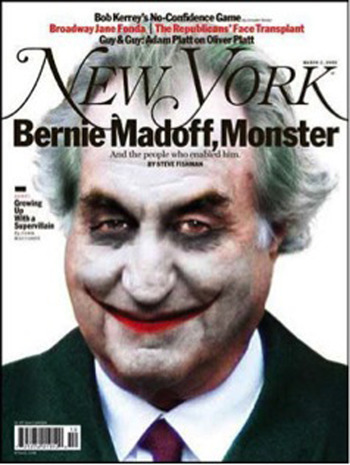
Whether in The Soprano's fictional diegesis or Rolling Stone's fact-based reportage, this pairing of legitimate and illegitimate economies has been increasingly brought into representations of the circulation and store of money. At the height of the credit crisis, for example, the New York Times reported that “mutually beneficial relationships between bankers and gangsters aren't new, but what's remarkable is their reach at the highest levels of global finance.”Footnote 3 The article went on to trace the collaboration between the two cohorts to the early financialization of mid-1980s, the same period in which the Corporate Crime Reporter (1987) was launched to track academically exactly how Fortune 500 companies manage money in both legitimate and illegitimate contexts.Footnote 4 And when, two years after the crisis, Bernie Madoff made off with his clients' millions, his personage was fictionalized and he morphed into Batman's arch nemesis, the Joker, on the cover of New York magazine (see Figure 1).
New York magazine, 2 March 2009.

On the one hand, fiction here mediates the legitimate/illegitimate binary. To whom or what, precisely, are the Times and Taibbi referring? American culture has no equivalent of Pablo Escobar or Joaquin “El Chapo” Guzman, titans of drug and thus money-laundering economies, who are celebrated in films, ballads (narcocorridos) and festivals. It's not that American narcotraficantes and contrabandistas don't exist and aren't celebrated, but rather that in post-fin de siecle American culture, fictional characters run our illegitimate empires. Subsequently, when real-life financiers behave illegally, they often become fictionalized or radically historicized, as was the case with 1980s arbitrageur Ivan Boesky.Footnote 5 On the other hand, fiction often provides common-sense representations of how an illegitimate economy operates, even, according to the New York Times, for members of such outfits themselves. “Call it a case of crime imitating art imitating crime,” the Times began its article on how a Queens-based drug dealership borrowed tactics and strategies from David Simon's television show The Wire.Footnote 6
Of course, actual illegal and illegitimate sites to store and process money do exist.Footnote 7 But we know that the structures that enable such economies, including offshore sites, shadow banks, Swiss bank accounts, and so on, are predominantly used by Corporate 500 companies, not by drug-runners and money launderers, whose presence could hardly explain the volume of transactions.Footnote 8 Indeed, corporate money appears and disappears with such surprising frequency from the most conservative of accounting practices that Bill Maurer has estimated that around 50 percent of transnational business transactions pass through a tax haven or some such semi-legal offshore financial center.Footnote 9 It is precisely the fictional and factual coordinates of this pairing in the demarcation of, and the contest between, legitimate and illegitimate economies as a feature of contemporary capitalist activity that interests me. I argue that this demarcation and contest is productive of the maintenance and increase of certain values, but that such productivity requires fictional ontologies to function as a simultaneous space of representation and accumulation. In the case of illegitimate economies, “fiction” and “fact” subtend each other. My hope in this article is to explore the ontological and epistemological character of this representation and to suggest that fiction may be considered part of money's definitional property, namely its liquidity.
The reference to the mob in Taibbi's title, for example, refers to texts such as The Godfather or The Sopranos. Indeed, in the anglophone, North American context, the fictional representation on which such claims depend is less based on Francis Ford Coppola's trilogy and more on a recent issue of television shows – incidentally heralded as some of the best television shows ever produced – about illegal economies: heroin in the northeast corridor in The Wire; methamphetamine in the southwest borderlands in Breaking Bad; stolen goods, political bribes, and recreational drugs in the New Jersey of The Sopranos.Footnote 10 What holds these shows together in some proto-generic organization is that money functions as both a criminal outside to capital and a structural assertion that capital has no outside. Capital, that is, is best represented by its own double, legitimate enterprise is best represented by illegitimate enterprise, but that representation is only efficacious because ultimately there is no capitalist activity that, for the right price, cannot become legitimate.Footnote 11 As we will see, representation and the potential for accumulation become theoretical cognates.
My claim is that these pairings of legitimate and illegitimate compose a contemporary allegory of money as it stores value and as it is deployed in financial transactions.Footnote 12 These legitimate/illegitimate states of money refract against each other in a liquid state through an arbitrage-like process where difference amidst sameness is a prized opportunity.Footnote 13 In institutional finance, from Charles Schwab to JP Morgan, that differential comes from divergent yet simultaneous prices for the same commodity. In cultural texts, I argue, we find a similar arbitrage-like scenario in the categorical binary of legitimate and illegitimate wherein the division itself allegorizes how money is routinely stored and valued in contemporary financial transactions. Indeed, my speculation is that the fact of the representation of this division is crucial for many transactions to be legitimated and to proceed outside a fictional frame. Contemporary capital valorizes fictional illegitimate economies.Footnote 14 I read The Sopranos and Breaking Bad according to these mediations, and I show how a necessary division around legitimate and illegitimate emerges as the structuring irony of each series, wherein a certain problematic functions ultimately to compromise the division. In the Sopranos, affect becomes unable to be illegitimate; in Breaking Bad cleanliness emerges in a similar structuring role.
II. TOXIC ASSETS
From 1999 through 2013, television viewers were able to receive ongoing, fictional commentary about some of the most represented and narrated moments of American economic history. During the dot-com bubble and its implosion alongside the Enron and Worldcom accounting scandals, The Sopranos ran on HBO. The Wire played alongside the militarization and securitization that accompanied the economic event otherwise known as the “war on terror,” a moment that sutured together security and securitization.Footnote 15 And finally, during the 2007–8 credit crisis that morphed into the 2008–12 “Great Recession,” Breaking Bad ran on AMC.Footnote 16 Each series portrayed an adjacent, illegal, narrativized economy, one whose space was proximally close to the standard-issue narrations that delimit our formal economy. To the economic patriotism of homeland security – remember Rudolph Giuliani's famous post-9/11 advice, “go shop” – The Sopranos reiterated that Wal-Mart would never stand for too elaborate port inspections, as commerce is the one logic that may compete with surveillance. To the economic violence of deindustrial, racialized poverty and the drug economies that flourish therein, The Wire reminded us to “follow the money,” as it circulated back into the same infrastructure that so publicly abhorred its presence.Footnote 17 And finally, to the global mortgage fraud and the arbitrage opportunities generated therein through the construction and sale of mortgage-backed securities, Breaking Bad moved its covert meth-lab setup from an industrial laundromat to a rotating crop of single-family, suburban homes, a toxic asset indeed.Footnote 18
Unlike the now-coherent genre of reality television, whose novelty Anna McCarthy maintains was developed in the 1990s alongside “neoliberal policies and discourses,” these shows' generic comportment is more subtle.Footnote 19 How shall we designate them? Jason Mittell suggests that they do derive from a new televisual narrative mode, what he calls a “complex narrative” that “redefines episodic forms under the influence of serial narration.”Footnote 20 My interest, however, lies more in the resonance of their representation of money's circulation and identity than in the structure of their story arcs. But those arcs do offer a periodicity and specularity that render them particularly germane to tracking economic crisis, as did the novel in that genre's serial heyday. Each show, I suggest, may be read as an allegory of money in which legitimate and illegitimate forms cannot exist together and cannot be separated. This contradiction is addressed through a central trope in both The Sopranos and Breaking Bad. The former bases its allegory of money in the representation of affect; the latter bases its allegory of money in the trope of “cleanliness.” It is through these sites that we may locate the representation of illegitimate accumulation as a kind of liquidity to be used in actually existing transactions.
In the first episode of The Sopranos, mafia boss Tony Soprano presents himself for psychotherapy with symptoms of acute anxiety. As he begins to narrate to his therapist, Dr. Jennifer Melfi, the recent life events that preceded his first panic attack, the viewer sees via a flashback what the therapist cannot: when he tells his therapist that he had a difficult meeting with a colleague, we see a clip of him attempting to run over a debtor in one of his gambling rackets with a car; when he makes reference to a disagreement with an associate, we see him assaulting a man to the point of near death. The series begins, then, with a scene of economic violence but, in keeping with the “mob genre,” that violence is interpersonal not structural. From The Godfather to The Untouchables, viewers of this genre know that interpersonal economic violence indicates an illegitimate economy, one that essentially has no structures outside personal relationships. In a film like Margin Call, by contrast, two bankers reference a greater whole on the eve the impending credit crisis: “a lot of people are going to lose their jobs,” one says; his comment is an acknowledgment of structural economic violence, real but not represented. The Soprano's indication of interpersonal violence metonymizes structural violence, much as its illegitimate economy metonymizes the legitimate one. Taken together, these twin metonymies have been understood to constitute the mob genre's critical force.Footnote 21
In The Sopranos yet another marking of its illegitimate economy is its white, masculine affective intensity. Constant kissing, hugging, eating, and drinking, not to mention punching, fighting, and other forms of intimate assault, draw our focus to the white body and distinguish ethnically mafia masculinity.Footnote 22 This physicality extends to accumulation in ways both violent and not: business deals, when they succeed, are sealed with a kiss and a meal; if they fail, bodily injury often results. Once money has been captured, it takes on physical characteristics as well in that it is visible as cash, stored in pockets and thus close to the body, and palpated constantly as it is transferred from one person to another. To cement, as it were, Dr. Melfi's knowledge of Tony's employment and thus identity – he tells her he works in “waste management” – at the end of their first psychotherapy session he retrieves a money-clipped handful of cash from his front pocket and offers to pay her fee. Her response to the fist full of cash, and her citation of patient confidentiality, are understood as her acknowledgment of his illegitimate, violent, and illegal economic world.
From the first episode through the last, these two iconographies of intimate affect and illegitimate money redound in the series, enforcing and complementing each other. It is Tony's boisterous intensity and fitful despair that make him so easily affected, that make him boss, and that make him money. He describes himself to Melfi as a “sad clown,” and the personal history that has put him in that position, including his violent father and sadistic mother, has left its psychic mark. “I can't shake it. I'm depressed,” he confides to his wife, after downing a handful of Prozac, which he titrates himself based on his morning mood. The Sopranos is a character-driven series whose affect management – that is, after all, what therapy is – organizes its money management, giving the show a rather melodramatic sheen.
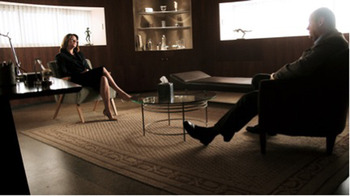
I begin with the scene of therapy because it is through the show's representation of affect that we can locate its economic allegory or the sameness and difference of money in various states. Furthermore, the scene of therapy allows the series to consider – in a Jamesonian parlance, “to contain” – perhaps the most popular ideological fantasy about crime, namely that it is a characterologically rather than economically driven pursuit.Footnote 23The Sopranos internalizes into its diegesis the temptation of the viewer to reproduce this stand-issue discourse of crime, which neutralizes crime's economic scope by individuating and psychologizing the criminal himself. This popular discourse, not to mention much of the discipline of academic criminology, asks, why would some one do it? What's wrong with them? How can they be rehabilitated? The Sopranos manifestly incorporates a psychological critique into its plot in order to reject it: Tony spends a lot of time in session with Dr. Melfi (see Figure 2) discussing his motivations. Why does he do it? Narcissism, pathology, excessive proclivity toward risk-taking? Or perhaps a not “good enough” mother? The show playfully dares us as social critics to psychologize Tony's economy, knowing full well this is a valueless translation: he does “it” for money, for material comfort, to support a family – all reasons indistinguishable from any late capitalist scene of employment.
In the hours, Dr. Melfi and Tony.

The illegitimate money that perennially passes through characters' hands and lives possesses structural similarities to the affect that is witnessed and analyzed in session with Melfi. Money and affect are both material, embodied, coincident with violence, and in need of some kind of regulation. If Tony cannot regulate his anxiety, he will suffer panic attacks and be unable to work; if he cannot regulate the risk that adheres to his style of accumulation, he will be imprisoned and unable to work; indeed, he will forfeit his assets, as his rival Johnny Sacrimoni was forced to do in Season 5. Because the Soprano family run a criminal enterprise, theirs is a cash business. Marked as criminal, however, money cannot be financed away temporally or spatially through standard channels of banking and investment; rather it is laundered, buried, gambled, or otherwise kept at hand. Tony habitually pulls thousands of dollars out of his pockets; when his wife, Carmela, needs legitimately to transfer money, she removes stacks of bills from her pocketbook, careful to allot them in 10,000-dollar allotments, one dollar over and her transaction must be reported to the federal government, which the money transfer agent tells her. “Really?” she replies knowingly, “I had no idea.” The Soprano family money is buried in a garage, hidden in backyard birdseed holders, ensconced in a wall safe, and so on.
Indeed, all money in the series diegesis must be assumed to have illegitimate origins. Yet it still functions as a materialized universal equivalent of abstract labor. It can store value, it can represent value, and it can lubricate exchange. Perhaps the most distinctive feature of money qua money is that it can move from one sphere to another without undergoing too drastic a discount – its property of liquidity. It may undergo some discount and still maintain its identity as money, but too radical a discount and that identity will be threatened. The precise scale of “some” and “too” are themselves local to the situation, of course. Who's to say, exactly, how they convert? That money can be both local and universal simultaneously makes it worth accumulating to start with. Money has no outside or double; it is immanent to itself and necessarily present. What is distinctive about an illegitimate economy is its money's “dirtiness,” the fact that it is indexed to illegal actions and thus potentially incriminating. Nonetheless, if that money did not have a reasonable chance of surmounting its origins, it would not be money.
This present-ness, locality, and immanence denote the limit of money and they structure a comparative relationship with affect as it has been theorized in the relational psychoanalytic tradition. Affect, according to Charles Spezzano (whose book on the subject is unsurpassed), is “an assessment of the psychic advantages and disadvantages of one's current position in the physical and relational world, as well as a readying and orienting of oneself to act intrapsychically and interpersonally.”Footnote 24 Sianne Ngai refers to affect as a kind of geographical mood not reducible to any single representation or incident.Footnote 25 To recognize an affect is to feel it. The job of the therapist is to assist in articulating the split-off affects of the patient by, in part, feeling them herself. “How was it growing up with the rage and violence [of your Mafia father?]” Melfi asks, responding to Tony's obvious but dissociated anger. “Your father shooting a bullet through your mother's beehive, for example,” Melfi reminds him. “Ah,” says Tony with frustration and dismissal, “I never should have told you that.” Yet the specifics are unimportant. Melfi and Tony's colleagues can feel his rage even when he cannot. Much as his money cannot be financed away temporally or spatially, his affect cannot be disappeared. All affect is imminent to itself; it cannot be abstracted or represented through a non-proprioceptive infrastructure. Both illegitimate money and affect may be split off, buried, or dissociated, but not permanently banished from circulation.
These descriptions allow for a both structural and a relational understanding of affect, and an easy equating of it with the depiction of money in The Sopranos. Unsurprisingly given her role as affect interpreter, Dr. Melfi is also charged with providing meta-commentary within the show. “Borderline personalities are very good at splitting behavior,” she explains of Tony's long-suffering mother, Livia. Melfi simultaneously and unself-consciously describes the structure of the show: namely its central split between the legitimate and illegitimate money represented by a split between present and dissociated affect. Without being able to acknowledge his full economic reality and thus identity, Tony and Dr. Melfi agree on this: he'll be in therapy to work on managing his affects, primarily his depressive rage, but not his employment and money-making stresses. He will not discuss, and Melfi cannot legally hear, details of the profitable violence which he organizes and in which he participates. Melfi abides by the legal requirements of her profession: total patient confidentiality unless either the patient or another person is in immediate danger of physical harm. Of course, Tony's enterprise, his daily social reproduction, depends on producing immediate danger and perpetuating physical harm. His and Melfi's mutual and constitutive disavowal of interpersonal economic violence is the flipside to the genre's metonymizing of structural economic violence; after all, were a patient to say to Melfi that he intended to foreclose on 10,000 homes or to cancel 100,000 people's health insurance, this would not constitute “immediate danger” and she could keep that patient's confidence.
However, because money has been linked so forcefully to affect in the diegesis, the two spheres cannot be conceptually or visually separated. The show continually reminds the viewer of this, showing, for example, Tony watching a man being impaled from his car as he is on the phone scheduling an appointment with Dr. Melfi. The series also ties Melfi to interpersonal violence through her rape in a parking garage. If money cannot be illegitimate and money corresponds with affect, then the ultimate question for this series, which is in fact an economic one, is: can affect be illegitimate? Money is a representation of labor that can be equated with different people and different forms, and money in an illegitimate context requires constant calculation since its value cannot be financed away to another time or space. Affect, according to Spezzano, is always calculative, it may be repressed, dissociated or split off, but it possesses a fundamental haecceity. The series, then, revolves around this question: may Tony banish his feelings of rage, guilt, dread, and anxiety that result from his life of crime or is it sufficient to abreact those affects without describing to Melfi their proper origins in order to continue that life, that accumulation?
Perhaps the most incisive scene in this regard transpires in the aftermath of Tony's decision to murder his nephew and closest associate, the recovering addict and aspiring screenplay writer, Christopher Moltisanti.Footnote 26 Tony executes the murder opportunistically: after a car accident, with Christopher trapped by his seatbelt, bleeding and unable to move, Tony suffocates him. That Christopher may have died regardless only adds to the dramatic intensity of the action. Now Tony returns to mourn both publicly with his family and associates and privately, with Melfi in session. This mourning transpires twice. First, we see the familiar scene of Melfi's office, with its soft light and circular shape, and we hear Tony describe his anguish through his tears. Unable to maintain eye contact he says, “I've murdered business associates before, friends even, but this, this is …” and he stares off in despair, unable to finish the sentence. Then he wakes up. It was a dream sequence, one immediately followed by him in his therapist's office sharing with Melfi the shock of the what she labels the “senseless tragedy” of Christopher's death. Because of the repetition we are assured that this second appraisal is real. Tony does not confess to the murder, but he explains that he did carry anger at Christopher and he's “not feeling” the pain of those around him; rather he feels angry and relieved. Nonetheless, given his position as family boss and as Christopher's uncle, he must seem to be in mourning, and it is this perceived pressure that makes him upset. “I've gotta be around people who are hurting. Bad.” He continues. “I see,” Melfi responds coolly.
What are we witnessing here? A counterfeit emotional scene or a genuine emotional scene, albeit one of a narcissistic sociopath? The emotions Tony describes are the correct ones even as they are not indexed to the actions that produced them. He is relieved, he was worried that Christopher “would dime [him] to the FBI,” and he is angry. His anger, however, derives not from an experience of senseless loss but from the lack of recognition and resentment for the benefits his associates will accrue from the murder undertaken with his affective labor. His affect in describing this to Melfi is necessarily present; it cannot not be present – even disassociation leaves a mark. When Melfi responded, “I see” she also communicated “I feel” and “I know.” Money and affect are enjoined to each other and are independent, twin presences that cannot be jettisoned. In both his money-making, where affect is the distinguishing marker, and his therapy, where affect is also the distinguishing marker, both must be understood as accepted and able to circulate in this space. This suspension between the radical acceptance and the radical disavowal of Tony's true psychic life is why the therapeutic relationship in The Sopranos has been described by the New York Review of Books as either the most utopian or the most cynical representation of the therapeutic process ever.Footnote 27 In accepting his affect, but not the knowledge from where his money, thus violence, thus affect, derives, Melfi nonetheless on some level accepts and even legitimates his money. Melfi's acceptance reinforces the fact that money is always present, that it is always legitimate and illegitimate at the same time. The possibility for it to move between these two states is both a matter of representation and a matter of profit. It is where we may begin to locate fiction's liquidity.
Thus far, my claim has been confined to representation. But what of worldly financial transactions? My argument in the introduction was that such fictional representation subtends factual accumulation in actuality. At what level of mediation should such a claim be organized? Surely, it must include more than fiction. The economist Michael Hudson writes that when he worked for Standard Oil industry in the 1960s he was unable to locate any profit on the company's transnational balance sheets. Hudson's superior arranged for him to talk to the treasurer, who explained that “the profits are made right here in the treasurer's office, wherever I decide.”Footnote 28 Should the process Hudson describes be understood as accumulation or representation? In it, money is indexed to its accounting and writing. Yet this is too literal a claim to support mine. Curtis Marez, in his influential Drug Wars, offers another possible level of mediation. Dealing with the representation of violent, illegal economies and their ability to mediate other economies, Marez writes, “Scarface and other films, TV shows, and music about the U. S. war on drugs during the 1980s and 1990s constituted cognitive maps for popular thinking about political economy … drug war narratives were influential cultural forms for organizing thinking about state power, capitalism, and labor.”Footnote 29 Following the standard set by Jamesonian cultural Marxism, Marez's argument blends narratology and ideology. Yet his is not literal enough a claim, as it doesn't indicate the capture of profit. As I turn now to Breaking Bad, which Marez himself claims recuperates the black and brown bodies that other drug war films dispose of, I suggest that we see fictional representation of illegitimate economies as participating in the work of maintaining money's liquidity, its ability to transfer from one state to another without undergoing too drastic a discount.
Breaking Bad localizes and allegorizes the translation of drug-derived money from the illegitimate sphere into the legitimate one through the trope of cleanliness.Footnote 30 This money-laundering, western-influenced melodrama follows the production and sale of crystal meth and is set first in a laundromat, and then, when the laundromat is incinerated to destroy evidence, in a car wash and a residential extermination business. The laundromat provides cover for the chemicals while the profits are laundered elsewhere; then meth is produced in single-family homes, while money is laundered through a car wash. “To clean cars and clean money,” toasts the protagonist, Walter White, with a 300-dollar bottle of champagne. “Don't worry,” he tells his wife and accountant, Skyler, “I paid for it with cash.”
Walt's original plan requires him to make $737,000 to cover his own medical expenses and to provide for his family after his impending death. But as his cancer goes into remission, he remakes himself into a businessman whose craft is not only his violence but his technique: purer methamphetamine, easier conduits to poisoning his competition, and so on. The symbolic punctuation that runs throughout Breaking Bad has a similar dichotomous parallelism to The Sopranos. As cancer poisons Walt unto death, so the toxicity of crystal meth frees him to make a new life. “I [cooked meth] for myself,” he finally admits after five seasons of terror and dread ostensibly for the sake of his family. “I liked it and I was good at it.” While his body becomes toxic to itself as cancer spreads, the site of cleanliness to recycle money, industrial cleanliness, relies on the same cancer-producing chemicals that make him ill. The industrial cleanliness of laundry and extermination is not clean, of course, but it does clean money.
This dirty/clean contradiction at the scene of money's production in the show is but one of many doublings of value that structure Breaking Bad. Walter White becomes linked via plot to Walt Whitman, and the initials “WW” do double work in the series' denouement much as illegitimate money doubles back to its legitimate state. Walt Whitman will be one plot-determinant reference to “Walter White,” but “white” also refers to “white collar,” as the “Blue” of Walt's signature meth refers to “blue collar.” The workers in the laundromat and fast-food chain, most of them “illegals,” according to Walt's lawyer Saul Goodman, undertake the blue-collar labor necessary for Walt's white-collar crime. Like The Sopranos' fourth season, which revolved around family member Adriana becoming an FBI informant, the structuring dramatic irony of Breaking Bad occurs through familial configuration, an “in-law”: it is Walt's DEA-agent brother-in-law, Hank Schrader, who introduces him to the possibilities of methamphetamine production and reintroduces him to his business partner, Jesse Pinkman, Walt's former student. It is Hank who trails Walt for years not knowing his identity other than his street name, Heisenberg. This central irony serves as a foundation for others: the first four seasons' chief illegitimate businessman, Gustavo Fring, is also its chief legitimate one: he sponsors the DEA's fun runs, is on the board of the hospital where the DEA takes its wounded, and so on. The larger irony suggested by this intimate configuration is that the DEA organize the market and maintain the value of illegal drugs; it is the DEA, not the cartels, who enforce their product's worth. “Keep your friends close but your enemies closer,” Hank jokingly quotes Godfather Michael Corleone to his colleagues.
But it is Breaking Bad's laundromat/car wash that suture together the generic problem of these shows – indeed of this genre. Both the laundromat and the car wash are places of chemicals and places of cleanliness. The idiomatic phrase “to launder money” no doubt has some fantastic origin stories, but the consensus is that early and mid-twentieth-century criminal rackets purchased cash-only businesses, including many a laundromat, so as to reconfigure their own profits' genesis.Footnote 31 Criminal money laundering was codified in the United States in that crucial decade for all forms of money, the 1980s, when it was defined as one's involvement “in a financial transaction that represents the proceeds of some form of unlawful activity … knowing that the transaction is designed in whole or in part … to conceal or disguise the nature, the location, the source, the ownership, or the control of the proceeds.”Footnote 32 Of course, by the 1980s, money launderers were far from the laundromat, conceptually and physically, and by the 2010s even more so.Footnote 33 But Breaking Bad reminds us that this process was once literal and in fact suggests that it still may be. Indeed, when we hear in the background of one of the White family's domestic scenes the radio distantly announcing that “the subprime crisis continues to spread with no end in sight; traffic when we return,” we realize that Breaking Bad is subsuming one of the great criminal, financial scandals of modern capitalism, the global dissemination of so-called toxic mortgages, into its diegesis.
Yet that coincidence, as it were, is hardly needed. Rather, what we realize is that Breaking Bad represents the normal course of things. The spectacular event as background to the quotidian reminds us that it's not that money laundering is unusual and needs highlighting by a crisis; it's that usually the recycling of money from illegitimate to legitimate transpires without crisis, without crime, without notice. The series' “dirty money” in need of laundering seems at first to literalize what we might think of as a metaphorical process. But, in fact, it literalizes a literal process. Who, after all, hides money, disappears money, and recycles money from one state to another? Even the most robust estimates of global black market money movement put the figure at no more than 10 percent, and many analysts would say that's too high,Footnote 34 although Maurer claims that around 50 percent of all global transactions at some point do pass through an offshore site. A glimpse of any large financial institution's offshore offerings provides a different story. Citibank advertises, “If you're looking for an international location for your investments, you'll find London, Jersey and Switzerland each offer a range of financial benefits. And they're great places to visit, too.” HBSC provides a “Global Tax Navigator” functionality on its offshore website. This friendliness and accessibility are not to suggest that offshore sites are not also used illegally. Indeed, the separate categories of illegal, illegitimate and illicit become difficult to discern. It is legal for them to exist; but illegal for Americans to use them if they don't pay taxes on those monies. Yet the whole point is to avoid an index from money to owner so as not to pay tax. So, then, for Americans, using an offshore account is likely illegal, but having an offshore account is not. The journalist Michael Hudson offers this claim in his in-depth article on JP Morgan's offshore structure:
Over the years, JPMorgan Chase and its corporate forebears have been accused of serving as conduits for money controlled by drug smugglers, mobsters and political despots and acting as magnets for “flight capital” from rich tax dodgers from Latin America and other regions. The bank also played a part, lawsuits alleged, in massive tax haven-enabled frauds in the Enron and Madoff scandals.Footnote 35
In Hudson's account, these legal entities are clearly designed and used for illegal monetary transactions.
For this ambiguity between legal existence/illegal use to be productive, we must have narratives like those of Tony Soprano's and Walter White's business dealings. They maintain the fiction that such sites are places of radical, individual illegality. They maintain the fiction of fiction. Ultimately, Breaking Bad is structured so that legitimate and illegitimate (dirty and clean, in the vernacular of the show) compose a singular category at the level of plot which, by my reading, cedes into the representation of money. The series provides one particularly striking portrayal of dirty money's ability to circulate and take multiple forms regardless of its origins. Toward the series' end, Walt's underground life of crime is inadvertently revealed to Hank. Sitting on the toilet, flipping through reading material in Walt's home, Hank picks up an inscribed copy of Leaves of Grass and sees an inscription to “WW” which not only connects Walt to Whitman but to a deceased meth-cooker, Gail Boetticher (i.e. GB, Great Britain?) in whose papers Hank had seen the same visage of the poet and the same handwritten inscription. Hank is now able to identify the master cooker and violent businessman whom he has known only as Heisenberg as one of his own family members, an in-law outlaw. The categories that have structured Hank's investigation are immediately transposed; for Walt, the content that previously had to be hidden at all costs, namely his life of crime, is now known and must be managed. My interest here is to locate the visual and plot transversals that accompany this realization and my claim is that these represent the series' philosophy of money.
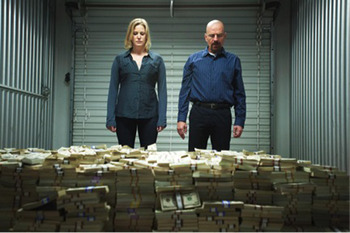
Several episodes before Hank's discovery, Skyler had led Walt to a storage facility used for their cash. Walt “cooks” methamphetamine and Skyler “cooks the books” of their car wash. Yet, as the series progresses and the dirty money accumulates, Skyler declares, “I can't launder this amount with 100 car washes,” as the two look down at a square mass of dollars (Episode 5·10; Figure 3). They stand over the money with the camera at a medium distance, framing them, and, despite their height difference, they now appear equivalent. They discuss various metrics of value including denomination and weight but are unable to represent their money numerically. This scene might be considered one of the moments of signal crisis of the show, the moment in which Walt can no longer evaluate his money. “How much is this?” he asks. “I don't know,” Skyler responds. “It's incomprehensible,” she concludes. That is the same adjective Walt himself had used to describe General Electric's wealth in the show's first season, a repetition that presents a doubling back wherein the gap between illegitimate and legitimate money is bridged: General Electric and Heisenberg's enterprise have become commensurate.
Skyler and Walt with dirty money, Breaking Bad, Episode 5.10.

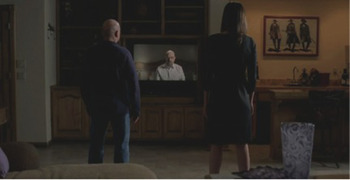
The second image from the series now quotes and critiques the first through an explicit engagement with the dimensions and possibilities of dirty money. In the mise en scène we note a series of dichotomous juxtapositions: the male/female positioning is reversed, as is the forward/backward orientation of the characters. Each character's arms and legs hang in stiff congruity, Hank's and Walt's bald heads mimic each other. Walt and Skyler are viewing money, which is placed in front of them, while Hank and Marie are viewing Walt, who places himself in front of them. The still of Hank and Marie appears not to represent money, but rather to stress triangulation: between Walt, Hank, and Marie, but also conceptually: note the three gunmen standing in similar posture to the protagonists to the right of the television. In the still with Walt and Skyler, money has spatial dimension but no specific value. In Figure 4 with Hank and Marie, I want to suggest that dirty money is being cleaned. Hank and Marie are looking at Walt; Walt, however, has assumed the form of money qua money: he has become liquid, able to circulate in all locations, and amenable to all values.
Hank and Marie watch Walt, Breaking Bad, Episode 5.11.

Walt represents this property by offering an ironic confession: Walt “confesses” to the precise opposite of his actions. He “confesses” to having been manipulated and threatened by Hank into the service of methamphetamine production and distribution. Because Hank has in fact been shadowing Walt without knowing it is Walt whom he has been shadowing, the two have been in intimate, relational proximity to each other. Walt may now easily transpose their roles: Walt now claims it is he who has been following Hank against his own will, as it were. Walt, in other words, now claims he has been forced to occupy an illegitimate position and this “confession” is his attempt to explain how he traveled from high-school chemistry teacher to drug producer and accomplice in murder.
Their intimacy had, for the duration of the series, formed Walt's risk, namely the risk of being apprehended by the state. That risk constitutes the price of illegitimate money, and that risk is now inverted: it is Hank who is forced to assume the risk of their shared intimacy. Walt's confession effects a complete transposition around the category of risk in relation to the state, yet, as with affect in The Sopranos, this transposition must be understood as revolving around money's potential to circulate seamlessly, to be both legitimate and illegitimate together. All that is required for this transformation is for Walt to issue a declaration. In being close to the state, Walt is able to render the state not Walt the ultimate bearer of risk. And indeed it is Hank-as-state-agent who is killed in the series' denouement and Walt who chooses to die. His final act is to launder his money again, this time through a legitimate chemical company, Grey Matter, by threatening his former business partners who run it.
III. CONCLUSION: ACCUMULATIVE ALLEGORY
These shows are allegories, then, because they employ illegitimate money to represent legitimate money. What we have seen, however, is that the very division these shows allegorize, namely that some money is legitimate and other money illegitimate, could also be understood as a moral allegory of capitalism. In the fiction of The Sopranos and Breaking Bad, illegitimate money represents legitimate money. I have claimed that some forms of actually existing financial transaction are possible precisely because we assume they must be authored by the likes of Tony and Walt and not Henry Paulson, US Secretary of the Treasury under George W. Bush and former chairman of Goldman Sachs, or Robert Rubin, Secretary of the Treasury of Clinton, and former chairman of Goldman Sachs.
The primary representation, the common sense, of money as it transitions between its illegitimate and legitimate states is fictional, and this ontology must be understood as a crucial form of liquidity for capital.Footnote 36 As such, representation of illegitimate economies includes the possibility of accumulation. These allegories, then, are not only a form of representation, they are a transactional form as well. Allegory, like arbitrage, is profitable difference amidst some equivalence. Finally, since in this essay I have repeatedly followed the fictional movement from illegitimate to legitimate, it should be noted that this proposition may be reversed as well: the British newspaper The Observer claims that during the 2007–8 credit crisis “in many instances, the money from drugs was the only liquid investment capital available to some banks at the height of the crisis,” and that “interbank loans were funded by money that originated from the drugs trade and other illegal activities … There were signs that some banks were rescued that way.”Footnote 37 Such a claim is no doubt true and interesting, but my argument does not depend on this kind of specificity. Indeed, as Hegel himself contended, the immediate is mediated and the concrete may mislead.Footnote 38