Introduction
Apathy is a neuropsychiatric syndrome that is prevalent in a number of psychiatric diseases, especially dementia, and also commonly seen in individuals who have suffered traumatic brain injury. It is characterized by a lack of motivation that is not attributable to diminished level of consciousness, cognitive impairment, or emotional distress (Marin, Reference Marin1991). Apathy is associated with many adverse outcomes, such as low performance on cognitive tests (Onyike et al., Reference Onyike2007; Turró-Garriga et al., Reference Turró-Garriga2009), conversion from mild cognitive impairment to Alzheimer's disease (Robert et al., Reference Robert2006), depression (Lavretsky et al., Reference Lavretsky, Lesser, Wohl, Miller and Mehringer1999; Starkstein et al., Reference Starkstein, Jorge, Mizrahi and Robinson2006), and greater impairment in functional activities (Freels et al., Reference Freels1992; Starkstein et al., Reference Starkstein, Petracca, Chemeerinksi and Kremer2001; Lechowski et al., 2008). Understanding the public health impact of apathy is limited due to a dearth of research from large and representative population-based samples, particularly with longitudinal designs.
Studies of apathy are often carried out in relation to specific health conditions typically using clinical samples (i.e. hospitalized or community-dwelling individuals presenting at particular clinics) (Robert et al., Reference Robert2006; Clarke et al., Reference Clarke, van Reekum, Simard, Streiner, Freedman and Conn2007; Reference Clarke2008). Therefore, the majority of available prevalence estimates and observed correlates of apathy might not reflect the occurrence of apathy in the general population but illustrate apathy in specialized samples. For example, Clarke and colleagues (Reference Clarke, van Reekum, Simard, Streiner, Freedman and Conn2007; Reference Clarke2008) reported prevalence rates for apathy ranging from 42.9% to 75% in individuals with Alzheimer's disease, vascular dementia, dementia with Lewy-bodies, and frontal temporal dementia, but the study sample was drawn from community-dwelling individuals presenting to the Memory Disorder Clinic at a Geriatric Hospital in Toronto, Canada. In contrast, Onyike and colleagues (Reference Onyike2007) used the population-based data from the Cache County study on Memory, Health and Aging and found 1.4%, 3.1%, and 17.3% apathy prevalence among individuals classified, respectively, as cognitively normal, with a mild cognitive syndrome, and with dementia. This study provided valuable population-based results but the Cache County study data may not be generalizable to the entire U.S. population because the county has very low rates of in- and out-migration (Miech et al., Reference Miech, Breitner, Zandi, Khachaturian, Anthony and Mayer2002) compared to other U.S. counties. In addition, members of the Church of Jesus Christ of Latter Day Saints, a religious denomination that prohibits the use of alcohol and tobacco, comprise approximately 91% of the population (Miech et al., Reference Miech, Breitner, Zandi, Khachaturian, Anthony and Mayer2002). The cross-sectional nature of the existing studies (e.g. Lyketsos et al., Reference Lyketsos, Lopez, Jones, Fitzpatrick, Breitner and DeKosky2002; Clarke et al., Reference Clarke, van Reekum, Simard, Streiner, Freedman and Conn2007; Reference Clarke2008; Onyike et al., Reference Onyike2007) limits the ability to make causal inferences regarding the relationships between apathy and the correlates examined.
The limited longitudinal studies of apathy (e.g. Starkstein et al., Reference Starkstein, Jorge, Mizrahi and Robinson2006; Lechowski et al., Reference Lechowski2009; Turró-Garriga et al., Reference Turró-Garriga2009) have indicated high prevalence and one-year incidence rates for apathy and found that this neuropsychiatric condition can have significant and negative impact on cognitive and functional decline. For instance, Starkstein et al. (Reference Starkstein, Jorge, Mizrahi and Robinson2006) reported an overall prevalence rate of 24% for apathy at baseline in a sample of 354 outpatients attending a dementia clinic in Buenos Aires. This prevalence estimate was similar to that (i.e. 18.7%) reported by Turró-Garriga et al. (Reference Turró-Garriga2009) in outpatients seen at an outpatient dementia clinic in Spain. Starkstein et al. (Reference Starkstein, Jorge, Mizrahi and Robinson2006) reported that for individuals without depression, the prevalence of apathy was 23% compared to 55% and 41% for individuals with major and minor depression, respectively. The one-year incidence of apathy among those without apathy at baseline was 17.5% (Starkstein et al., Reference Starkstein, Jorge, Mizrahi and Robinson2006) and 21.7% (Turró-Garriga et al., Reference Turró-Garriga2009). Among those with apathy at baseline, apathy persisted in about 50% of the sample by one-year follow-up (Starkstein et al., Reference Starkstein, Jorge, Mizrahi and Robinson2006; Turró-Garriga et al., Reference Turró-Garriga2009). Lechowski and colleagues (2008) observed persistent apathy, over three 6-month follow-up assessments (i.e. 18 months), in 22.1% of 272 female outpatients with AD who were recruited from 16 university hospital centers in France as part of the REAL longitudinal cohort study. These studies, however, utilized specialized outpatient samples, in that participants were attending dementia clinics and therefore the prevalence, incidence, and persistent apathy estimates might be greater than what would be expected in a general population sample. These findings warrant replication in studies that are longitudinal in nature, with larger sample sizes, and with non-clinical samples.
The current study therefore examines the prevalence and incidence of apathy and its correlates in a community-based sample of older adults aged 50 years and older using data from the Baltimore Epidemiologic Catchman Area (ECA) follow-up study. More specifically, the study also examines the effects of baseline apathy on cognitive and functional decline at 1 year and 13 years follow-up. Based on available evidence, we hypothesize that our prevalence estimate will fall in the range 17–37%. Based on current literature, we expect to observe associations between apathy and cognitive impairment, depression, and impairment in functional abilities.
Methods
Data source and study population
The study involved secondary data analysis using the Baltimore ECA study. The study sample comprised 1,136 participants aged 50 years and older at the time the Baltimore ECA study was initiated in 1981 with follow-up in 1982, 1994, and 2004. The ECA was designed to collect data on the prevalence and incidence of mental disorders in an adult community sample, according to DSM criteria, and on the use of and need for services by individuals with mental disorders.
The 1,136 older adults included in this study represented 70.5% of all individuals aged 50 and older who participated in the Baltimore ECA study at its initiation in 1981. Individuals were excluded if they had missing information on the measure that was used to ascertain apathy status (n = 95); if they scored below 24 on the Mini-mental State Examination (MMSE; Folstein et al., Reference Folstein, Folstein and McHugh1975), which was used to indicate significant cognitive impairment (n = 211); and if they met DSM-III criteria for major depressive disorder or minor depression (i.e. three or more depression symptoms) at the time of the 1981 interview (n = 170) (Eaton et al., Reference Eaton1997). The baseline, 1-year, and 13-year follow-up data for this sample were used to examine changes in apathy status, and its impact on cognition on level of functioning in basic and instrumental activities of daily living.
Measures
Apathy
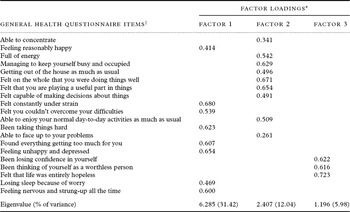
The items: “full of energy”, “managing to keep yourself busy and occupied”, “getting out of the house as much as usual”, “felt on the whole that you were doing things well”, “felt that you are playing a useful part in things”, and “able to enjoy your normal day-to-day activities as much as usual”, from the 20-item General Health Questionnaire (GHQ; Goldberg, Reference Goldberg1978) were used to ascertain apathy status based on our initial findings that these items loaded onto a single factor (Table 1) with good model fit using Confirmatory Factor Analysis (CFA) within a MPlus Framework (CFI = 0.88; TLI = 0.94; RMSEA = 0.114). Each item was rated on a scale of 0 to 3 giving total scores that ranged from 0 to 18, with higher scores indicating worse apathy. Apathy status was determined by a score ≥6.5 on the GHQ-apathy (i.e. GHQ-apathy score ≥6.5 = “having apathy” versus GHQ-apathy score < 6.5 = “not having apathy”) based on the validation analyses below.
Factor Structure of 20-item General Health Questionnaire (GHQ) using Principal Axis Analysis with Varimax Rotation Method

‡ Adapted from the 60-item General Health Questionnaire by Goldberg (Reference Goldberg1978).
*Factor analysis on the 28-item GHQ from ECA Wave 3 data found that all six apathy items loaded onto a single factor as found with Wave 1 data based on 20 items from the GHQ. The items and their factor loadings are: full of energy: 0.557; managing to keep yourself busy and occupied: 0.597; getting out of the house as much as usual: 0.426; felt on the whole that you were doing well: 0.407; felt that you are playing a useful part in things: 0.618; able to enjoy your normal day-to day activities as much as usual: 0.546. When a confirmatory factor analysis using MPlus software was conducted, the same factors were identified with good model fit (CFI = 0.88; TLI = 0.94; RMSEA = 0.114).
Validation analyses
In 1994, in-depth clinical psychiatric assessments, using the study's board certified psychiatrists, were carried out on a subsample of individuals in the Baltimore ECA study (i.e. N = 349 of whom 174 were aged 50 and older). Both the GHQ and the Schedules for Clinical Assessment in Neuropsychiatry (SCAN) were completed on this subsample. The psychiatrists’ ratings of the SCAN apathy-items, loss of interest, lost energy or vigor, and feeling of being overwhelmed by everyday tasks, was used as the validator in determining a cut-off score for the GHQ apathy subscale. These SCAN items were identified as apathy-related items because their description (World Health Organization, 1994) matches the definition and description of apathy and apathy-related behaviors in existing literature (Marin, Reference Marin1991; Marin et al., Reference Marin, Biedrzycki and Firinciogullari1991; van Reekum et al., Reference van Reekum, Stuss and Ostrander2005). In addition, these items represent three of the six items in the “Thinking, concentration, energy, interest” section of the SCAN (World Health Organization, 1994). Schützwohl (Reference Schützwohl, Kallert and Jurjanz2007) reported that these six items all loaded onto a single factor, giving some strength to their use to determine the cut-off score for apathy in this study. The inherent limitations of this method are discussed in the discussion section below.
More specifically, a cut-off score of 6.5 on the GHQ-apathy (i.e. sensitivity = 0.83 and specificity = 0.69) was determined based on receiver operating curve (ROC) analysis using the psychiatrists’ rating of apathy according to SCAN as the “gold standard” (see validation study below) and used to categorize the study participants as “having apathy” versus “not having apathy”. For the “gold standard” in the ROC analysis, SCAN-apathy total scores > 3 per the study psychiatrists were used to classify individuals as “having apathy” and scores ≤ 3 classified individuals as “not having apathy”. This cut-off score on the SCAN-apathy was used because it indicated that individuals had at least one item that resulted in moderate or intermittently severe impairment. ROC analysis and the cutoff score of 6.5 on the GHQ-apathy yielded an area under the curve of 0.795 (95%CI: [54.9–1.04]). Furthermore, the GHQ-apathy total score correlated well with SCAN-apathy total score (r = 0.421; p = 0.001) but weakly with irritability (r = 0.195, p = 0.012) and anxiety (r = 0.060, p = 0.433) as measured by the SCAN.
Cognitive decline
The MMSE was used to assess cognition at each wave of the ECA study. A score of less than or equal to 23 (Folstein et al., Reference Folstein, Folstein and McHugh1975) was used to classify individuals as being cognitively impaired versus non-cognitively impaired (i.e., MMSE ≥24) in our initial sample selection. In the follow-up assessment of cognitive status, cognitive decline was defined as greater than or equal to a 3-point reduction in MMSE scores between baseline and 1-year follow-up and between baseline and 13-year follow-up per Mielke et al., Reference Mielke2007 and Silverstein et al., Reference Silverstein2006.
Functional decline
Basic Activities of Daily Living (ADL) and Instrumental Activities of Daily Living (IADL) were two measures of functional abilities assessed at each ECA study visit. In the current study, the variables “any ADL disability” (i.e. Yes vs. No) and “any IADL disability” (i.e. Yes vs. No) were used.
“Any ADL disability” was defined as having difficulty with any of the following tasks: walking, getting in or out of bed, dressing and undressing, taking a bath or shower, using the toilet, and/or using a knife and fork to cut up food. A decline in ADLs was defined as a worsening of ADL status from baseline to Wave 2 and Wave 3 follow-up interviews respectively (i.e. a change from having no ADL disability at baseline to having any disability in ADL at follow-up).
“Any IADL disability” was defined as having difficulty with any of the following tasks: keeping track of money and bills, cleaning the house, preparing meals, traveling via car/public transport, shopping, medication use, and/or using the telephone. Decline in IADL was therefore defined as a worsening in IADL status from baseline to Wave 2 and Wave 3 follow-up (i.e., a change from having no IADL disability at baseline to having any disability in IADL at follow-up).
Depression
The Diagnostic Interview Schedule (DIS) was administered at each ECA study interview to assess symptoms of depression and ascertain diagnosis of major depressive disorder according to DSM-III or III-R criteria (American Psychiatric Association, 1980; 1987). Individuals having three or four depressive symptoms of 2 weeks or more duration and with some impairment in function were classified as having minor depression/syndromal depression (Fogel et al., Reference Fogel, Eaton and Ford2006). Baseline depression in this study was based on whether the individual had ever met the diagnostic criteria for major or minor depression or dysthymia (i.e. Yes vs. No). Only individuals with no lifetime depression were selected for entry into the study sample. Change in depression status over time and its effect on the relationship between apathy and cognitive and functional decline was investigated.
Statistical analysis
SPSS 15.0 was used for all analyses. Principal axis factor analyses were conducted in SPSS to determine if the apathy-related items of the GHQ loaded onto the same factor. Confirmatory Factor Analysis (CFA) using MPlus software (Muthén and Muthén, Reference Muthén and Muthén2000) were conducted. A combination of χ2 statistics, t-tests, and logistic regressions were used to examine the relationship between apathy and cognitive decline and apathy and declines in basic and instrumental activities of daily living (ADL and IADL). The potential effects of age, sex, education, race, and depression were examined. Generalized Estimating Equations (GEE) analyses with exchangeable correlation structure were also conducted. These analyses took into account the repeated assessments of apathy, depression, ADL, IADL and cognitive decline at each follow-up. Of the 1,136 individuals included at baseline, 888 and 488 individuals were available respectively, at 1- and 13-year follow-up for the GEE analyses.
Results
General characteristics of the sample
The study sample was primarily female (61.6%), white (77.1%) and with at least high school education (56.8%). The mean age for the cohort was 65.6 years (±8.8) and the mean MMSE score was 28.0 (±1.6). With respect to functional status, 4.0% reported disability in ADL and 10.9% reported disability in IADL at baseline. In addition, 23.7% of the sample met our criterion for apathy at baseline. Of individuals with apathy at baseline, 46.4% had apathy at one-year follow-up. Among those who did not have apathy at baseline, 22.6% were found to have apathy at the 1-year follow-up and 29.4% at the 13-year follow-up interview. Apathy was present in 8.2% of the sample at all three study interviews. Among individuals with apathy at baseline, those with apathy at 1-year follow-up were more likely to meet criteria for depression (χ2 (df = 1) = 12.26; p = 0.001), have an IADL disability (χ2 (df = 1) = 5.18; p = 0.033), and to score one point lower on the MMSE (t(df = 204) = ˗2.115; p = 0.036) than those without apathy at 1-year follow-up. Among individuals with apathy at 1-year follow-up, those with apathy at 13-year follow-up were more likely to have IADL (χ2 (df = 1) = 23.31; p<0.001) and ADL disability (χ2 (df = 1) = 11.48; p = 0.001) than individuals without apathy at 13-year follow-up. At 1-year follow-up, 2.6% of the sample met criteria for a depressive disorder (i.e. major or minor depressive disorder). Also, among those without any ADL disabilities at baseline, 2.4% reported new ADL disability and among those without baseline IADL disabilities 4.5% reported new disabilities in IADL.
The majority of individuals who were lost to the study between baseline and 13-year follow-up (n = 469) were lost due to death. Among these individuals, 31% had baseline apathy. The remaining individuals (n = 113) were lost to follow-up (n = 51) or refused to take part (n = 62). Respectively, 27.5% and 19.4% of individuals lost to follow-up or refusals had baseline apathy. Across apathy groups (i.e. apathy status at baseline), those who died by 13-year follow-up were on average seven years older than those who did not and were available for the 13-year follow-up interview (F (1, 1021) = 176.90; p<0.001).
Correlates of apathy
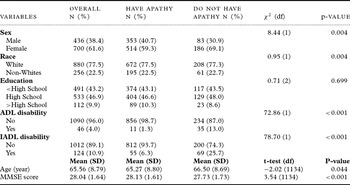
As indicated in Table 2, individuals with apathy at baseline were older (t (df = 1134) = -2.02; p = 0.044), more likely to be female (χ2 (df = 1) = 8.44; p-value = 0.004), more likely to be white (t(df = 1) = 0.95; p-value = 0.004), and to have had ADL (χ2 (df = 1) = 72.86; p<0.001) or IADL disabilities (χ2 (df = 1) = 78.70; p<0.001). Individuals who did have and those who did not have apathy at baseline did not differ in terms of education. Although the entire study sample had an MMSE score greater than or equal to 24 at baseline, since it was an inclusion criteria for the study, individuals who met the study's criteria for apathy had significantly lower mean MMSE scores than those who did not (t (df = 1134) = 3.54; p<0.001).
Baseline sociodemographic and clinical characteristics of study sample (N = 1136)

ADL = activities of daily living; IADL = instrumental activities of daily living; MMSE = Mini-mental State Examination.
χ2 = chi-square statistic; df = degree of freedom; SD = Standard Deviation; p = level of significance.
The association between apathy and cognitive decline at 1-year follow-up
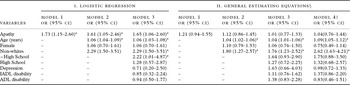
Individuals who had apathy had a greater likelihood of exhibiting cognitive decline at 1-year follow-up compared to those who did not have apathy (OR = 1.73; 95% CI = 1.15, 2.60) (Table 3). Using conventional multiple logistic regression analyses, this greater likelihood of cognitive decline in individuals who had apathy, compared to those who did not have apathy, persisted after adjustment for age and sex (Model 2), and age, sex, education, race, follow-up depression, and baseline ADL and IADL disabilities (Model 3: OR = 1.65; 95% CI = 1.05, 2.60).
Estimated odds ratios and 95% confidence intervals for the effect of apathy on cognitive decline at 1-year and 13- year follow-up in the ECA data (N = 1136)

*p-value < 0.05.
OR: Odds Ratio; CI: Confidence Interval.
†: Used 13 year follow-up data.
§ Used repeated measures for apathy, IADL, ADL, and depression (except for Model 3, where depression was only measured at Wave 2).
The GEE analyses, which included repeated assessments of apathy (baseline and one-year follow-up), accounted for the state characteristic of apathy. The significant relationship between apathy and cognitive decline was not observed in these models (Table 3: GEE Models 1–3).
The association between apathy and functional decline at 1-year follow-up
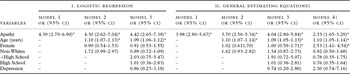
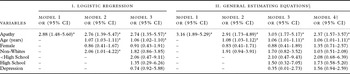
The risk of developing new IADL disabilities at 1-year follow-up was greater for individuals with apathy compared to those without apathy (Table 4, Logistic Regression Model 1; OR = 4.39; 95% CI = 2.79, 6.90). This increased risk remained after adjustment for age, sex, race, education, and follow-up depression (Table 4, Logistic Regression Model 3). Similarly, the risk of developing new ADL disabilities at the 1-year follow-up was greater for individuals with apathy compared to those without apathy (Table 5, Logistic Regression Model 1; OR = 2.88; 95% CI = 1.48, 5.60). This greater risk persisted after adjustment for age, sex, race, education, and depression at follow-up (See Table 5, Logistic Regression Model 3). The GEE analyses, which take into account the repeated measures and associated correlations, provided similar results (GEE models 1–3). More specifically, at one year follow-up, individuals who had apathy at baseline were more likely to have declines in IADL and ADL compared to those who did not have apathy even with adjustments for age, sex, race, education, and depression over time.
Estimated odds ratios and 95% confidence intervals for the effect of apathy on impairment in instrumental activities of daily living (N = 1136), ECA

*p-value < 0.05.
OR: Odds Ratio; CI: Confidence Interval.
†: Used 13 year follow-up data.
§ Used repeated measures for apathy, IADL, ADL, and depression (except for Model 3, where depression was only measured at Wave 2.
Estimated odds ratios and 95% confidence intervals for the effect of apathy on impairment in basic activities of daily living (N = 1136), ECA

*p-value < 0.05.
OR: Odds Ratio; CI: Confidence Interval.
†: Used 13 year follow-up data.
§ Used repeated measures for apathy, IADL, ADL, and depression (except for Model 3, where depression was only measured at Wave 2.
The effects of apathy on cognitive and functional decline at thirteen year follow-up
Baseline apathy was not predictive of cognitive decline at 13-year follow-up (Table 3, GEE model 4; OR = 1.04; 95% CI = 0.76, 1.44). On the other hand, individuals who had apathy at any point over the study (baseline, 1-year, 13-year follow-up) were more than twice as likely to have functional decline per IADL (Table 4, GEE model 4) and ADL (Table 5, GEE model 4).
Discussion
Apathy is prevalent in this sample of older adults, has a high incidence rate, and is stable in 46.4% of the sample at 1-year follow-up and in 8.2% at 13-year follow-up. It does not affect cognitive decline but is significantly associated with functional decline. In addition, age, race, and education were independent predictors of the risk of cognitive decline.
It is important to note the limitations of this study. The racial/ethnic composition of the Baltimore ECA study sample was mainly White and African-American and, as such, the results might not be generalizable to all racial/ethnic groups within the U.S.A. or globally. The use of GHQ items to assess apathy is a weakness since use of these items in this context has not been validated elsewhere or against existing apathy measures. However, the use of the psychiatrists’ ratings of apathy based on the SCAN items to validate the use of the GHQ apathy items lends credibility to the results, since it is validated against a clinical judgment. Furthermore, the use of the GHQ-apathy items allowed us to examine the prevalence, incidence, and correlates of apathy in a community-dwelling sample with a scale that was not designed for and validated in a clinical sample. In addition, the method used to identify functional decline was limited in that it was dichotomous and failed to capture the various levels of functioning. However, since the study involved secondary data analysis, the researchers had to make use of the available data set despite its limitations. The results however, provide support for the idea that apathy can negatively impact functional ability, as observed by other apathy researchers (Freels et al., Reference Freels1992; Starkstein et al., Reference Starkstein, Petracca, Chemeerinksi and Kremer2001; Lechowski et al., 2008).
Studies on apathy in older adults who were referred to an outpatient memory disorder clinic for neurological and neuropsychiatric assessments due to memory complaints have reported current prevalence rates ranging from 28.3% (Clarke et al., Reference Clarke, van Reekum, Simard, Streiner, Freedman and Conn2007) to 86.4% (Thomas et al., Reference Thomas, Clément, Hazif-Thomas and Leger2001). The prevalence of apathy observed in the current study (23.7%) is similar to that reported by Starkstein et al. (Reference Starkstein, Jorge, Mizrahi and Robinson2006) and Turró-Garriga et al. (Reference Turró-Garriga2009) in the existing longitudinal studies and lower than the range observed in clinic samples, likely reflecting the composition of this sample derived from a less cognitively impaired population. However, two studies on community-dwelling older adults using the Neuropsychiatric Inventory (NPI) to assess apathy have reported prevalence estimates between 17% and 37% for the subset of individuals with dementia (Lyketsos et al., Reference Lyketsos, Lopez, Jones, Fitzpatrick, Breitner and DeKosky2002; Onyike et al., Reference Onyike2007) and between 3.1% (Onyike et al., Reference Onyike2007) to 15% (Lyketsos et al., Reference Lyketsos, Lopez, Jones, Fitzpatrick, Breitner and DeKosky2002) for individuals with mild cognitive impairment (MCI). Therefore, the apathy estimate observed in the current study falls within the category of community-dwelling individuals with dementia. It is possible that the measurement used here to classify individuals as demented was not as sensitive as the measures used in the aforementioned studies. As such, despite our attempts to remove individuals with dementia at baseline (i.e. individuals with MMSE ≤ 23), it is likely that some individuals with borderline dementia or MCI/cognitive impairment no dementia (CIND) were misclassified as not having dementia. This assumption is supported by Kukull and colleagues (Reference Kukull, Larson, Teri, Bowen, McCormick and Pfanschmidt1994) who found that the MMSE cut-off score (≤ 23) had a sensitivity of 0.63 and a specificity of 0.96 in a community-dwelling sample with cognitive complaints. In addition, the variations of measures used to ascertain apathy status may account for the observed differences in the prevalence of apathy. Depression diagnosis and ADL and IADL impairment were associated with apathy; these results are in agreement with the current literature on apathy (Freels et al., Reference Freels1992; Lavretsky et al., Reference Lavretsky, Lesser, Wohl, Miller and Mehringer1999; Starkstein et al., Reference Starkstein, Petracca, Chemeerinksi and Kremer2001; Reference Starkstein, Jorge, Mizrahi and Robinson2006; Turró-Garriga et al., Reference Turró-Garriga2009).
The observed incidence of apathy at 1-year follow-up in individuals without apathy at baseline (22.6%) is similar to the 21.7% reported by Turró-Zarriga and colleagues (Reference Turró-Garriga2009) in which the NPI was used to ascertain apathy status. This finding lends support to the use of the GHQ-apathy related items to ascertain apathy status in the current study. The observation of persistent apathy in 46.4% of the sample at 1-year follow-up was slightly lower than the 51.7% ascertained with the NPI in the longitudinal study on apathy conducted by Turró-Zarriga and colleagues (Reference Turró-Garriga2009) or the 50% reported by Starkstein et al. (Reference Starkstein, Jorge, Mizrahi and Robinson2006) in which the 10-item Apathy Scale was used to ascertain severity of apathy. The fact that the study by Turró-Zarriga and colleagues consisted of individuals with mild to severe AD might account for the slight difference in the percentage of the two study samples with persistent apathy at 1-year follow-up. On the other hand, Lechowski and colleagues (Reference Lechowski2009), using the NPI to ascertain apathy status, found that only 22.1% of their sample of women with AD had persistent apathy at 18 months follow-up. The current study is the first to report the persistence of apathy at 13 years follow-up using a non-specialized clinical sample. Unfortunately, the number of individuals with persistent apathy at the 13-year follow-up was small (n = 22), and hence the study lacked the power to conduct in-depth inferential analyses. Given that apathy is highly prevalent across a number of disorders and related to significant cognitive and functional decline, it is important to identify and further characterize this high risk group (i.e. individuals with persistent apathy) in terms of sociodemographic, clinical, and genetic factors. An initial attempt at this line of research was carried out by Lechowski and colleagues (Reference Lechowski2009) in their study involving females with AD in outpatient care. They found that persistent apathy was associated with “rapid loss of autonomy in activities of daily living”. It would be important to know if these results extend to other dementia groups, males and general community samples.
Individuals who had apathy at baseline were more likely to experience functional decline in IADL and ADL at the one-year and 13-year follow-up compared to those who did not have apathy. This greater risk of functional decline in individuals who had apathy, which persisted despite adjustment for age, sex, race, education, and the changing state of apathy and depression, is consistent with results observed by Starkstein et al. (Reference Starkstein, Jorge, Mizrahi and Robinson2006), Turró-Zarriga et al. (Reference Turró-Garriga2009), and Lechowski et al. (Reference Lechowski2009)in their respective longitudinal studies. These more recent results advance our knowledge of the effects of apathy which had previously been based mainly on the observation of statistically significant associations in cross-sectional studies (e.g. Landes et al., Reference Landes, Sperry and Strauss2005; Onyike et al., Reference Onyike2007; Clarke et al., Reference Clarke2008). These cross-sectional studies have also indicated significant associations between apathy and poor cognitive functioning (Landes et al., Reference Landes, Sperry and Strauss2005; Onyike et al., Reference Onyike2007; Clarke et al., Reference Clarke2008). The existing longitudinal studies, albeit limited in that they utilized dementia patients in outpatient care at various dementia clinics, have provided supporting results that indicated a causal relationship between apathy and cognitive functioning (Robert et al., Reference Robert2006; Starkstein et al., Reference Starkstein, Jorge, Mizrahi and Robinson2006; Lechowski et al., Reference Lechowski2009; Turró-Zarriga et al., Reference Turró-Garriga2009). More specifically, such studies have shown that apathy at baseline was associated with significant decline in cognitive functioning at one-year follow-up. Although the current study also found a statistically significant relationship between apathy and cognitive decline at one-year follow-up, this was not observed at 13-year follow-up. Furthermore, the significant relationship between apathy and cognitive decline at one-year follow-up did not hold true when the changing state of apathy, depression, and functional status were taken into account using GEE analyses. The observations from this study might suggest the potential benefits of the reversal of apathy on cognitive functioning. Further investigations into the longitudinal relationship between apathy and cognitive functioning are needed.
The discrepancy between the results from this study and the existing longitudinal studies that have also taken into account the repeated measure of apathy could be related to the differences in how cognitive decline and apathy were measured. It is possible that the GHQ apathy-related items were not sensitive enough to capture all individuals with apathy (i.e. misclassification of individuals with apathy as non-apathetic), thereby diluting the measure of effect. Furthermore, survival bias and the observation of a transient apathy group (i.e. individuals with apathy at baseline but not at follow-up) might account for the lack of significant association between baseline apathy and cognitive decline at 13-year follow-up. In other words, it is possible that individuals with transient apathy sought treatment and the remaining individuals with apathy who survived through the 13-year follow-up interview were the healthiest of the stable apathetic group. This line of reasoning is supported by the observation that across apathy groups, those who died by the 13-year follow-up interview were, on average, seven years older and possibly had more health problems.
In summary, the current study supports the notion that apathy is an important predictor of functional decline and possibly cognitive decline in older adults. Given the high prevalence of apathy across a number of disorders, it is important to gain better understanding of apathy and its long-term impact on cognitive and functional status. This enhanced knowledge can improve treatment and prevention of cognitive and functional decline.
Conflict of interest
None.
Description of authors’ roles
Dr. Diana E. Clarke formulated the research questions, analyzed the data and was primarily responsible for writing the article. Jean Y. Ko conducted the literature searches and assisted in data analysis and manuscript preparation. Dr. Constantine Lyketsos provided consultation on the formulation of the research questions, as well as methodological advice and comments on the draft paper. Drs. George W. Rebok and William W. Eaton provided methodological advice and comments on the draft paper.
Acknowledgments
During this study, Dr. Clarke was supported by a Canadian Institute for Health Research Postdoctoral Fellowship Award (CIHR: 200602MFE-159564-115967), and in part by the Population Health Fellowship Award from the Department of Psychiatry at the University of Toronto. Drs. Eaton and Rebok are funded by the National Institute of Mental Health (NIMH: MH47447; NIDA grant DA026652). Jean Y. Ko is a PhD candidate in the Department of Mental Health, Johns Hopkins University School of Public Health, whose work was funded by the National Institute of Aging (NIA: 1F31AG030908-01-A1). Dr. Lyketsos is supported by the Johns Hopkins Alzheimer's Disease Research Center (P50-AG005146) and the Elizabeth Plank Althouse Endowment. We would like to emphasize that the views and opinions expressed herein are those of the authors and should not be taken to represent the views of any of the sponsoring organizations or agencies.