

Cornelius Cardew first encountered Ludwig Wittgenstein’s Tractatus logico-philosophicus around 1959, and by his own reckoning it made a ‘deep impression’ on him from the outset.Footnote 1 The Tractatus claims to solve the problems of philosophy by probing the logic and limits of language, and its austerely presented doctrines would preoccupy Cardew for the next few years,Footnote 2 encouraging his interest in new forms and uses of musical notation. This process culminated in Treatise, a gigantic graphic score consisting of 193 pages of ‘impeccable’ draughtsmanship,Footnote 3 which he explained was named after Wittgenstein’s book.Footnote 4
The accredited link between Treatise and the Tractatus has attracted some well-deserved commentary,Footnote 5 but the standard practice of excavating possible allusions to Wittgenstein’s text in the visual imagery employed by Cardew is bound to underplay broader connections. This article highlights the latter, thereby affording a more nuanced understanding of Cardew’s radical approach to notation in the 1960s. At the heart of the discussion is a striking concordance between the famous picture theory of the proposition, the centrepiece of the philosophy of language elaborated in the Tractatus, and Cardew’s views on the interpretation of his own symbolism during the first years in which he worked on his score. Others commenting on Treatise have mentioned the picture theory in passing, but their brief remarks reveal significant misunderstandings of Wittgenstein’s philosophy and a notable tendency to undervalue the formative role it played in shaping Cardew’s ideas.Footnote 6
The analysis presented below focuses exclusively on points of contact between Treatise and Wittgenstein’s early philosophy, published in German as ‘Logisch-philosophische Abhandlung’ in 1921 and then, a year later, in a German–English parallel edition bearing its more famous Latin name.Footnote 7 Others have posited correspondences between Treatise and Wittgenstein’s later thought (which emerged, in tandem with a rejection of many of his earlier convictions, after his return to philosophy in 1929), and indeed the overall course of his thinking between its early and later stages.Footnote 8 This article makes no mention of these further comparisons: revolving around a fundamentally different set of philosophical ideas,Footnote 9 they richly deserve their own review.
Background to the Treatise project
Treatise was first published in 1967 by Gallery Upstairs Press, a small publishing house based in Buffalo, NY, and in accordance with Cardew’s wishes no introduction or explanatory notes were provided.Footnote 10 Some years later, Cardew recalled that he had always intended the score to ‘stand entirely on its own, without any form of introduction or instruction to mislead prospective performers into the slavish practice of “doing what they are told”’.Footnote 11 This is confirmed by an otherwise odd-sounding remark in a letter dated 1 February 1963 (that is, around the time that he commenced working on the score), in which he prophesied that the new piece he had ‘in mind’ would be ‘nonexistent’. ‘I think I’ll call it Treatise,’ he continued; ‘that sounds nice & severe.’Footnote 12
One of Cardew’s pivotal ideas was that the use of visual imagery suggestive of conventional musical symbols would assist in evoking musical associations in a performer, thereby stimulating the process of interpretation.Footnote 13 He had already employed this device in Octet ’61 for Jasper Johns, but in Treatise he also made much freer use of a technique that he would subsequently describe as the ‘potential eloquence’ of simple black lines in diagrams.Footnote 14 Consequential associations were not meant to be restricted to those that Cardew himself had envisaged, meaning that his designs were always intended as connotative, never as prescriptive. This connotative dimension is highlighted in the explanatory notes provided with Octet ’61 for Jasper Johns, but in the first edition of Treatise, the notation was left to speak for itself; in this case, Cardew’s position was that explanations were not only unnecessary, but also ethically undesirable.
Commentators agree that the thought processes that culminated in Treatise were initiated by the so-called ‘Cage Shock’ that Cardew experienced in person at the Darmstadt new music courses in September 1958.Footnote 15 Recent work on the history of the courses has concluded that John Cage’s activities at this event destroyed the apparent collegiality of the leading Darmstadt composers by nurturing and exposing differences of ideology and approach, resulting in ‘open warfare’.Footnote 16 On a less political level, his lectures and the performances coupled with them also served to introduce the music of the New York School to many of those who attended. Various participants – including Cardew, it seems safe to assume – recognized the attitudes that underpinned this music as promising alternatives to the prevailing orthodoxy of serial control among the Darmstadt elite, for some of it was composed using chance operations, and much of it utilized non-standard musical notations and indeterminacy.Footnote 17 During the courses, Cardew befriended Cage and others in his circle who were also present, including Earle Brown and David Tudor.
It seems to have been these experiences that caused Cardew to question the role traditionally played by notation in Western art music, a turn of events that quickly led him to incorporate deliberately imprecise indications in his own output.Footnote 18 His perspective diverged from Cage’s, however. For Cage, the use of chance and indeterminacy were ways of circumventing the composer’s taste and memory, an outcome he deemed desirable because it ‘let sounds be themselves’.Footnote 19 Cardew’s interests were less esoteric: his focus was, instead, on giving greater freedom to the performer. As such, his viewpoint was closer to Brown’s and, arguably, more in tune with the climate of the times, which increasingly emphasized resistance to authority and the importance of individual freedom.Footnote 20 Thereafter, Cardew’s willingness to accept the creative input of others quickly increased and soon exceeded that of his American counterparts, for his interest in developing an elaborate notation that would suggest outcomes without prescriptive rules of interpretation went further than they had ventured, even though Cage had already experimented with a similar idea on a much more modest scale.Footnote 21 That said, Cardew seems to have regarded elements of Morton Feldman’s presentation and Christian Wolff’s general approach as foreshadowing his own prescriptionless ideal.Footnote 22
The first discernible traces of Cardew’s concept appear in a series of dated remarks that he set down in 1959–60, following his earliest contacts with Wittgenstein’s philosophy and after he had attended the next series of new music courses in Darmstadt in the autumn of 1959. At these, Karlheinz Stockhausen, Cardew’s employer at the time,Footnote 23 delivered his ‘Musik und Graphik’ lectures, focusing on newly composed works involving varying degrees of indeterminacy, and these seem to have given additional impetus to Cardew’s thinking.Footnote 24 For example, in notes that he recorded only a month after the event, he mooted the possibility of giving a performer ‘no rules whatever’ with a brand new notation (or novel use of conventional notation) ‘in the hope of waking him up’,Footnote 25 anticipating the strategy that he would eventually pursue in Treatise.
The fourth of Stockhausen’s five lectures that year included a lengthy discussion of Sylvano Bussotti’s Pièces de chair II, a song cycle for two voices and chamber ensemble that would not be finalized until 1960.Footnote 26 This discussion certainly provided Cardew with new food for thought, for he mentioned Five Piano Pieces for David Tudor (1959), which forms an extractable part of the song cycle, several times in his notes from this period.Footnote 27 The fact that Bussotti’s designs, in the three graphically notated pieces in the set, appear to succeed in suggesting musical outcomes, even though they are only line drawings, was one of the points that struck him most forcibly: ‘Drawings suggest their own interpretation,’ he wrote.Footnote 28 This is despite the fact that the drawings in question feature cryptic and occasionally paradoxical annotations,Footnote 29 a detail that Cardew interpreted as an attempt to attain ‘absolute’ (that is, total) indeterminacy.Footnote 30 Evidently, their use of recognizable musical symbols (staves, clefs and noteheads), albeit in highly unorthodox fashion, was partially responsible for their evocative character, and this was an approach that Cardew would go on to develop in Octet ’61 for Jasper Johns and then Treatise, in which considerably more distorted forms of conventional musical symbols were meant to assist in producing the same sort of connotative effect. It seems clear that he also connected the musically suggestive character of Bussotti’s presentation with the line-drawing format employed; this conviction was nurtured by his subsequent career as a graphic designer.Footnote 31
Cardew had serious reservations about Five Piano Pieces for David Tudor, however.Footnote 32 Foremost among these was that Bussotti had given priority to producing a musical notation that looks beautiful, but ‘a musical notation that looks beautiful is not a beautiful notation’;Footnote 33 Cardew’s view was that a notation must be functional above all else. Consequently, Bussotti’s designs were overly ‘aesthetic’;Footnote 34 not enough attention had been paid to evoking musical outcomes, which was hardly surprising, given that one of the three graphically notated pieces was based on an autonomous ink drawing prepared by him ten years previously that had only latterly been superimposed on staves. There was also an ontological problem that troubled Cardew. In his view, Bussotti’s designs did not amount to genuine notations; in the end, they were merely drawings. The problem, he felt, was that they did not lend themselves to a viable distinction between symbol types and tokens:Footnote 35
In the case of Bussotti it is important to remember that you are dealing with a drawing, not with writing, that you therefore require neither dictionary nor rules for its interpretation. But in a notation, as in writing, fluctuations of typography or handwriting should not prejudice its determinacy. An indeterminacy here would be the case where you ask ‘is that an A or an O?’, or in music ‘is that a line or a dot?’ (it’s no answer to say ‘it’s a mark, anyway’! That would again make it into a drawing).Footnote 36
Cardew did not explain why the type–token distinction was unsustainable in this case, but his reasons were surely connected with the general formlessness of Bussotti’s orthography, which makes it difficult to discern many recurring motifs other than those borrowed from conventional musical notation. Indeed, the only regularly repeated graphical elements are: straight and curved lines; arrows; irregular closed forms (filled and unfilled); and densely populated arrays of tiny dots. This lack of discernible variety creates an additional problem, for a restricted vocabulary is bound to limit a symbolism’s expressive power and consequent utility.Footnote 37 Cardew’s view seems to have been that graphic designs capable of serving as useful notations must include a richer vocabulary of readily identifiable recurring elements – hence his subsequent stress on the much larger number of symbols (67) on which Treatise is based.Footnote 38
It is no wonder that Cardew was drawn to the Tractatus during this period, for Wittgenstein’s book purports to reveal the logical basis of all forms of symbolic notation. This is accomplished by positing an utterly perspicuous essence that animates every conceivable language. The perspicuity of this infrastructure, or ‘skeleton’, as Anthony Quinton once characterized it,Footnote 39 is attributable to its perfect grammar, which entirely precludes confused expression, and its completely transparent mode of operation, for its workings cannot possibly be described. It is easy to imagine that this second aspect of Wittgenstein’s conception would have resonated with Cardew’s emerging ideas about connotative symbols. Given his preoccupation with the boundary between drawings and notations, its apparent saliency would have been further enhanced by the nature of the mechanism said to underpin the operation of the animating skeleton, for according to the Tractatus this mechanism is intrinsically pictorial in character.
The picture theory of the proposition
An entry recorded in Cardew’s notebooks in May 1961 includes a suggested method of making a ‘modern score’ more accessible:
The pre-publication history of a piece should be published along with the score […] A chronical [sic] of the first performance, the experience gained from it, subsequent changes listed, different aspects shown by different performances as available, reactions of conductors and players – all this could help to bring the music into focus. And by surrounding the score with apparently irrelevant details […] it would be possible to give it a sort of approachable personality.Footnote 40
Ten years later, Cardew’s vision would be realized in the guise of a Treatise Handbook, an eclectic compendium of notes, essays and other materials connected with the Treatise project. This handbook was made available in 1971 as a discrete publication, serving as an optional appendix to an impression of the original score now bearing the ‘Edition Peters’ logo. Peters Edition (or Hinrichsen Edition, as it was then known) had acquired the copyright to Treatise from Gallery Upstairs Press in 1970, having previously distributed the original impression on an agency basis in the UK, the British Commonwealth (excluding Canada) and Europe.
The publication of the Treatise Handbook discharged a long-standing ambition, but Cardew was nevertheless ambivalent about its appearance, as he was at pains to make clear in an introductory note. It was, he confessed, only with ‘great reluctance’ that he had allowed himself to be ‘persuaded’ to make it available. What had persuaded him, he said, was the prospect of including the score of Volo solo, an offshoot of the Treatise project, which he had struggled to place with a publisher.Footnote 41 Who had persuaded him is not certain, but it may have been Ed Budowski, the owner of Gallery Upstairs Press. In the period leading up to the publication of the first edition of Treatise, Budowski had argued that it would be ‘helpful’ if Cage contributed a ‘short introduction’,Footnote 42 which suggests that he was uncomfortable with Cardew’s preferred approach of issuing the score on a stand-alone basis. Budowski’s suggestion was duly abandoned,Footnote 43 but the idea of providing some form of guidance was not dropped entirely. In October 1967, the same month in which the original impression was finally issued, Cardew was already discussing the contents of a ‘“treatise handbook” consisting of working notes, documentation of performances and other material relevant to Treatise’ with Gallery Upstairs Press.Footnote 44 Cardew’s apparent lack of enthusiasm for the handbook assignment is hardly surprising, given its uncomfortable fit with the spirit of the Treatise project, which had previously been invested with the idea that the notation should stand altogether alone. This mismatch is a subject to which I will return, but the more pressing consequence of this turn of events is that it made available an indispensable resource that casts light on Cardew’s evolving ideas about Treatise over several years.
An early entry in the handbook, dated July 1963, states: ‘The score must govern the music. It must have authority, and not merely be an arbitrary jumping-off point for improvisation, with no internal consistency,’Footnote 45 but another comment, simply dated 1963, suggests a more onerous requirement: ‘NB the sound should be a picture of the score, not vice versa.’Footnote 46 In teasing out the implications of this overt reference to the celebrated picture theory of the proposition from the Tractatus, an initial survey of Wittgenstein’s views on picturing will be of service.
‘A picture is a model of reality,’ we are told at Tractatus 2.12.Footnote 47 This statement provides an early warning that Wittgenstein was operating with a conception of pictures that does not coincide with the ordinary use of the term ‘picture’ in English, a verdict confirmed by subsequent remarks. His concept encompassed three-dimensional models, such as tableaux vivants, and in this respect was more accommodating than everyday English usage and closer to that of the German word Bild (which he originally employed). In other respects, his concept was narrower, encompassing only pictures with representational properties and, among these, only pictures that have real subjects – actual persons, for example – to which they can be compared for accuracy. Therefore, abstract designs and pictures of generic subject matter are not covered by his theory.Footnote 48 Henceforth, the term ‘picture’ is used with its Wittgensteinian overtones unless otherwise indicated.
A picture features a number of elements that stand for objects, an association dubbed the ‘pictorial relationship’.Footnote 49 The picture is not merely a collection of these elements, however, for in the picture they are arranged; this arrangement is ‘the structure of the picture’, and it portrays a situation in which the objects are related to one another in a particular way.Footnote 50 The situation in question is the picture’s ‘sense’,Footnote 51 which differentiates Wittgenstein’s use of the term ‘sense’ from that of his guiding spirit Gottlob Frege, for whom a ‘sense’ was a mode of presentation of a referent.Footnote 52 Evidently, a picture conceived thus possesses a sense independently of its truth value; whether it is true or false depends upon whether it and, by implication, its sense agree with reality.Footnote 53 When the picture is correct, the situation that it portrays exists, and in this case it depicts a fact,Footnote 54 facts being the ultimate constituents of reality.Footnote 55
A corollary is that a picture is itself a fact, for it is identical with the fact that its elements are arranged as they are.Footnote 56 As such, it is unlike its elements, which are objects. This is a highly implausible thesis when applied to run-of-the-mill examples of pictures, as various commentators, including James Bogen and Michael Dummett, have pointed out,Footnote 57 for regular pictures are undoubtedly objects. By the same token, everyday examples were peripheral to Wittgenstein’s project of revealing the logical underpinnings of language, so it would be unwise to dismiss his position at this early stage; a commonly held view is that his picture theory is considerably less implausible as a theory of language than as one of things we ordinarily call ‘pictures’.Footnote 58 Part of Wittgenstein’s reason for classifying pictures as facts was that it enabled him to explain how a picture can present a situation that does not actually obtain, even though its elements can stand for objects only if they exist. It does so because the arrangement of elements may present a configuration of corresponding objects that differs from their configuration in actuality. For obvious reasons, this would prove useful both in explaining how the meaning of a proposition is independent of its truth value and in accounting for the nature of truth and falsehood.
Another thesis that was integral to Wittgenstein’s position was that there must be ‘something identical’ in a picture and the situation it presents.Footnote 59 In special cases, it is the relationship between constituent elements that is common to picture and pictured situation, and when this applies, ‘The fact that the elements of a picture are related to one another in a determinate way represents that things are related to one another in the same way.’Footnote 60 Wittgenstein’s notebooks from the period prior to the publication of the Tractatus include a famous example of this type: ‘As when in the law-court in Paris a motor-car accident is represented by means of dolls, etc.’Footnote 61 In this instance, the fact that the elements in the model (the dolls and so on) stand in certain spatial relationships to one another (in front of, behind, besides, under and so on) portrays the associated objects in the situation (the victims and cars) as spatially related in exactly the same way. When the relationships are identical, as here, Wittgenstein maintained that the picture and the pictured situation possess the same ‘pictorial form’, by which he meant that the picture elements are capable of standing in the very same relations as the objects that they stand for.Footnote 62
Every picture has a pictorial form, inherited from the materiality of its elements, this being the way in which those elements are capable of combining. Consequently, a picture can depict any possible situation built from objects capable of combining in exactly the same way, which thereby possesses the same pictorial form.Footnote 63 Ergo, ‘A spatial picture can depict anything spatial, a coloured one anything coloured, etc.’Footnote 64 Commentators are largely in agreement on these matters, but the interpretation of Wittgenstein’s position beyond them is disputed.Footnote 65 For example, it is not clear whether he conceived of the identity of pictorial form as a necessary condition of picturing.Footnote 66 His opening statement in Tractatus 2.15, which I have already quoted, suggests that he did,Footnote 67 as does Tractatus 2.17: ‘What a picture must have in common with reality, in order to be able to depict it – correctly or incorrectly – in the way it does, is its pictorial form.’ This is the line taken by James Griffin and Norman Malcolm,Footnote 68 but interpreted thus the theory seems unable to account for a multitude of familiar cases; in a figurative painting of three-dimensional objects, pictorial form, understood as above, is plainly not shared.
A now popular solution to this apparent impasse was foreshadowed in commentaries by Geoffrey Warnock and Elizabeth Anscombe issued in the late 1950s,Footnote 69 but was made considerably more precise in a controversial study of the Tractatus by Erik Stenius published in 1960, soon after Cardew became interested in Wittgenstein’s ideas.Footnote 70 This alternative reading maintains that identity of pictorial form is not a prerequisite of picturing, for in some cases the relationship between the picture elements may merely correspond to the relationship between the objects they stand for, a position that accommodates figurative paintings because they utilize the laws of perspective in presenting three-dimensional space. According to this view, the common element – the ‘something identical’ – in picture and situation is merely an abstract structural property, which Wittgenstein calls their ‘logical form’.Footnote 71 Both interpretations of Wittgenstein’s position converge on this important point, for the more literal reading of his words requires identity of pictorial form and logical form, whereas the less exacting proposal, championed by Stenius, requires identity of logical form only.
The idea of a mere correspondence between picture and pictured situation appears vague, but Stenius made it sharp by invoking the idea of an isomorphism,Footnote 72 which he based on the mathematical concept bearing the same name.Footnote 73 For Stenius, picture and situation correspond when they are isomorphic, and this transpires when there is a general rule that establishes a one-to-one correspondence between possible configurations of elements in the picture and possible configurations of the objects associated with them by the pictorial relationship.Footnote 74 A rule of this type can exist only if two conditions are met: there must be a one-to-one correspondence between objects in the world and elements in the picture; and there must be a one-to-one correspondence between possible arrangements of the objects in question and possible arrangements of picture elements.
Textual evidence that supports this reading appears at Tractatus 4.014–4.0141, which argues that:
A gramophone record, the musical idea, the written notes, and the sound-waves, all stand to one another in the same internal relation of depicting that holds between language and the world […] There is a general rule by means of which the musician can obtain the symphony from the score, and which makes it possible to derive the symphony from the groove on the gramophone record, and, using the first rule, to derive the score again. That is what constitutes the inner similarity between these things which seem to be constructed in such entirely different ways. And that rule is the law of projection which projects the symphony into the language of musical notation. It is the rule for translating this language into the language of gramophone records.Footnote 75
That is to say, these very different phenomena are capable of serving as pictures of each other because there are structural similarities between them, and these similarities facilitate reliable translation from one to the other and back again, by way of a ‘general rule’ or ‘law of projection’. This position certainly supports the idea that Wittgenstein’s views on picturing were grounded not in identity of pictorial form, but in isomorphism.
My reason for dwelling on this particular quotation is that it forms part of the most elaborate reference to music in Wittgenstein’s book. It is hardly surprising, then, that it attracted Cardew’s attention, so much so that he went on to quote from it in the closing stages of the Treatise Handbook. Footnote 76 This is significant for current purposes because it justifies the assumption that Cardew’s reading of the picture theory would have been broadly in agreement with the one that lies closest to the surface in this passage, thereby aligning his interpretation with that of Stenius, whether or not he was familiar with Stenius’s views.
The sound should be a picture of the score, not vice versa
I shall start to address the resonances between the picture theory and the Treatise project by focusing on Wittgenstein’s contention that ‘musical notation’ is ‘a picture of music’,Footnote 77 which is easily misunderstood as claiming that the score functions as a picture of the physical sounds that are played in an error-free performance.Footnote 78 Facilitating performances is, of course, one of several functions that conventional musical notation may discharge,Footnote 79 but it was surely not this function that Wittgenstein was contemplating. His focus was elsewhere, on the role played by the score in recording a musical idea, for it is only in this capacity that the notation has representational properties. Only thus is it like a picture in being answerable to a range of facts – namely, those that concern the composer’s intentions – that make it correct or incorrect, true or false. When the score serves to facilitate a performance, it cannot be regarded analogously, for in this normative capacity it is not accountable to facts and is therefore not assessable as correct or incorrect. The resulting performance does represent, however. This is because it is answerable to the score, which it follows accurately or inaccurately – that is, correctly or incorrectly. Although Wittgenstein did not refer to this facet of performances, it is reasonable to suppose that he would have regarded them as pictures of scores for this reason.
Turning to the score of Treatise, the functions discharged by its notation are more circumscribed, for Cardew’s official line was that the score is ‘not representational’.Footnote 80 What he meant was that it does not record a musical idea, not because of any inherent deficiency, but because it was simply not intended to perform that role. Given that Treatise is not answerable to a musical idea, it cannot be assessed as correct or incorrect; that being so, it is unlike conventionally notated music in not being a picture.
The sole purpose of Cardew’s score is to facilitate performances: it is simply ‘a way of making people move’, as he put it.Footnote 81 Therefore, its performances will be pictures of the score for precisely the same reason given above in connection with renderings of conventionally notated music, but only provided that certain preconditions of picturing laid down by the Tractatus are met. Consequently, Cardew’s charged statement that ‘the sound should be a picture of the score, not vice versa’ is both an injunction, addressed to himself, that the score should not be made answerable to a musical idea, and a directive, addressed to potential interpreters, that in performing Treatise the preconditions of picturing the score ought to be met.Footnote 82
Undoubtedly, this perspective on Treatise elevates the status of the score in the musical process. In more conventionally notated music, the composer’s musical idea is primary, for the score is answerable to the idea, as is the performance, albeit indirectly, by virtue of its being answerable to the score. With Treatise, this chain of accountability is truncated because the score is not representational and, therefore, not answerable to a musical idea. Thus, the score is primary, for the performance is accountable to the score, whereas the score is not similarly accountable.Footnote 83
The idea that a performance of Treatise should be a Wittgensteinian picture of the score certainly implies that there should be a systematic connection between sounds and symbols. Hence Cardew’s call for ‘consistency’ in the entry in the handbook dated July 1963, quoted above (see above, note 45), and his insistence, in another entry, dated simply 1963, that symbols ‘be interpreted in the context of their role in the whole’.Footnote 84 It implies more than this, however. To count as a picture of the score, the performance must also be related to his designs by a nexus of one-to-one correlations. Clearly, relationships of this type are unlikely to be present unless an appropriately tight set of rules was used in systematically deriving the performance from the score. Therefore, Cardew’s official position in 1963, as he began work on Treatise, was that an interpreter should begin by selecting a set of basic symbolic elements, as well as a set of rules for translating them into mutually exclusive outputs.
This reading of Cardew’s position during the early stages of the Treatise project receives support from an entry in the handbook, dated December 1963, describing a ‘practical attempt’ at interpretation, which begins:
Take the enclosed spaces and divide them into the following categories: triangles, circles, circle derivatives […], squares, square derivatives […], irregular enclosures. Musical categories can be matched up with these: triads, trills, irregular tremolos, periodicities, deviating periodicities, clusters that disintegrate in the direction of whatever shape is closest. Dynamics for all shapes can be determined thus: horizontal dimension gives the degree of loudness; vertical dimension gives the degree of dynamic contrast.Footnote 85
The remaining comments describe an intricate, rule-based procedure for interpreting triangles as triads, and this procedure is the focus of interest.
Cardew’s explanations begin by concentrating on triangles with at least one side that is vertical or horizontal. These are classified as left-orientated or right-orientated if a vertical side is present, and top-orientated or bottom-orientated when there is a horizontal side. His scheme of translation begins thus:
left-orientated – all three elements [of the triad] have equal dynamics,
top-orientated – all three elements [of the triad] have equal duration,
right-orientated – the three elements [of the triad] span two equal intervals,
bottom-orientated – all three elements [of the triad] are in the same register.Footnote 86
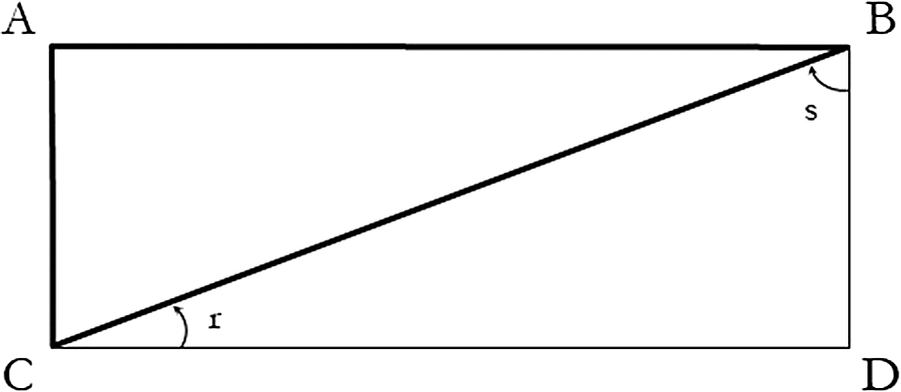
This scheme leaves it unclear whether the configuration specified on the right-hand side of each rule can apply in cases that do not satisfy the condition specified on the left-hand side, whereas a faithful analogue of Wittgenstein’s picture theory must insist that they cannot, or else it will not be possible to infer pertinent diagrammatic elements from interpretative outputs. However, Cardew’s comments also specify an elaborate method for gauging the extent to which the properties of the triad deviate from those outlined above, based on the angular deviation of sides that are neither vertical nor horizontal from vertical and horizontal axes. To see how this works, it will be useful to start with the simplest case, involving a triangle that possesses both vertical and horizontal sides, such as ABC in Figure 1. This particular example is left-orientated and top-orientated, meaning that Cardew’s scheme correlates it with a triad in which all three elements have equal dynamics and identical durations. To determine its intervallic span and internal organization, we are asked to complete the rectangle ABDC and then to use the angular deviation of BC from the vertical and the horizontal as our guide: the larger the deviation (r) from the lower horizontal, the greater the extent to which the triad deviates from the bottom-orientated case – that is, the bigger its intervallic span; and the larger the deviation (s) from the vertical on the right, the greater the extent to which the triad deviates from the right-orientated case – that is, the bigger the disparity between the widths of its two internal intervals. This establishes precisely the kind of mutually exclusive relationship between aspects of symbols and aspects of sounds required by the picture theory. Not only does it ensure that the condition specified on the right-hand side of each rule given above cannot apply unless the condition specified on the left-hand side is met, but it also allows an observer to infer specific properties of a triangle – namely, the orientation of the side that is neither horizontal nor vertical – from properties of the triad.
Schematic diagram of triangle (ABC) with one vertical side and one horizontal side.

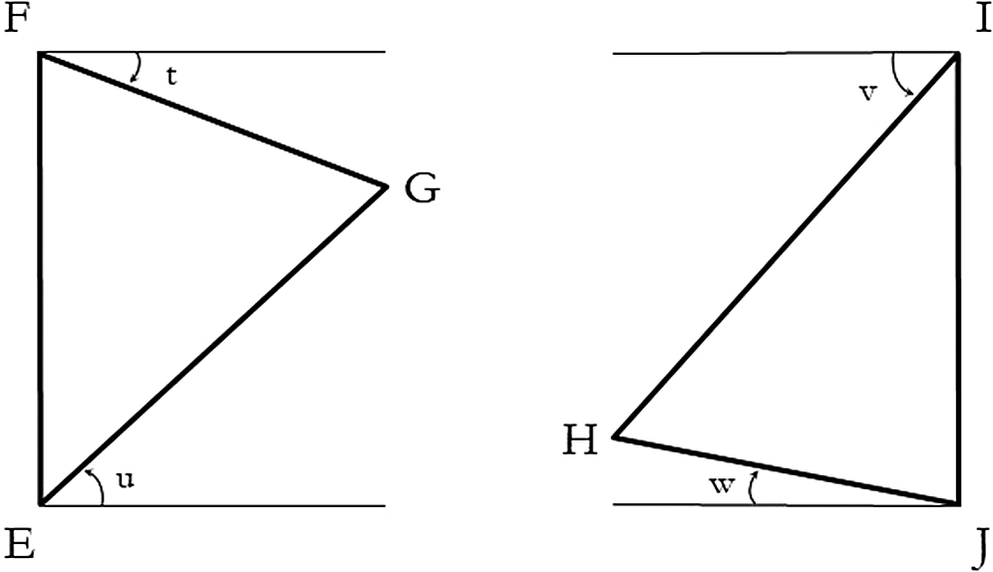
An assessment of Cardew’s position is complicated by his treatment of other cases. Beginning with triangles in which only one side is vertical or horizontal, his method gives no indication of the extent of the deviation from one of the four rules, and his conclusion is that this rule may or may not be applied. Thus, a triangle that is only left-orientated, like EFG in Figure 2, indicates degrees of deviation (t and u) from the rules for horizontally orientated examples, but it provides no information about the application of the rule for right-orientated cases. Similarly, a triangle that is only right-orientated, like HIJ, which also indicates degrees of deviation (v and w) from the two horizontally based rules, is silent about the application of the rule for left-orientated cases. This indeterminacy means that a triad that satisfies both rules for vertically orientated triangles – that is, a triad having equal internal intervals and equal dynamics – is permitted by Cardew’s interpretation, even though it will be impossible to infer from the sound whether the associated triangle is left-orientated or right-orientated. Redundancy of this sort is commonplace in natural languages and conventional musical notation, but it is a defect to be avoided from the standpoint of the picture theory.
Schematic diagrams of triangles (EFG and HIJ) with one vertical side.

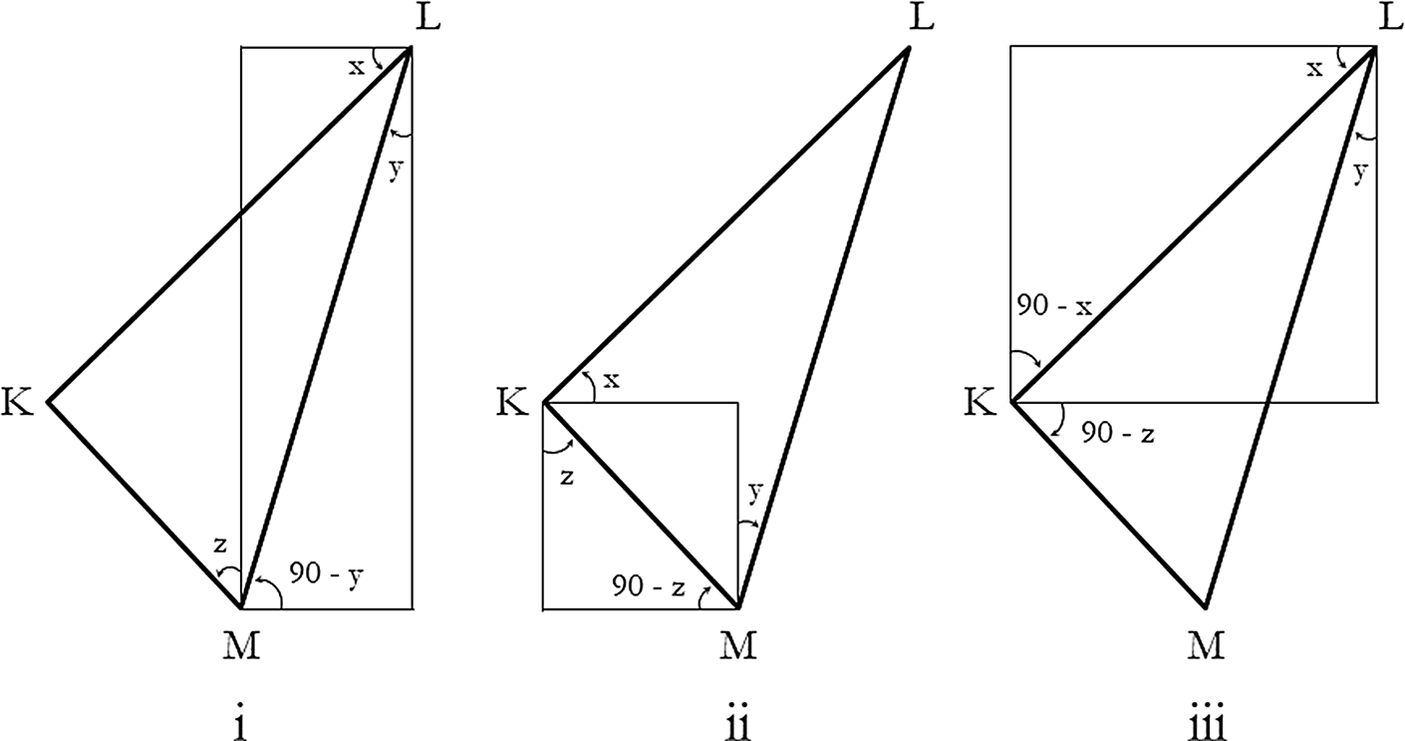
A different, and arguably more damaging, issue emerges from Cardew’s treatment of triangles lacking vertical or horizontal sides, for in these cases his method of measuring angular deviations delivers three overlapping, but nevertheless distinct, sets of angles for each triangle. This is because it envisages three different ways of constructing horizontal and vertical axes for use in measuring angular deviations. These are shown in Figure 3, which superimposes labels on the triangles and measuring frames actually used in his demonstration. Perhaps he was under the impression that all three constructions deliver the same geometrical outputs, a thought encouraged by his unfortunate choice of an illustrative case in which many of the significant angles (x, z, 90−x and 90−z) are similar in magnitude (around 45 degrees), but if so he was mistaken, for the three different possibilities are highlighted in Table 1. From the perspective of the picture theory, this is another type of defect – namely ambiguity – and its presence results in the association of three different triads with each triangle. It also generates additional redundancy because each set of four angles is shared by other triangles, meaning that once again it will not be possible to read off properties of the triangle from aspects of the triad.
Schematic diagrams of triangle (KLM) without horizontal or vertical sides.

ANGULAR DEVIATIONS FROM HORIZONTAL AND VERTICAL SIDES IN FIGURE 3
| Deviation (degrees) | |||
|---|---|---|---|
| Case i | Case ii | Case iii | |
| Top-orientated axis | x | x | x |
| Bottom-orientated axis | 90−y | 90−z | 90−z |
| Left-orientated axis | z | z | 90−x |
| Right-orientated axis | y | y | y |
The skeleton
Wittgenstein’s views on picturing outlined above form only a preamble to his main project, which was to apply them to language or, it would be truer to say, to that portion of language that was his sole concern at this time, namely descriptive statements in the indicative mood. Stenius proved an unreliable guide as to how this was to be achieved, and I will largely ignore his views henceforth.Footnote 87 In presenting the bare bones of Wittgenstein’s position, I will follow his order of exposition, beginning with an initial sketch, developed in connection with surface features of ordinary language, which is then applied in more rigorous fashion at the level of the underlying skeleton, where it fits seamlessly with his atomistic ontology.
Wittgenstein’s pivotal idea was that ‘a proposition is a picture of reality’, in precisely the sense outlined previously.Footnote 88 It is not merely a ‘medley of words’;Footnote 89 instead, it is a specific arrangement of signs that ‘go proxy for’ elements in the world,Footnote 90 and it is the relationship that holds between these signs that says that the designated elements stand in a corresponding relation.Footnote 91 This idea is summed up in a famous remark: ‘Instead of, “The complex sign ‘aRb’ says that a stands to b in the relation R”, we ought to put, “That ‘a’ stands to ‘b’ in a certain relation says that aRb.”’Footnote 92 According to this view, the symbols ‘a’ and ‘b’ in ‘aRb’ function in radically different fashion from ‘R’: whereas ‘a’ and ‘b’ deputize for entities, ‘R’ is not a symbol that goes proxy for anything, but merely an aspect of the physical arrangement of ‘a’ in relation to ‘b’, an arrangement that can be characterized by saying that ‘R’ is immediately to the right of ‘a’ and immediately to the left of ‘b’.Footnote 93 The implication is that, logically speaking, ‘R’ is redundant, for the same situation could also be presented by a purely spatial arrangement of ‘a’ in relation to ‘b’. Although Wittgenstein does not say this, the latter would seem to be preferable because it is less likely to mislead us into thinking that a putative fact with two elements has three.
At first sight, this approach appears inapplicable to many propositions of ordinary language, even if we follow the early Wittgenstein in restricting our attention to those in the indicative mood. However, this is not a good reason for concluding with Bertrand Russell that the Tractatus is concerned only with ‘the conditions which would have to be fulfilled by a logically perfect language’,Footnote 94 an interpretation now customarily rejected. Wittgenstein’s true position was that the appearance of mismatch is generated by inadequacies in the surface forms of regular sentences, which conceal their underlying structure, an insight he had derived from Russell’s own theory of descriptions.Footnote 95 According to the Tractatus, this underlying structure can in principle be revealed by linguistic analysis, even though in practice this may prove extremely difficult, or even humanly impossible, to achieve – hence the fact that it contains no fully analysed examples.Footnote 96
At this regularly hidden but fundamentally more important level of language in which every proposition is ‘completely analysed’,Footnote 97 Wittgenstein distinguished between elementary propositions,Footnote 98 which function exactly as indicated above, and all other propositions, which are truth functions of elementary propositions.Footnote 99 This strategy must be shown to accommodate cases involving generality and also reconciled with the existence of ostensibly non-extensional occurrences of propositions in ordinary discourse.Footnote 100 In addition, it raises the question of whether non-elementary propositions are themselves pictures; here, Wittgenstein’s statement that ‘the totality of true thoughts is a picture of the world’ argues in favour of an affirmative response.Footnote 101 The constituent elements of an elementary proposition are ‘simple’ (that is, unanalysable) signs that Wittgenstein calls ‘names’;Footnote 102 these deputize for ‘objects’, to which they have been assigned, not by means of intermediary definitions, but directly.
From this point onwards, the word ‘object’ is employed not in the loose way in which I have used it thus far, as an alternative to ‘entities’ or ‘things’, but as a technical term denoting simples, the existence of which Wittgenstein inferred using a transcendental deduction from the fact that we are capable of forming pictures of the world.Footnote 103 These objects are indestructible and unchanging,Footnote 104 but much else about them is left unclear, for no concrete examples are provided; it seems that Wittgenstein’s view at the time was that their categorical status was a subject for empirical enquiry.Footnote 105 There is a venerable tradition of taking them to include particulars only, thereby excluding universals from their ranks,Footnote 106 but even this very general claim has been disputed.Footnote 107 Nonetheless, it is clear that objects are unlike facts, which might have been different, because objects could not have been other than what they are.Footnote 108
Each elementary proposition is a ‘concatenation […] of names’,Footnote 109 and the arrangement of names within it ‘asserts the existence of a state of affairs’ in which corresponding objects ‘fit into one another like the links of a chain’.Footnote 110 The putative configuration of objects is the sense of the proposition, which is independent of its truth value, and it is knowledge of this sense that constitutes understanding;Footnote 111 this is equivalent to saying that understanding consists in knowing what is the case if the proposition is true.Footnote 112 Finally, states of affairs presented by elementary propositions are mutually independent in that no elementary proposition implies the truth or falsity of any other elementary proposition.Footnote 113 This must be the case, Wittgenstein reasoned, because entailment is a mark of internal complexity in the antecedent, which must in some way ‘contain’ the consequent.Footnote 114 It was this requirement of mutual independence that was the first that he would go on to reject in due course,Footnote 115 heralding the repudiation of the picture theory and the beginning of his later philosophy.Footnote 116 Nevertheless, before then, the perceived strength of the edifice resided in its ability to explain a range of puzzling features of languages and language mastery.Footnote 117
Reading pages left to right, in sequence
The illustrative interpretation of triangles from the Treatise Handbook described above concerns one aspect of their interpretation as pictures: the association of symbols with sounds. Within the picture theory, this association is the pictorial relationship, which forms only part of an applicable law of projection, for there is more to making a Wittgensteinian picture than correlating objects with picture elements. A picture is not merely a medley of signs, but a specific arrangement of signs (of ‘a’ relative to ‘b’ in ‘aRb’), and it is this arrangement that says that the designated objects stand in a corresponding relation. Converting signs-for-sounds into a picture of a musical idea, or sounds-for-signs into a picture of a musical notation, necessarily involves laying down a convention about which arrangements of signs will be associated with which arrangements of corresponding sounds, and Cardew’s commentary on triangles is silent on this issue.
It is small wonder that he did not feel the need to address this matter directly, for the score of Treatise is designed to invite the use of one, and only one, such convention – namely, that the sequence of sounds in time matches the spatial sequence in which the signs appear when the score, or a group of consecutive pages excerpted from it, is read from left to right in page order. To be clear, my suggestion is not that his graphic notation insists on being read as proportional, a claim that is certainly untrue (‘Remember that space does not correspond literally to time’Footnote 118); it is instead that the notation cries out to be read as if it were a single line of writing, such that the given order of appearance of symbols, judged by dropping perpendiculars to the horizontal axis, is mirrored in the temporal ordering of associated sounds.
An initial indication that this was Cardew’s intent is provided by a review of the physical disposition of the published score, for unlike many comparable publications, which consist of loose-leaf sheets to be consulted in any order, Treatise is presented in a spiral-bound book, consisting of numbered pages in number sequence. Equally noteworthy is the fact that the printing is double-sided. This is important, not only because it deters disassembly, but also because it results in pages being displayed side by side in pairs. This mode of presentation subverts perception of individual sheets as framed pictures.Footnote 119 Given that many of Cardew’s designs extend across multiple page boundaries,Footnote 120 the resulting juxtaposition also serves to emphasize the score’s very pronounced linearity, as does the presence of the thick horizontal line – the so-called ‘life-line’ – that runs through the middle of many pages, thereby heightening the impression that they form parts of a continuous run.Footnote 121 These factors encourage the interpreter to read pages in the given sequence as loose narrative structures, or ‘arguments’, in Cardew’s terminology.Footnote 122
That pages are ‘to be read in sequence and from left to right’ is also the most consistently reiterated injunction in the Treatise Handbook. Footnote 123 A weak reading of this formulation demands only that score pages be read consecutively, beginning with the lowest numbered page in the sequence, the edict ‘from left to right’ being taken merely as an indication of the required ordering of pages. This squares with Cardew’s descriptions of pre-publication performances in a résumé included in the handbook, which reveal that the participants always rendered a single group of consecutive pages, or else two or three groups of consecutive pages drawn from different locations within the score, with each group being presented as a discrete section or performance (Table 2).Footnote 124 Occasionally, however, Cardew was clear that he also expected a left-to-right trajectory within pages. For example, he once compared Treatise with ‘a lengthy work of prose’,Footnote 125 which makes little sense if individual sheets can legitimately be scanned to and fro, like maps and pictures. John Tilbury recalled that Keith Rowe adopted a non-linear approach to interpreting individual pages in early performances (‘He looked at it more like a picture’),Footnote 126 but Cardew’s silence on this matter speaks volumes given that a purpose of the handbook was to highlight certain performance strategies as ‘available’.Footnote 127
PAGES RENDERED IN PERFORMANCES DESCRIBED IN THE TREATISE HANDBOOK
| Year | Month | Pages performed | Location | Performers (including conductor if present) |
|---|---|---|---|---|
| 1964 | June | 57–60, 75–9 | Florence | Sylvano Bussotti, Cardew, Italo Gomez, Mauricio Kagel, Frederic Rzewski |
| 1965 | May | 89–106 | Walthamstow | Clem Adelman, David Bedford, Cardew, Roger Smalley, John Tilbury, John White |
| September | 45–64, 74, 89–127 | Stratford | Cardew, Peter Greenham, Keith Rowe, Kurt Schwertsik, John Surman, Tilbury | |
| October | 107–26 | Watford | Cardew | |
| 1966 | January | 107–26 | London | Bedford, Cardew, Greenham, Rowe, Tilbury, John White |
| February | 89–142 | Paris | Bedford, Cardew, Tilbury | |
| February | 89–129 | Leeds | Cardew, Robin Page, 15 art students | |
| September | 45–88 | Warsaw | Bedford, Cardew, Zygmunt Krauze, Tilbury | |
| December | 1–20 | Buffalo | Carlos Alsina, Maryanne Amacher, Edward Burnham, Cardew, Jean Dupouy, Makoto Michii, William Penn, Andrew White, Jan Williams, Klaus von Wrochem, Paul Zonn | |
| December | 1–44 | New York City | Alsina, Amacher, Burnham, Cardew, Dupouy, Michii, Penn, Andrew White, Williams, von Wrochem, Zonn | |
| 1967 | January | 107–16 | London | Bedford (assisted by Francine Elliott), Tilbury |
| April | 1–193 | London | Bedford, Cardew, Lou Gare, Krauze, Egon Mayer, Page, Eddie Prévost, Rowe, Laurence Sheaff, Surman, Tilbury, John White | |
| May | 1–193 | York | Cardew, Ranulf Glanville, Page, Rowe, Tilbury, John White | |
| September | 1–44 | Prague | Jan Hynčica, Pavel Kondelík, Petr Kotik, Josef Vejvoda, Václav Zahradník |
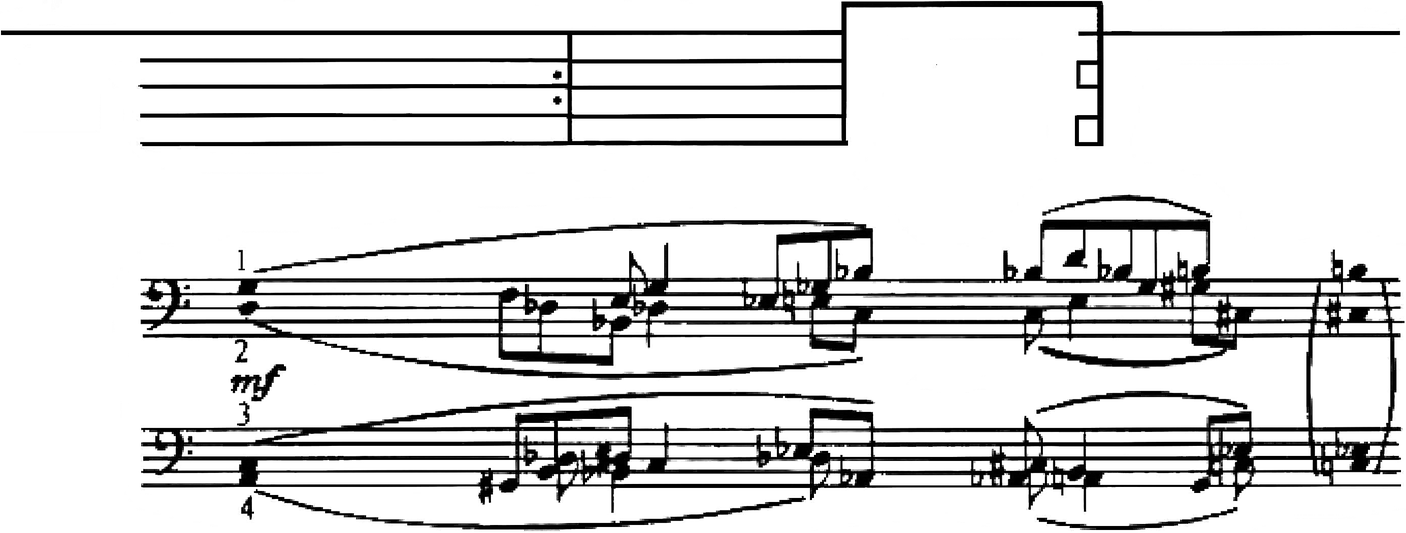
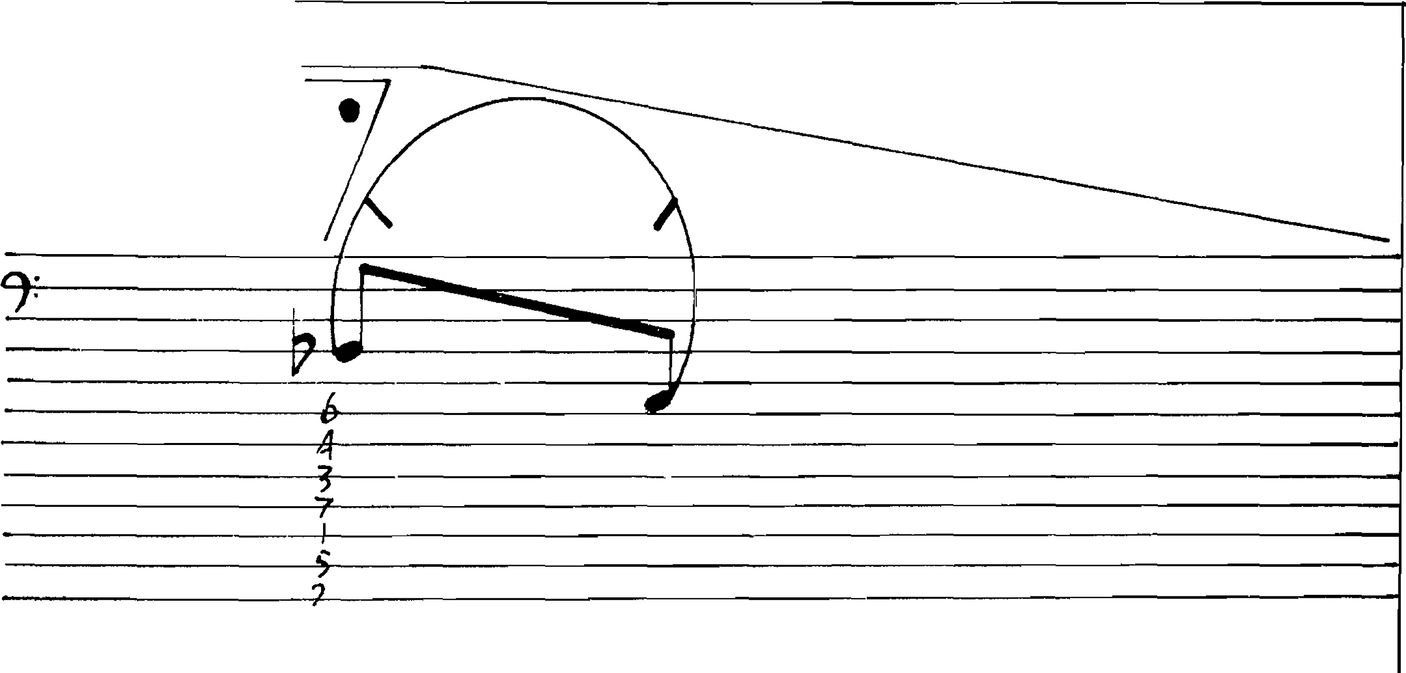
The résumé also includes other materials which confirm that Cardew was thinking along the lines just sketched. These include a ‘provisional instruction sheet’ for a trombone quartet, which had been scheduled to play in a 1966 performance of pages 45–88 in which, however, it did not ultimately take part.Footnote 128 Cardew’s directions, which are solely concerned with the interpretation of five-line staves, specify that each performer should begin by appropriating one line as their exclusive province. Then, on encountering a stave, they play an arbitrarily chosen note. Thereafter, they read their line from left to right, watching for points of intersection with other diagrammatic elements. On encountering an intersection, a new note or group of notes is played, with the intervallic progression from the previous note being chosen in accordance with a key supplied by Cardew. This key links the magnitude and direction of intervallic change to geometrical properties of the intersection. An illustrative application of this procedure, reproduced in Example 1, is also included.Footnote 129
Excerpt from Cardew’s ‘provisional instruction sheet’ for a trombone quartet, showing a section from p. 45 of Treatise above a conventionally notated realization.

A gloss below the figure explains that the first chord in the realization consists of arbitrarily chosen notes, while the last chord (in parentheses) ‘is used for the commencement of the next occurrence of the 5-line stave’.Footnote 130 The focus of interest is the intervening material, however, for it is immediately apparent that the realization of each set of intersections commences directly below its location in the corresponding graphics. Thus, the temporal ordering of the musical events in the realization matches the spatial sequence of intersections when Cardew’s graphics are read from left to right.
The importance of reading pages from left to right in the given sequence was an unchanging point of reference for Cardew, but his comments in the résumé reveal that some of his other views on interpretation altered over time. This can be illustrated by a survey of his stance on the synchronization of performers. To begin with, he described a rendition in February 1966 as having gone ‘astray’ because one of the participants (Tilbury in this case) ‘was two pages behind most of the time’.Footnote 131 This verdict implies that synchronization was intended, but it is initially unclear whether this reflects Cardew’s general position, in which case he regarded synchronization as a constitutive property of the work at this stage, or, alternatively, a more circumscribed constraint intended to apply only in this particular case, presumably because synchronization had been previously agreed by those playing. His descriptions of subsequent performances certainly point in the direction of the former. One performance, later the same month, featured an elaborate set-up in which a conductor moved his baton along a coloured and enlarged score ‘to keep everyone together’,Footnote 132 surely an attempt to avoid a repeat of the Tilbury ‘issue’, whereas another, in December 1966, involved the performers following predetermined beats marked by a conductor and turning their pages when he turned his.Footnote 133 However, Cardew’s comments on performances from the following year reveal a progressive softening in his position. Thus, a rendering of pages 107–16 in January 1967 is said to have allowed exactly five minutes per page, but no mention is made of synchronization within pages being obligatory.Footnote 134 Finally, a performance of all 193 pages in May that year is described as follows: ‘Each player read the score in his own time […] No co-ordination was attempted.’Footnote 135
The virtues of coordination from the vantage point of the picture theory are readily apparent, for it ensures that individual contributions remain constituent parts of a unified picture of the score. Once synchronization is abandoned, information about the relative placing of symbols played by different musicians is no longer embedded in the performance, meaning that the unity of the picture is compromised. Each participant will then produce a different picture of the score, and if the symbols played differ, it will be impossible to reconstruct the relative locations of all symbols. Even so, it is possible to accommodate the resulting disunity within the framework laid down by the picture theory, provided that we regard the amalgam of individual performances as a composite picture. Viewed in this way, the situation invites comparison with a particular strain of non-elementary propositions – namely, those analysable as conjunctions of elementary propositions.
Volo solo
Volo solo, composed by Cardew in 1965 while he was studying in Rome, is one of two compositions known to be progeny of Treatise, the other being the somewhat earlier Bun no. 2 for orchestra (1964).Footnote 136 Both are of considerable interest in the current context, for they might be expected to shine further light on Cardew’s methods of interpreting his graphics. Yet neither has betrayed details of its parentage. Tilbury explained the dilemma faced by the would-be analyst of Bun no. 2:
It is not difficult to ‘construe’ instances of correspondence [with Treatise], but it is when a more rigorous and ongoing analysis of the relationship is attempted that we flounder in a sea of compromise and self-deception; perhaps it is no more than the lineaments of the relationship between the two works that can be determined with any degree of confidence.Footnote 137
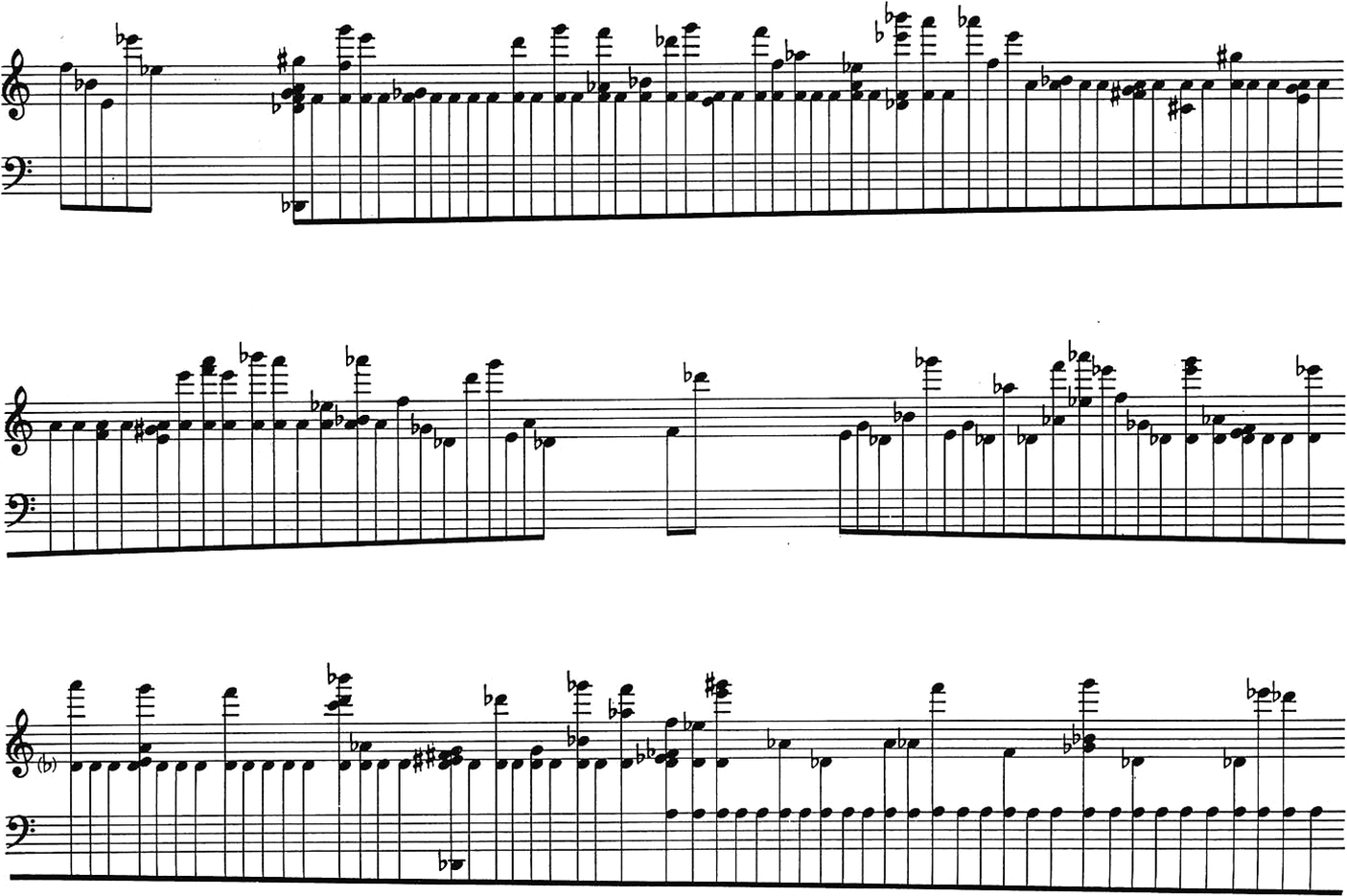
There are superficially compelling reasons for focusing any search for the lineaments in question on Bun no. 2, and for disregarding Volo solo. The ostensibly decisive point is that the source material from Treatise that underpins Bun no. 2 is not only extant, but also readily identifiable, for Cardew’s explanatory notes state that all but two of its sections were based on Treatise ‘pp 45–51 (middle)’, whereas the identity and whereabouts of the source material for Volo solo are considerably more difficult to discern. Even so, there are countervailing analytical considerations that urge the obverse course, pursued here, of focusing on Volo solo. Foremost among these is the singular austerity of its presentation, for the score consists of a solitary line of unadorned notes, dyads and chords, all possessing the same relative time value, which are barred into groups of vastly different size, separated by pauses, as in Example 2. This solitary line presents the one or more performers with a considerable challenge,Footnote 138 for each musician is charged with playing it – or, alternatively, a reduction that omits pitches impossible to play on their instrument – as fast as physically possible. (‘The instrument should seem to be breaking apart.’Footnote 139) Be that as it may, there are very few parameters for the analyst to focus upon – only pitches, intervals and barring – and this economy curtails the range of possible correspondences with Treatise. Contrast this situation with the much greater diversity present in the notation of Bun no. 2, which includes 23 instrumental parts that make use of many of the standard resources of conventional staff notation and a few special symbols to boot.
Cornelius Cardew, Volo solo, published edition, p. 5.

Cardew’s explanatory notes state that Volo solo ‘contains (with a few trivial alterations connected with the gaps, which feature in Treatise as numbers) the entire formal scheme of Treatise transliterated into well-tempered pitches’. Herein lies a seemingly insurmountable obstacle that confronts any attempt to reconstruct the transliteration process, for these same notes indicate that Volo solo was composed in February 1965, that is, two full years before Treatise was finally completed. Cardew’s testimony elsewhere suggests not only that Treatise was incomplete at this stage, but also that many of the pages that existed in draft form at this time were destined for future revision:
Early in 1963 […] I began sketching what I soon came to regard as my Treatise and pressed quite quickly ahead to what is now page 99 […] later, in Buffalo in November 1966 I felt it necessary to completely re-compose the first 44 pages […] The apparent musicality of page 99 seemed a stumbling block that impeded my way for some time to come […] In Rome in the first months of 1965 I pushed ahead to page 143, putting it into fair copy as I went along, with the exception of the ‘black pages’ which I did not finalise until much later.Footnote 140
Let us tentatively assume (although it is by no means certain) that Cardew composed Volo solo after completing work on pages 100–43, meaning that at this stage in the Treatise project he had a draft of pages 1–143. His chronology suggests that the first 44 pages of this draft differed from those in the published edition to an undisclosed extent, as did the ‘black pages’. These ‘black pages’ definitely included pages 130–5 of the published edition, on which black circular forms predominate, but there is reason to think that they also included pages 136–8, on which black shading is present, but less pronounced. The evidence that supports this conclusion emerges from a review of materials that Cardew forwarded to Cage in January 1966, following the latter’s request for manuscripts for possible inclusion in a book that he and Alison Knowles were then compiling. These materials, which are now part of the ‘Notations Project’ collection at Northwestern University, include sketches of nine pages of Treatise, one of which duly appeared in the aforementioned volume.Footnote 141 There are a number of minor differences between these sketches, which correspond to pages 130–8 of the published edition, and their published versions, but a more telling observation emerges from a review of their versos, for they are all drawn on what appear to be photographic copies of pages taken from a pre-publication version of Volo solo. Unlike the published edition of Volo solo, which is engraved, these earlier materials are presented in Cardew’s own handwriting. Five sheets are duplicates, meaning that this repository includes copies of four distinct pages from Cardew’s handwritten manuscript. Their musical contents are almost identical to those of the corresponding elements in the published edition: only one of more than 1,000 notated pitches differs and the only other disparities are insignificant, for they derive from a slight mismatch between the divisions of materials among pages.Footnote 142 We can conclude that pages 130–8 from Treatise are the black pages referred to by Cardew, and that they post-dated the composition of Volo solo. Therefore, at least 53 pages of the 143-page draft of Treatise that Cardew had in his possession when composing Volo solo differed from those that were subsequently published.Footnote 143 The fact that none of these earlier materials appears to have survived would seem bound to impede any attempt to reconstruct his scheme of transliteration.
In attempting nevertheless to do just that, a useful starting point is Tilbury’s observation that Volo solo utilizes only 67 of the 88 pitches available on a piano.Footnote 144 In fact, 68 pitches are used in the published edition of the score, for a lone instance of c′′′′ – the highest pitch present – appears in the third system on page 2. That said, the isolated character of this particular note and its displacement by two semitones from the next highest pitch (b♭′′′) marks it out as an anomaly, for the 67 ‘core’ pitches form an uninterrupted chromatic field (E′–b♭′′′) and are instanced much more frequently. Furthermore, there is reason to believe that the outlier may have been unintended. The corresponding page does not appear in the materials that were cannibalized by Cardew and sent to Cage, but a complete copy of Cardew’s handwritten manuscript at the British Library, which includes the cannibalized materials, has an instance of a′′′ in the corresponding location.Footnote 145 This suggests that the single instance of c′′′′ may have been a copying error that emerged during the engraving process, possibly because of the superabundance of leger lines.
The presence of 67 core pitches is highly suggestive, given that Cardew testified that his Treatise designs feature exactly 67 different symbols. Tilbury did not dwell on this numerical agreement, which he certainly recognized,Footnote 146 but in view of Cardew’s interest in the picture theory of the Tractatus, a credible diagnosis is that he assigned a different pitch to each symbol, thereby establishing the pictorial relationship that would duly serve in a picture. This verdict is consistent with his comment in the handbook that, ‘The tones of Volo Solo are the nucleus of the piece.’Footnote 147 In view of the importance that Cardew placed on reading Treatise score pages in order and from left to right, an initially credible hypothesis is that he worked systematically through his draft, from beginning to end, notating a specific pitch in Volo solo whenever he encountered an instance of the symbol previously associated with it. The ubiquity of dyads and chords in the transliteration is readily explained, for it seems clear that he would have notated a simultaneous group whenever he encountered corresponding symbols that straddle the same horizontal location.
This hypothesis tallies with one of the most striking features of Volo solo, which is that most of the longer barred groups of notes include lengthy strings of repeated pitches, for there are many passages in Treatise in which Cardew returned time and time again to the same symbol: the ‘f’ motif on pages 23–9, the small rectangle on pages 65–71 and the minor arc of a circle on pages 80–5 are just a few of very many examples. Cardew referred to this aspect of Treatise in an interview published in the newspaper International Times in February 1968, in which he spoke of a formal scheme that had served to regulate his compositional process: ‘There’s a master plan for this piece (TREATISE) which determines where certain elements are going to preponderate … all these elements are joined up at more or less regular intervals … (as) constellations of elements, deformed shapes.’Footnote 148 Although this ‘master plan’ appears to have been lost, Cardew’s description of it as specifying where certain elements would predominate fits with the obsessive reiteration of symbols in some passages in the finished score and with the presence of hefty repetition in Volo solo.
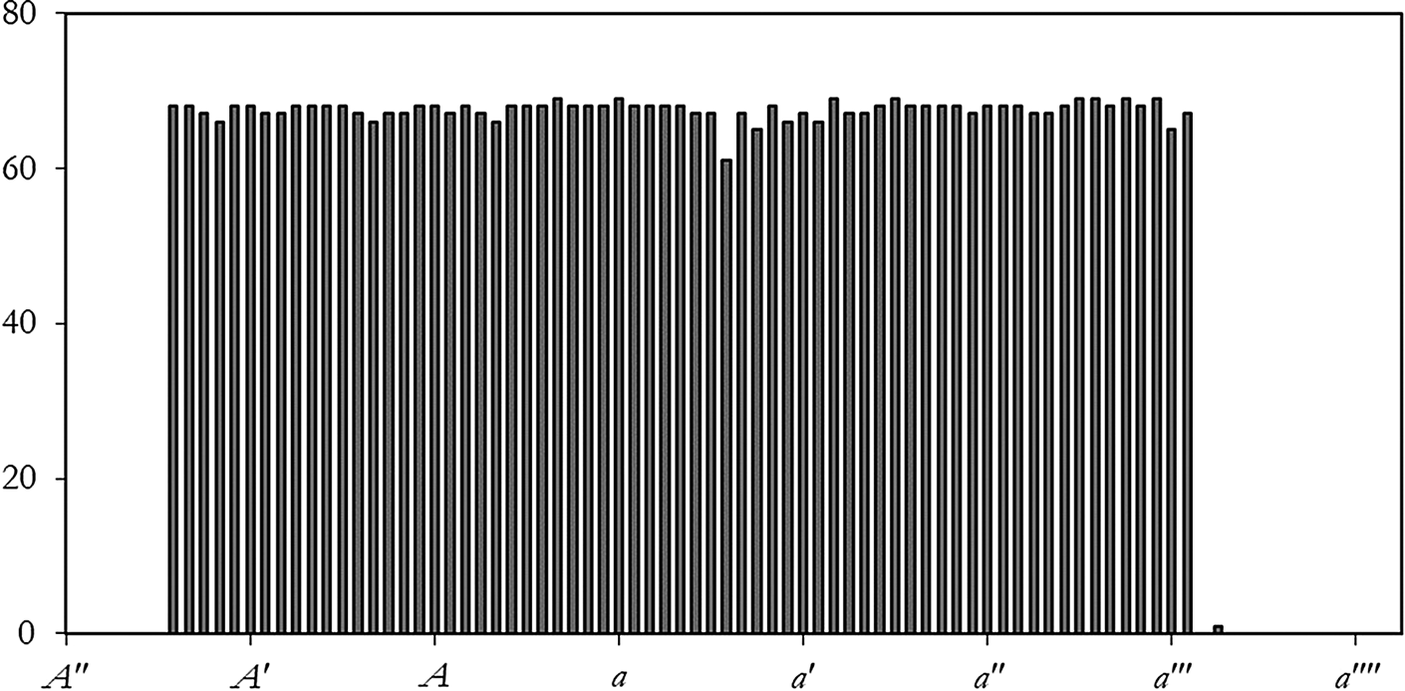
This neat outline is compromised by the discovery of further numerical concordances that are considerably less easy to discern. One of these emerges from a review of the distribution of individual notes between pitches. Here we encounter another surprising numerical agreement, for most pitches are instanced on 67 or, even more frequently, 68 occasions. In other cases, the number of occurrences diverges only minimally from these figures, the sole exceptions to this rule being e′, which is instanced 61 times in the engraved edition and 62 times in the handwritten manuscript, and c′′′′, which is instanced just once in the former but not at all in the latter, as previously mentioned. The distribution found in the published edition is displayed in Figure 4. The raw data for the two sources are very similar, but both sets are presented in Table 3.Footnote 149 As elsewhere in this section, differences between the spellings of enharmonic equivalents are ignored.
Cornelius Cardew, Volo solo, published edition, distribution of notes by pitch.

VOLO SOLO: DISTRIBUTION OF NOTES BY PITCH
| Pitch | Occurrences | Pitch | Occurrences | Pitch | Occurrences | Pitch | Occurrences |
|---|---|---|---|---|---|---|---|
| c′′′′′ | 0 | d′′′ | 68 | e′ | 61 (62) | F♯ | 67 |
| b′′′′ | 0 | c♯′′′ | 67 | d♯′ | 67 | F | 66 (67) |
| b♭′′′′ | 0 | c′′′ | 67 | d′ | 67 (68) | E | 67 |
| a′′′′ | 0 | b′′ | 68 | c♯′ | 68 | D♯ | 68 |
| g♯′′′′ | 0 | b♭′′ | 68 | c′ | 68 | D | 68 |
| g′′′′ | 0 | a′′ | 68 | b | 68 | C♯ | 68 |
| f♯′′′′ | 0 | g♯′′ | 67 | b♭ | 68 | C | 68 |
| f′′′′ | 0 | g′′ | 68 | a | 69 | B′ | 67 |
| e′′′′ | 0 | f♯′′ | 68 | g♯ | 68 | B♭′ | 67 |
| d♯′′′′ | 0 | f′′ | 68 | g | 68 | A′ | 68 |
| d′′′′ | 0 | e′′ | 68 | f♯ | 68 | G♯′ | 68 |
| c♯′′′′ | 0 | d♯′′ | 69 | f | 69 | G′ | 66 (67) |
| c′′′′ | 1 (0) | d′′ | 68 | e | 68 | F♯′ | 67 |
| b′′′ | 0 | c♯′′ | 67 | d♯ | 68 | F′ | 68 |
| b♭′′′ | 67 | c′′ | 67 | d | 68 | E′ | 68 |
| a′′′ | 65 (66) | b′ | 69 (68) | c♯ | 66 | D♯′ | 0 |
| g♯′′′ | 69 (70) | b♭′ | 66 (68) | c | 67 (68) | D′ | 0 |
| g′′′ | 68 | a′ | 67 | B | 68 | C♯′ | 0 |
| f♯′′′ | 69 | g♯′ | 66 (67) | B♭ | 67 | C′ | 0 |
| f′′′ | 68 | g′ | 68 | A | 68 | B′′ | 0 |
| e′′′ | 69 (68) | f♯′ | 65 (66) | G♯ | 68 | B♭′′ | 0 |
| d♯′′′ | 69 | f′ | 67 | G | 67 | A′′ | 0 |
Note: Where figures for the published edition differ from those for the manuscript, the latter appear in parentheses.
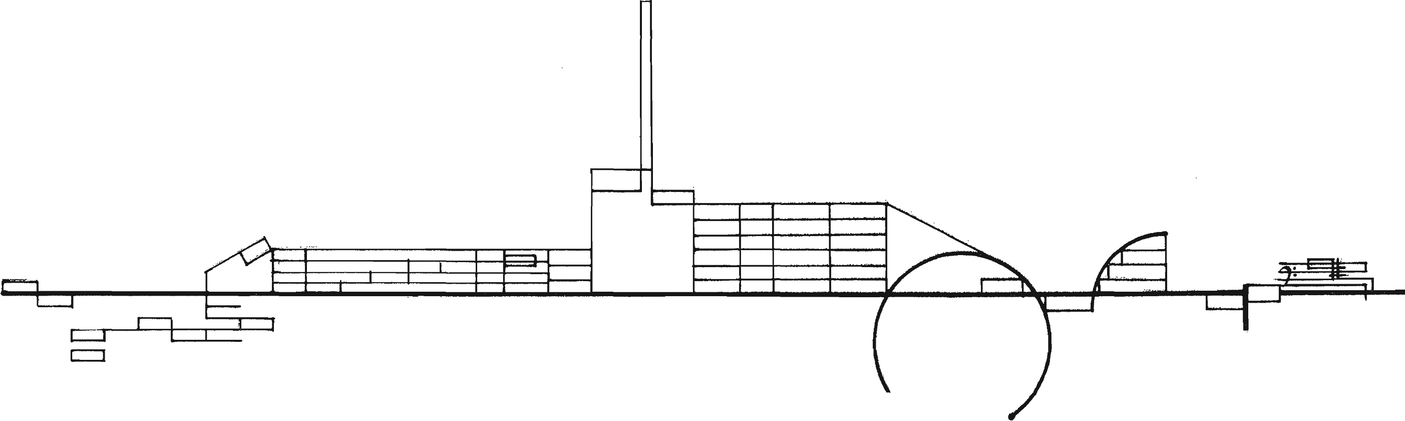
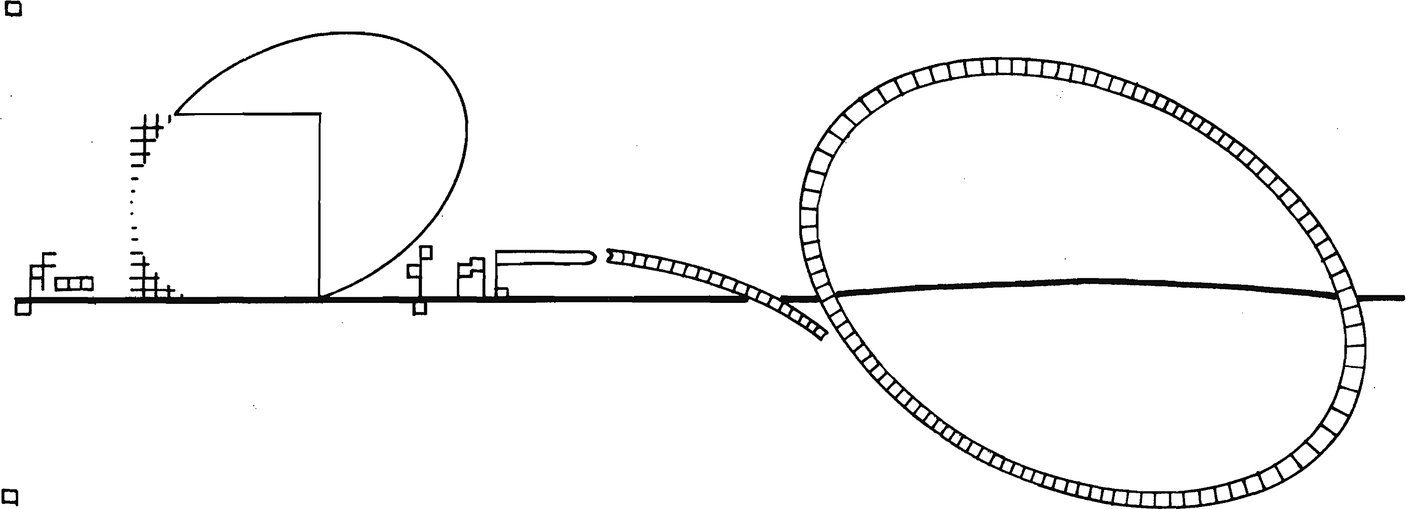
The fit between this new concordance and the provisional outline of the transliteration process described above appears poor, for it seems most unlikely that there were exactly this many occurrences of each symbol in Cardew’s draft of Treatise. One argument that rules against such a scenario is that Treatise was, at this stage, far from complete, whereas a geometrically organized outcome, involving 67 or 68 occurrences of 67 pitches, would seem much better suited to a finished product. Moreover, a review of the published edition of Treatise suggests that some symbols are instanced on many more than 60-odd occasions. Example 3, which is excerpted from a page that Cardew’s chronology suggests was already included in his draft when he composed Volo solo,Footnote 150 supports this assessment, for the quasi-architectural design shown is built from component parts that include 67 small rectangles. This new accord is probably significant in its own right, but the salient point here is this: given that there are several other similar rectangles elsewhere on the same page, and many on nearby pages, we can safely assume that the number of occurrences of symbols was not capped at 67.
Cornelius Cardew, Treatise, p. 66, excerpt.

No doubt the provisional outline could be adjusted to accommodate these points, albeit with some loss of credibility, but rather than undertake this exercise, it will prove more efficient to shift the focus of the discussion onto a numerically organized aspect of the use of repetition in Volo solo that will force upon us a quite different view. The best place to begin is with this observation: for each core pitch, there is one and only one string of repetitions; consequently, there are 67 strings in total. In making this statement, I am using the term ‘string’ in a liberal way, not only because in my usage it covers strings as short as two consecutive pitches (b♭′′′), but also because in five much longer cases (G′, d′, f♯′, g♯′ and b♭′), the string that appears in the published edition is not strictly speaking a single continuous run of repeated pitches, but two, for the run is interrupted by a single alien element. Thus the b♭′ string, shown in Example 4, is interrupted by a lone instance of a♭′′. This intrusion appears in a dyad with G♭′, which forms part of an uninterrupted string of repetitions that commences in the previous system (not shown). The onsets of the F and G strings are also seen in this example.
Cornelius Cardew, Volo solo, published edition, p. 2, system 2.

It is distinctly possible that the five interruptions within strings were unintended. None of them is replicated in Cardew’s manuscript, which always includes an additional note that belongs to the relevant string at the corresponding location. Thus G♭′/b♭′/a♭′′ replaces the aforementioned dyad, meaning that the interrupted string of 25 instances of b♭′ in the published edition appears as an uninterrupted string of 26 instances in the handwritten source. This disparity between the two sources is certainly noteworthy, but it will not be necessary to adjudicate between them for current purposes.
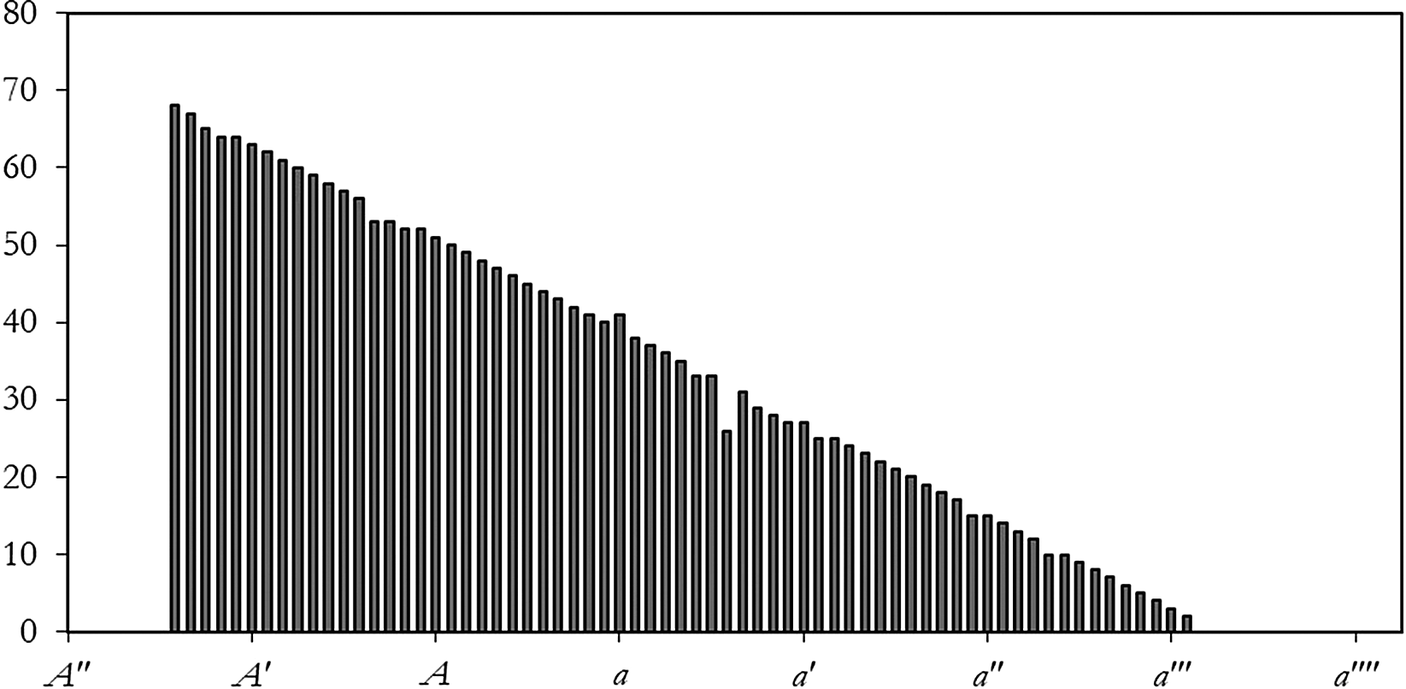
In the published edition and the manuscript, most of the continuous and momentarily interrupted repetitions have different lengths, and it is in these that a hidden organization lies buried. The covert structure is made manifest in Figure 5, which presents the length of each string of repetitions in the published edition in pitch sequence. The raw data for both sources appear in Table 4.Footnote 151 It can be seen that the pitch with the shortest string of repeated occurrences (only two in this case) is the highest core pitch (b♭′′′), whereas the pitch with the longest string of repeated occurrences (68) is the lowest core pitch (E′); between these extremes, the length of the string of repeated occurrences progressively increases as we proceed from higher to lower pitches. Evidently, the frequency with which pitches are repeated was predetermined by Cardew using a scheme very similar to the one shown in the figure.
Cornelius Cardew, Volo solo, published edition, number of repeated notes in strings of repetitions by pitch.

VOLO SOLO: NUMBER OF REPEATED NOTES IN STRINGS OF REPETITIONS BY PITCH
| Pitch | Occurrences | Pitch | Occurrences | Pitch | Occurrences | Pitch | Occurrences |
|---|---|---|---|---|---|---|---|
| c′′′′′ | 0 | d′′′ | 10 | e′ | 26 | F♯ | 53 |
| b′′′′ | 0 | c♯′′′ | 10 | d♯′ | 33 | F | 53 (54) |
| b♭′′′′ | 0 | c′′′ | 12 | d′ | 33 (34) | E | 56 |
| a′′′′ | 0 | b′′ | 13 | c♯′ | 35 | D♯ | 57 |
| g♯′′′′ | 0 | b♭′′ | 14 | c′ | 36 | D | 58 |
| g′′′′ | 0 | a′′ | 15 | b | 37 | C♯ | 59 |
| f♯′′′′ | 0 | g♯′′ | 15 | b♭ | 38 | C | 60 |
| f′′′′ | 0 | g′′ | 17 | a | 41 | B′ | 61 |
| e′′′′ | 0 | f♯′′ | 18 | g♯ | 40 | B♭′ | 62 |
| d♯′′′′ | 0 | f′′ | 19 | g | 41 | A′ | 63 |
| d′′′′ | 0 | e′′ | 20 | f♯ | 42 | G♯′ | 64 |
| c♯′′′′ | 0 | d♯′′ | 21 | f | 43 | G′ | 64 (65) |
| c′′′′ | 0 | d′′ | 22 | e | 44 | F♯′ | 65 |
| b′′′ | 0 | c♯′′ | 23 | d♯ | 45 | F′ | 67 |
| b♭′′′ | 2 | c′′ | 24 | d | 46 | E′ | 68 |
| a′′′ | 3 | b′ | 25 | c♯ | 47 | D♯′ | 0 |
| g♯′′′ | 4 | b♭′ | 25 (26) | c | 48 | D′ | 0 |
| g′′′ | 5 | a′ | 27 | B | 49 | C♯′ | 0 |
| f♯′′′ | 6 | g♯′ | 27 (28) | B♭ | 50 | C′ | 0 |
| f′′′ | 7 | g′ | 28 | A | 51 | B′′ | 0 |
| e′′′ | 8 | f♯′ | 29 (30) | G♯ | 52 | B♭′′ | 0 |
| d♯′′′ | 9 | f′ | 31 | G | 52 | A′′ | 0 |
Note: Where figures for the published edition differ from those for the manuscript, the latter appear in parentheses.
My initial hypothesis was that Cardew’s method of composing Volo solo involved him working through an incomplete version of Treatise from left to right, notating a pitch on encountering the associated symbol, but this idea is very difficult to square with the systematic organization of pitch repetitions outlined above. The signal issue is, once again, connected with the incomplete state of Treatise at this stage, but is now more acute, because even if we are prepared to accept the idea that Cardew grouped symbols within his designs in this way, it seems inconceivable that, with only two thirds or so of the score in hand, he would have already dispensed all of the major repetitions. Evidence for this conclusion emerges from a review of Treatise pages 144–93, which Cardew’s testimony suggests post-date the incomplete draft,Footnote 152 for these include numerous examples of incessant repetition.
The solution to this seeming impasse emerges from a rereading of Cardew’s description of Volo solo as containing ‘the entire formal scheme of Treatise transliterated into well-tempered pitches’.Footnote 153 A tacit assumption hitherto has been that the ‘entire formal scheme’ was none other than the structure of his incomplete draft as of February 1965, but another possibility, which now looks considerably more likely, is that it was the entire formal scheme of the still unfinished score, already laid out in the master plan that Cardew subsequently referred to in his International Times interview (see above, note 148). Volo solo is, I suggest, a transliteration of this schematic plan, and the extent to which it may also count as an indirect transliteration of the finished score depends upon the authority he vested in the plan, which is uncertain.
In all probability, the master plan was only a schematic outline; this explains why Cardew could not simply read off Volo solo once the pictorial relationship was established. The plan specified where ‘certain elements’ would ‘preponderate’,Footnote 154 but it seems unlikely that it would have stipulated how many instances of each symbol would eventually appear, for example; hence Cardew’s idea of mirroring the number of symbols in the number of instances of each pitch. This strategy, if perfectly executed, would have delivered 4,489 pitches, an outcome he may have regarded as satisfactory because it implied an acceptable range of performance durations given a provisional assumption about the average number of individual pitches per attack (the actual figure is 2.0) and his own ‘as fast as possible’ delivery at the keyboard. Presumably, the rule of projection replicated the planned sequence in which symbols were to predominate, set out in the master plan, in the actual sequence in which repetitions of associated pitches appear in the transliteration; but how it delivered the locations of the non-repeated pitches is unclear. The idea of differentiating between repetitions of different pitches using the simple arithmetic rule articulated in Figure 5 was not only a neat way of ensuring variety in the finished transliteration, but also a means of importing an arithmetical structure that complemented the highly symmetrical principle (67 x 67/68) around which the entire work was based.
This remarkably proportional structure is also reflected in a further aspect of Volo solo: as Tilbury noted with evident surprise, the beaming of chords results in a total of 68 groups.Footnote 155 A review of this new concordance reveals that each string of repeated notes is placed within the same beamed group, which is hardly surprising given the central role played by the repetitions in the transliteration process. It also reveals that segregating these strings was not deemed of similar importance: beamed groups often include multiple strings of repeated pitches that do not overlap, which could therefore have been annexed. Equally apparent is a rough mirror symmetry in the beaming, most clearly manifest in the fact that the work opens and closes with beamed groups of particularly small size. A systematic principle underpinning the given organization into groups is difficult to discern, however. The surmise that the beaming was dictated by a system of aggregate completions is incorrect,Footnote 156 as is the similar idea that the commencement of a new beamed group was linked to a rotating list of symbols: both methods would have left readily identifiable traces in the transliteration that are demonstrably absent. The idea that a Cagean ‘micro-macrocosmic’ rhythmic structure might be present is encouraged by the discovery of the 67 x 67/68 principle underpinning the entire work, but is quickly dismissed because the shortest groupings contain only a single pitch; they thereby lack the requisite internal structure.Footnote 157
Perhaps Cardew simply proceeded ‘by eye’ or ‘by ear’, carving up the materials dictated by his master plan and his rule of projection into chunks as he felt fit, while remaining minded to finish up with a total of 68 groups, an outcome that was evidently intended to enhance the symmetrical proportions of the finished work. However, a more compelling hypothesis is available. In my version of this history, Cardew’s control of the beaming was, in actuality, only indirect. Although the presence of exactly 68 beamed groups is certainly noteworthy, I maintain that it was the 67 spaces between them that were the real focus of his attention. He alluded to these spaces in an explanatory note published with the score of Volo solo, from which I have already quoted, which states that it contains ‘a few trivial alterations connected with the gaps, which feature in Treatise as numbers’. Thus, the locations of the ‘gaps’ were to be read off from indications given in the master plan about the expected distribution of numbers. How this was achieved is unclear, but it is no wonder that ‘a few trivial alterations’ to the theoretically determined outcomes were necessary, for it seems inevitable that, on occasion, they would have conflicted with his strategy of beaming repetitions within the same group.
There are a number of outstanding questions that concern the existence of the many minor deviations from my schematic reconstruction of Cardew’s method. Some were probably errors in execution, but it seems safe to assume that others were deliberate perturbations from the highly symmetrical underlying scheme. Trying to decide which is which, and why the perturbations were introduced, would in all probability prove a thankless task unless new source materials, such as the master plan itself, were to come to light.
A definitive assessment of the status of Volo solo as a Wittgensteinian picture is impossible in the absence of the master plan, but certain tentative conclusions are warranted. Much depends upon which features of the transliteration are regarded as picture elements. If each individual note is regarded thus, then Volo solo is probably not a picture of the master plan, for it seems unlikely that the latter would have included detailed information about the location of non-repeated symbols. Unless this information was originally present, the locations of non-repeated notes cannot be traced back to the plan via a rule of projection. That said, the transliteration may still count as a fully fledged picture of one possible realization of the plan, with minor inadequacies attributable to the concessions made in beaming, even though it would almost certainly be wrong to equate this realization with the published edition of the score of Treatise.
A different perspective emerges if we regard the 67 strings of repeated pitches and the gaps, and only them, as picture elements. Seen thus, the individual notes lack representational properties: when they form parts of strings of repeated pitches, they are simply component parts of picture elements; when they stand apart from strings, they are merely embellishments that perform a decorative role without contributing substance to the picture. In this case, Volo solo is, I suggest, a fully fledged picture of the master plan, in which case it will also qualify indirectly as a genuine, but rather schematic and occasionally inaccurate, picture of the published edition of the score of Treatise provided that, in creating the latter, Cardew complied with his own guidelines, set out in the master plan, about where symbols should predominate.
The problem of audibly indistinguishable instruments
The materials presented in the Treatise Handbook suggest that, in the early years of working on Treatise, Cardew was searching for a way of interpreting his designs that was a faithful analogue of Wittgenstein’s picture theory. The difficulty he encountered in construing triangles, of establishing a pictorial relationship that satisfied the minimum requirements laid down in the Tractatus, demonstrates the stringency of Wittgenstein’s position, which can also be illustrated by reviewing its implications for an ensemble that includes performers with audibly indistinguishable instruments.
I will start by revisiting Wittgenstein’s dubious assessment of the relationships that hold between a ‘gramophone record, the musical idea, the written notes, and the [associated] sound-waves’,Footnote 158 which was that any of these states could be derived from any other.Footnote 159 An initial difficulty with this position is presented by persistent redundancy and imprecision in conventional musical notation, traits that ensure that the same sound can always be notated in different ways and that the same notation can always be sounded differently.Footnote 160 Wittgenstein’s view was that corresponding features of natural languages create confusion by concealing thought,Footnote 161 but are, in the end, eliminable defects, and it seems reasonable to suppose that he would have held a similar view in connection with music.
There is a deeper problem with his view, which is not so easily dismissed, however. As previously noted, one important function that a musical score fulfils is to facilitate performances. In conventionally notated cases, it does this by indicating not merely a sonic outcome, but also which sounds should be played by whom. Frequently, this involves distributing activity between audibly indistinguishable instruments (two or more violins of similar pedigree, for example), and there will always be many different ways of doing so. Such multiplicity means that it will never be possible to derive the score from the sound in these cases, and by parity of reasoning it will never be possible to infer the score from the sound alone, even in cases in which there are no audibly indistinguishable instruments, because the sound itself can never reveal that only one instrument of each audibly distinguishable type is playing. This could look like another example of redundancy, and perhaps this would have been Wittgenstein’s judgment, but to see it this way would, I think, involve misconceiving the purpose of conventional musical notation, which would no longer serve as a specification of who plays what, but only as a specification of which sounds are to be played. Consequently, genuine isomorphism between a score, as normally conceived, and the associated sound is never possible, pace Wittgenstein.
The issue at stake here concerns the criteria of identity for musical scores,Footnote 162 and it is perhaps worth pursuing this matter a little further. Defending Wittgenstein’s position on fungibility requires us to accept a conception of scores, and indeed the musical works which they delineate, that conflicts with everyday discourse about music. For example, it is inconsistent with the idea that the score of Volo solo – or, indeed, any other score – is for virtuoso performers, for if the instructions that concern the means by which the sounds are to be played are not regarded as constitutive properties of the score, then the very same score can be played by dividing the specified notes between any number of technically inept performers. According to this point of view, a regular score for piano trio is the very same score as that which specifies all the same notes, but insists that all three instruments be played concurrently by only one musician.
None of this undermines Cardew’s approach to interpreting Treatise, which is assuredly not a score in the conventional sense; but it does highlight an issue with his treatment of audibly indistinguishable instruments. This becomes clear with further reflection on his instructions for the trombone quartet. The difficulty with his suggested approach is that it seems bound to contravene the picture theory when two or more trombones are audibly indistinguishable, for it is highly likely that they will end up playing the same sound with different symbols. There is no indication that the notes selected for the first occurrence of a stave should be different, for example; the instructions merely state that they should be arbitrarily chosen. Even if they happen to be different, the iterative scheme for permuting pitches on encountering intersections with stave lines seems bound to result in overlap in due course. This means that it would be impossible to deduce aspects of the score from the music; therefore the music will not be a picture of Cardew’s notation.
This deficiency underlines that, in practice, performers playing audibly indistinguishable instruments who wish their music to be a Wittgensteinian picture of Treatise will need to consult with one another before playing: they cannot act independently, for they must ensure that their selections never conflict. They can play the same symbol differently, provided that they do so consistently throughout the performance, but they must not play the same sound with different symbols. In the former case, the symbol will always be associated with one or other or both of their dissimilar responses, in which case it will be possible to infer the presence of the symbol when either response is elicited, but in the latter case no inference from sound to symbol will be possible.
The impossibility of saying what can only be shown
Logical form is the absolute minimum that any picture – regardless of its pictorial form – must have in common with a situation in order to be capable of presenting it, but what is this minimum? Wittgenstein explicitly stated that a picture and the situation it presents must have exactly the same number of distinguishable elements – the same ‘logical (mathematical) multiplicity’, as he put it.Footnote 163 Some have concluded that this exhausted his conception of logical form,Footnote 164 but this verdict is unconvincing because in the very same remark he referred to Heinrich Hertz’s The Principles of Mechanics Presented in a New Form. Footnote 165 This text, which Wittgenstein is known to have admired,Footnote 166 places additional minimum constraints on the ways in which coordinates can be arranged in dynamical models,Footnote 167 which surely suggests that the logical form shared by a picture and the situation it presents must also reflect aspects of their internal arrangement. Given that Wittgenstein was adamant that a picture must present a possible situation,Footnote 168 it is safe to assume that an added constraint must be satisfied for logical form to be shared – namely, that possible configurations of elements in the picture (that is, configurations deemed permissible by the applicable law of projection) must match possible configurations of the objects they stand for; this rules out supposed portrayals of impossible situations, like those produced by M. C. Escher, by denying them the status of genuine pictures. Interpreting the text thus dovetails with Wittgenstein’s use of a concept of logical form in connection with objects.Footnote 169 The logical form of an object is determined by its combinatorial possibilities,Footnote 170 meaning that the logical form of a picture can be identical with that of a situation only if the combinatorial possibilities of each picture element under the law of projection match those inherent in the logical forms of the corresponding objects.Footnote 171
I shall complete my summary of the picture theory by turning to Wittgenstein’s famous distinction between saying and showing, beginning with his dictum that propositions ‘cannot represent what they must have in common with reality in order to be able to represent it – logical form’.Footnote 172 The reason why this is judged impossible is that in order to be able to represent logical form ‘we should have to be able to station ourselves […] somewhere outside logic’,Footnote 173 which we cannot. Although Wittgenstein’s position was that the logical form of a proposition cannot be described, his conclusion was not that it is, therefore, fundamentally inaccessible; on the contrary, logical form is made manifest by the structure of a perspicuous notation. In his terminology, it is shown by the notation, even though it cannot be said. Footnote 174
The distinction between saying and showing logical form was a specific case of a more generally applicable idea, which was that the skeleton that underpins all languages perspicuously displays its inner workings, but is incapable of reporting them. This is because descriptions of the innermost workings of language must conform to the constitutive rules of the skeleton; as such, they cannot be statements of contingent fact that are capable of being true and capable of being false.Footnote 175 Being necessarily true, when true, they are ipso facto inadmissible as propositions. Unlike propositions that are pictures of reality, these quasi-propositions say nothing, but they too succeed in showing aspects of the skeleton’s operations, thereby conveying them indirectly.Footnote 176
This idea is clearest in connection with logical truths and falsehoods, for tautologies say nothing by virtue of the fact that they rule nothing out, whereas contradictions say nothing by virtue of ruling nothing in.Footnote 177 Consequently, they are not pictures of reality,Footnote 178 but even so their internal configurations show us something about the structure of the symbolism in which they were assembled,Footnote 179 and this in its turn shows us something about the nature of the world,Footnote 180 for their very existence presupposes that names designate objects and that elementary propositions possess sense.Footnote 181 Wittgenstein’s view was that any attempt to talk about the mechanism by which propositions picture reality – the picture theory of the proposition, ostensibly the centrepiece of his book – encounters the very same issues because it involves attempting to say what can only be shown. The truth of the theory can nevertheless be communicated indirectly, in the manner undertaken by the Tractatus, by drawing attention to the structure of certain sentences.Footnote 182 Hence Wittgenstein’s recourse to the metaphor of the ladder (that must be thrown away), which appears in the penultimate numbered paragraph of the book to describe its intended purpose: ‘My propositions serve as elucidations in the following way: anyone who understands me eventually recognizes them as nonsensical, when he has used them – as steps – to climb up beyond them. (He must, so to speak, throw away the ladder after he has climbed up it.)’Footnote 183
Wittgenstein’s claim that a description of the workings of language is impossible was a point of contact between the Tractatus and the Treatise project, the crux of which had been to create a connotative symbolism that would ‘stand entirely on its own, without any form of introduction or instruction’.Footnote 184 There can be little doubt that Cardew perceived this resonance, and (as noted previously) it seems likely that Wittgenstein’s position encouraged the development of his broadly analogous views. Moreover, a credible case can even be made for accommodating the Treatise Handbook within this Wittgensteinian conception of Cardew’s aims. Strictly speaking, its publication contradicted the goals of the project, but in this respect it resembles the Tractatus itself, which, strictly speaking, is undermined by the very theory it attempts to explain. The force of this analogy is strongest if the self-effacing character of the Tractatus is interpreted as above. This standard reading, first proposed by Russell in his introduction,Footnote 185 maintains that Wittgenstein’s sentences, though nonsensical, are nevertheless illuminating because they assist the reader in grasping what they attempt to say, which in fact cannot be said:Footnote 186 the few constraints that the handbook lays down – that score pages be read from left to right in sequence and that they be interpreted (more of which below) – and the various examples of possible approaches it provides can then be seen as analogous to the illumination that Wittgenstein’s nonsensical sentences provide. The analogy would be weaker with so-called ‘new’ readings of the Tractatus, which first emerged in the writings of Cora Diamond and James Conant in the late 1980s, and which remain a focus of scholarly debate, but these post-date Treatise by many years.Footnote 187 This radical rethinking of Wittgenstein’s views maintains that he self-consciously used nonsensical sentences, conveying nothing whatsoever, in an attempt to nullify their appeal, thereby liberating the reader from the temptation to engage in such discourse.
Improvisation
It was during the course of 1966, the year in which Cardew prepared the instruction sheet for the four trombones, that a contrary thread in his thinking began to emerge, for it was then that he commenced playing with the free improvisation group AMM, a development that he later described as ‘the turning point, both in the composition of Treatise and in everything I have thought about music’.Footnote 188 Hitherto, the Treatise project had been regarded by him as an exercise in musical notation, focused on inventing designs likely to evoke associations in trained musicians.Footnote 189 During this phase, facilitating improvisation does not seem to have been a concern. Although Cardew is known to have enjoyed listening to modern jazz,Footnote 190 the surviving record suggests that, in the late 1950s and early 1960s, he was sceptical about the utility of improvisation in Western art music. For example, the explanatory notes provided with his earliest works with indeterminate elements, such as Two Books of Study for Pianists and Autumn 60, limit spontaneous decision-making during the course of performances to relatively mundane elements. In the former, only one of three ‘performance procedures’ outlined involves spontaneity, and even in this case the musicians are urged to use the empty staves at the bottom of each page ‘for sorting out any passages that appear too complex to be controlled in the head’. In the latter, the musicians are instructed to use the empty stave that appears below Cardew’s notation ‘for writing in whatever one intends to play, or a selection of the possibilities’: the recourse to spontaneous choices is therefore confined to the process of selecting from previously notated options. This resistance to improvisation is also evident in his writings and correspondence. In remarks recorded in October 1959, he dismissed spontaneous choices, writing, ‘Mistakes are the only truly spontaneous actions we are capable of.’Footnote 191 Elsewhere, he explained that the ‘problem I […] keep trying to brush off’, but which ‘always comes back’, was this: ‘The spontaneous action is only interesting to the person that makes it […] Because he is the only one who knows anything about its spontaneity.’Footnote 192 According to his notebooks, the great improvising jazz musician circumvents this difficulty by making a successful recording: his or her audience memorizes the recorded solos through repeated listening, this knowledge then serving as a benchmark, enabling listeners to appreciate the ‘freshness’ of ensuing performances.Footnote 193 Evidently, Cardew’s view, at this time, was that the use of a similar strategy outside jazz was simply not feasible.Footnote 194 His own predilections are evident in a letter requesting copies of Feldman’s Intersections (1951–3), in which he wrote, ‘I would very much like to make versions and play them in a couple of concerts I have scheduled hazily for a month or so ahead,’Footnote 195 anticipating the approach that he would go on to take in preparing conventionally notated realizations of Treatise materials in 1964–5, as noted above. His apparent unease with spontaneous decision-making may have been induced by his contacts with Cage and Tudor: Cage openly opposed improvisation,Footnote 196 and Tudor’s preferred approach to performing graphic scores was to play from a more conventionally notated realization that he had prepared in advance.Footnote 197
Nonetheless, soon after joining AMM, Cardew seems to have come to a quite different view, writing a few weeks later that in Treatise, ‘A number of general decisions may be made in advance to hold the performance together, but an improvisatory character is essential to the piece.’Footnote 198 Tilbury, who played in eight of the 14 pre-publication performances listed in Table 2, remembered this change of heart thus: interpretation ‘became freer’; the score ‘was something you could use more impressionistically’.Footnote 199 Cardew’s looser attitude towards coordination between performers, discussed in a previous section, which seems to have emerged in 1967, may have been one manifestation of this shift.
Cardew’s comments show that he was acutely aware of the potential difficulties involved in reconciling his new interest in free improvisation with his previously preferred approach to interpreting Treatise, for in an article included in the handbook he denied that an improvisation has ‘logical structure’.Footnote 200 The context makes clear that he had logical form in mind because this remark is placed immediately after a quotation from Tractatus 4.014, which outlines the alleged isomorphism between stages in the process of creating and recording music. If an improvisation cannot have logical form, this would imply that it cannot be a picture, for according to the Tractatus, identity of logical form is a prerequisite of picturing.
I think Cardew was right to see a tension here, but on this occasion wrong in his assessment of its source. His diagnosis focuses on the alleged impossibility of picturing an improvisation:
Documents such as tape recordings of improvisation are essentially empty, as they […] give at best an indistinct hint as to the feeling and cannot convey any sense of time and place […] it is impossible to record with any fidelity a kind of music that is actually derived in some sense from the room in which it is taking place – its shape, acoustical properties, even the view from the windows […] what you hear on tape or disc is indeed the same playing, but divorced from its natural context.Footnote 201
The implied dichotomy between improvised and non-improvised cases underpinning this argument is suspect, however, for a commonly held view is that musicians performing from conventionally notated scores are themselves affected by properties of the environment in which they play,Footnote 202 in which case live recordings of their performances must be incomplete in the same way as recordings of improvisations. Even if we were to accept the very dubious suggestion that improvised playing is always derived from the room to a greater extent than score-based performance, this difference of degree seems ill-equipped to serve as the basis of a fundamental difference in means of epistemological access.
The true source of the tension between Cardew’s new interest in free improvisation and his earlier ideas about interpreting Treatise resides not in any supposed absence of logical form in an improvisation, for an improvisation has logical form just by virtue of being a fact, in Wittgenstein’s view. It arises, instead, from the difficulties involved in creating an improvisation that counts as a picture of his notation. The nub of the problem is that a picture must comply with an appropriately strict set of rules, a requirement that presents insurmountable difficulties when interpretation becomes ‘impressionistic’ (in Tilbury’s terminology), assuming that this impressionism entails looseness in the application of predetermined performance strategies, as it surely does. The bottom line is that the Tractatus rules out impressionism, for the isomorphism that guarantees the possibility of reciprocal translation between picture and pictured is bound to be compromised by slack. As Cardew recognized in an early entry in the handbook, which I have already quoted (see above, note 45), but which merits restatement: ‘The score […] must have authority, and not merely be an arbitrary jumping-off point for improvisation, with no internal consistency’ (emphasis added).
The conflict between Cardew’s earlier and later perspectives becomes even starker if we examine the conception of improvisation that he advocated in the early 1970s. In his view, improvisation necessarily involves ‘discipline’, but:
Discipline is not to be seen as the ability to conform to a rigid rule structure, but as the ability to work collectively with other people in a harmonious and fruitful way. Integrity, self-reliance, initiative, to be articulate (say, on an instrument) in a natural, direct way; these are the qualities necessary for improvisation. Self discipline is the necessary basis for the desired spontaneity, where everything that occurs is heard and responded to without the ‘aid’ of arbitrarily controlled procedures and intellectual labour.Footnote 203
Cardew’s insistence, in this passage, on spontaneous dialogue during the course of a performance sits uncomfortably with the demands imposed by a rule-based approach to interpreting Treatise. Although it might be possible to engineer a reconciliation in theory, this is explicitly ruled out by the bar on ‘arbitrarily controlled procedures and intellectual labour’, which in improvisation (as Cardew conceived of it) were precluded, whereas they were central to his earlier Wittgensteinian conception of how to interpret his symbolism.
Cardew’s reference to ‘intellectual labour’ is also noteworthy in another way because it acknowledges the sizeable workload involved in formulating a rigorously Wittgensteinian interpretation of his designs which is not merely reductive, but which does some justice to the richness of his presentation. This is evident from his illustrative interpretation of triangles, described in a previous section: preparing a nuanced performance, which mirrors his ornate orthography in some detail, would be bound to involve the formulation and implementation of many analogous devices.Footnote 204 Inventing suitable algorithms would require considerable ingenuity, and it is questionable whether this particular form of creativity would appeal to every performer attracted to the freedoms typically conferred by graphic notations; this may have been a consideration that actively encouraged others to engage with the symbolism in a less systematic fashion. As Tilbury observed, an algorithmic approach became ‘an exercise in scholarship’;Footnote 205 consequently, ‘the majority [of interpreters] found it simply more practical, and less daunting, to adopt an impressionistic attitude’.Footnote 206
Cardew’s introduction to the Treatise Handbook includes a brief postscript, dated February 1970, which includes the following statement: ‘Not that I now consider Treatise “improvisatory” any more than I did while writing it. But it does seem (using hindsight) to have pointed in the direction of improvisation.’Footnote 207 He did not elaborate,Footnote 208 but it seems clear that he was not thinking along the lines just outlined. The more positive connection between Treatise and improvisation that he had in mind was related to the score’s connotative aspect, or ‘the musicalness of the notation in its notating’, as he put it.Footnote 209 The ‘musical associations’ engendered by the notation were to ‘form the basis’ of the musician’s interpretation,Footnote 210 and this process would foster their confidence in their own intuitive responses and, therefore, a willingness to place a greater reliance on their own internal resources, eventually without recourse to a score in free improvisation. As Prévost noted, Treatise ‘put musicians in touch with their subconscious’.Footnote 211
That pages be read from left to right in sequence is not the only stipulation that survives Cardew’s change of heart, however. Even though a rigorously Wittgensteinian model of interpretation is finally not mandated, the handbook does endorse an affiliated, but indisputably weaker, constraint. As the working notes emphasize and his descriptions of performances – even those that occurred after he joined AMM – serve to illustrate, players are required to interpret his notation, even if improvisation is involved, in which case an ‘improvised interpretation’ is necessary.Footnote 212 His designs were meant not only to inspire, but also to shape. Hence his comment:
There is a great difference between: a) doing anything you like and at the same time reading the notations, and b) reading the notations and trying to translate them into action. Of course you can let the score work on previously given material, but you must have it work actively. Footnote 213
What this amounts to in practice is debatable, but one possibility is that aspects of the organization of the score must be reflected in the structure of the performance, in which case it must be possible, at least in theory, for the musicians to rationalize their choices by reference to his designs and for sufficiently acute listeners to discern structure in the resulting sounds that mirrors aspects of the score’s organization.
Allusions to the Tractatus
A comprehensive study of Treatise would need to include an appraisal of its visual aspects, for its artistic style merits commentary, as do many of its constituent designs. The latter include overtly figurative images and (somewhat less overtly) allusive likenesses and motifs. Some of the allusive elements concern the Tractatus, and it is to these that I turn in this final section.
Brian Dennis – the first to discuss this topic – portrayed the opening and closing sections of Treatise as referring to Wittgenstein’s concluding statement, ‘What we cannot speak about we must pass over in silence,’Footnote 214 a memorable dénouement that admonishes the reader not to try to say what can only be shown, which by this stage in his book includes not only logic and the picture theory of the proposition, but also the whole paraphernalia of philosophy, ethics and religion.Footnote 215 Let me begin by dismissing Dennis’s weaker suggestion, that the number 34 that forms the first symbol in Cardew’s score is, in actual fact, a hidden allusion to the number 7 – because 3 + 4 = 7 – and therefore to the climax of Wittgenstein’s text,Footnote 216 which bears this number. This suggestion is highly implausible, as would be a similarly far-fetched claim about the total number of pages in the score, for a simple piece of arithmetic using the digits in 193 also yields 7. Such proposals are obviously forced and should be dismissed as merely whimsical unless there is independent reason to think that they are true. Dennis cited the character of the second symbol, which bears some resemblance to a number 7 that has been rotated anticlockwise by 90 degrees,Footnote 217 but this support is evidently insufficient. The same symbol also bears some resemblance to a letter L that has been rotated through the same angle in the opposite direction, but I doubt that this is a credible reason for suggesting a hidden allusion to Wittgenstein’s Christian name. On a more serious note, the score includes a sizeable quantity of symbols that are unambiguously numbers (more than 170 in total), and it is surely pertinent that only two of these are 7s, which must argue against Cardew having had a special interest in highlighting this figure. Given that Cardew vouchsafed that the number 34 was derived from a happenstance (namely, that ‘there were 34 blank spaces [in the underlying grid on which he was working] before the first sign put in an appearance’), we can, I think, consider this matter closed.Footnote 218
The two unambiguous instances of the number 7, both shown in Example 5, merit further commentary, however. Let me begin by focusing on the 7 that forms part of the column of seven small numbers – one of which is incomplete – that are placed on the first seven lines of a 12-line stave. The incomplete number is a 2, which appears without its lower horizontal element, making it suggestive of a bass clef – but putting aside this patently intentional deformation, the column includes all of the integers from 1 to 7. Although they are not presented in ascending or descending order, it is distinctly possible that they were meant to allude to the seven key claims in Wittgenstein’s book, which are numbered 1–7, and which serve as focal points around which the rest of the text is organized by means of a hierarchical scheme of decimal numbering. This suggestion is, in my view, considerably less contrived than the alternative rejected above.
Cornelius Cardew, Treatise, p. 174, excerpt.

There is also a credible case for seeing some of Cardew’s symbols as alluding to the logical notation that the Tractatus employs. Consider his frequent recourse to the letters p and f, which appear in unsullied form and in various states of malformation in many places in the score, but most memorably on pages 23–9, 136–8 and 146–7. These letters are suggestive of musical outcomes, and there can be no doubt that this was Cardew’s intent, but it is conceivable that they were meant to perform an additional role, as echoes of their prominent position in Wittgenstein’s book, where the letter p is the standard variable for propositions, the lower-case f is the most commonly used variable for functions and the upper-case F is used as signifying falsehood in truth tables. In a similar vein, the preponderance of musical staves in Treatise, which appear not only in unadulterated form at the bottom of most pages, but also in innumerable distortions in the designs placed above them, can be seen as referencing the metaphor of the ladder – which, Wittgenstein maintains, must be thrown away – that he uses in his penultimate numbered paragraph to describe the intended purpose of his book.Footnote 219 If so, it may be significant that ladder-like constructions are particularly prominent in the closing stages of Treatise, from page 174 onwards. With this in mind, the elliptical structure on page 145, shown in Example 6, which looks like an oblique view of a train set, assumes greater significance, as an image of a circular ladder and, therefore, an allusion to the circular form of Wittgenstein’s text, which ends by dismissing the metaphysical statements with which it begins.Footnote 220 Moreover, given Wittgenstein’s statement that anyone who understands him will use his remarks ‘as steps – to climb up beyond them’ (see above, note 183), is it merely coincidence that the column of small numbers from 1 to 7 that appears in Example 5 is presented on the seven lowest rungs of a ladder-like stave, with five empty rungs situated above them, and that this ladder is surmounted by the only other unambiguous instance of the number 7 (referencing the selective silence achieved once the ladder is scaled) to be found in the score? I think not.
Cornelius Cardew, Treatise, p. 145, excerpt.

The second suggestion made by Dennis was that the ‘uncanny emptiness’ of the last two-and-a-bit pages of Treatise also allude to Wittgenstein’s concluding statement, in this case because symbols and symbolized both address silence.Footnote 221 An initial difficulty with this idea is that Wittgenstein’s final statement is a call for selective silence only, on matters other than contingent fact, and not an invocation of silence more generally, which a genuinely empty passage in a musical composition might more naturally evoke. Even so, a modified version of the same idea is salvageable because, in a letter written to a prospective publisher in 1919, Wittgenstein explained that the ‘important’ part of the Tractatus consists of all that cannot be said, but which can be made manifest by being shown.Footnote 222 Consequently, we can see the closing stages of Treatise not as concerned with silence per se, but as alluding to this more important realm that cannot be put into words, a realm beyond expression that the Tractatus classifies as ‘mystical’.Footnote 223
A further difficulty emerges from a closer inspection of the ending of Treatise, which reveals that its final stages are not so readily regarded as empty after all. The issue is not the presence of the two five-line staves that appear at the bottom of every page, for Cardew explained that these are a convenience for use in preparing a performable score, and not properly regarded as elements of his graphic notation.Footnote 224 The real issue is that the additional staves that emerge on page 191, and which also extend across the last two pages, are not homogeneous, as Dennis himself pointed out:Footnote 225 in the upper stave, all but one of the lines are hand drawn, the only exception being line 2, which is ruled, whereas in the lower stave, all but one of the lines are ruled, the only exception again being line 2, which on this occasion is hand drawn. The minute fluctuations in the hand-drawn lines are highlighted by the contrasting uniformity of those that are ruled; accordingly, they would seem to connote traces of activity. Compare the blank page 141, which is more naturally read as referencing absolute silence.
All is not lost, however. Cardew’s view was that ‘in a notation, as in writing, fluctuations of typography or handwriting should not prejudice its determinacy’;Footnote 226 this was the principle he invoked in criticizing Bussotti’s Five Piano Pieces for David Tudor. Footnote 227 From this perspective, the question of whether the hand-drawn and ruled lines in the final staves of Treatise should be regarded differently is not clear-cut, for an answer must depend upon whether the staves are read as elements in a drawing or, alternatively, as symbols in a notation. Read as drawings, the lines contrast with one another, in which case the closing staves connote trace activity, not Wittgenstein. Read as symbols, the lines are as one and the staves are truly empty, in which case they allude to the Tractatus by evoking the mystical.
Viewed thus, the closing stages of Treatise challenge the interpreter to decide between irreconcilable conceptions of the score. Cardew’s description of the first performance of all 193 pages on 8 April 1967 refers to trace activity in the closing moments,Footnote 228 which suggests that the final pages may have been read as drawings on that occasion. Nevertheless, Cardew’s critique of Bussotti suggests that a symbolism, not a sketch, was originally intended, as does the resulting eloquence of the final staves that summon up the indescribable higher realm posited by the Tractatus if – and only if – a notation is assumed.