Introduction
When one listens to the music of the Venetian composer Luigi Nono (1924–90), it is apparent that the thematic content of some these works are pointedly political in nature. From the harsh scrapes and scratches (which were literally recorded from a steel-factory floor) in La fabricca illuminata of 1964, to the mourning cries of ‘Luciano!’ (a reference to the death of Chilean resistance fighter Luciano Cruz) in the 1972 work Como una ola de fuerza y luz, Nono’s oeuvre often makes quite evident the composer’s socialist ideals. In 1952, Nono became a member of the Italian Communist Party, prompted by his increasing awareness of the underlying political structures in cultural production.Footnote 1 For Nono, a growing assuredness arose over the course of his career that there was ‘no longer a difference between music and politics’,Footnote 2 and he was even admitted to the Central Committee of the party in 1975. Yet in 1976, Nono was struck by – in his own words – an ‘inexpressible silence’,Footnote 3 which opened his political outlook, and therefore his musical aesthetic, into a new period of development.
It is difficult to identify the direct cause of this shift, but within the scope of this article, two important events are given serious consideration. First, on a very personal level, Nono suffered the loss of both of his parents between the end of 1975 and the beginning of 1976. Second, in 1975 Nono rekindled a friendship with the Venetian philosopher Massimo Cacciari, who explored with Nono new ways of engaging with Greek mythology and German philosophy. This resulted in a long artistic collaboration during which Cacciari compiled the librettos for many of Nono’s late works, with Cacciari being hugely influential in the development of new possibilities of thinking that surround the compositions of Nono, as will be explored later in this article.
The first composition to emerge after this period of emotional distress was …‥ sofferte onde serene … for tape and piano in 1976, the result of a lengthy collaboration with the pianist Maurizio Pollini. Both Nono and Pollini suffered great personal loss during the time of its conception, with Nono describing the creation of …‥ sofferte onde serene … as being marked with ‘a harsh wind of death [that] swept “the infinite smile of the waves” in my family and in that of the Pollini’.Footnote 4 In a lamenting tone, Nono expresses – in regard to the evolution of the piece – that ‘on the Giudecca in Venice, the sounds of various bells continually reach, variously repeated, variously significant, day and night, through the fog and sun. They are signs of life on the lagoon, on the sea. Invitations to work, meditation, warnings. And life continues there in the painful and serene need for the “balance of the interior”, as Kafka says.’Footnote 5 What resulted from this collaboration with Pollini is a piece of profound reflection on loss, which the musicologist and critic Massimo Mila described as the first time Nono was ‘deprived of his two most stable assets, the human voice and political engagement’.Footnote 6
In a move from librettos espousing socialist thought (the 1975 opera Al gran sole carico d’amore alone contains quotations taken from Communist heavyweights such as Karl Marx, Fidel Castro, Antonio Gramsci, Vladimir Lenin and Ernesto ‘Che’ Guevara, among others), Nono’s late period of works – which I define as being from 1980 to his final piece in 1989 – are marked by the utilization of poets and philosophers. This is made apparent by the fact that of the 18 distinct compositions of this period none contains overt political references in its libretto, and only three possess direct political connotations in their titles.Footnote 7 Whereas Nono’s music was broadly marked by clear dissonances in the late 1960s and early 1970s, extremities of the perceptibility in sound emerge in his late period of compositions. Librettos containing political calls to action shift to whispers of personal reflection and responsibility. In short, Nono re-evaluates his political and philosophical perceptions, and necessarily shifts his aesthetic to incorporate these new ideas.
The purpose of this examination is to explore two facets of Nono’s late period of works. First, to understand how his philosophical and political ideas could be represented both compositionally and sonically, and second (though related to the first), to explore an aspect of the thinking that pervaded Nono’s late period of works and the newfound political vision that emerged with it. However, this is a difficult endeavour owing to the breadth of ideas and references contained within Nono’s works, by which every piece exists as a type of ‘constellation’ that cannot be reduced to direct comprehension. For instance, the 1984 opera Prometeo relies heavily on the philosophy of Walter Benjamin in the libretto as the underlying philosophical material of the work. Yet overshadowing this is the incorporation of the ancient Greek and Romantic German telling of the Promethean myth (filtered through the philosophy of Benjamin) and the story of Moses and Aaron (situated via Nono’s father-in-law, Arnold Schoenberg).
What manifests itself, is an inseparable blend of philosophy, theology and Greek mythology, through which it is possible only with great difficulty to focus clearly on a single aspect. Therefore, I will narrow this investigation to a single work, the 1984 composition A Carlo Scarpa (named after, and dedicated to, the recently deceased Venetian architect) for large ensemble,Footnote 8 and the influence of one thinker who was hugely influential on the thinking of Cacciari, and therefore in his collaboration with Nono – the German philosopher Martin Heidegger (1889–1976). Through this microcosm, it will be possible to garner an understanding of a shift within not only Nono’s aesthetic, but also his philosophical and political thought.
To achieve this, I will deconstruct the work A Carlo Scarpa compositionally in order to understand the basic make-up of the piece itself. After this, I will examine aspects of Heidegger’s thought that were of influence to Nono during this period – using Cacciari’s writing as a guide – in order to draw connections between Heidegger, the creation of A Carlo Scarpa and an avenue into understanding aspects of the thinking that pervades Nono’s late works. Once these connections are made, I will then infer the political reasoning behind these compositional decisions, illuminating a radical philosophical and political position that is continually explored – and re-explored – by Nono in his late pieces.
A Carlo Scarpa
While Nono’s late-period compositions generally are noticeable for elements such as the utilization of poetry in librettos, the incorporation of live electronics and the spatial distribution of instruments, A Carlo Scarpa possesses none of these. Consisting of 71 bars and lasting for between nine and ten minutes depending on performance decisions, it is also the third-shortest of the 18 pieces Nono produced in the 1980s. Further still, the work itself consists of only two pitches, C and E♭, which represent the initials of Carlo Scarpa (the ‘S’ is converted to the German ‘Es’, which is the abbreviation for E♭). These two pitches are orchestrated in varying ways through the ensemble, and are given harmonic dissonance through the addition of microtonal deviations. What this means is that A Carlo Scarpa is a very ‘skeletal’ composition in comparison with Nono’s other late works, allowing for analysis with greater clarity of its core musical structures.
There are three fundamental compositional elements to consider when analysing A Carlo Scarpa. The first and foremost are the pitches of C and E♭, which occur through the piece sequentially within a single section, across sections, or as a single minor third chord in section 19. Secondly, very few of the pitches are played at the concert pitch of C or E♭. Instead, Nono frequently orchestrates notes with microtonal inflections of either a quarter, an eighth or a sixteenth of a tone from the concert note, disrupting the philharmonic clarity of the chords, and thereby creating complex and dynamic harmonies. This element is so prevalent that in no section (except for section 9, which is silence) is there not at least one instrument playing with some degree of microtonal deviation, and in five of the 22 sections not a single instrument plays at concert pitch. The final compositional aspect of A Carlo Scarpa is the unpitched element that further disrupts philharmonic clarity. The materials used to achieve this are found most prominently in the seven triangles, and percussive effects used in the strings (this is found through variations of the ‘battuto’ – literally ‘beaten’ – technique, whereby the bow strikes the string, creating a percussive effect mixed with spectres of the string’s pitch).
With these three elements in mind, it is possible to observe the piece with greater clarity. To begin with, I briefly give an overview of the piece, following which I analyse section 1, slowly delving deeper into how Nono shapes and composes the sonic materials. This section acts as a form of motif, through which the rest of the piece may be understood. Continuing from this analysis, I then turn to the work’s philosophical and political foundations; I believe that once the material and structure of the piece have been more clearly outlined, the philosophical and political intent will be easier to understand.
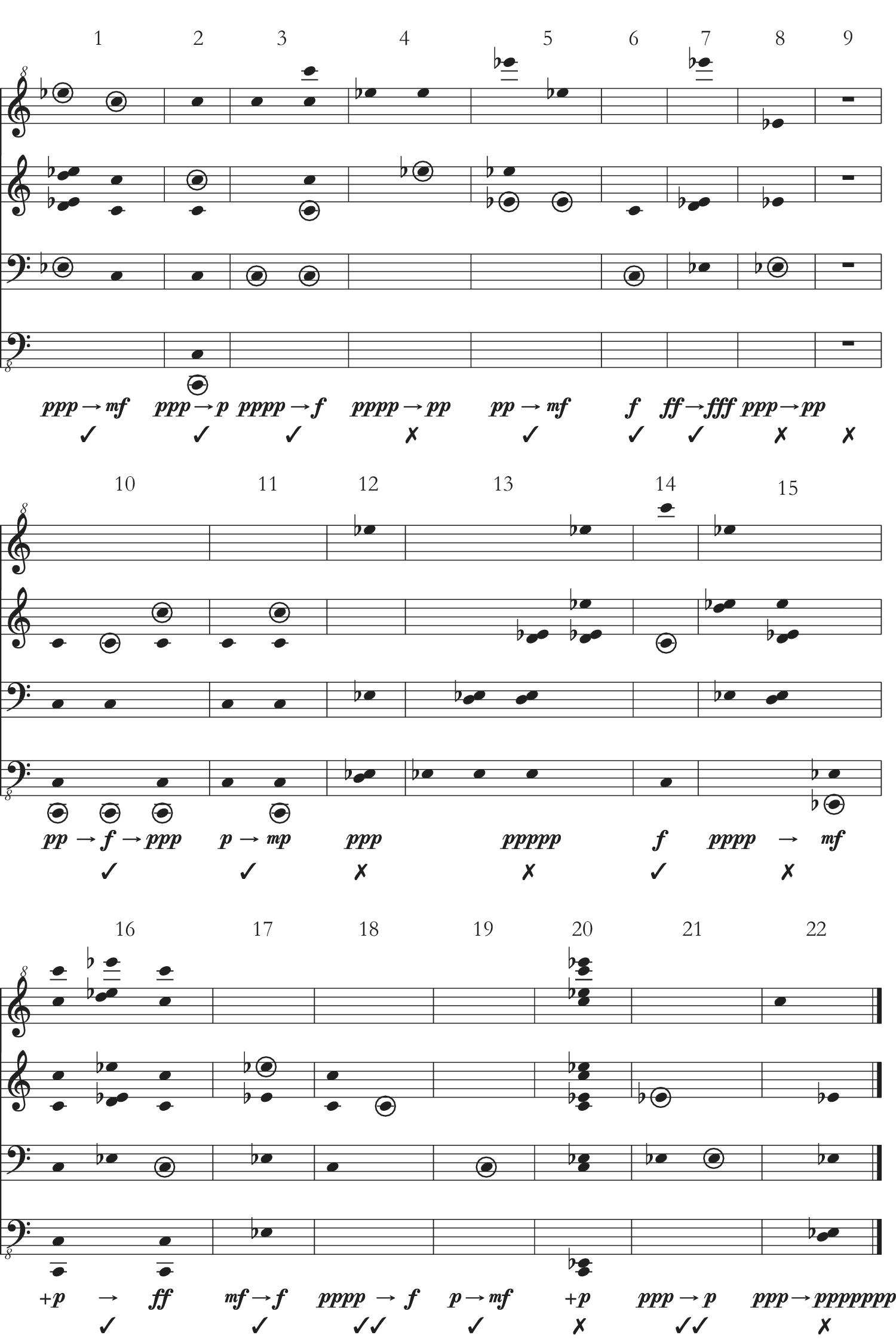
As is observable in the overview of the piece exhibited in Example 1, A Carlo Scarpa consists of 22 sections that reconfigure the C and E♭ chords in differing ways. The figure shows the harmonic outline of the piece, with circled notes indicating where a concert pitch is played (however, they may also be accompanied by other instruments playing microtonal deviations of the same note), while the ticks and crosses below each section indicate the presence or absence of the triangles respectively. The two ticks in sections 18 and 21 mark the prominent use of triangles therein: in section 18, for instance, four triangles play together, forte, soaring above the remainder of the ensemble; while in section 21, all seven triangles are featured.
Outline of the harmony and sections of A Carlo Scarpa.

As mentioned previously, of the 22 sections, 16 feature at least one instrument that plays at concert pitch and 5 whereby none do (section 9 consists of silence). As observable in Example 1, each section focuses on either the C or E♭ chord, except sections 1 and 22, which open and close the piece. In these sections, the chords are played sequentially, as a minor third from E♭ to C in section 1, and as a descending major sixth in section 22. Section 20 is the only segment of the piece where the minor third chord of C and E♭ together is performed, composed over the span of seven octaves.
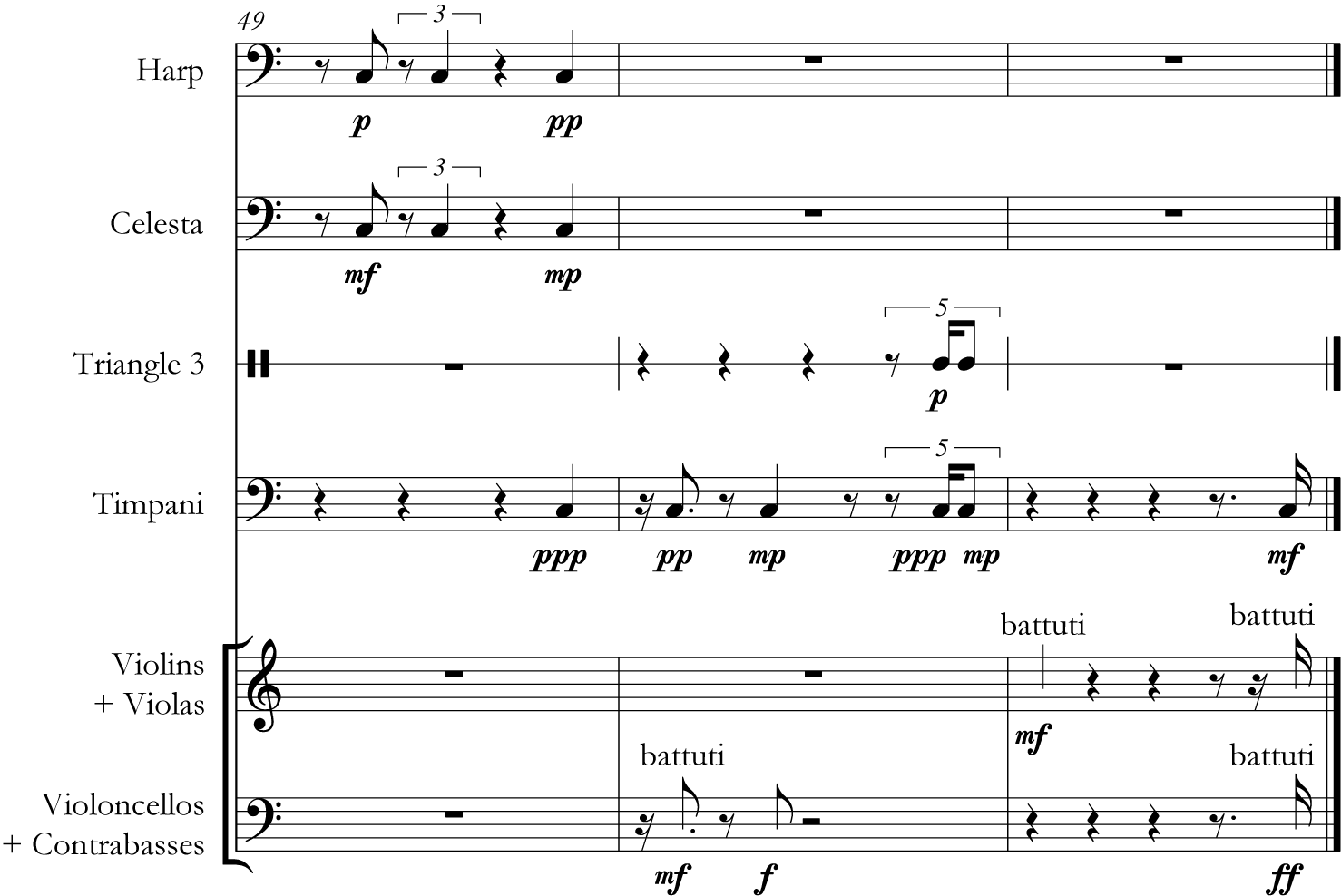
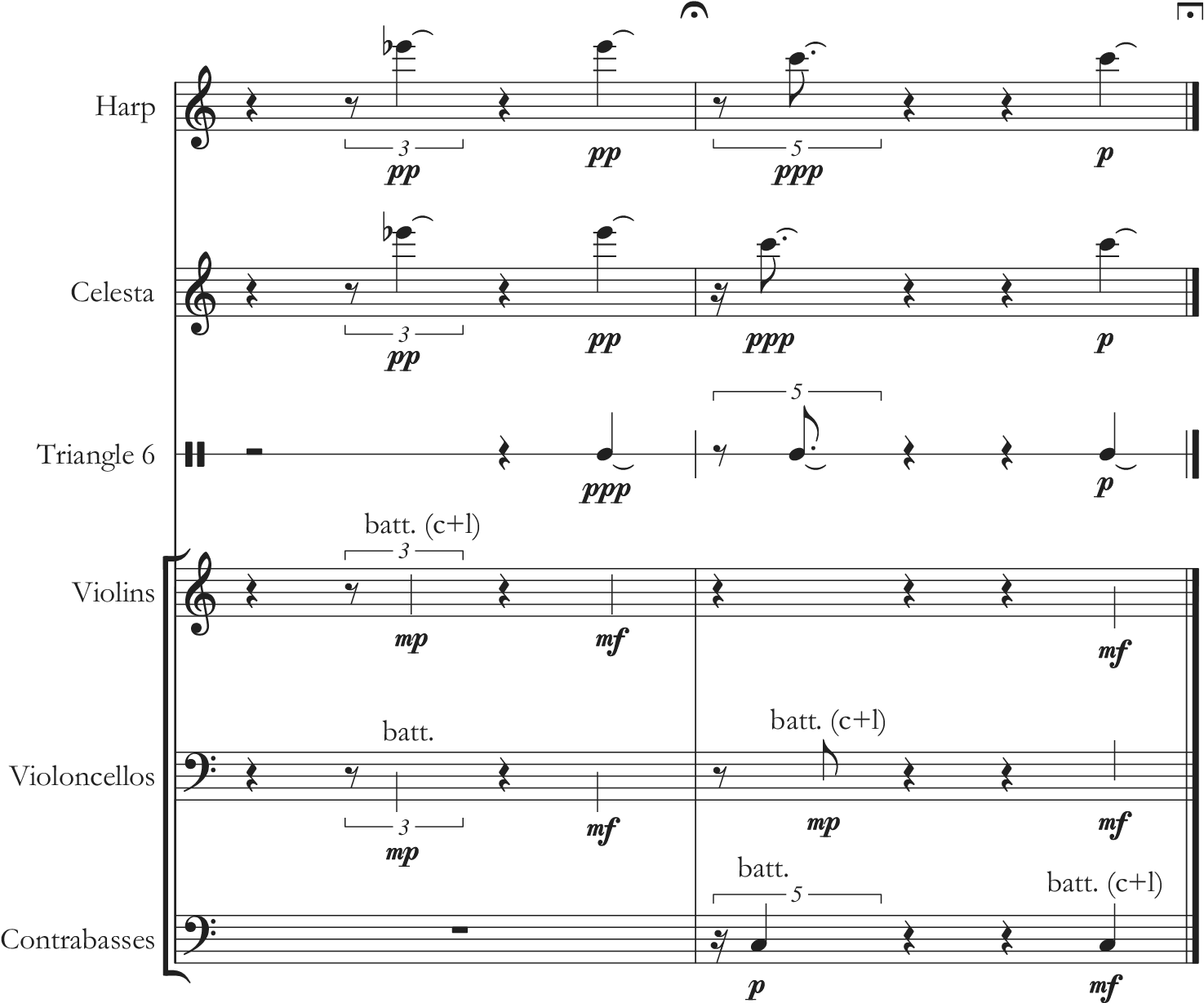
Following the structure of the piece, it is possible to follow how Nono ‘opens’ and ‘closes’ these chords in various ways. At times they are hollow and sparse, such as in sections 16 and 20, where the ensemble plays over the distance of seven octaves and at a ‘+p’ dynamic, which is at the very edge of tone becoming breath or the shimmer of hair on string; in other moments, chords are closed, such as in section 19 (see Example 2), in which the harp, celesta, timpani and strings play on c only. The harp is used to disrupt the timbre of the celesta first, followed by the battuti strikes of the strings with the timpani, then a brief glistening of the third triangle with the timpani, and finally a forceful crash of the battuti strings with the timpani to close the section.
Section 19 is a harmonically clear section compared with other sections (the battuti strings being the only elements that play with microtonal deviations), and consists of only a single pitch (c). Despite the clarity of the celesta in the first bar, a very delicately played harp doubles it. Throughout the piece, no instruments play with complete instrumental purity; they are always either melded with other instruments or disrupted by percussive effects.

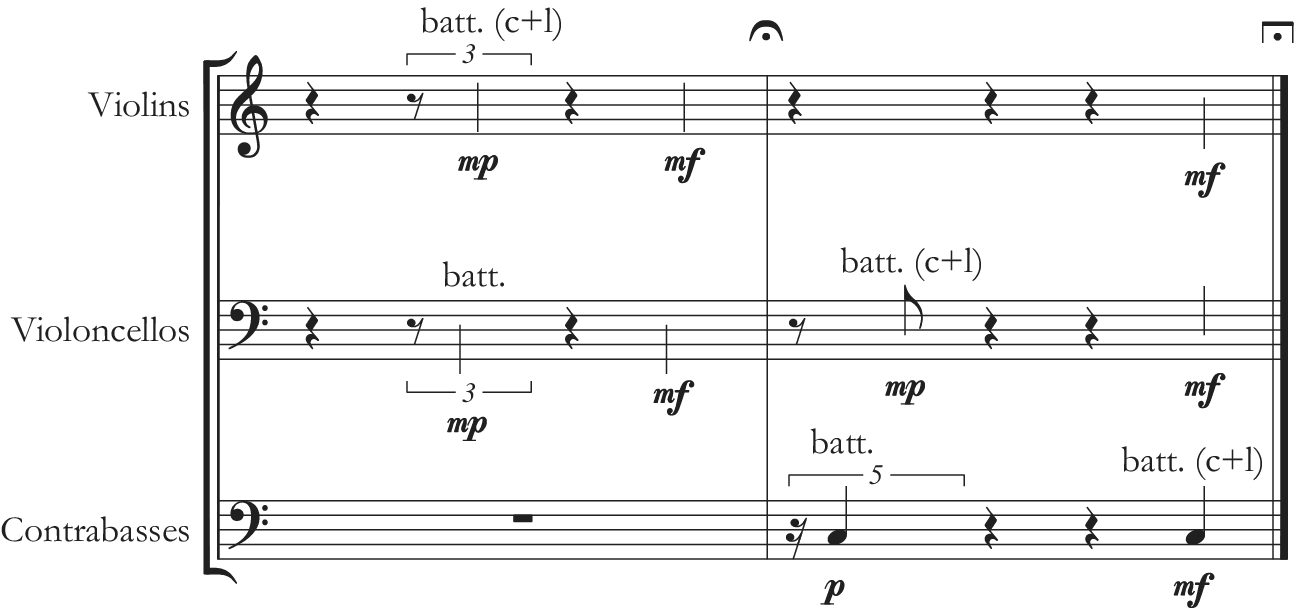
As is observable, the strings have no heads on their stems. While there is no instruction as to what this means in the score, it is clear that Nono is asking for the bowed strings to play not only on the concert pitch of C or E♭ (though the player may certainly choose to) but also in microtones around it, at each performer’s discretion. The result of the battuti is a very open and hollow percussive effect with microtonal colours; while there is audible pitch to this technique, it drifts away very quickly, leaving the listener with a sharp, percussive timbre.
As these chords disperse and condense, it is possible to recognize a visual movement of how the sound is expressed. Listening to the piece, there are moments of drama and action, followed by long durations of quiet contemplation. In the entire span of the work, only two chords are played, which are deviated from harmonic clarity through the use of microtones. What is Nono attempting to express through the harmonic and sonic materials he is using? This is the question at the core of this examination, and what will now be interrogated.
In Nono’s writings and interviews from the time period around A Carlo Scarpa’s composition (1983–5) there is a consistent preoccupation with several concepts that act as a gateway for comprehension of the piece. Primary to understanding this piece is Nono’s research into what he terms ‘mobile’Footnote 9 or ‘nonunitary’ sounds.Footnote 10 For Nono, these types of sound break away from what is expected by the ear. They change the timbre and clarity of produced sounds, allowing for new approaches to listening. ‘Mobile’ sounds are produced in Nono’s late artistic output through the use of microtonal intervals that are not ‘statically attached to intonation’,Footnote 11 the use of timbral variations – such as extended playing techniques, live-electronic manipulation, and instrumental combinations – in searching for the limits of perceptibility in sound (for example, attempting to play instruments at their lowest volume to create sounds that drift on the edge of tone and breathe),Footnote 12 and the use of space and acoustics.
Utilizing these different compositional techniques, Nono creates these mobile sounds that occur when timbre and harmony lose their traditional rigidity, creating sonic events that are unknown and unidentifiable. The sounds of the chords in A Carlo Scarpa are not only in constant change through harmonic reconstructions (density, instrumentation and pitch), but also through altering the sonic material itself. This is realized through the utilization of microtonal intervals, intensity of sound, the use of extended techniques and the precise combining of different timbres. These elements combined result in chords that seem to have ‘life’ to them. By now, turning to section 1, it is possible to understand how Nono constructs the chords with these different materials.
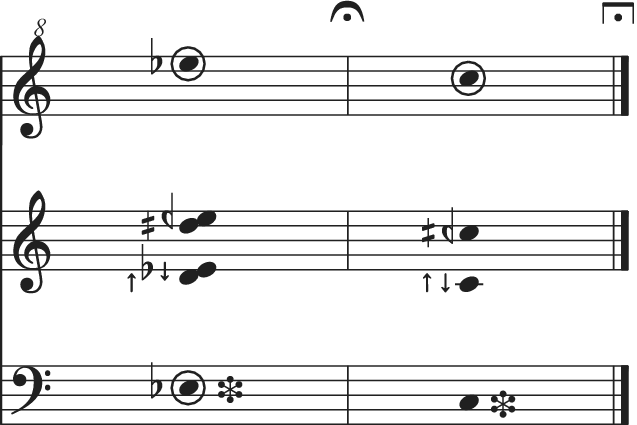
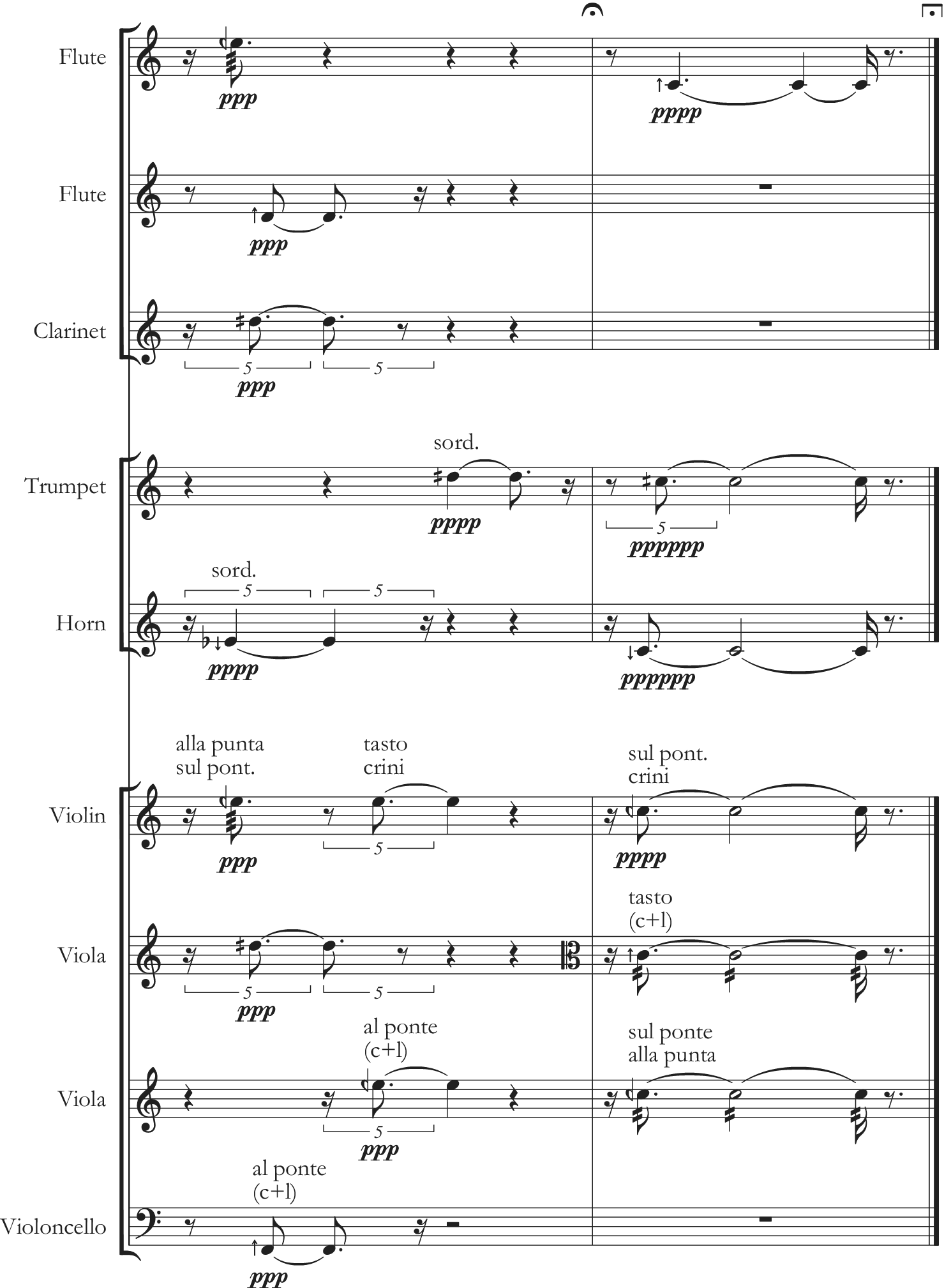
In section 1 (see Example 3), an E♭ chord plays for the first bar, and then moves down a minor third to C in the second bar. These two chords are orchestrated over four octaves, with the highest notes (e♭‴ and c‴) played by the harp and celesta, while the lowest notes (e♭ and c) are performed by the timpani, doubled by a solo contrabass in bar 1. This outer ‘shell’ of the chords – performed at concert pitch by the celesta and harp at the top, and by timpani and double bass at the bottom – is then blurred by the majority of strings performing battuti strikes (see Example 6, below). Held within this shell are two flutes, a clarinet, a muted trumpet, a muted French horn, a solo violin, two solo violas and a cello, all of which play a quarter or an eighth of a tone away from concert pitch (see Example 5, below).
The harmonic structure of the two chords that make up section 1 of the piece. The first chord is E♭, which descends a minor third in bar 2 to C. The circled notes indicate they are performed at concert pitch, while the asterisk denotes the presence of the timpani. Backwards flats ( ) and single stroke sharps (
 ) represent a quartertone flat and a quartertone sharp respectively. Single stroke arrows up ( ↑ ) and down ( ↓ ) represent an eighth of a tone sharp or flat respectively, and multiple signs next to a single note represent that two or more instruments are playing different microtonal deviations on that pitch. For instance, as will be shown momentarily, in the second bar, a flute and viola play an eighth of a tone sharp on middle C, while a French horn plays an eighth of a tone flat.

The first of the three elements described previously are instruments that play without microtonal deviations. These construct an ‘outer shell’ to section 1 (see Example 4), which displays the minor third interval. This figure exhibits the pitches played without microtonal deviation, consisting of a harp and celesta at the top, and timpani and solo contrabass at the bottom. These instruments are used to ‘hold’ the microtonally deviated pitches that are found within the chord. They also, along with pitched bells, form the basis of instruments used throughout the piece that play notes at concert pitch.
The instruments that play at concert pitch in section 1.

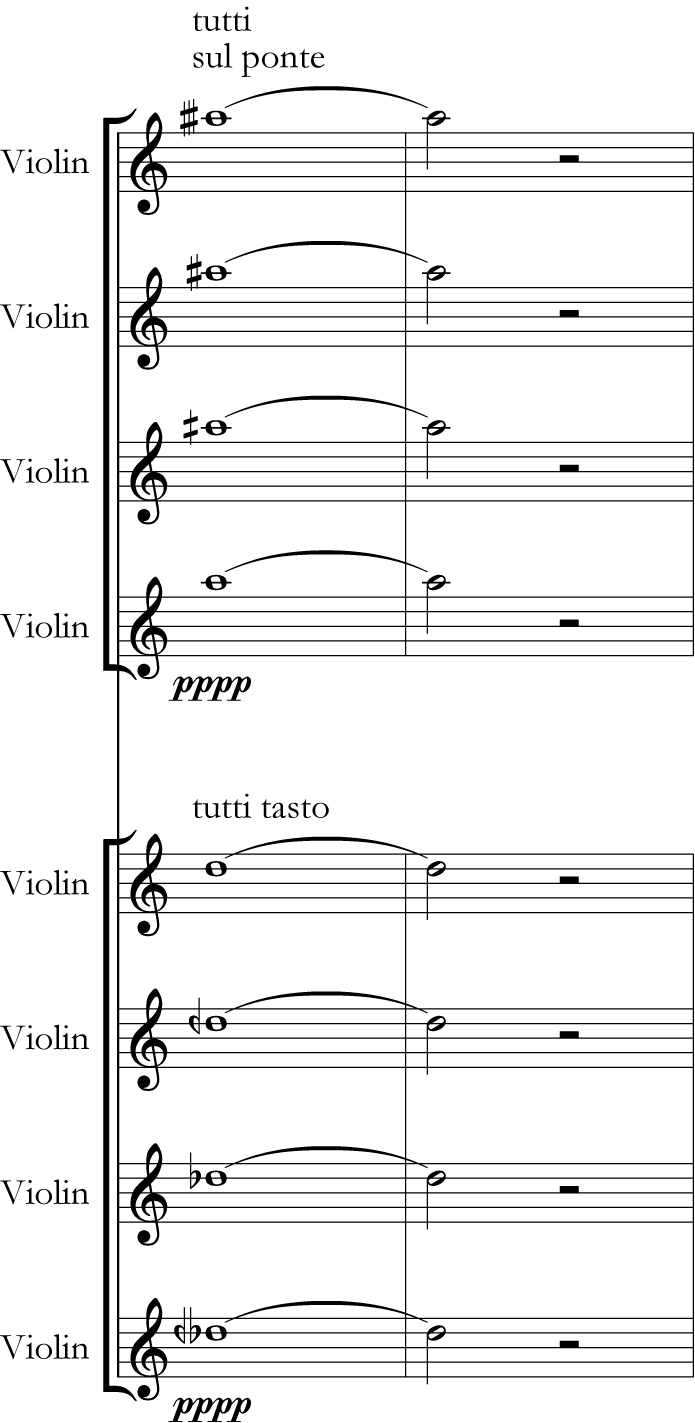
In Example 5, the ‘interior’ of the two chords is shown in greater detail. Constructed with winds, brass and strings, these materials subvert the philharmonic quality of the chords through the use of microtonal deviations and novel playing techniques. These playing techniques include extremely soft dynamics in the brass section and the use of extended techniques in the strings. The extended techniques used include playing with the tip of the bow (‘alla punta’), on the bridge (‘sul ponte’), on the fingerboard (‘sul tasto’), and with either the hair of the bow (‘crini’), the wood of the bow (‘legno’) or both simultaneously (indicated in the score as ‘c+l’, an abbreviation of ‘crini e legno’).
The instruments that play with microtonal deviation in section 1. It is important to note how Nono incorporates many diverse timbral colours with these instruments.

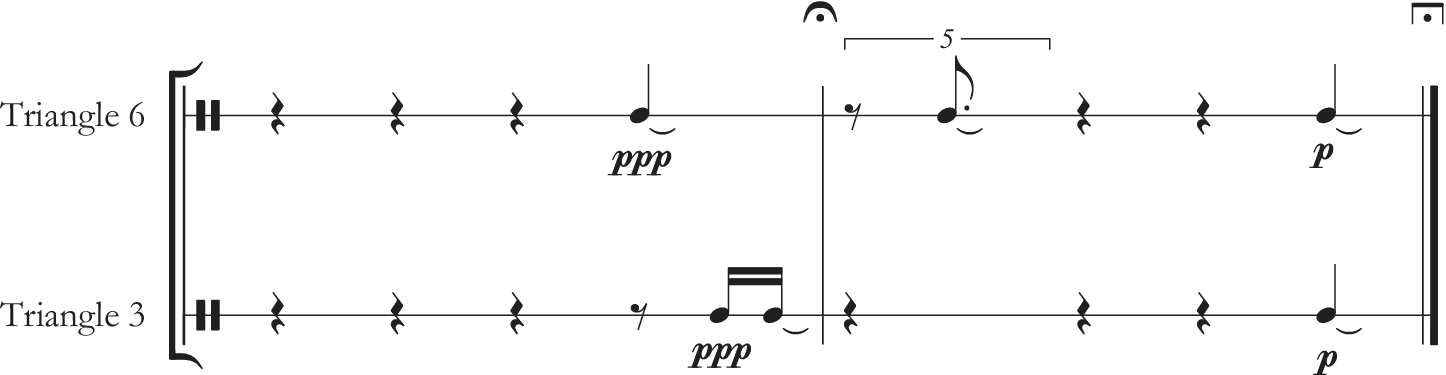
The two chords’ philharmonic clarity is disrupted further by two more sonic elements: the incorporation of seven triangles (see Example 6) and the use of battuti in the string instruments (see Example 7). This latter effect can be achieved with just the hair (marked in the score as ‘battuti’), with the wood of the bow (‘col legno battuti’) or with both simultaneously (labelled as ‘battuti c+l’, an abbreviation, once again, for battuti with both ‘crini e legno’). As observed in Example 7, the violins and cellos play notes without heads in the score, while the contrabasses are clearly notated on the pitch to be played. This indicates, as observed in section 19, that the contrabasses are to play at concert pitch, while the rest of the strings are to play anywhere within, while including, a quarter tone higher or lower than concert pitch.
There are seven triangles used in A Carlo Scarpa. In section 1 – shown in this figure – the 3rd lowest and 2nd highest (triangles 3 and 6 respectively) are used. Triangle 3 mimics the rhythm of the timpani (the low part of the outer shell of concert pitches), while triangle 6 plays with the harp (the high part of the shell).

The strings playing battuti in section 1. In relation to Example 3, it is clear the contrabasses are playing at concert pitch and would be included in the ‘outer shell’ of the piece. However, because of the percussive effect of the technique, I have not included them there owing to the lack of tonal strength (though it is still perceptible). The violins and cellos are given headless stems, indicating that each player chooses a pitch that may be microtonally deviated from concert pitch.

The final timbral element is the seven triangles, which are to be selected by the ensemble, with the ‘lowest’ sounding as 1 and ‘brightest’ as 7.Footnote 13 This results in each performance changing based on this component alone. One performance may have all low triangles, while in another all triangles are high and bright-sounding. Further still, owing to the lack of clarity of pitch that triangles possess because of the non-harmonic overtones they produce, they further disrupt the clarity of the C and E♭ chords.
With these elements considered, it is possible to recognize several layers of compositional control Nono possesses in A Carlo Scarpa. At the highest point are his very specific indications of tempo, rhythm, pitch and timbre that are marked in the score. At the lowest point of control is the incorporation of the triangles, which are given clear instructions regarding dynamics, duration and playing style, but are undefined as to size or texture. However, despite the clarity with which the score is marked by Nono, it is often very difficult for the player to achieve accurately the desired quality of notes. This includes instances where the performer is asked to play slight, but concise, microtonal deviations, at extreme dynamic markings that test the boundaries of tone production, with difficult extended techniques, and to perform notes (often with microtonal inflections) at the limitation of an instrument’s register. From these factors, we can understand the great difficulty for the performer in producing the piece as notated with exactitude (although it is entirely possible), therefore giving the piece an element of tension.
The final compositional technique used by Nono to create his mobile sounds is the combination of instruments to create dynamic timbres. To deconstruct the materials exhibited previously and separate them out further, it is possible to identify three core timbral colours, of decreasing prominence. The primary element concerns the pitched celesta and harp, which are texturally disrupted by the battuti strings (see Example 8). The harp is then further distorted by the sixth triangle, which plays with it at the end of bar 1, and each time in bar 2.
The upper part of the ‘shell’ produced by the celesta and harp in section 1. The clarity of instruments is distorted by the strings playing battuti and by the triangle.

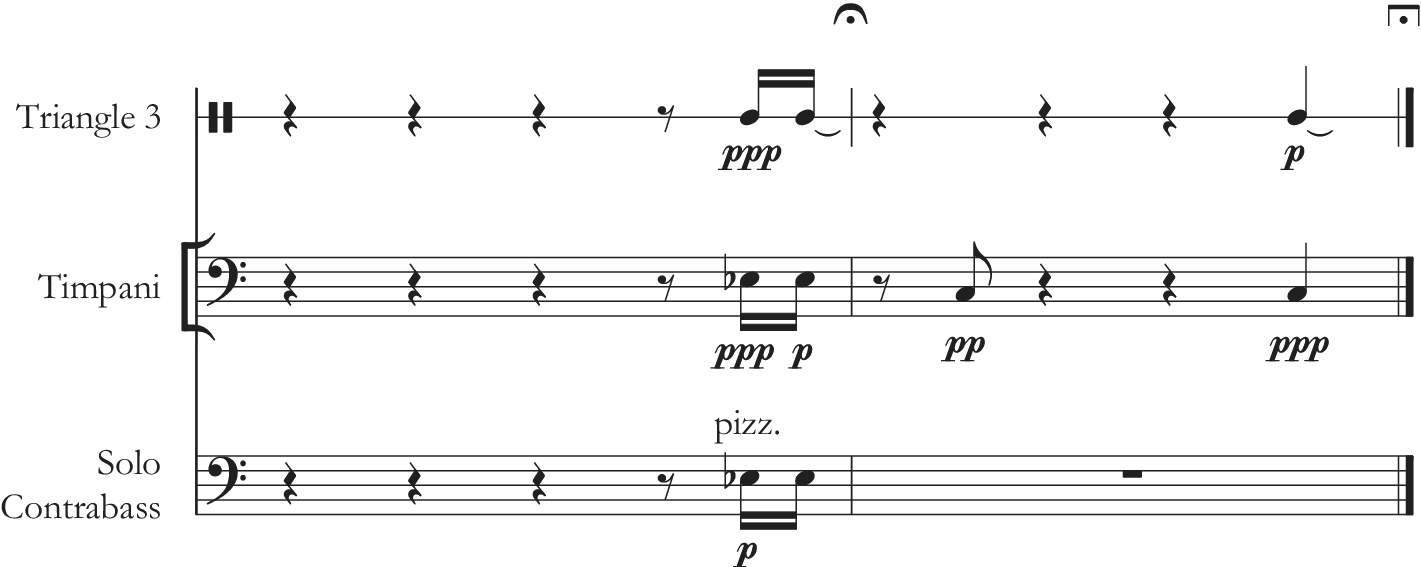
The second aspect is the lower-pitched timpani (see Example 9). This is combined with the solo contrabass and triangle 3 in the first bar, and in the second bar both the timpani and triangle merge with the harp, celesta, battuti strings and sixth triangle to end the section.
The lower part of the ‘shell’ in section 1, consisting of the timpani accompanied by a triangle and solo contrabass.

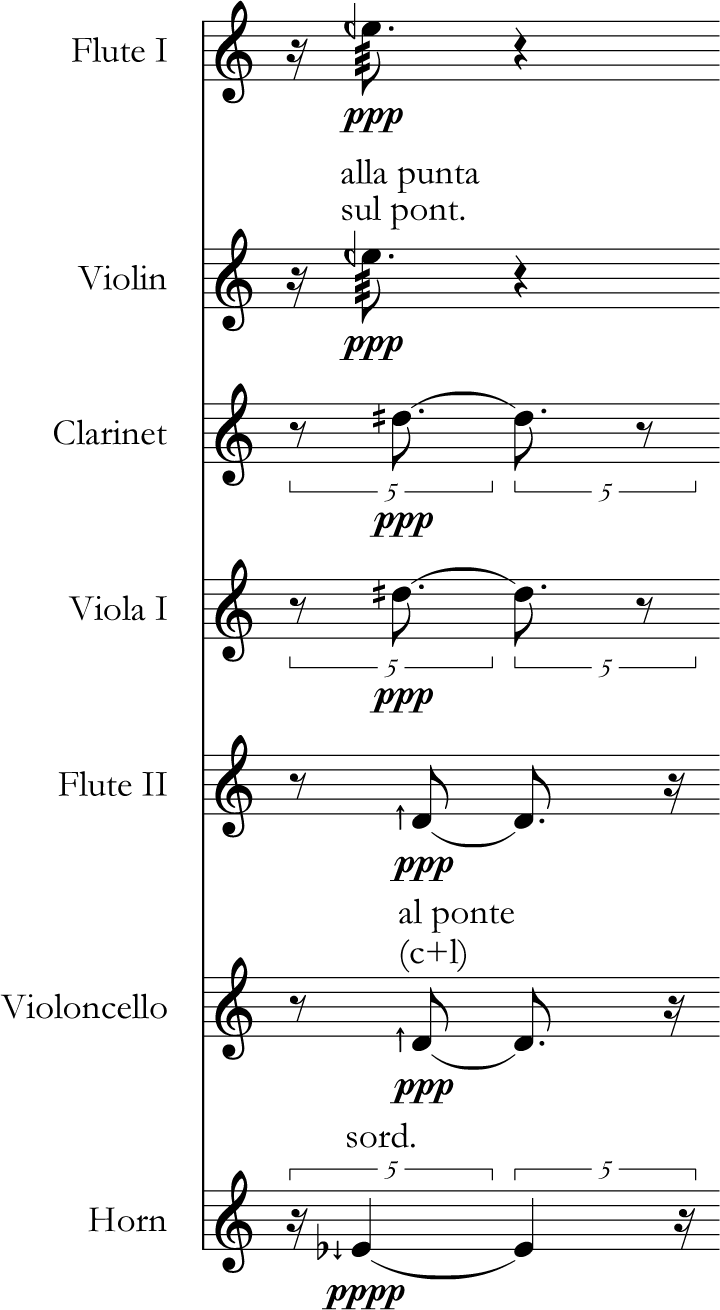
The last element to consider are the textures contained ‘within’ these two structures. By observing these parts individually, it will be possible to understand how Nono creates a ‘moving’ and ‘living’ sound, despite the use of only two pitches in the entire piece. The first of these textures occurs at the opening of the first bar (see Example 10), whereby Nono combines the first flute with a solo violin, the first solo viola pairs with the clarinet, and the second flute with a solo cello. Rhythmically overlapping each instrumental colour is a French horn, which holds these textures together.
The first two beats of bar 1, exhibiting the way different timbres meld with one another.

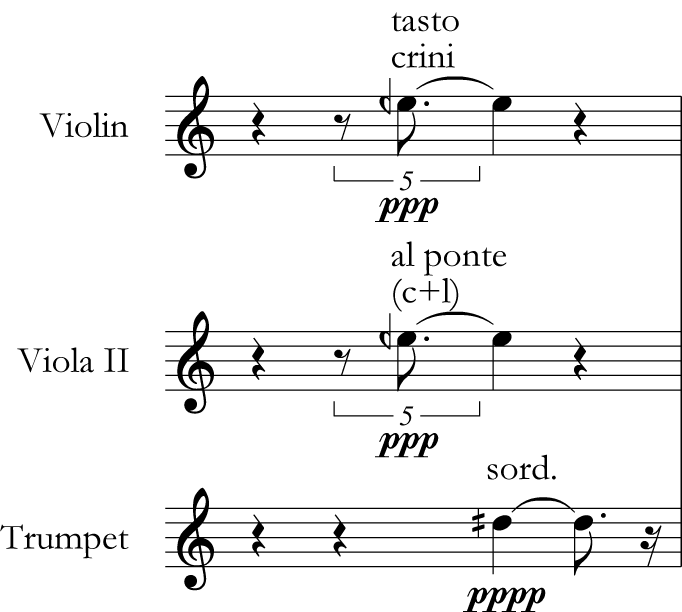
This passage of notes is taken over by the solo violin and second solo viola playing the same notes and rhythms, which are then joined and eventually succeeded by the muted trumpet, which plays a semitone lower than them, on d ″ quartertone sharp (see Example 11).
The end of bar 1, with a violin playing on e″ quartertone flat, playing on the fingerboard (‘tasto’) with hair (‘crini’), while the viola plays at the bridge (‘al ponte’) and with both hair and wood of the bow (‘c+l’). These instruments then meld with a trumpet playing a very soft d″ quartertone sharp.

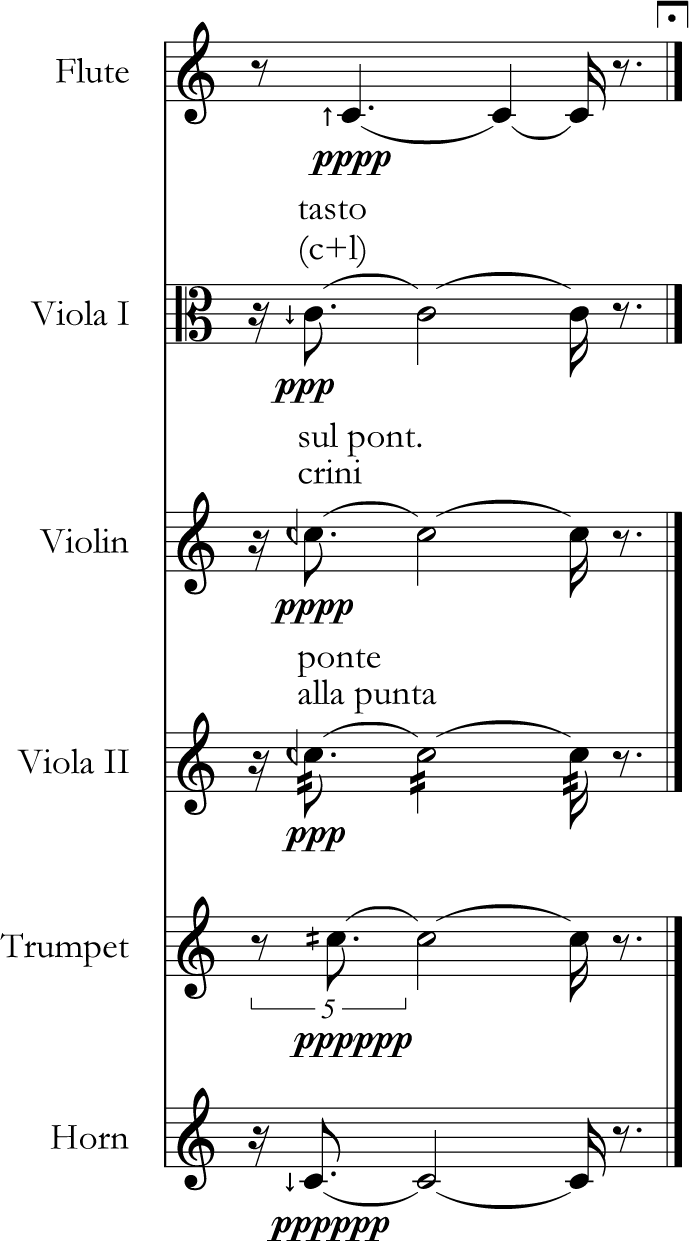
Finally, in bar 2 (see Example 12), there is a very large, coloured chord, consisting of the first solo flute with first viola, the solo violin with second viola, and the trumpet and French horn adding a very soft texture to these combinations.
The ‘inner’ parts of the chord in bar 2 of section 1, based on the pitch of C. Once more it is possible to observe instruments that meld with one another, and use variable playing styles, creating dynamic, mobile textures.

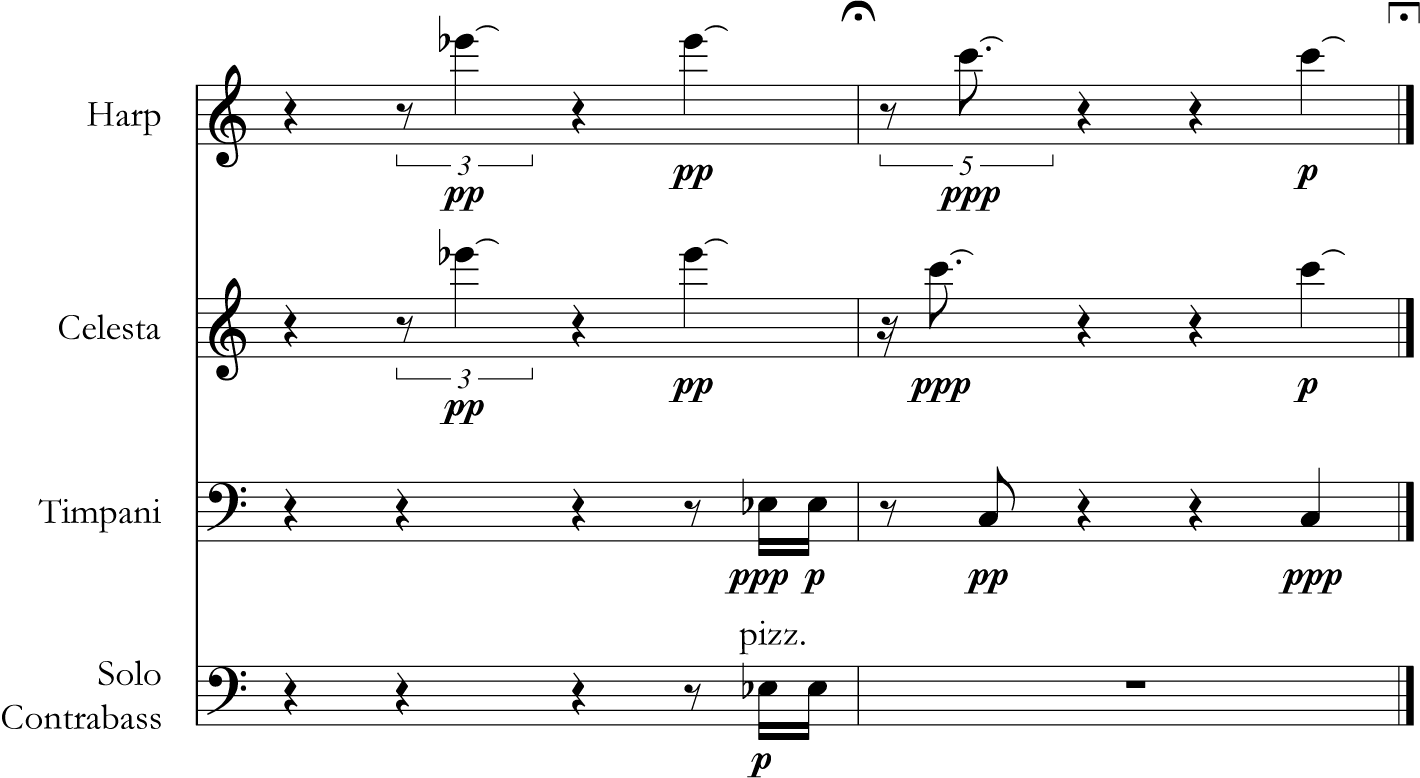
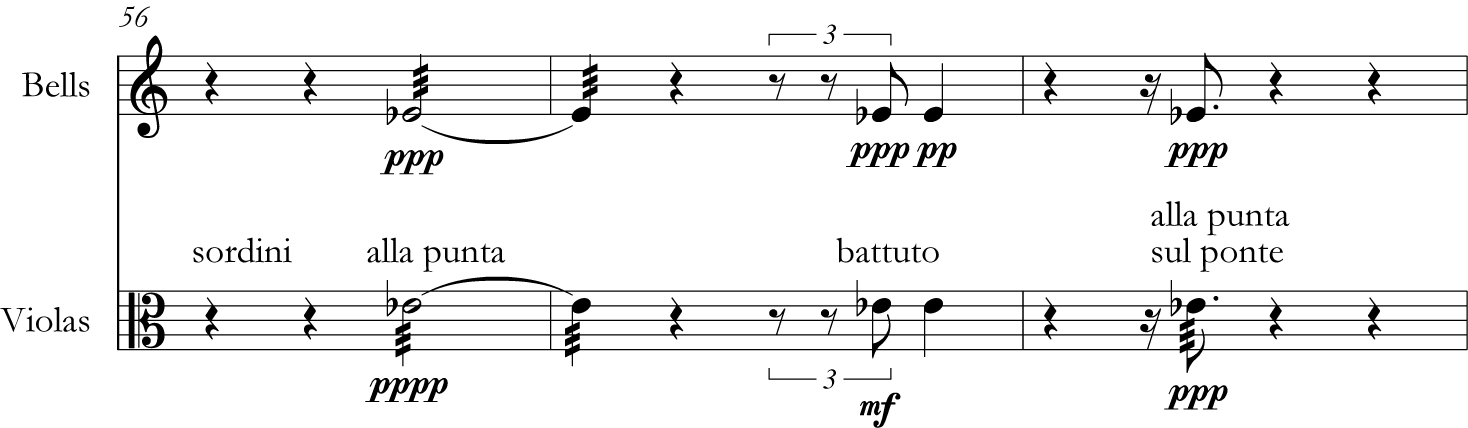
Throughout A Carlo Scarpa, the concept and composition of Nono’s mobile sounds appear. As observed, this is achieved through the use of overlapping rhythms, microtonal deviations and timbral combinations. In only section 21 does a string instrument play without microtonal deviation with a pitched instrument (beyond a solo contrabass playing pizzicato to double the timpani in section 1, and the harp also doubling the timpani in section 3). In section 21 (see Example 13), the violas follow the action of the pitched bells, both in rhythm and pitch. The violas play muted, first at the tip of the bow (‘alla punta’), then battuti, and finally at the tip of the bow on the bridge (‘alla punta sul ponte’). Not only is the timbre of the bells subverted by the addition of the violas, but the violas also playing with a new texture in each instance.
The violas subverting the texture of the bell in section 21.

As observed, in the aforementioned examples, even fixed-pitch instruments are given a dynamic timbre by always being accompanied by other timbres. In section 1, this occurs with the battuti blasts of the violins, cellos and contrabasses, and with the triangles. In section 21, this occurs where the pitched bells are accompanied by the violas, and in section 19 (see Example 2) where the celesta is melded with a faint harp. Through the entire piece, the musical objects of the C and E♭ chords are in a constant state of mobility, driven by every aspect of its composition (pitch, rhythm, intensity, tempo, playing techniques and timbral combinations). This is how Nono allows each chord to become something akin to a ‘living’ musical object. The final section of this examination will turn towards the philosophical and political ideas that motivate these compositional decisions.
Releasing the interval
As is clear from this analysis, Nono has a preoccupation with what he terms ‘mobile’ sounds in his late period of compositions. These consist of creating new textures and harmonies through non-static timbres and pitches, which – as observed – involves the use of instrumental combinations, playing techniques and microtonal deviations. For Nono, the aim of creating these sounds is that ‘perception and listening can be made much more difficult, but in truth can greatly liberate the ears from almost “ritually” unidirectional, visualized and selective habits’.Footnote 14 At the core of these late works is a deeply considered philosophical and political motivation, which will be explored for the remainder of this examination.
Throughout his writing and interviews of the 1980s, Nono persistently expresses ideas such as the need to ‘reawaken the ear’ in the hope of stimulating ‘other ways of listening’.Footnote 15 An aspect of this shift in Nono’s late period of work from his previous output is a movement away from a direct critique of capitalism and towards foundational aspects of Western thought, such as metaphysics, scientific logic and binary thinking. For Nono, ‘There are possibilities that we should approach if we do not wish to remain blocked by the rules of the game in a stationary, repetitive, and stabilizing culture.’Footnote 16 Nono talks now of entering the studio ‘without ideas. Without plans; as this results in the complete abandonment of the logocentric.’Footnote 17
No longer are librettos marked by direct use of Communist references and quotations, as demarcates much of Nono’s earlier work. The problem he faces in this late period is to do with something deeply entrenched within the core structures of Western ideological and political thinking. This shift resulted, by no insignificant margin, from Nono’s collaboration with Cacciari, whose engagement with the history of philosophy opened new avenues of interrogation in socialist thought, as will be explored momentarily. Core to Cacciari’s research at the advent of his collaboration with Nono in 1976 was, as expressed by Matteo Mandarini, finding that ‘the true inheritors of Marx’s critique are Nietzsche and Heidegger’.Footnote 18
In the 1980s, Nono considered potential freedoms that exist, necessarily, in the ‘infinite possibilities’ that lay before us, as the subtitle of A Carlo Scarpa (‘ai suoi infiniti possibili’) suggests.Footnote 19 This is strikingly exhibited in the final pieces of this late period of works, which use fragments of a poem in their title that Nono found on a monastery wall in Toledo, which reads: ‘Caminantes no hay caminos, hay que caminar’ (‘Wanderers: there is no path, yet you must walk on’).Footnote 20 The reconsideration of his political outlook is what marks a shift in Nono’s work from 1976 onwards, and by extension involves a reconsideration of sound, music and composition in order to align with this watershed moment. In this movement of thought, Nono considers the philosophical, political and theological practices that underlie Western culture; from its earliest traces in ancient Greece through to modern European society.
A central influence in developing this critique was Nono’s collaboration with Cacciari. For Cacciari, as previously expressed, the political thought initiated by Marx is taken up by Nietzsche, and then Heidegger.Footnote 21 He considers, regarding Heidegger, the ‘“enfeeblement of the European spirit” as “fatal and incurable” – as the product of forces belonging to this spirit itself, not as a “betrayal” or “derailing” of history – and the “new beginning” is for Heidegger no longer “philosophical”’.Footnote 22 What is derived from this – in connection to Marx – is that Heidegger uncovers that ‘the concealment of Being is a productive force, precisely in the political-economic sense of the term’.Footnote 23
Cacciari finds in Heidegger an avenue for striking new paths of social critique, because ‘to the extent that it speaks of the subject and nihilates Being, metaphysics is the fulfilment of scientific alienation as a productive force characteristic of the modern epoch’.Footnote 24 What this amounts to, for Cacciari, is that there is an ‘affinity’ between Marx and Heidegger,Footnote 25 which occurs in the recognition of the ‘non-neutrality’ of the (interwoven) scientific, technological and metaphysical Western traditions.Footnote 26 This acute assessment of the link between philosophy and technology has greater political consequences, namely that the historical narrative of European culture has the potential to come to an end, leaving open an entirely unknown possibility, and potential, of living in the world. As Cacciari posits, in clear reference to Heidegger, ‘We must uproot ourselves from this “dwelling”. Or rather, we must understand that the essence of the historical event that we have traversed consists in pro-ducing such an uprooting.’Footnote 27
Despite the political difficulties that have surrounded the works of Heidegger owing to his association with Nazism, it is clear that Cacciari – during the time of his collaboration with Nono – was deeply invested in his thought. It is also owing to this association with Nazism that it is possible to infer that Nono was careful in mentioning his name in regard to his own work, little more than citing that, through Cacciari, Heidegger’s thought could be reopened to discussion within socialist circles.Footnote 28 In spite of this, Nono collected many works by Heidegger, and his engagement with these texts is visible through his notations within them.
In each work of Nono’s oeuvre there is no central thinker that dictates the idea behind the pieces, and they are instead ‘constellations’ of thoughts and expressions that necessarily lack clear definition and comprehension. This means that through his late period of compositions, Nono is exploring concepts such as the ‘infinite’ or ‘otherness’ through a diverse range of thinkers, poets and artists. In this sense, A Carlo Scarpa may be taking as much influence from the jilted staircases and gently skewed walls that demarcate Carlo Scarpa’s architecture as from any theoretical or political treatise. What is crucial to understand is that for Nono, ‘music is thought’,Footnote 29 and his compositions try to produce ‘thought’ within the very sonic materials of his work.
The works produced in 1984–5 are more concerned with the ‘living chords’ that I demonstrated in section 1 of A Carlo Scarpa. These types of chords were first utilized in the 1984 opera Prometeo, where at the beginning of the work a perfect fifth is played by two groups of violins (see Example 14). However, half of the violins play in quartertones, with the violins on a″ spread a quartertone apart moving upwards, and the violins on d″ playing quartertones descending downwards. This creates two clusters that ‘fray’ the interval, diminishing its philharmonic clarity.
This figure shows bars three and four from the opening of Prometeo (1984, rev. 1985). Eight violins play a perfect fifth (four on the d ″ and four on the a ″). As is visible, Nono incorporates microtones into the interval, with the violins on A playing upwards in microtonal intervals (A, A quartertone sharp [ ], A sharp and A three-quartertone sharp – represented by three strokes [
 ]) and in D playing downwards (D, D quartertone flat [
 ], D flat, D three-quartertone flat – represented by the mirrored flat symbol [
 ]). What this leaves is a ‘void’ in the middle of the chord, the meaning of which I will explore in greater depth momentarily. What is important to recognize, is how Nono uses microtones in order to give complexity to the most basic building blocks in Western music: the interval.

In the narrative context of Prometeo the perfect fifth represents the birth of the Western musical tradition, and while the C and E♭ of A Carlo Scarpa do not take on such a purposeful significance, the treatment of the chords in the piece does. To understand an influencing aspect on why Nono writes these harmonically and texturally complex musical events, an examination of Heidegger’s philosophy is necessary.
Both Prometeo and A Carlo Scarpa were completed in 1984. Prometeo was premiered on 25 September and was then heavily revised in 1985, while A Carlo Scarpa was completed on 13 December 1984. While Prometeo was written over the course of many years (first conceived after meeting Cacciari in 1975, who compiled its libretto),Footnote 30 and therefore contains a broader constellation of thoughts and points of reference, A Carlo Scarpa has a much more concise aesthetic and compositional idea. For this reason, it allows for a clearer avenue in linking Nono’s artistic output with greater theoretical concepts, which in the scope of this analysis is the work of Heidegger.
While working at the Studio for Electronic Music (WDR) in Freiberg, Nono purchased four books by Heidegger on 1 February 1984. A key work in this collection was Die Technik und die Kehre (‘The technological and the turn’),Footnote 31 which includes the 1954 lecture ‘Die Frage nach der Technik’ (‘The question concerning technology’). This essay is of importance owing to the temporal proximity of its purchase to the composition of A Carlo Scarpa, and to the way the ideas within it may be correlated to the piece. It will therefore be necessary briefly to examine this essay, so inferences may be drawn to the creation of A Carlo Scarpa.
In ‘Die Frage nach der Technik’, Heidegger is not concerned so much with how we use technology, but with what technology actually ‘is’ – its ‘essence’.Footnote 32 To begin this investigation, Heidegger examines the ancient Greek understanding of technology, evoking the philosophy of Aristotle. The creation of something, Heidegger perceives in Aristotle’s thinking, involves ‘four causes’.Footnote 33 These consist of the material cause (the matter used to make an object), the formal cause (the shape the material is put into for use), the final cause (the purpose for which the material was shaped) and, finally, the efficient cause (the person who shapes the material). In the modern conception of these elements, there is a predominantly distinct hierarchy given to these causes, whereby at the base is lifeless matter (the material), which is shaped by a divine-like creator (the efficient). This, as earlier noted in the analysis of Cacciari, is due to the ‘completion’ of modern metaphysics, whereby ‘philosophy comes to an end when it fulfils its own fundamental destiny: nihilating the Being of beings, translating it without residue into subjectivity, in terms of subjectivity’.Footnote 34
For Heidegger, the modern hierarchical conception of creation is problematic, because it reduces the world to a neutral resource. While this has realized implications, such as environmental degradation and maltreatment, it has also created an entrenched belief in our society that humans can master science and technology, leading to a technological utopia, at the cost of other possibilities of being.Footnote 35 Heidegger, however, searches for paths out of this through his concept of Andenken (‘rememberence’), which Cacciari conceives of as the point of his ‘affinity’ with Marx.Footnote 36 As such, Cacciari posits that the ‘Heideggerian “history” of “philosophy” goes directly to the whats that the different epochs think’ and that ‘the passage among them is always in crisis’.Footnote 37 This means the Andenken of Heidegger is in remembering – and being aware – that the historical structures of history are not definitive, but lead to a history of increasing subjectivity, which ‘determines nature mathematically’, with other possibilities unrealized.Footnote 38 This ‘crisis’ also implies that history is retrospectively reimagined – from a positivist perspective – in a way that makes it appear as a linear, or determinate, evolution from one epoch to the next.
Therefore, in this historical analysis of technology, Heidegger posits that the Greeks did not consider creation as hierarchical, but considered each element as relating with ‘indebtedness’ to one another (this term Heidegger uses as a translation of the Greek word aiton).Footnote 39 Owing to this, each of the four causes become ‘responsible’ to one another,Footnote 40 without any element holding superior importance. Following this understanding of creation, the creator forms the material in a way that the material allows itself to be formed. The material also informs the reason for its shaping, while the reason in turn influences the creator and so forth. This cyclical interplay between each cause continues, giving a sense of importance, and even ‘life’, to each element, while each element in turn is needed to produce the finished object.
This understanding of creation is contrary to the modern conception of creation, whereby a supreme creator forces the material into its shape in a showing of complete subjectivity. For Heidegger, modern thinking (at the completion of metaphysics and its full annihilation of Being into subjectivity) about technology envisions ‘nature’ as a source of energy that can be ‘extracted and stored as such’.Footnote 41 The problem with this is that it reduces possibilities in outcomes as it decreases the importance of the causes in the act of creation. It is, for Heidegger, turning the world into a static object, and therefore restricting the world’s, and our own, vast creative potential.
It is reasonable to assume, from this brief analysis, that Nono would have found fertile ground in Heidegger’s thought to cultivate his political thinking and artistic expression. In many respects (outside the glaring difference that – in the most reductive manner – one is remembered as a Nazi and the other as a Communist), both thinkers share similar concerns surrounding the concept of freedom and the dangers in regard to technical domination over the world. These concepts are considered and interrogated in A Carlo Scarpa through the way Nono composes the C and E♭ chords, which will now be explored in greater depth.
As observed in the analysis of A Carlo Scarpa, while Nono retains much compositional control in terms of instrumentation, dynamics, pitch and rhythm, it is also recognizable that through the different mobile sounds that Nono uses, he is attempting to give ‘life’ and a sense of autonomy to the chords in the piece. Following Heidegger’s consideration of the causes in technical creation as being ‘indebted’ to one another, Nono is attempting to allow the instruments to become reliant on one another to create the chords of the work; in other words, to create new possibilities of thought.
Heidegger considered the working of the causes as allowing ‘what is not yet present [to] arrive into presencing’,Footnote 42 and therefore allows for ‘bringing-forth’ something concealed ‘into unconcealment’.Footnote 43 This means that the work of not only technology but also the artist and nature is therefore a type of ‘revealing’,Footnote 44 which Heidegger equates – in this instance, but it appears in many different contexts throughout Heidegger’s work – to the word aletheia in Greek.Footnote 45 For Heidegger, the word aletheia corresponds to the word we use today for ‘truth’, which does not correspond to ‘revealing’. Instead, Heidegger argues that we have inherited the Latin version of ‘truth’ in veritas, which means ‘right’ or ‘correct’.Footnote 46 Therefore, ‘technology is a way of revealing’,Footnote 47 but the way ‘revealing’ understood by the Greeks has been transformed into the modern metaphysical understanding of ‘truth’ as being ‘correct’, and as such the way modern technology is built, comes from the perspective of complete ‘subjectivity’, as expressed by Cacciari, at the completion of modern metaphysics.Footnote 48
As previously mentioned, Nono is concerned in this period with moving away from a ‘stabilized’ understanding of reality, and this is precisely what Heidegger is interrogating. In exposing the underlying assumption in modern thinking that to be ‘truthful’ is also to be ‘correct’, Heidegger turns to the Greek understanding of ‘truth’ as when the internal essence of something is revealed externally. Therefore, the ‘truth’ of technology in Heidegger’s reading of Aristotle’s understanding is when the four causes of technical creation work with one another to reveal something contained within the material. They rely upon one another – and are responsible to one another – in allowing a hidden possibility in the matter to be revealed.
Sound and silence are the materials Nono works with. As observed, A Carlo Scarpa consists of two pitches – C and E♭ – as the basis of its harmonic material; a material that is still within, yet also subverts, the Western musical tradition and normative listening practices. Through the use of timbres that meld and flow into one another, and the use of microtonal deviations, these chords are ‘opened up’ in order to create, as the subtitle of the work expresses, ‘infinite possibilities’. In relation to the four causes expressed by Heidegger, Nono is the efficient cause, sound and silence is the material cause, which is shaped into the chords of C and E♭, the formal cause. What, however, is the final cause? What type of outcome is created by these causes, and what type of philosophical and political thinking does it produce?
In the sleeve notes of an early recording of the 1981 piece Das atmende Klarsein, Cacciari (who compiled the libretto for the work) expresses that freedom is ‘not a liberation from the world but a liberation of the world from the stare which condemns it to the insignificance of that which occurs, moment following moment’.Footnote 49 This conception of freedom runs counter to what Heidegger considers to be a dominant aspect of modern Western culture, which attempts to predict, define and control not only culture, but also the world, at all times. In A Carlo Scarpa, Nono uses the C and E♭ chords in a way that attempts to liberate them from clear comprehension. Nono is so concerned with this liberation of sound, that in section 7 he begins to include the indication ‘lasciar librare’ (‘allow to be free’) in regard to the triangles.Footnote 50 From section 18, he indicates ‘Lasciar Vibrare Sempre!’ (‘Always Allow to Vibrate!’) for the triangles,Footnote 51 whereby out of the monolithic chords of C and E♭ there emerge unexpected moments of freedom in sonic possibilities.
While not within Nono’s library, the 1950 essay ‘Das Ding’ (‘The thing’) by Heidegger allows for further consideration of what Nono explores in A Carlo Scarpa. In this essay, Heidegger examines the problem of technology from a different, yet interlinked, perspective. For him, modern technology has made the world so close and convenient for us that no ‘thing … stands on their own’.Footnote 52 At the base of this problem for Heidegger, is once again a difficulty in language, and therefore thought. This has occurred by giving the same equivalent meaning to the words ‘thing’ and ‘object’. The result of this relation is that material phenomena are shorn of their depth and turned simply into ‘what stands forth’ to our perception.Footnote 53
The difference between the words ‘thing’ and ‘object’ is of great importance to Heidegger. For him, ‘thing’ is a very old Germanic word,Footnote 54 while ‘object’ consists of the Latin words ob-, a prefix meaning to move something ‘in the way of’, and jacere, ‘to throw’.Footnote 55 An object, then, is something that is simply ‘thrown’ in the way of our perception. Yet what the phenomenon is is irrelevant, and is able to be determined by a neutral subject in the wake of the ‘essential nihilism’ at the end of Western metaphysics and its mathematization of the world.Footnote 56 Here, Heidegger is concerned with finding new possibilities of thinking through relocating (or remembering) the meaning of words. Therefore, in attempting to understand what a ‘thing’ is, Heidegger considers a simple jug. Instead of examining what material is used to make the jug, Heidegger instead speculates that a jug is a ‘thing’ that surrounds and holds a void.Footnote 57 The jug allows the void to become visible, which is then displaced when the jug is filled with wine. The jug is no longer a mere object in this analysis, but a being of its own that holds other things, giving it importance and ‘life’ in the world.
Is it possible to consider that what truly defines A Carlo Scarpa is Nono’s attempt to make the chords produce ‘things’ rather than mere musical ‘objects’? The mobile sounds that Nono composes with allow for the chords to be in constant motion, with no clear philharmonic clarity. The chords feel as though they have a sense of ‘life’ to them. Further still, just as the jug in Heidegger’s analysis holds a void, is it also possible to consider that the monolithic chords in A Carlo Scarpa are composed as a way of shaping sound around silence? Viewed in this manner, sound for Nono becomes the material that holds silence, and simultaneously allows pitches and intervals to regain their ability to be more than static, harmonic materials.
Based on this analysis of sound holding the silence, is then the primary material of A Carlo Scarpa actually silence, and the material of sound needed to ‘hold’ and ‘expose’ it? Section 9 of A Carlo Scarpa (see Example 1) consists of five crotchet rests at 30 beats per minute, or 10 seconds of silence. To appear to us, silence must be contained within sound, and section 9 exhibits when Nono chooses not to use sound to hold it, but allows it to lay bare, like a void not held by a jug. While the audience believes they are waiting for the piece to continue, in actuality, they may be listening to the piece at its most pure: when the silence held within the chords has not been highlighted by sound.
Considering the perfect fifth at the beginning of Prometeo once more (see Example 14), the chord ‘frays’ outwards, clearly exposing the void held within these notes. The chords in A Carlo Scarpa – while more complex – consist of the same idea, which is for material to be used to contain something we cannot perceive without the material surrounding it. This is a way Nono is able to incorporate very difficult philosophical and political ideas within the very sonic fabric of the works themselves, and an aspect of what makes these late period compositions so distinguishable and important.
Conclusion
In 1983, Nono wrote, ‘Silence. It is very hard to listen. Very hard to listen, in the silence, to others.’Footnote 58 Is it in silence that Nono finds the possibilities of the unsaid and unheard? In light of the influence of Cacciari’s thought, Nono explores a radical new political outlook when he writes about ‘knowing how to listen, even in silence. Very hard to listen, in the silence, to others, to the other. Other thoughts, other signals, other sonorities, other words, other languages’.Footnote 59 Nono’s aesthetic in the 1980s may be considered as creating music that does not just speak to us, but implores us to listen to the limits of perceptibility, impelling us to listen to the hidden voices of others, of the world, and within ourselves. Nono’s political vision becomes concerned not only with voices that are too disenfranchised to be noticed, but with voices that do not speak at all: not only voices from the present, but also the forgotten or unrealized possibilities of the past that may be remembered (Andenken), in order to break from the increasing subjectification (and forgetting) of the Being of beings,Footnote 60 which also allows for the possibility of our historical ‘uprooting’.
If, as Cacciari asserts in regard to the thinking of Heidegger, ‘metaphysics is the history of the fulfilment of scientific alienation as a productive force’,Footnote 61 are we simply faced with endlessly furthering its development at the cost of other modes of being and living? Or are we instead able to find a passage that does not involve dragging ‘the raft that served us so well in crossing the river along the mountains that await us’?Footnote 62 It is from this type of sentiment that Nono’s late-period works attempt to find infinite possibilities in every moment, so as to liberate not only the world, but also ourselves, from technical and teleological domination. This shift is what marks a radical transition not only in his philosophical and political thought, but also, necessarily, his perceptions of sound, music and composition.