The relationship between brain and cognitive control is a fundamental question in neuroscience. It has been suggested that the anterior cingulate cortex (ACC) is necessary for initiating cognitive control by monitoring conflict in behavioural tasks (Botvinick, Nystrom, Fissell, Carter & Cohen, Reference Botvinick, Nystrom, Fissell, Carter and Cohen1999; Botvinick, Braver, Barch, Carter & Cohen, Reference Botvinick, Braver, Barch, Carter and Cohen2001; Kerns, Cohen, MacDonald, Cho, Stenger & Carter, Reference Kerns, Cohen, MacDonald, Cho, Stenger and Carter2004), whereas the dorsolateral prefrontal cortex (DLPFC) would implement executive control (Desmet, Fias, Hartstra & Brass, Reference Desmet, Fias, Hartstra and Brass2011; Egner & Hirsch, Reference Egner and Hirsch2005; Kerns et al., Reference Kerns, Cohen, MacDonald, Cho, Stenger and Carter2004; MacDonald, Cohen, Stenger & Carter, Reference MacDonald, Cohen, Stenger and Carter2000). The evidence to support this view comes from functional neuroimaging studies showing that the ACC and the prefrontal cortex (PFC) are active during behavioural tasks such as the Flanker, Simon and Stroop paradigms. In these tasks, brain activation is greater for conditions involving cognitive conflict (e.g., where trials present multiple, incongruent pieces of information simultaneously, such as reading RED printed in green ink) relative to conditions without conflict where all information is congruent (e.g., reading RED printed in red ink; Blais & Bunge, Reference Blais and Bunge2010; Carter, Macdonald, Botvinick, Ross, Stenger, Noll & Cohen, Reference Carter, Macdonald, Botvinick, Ross, Stenger, Noll and Cohen2000; Fan, Flombaum, McCandliss, Thomas & Posner, Reference Fan, Flombaum, McCandliss, Thomas and Posner2003; Liu, Banich, Jacobson & Tanabe, Reference Liu, Banich, Jacobson and Tanabe2004; Peterson, Kane, Alexander, Lacadie, Skudlarski, Leung, May & Gore, Reference Peterson, Kane, Alexander, Lacadie, Skudlarski, Leung, May and Gore2002; Wittfoth, Buck, Fahle & Herrmann, Reference Wittfoth, Buck, Fahle and Herrmann2006). Although it is universally agreed that tasks placing greater demands on cognitive operations engage more anterior aspects of PFC and/or parts of DLPFC (Amiez & Petrides, Reference Amiez and Petrides2007; Miller & Cohen, Reference Miller and Cohen2001; Petrides, Reference Petrides1991) and healthy aging reduces grey matter volume (GMV) in these regions, it is not clear how the declines in GMV and performance on behavioural tasks are correlated in the aging brain. It has meanwhile been reported that bilingual seniors outperform monolinguals on these tasks (Costa, Hernández, Costa-Faidella & Sebastián-Gallés, Reference Costa, Hernández, Costa-Faidella and Sebastián-Gallés2009) and have greater GMV in relevant regions of interest (Borsa, Perani, Della Rosa, Videsott, Guidi, Weekes, Franceschini & Abutalebi, Reference Borsa, Perani, Della Rosa, Videsott, Guidi, Weekes, Franceschini and Abutalebi2018; Del Maschio, Sulpizio, Gallo, Weekes & Abutalebi, under review), leading to the hypothesis that lifelong bilingual experience confers a neuroprotective benefit against the effects of typical aging (Bialystok, Craik & Freedman, Reference Bialystok, Craik and Freedman2007; Bialystok, Poarch, Luo & Craik, Reference Bialystok, Poarch, Luo and Craik2014). Although this hypothesis remains controversial (Paap, Johnson & Sawi, Reference Paap, Johnson and Sawi2016), available evidence from a variety of studies reporting advantages in performance (RT) in bilingual seniors (Bialystok, Craik, Klein & Viswanathan, Reference Bialystok, Craik, Klein and Viswanathan2004; Bialystok, Craik & Ryan, Reference Bialystok, Craik and Ryan2006) support greater GMV in brain regions such as the ACC for bilingual seniors (Abutalebi et al., Reference Abutalebi, Guidi, Borsa, Canini, Della Rosa, Parris and Weekes2015) and even a delayed onset of dementia in bilingual populations by up to four to five years, compared to matched monolingual speakers (Bialystok et al., Reference Bialystok, Craik and Freedman2007; Craik, Bialystok & Freedman, Reference Craik, Bialystok and Freedman2010; Alladi, Bak, Duggirala, Surampudi, Shailaja, Shukla, Chaudhuri & Kaul, Reference Alladi, Bak, Duggirala, Surampudi, Shailaja, Shukla, Chaudhri and Kaul2013; Perani, Farsad, Ballarini, Lubian, Malpetti, Fracchetti, Magnani, March & Abutalebi, Reference Perani, Farsad, Ballarini, Lubian, Malpetti, Fracchetti, Magnani, March and Abutalebi2017). These findings have led to the interpretation that bilingualism is beneficial to the aging brain. In this study, we investigate the relationship between neurocognitive control and healthy aging with a novel analysis of RT data from the Flanker task performance. To preface the results, cognitive control performance and GMV are highly correlated in healthy seniors and both decline with chronological age as expected. However, the novel finding is that bilingualism confers not only a neurocognitive benefit, but the resulting neural signature of bilingual experience is unique.
Neural structures involved in cognitive control
The ACC and the DLPFC are respectively involved in initiating and implementing cognitive control processes to overcome interference (see Wang & Weekes, Reference Wang and Weekes2014). However, the processes relating these relationships and behavior are not clear (Henson, Rugg, Shallice & Dolan, Reference Henson, Rugg, Shallice and Dolan2000; Rugg, Reference Rugg and Gazzaniga2004; Shallice & Burgess, Reference Shallice and Burgess1996). In particular, once cognitive conflict is detected via the ACC (Botvinick, Cohen & Carter, Reference Botvinick, Cohen and Carter2004), the implementation of control on behavior during task performance via the DLPFC is less well-defined. Similarly, relatively little is known about the mechanism of neurocognitive control on language processing and memory (Baddeley, Reference Baddeley2000; Friederici, Reference Friederici2011; Wilson, Marslen-Wilson & Petkov, Reference Wilson, Marslen-Wilson and Petkov2017) including in bilingual speakers (see Radman, Britz, Bütler, Speirer, Weekes & Annoni, in press). One exception to this is the theory of adaptive behaviour first applied to bilingual language processing by Green (Reference Green1998) and later fully developed by Green and Abutalebi (Reference Green and Abutalebi2013). In the Green and Abutalebi model (Reference Green and Abutalebi2013), cognitive control plays a central role in the coordination of competing responses during bilingual language processing and these processes are assumed to rely on neural loci including (but not limited to) the ACC and DLPFC (see Abutalebi & Green, Reference Abutalebi and Green2016). Evidence to support the Green and Abutalebi (Reference Green and Abutalebi2013) model is now plentiful and includes studies of bilingual speech comprehension, production, translation and – in a set of studies in Hong Kong – neuropathology, e.g., pathological switching (Kong, Abutalebi, Lam & Weekes, Reference Kong, Abutalebi, Lam and Weekes2014), dementia (Zhang, Reference Zhang2015) and healthy aging (Abutalebi, Canini, Della Rosa, Sheung, Green & Weekes, Reference Abutalebi, Canini, Della Rosa, Sheung, Green and Weekes2014; Abutalebi, Guidi, Borsa, Canini, Della Rosa, Parris & Weekes, Reference Abutalebi, Guidi, Borsa, Canini, Della Rosa, Parris and Weekes2015; Del Maschio et al., under review; Ong, Sewell, Weekes, McKague & Abutalebi, Reference Ong, Sewell, Weekes, McKague and Abutalebi2017). A majority of these studies were conducted using a revised version of the Eriksen Flanker Task (Eriksen & Eriksen, Reference Eriksen and Eriksen1974; Fan, McCandliss, Sommer, Raz & Posner, Reference Fan, McCandliss, Sommer, Raz and Posner2002).
The Flanker task was designed to induce conflict-related interference, whereby a visually presented target (a left-pointing or right-pointing arrow) is flanked by either congruent or incongruent distractors (other arrows with either the same orientation or a different orientation to the target) causing response conflict. Functional magnetic resonance imaging (fMRI) studies show more BOLD activation in the incongruent condition relative to the congruent and neutral conditions across several brain regions, including the frontal system (the inferior frontal gyrus/VLPFC, middle frontal gyrus/DLPFC, superior frontal gyrus), the parietal system (inferior parietal lobule, superior parietal lobule), bilateral insula, ACC as well as other regions such as the precentral gyrus, the supplementary motor area (SMA) and inferior temporal cortices (Nee, Wager & Jonides, Reference Nee, Wager and Jonides2007). Nee et al. (Reference Nee, Wager and Jonides2007), using cathodal transcranial direct current stimulation (tDCS) applied to the right DLPFC during Flanker performance, report increased interference, emphasizing its importance during stimulus-based conflict resolution (Zmigrod, Zmigrod & Hommel, Reference Zmigrod, Zmigrod and Hommel2016). In an fMRI study of Stroop task interference, Egner and Hirsh (Reference Egner and Hirsch2005) report that performance was directly associated with increased activity in DLPFC. Gbadeyan, McMahon, Steinhauser and Meinzer (Reference Gbadeyan, McMahon, Steinhauser and Meinzer2016) also report an association between enhanced conflict adaptation (i.e., a smaller Flanker effect after incongruent trials than after congruent trials) following bilateral tDCS over the DLPFC. Gbadeyan and colleagues argued that enhanced conflict adaptation during stimulation of the DLPFC is due to increased attentional modulation, facilitating allocation of attentional resources toward a relevant change in the stimulus (i.e., to a target following incongruent trials and a distractor following congruent trials). In the context of conflict-related tasks (e.g., Wang & Weekes, Reference Wang and Weekes2014), the extant literature thus suggests that the DLPFC may be related to attentional implementation of cognitive control. Specifically, once the ACC identifies conflicting information during a task, the DLPFC resolves the conflict by upregulating attention to stimulus information that is relevant to that task. Indeed, a recent meta-analysis identified a causal relationship between Flanker interference and activity in a bilateral dorsal fronto-parietal network consisting of dorsal premotor cortex and superior parietal cortices, as well as activity in the right inferior frontal junction and adjacent inferior frontal gyrus, right anterior insula and anterior midcingulate cortex extending to the pre-supplementary motor area (Cieslik, Mueller, Eickhoff, Langner & Eickhoff, Reference Cieslik, Mueller, Eickhoff, Langner and Eickhoff2015). Remarkably, these regions are overlapping with the neurocognitive model of bilingual language processing and control first proposed by Green and Abutalebi (Reference Green and Abutalebi2013), confirming a correspondence between bilingualism, brain regions of interest and cognitive control. Indeed, there is neural evidence that word retrieval in bilingual speakers partly depends on executive control systems in the DLPFC (Radman et al., in press). Critically, DLPFC-mediated activation is a constraint on language production more specifically in the second language (L2) for bilinguals.
Evidence for correlations in bilingual seniors comes from a report by Luks, Oliveira, Possin, Bird, Miller, Weiner and Kramer (Reference Luks, Oliveira, Possin, Bird, Miller, Weiner and Kramer2010), who investigated the brain basis of cognitive control in bilingual seniors with neurodegenerative diseases. They correlated the magnitude of regional brain atrophy by measuring GMV and Flanker task performance. The key finding was that atrophy in the left hemisphere DLPFC and ACC as well as right hemisphere temporal–parietal junction (TPJ) and ventrolateral prefrontal cortex (VLPFC) was correlated with slower Flanker response times (RTs).
Aging and cognitive control
It is well known that cognitive control diminishes with age (Colcombe, Kramer, Erickson, Scalf, McAuley, Cohen, Webb, Jerome, Marquez & Elavsky, Reference Colcombe, Kramer, Erickson, Scalf, McAuley, Cohen, Webb, Jerome, Marquez and Elavsky2004; Craik & Bialystok, Reference Craik and Bialystok2006; West, Reference West1996). For example, Colcombe et al. (Reference Colcombe, Kramer, Erickson, Scalf, McAuley, Cohen, Webb, Jerome, Marquez and Elavsky2004) report that increases in cardiovascular fitness correlate with Flanker performance in healthy elderly. In this breakthrough study, highly fit and aerobically trained participants show higher correlations between Flanker performance and activity in regions of the prefrontal and parietal cortices. Most relevant to the present work, Colcombe et al. (Reference Colcombe, Kramer, Erickson, Scalf, McAuley, Cohen, Webb, Jerome, Marquez and Elavsky2004) reported negative correlations between fitness and activation in the anterior cingulate cortex, which they posit reflects both conflict monitoring and adaptation in the attentional network. Their data showed for the first time that lifestyle can affect improvements in the plasticity of the aging human brain. Colcombe and colleagues also reported positive correlations with activation in middle frontal gyrus (MFG), superior frontal gyrus (SFG) and superior parietal lobe (SPL), but did not investigate DLPFC or the Caudate.
The reasons for decline and the neuroanatomical sequelae are less well understood. From a behavioural perspective, Duchek, Balota, Tse, Holtzman, Fagan, and Goate (Reference Duchek, Balota, Tse, Holtzman, Fagan and Goate2009) and Dixon, Garrett, Lentz, MacDonald, Strauss, and Hultsch (Reference Dixon, Garrett, Lentz, MacDonald, Strauss and Hultsch2007) proposed that the variation in RT on cognitive control tasks can discriminate between healthy and pathological aging, and also identify individuals at risk for dementia. Connecting this to neural data, Duchek et al. (Reference Duchek, Balota, Tse, Holtzman, Fagan and Goate2009) also reported significant associations between a coefficient of variation (CoV) in RT in a Stroop Task and DLPFC and argued the CoV reflects frontally-mediated lapses of attention, as lapses in attention would intuitively lead to increased variation in RTs. Analysing variation and distributional properties of raw RT data is useful because collapsing RTs into means can lead to a loss of information (Heathcote, Popiel & Mewhort, Reference Heathcote, Popiel and Mewhort1991; see also Abutalebi et al., Reference Abutalebi, Guidi, Borsa, Canini, Della Rosa, Parris and Weekes2015). By examining variability in RT over short intervals (i.e., on a trial-to-trial level), Duchek et al. (Reference Duchek, Balota, Tse, Holtzman, Fagan and Goate2009) found an association between CoV and ventral/dorsolateral prefrontal cortex, the superior frontal gyrus, and ACC. In a related study Jackson, Balota, Duchek and Head (Reference Jackson, Balota, Duchek and Head2012) report associations between white matter integrity and the ex-Gaussian parameters of a Stroop Task in healthy aging. Thicker volumes were associated with less RT variability, slowing in the tail of the RT distribution, and larger cerebral and inferior parietal white matter volumes were associated with faster overall RT. Aging thus contributes to a noticeable change to performance on visual conflict tasks, and this behavioural effect can be linked to differences in neural structure. From a neural perspective, enhanced recruitment of DLPFC in seniors can be considered an adaptive response to age-related decline in visual processing (Davis, Dennis, Daselaar, Fleck & Cabeza, Reference Davis, Dennis, Daselaar, Fleck and Cabeza2007). Subsequently, the DLPFC is a target for neurorehabilitation in dementia (Cotelli, Manenti, Cappa, Geroldi, Zanetti, Rossini & Miniussi, Reference Cotelli, Manenti, Cappa, Geroldi, Zanetti, Rossini and Miniussi2006; Cotelli, Manenti, Cappa, Zanetti & Miniussi, Reference Cotelli, Manenti, Cappa, Zanetti and Miniussi2008; Voytek, Davis, Yago, Barceló, Vogel & Knight, Reference Voytek, Davis, Yago, Barceló, Vogel and Knight2010). Linking this to bilingualism, Abutalebi et al. (Reference Abutalebi, Guidi, Borsa, Canini, Della Rosa, Parris and Weekes2015) report ex-Gaussian analyses on the RTs from seniors on the Flanker task and show that aging bilinguals performed better than aging monolinguals and that bilingualism is associated with increased GMV in the ACC. Surprisingly, Flanker task performance correlated with decreased GMV in the DLPFC for monolingual seniors only, suggesting that this neural region might confer a neural advantage protecting against aging.
The claim that bilingualism can provide a protective reserve against cognitive decline with aging is debated (Baum & Titone, Reference Baum and Titone2014; Paap et al., Reference Paap, Johnson and Sawi2016; Perani & Abutalebi, Reference Perani and Abutalebi2015; Zahodne, Schofield, Farrell, Stern & Manly, Reference Zahodne, Schofield, Farrell, Stern and Manly2014). Reports of a behavioural advantage for bilinguals on cognitive control tasks tends to be observed more readily in seniors (Bialystok et al., Reference Bialystok, Craik and Ryan2006). Kroll and Bialystok (Reference Kroll and Bialystok2013) argue that this is because younger participants perform at peak cognitive capacity, which effectively imposes a ceiling that prevents easy identification of a bilingual advantage. Valian (Reference Valian2015) made a similar (post-hoc) but distinct argument, suggesting that younger bilingual individuals are exposed to a plethora of cognitively demanding activities that enhance cognition through regular practice whereas, in older bilingual individuals, these potential confounding factors are reduced. In either case, the literature linking conflict-related tasks to specific neural structures suggests that this protective effect should relate to structural differences in the ACC and the DLPFC in bilinguals compared to monolinguals across age.
Abutalebi et al. (Reference Abutalebi, Guidi, Borsa, Canini, Della Rosa, Parris and Weekes2015) found that GMV in the right DLPFC is inversely correlated with an increase in the tail of RT distribution (т) for incongruent trials in a sample of healthy seniors. Interestingly, Abutalebi et al. (Reference Abutalebi, Guidi, Borsa, Canini, Della Rosa, Parris and Weekes2015) found no evidence for these associations in bilingual seniors even though mean GMV in this region is greater in bilingual seniors than monolingual speakers. Although ex-Gaussian parameters enable characterization of RT distribution across groups, they do not permit direct interpretation of the cognitive processes involved (Matzke & Wagenmakers, Reference Matzke and Wagenmakers2009). To date, few studies have directly linked cognitive processes that are putatively enhanced in bilingual seniors to anatomical brain differences. This is a shortcoming given the potential value of improving attentional control in the treatment of cognitive decline in healthy aging and accompanying neuropathology. Crucially, if bilingual advantages generalise beyond the language domain to non-verbal tasks that require control over (silent) visual attention, then links between speaking another language and cognitive control have potential to generalise beyond bilinguals.
Extending the work of Abutalebi et al. (Reference Abutalebi, Guidi, Borsa, Canini, Della Rosa, Parris and Weekes2015) beyond simple RT and the ex-Gaussian analysis, Ong et al. (Reference Ong, Sewell, Weekes, McKague and Abutalebi2017) used the diffusion model (Ratcliff, Reference Ratcliff1978) to analyse the RT distribution data from the Flanker task for Hong Kong bilingual seniors. The diffusion model assumes that behavioural responses on a 2-alternative forced choice (2AFC) task such as the Flanker task is the outcome of stochastic evidence accumulation that approaches a decision boundary (e.g., identifying the left or right orientation of the target arrow on a Flanker Task). Four decision parameters are assumed to determine the decision process: the starting point (z), boundary separation (a), drift rate (v) and non-decision time (T er). These have been linked to underlying psychological processes: the starting point reflects response bias and determines the initial point of evidence accumulation; boundary separation refers to the amount of evidence accumulated before initiating a response; drift rate reflects the quality of information informing decision-making and shows the speed of evidence accumulation toward a decision boundary; and non-decision time reflects the time course of processes not related to evidence accumulation such as perceptual encoding and execution of motor response (Voss, Rothermund & Voss, Reference Voss, Rothermund and Voss2004).
Ong et al. (Reference Ong, Sewell, Weekes, McKague and Abutalebi2017) reported that when comparing incongruent trials to congruent trials on the Flanker task, there was a decrease in the drift rate parameter accompanied by an increase in the non-decision time parameter. They argued that the drift cost reflects distracting information from the flanking stimuli interfering with the process of evidence accumulation for the correct target orientation, while the non-decision time cost reflects differences in the pre-response time required to zoom visual attention on to the central flanker arrow in incongruent trials (for a more exhaustive description of the model as applied to the Flanker task see Ong et al., Reference Ong, Sewell, Weekes, McKague and Abutalebi2017). Crucially, Ong et al. (Reference Ong, Sewell, Weekes, McKague and Abutalebi2017) found that bilingual seniors had smaller non-decision time costs compared to their monolingual counterparts, suggesting that bilingual seniors were able to more quickly focus visual attention on the central flanker during incongruent trials. What is not yet known is whether the putative bilingual advantage in zooming of visual attention has a neural correlate. A wealth of evidence from healthy seniors suggests there is a neural signature for the bilingual advantage – specifically in the ACC and the DLPFC (see Abutalebi & Green, 2013).
The Abutalebi et al. (Reference Abutalebi, Guidi, Borsa, Canini, Della Rosa, Parris and Weekes2015) and Ong et al. (Reference Ong, Sewell, Weekes, McKague and Abutalebi2017) studies differ in approaches to modeling RT distributions observed in Hong Kong bilingual seniors. The ex-Gaussian approach reported by Abutalebi et al. (Reference Abutalebi, Guidi, Borsa, Canini, Della Rosa, Parris and Weekes2015) is a descriptive analysis of RT distributions: ex-Gaussian parameters provide a succinct representation of the overall shape of an RT distribution (i.e., in terms of mean, variance, and skew). The variables that correlate with ex-Gaussian parameters can thus provide some insight into how these variables affect certain aspects of the empirical distributions of RTs, but they do not necessarily characterize the underlying cognitive processes. Abutalebi et al. (Reference Abutalebi, Guidi, Borsa, Canini, Della Rosa, Parris and Weekes2015) found that, for monolingual seniors, GMV in the right DLPFC inversely correlated with tau (τ; the tail of the distribution), suggesting that the slower RTs are related to the right DLPFC, which is informative in itself, but could be due to a multitude of cognitive reasons. The diffusion model meanwhile is able to provide a description of the data in terms of the cognitive processes that were responsible for generating the data. Because the model parameters correspond to different sub-components of the underlying decision process (e.g., decision threshold, quality of evidence, and onset of decision-making), examining correlations between diffusion model parameters and other variables of interest (e.g., language experience) can reveal how specific cognitive processes are affected by bilingualism. One motivation for this study is thus to extend the neural analyses in Abutalebi et al. (Reference Abutalebi, Guidi, Borsa, Canini, Della Rosa, Parris and Weekes2015) to parameters of the diffusion model. However, instead of describing the characteristics of the RT distribution data directly, we aim to identify cognitive processes associated with the bilingual advantage and cognitive control, and relate them to regions of the brain.
The present study is the first to relate diffusion model parameters from performance on the Flanker task with neurostructural data in the context of bilingualism, cognition and healthy aging. The rationale for using neurostructural data comes from previous reports of Abutalebi and colleagues (Reference Abutalebi, Guidi, Borsa, Canini, Della Rosa, Parris and Weekes2015) showing that bilingual speakers in Hong Kong have greater GMV in brain regions of interest for task control. Our goal is to test correlations between cognitive control as instantiated by diffusion model parameters and GMV in specific regions of interest for healthy seniors. We are specifically interested in how any correlations interact with lifelong bilingual experience. The linking of cognitive control, diffusion model parameters and neural data is not without precedent. For example, Mulder, Wagenmakers, Ratcliff, Boekel and Forstmann (Reference Mulder, Wagenmakers, Ratcliff, Boekel and Forstmann2012) correlated fMRI data with diffusion model parameters and found a bias in the starting point parameter associated with BOLD signal changes in a frontoparietal network, specifically the medFG and ACC. However, we will select ROIs according to the model of Abutalebi and Green.
Our diffusion model parameter of interest is the conflict effect in non-decision time (incongruent-congruent) rather than congruent and incongruent non-decision time estimates separately. This is based on the result of Ong et al. (Reference Ong, Sewell, Weekes, McKague and Abutalebi2017) which demonstrated a bilingual advantage on the non-decision time cost, but no other bilingual effect. Additionally, by utilizing the difference between incongruent and congruent non-decision time, we are able to filter out the more general aspects of non-decision time such as sensory encoding and motor execution (Ratcliff & McKoon, 2008; Voss et al., Reference Voss, Rothermund and Voss2004) that are implicated in cognitive decline due to aging. We thus attempt to relate attentional zooming in particular to healthy aging, the bilingual advantage and cognitive control in ROIs motivated by theoretical assumptions (Abutalebi & Green, Reference Green and Abutalebi2013) and empirical findings (Radman et al., in press) about bilingual speakers.
One prediction derived from previous findings (Abutalebi et al., Reference Abutalebi, Guidi, Borsa, Canini, Della Rosa, Parris and Weekes2015; Ong et al., Reference Ong, Sewell, Weekes, McKague and Abutalebi2017) is that there is a relationship between the non-decision time parameter costs (i.e., attentional zooming) performance and GMV in fronto-striatal ROIs (ACC and DLPFC). Also using the Flanker task, Luk, Anderson, Craik, Grady and Bialystok (Reference Luk, Anderson, Craik, Grady and Bialystok2010) reported that greater GMV in the DLPFC is correlated with reduced RT costs for incongruent trials in healthy young adult bilingual speakers. As the DLPFC has been linked to visual attentional control in other conflict tasks (e.g., Egner & Hirsch, Reference Egner and Hirsch2005; Gbadeyan et al., Reference Gbadeyan, McMahon, Steinhauser and Meinzer2016; Zanto, Rubens, Thangavel & Gazzaley, Reference Zanto, Rubens, Thangavel and Gazzaley2011), we expect attentional zooming will be negatively correlated with GMV in this brain region for seniors. We similarly expect a link between attentional zooming and GMV in the ACC. If these correlations are observed, we also expect to find reduced attentional zooming with age as well as GMV loss in regions of interest. Finally, given results of Abutalebi et al. (Reference Abutalebi, Guidi, Borsa, Canini, Della Rosa, Parris and Weekes2015), we expect the relationships between age, attention zooming and GMV to be reduced for bilingual seniors when compared to monolingual seniors i.e., the experience of lifelong bilingualism attenuates the typical effects of neurocognitive decline in bilingual seniors (see also Borsa et al., Reference Borsa, Perani, Della Rosa, Videsott, Guidi, Weekes, Franceschini and Abutalebi2018; Del Maschio et al., under review).
Finally, as a further control we included the caudate as a ROI as well as ACC and DLPFC for two reasons. Firstly, the caudate is assumed to be a part of the bilingual language network in Abutalebi and Green's model and therefore potentially relevant to cognitive control in bilingual seniors. However, as the caudate is assumed to be more related to task switching than conflict per se, we did not expect any correlations between non-decision time and GMV in the caudate here.
Methods
Participants
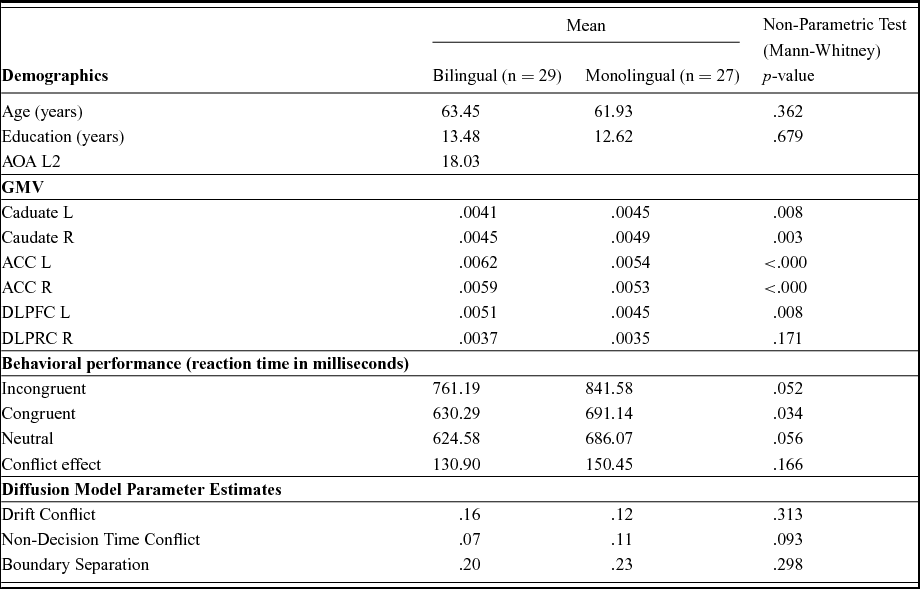
The sample is the same as reported in Abutalebi et al. (Reference Abutalebi, Canini, Della Rosa, Sheung, Green and Weekes2014; Reference Abutalebi, Guidi, Borsa, Canini, Della Rosa, Parris and Weekes2015) and Ong et al. (Reference Ong, Sewell, Weekes, McKague and Abutalebi2017). Twenty-nine senior bilinguals from the Special Administrative Region Hong Kong, China (13 males, mean age = 63.4; SD = 5.8) and twenty-seven age-matched monolinguals from Milan, Italy (13 males, mean age = 61.9; SD = 6.4) participated in the study. Participants from both groups were matched on MMSE score, socio-economic status (SES) and level of education (Abutalebi et al., Reference Abutalebi, Guidi, Borsa, Canini, Della Rosa, Parris and Weekes2015). The study was approved by the Human Research Ethics Committee (non-clinical studies) at the University of Hong Kong. Written informed consent was obtained from all participants. The participants were paid HK$150 dollar plus a transportation allowance. Participants were matched pairwise and Mann-Whitney U tests showed no significant differences in chronological age (p = 0.89) and years of education (p = 0.20; see Table 1).
Demographic data and mean behavioral performance of bilingual and monolingual subjects.

Key: AOA L2, age of second language acquisition; L1 NAM, first language naming; L2 NAM, second language naming; mM, millimolar; SES, Socioeconomic Status
Milanese participants were chosen as a control group because monolinguals in Hong Kong tend to have lower SES and level of education than bilingual speakers. Milan and Hong Kong are similar cities in that they are densely populated global economic hubs located in a network defined by a common ethnic and historical identity (Hong Kong in China and Milan in Italy). Culturally, both cities have distinct identities in their respective nation states with well-defined epistemological, linguistic and pedagogical roots. Critically, code switching is less dominant in Hong Kong than in other multilingual environments (India and Singapore). There is therefore no expectation that correlations would be observed with mean GMV in the caudate.
Method
Details of the image acquisition are reported in Abutalebi et al. (Reference Abutalebi, Canini, Della Rosa, Sheung, Green and Weekes2014; Reference Abutalebi, Guidi, Borsa, Canini, Della Rosa, Parris and Weekes2015) and are not repeated here. Details of the task and diffusion analysis are reported in Ong et al. (Reference Ong, Sewell, Weekes, McKague and Abutalebi2017) and are summarised only. All participants completed the Flanker task as described by Fan et al. (Reference Fan, McCandliss, Sommer, Raz and Posner2002). Stimuli were presented via a computer monitor. Each trial began with a central fixation point for 400 ms, followed by a display of five arrows pointing either left or right for 1700 ms (after this point, the stimulus disappeared; trials longer than 1700 ms were not analysed). Participants were required to identify the direction (left or right) of the central target by pressing a response button. The flanking arrows (two on the left, and two on the right) could be congruent (same orientation as the target), incongruent (opposite orientation to the target) or neutral (no arrowhead). The experiment consisted of 2 sessions, each composed of 96 trials (32 congruent, 32 incongruent and 32 neutral; overall n of trials = 192) presented in a pseudo-randomized order. Prior to the experiment, participants had a practice run consisting of 24 pseudo-randomized trials. Stimulus presentation and data collection were controlled using the Presentation software® (Version 18.0, Neurobehavioral Systems, Inc., Berkeley, CA, www.neurobs.com).
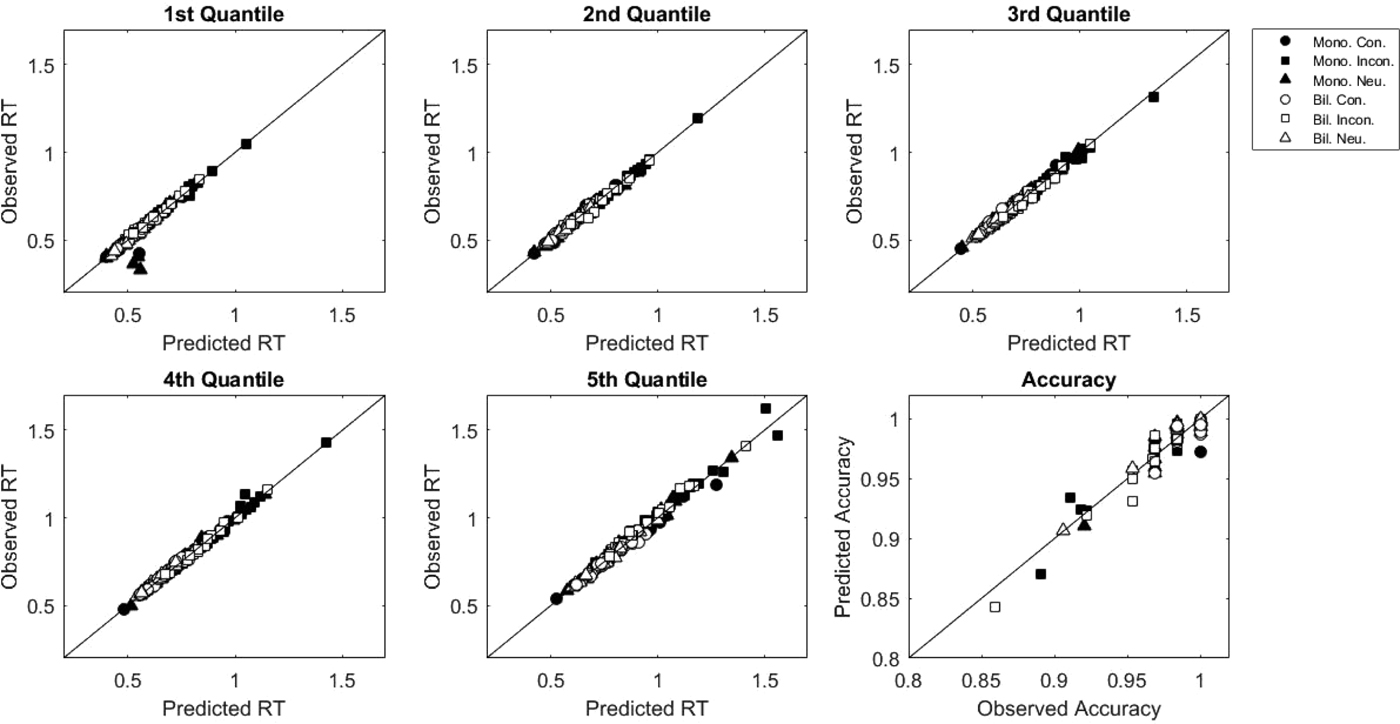
Diffusion model parameters (drift rate, non-decision time, and boundary separation) were estimated by individually fitting the RT distribution from each participant for the three experimental conditions (congruent, incongruent and neutral). Starting point was set to z = a/2 because the decision process for the Flanker task is assumed to be unbiased. Values for drift rate and non-decision time parameters were estimated for each Flanker condition. Because different types of trial occurred in a random order and thus prevented systematic trial-by-trial differences in the decision criterion, boundary separation was held constant across all trial types. For more information on the fitting procedure, refer to Ong et al. (Reference Ong, Sewell, Weekes, McKague and Abutalebi2017). A summary of the diffusion model predictions versus observed RT data for all participants across conditions is presented in Figure 1.
Predicted and observed correct RT quantiles and accuracy of all participants. Each panel summarizes quantiles from three flanker conditions for each of the 56 participants. The first five panels depict data from a single RT quantile—with the first through fifth quantiles referring to the 0.1, 0.3, 0.5, 0.7, and 0.9 RT quantiles, respectively. The sixth panel depicts overall accuracy. Squares reflect incongruent trial data, circles reflect congruent trial data and triangles reflect neutral trial data. Monolingual data are represented by black plotting symbols while bilingual data are represented by white plotting symbols. In each panel, the diagonal reflects a perfect fit (i.e., where observed = predicted).

For testing our predictions, we are particularly interested in the conflict effect (i.e., RT difference between incongruent and congruent trials), which represents the cognitive costs associated with processing incongruent information. Following Ong et al. (Reference Ong, Sewell, Weekes, McKague and Abutalebi2017), we interpret non-decision time conflict as reflecting the ability to zoom visual attention on to the central target in the Flanker task.
Results
GMV
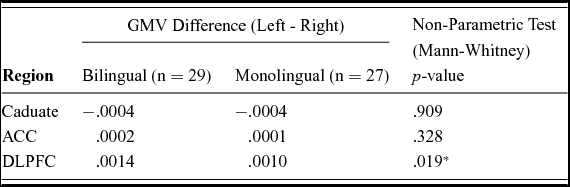
Confirming the prediction that bilingual speakers will exhibit greater neural reserve (expressed as mean GMV) compared to monolingual seniors, we observed a difference for all ROIs (Abutalebi et al., Reference Abutalebi, Guidi, Borsa, Canini, Della Rosa, Parris and Weekes2015) except the right DLPFC. Therefore, bilingual Hong Kong seniors have significantly more GMV in ACC and left DLPFC (Table 1) as previously reported but not in the right hemisphere analogs. We also observed differential patterns in the left and right hemisphere. Table 2 reports the significance of the differences between left hemisphere and right hemisphere mean GMV (laterality effect) in all ROIs (Caudate, ACC, DLPFC) for monolingual and bilingual speakers.
Size difference in left and right hemispheres between monolinguals and bilinguals.

* Significance at the .05 level
There is no significant difference between groups in the size of the laterality effect except for DLPFC where the laterality effect is larger for bilingual than monolingual speakers (p = .019), indicating more GMV in the left hemisphere for bilingual speakers. The effect of laterality is not unexpected and confirms that the DLPFC is a signature of bilingual language experience specifically (cf. Abutalebi et al., Reference Abutalebi, Guidi, Borsa, Canini, Della Rosa, Parris and Weekes2015; Abutalebi & Green, Reference Abutalebi and Green2016). We will discuss this possibility further below.
Behavioral
Mean results for Flanker effects are summarised in Table 1. There were significant differences in behavioral performance between groups but there was no significant interaction between group and conflict effects on mean RT (Abutalebi et al., Reference Abutalebi, Guidi, Borsa, Canini, Della Rosa, Parris and Weekes2015). In terms of diffusion model parameters, Mann-Whitney U tests revealed that bilingual and monolingual groups were not significantly different for drift rate conflict (p = .313) and boundary separation conflict (p = .298), whereas a trend (p = .093) was observed for non-decision time conflict (i.e., more non-decision time conflict for monolinguals).
Correlation between behavioral performance and GMV in ROIs
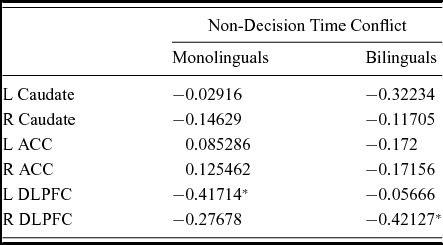
Relationships between mean GMV in various ROIs and attentional visual zooming, as measured by the non-decision time parameter for conflict effects for bilingual and monolingual participants are shown in Table 3.
Correlation coefficients between gray matter volume and non-decision time conflict.

* Significance at the .05 level
We observed a significant correlation (p<0.05) between mean GMV in the left DLPFC and non-decision time for monolingual speakers but not for bilinguals. Bilinguals meanwhile showed a significant correlation (p<0.05) between mean GMV in the right DLPFC and non-decision time. We consider possible reasons for the lateralized structural dissociations below, after presenting the rest of the data.
Correlation between age, behavioral performance and ROIs for monolinguals and bilinguals
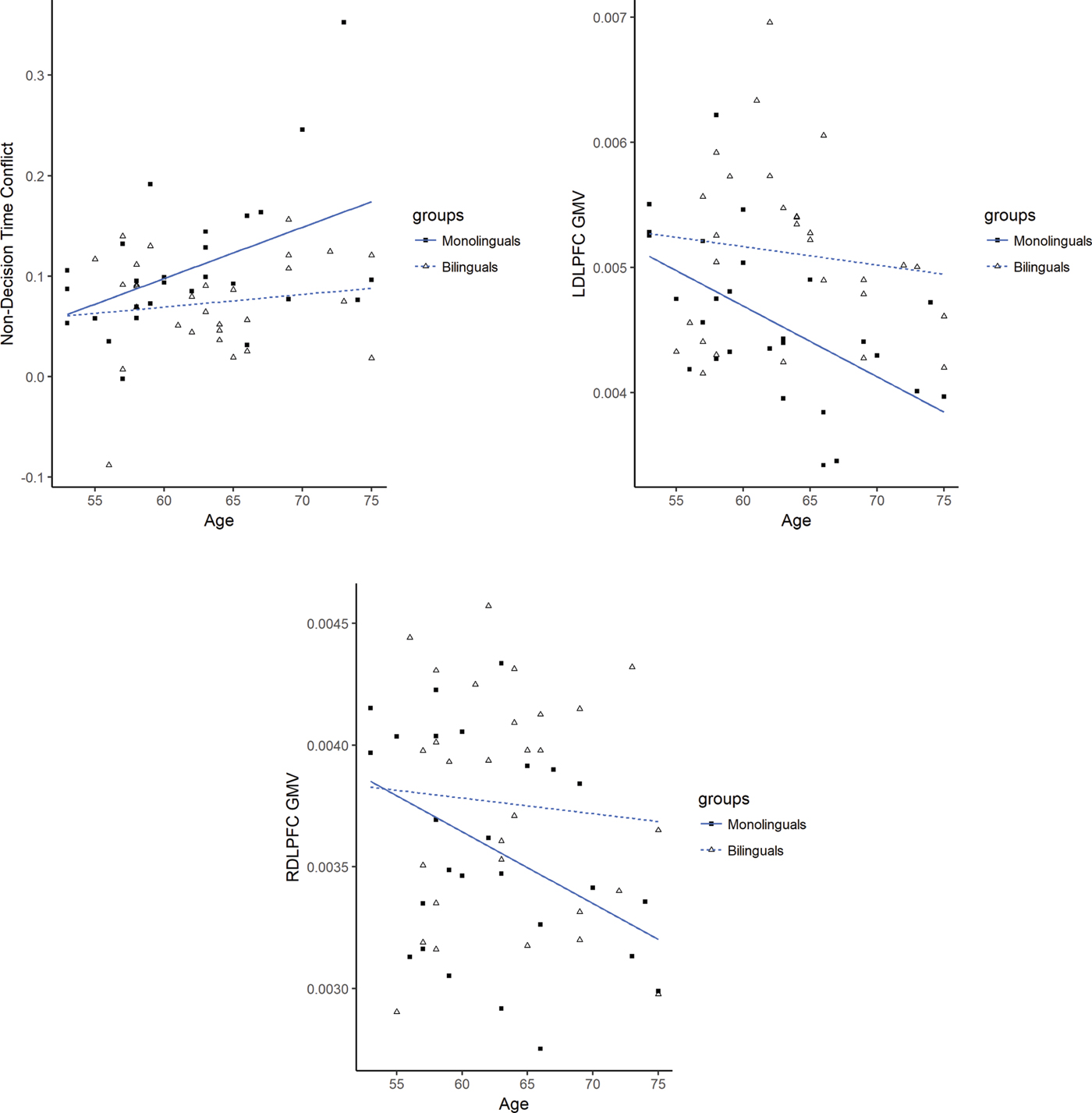
For the non-decision time parameter, we observed a significant correlation with age for monolinguals (r = .459, p<0.05) but not for bilinguals (r = .145, p = .453) (Figure 2a). In other words, as age increases, conflict as measured by the non-decision time parameter also increases in monolingual speakers. Therefore, we conjecture that whereas attentional zooming is vulnerable to effects of chronological age, this effect is not significant in bilingual speakers suggesting cognitive reserve. Figure 2b and 2c show the relationship between mean GMV in ROIs and chronological age.
(Top) Relationship between age and non-decision time conflict in Bilinguals and Monolinguals. (Centre) Relationship between GMV in the Left Dorsolateral Prefrontal Cortex and age in Bilinguals and Monolinguals. (Bottom) Relationship between GMV in the Right Dorsolateral Prefrontal Cortex and age in Bilinguals and Monolinguals.

As expected, there is a decrease to mean GMV in the left and right DLPFC with increasing chronological age, although the negative relationships are significant for monolinguals only for both the left DLPFC (r = −.560, p<0.05) and right DLPFC (r = −.418, p<0.05). Bilinguals do not exhibit a significant correlation between GMV and chronological age in the left DLPFC (r = −123, p = .525) or right DLPFC (r = −.079, p = .685). Therefore, we conjecture that whereas chronological age predicts the loss of mean GMV in ROI during healthy aging for monolinguals as expected, this relationship is not present for bilingual speakers.
Discussion
As reported previously, the data demonstrate an advantage in overall mean RT for bilinguals over monolinguals (Abutalebi et al., Reference Abutalebi, Guidi, Borsa, Canini, Della Rosa, Parris and Weekes2015; Ong et al., Reference Ong, Sewell, Weekes, McKague and Abutalebi2017). Although there was no difference in the conflict effect between bilinguals and monolinguals on mean RT, this finding is not uncommon in the literature (Hilchey & Klein, Reference Hilchey and Klein2011). Furthermore, the diffusion model parameters do suggest a conflict advantage for bilinguals on non-decision time, highlighting the importance of analysing complete RT distributions as opposed to mean RT (Heathcote et al., Reference Heathcote, Popiel and Mewhort1991; for an in-depth discussion of the behavioural results, see Ong et al., Reference Ong, Sewell, Weekes, McKague and Abutalebi2017).
With regards to the structural neuroimaging analysis, the results confirmed most of our predictions. First, we identified a relationship between the non-decision time parameter (visual attentional zooming) in the Flanker task and mean GMV in DLPFC but not the ACC or the caudate. Luk et al. (Reference Luk, Anderson, Craik, Grady and Bialystok2010) reported that GMV in the DLPFC is correlated with reduced RT costs for incongruent trials in healthy young adult bilingual speakers. Our results complement their findings by identifying a relationship in bilingual seniors. As the DLPFC is linked to visual attentional control, we contend that the non-decision time parameter is negatively correlated with GMV in this brain region for seniors. Second, we found relationships between age, attentional zooming and GMV to be reduced for bilingual seniors, suggesting that bilingualism attenuates the effects of neurocognitive decline. As Ong et al. (Reference Ong, Sewell, Weekes, McKague and Abutalebi2017) reported, attentional zooming is better in bilingual seniors. However, we can relate this advantage to mean GMV specifically in the right DLPFC. We did not predict this a priori but the result is compatible with studies of DLPFC in bilingual speakers (e.g., Abutalebi et al., Reference Abutalebi, Guidi, Borsa, Canini, Della Rosa, Parris and Weekes2015; Abutalebi & Green, Reference Abutalebi and Green2016). Also unexpected was the fact that attentional zooming is related to left DLFC in monolingual speakers, which confirms the importance of this region in visual attentional control (Table 3).
As outlined in the introduction, the ACC and the DLPFC are both implicated in control mechanisms to overcome interference in responding (Botvinick et al., Reference Botvinick, Braver, Barch, Carter and Cohen2001; Gbadeyan et al., Reference Gbadeyan, McMahon, Steinhauser and Meinzer2016). In such a top-down fronto-striatal network, the ACC has been linked to the detection of cognitive conflict while the DLPFC has been associated with the implementation of cognitive control to overcome interference in tasks that involve the visual attentional control system (Botvinick et al., Reference Botvinick, Braver, Barch, Carter and Cohen2001). The current results – in conjunction with the extant literature – are thus consistent with Ong et al.’s (Reference Ong, Sewell, Weekes, McKague and Abutalebi2017) interpretation of the non-decision time parameter in the Flanker task as reflecting the time course of visual attentional processing. One outstanding issue, however, is the lack of any relationship between the ACC and the non-decision time parameter (as presumably the process of conflict detection itself should take time). One possibility is that the efficiency of the ACC is constant across age and language groups, but that subsequent engagement of the DLPFC is not in terms of the Botvinick model. Ong and colleagues (Reference Ong, Sewell, Weekes, McKague and Abutalebi2017) found that bilingual seniors exhibited a reduced non-decision time cost for incongruent trials. In our GMV analysis, it would appear that utilization of the right DLPFC, as opposed to the left DLPFC, may be driving this difference in performance. Lateralized differences in DLPFC function have been observed in another study of healthy aging using Positron Emission Tomography (PET). Reuter-Lorenz, Jonides, Smith, Hartley, Miller, Marshuetz and Koeppe (Reference Reuter-Lorenz, Jonides, Smith, Hartley, Miller, Marshuetz and Koeppe2000) observed that, for young adults, verbal tasks are associated with left DLPFC activation while spatial tasks are associated with activation in the right DLPFC. However, in older adults, the pattern reverses. They interpreted differences in terms of a change in the relative role of the left and right DLPFC with age. If we assume that bilinguals are cognitively and neurally ‘stronger’ than their monolingual counterparts as proposed by Abutalebi and colleagues (see for example Borsa et al., Reference Borsa, Perani, Della Rosa, Videsott, Guidi, Weekes, Franceschini and Abutalebi2018), we could show that bilingual seniors are also functionally and structurally ‘younger’ than monolingual peers.
Vanderhasselt, De Raedt and Baeken (Reference Vanderhasselt, De Raedt and Baeken2009) argued that left DLPFC is activated during high conflict (for example, color naming instruction in the Stroop task, see also MacDonald et al., Reference MacDonald, Cohen, Stenger and Carter2000), where a fast and sequential up-regulation of attention is required (i.e., in expectation of a conflict, and not conflict per se, see Postle, Reference Postle2006). The right DLPFC, on the other hand, is more active post-conflict to minimize further conflict (i.e., upregulation of cognitive control through ‘macro-adjustments’ when conflict is experienced; see Wang & Weekes, Reference Wang and Weekes2014). Relating their findings to our results, we speculate that bilinguals outperform monolinguals – as bilingualism affords a more fluid relocation of attention from the left to the right DLPFC and, by so doing, a more fine tuned balance of cognitive control is achieved in bilingual seniors. Remarkably, the literature has shown a high degree of heterogeneity concerning the lateralization of the DLPFC on cognitive control tasks, so it appears to be task specific (Kerns et al., Reference Kerns, Cohen, MacDonald, Cho, Stenger and Carter2004; Miller & Cohen, Reference Miller and Cohen2001). In this context, although our interpretations are purely speculative as no previous work has been reported on the effects of healthy aging on DLPFC lateralization on the Flanker task, we add a new observation to the literature.
We also speculate that the lifelong executive control in language production for bilinguals results in rewiring of cognitive processing that coincides with increased efficiency, as a special case of neuroplasticity (Grafman, Reference Grafman2000). One caveat to this account is that whereas Abutalebi et al. analysed their behavioural data using parametric tests (appropriately), we were forced to use a non-parametric analog (Mann-Whitney U test) due to the truncated range of the parameter data. Non-parametric statistics are well known to deliver a more conservative analysis of the data. We note that there is a trend towards a significant difference between groups using the conservative test (p = .093). We contend therefore that, at a minimum, a larger sample is required to verify any neurocognitive advantage when non-parametric analyses are used to test diffusion parameters.
Regardless of whether a neurocognitive advantage is a characteristic of bilingual seniors because of lifelong bilingual language experience, the current study reveals that loss of GMV in the left DLPFC in typical aging can be attenuated by bilingual language experience. The critical difference between the Hong Kong sample and the Milan sample is the regular, continuous use of more than one language over more than 50 years from first acquisition. We interpret these results in light of the controversial hypothesis of a neuroprotective (neuroplastic) impact of bilingualism on domain-general cognitive functioning (see reviews by Abutalebi & Clahsen, Reference Abutalebi and Clahsen2015; Adesope, Lavin, Thompson & Ungerleider, Reference Adesope, Lavin, Thompson and Ungerleider2010; Ardila & Ramos, Reference Ardila and Ramos2010; Bialystok et al., Reference Bialystok, Poarch, Luo and Craik2014; Perani & Abutalebi, Reference Perani and Abutalebi2015; Valian, Reference Valian2015). Recent studies also report more GMV and white matter integrity in individuals who speak more than one language (Abutalebi, Della Rosa, Gonzaga, Keim, Costa & Perani, Reference Abutalebi, Della Rosa, Gonzaga, Keim, Costa and Perani2013; Olsen, Pangelinan, Bogulski, Chakravarty, Luk, Grady & Bialystok, Reference Olsen, Pangelinan, Bogulski, Chakravarty, Luk, Grady and Bialystok2015; Zou, Ding, Abutalebi, Shu & Peng, Reference Zou, Ding, Abutalebi, Shu and Peng2012; Singh et al., 2017), especially when levels of L2 proficiency and immersion are relatively high (e.g., Pliatsikas, DeLuca, Moschopoulou & Saddy, Reference Pliatsikas, DeLuca, Moschopoulou and Saddy2017). Our analysis adds to this literature by revealing an effect of bilingualism on the inevitable age related decline of GMV. The results suggest that cognitive advantages will be correlated with neural and thus health benefits, particularly for the elderly (Perani & Abutalebi, Reference Perani and Abutalebi2015). In terms of the effect on behaviour, Luks et al. (Reference Luks, Oliveira, Possin, Bird, Miller, Weiner and Kramer2010) revealed an association between poorer visual attentional control and atrophy in the left hemisphere DLPFC but also in the ACC on the Flanker task. Our analyses revealed that bilingual language experience can tune this association; bilinguals are not uniquely constrained to using the left DLPFC to perform the Flanker task, but may receive a benefit due to less atrophy in GMV with age across the DLPFC bilaterally. This can explain why the bilingual cognitive and neural advantage appears to be more evident with age (Bialystok et al., Reference Bialystok, Craik and Ryan2006). In a related study, Gold, Kim, Johnson, Kryscio and Smith (Reference Gold, Kim, Johnson, Kryscio and Smith2013) also reported better performance in bilingual than monolingual seniors on a visual perceptual task-switching paradigm. Interestingly, the fMRI data indicated that bilinguals outperform monolinguals and yet display less activation in frontal brain regions (left PFC and ACC). They argued that the bilingual advantage in healthy aging relates in part to a greater neural efficiency. Our results suggest that this neural efficiency might be a result of previously unknown plasticity in neural structure (since bilinguals’ GMV in their right DLPFC seems to predict performance as opposed to GMV in their left DLPFC, and bilinguals also have higher GMV in various brain structures compared to monolinguals). Other studies confirm that lifelong bilingualism has protective effects on similar neural structures. For instance, improved performance in a second language (L2; Abutalebi, Della Rosa, Green, Hernandez, Scifo, Keim, Cappa & Costa, Reference Abutalebi, Della Rosa, Green, Hernandez, Scifo, Keim, Cappa and Costa2011; Della Rosa, Videsott, Borsa, Canini, Weekes, Franceschini & Abutalebi, Reference Della Rosa, Videsott, Borsa, Canini, Weekes, Franceschini and Abutalebi2013) and learning new vocabulary (Kroll & Stewart, Reference Kroll and Stewart1994; Grogan, Jones, Ali, Crinion, Orabona, Mechias, Ramsden, Green & Price, Reference Grogan, Jones, Ali, Crinion, Orabona, Mechias, Ramsden, Green and Price2012; Mechelli, Crinion, Noppeney, O'doherty, Ashburner, Frackowiak & Price, Reference Mechelli, Crinion, Noppeney, O'doherty, Ashburner, Frackowiak and Price2004) induces brain plasticity and neurostructural changes. Bilinguals also exhibit increased mean GMV compared to monolinguals in areas that are susceptible of neuroplasticity as a result of growth in vocabulary size across the lifespan (Richardson, Thomas, Filippi, Harth & Price, Reference Richardson, Thomas, Filippi, Harth and Price2010). Furthermore, Abutalebi et al. (Reference Abutalebi, Canini, Della Rosa, Sheung, Green and Weekes2014) highlighted the role of bilingualism as a protective factor against loss of mean GMV in healthy aging. Our findings extend these conjectures, since bilinguals appear to lose GMV in their left and right DLPFC at a lower rate than monolinguals (see Figure 2b and 2c).
Relating the current results to the ex-Gaussian analysis of Abutalebi et al. (Reference Abutalebi, Guidi, Borsa, Canini, Della Rosa, Parris and Weekes2015), both studies highlight the relevance of the DLPFC in bilingualism, with the ex-gaussian analysis demonstrating that the decrease of GMV in the DLPFC with age related to an increased tau-conflict effect in monolinguals only. Curiously, the ex-gaussian effects were specifically related to GMV in the right DLPFC in monolinguals, rather than the left, and no correlations were found between ex-gaussian parameters and bilingual DLPFC GMV. While unexpected, this difference between the ex-gaussian and diffusion model parameter effects is consistent with previous studies which indicate a lack of one-to-one correspondence between parameters in the two models (Matzke & Wagenmakers, Reference Matzke and Wagenmakers2009). Nevertheless, the two analyses are convergent in highlighting differences between monolinguals and bilinguals with regards to the interaction of effects between aging and the DLPFC GMV on RT distributions in the flanker task.
Another unresolved issue is the role of other neural structures in conflict tasks, and how they relate to aging and bilingualism. Comparing good and poor performers on the Flanker task, Colcombe, Kramer, Erickson, and Scalf (Reference Colcombe, Kramer, Erickson and Scalf2005) reported a significantly greater concentration of gray matter in a left-lateralized portion of the anterior superior frontal gyrus for high-performing seniors, but no difference in the middle frontal gyrus, ACC and SMA. On the other hand, Chen, Yang, Lai, Li, and Yuan (Reference Chen, Yang, Lai, Li and Yuan2015) found that mean GMV correlates with cognitive control in the bilateral prefrontal gyri, left insula, inferior temporal gyrus, and left inferior parietal lobule. The characteristics of these neural regions are not as well characterized as the ACC and DLPFC for cognitive control. However, we note that these structures are assumed in the conflict monitoring and resolution processes in the models of bilingual language processing and control (Abutalebi & Green, Reference Abutalebi and Green2016; Green & Abutalebi, Reference Green and Abutalebi2013).
One limitation of the study is that the sample populations derive from different cultural backgrounds. Because monolinguals in Hong Kong tend to have a lower SES and education in comparison to their bilingual peers, it was not considered a representative group for comparison. Although not ideal, the choice of Milanese seniors was deliberate (see Abutalebi et al., Reference Abutalebi, Canini, Della Rosa, Sheung, Green and Weekes2014). In future studies, matching the sociolinguistic background could be improved. Another caveat to the results is that analysing structural differences with a cross-sectional design makes it difficult to infer causal relationships between brain regions and cognitive process. One direction would be to correlate diffusion model parameters with known electrophysiological, fMRI or tDCS criteria to link cognitive processes to underlying neural events more precisely (e.g., Bode, Sewell, Lilburn, Forte, Smith & Stahl, Reference Bode, Sewell, Lilburn, Forte, Smith and Stahl2012).
To summarize, non-decision time conflict is correlated with mean GMV in monolingual and bilingual seniors. The results confirm the reported association between attentional cognitive control in the Flanker task and the DLPFC (Egner & Hirsch, Reference Egner and Hirsch2005). More critically, our results are consistent with the idea that the DLPFC plays a role in control on the Flanker task (and other stimulus-conflict tasks) by upregulating processes that direct attention to the central stimulus (Egner & Hirsch, Reference Egner and Hirsch2005; Ong et al., Reference Ong, Sewell, Weekes, McKague and Abutalebi2017; Wang & Weekes, Reference Wang and Weekes2014). We also report for the first time an effect of age on the non-decision time parameter in seniors and a faster decline in GMV in the left DLPFC and right DLPFC for monolinguals compared to bilinguals. We are thus able to better characterize the nature of the putative neuroprotective benefit of bilingualism on the inevitable effects of healthy aging (Perani & Abutalebi, Reference Perani and Abutalebi2015) cognitively and neurally, and we offer testable hypotheses by adding an additional layer to the models of bilingualism and aging.
Future directions and conclusion
The relationship between cognitive functioning, neural development, and the benefits conferred by bilingualism in aging is a highly relevant and influential topic in modern society, to the extent that even worldwide leading journals, such as The Guardian (September 2011; 2014), raised the issue (see Abutalebi & Clahsen, Reference Abutalebi and Clahsen2015). A deep understanding of the underlying neuroprotective processes of bilingualism on healthy aging helps to prepare for rapid demographic changes in our near future (Bialystok, Abutalebi, Bak, Burke & Kroll, Reference Bialystok, Abutalebi, Bak, Burke and Kroll2016). It is worth emphasizing that even modest effects on the rate or onset of cognitive decline at an individual level can have a massive impact on successful aging worldwide (Rowe & Kahn, Reference Rowe and Kahn1987; Reference Rowe and Kahn2015). We submit that our novel approach to analysing RT in bilingual speakers – by correlating the parameters of Ratcliff's (Reference Ratcliff1978) diffusion model with neural data – sheds light on processes governing cognitive control. We report an effect of attentional control on DLPFC (explained via the non-decision time parameter) and an advantage of bilingualism on healthy aging, realised as slower deterioration in DLPFC. It is necessary to perform further experiments to address some of the data, i.e., why does bilingual attention shift from left to right DLPFC? In our view, studies can extend this literature by linking neural data to diffusion model parameters to be clarify our interpretation of behavioural effects.