Introduction
Caring for family members who have Alzheimer's disease (AD) is a compelling public health issue due to a growing aging population, the increased likelihood of developing AD with advancing age, and the emotional burden associated with caregiving (Talley and Crews, Reference Talley and Crews2007). Family caregivers are the foundation of the long-term care system, providing almost two-thirds of home/community-based care and contributing $350 billion in “in-kind” services (Gibson and Houser, Reference Gibson and Houser2007). Their contributions can beget serious health consequences for themselves including depression, physical declines (Pinquart and Sorensen, Reference Pinquart and Sorensen2007), and a greater risk of mortality (Schulz and Beach, Reference Schulz and Beach1999). Family caregivers of individuals with AD experience worse mental health outcomes compared to caregivers of persons with other chronic illnesses such as Parkinson's disease (Hooker et al., Reference Hooker, Monahan, Bowman, Frazier and Shifren1998), suggesting that these caregivers are affected uniquely by AD.
Previous work on the role of AD on caregiver burden has focused primarily on disease-related factors, particularly communication impairments and problem behaviors. Qualitative studies, including multinational samples, have described communication impairments as very distressing to family caregivers (Murray et al., Reference Murray, Schneider, Banerjee and Mann1999; Small et al., Reference Small, Geldart and Gutman2000). However, communication problems have also been linked closely with problem behaviors. The root of problem behaviors may be due to difficulties understanding verbal directions, difficulties finding words to express feelings/intent (Bourgeois, Reference Bourgeois2002) or inability to retrieve words to explain the need to engage in activities (Volicer and Bloom-Charette, Reference Volicer, Bloom-Charette, Volicer and Bloom-Charette1999), among other factors. Research in nursing home contexts has shown that there is a relationship between communication impairment and problem behaviors (Talerico et al., Reference Talerico, Evans and Strumpf2002; Potkins et al., Reference Potkins2003). Only one study of community-dwelling individuals with dementia and their family caregivers directly addressed this issue and demonstrated that the frequency of dementia-related communication problems predicted the frequency of problem behaviors, which in turn was related to caregiver burden (Savundranayagam et al., Reference Savundranayagam, Hummert and Montgomery2005).
These results, however, provide a partial picture of how communication breakdowns might be linked with caregiver burden. Communication is a highly interactive, dynamic process between speakers and listeners who normally alternate roles quickly and effectively. Within the context of AD, however, communication breakdowns can occur due to the disease or due to ineffective communication strategies on the part of the caregivers that are viewed or appraised incorrectly as helpful. What remains unknown is the relationship between caregiver burden and caregivers’ appraisals or perceptions of the helpfulness of communication strategies used to resolve communication breakdowns. Accordingly, the purpose of this study was to investigate the roles of the appraisals of caregiver communication strategies on caregiver burden, after controlling for the effects of factors that have been linked with burden such as kinship status, cognitive level, and problem behaviors (Pinquart and Sorensen, Reference Pinquart and Sorensen2003).
Current knowledge of the impact of caregiver communication strategies on resolving communication breakdowns comes primarily from the meticulous work of speech-language pathologists and psycholinguistic researchers. Strategies shown to improve comprehension include using verbatim repetition (Small et al., Reference Small, Kemper and Lyons1997; Tappen et al., Reference Tappen, Williams-Burgess, Edelstein, Touhy and Fishman1997; Bourgeois, Reference Bourgeois2002; Mahendra et al., Reference Mahendra, Kim, Bayles, Hopper, Cleary and Azuma2005) or paraphrased sentences (Small et al., Reference Small, Kemper and Lyons1997; Tappen et al., Reference Tappen, Williams-Burgess, Edelstein, Touhy and Fishman1997; Gentry and Fisher, Reference Gentry and Fisher2007). When adding new information, comprehension improves if one concept or idea is used per statement (Rochon et al., Reference Rochon, Waters and Caplan1994), especially in the case of providing instructions (Hopper, Reference Hopper2001). Morphosyntactically simple sentences with no embedded clauses are also more helpful than grammatically complex sentences (Tomoeda et al., Reference Tomoeda, Bayles, Boone, Kaszniak and Slauson1990; Small et al., Reference Small, Kemper and Lyons1997; Reference Small, Gutman, Makela and Hillhouse2003). If listening comprehension is problematic, it is helpful to switch the mode of communication from verbal to non-verbal, including the use of gestures (Bourgeois et al., Reference Bourgeois, Burgio, Schulz, Beach and Palmer1997; Ripich et al., Reference Ripich, Ziol and Lee1998; Bourgeois, Reference Bourgeois2002).
Strategies that are ineffective in resolving communication breakdowns include speaking louder, tuning out the person with AD, completing actions oneself or adding in a lot of new information within one utterance (Orange et al., Reference Orange, Lubinski and Higginbotham1996; Small et al., Reference Small, Kemper and Lyons1997; Reference Small, Gutman, Makela and Hillhouse2003; Smith et al., Reference Smith2011). Contrary to the advice of local caregiver organizations and many clinicians, speaking slowly leads to more communication breakdowns because persons with dementia have to retain the information for longer periods of time, which places added stress on working memory (Tomoeda et al., Reference Tomoeda, Bayles, Boone, Kaszniak and Slauson1990; Small et al., Reference Small, Kemper and Lyons1997; Reference Small, Gutman, Makela and Hillhouse2003). It should be noted that slow speaking rate may be effective for semantically or morphosyntactically complex sentences, although detailed empirical discourse analyses are warranted to confirm such perceptions.
The present study aims to extend the current state of knowledge by investigating the impact of caregivers’ appraisals of the effectiveness of their own communication strategies on three types of caregiver burden. These include stress burden (emotional impact of caregiving), relationship burden (extent to which the care receiver is perceived to be overly demanding by the caregiver), and objective burden (infringement on other aspects of caregivers’ lives) (Montgomery et al., Reference Montgomery, Borgatta, Borgatta, Liu and Kendig2000). To date, there are no published studies on the impact of the appraisals of caregiver communication strategies on burden among community-dwelling caregivers. The existing studies have been undertaken either in nursing homes or laboratory settings (Bourgeois et al., Reference Bourgeois, Dijkstra, Burgio and Allen2004; Perry et al., Reference Perry, Galloway, Bottorff and Nixon2005; Vasse et al., Reference Vasse, Vernooij-Dassen, Spijker, Rikkert and Koopmans2010) and have characterized strategy effectiveness in terms of communication outcomes such as improved production or comprehension by persons with AD, or the increased use of learned strategies by caregivers (Small et al., Reference Small, Kemper and Lyons1997; Small and Perry, Reference Small and Perry2005). Although characterizing strategy effectiveness in terms of communication outcomes is important, it will be critical to test whether correct appraisals of these effective strategies translates into lower levels of burden among community-dwelling family caregivers. There is an implicit assumption that caregivers who correctly appraise communication strategies as effective (vs. those that are ineffective) are likely to experience fewer communication breakdowns and consequently, lower levels of stress. Moreover, the assumption also considers that those caregivers who correctly appraise strategies as effective are more likely to use those effective strategies. The following hypotheses were tested:
1. Caregivers who correctly appraised empirically supported, effective strategies as helpful will exhibit lower levels of stress burden, relationship burden, and objective burden.
2. Conversely, caregivers who incorrectly appraised empirically supported, ineffective strategies as helpful will exhibit higher levels of all three types of burden.
Methods
Participants and procedure
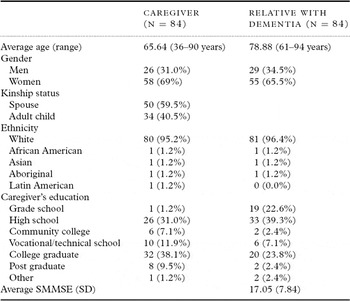
Data were collected as part of a multi-center study on the psychometric properties of a tool designed to measure caregivers’ perceptions of conversations with their relative with AD (Orange et al., Reference Orange, Lubinski, Johnson, Purves and Small2009). Data were collected from dyads living in two cities in Canada (London, Ontario, and Vancouver, British Columbia) and one city in the USA (Buffalo, New York) from October 2004 to January 2007. Participants included 84 community-dwelling individuals with AD and their family caregivers (44 caregivers of participants with mild AD, 22 caregivers of moderate AD, and 18 caregivers of severe AD). The average ages of AD participants and their caregivers were 79 and 66 years, respectively (see Table 1). The AD sample included 29 men and 55 women. The caregiver sample included 26 men and 58 women. The sample of caregivers consisted of approximately 60% spouses and 40% adult children. The AD and caregiver samples were predominantly white (96% and 95%, respectively). Kinship status and cognitive ability of the person with AD were included as control variables because they are known to influence caregiver burden (Pinquart and Sorensen, Reference Pinquart and Sorensen2003).
Demographic characteristics of sample

SMMSE = Standardized Mini-Mental State Examination; SD = standard deviation
Measures
Cognitive screening
The Standardized Mini-Mental State Examination (SMMSE) was administered to screen the cognitive status of persons with AD (Molloy et al., Reference Molloy, Alemyaheu and Roberts1991). Scores on the SMMSE have a possible range of 0 to 30. Scores ranging from 19 to 25 out of 30 indicate mild AD, scores of 12 to 18 moderate AD, and scores less than 12 severe AD. The SMMSE scores, treated as a continuous variable, were used in the analyses. In the current sample, the average SMMSE score was 17.05 (Table 1).
Caregiver communication strategies
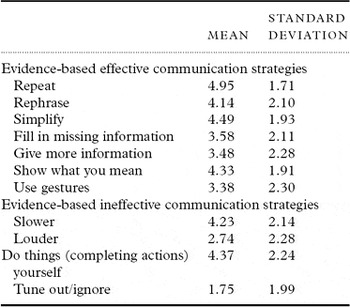
The Perception of Conversation Index – Dementia of the Alzheimer's Type (PCI-DAT) was used to assess the appraisals of caregiver communication strategies (Orange et al., Reference Orange, Lubinski, Johnson, Purves and Small2009). It contains 22 items that address caregivers’ strategies to overcome conversation difficulties. Caregivers circled 0 if they did not use the strategy. If they used the strategy, caregivers then appraised how helpful the strategy was in overcoming conversation difficulties by selecting an option on a 7-point Likert scale ranging from 1 (not helpful) to 7 (very helpful). Using existing literature on communication strategies in AD, seven items were categorized as effective strategies and four items were categorized as ineffective strategies (Table 2). Cronbach's α for the appraisals of effective strategies was 0.82. An appraisal score, in terms of perceived helpfulness of strategies in resolving breakdowns, was created using the mean appraisal scores of the effective strategies. Higher scores indicated that caregivers perceived the effective strategies to be helpful in overcoming communication breakdowns. An appraisal score for ineffective strategies was not created because of low reliability among the items (Cronbach's α = 0.38). An examination of the mean appraisal scores for ineffective strategies suggests that some strategies (i.e. louder and tune out/ignore) were appraised correctly as ineffective whereas others (i.e. speak slowly and complete actions yourself) were appraised incorrectly as effective. This may have contributed to the poor reliability (Table 2). As a result, individual items were examined in preliminary correlational analyses.
Descriptive statistics for effective and ineffective communication strategies

Note: Total possible score for each item is 7, where 1 = not helpful and 7 = very helpful
Problem behaviors
The Revised Memory and Behavior Problems Checklist (RMBPC) was used to measure caregivers’ report of their family members’ problem behaviors (Roth et al., Reference Roth2003). The checklist contains 24 items that address whether memory problems, depressive symptoms, or disruptive behaviors were observed in the past week and the degree of distress related to each item on a scale of 1 (a little) to 4 (extremely). This study used items from the depressive symptoms (9 items) and disruptive behaviors (7 items) domains because including memory problems could result in multicollinearity issues related to SMMSE items. Examples of items include “expressing feelings of hopelessness or sadness about the future” (depressive) and “waking you or other family members up at night” (disruptive). An appraisal score (in terms of distress) was created using the mean appraisal scores for reported problem behaviors. Cronbach's α for the appraisals of problem behaviors was 0.87.
Caregiver burden
Caregiver burden was measured using the burden measure of Montgomery et al. (Reference Montgomery, Borgatta, Borgatta, Liu and Kendig2000), which asks respondents to rate, on a 5-point Likert scale of 1 (a lot less) to 5 (a lot more), the extent to which their lives have been affected by caregiver responsibilities. Stress burden included four items that measured the emotional component of burden. These items asked participants how caregiving affected the following: “stress in your relationship with your relative”, “tension in your life”, “nervousness and depression concerning your relationship with your relative”, and “anxiety about things”. Relationship burden included four items that captured the extent to which the care-recipient's behavior is perceived as overly demanding, unreasonable, or manipulative. The items asked participants how caregiving affected the following: “attempts by your relative to manipulate you”, “unreasonable requests made of you by your relative”, feelings that you are being taken advantage of by your relative”, and “demands made by your relative that are over and above what s/he needs”. Objective burden included six items that measured the extent to which care responsibilities impose on observable aspects of a caregiver's life such as time for self and others. The items asked participants how caregiving affected the following: “time to yourself”, “time to spend in recreational activities”, “time for vacation activities and trips”, “personal privacy”, “time to do your own work and daily chores”, and “time for friends and other relatives”. Cronbach's α for all forms of burden ranged from 0.73 to 0.83.
Regression analyses
Multiple hierarchical regression analyses were conducted to investigate the unique contributions of the appraisals of caregiver communication strategies on each type of caregiver burden. The first step in the regression analysis included kinship (0 = adult child and 1 = spouse) and cognitive status as measured by the SMMSE scores. The second step in the regression analysis included scores of the appraisals of problem behaviors. The third step included scores on the appraisals of effective strategies.
Results
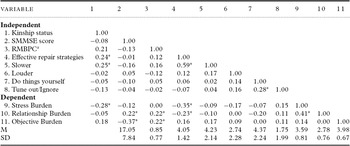
Table 3 includes descriptive statistics and correlations of variables considered for the regression analyses. The appraisals of ineffective strategies were not included in the regression analyses because of the possibility of suppression given that they were not significantly correlated with any of the measures of burden. In fact, the appraisals of ineffective strategies were not significantly correlated with any other variables (Table 3). The only exception was the appraisals of speaking slowly, which was significantly correlated with kinship status, where adult children were more likely to perceive speaking slowly as helpful compared with spouses. Additionally, the appraisals of speaking slowing were also correlated with the appraisals of effective strategies, suggesting that participants who appraised effective strategies correctly as helpful were also likely to appraise, albeit incorrectly, that speaking slowly as helpful.
Descriptive statistics of major study variables and their intercorrelations

Note: * Correlation is significant at p < 0.05 level
a RMBPC = appraisal scores of the disruptive and depressive domains of Revised Memory and Behavior Problems Checklist
SMMSE = Standardized Mini-Mental State Examination; M = mean; SD = standard deviation
Predictors of stress burden
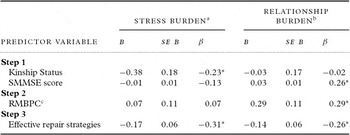
The full model for stress burden was significant, F(4,83) = 4.52, p < 0.005, and explained 19% of the variance. Results indicated that kinship status and the appraisals of effective strategies were significant predictor variables, accounting for 10% and 9% of the variance in stress burden, respectively. As shown in Table 4, spouses experienced greater levels of stress (β = −0.23, p < 0.05). Higher appraisals of effective strategies as being helpful were linked with lower levels of stress burden (β = −0.31, p < 0.01).
Hierarchical regression analyses for variables stress burden and relationship burden

Note: Coefficients are from the Step 3 model.
aFor the regression on stress burden, R 2 = 0.01 for Step 1 (p < 0.05); ▵R2 = 0.002 for Step 2 (p = 0.69); ▵R2 = 0.09 for Step 3 (p < 0.01);.
bFor the regression on relationship burden, R 2 = 0.05 for Step 1 (p = 0.12); ▵R 2 = 0.07 for Step 2 (p = 0.01); ▵R 2 = 0.06 for Step 3 (p = 0.02);
cRMBPC = Appraisal scores of the disruptive and depressive domains of Revised Memory and Behavior Problems Checklist
*p < 0.05
SMMSE = Standardized Mini-Mental State Examination
Predictors of relationship burden
The hierarchical regression model with relationship burden as the dependent variable was also significant (F(4,84) = 4.33, p < 0.005) and explained 18% of the variance. Appraisals of problem behaviors were significant predictors of relationship burden, accounting for 7% of the variance. As observed in the analyses with stress burden as the dependent variable, the appraisals of effective strategies were also significantly linked with relationship burden, accounting for 6% of the variance. Results from the final model (Table 4) indicated that both higher SMMSE scores (β = 0.25, p < 0.05) and appraising problem behaviors as distressing (β = 0.29, p < 0.01) were positively related with greater burden. In contrast, higher appraisals of effective strategies as helpful were related with lower levels of relationship burden (β = −0.24, p < 0.05).
Predictors of objective burden
In the regression analyses with objective burden as the dependent variable, the only step that was significant was Step 1, F(2,83) = 7.78, p < 0.005. It explained 16% of the variance. The explained variance did not increase significantly with the addition of the steps involving problem behaviors and effective strategies. Cognitive ability was the only significant predictor of objective burden. Higher SMMSE scores were related with significantly lower levels of objective burden (β = −0.36, p < 0.01).
Discussion
Communication problems among individuals with AD and their caregivers are important to study theoretically and clinically, and crucial to prevent and to remedy. To date, few published studies have examined the nature and repair of communication problems in AD dyads, especially among family caregivers. The focus of the present study on caregivers’ appraisals of communication strategies to repair communication problems addresses a significant gap in the current understanding of mechanisms by which communication breakdowns influence relational outcomes, such as burden, within family care contexts.
The findings from this study provide valuable insights into the types of burden that are affected by the correct appraisals of effective repair strategies. As expected, results showed that family caregivers who correctly appraised effective strategies as helpful were more likely to experience less stress andrelationship burden. However, there was no effect on objective burden (i.e. measurable negative effects on caregivers such as less time for themselves). The findings regarding the correct appraisals of effective strategies are compelling because we controlled for the appraisals of problem behaviors, which have been strong and consistent predictors of all three types of caregiver burden (Savundranayagam et al., Reference Savundranayagam, Hummert and Montgomery2005; Savundranayagam and Montgomery, Reference Savundranayagam and Montgomery2010). Greater cognitive ability, as reflected by higher SMMSE scores, was also linked significantly with higher scores on relationship burden, mirroring previous findings (Savundranayagam et al., Reference Savundranayagam, Hummert and Montgomery2005). The significance of this finding is that, paradoxically, caregivers may feel that they are being manipulated with too many unnecessary demands when caring for an individual with high cognitive abilities – one who is expected to be more capable and is expected to function at high levels of independence. On the other hand, our findings showed that lower cognitive ability was related to lower scores on objective burden, suggesting that greater caregiver support, in terms of time, is necessary as AD progresses.
Taken together, the findings demonstrate that effective strategies have a greater impact on the interpersonal relationship between caregivers and their relatives with AD than on perceptions of time infringement brought on by caregiving responsibilities. In other words, when family caregivers use strategies that resolve communication breakdowns successfully, they experience less anxiety and perceive their relative with AD as less demanding or unreasonable. It is possible we did not find an effect on objective burden because it takes added time and increased cognitive and linguistic efforts to resolve communication breakdowns effectively. It is likely that in the minds of family caregivers the increased linguistic efforts and the longer interactional commitments required to mend misunderstandings are not perceived as an imposition, especially given that successful communication is inherently rewarding and socially fulfilling. Our findings then could be occurring, in part, because successful resolutions of communication breakdowns yield more productive and meaningful interactions between caregivers and their relatives with AD. The finding that effective strategies were not related to objective burden may signify the importance of focusing future efforts on enhancing dyadic relationships (i.e. family caregivers and relatives with AD) using empirically-based communication enhancement education and training programs rather than focusing primarily or exclusively on transactional aspects of communication (i.e. merely information exchange).
Contrary to expectations, caregivers’ appraisals of ineffective strategies were not associated with any type of caregiver burden. This finding should be interpreted with caution since the analysis was only correlational. It may be that the family caregivers became accustomed to using multiple strategies, as recommended in the AD-communication enhancement literature, some of which may have been intermittently effective for resolving selected problems. The communication enhancement literature for individuals with AD documents that sometimes well-established strategies may not work well for a targeted problem despite previous successes (Santo Pietro and Ostuni, Reference Santo Pietro and Ostuni2003). In addition, the findings that ineffective strategies were not associated with any type of caregiver burden also may have occurred because of too few ineffective strategies in our index. Further, it may be the case that family caregivers abandoned the use of ineffective strategies once they realized their lack of usefulness in resolving communication problems. A frequency count and analyses of the proportions of ineffective strategies vs. effective ones, in addition to correlational analyses between actual use of strategies and their perceived level of effectiveness, are warranted to help uncover the relationship between ineffective strategy use and caregiver burden.
The frequency of strategy use was not assessed in this study. It is necessary for future studies to disentangle the relative contributions of the frequency versus the appraisals of communication strategies on caregiver burden. It is unknown whether lower burden scores are associated with (a) caregivers who use effective strategies more frequently and ineffective strategies less frequently and/or (b) caregivers who correctly appraise effective strategies as helpful and ineffective strategies as unhelpful. Both measures of the frequency and the appraisal are likely to be important factors to consider when designing future communication enhancement education and training interventions. To date, only one published study has examined the relationship between appraisals and frequency of strategy use. The investigators found that the frequencies of only a few strategies were correlated significantly with appraisals (Small et al., Reference Small, Gutman, Makela and Hillhouse2003). Interestingly, they did not examine relationships with caregiver burden and the sample size was relatively small (N = 18).
Conclusions
The results from the present study help inform future communication enhancement interventions designed to empower family caregivers with evidence-based communication strategies that have the potential to diminish distress associated with AD-related stressors. To date, few published studies, with some notable exceptions (Bourgeois et al., Reference Bourgeois, Burgio, Schulz, Beach and Palmer1997; Small et al., Reference Small, Gutman, Makela and Hillhouse2003; Small and Perry, Reference Small and Perry2005) have implemented and tested the effectiveness of selected communication strategies for family caregivers of individuals with AD. It would be useful to explore in greater depth the relationships among the appraisals of communication strategy effectiveness versus ineffectiveness and family caregivers’ ratings of “good/satisfying” versus “not good/unsatisfying” communication outcomes.
Moreover, the results of the present study highlight the need to target misconceptions regarding strategies rated as effective. For example, family caregivers in this study appraised speaking slowly and completing actions oneself as effective (Table 2) despite evidence to the contrary (Small et al., Reference Small, Kemper and Lyons1997; Reference Small, Gutman, Makela and Hillhouse2003). It is not merely sufficient to teach communication skills to family caregivers. It is imperative that communication interventions directed toward family caregivers assess their perceptions or their appraisals of strategy effectiveness. Changing incorrect appraisals will be a necessary first step prior to expanding caregivers’ repertoire of empirically supported communication skills. Communication interventions that address such misconceptions hold much promise because they are relatively inexpensive compared to pharmacological interventions (Gallagher-Thompson and Coon, Reference Gallagher-Thompson and Coon2007) and their potential positive effects might include reconnections among various family caregivers and their relative with AD, yield improvements in caregiver moods (i.e. lifting depression), and result in fewer premature nursing home placements.
Conflict of interest
None.
Description of authors' roles
M. Y. Savundranayagam and J. B. Orange designed the study, collected the data, and contributed to writing the manuscript. M. Y. Savundranayagam carried out the statistical analysis. Both authors helped interpret the data analysis.
Acknowledgments
This research was supported by a grant from the Alzheimer's Association (NIRG-09-132740) and a Research Growth Initiative grant from the University of Wisconsin-Milwaukee to the first author. The research also was supported by a joint grant from the Alzheimer Society of Canada and the Canadian Nurses Foundation (ASC5-99) to the second author. We are grateful to the diligent assistance of Trisha L. Meyer and Rachel K. M. Garrett, research assistants at the University of Wisconsin-Milwaukee. The support of the participants with AD and their family caregivers is appreciated and acknowledged.